
Published: October 2025 | Last updated: May 2026 | Editorial review and quality control: Martina N.
For decades the message that lesbian sex is safe sex shaped how clinicians counseled patients, how school sex-ed handled same-sex relationships, and how lesbian and bisexual women themselves thought about screening. The premise was that without sperm or penetrative sex, sexually transmitted infections had nowhere to go. Decades of research have proven the opposite. Skin-to-skin contact, oral sex, fingers, and shared sex toys all transmit infection. Some pathogens, including the bacteria that drive bacterial vaginosis, actually appear more often in same-sex female partnerships than in mixed-sex pairings.
This guide walks through what the evidence currently shows for women who have sex with women (WSW), which infections matter most, why screening rates lag the general population, and what at-home testing can and cannot answer. The goal is not alarm. It is a clear, calm picture of what your sexual health requires. This article is published by stdrapidtestkits.com, which sells at-home STI testing kits; the recommendations below reflect what the evidence supports, not what is most commercially convenient.
Do lesbian and bisexual women need regular STI testing?
Yes. Sex between women can transmit HPV, herpes, trichomoniasis, chlamydia, gonorrhea, syphilis, and rarely HIV through oral sex, genital skin contact, fingering, and shared sex toys. The CDC recommends routine sexual-health screening for any sexually active adult, regardless of partner gender, and women who have sex only with women still need cervical screening (Pap and HPV testing) on the same age-based schedule as women in mixed-sex relationships.
Key Takeaways
- Lesbian and bisexual women are not low-risk for STIs by default. HPV, herpes, trichomoniasis, and bacterial vaginosis all transmit readily through oral sex, skin-to-skin genital contact, and shared sex toys.
- Cervical cancer screening rates are lower among women who have sex with women, yet HPV risk is comparable. Routine Pap and HPV testing matters regardless of who you sleep with.
Are women who have sex with women at risk?
Yes, and the assumption that they are not is one of the best-documented blind spots in sexual-health research. The U.S. Centers for Disease Control and Prevention publishes specific clinical guidance for women who have sex with women (WSW), precisely because the standard heterosexual playbook misses the actual exposure routes (CDC overview of sexually transmitted infections). The U.K. National Health Service has published similar dedicated guidance for the same reason (NHS sexual health for lesbian and bisexual women).
The headline points from the published evidence:
- Bacterial vaginosis occurs roughly twice as often among women who report sex with women compared with exclusively heterosexual women, and partner concordance is high enough that researchers describe BV as effectively transmissible between female partners (NHS: bacterial vaginosis).
- HPV transmits through skin-to-skin genital contact, oral-genital contact, and shared sex toys. Cervical screening uptake among WSW is consistently lower than among heterosexual women despite comparable HPV prevalence (CDC: about HPV).
- Trichomoniasis, long assumed to require penile-vaginal contact, has documented female-to-female transmission via genital contact and shared toys.
- Herpes simplex virus type 1 (HSV-1), traditionally an oral infection, now causes a meaningful share of new genital herpes cases via oral-to-genital sex (CDC: about genital herpes).
- Chlamydia and gonorrhea circulate at lower rates in exclusively WSW networks than in mixed-sex networks, but they are not absent, particularly among bisexual women whose partner networks bridge populations.
Sexual orientation is not a biological barrier to infection. What changes between populations is the pathogen mix, the typical exposure routes, and the realistic prevention toolkit. Treating WSW relationships as risk-free is what produces the documented care gaps. The more useful frame is to treat them as a different exposure context that calls for a different screening checklist.
Partner-pair studies in the Journal of Infectious Diseases and similar journals consistently show that when one female partner has BV, the other often does too, with the bacterial composition tracking closely between partners. This is the strongest single data point that female-to-female sexual contact transmits infection-like conditions, and the reason recurrent BV in same-sex partnerships often calls for rebalancing the shared microbiome rather than treating one partner alone.
Common STIs among women who have sex with women
The infection mix in same-sex female partnerships skews toward viral and parasitic infections that move through skin and mucosal contact, with bacterial vaginosis as a closely related condition that is technically not classified as an STI. Each one is worth knowing in detail, because the correct response (vaccination, testing, partner notification, treatment) differs by pathogen.
Human papillomavirus (HPV)
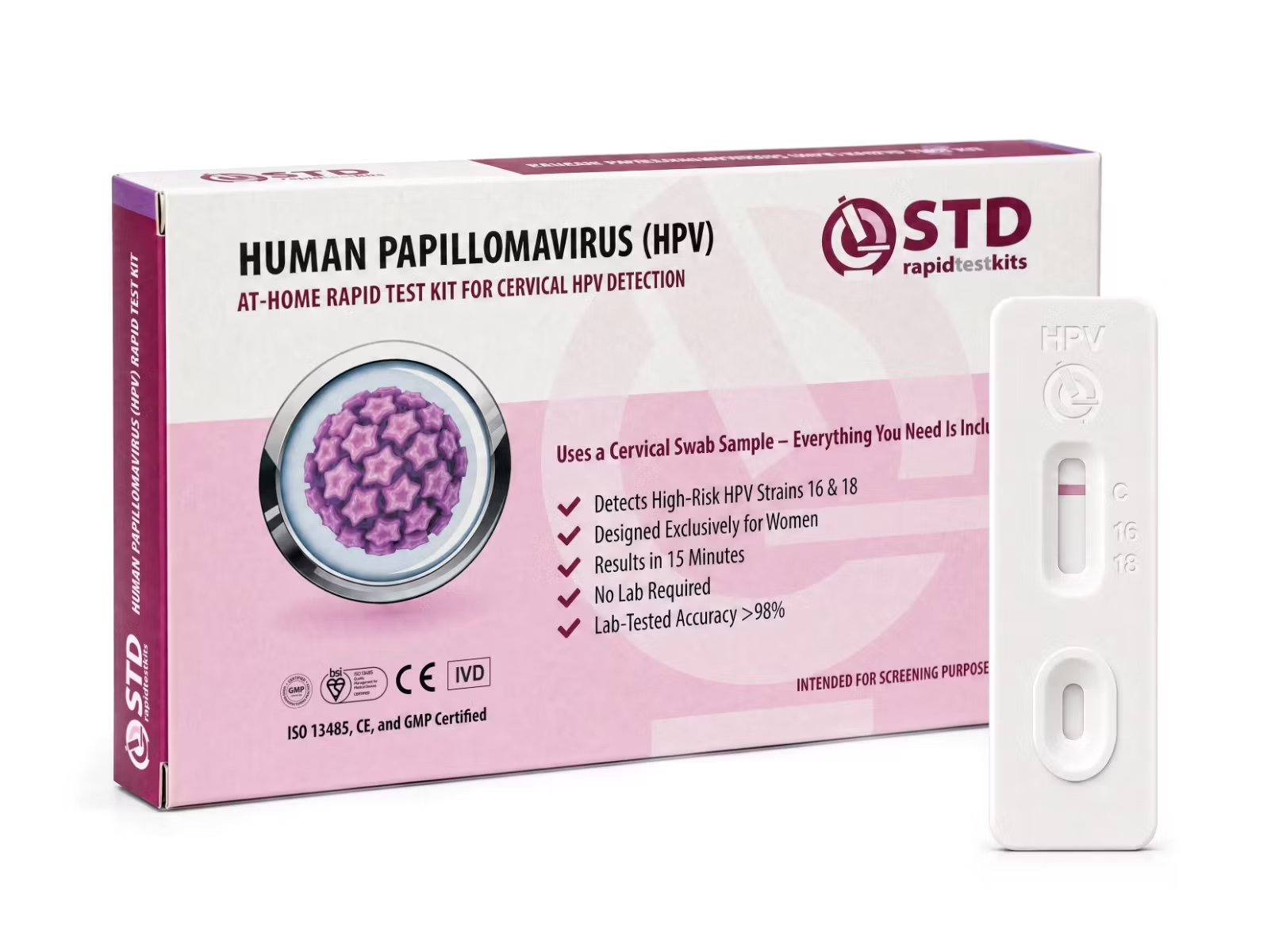
HPV is the most common viral STI worldwide. Most strains cause no symptoms and clear on their own; a smaller subset of high-risk strains (notably HPV 16 and 18) drive the majority of cervical, vaginal, and oropharyngeal cancers (WHO cervical cancer fact sheet). Transmission between women happens through skin-to-skin genital contact, oral-genital contact, and shared sex toys. There is no blood-test screening for HPV; the screening tool is a cervical sample (Pap smear plus HPV co-testing) collected by a clinician or, in certain self-sample programs, at home. The HPV vaccine (Gardasil 9) is recommended through age 26 routinely and through age 45 with shared clinical decision-making per the U.S. Advisory Committee on Immunization Practices. Sexual orientation does not change the recommendation.
Bacterial vaginosis (BV)
BV is a disturbance in the vaginal microbiome where lactobacilli are displaced by anaerobic bacteria. It is not classified as an STI by the CDC, but it behaves like one in WSW: BV is the most common cause of abnormal vaginal discharge among reproductive-aged women, prevalence runs higher among WSW than among heterosexual women, and concordance between female partners is significant enough that recurrent BV often requires rebalancing the shared microbiome rather than treating one partner alone. Symptoms include thin grey or white discharge, a fishy odor that worsens after sex, and mild irritation. Roughly half of cases are asymptomatic.
Chlamydia and gonorrhea
These two bacterial infections are less common in exclusively WSW networks than in mixed-sex networks, but they are not absent. Transmission occurs through oral sex, shared toys, and genital-to-genital contact. Most cases in women are asymptomatic; when symptoms occur they include unusual discharge, intermenstrual bleeding, lower abdominal pain, or pain on urination. Annual screening is the CDC recommendation for women under 25 and for older women with new or multiple partners (CDC STI screening recommendations). Bisexual women who also have male partners carry the same chlamydia and gonorrhea risk as heterosexual women and should follow annual screening regardless of their concurrent same-sex relationship status. At-home rapid lateral-flow tests for chlamydia and gonorrhea are validated for self-collected vaginal swabs.
Herpes simplex (HSV-1 and HSV-2)
Both HSV types matter in WSW. HSV-1 commonly causes oral cold sores and is now responsible for a substantial share of first-episode genital herpes, particularly in younger adults, transmitting via oral sex. HSV-2 is the more common cause of recurrent genital herpes overall. Both viruses transmit during asymptomatic shedding, which is why a partner with no visible lesion can still pass the virus on. Blood antibody tests detect prior exposure but cannot localize the infection to oral or genital. Active visible lesions are diagnosed by clinician swab and PCR.
Trichomoniasis
Trichomonas vaginalis is a parasitic protozoan. Most infections in women cause itching, frothy yellow-green discharge, and irritation, although roughly half are asymptomatic at any given time. Female-to-female transmission via genital contact and shared toys is documented in case series and partner-tracing studies. The infection is curable with a single dose of metronidazole or tinidazole. At-home rapid swab tests validated for vaginal self-collection are available.
HIV and syphilis
HIV transmission between women is rare but documented, primarily in cases involving shared menstrual blood, exposure to lesions, or sex toys with blood transfer (CDC: how HIV spreads). The realistic HIV concern in this population is bisexual women whose partner networks include men who have sex with men or men with other risk factors. Syphilis transmits through direct contact with infectious lesions, including oral, vulvar, and rectal; rates have been rising in the general population for over a decade and routine syphilis screening is reasonable for any sexually active adult with new partners.
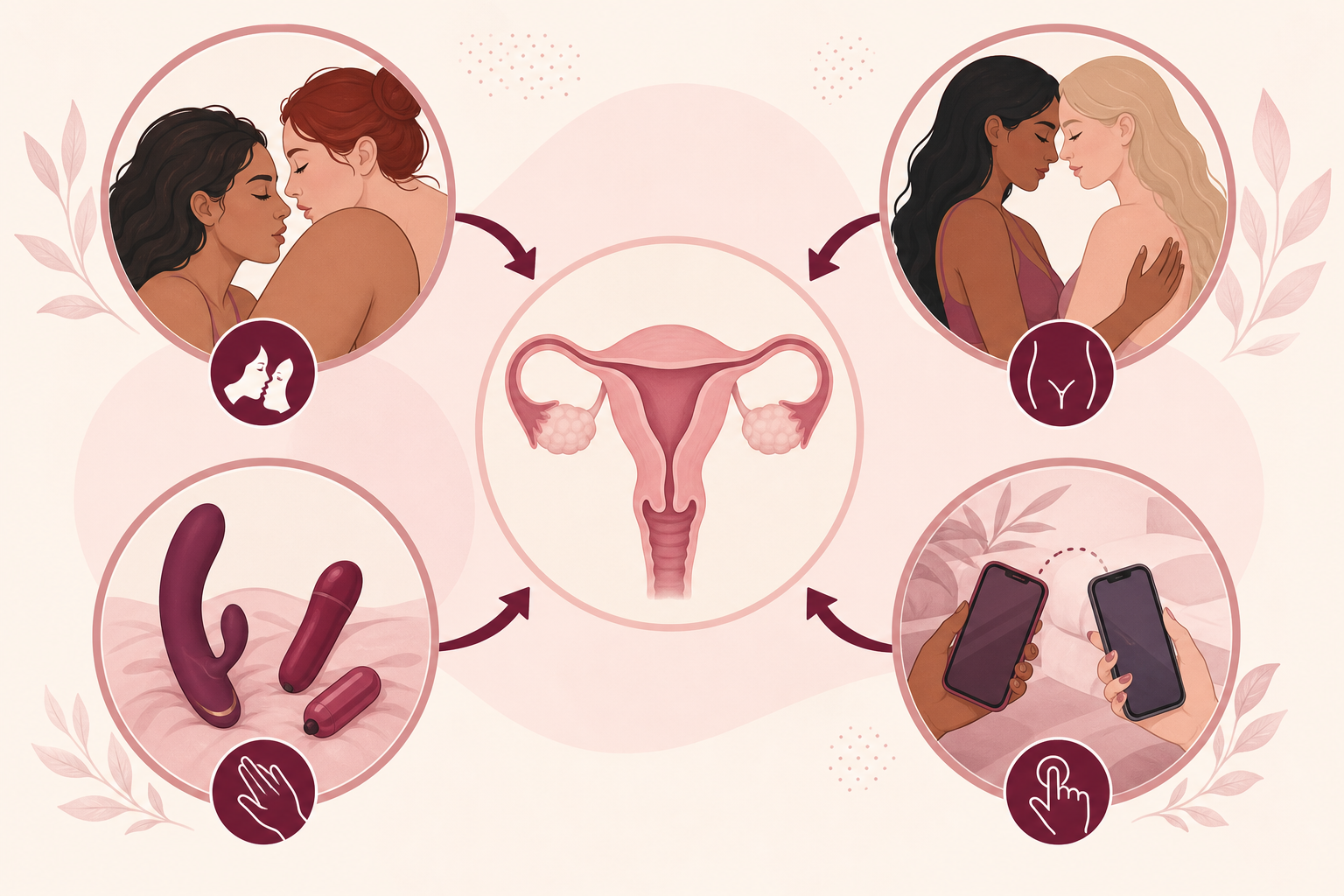
Why HPV and cervical screening still matter
The single largest documented care gap for women who have sex with women is cervical screening uptake. Multiple population studies, including the U.S. National Survey of Family Growth and the Behavioral Risk Factor Surveillance System, find that lesbian and bisexual women report Pap testing within the recommended interval at lower rates than heterosexual women. Reasons cited in qualitative research include past negative healthcare interactions, the misconception that HPV requires heterosexual contact, and clinicians who stop offering the test once they learn the patient's sexual history.
The biology does not care. HPV is the most efficiently transmitted STI in adult populations, and it transmits between women. Cervical cancer screening (Pap smear with HPV co-testing per current guidelines) is the single most evidence-based preventive intervention available for any person with a cervix, including transgender men who retain a cervix (CDC cervical cancer screening). The CDC recommends starting screening at age 21, with co-testing options through age 65 depending on test type and prior results.
If you are a woman who has sex with women and you are due for a Pap, the most important thing you can do for your sexual health this year is book the appointment. The HPV vaccine is the second most important thing if you are within the eligible age range and have not been fully vaccinated. The vaccine prevents most cancers caused by HPV; it does not treat existing infections, which is why it works best given before sexual debut and remains useful into the mid-40s for unvaccinated adults.
The Advisory Committee on Immunization Practices recommends Gardasil 9 routinely through age 26, and through age 45 with shared clinical decision-making for unvaccinated adults. The vaccine works best when given before sexual debut, but provides meaningful benefit for older adults who have not yet been exposed to the high-risk strains it covers. Sexual orientation does not change the recommendation.
Herpes between women: HSV-1 and HSV-2
Herpes is the infection that produces the largest gap between fear and reality in counseling rooms. The objective facts are these: most adults carry HSV-1 from childhood oral exposure with no awareness; HSV-2 is common in U.S. women, with millions carrying the virus often without knowing, and the CDC estimated 572,000 new genital herpes infections in the U.S. in 2018 alone; and the lifetime impact for most carriers is a small number of mild outbreaks rather than a major medical event (CDC: about genital herpes).
For women who have sex with women, the practical exposure routes are oral-to-genital sex (HSV-1 transmitting from a partner with oral cold sores or asymptomatic oral shedding) and genital-to-genital contact (HSV-2 transmitting from genital lesions or asymptomatic genital shedding). Skin-to-skin contact with the active lesion or the surrounding area carries the highest risk. Asymptomatic shedding is the reason most new infections come from partners who had no visible signs at the time.
Testing options:
- Active visible lesion: a clinician-administered swab with PCR is the gold standard; this identifies the specific HSV type and confirms the lesion is herpes rather than a different cause (folliculitis, fixed drug eruption, contact dermatitis can all mimic).
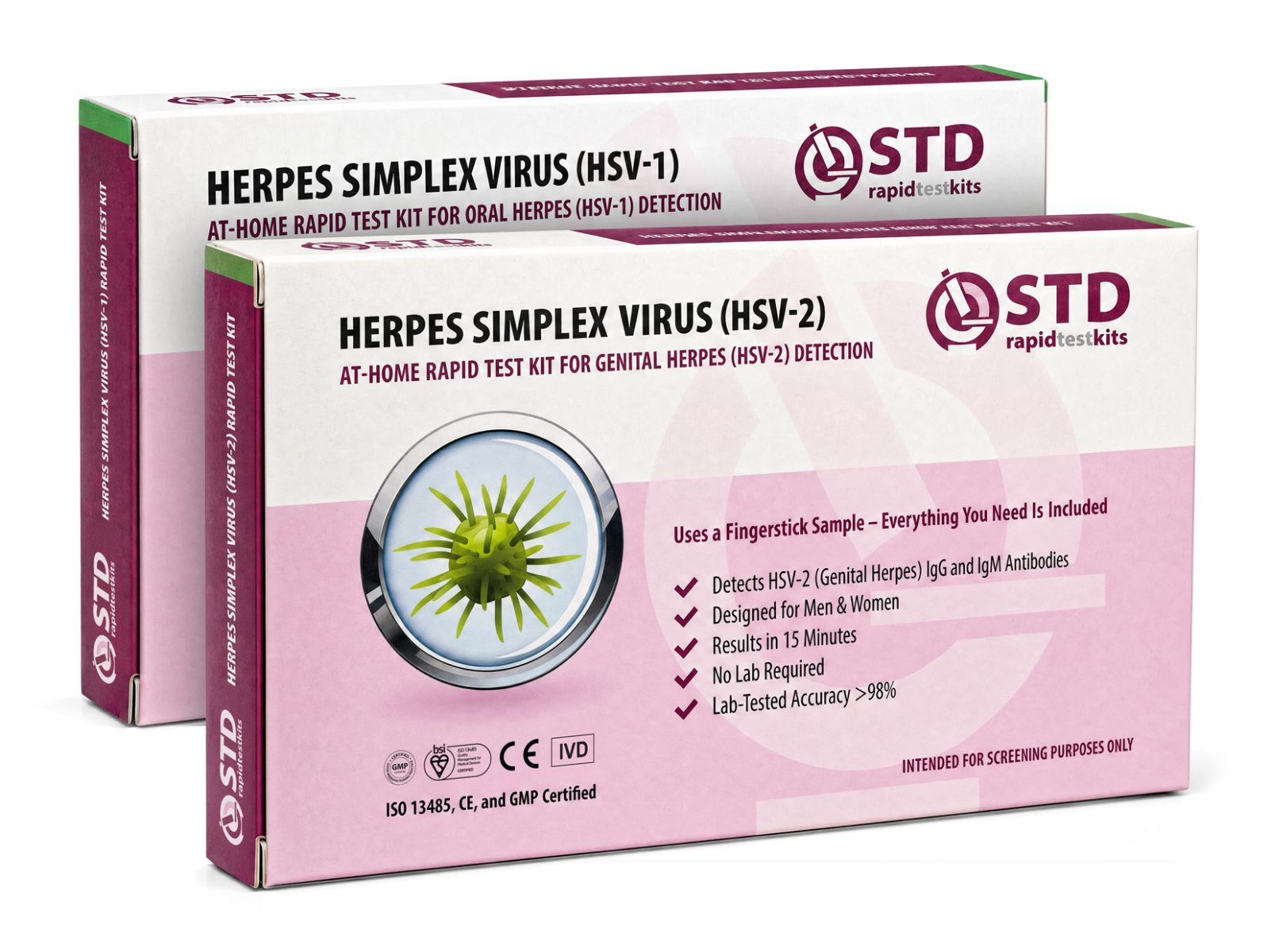
- No active lesion, want to know prior exposure: a fingerstick blood antibody test detects HSV-1 and HSV-2 antibodies. The test answers "have I been exposed at some point" but does not localize the infection to oral or genital. Antibody testing is most reliable 12 weeks or more after suspected exposure.
- Routine asymptomatic screening: the CDC currently does not recommend universal HSV-2 antibody screening in asymptomatic adults because of the rate of false positives and the counseling burden of equivocal results. Targeted antibody testing is reasonable when there is a specific question (a partner's recent diagnosis, planning pregnancy, persistent symptoms).
Two clinical questions, two different tools. If you can see an active lesion right now, the right test is a clinician-administered swab with PCR; this identifies the specific HSV type and rules out lookalikes. If there is no visible lesion and the question is whether you have been exposed in the past, a fingerstick blood antibody test is the appropriate screen, and it becomes reliable around 12 weeks or more after the suspected exposure. The blood test does not tell you whether the infection is oral or genital, only that seroconversion has occurred.
Bacterial vaginosis: not an STI but closely related
BV deserves its own section because it is the single most common reason a woman who has sex with women presents with vaginal symptoms, and yet it is technically not categorized as a sexually transmitted infection. The mechanism is a disruption of the normal lactobacillus-dominant vaginal microbiome, allowing anaerobes (including Gardnerella vaginalis) to overgrow.
What the evidence shows: BV prevalence among WSW runs roughly twice the rate among exclusively heterosexual women, partner concordance is high (when one partner has BV, the other often does), and recurrence is common. Partner-pair studies in journals including the Journal of Infectious Diseases and the American Journal of Obstetrics and Gynecology have shown that the bacterial composition tracks closely between female partners (NHS: bacterial vaginosis).
Symptoms when present include thin grey or white discharge, a fishy odor that worsens after sex, mild itching, and burning on urination. About half of cases are asymptomatic. Untreated BV in pregnancy is associated with preterm birth, and BV elevates susceptibility to other STIs, which is why it warrants treatment even when symptoms are mild. First-line treatment is metronidazole or clindamycin (oral or topical) per CDC guidelines. For recurrent BV in WSW partnerships, some clinicians treat both partners simultaneously, although the evidence base for paired treatment is still developing.
Standard treatment is a 7-day course of oral metronidazole, intravaginal metronidazole gel, or intravaginal clindamycin cream. Recurrence within 12 months is common (over 50 percent in some cohorts). For women who have sex with women with recurrent BV, talking to a clinician about whether to treat both partners together is a reasonable conversation, even though the formal evidence base is still developing.
Debunking the biggest myths
Five misconceptions show up repeatedly in qualitative research with women who have sex with women, and each one is associated with delayed diagnosis or skipped screening. Reading these once is a useful inoculation.
| Myth | Reality |
|---|---|
| Lesbian sex is safe sex. | Skin-to-skin, oral, and shared-toy contact transmit HPV, HSV, trichomoniasis, BV, syphilis, and rarely HIV. Risk is real, just different in mix from mixed-sex relationships. |
| Lesbian and bisexual women do not need Pap smears. | Anyone with a cervix needs cervical screening on the standard schedule. HPV transmits between women and causes cervical cancer regardless of partner gender. |
| You cannot spread STIs without penetration. | HPV, herpes, syphilis, and trichomoniasis spread through skin contact, oral sex, and shared toys. Penetration is not required. |
| No symptoms means no infection. | Most chlamydia, gonorrhea, HPV, and trichomoniasis cases produce no symptoms in women. Routine testing is the only way to catch asymptomatic carriage. |
| HIV is not a concern for women who have sex with women. | Female-to-female HIV transmission is rare but documented. Bisexual women whose partner networks include men with HIV risk factors carry meaningful overall HIV risk. |
Practical prevention and safer sex
The realistic prevention toolkit for women who have sex with women is shorter and less heroic than public-health pamphlets sometimes imply, but each item moves the needle.
- Use a barrier on shared toys. The single highest-yield intervention. An external condom rolled onto the toy and replaced between partners stops the bulk of toy-mediated transmission of BV-associated bacteria, trichomoniasis, HPV, HSV, and gonorrhea. Wash toys with soap and water between uses regardless.
- Dental dams for oral sex. A thin sheet of latex or non-latex equivalent placed between the mouth and the vulva or anus reduces transmission of HSV, HPV, gonorrhea, syphilis, and trichomoniasis. Real-world use is low because dental dams are unfamiliar, awkward to find, and not always pleasant. A useful workaround is to cut a regular condom lengthwise and unroll it. Any barrier used consistently beats an idealized barrier used rarely; the product matters less than the habit.
- Wash hands and trim nails before fingering. Microabrasions on the vaginal mucosa from rough fingering can become entry points for infection. Unglamorous but real prevention.
- Get vaccinated. HPV (Gardasil 9), hepatitis B, and hepatitis A vaccines are all relevant. Hepatitis B vaccination is recommended universally in adults under 60 per current ACIP guidance; the HPV vaccine is recommended through age 26 routinely and through age 45 with shared clinical decision-making.
- Have the testing conversation before, not after. Asking a new partner when she last tested and what for is awkward exactly once and protective for the rest of the relationship. Open the conversation by sharing your own most recent results, which lowers the social cost of asking.
- Pre-exposure prophylaxis (PrEP) for HIV is rarely indicated in exclusively WSW partnerships, but it is worth discussing with a clinician if you have male partners or a partner whose sexual network includes elevated HIV risk (CDC clinical guidance on PrEP).
Each step is individually small; stacked together they shift the risk meaningfully without making sex feel like a clinical procedure.
Active visible lesions, ongoing pelvic pain, abnormal bleeding, or systemic symptoms (fever, rash, joint pain) need clinician evaluation. At-home rapid tests are designed for asymptomatic screening, not for diagnosis when something is already wrong. If a symptom worries you, book an appointment rather than ordering a test kit.
How often should you test?
The CDC's screening recommendations apply to women who have sex with women on the same schedule as women in mixed-sex partnerships, with adjustments for actual exposure routes (CDC STI screening recommendations):
- Annually at minimum, if you are sexually active with new or multiple partners over the year.
- Every 3 to 6 months if you have multiple recent partners, a partner with a diagnosed STI, or you are starting a new sexual relationship without prior testing.
- Cervical screening (Pap plus HPV) on the standard schedule: every 3 years from age 21 with cytology alone, or every 5 years from age 30 with HPV co-testing or primary HPV testing, until age 65.
- Symptom-driven testing any time. Unusual discharge, pelvic pain, post-coital bleeding, sores, or systemic symptoms (fever, rash, joint pain) are reasons to test sooner.
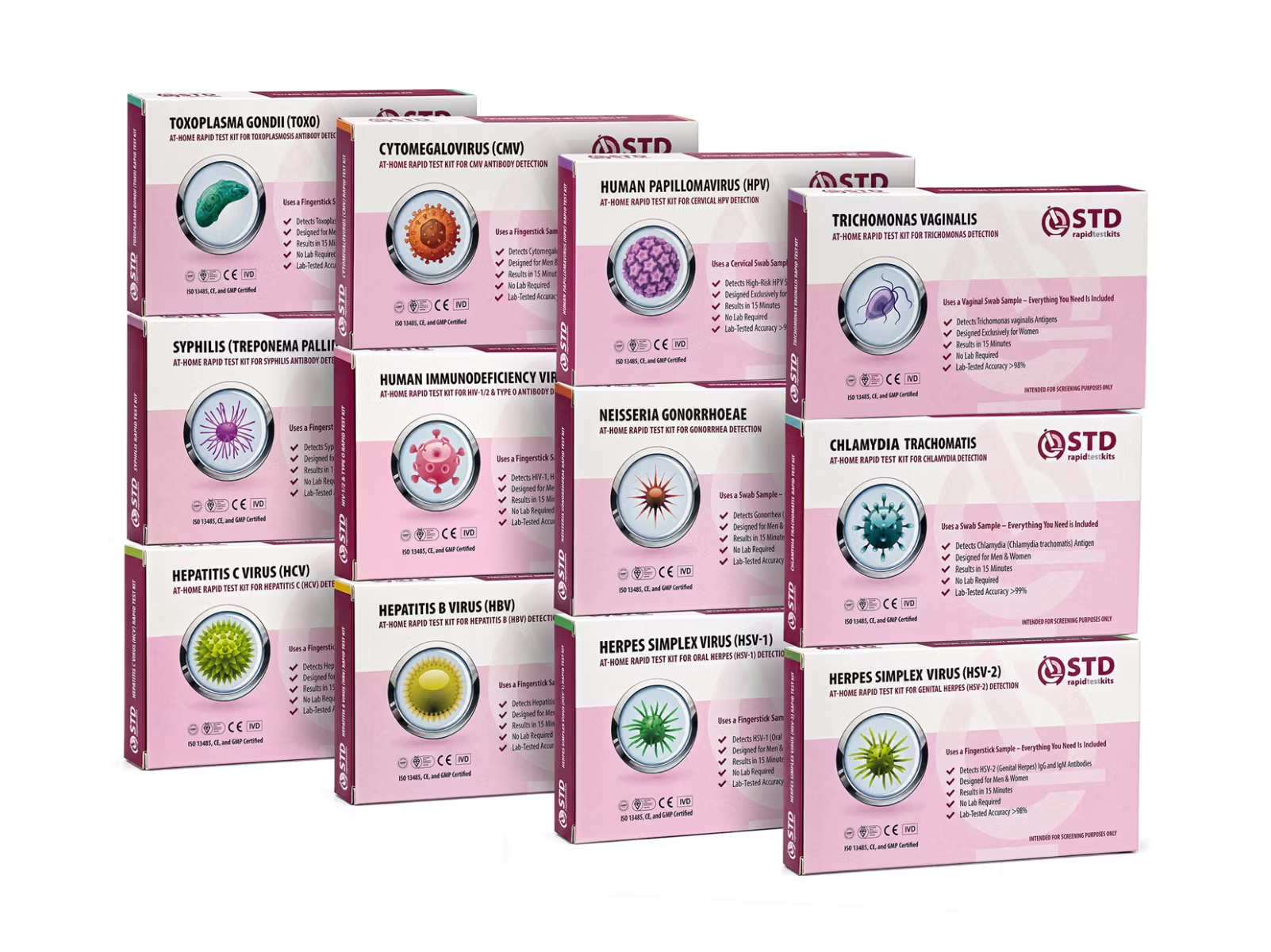
The realistic at-home testing toolkit covers most of what is needed for routine asymptomatic screening. Lateral-flow rapid tests for chlamydia, gonorrhea, trichomoniasis, HPV, and herpes antibodies are designed for self-collected samples and provide results in roughly 15 minutes. A positive result on any of these is a reason to follow up with a clinician for confirmatory laboratory testing (typically nucleic acid amplification testing, NAAT or PCR) and for treatment. The two technologies are complementary, not interchangeable: at-home lateral-flow chemistry trades some analytical sensitivity for speed, privacy, and zero clinic friction. For HPV-related cervical cancer screening specifically, the home test does not replace a clinician-collected Pap; it is one piece of a layered screening picture.
Screening intervals at a glance
- Annual full STI screen for any sexually active woman with new or multiple partners over the year.
- Every 3 to 6 months for higher-risk windows: concurrent partners, a partner's recent diagnosis, or starting a new relationship without prior testing.
- Cervical Pap plus HPV co-testing on the standard schedule: every 3 years from age 21 with cytology alone, or every 5 years from age 30 with HPV co-testing, through age 65.
- Test sooner than the calendar says whenever symptoms appear: unusual discharge, pelvic pain, post-coital bleeding, sores, or systemic signs.
What to do if you test positive
A positive result on a home rapid test is a screening signal, not a final diagnosis. The recommended path:
- Confirm with a clinician. Most STIs are confirmed by lab-grade nucleic acid amplification testing (NAAT or PCR), which is the gold standard the CDC references for chlamydia, gonorrhea, and trichomoniasis. Many primary care offices, family-planning clinics, and Planned Parenthood locations offer same-week appointments.
- Treat promptly. Bacterial and parasitic STIs (chlamydia, gonorrhea, trichomoniasis, syphilis) are curable with short antibiotic courses. BV is treatable with metronidazole or clindamycin. Viral STIs (HPV, HSV, HIV) are managed rather than cured: HPV most often clears on its own; HSV is suppressed with daily antivirals when outbreaks are frequent; HIV is now controlled with single-pill regimens that drive viral load to undetectable, with normal life expectancy on treatment.
- Notify partners. The CDC and most state health departments offer expedited partner therapy or anonymous partner-notification services for many bacterial STIs (CDC STI treatment guidelines). Notifying partners is what stops the chain of reinfection.
- Recheck after treatment. A test of cure is recommended for some infections (notably gonorrhea after specific treatment regimens, syphilis after RPR-tracked treatment) and is reasonable for chlamydia in pregnancy.
A positive STI test is a manageable event, not a defining one. Most STIs are curable. The ones that are not, including HSV and HIV, are managed effectively with current medicine, and the social weight of these diagnoses has eased substantially over the last decade.
Women who have sex with women are at risk for sexually transmitted infections from current and past partners, both male and female. Clinicians should not assume women who have sex with women are at low risk and should ask about specific sexual practices.
Take charge of your sexual health
The main takeaway is that women who have sex with women face a real but manageable set of sexual-health risks, and the largest single problem is undertesting rather than the infections themselves. Cervical screening, annual STI screening, vaccination against HPV and hepatitis B, barriers on shared toys, and a calm conversation with new partners cover most of what the evidence supports. Each of these steps is small in isolation, but together they close the gap between knowing the risks and managing them.
If reading this article makes you realize your last screening was longer ago than you remember, the right next step is to book one. Whether that is a clinic visit, an at-home rapid test, or both, the gap between knowing and acting is the part this guide is meant to close.
Frequently asked questions
- Do lesbian and bisexual women really need STI testing?
- Yes. STIs transmit between women through oral sex, genital skin contact, fingering, and shared sex toys. The CDC recommends routine sexual-health screening for any sexually active adult, regardless of partner gender. Skipping testing because the relationship is between women is the documented cause of delayed diagnoses in this population.
- How often should I get tested?
- For most sexually active women with new or multiple partners, an annual screen covers baseline risk. Step up to every three to six months if you have concurrent partners or a recent diagnosis in your network. Cervical Pap plus HPV testing follows the standard age 21 to 65 schedule regardless of sexual orientation, on a 3 to 5 year interval depending on the test used.
- Can HPV transmit between women?
- Yes. HPV transmits through skin-to-skin genital contact, oral-genital contact, and shared sex toys. Cervical screening uptake among women who have sex with women is lower than among heterosexual women despite comparable HPV prevalence, which is the single biggest reason routine Pap testing matters here.
- Are dental dams effective?
- Yes for reducing transmission of HSV, HPV, gonorrhea, syphilis, and trichomoniasis during oral-genital sex. Real-world use is low because dental dams are unfamiliar and awkward to find. A practical workaround is cutting a regular condom lengthwise. Any barrier consistently used beats an idealized barrier rarely used.
- Can shared sex toys spread STIs?
- Yes. Bacterial (BV-associated, gonorrhea, chlamydia), parasitic (trichomoniasis), and viral (HPV, HSV) infections can all transmit through unwashed shared toys. Rolling a fresh external condom onto the toy between partners and washing with soap and water are the practical mitigations.
- What about HIV risk between women?
- Female-to-female HIV transmission is rare but documented, mostly via shared menstrual blood, exposure to lesions, or toys with blood transfer. The realistic HIV concern in this population is bisexual women whose partner networks include male partners with HIV risk factors. PrEP is rarely indicated in exclusively WSW partnerships but is worth discussing if you have male partners.
- Can I test for all of these at home?
- Most of the relevant infections can be screened with at-home rapid lateral-flow tests, including HPV (women), trichomoniasis (women), chlamydia and gonorrhea, and herpes antibodies. Cervical Pap smears require clinician collection. Any positive home result should be confirmed with lab-grade NAAT or PCR through a clinician.
- What if I test positive?
- Confirm with clinician-ordered lab testing, complete the treatment course, notify partners (expedited partner therapy or anonymous notification services exist in most states), and retest after treatment for the infections that warrant a test of cure. Most STIs are curable; the ones that are not are managed effectively with current medicine.
- U.S. Centers for Disease Control and Prevention. Overview of sexually transmitted infections, including general clinical guidance and links to per-infection pages.
- U.K. National Health Service. Sexual health for lesbian and bisexual women, covering transmission routes and barrier methods.
- U.K. National Health Service. Bacterial vaginosis: symptoms, causes, treatment, and the relationship between BV and STI risk.
- World Health Organization. Sexually transmitted infections fact sheet, global epidemiology and prevention overview.
- U.S. Centers for Disease Control and Prevention. Cervical cancer screening recommendations, including the age 21 to 65 schedule and HPV co-testing options.
- U.S. Centers for Disease Control and Prevention. About HPV, transmission, vaccination, and screening basics.
- U.S. Centers for Disease Control and Prevention. STI screening recommendations by population and risk factor.
- U.S. Centers for Disease Control and Prevention. About genital herpes: epidemiology, transmission, and screening guidance.
