
Published: October 2025 | Last updated: May 2026 | Editorial review and quality control: Martina N.
The most reliable chlamydia test result comes from a sample collected at least 14 days after possible exposure. Test earlier than that and a negative result might just mean the test couldn't detect what is starting to grow inside your body.
If you tested in the first few days after sex and got a negative, that result isn't necessarily wrong. It's incomplete. Chlamydia trachomatis is a slow-growing bacterium that needs time to replicate inside host cells before any test can pick it up. The first one to five days after exposure sit inside what clinicians call the window period, where infection may be present but not yet detectable by any test on the market. The short version: don't treat an early negative as your final answer, and the day-14 retest is the move that turns "probably fine" into something you can actually rely on.
Key Takeaways
- Day 14 is when chlamydia testing, both lab NAAT and at-home rapid kits, becomes reliable after possible exposure.
- A negative test before day 5 does not rule out infection. Plan a retest at the 14-day mark.
How Chlamydia Develops in the First Two Weeks
When Chlamydia trachomatis enters cells lining the cervix, urethra, rectum, or throat, the bacteria don't immediately trigger a noticeable infection. They live and replicate inside the host cells over the first one to three weeks. According to the CDC, most people with chlamydia have no symptoms at all, which is why screening guidance is built around timed testing rather than waiting for something to feel wrong.
What a test is actually measuring depends on the test type. Nucleic acid amplification tests (NAATs), the laboratory standard, look for chlamydia genetic material directly from a urine sample or a swab. NAATs are sensitive, but they still need enough bacterial DNA in the sample to amplify reliably. Early in infection, before the bacterial load has grown enough, even a NAAT can return a false negative.
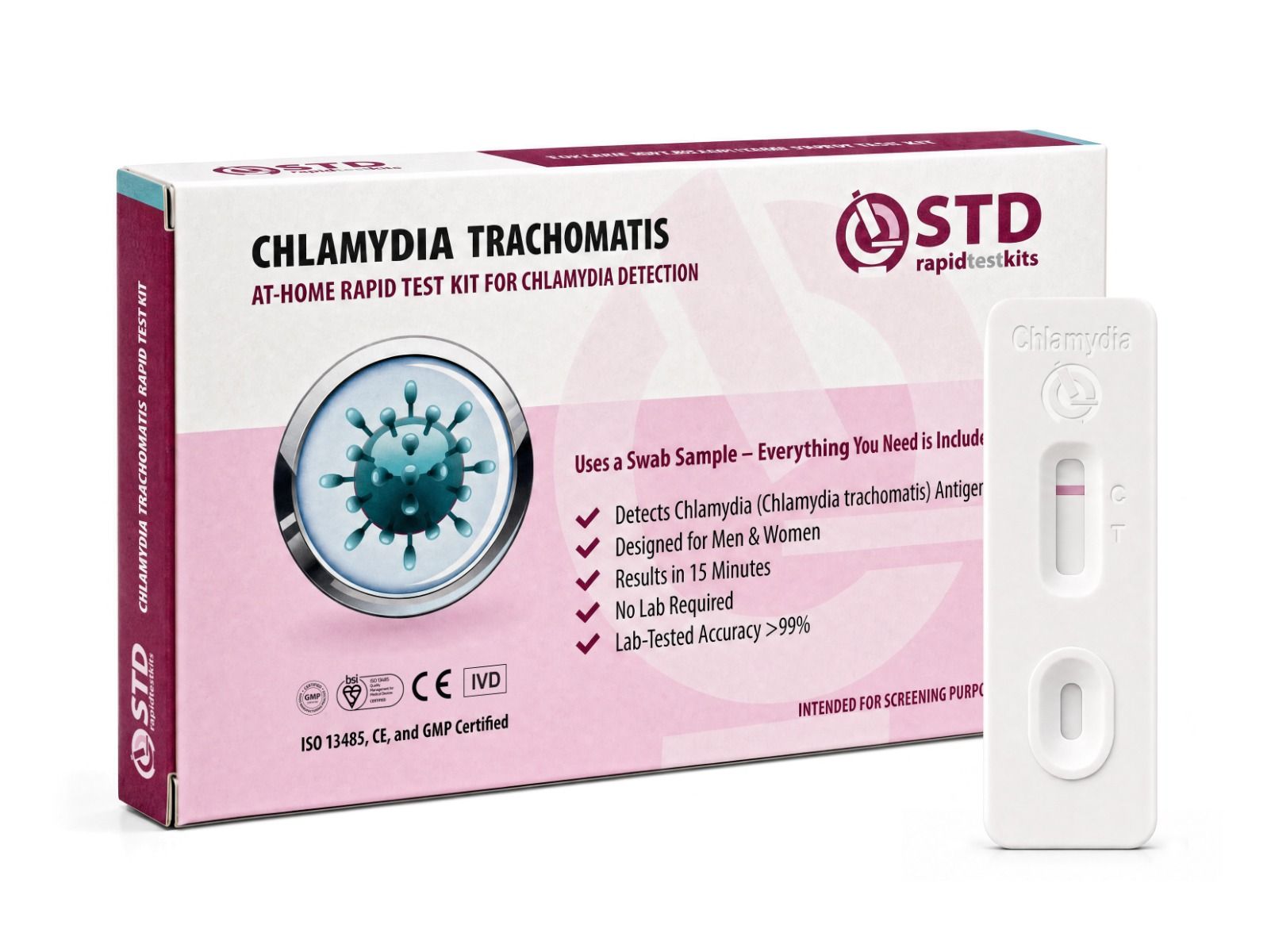
At-home rapid kits, including the ones sold on this site, use a different chemistry called lateral-flow immunoassay. Same biology underneath: the test cannot detect what isn't yet measurably present.
| Time After Exposure | What's Happening Biologically | Test Detection |
|---|---|---|
| 0 to 3 days | Bacteria entering host cells, very limited replication | Too early; high false negative risk |
| 4 to 7 days | Bacterial load increasing, infection establishing | Sometimes detectable, not yet reliable |
| 8 to 14 days | Infection established, enough bacterial DNA in the sample | Detection window opens |
| 14+ days | Mature infection (untreated) | Reliable result |
Why an Early Negative Isn't the Same as a Real Negative
A negative result feels like closure. Early on, it isn't.
What a test does, when there's no symptom and not enough bacterial load yet, is confirm that the assay couldn't find evidence of infection in the sample collected on that day. It does not confirm you are uninfected. The NHS notes that chlamydia frequently produces no symptoms, so you can't use how you feel as a check on the result either.
The practical translation: if your sample was collected within the first five days after a possible exposure, treat the result as preliminary. Plan a retest at day 14.
A negative before day 5 confirms that the window period exists, not that you are infection-free. The test is checking a sample where bacterial DNA may not yet be amplifiable. Treat it as a placeholder, not a verdict.
The Testing Window That Works
If you want a result you can act on, the timing follows this pattern.
| Day After Exposure | What It Means | Best Action |
|---|---|---|
| 0 to 4 | Too early to detect | Wait before testing |
| 5 to 7 | Early signal possible, not definitive | Test if anxious; retest at day 14 |
| 14 | Detection window opens reliably | Definitive test |
| 14+ | High-confidence detection | Test now if not yet tested |
Treat that result as preliminary, not final. Set a calendar reminder for the 14-day mark from your possible exposure date and retest then. A negative at day 14 carries real weight; a negative at day 3 mostly tells you the window period exists.
Lab NAAT and At-Home Rapid Tests Are Not the Same Technology
The chlamydia tests on the market use different technologies, and the differences matter for how you interpret results.
Lab-based NAAT
A laboratory NAAT amplifies chlamydia DNA from a urine sample or a swab. It is the most sensitive option available and is the CDC-recommended diagnostic standard for chlamydia. The downside is the turnaround: you give a sample at a clinic or mail one to a lab, then wait days for results.
At-home rapid lateral-flow tests
At-home rapid kits, including ours, use lateral-flow immunoassay chemistry rather than NAAT amplification. They give a result in roughly 15 minutes from a self-collected swab, with no lab visit. Lateral-flow rapid tests are useful for fast, private screening and are less analytically sensitive than lab NAATs, especially when the bacterial load is on the lower end.
A positive result on either test is worth taking seriously and worth confirming with a healthcare provider, who can verify with a lab NAAT and prescribe treatment.
Sample type matters too
Genital chlamydia testing uses a urine sample (common in lab NAAT workflows) or a self-collected vaginal or penile swab (used by our at-home rapid kit). Pharyngeal (throat) and rectal exposure require swabs taken at those specific sites, typically collected at a clinic. We don't sell a pharyngeal or rectal home swab, so if the exposure was oral or anal, a clinic visit is the right path for those anatomic sites.
Lab NAAT is the diagnostic gold standard for sensitivity. At-home rapid lateral-flow is built for fast, private screening. Different chemistry, same biology: both need at least 14 days after exposure for a result you can rely on.
What to Do If You Already Tested Too Early
If your test was within the first few days after possible exposure, here's how to handle it.
- Tested at days 1 to 4: treat the result as preliminary; schedule a retest at day 14.
- Tested at days 5 to 7: useful early signal but still confirm at day 14.
- Haven't tested yet: wait until at least day 7, ideally day 14, for the first test.
- Symptoms appear at any point (burning during urination, unusual discharge, pelvic discomfort): test now and see a clinician, regardless of where you are in the window.
One sensible plan beats every loose plan. Most people who get caught in the early-test anxiety loop do so because the first negative felt incomplete, then the second one did too.
No Symptoms Doesn't Move the Window
"I feel fine, so I'm probably okay" is one of the riskiest assumptions you can make about chlamydia.
Most genital chlamydia infections are asymptomatic, especially in women, and even when symptoms occur they can be mild enough to dismiss. Feeling normal at day 7 doesn't move the detection window earlier. Bacteria don't replicate faster because the immune system isn't producing visible signs; they replicate at the same biological pace whether or not you have symptoms.
The 14-day mark is determined by bacterial replication biology, not by how you feel. Whether you have symptoms or not, the same window applies.
At-Home Testing vs Clinic Testing
Both have a place. The honest comparison:
| Factor | At-Home Rapid (Lateral-Flow) | Clinic NAAT (Lab) |
|---|---|---|
| Detection method | Lateral-flow immunoassay | Nucleic acid amplification |
| Sample type | Self-collected swab | Urine or swab |
| Window period | Day 14 for reliable detection | Day 14 for reliable detection |
| Analytical sensitivity | Useful for screening | Highest available |
| Time to result | About 15 minutes | Several days |
| Privacy | High; done at home | Requires clinic visit |
| Treatment workflow | See clinician separately if positive | Often same-day prescription if positive |
A Reasonable Test-and-Confirm Plan
For many people, the practical workflow looks like this: use a home rapid test at day 14 for fast, private screening, and follow up with a clinician (who can order a lab NAAT) if the rapid result is positive or if symptoms persist despite a negative.
Going clinic-first is also reasonable. If you have access to a sexual health clinic, want the most analytically sensitive test available, or already need a clinician visit for other reasons, the lab NAAT at day 14 is a solid single test. There's no objectively right choice; pick the one that fits how you want to handle this week.
Home rapid first: screen privately at day 14, confirm with a clinician if positive or if symptoms persist.
Clinic first: single lab NAAT at day 14, most sensitive, often same-day prescription if positive.
When You Should Definitely Plan a Retest
Retesting isn't paranoia; it's the gap between probably and confirmed. If symptoms appear at any point, don't wait on the calendar. Test now and see a clinician.
- You tested before day 7.
- You had unprotected sex with a new or unknown-status partner during or after the window.
- You finished chlamydia treatment in the last three months. CDC guidance recommends a test-of-reinfection at roughly three months post-treatment, since reinfection is common.
- Symptoms appeared after a negative early test.
- You're still uncertain after a single day-14 test and want a follow-up to be sure.
What Happens If You Wait Too Long
There is no "too late" point for chlamydia testing. The window argument only applies for the first two weeks after possible exposure; past that, testing produces an informative result either way. But waiting past the point where you have a reason to test does carry consequences.
Untreated chlamydia can progress to pelvic inflammatory disease in women, which is a major preventable cause of infertility and ectopic pregnancy. Per MedlinePlus, untreated infections in men can cause epididymitis and, less commonly, reactive arthritis. Untreated infections in either anatomy can also spread to sexual partners.
The sweet spot is testing reliably at the 14-day mark and treating promptly if positive. If you're already past 14 days from your possible exposure and haven't tested, the right move is to test now rather than wait further.
Most people with chlamydia have no symptoms. If you do have symptoms, they may not appear until several weeks after you have sex with an infected partner.
The Most Common Timing Mistakes
These are the assumptions that keep people in the early-test anxiety loop. Each one quietly extends the gap between a real result and the result someone is acting on.
- "I tested at day 3, the result was negative, so I'm fine." Not yet. Day 3 is inside the window period for every test on the market.
- "I have no symptoms, so I don't need to test." Asymptomatic chlamydia is the norm in women and very common in men.
- "One test is enough." Only if it was taken at or after day 14 from possible exposure.
- "If something were wrong, I'd feel it by now." Often not. Per the WHO STI fact sheet, STIs including chlamydia frequently go undetected because they're silent.
These assumptions are exactly how infections slip through and reach the pelvic inflammatory disease stage before being caught.
Reframe the four most common mistakes
- An early negative means the window period exists, not that you are infection-free.
- Asymptomatic chlamydia is the norm in women and common in men. No symptoms does not shorten the 14-day window.
- One test is only enough when it was taken at or after day 14 from possible exposure.
- Silent infection is the default for chlamydia. "I'd feel it by now" is not a reliable check.
Time Your Test, Then Trust the Result
Mark the 14-day point on your calendar from the date of possible exposure. Test then. If positive, see a clinician (who can confirm with a lab NAAT and prescribe treatment, typically doxycycline 100mg twice daily for 7 days under current CDC STI Treatment Guidelines). If negative at day 14 and you have no symptoms, the result is one you can trust.
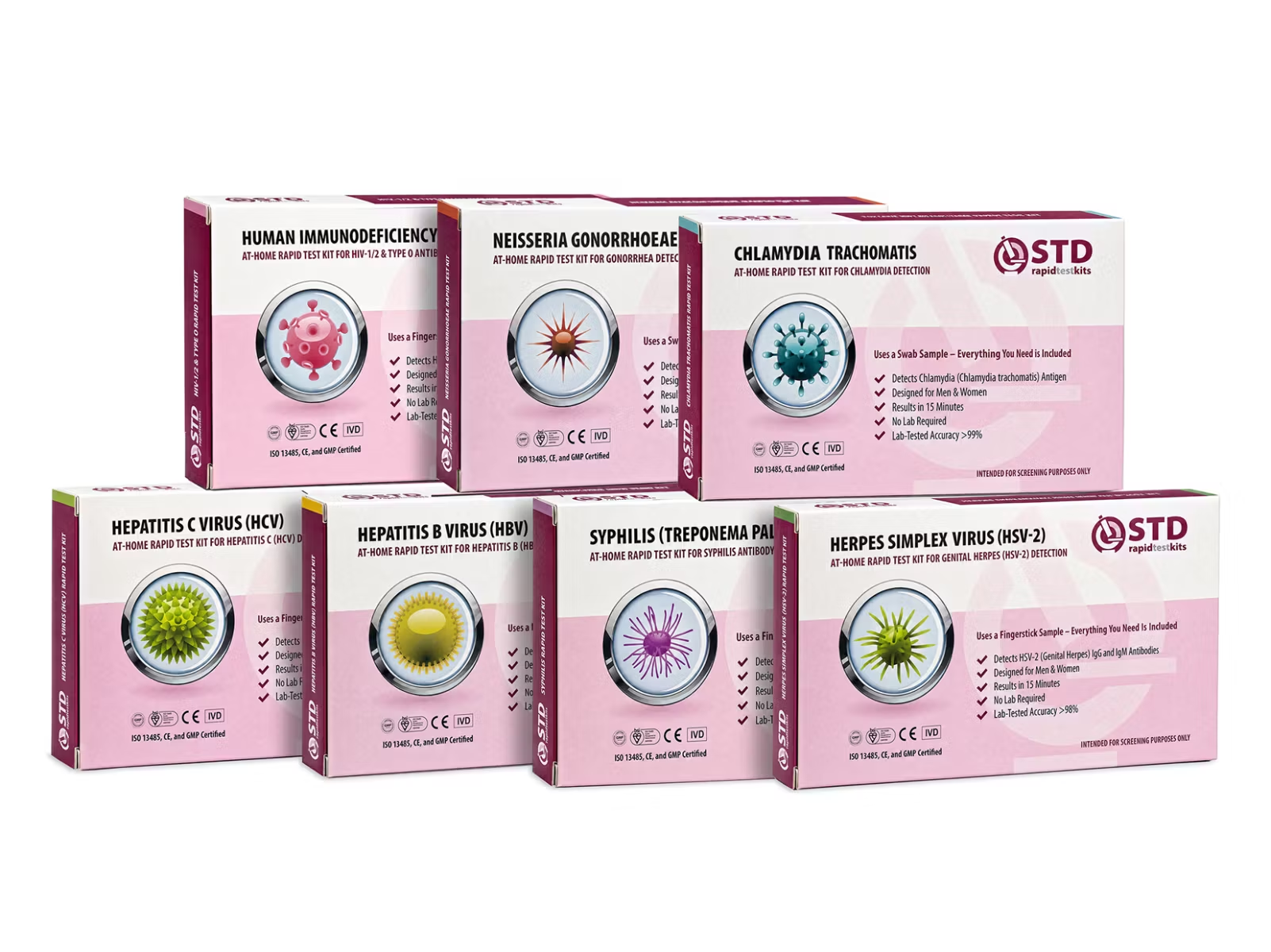
If you'd rather not wait on a clinic appointment, the rapid lateral-flow chlamydia kit lets you screen at home in roughly 15 minutes from a self-collected swab. If you're worried about more than chlamydia from the same exposure, broader screening kits are also available.
FAQs
- Can chlamydia show up on a test at 3 days?
- Usually no. Day 3 falls inside the window period. The bacterial load is typically too low for either a lab NAAT or an at-home rapid test to detect reliably. A negative at day 3 is not enough to rule out infection; plan a retest at day 14.
- I tested at day 5 and it came back negative. Am I in the clear?
- Not definitively. Days 5 to 7 are when some infections start to become detectable, but the result is still inside the unreliable end of the window. Treat a day-5 to day-7 negative as suggestive rather than final, and retest at the 14-day mark to get a result worth acting on.
- Why is day 14 the number everyone points to?
- It's biology, not arbitrary. By day 14, Chlamydia trachomatis has had time to replicate to a bacterial load that lab NAAT testing and reasonably-performing rapid tests can detect consistently. CDC, NHS, and WHO converge on roughly two weeks as the reliable detection point for most cases.
- What if I have symptoms before day 14?
- Test sooner and see a clinician. Symptoms before day 14 can mean a different infection (gonorrhea has a slightly faster timeline, for example), chlamydia at the upper end of bacterial load, or another genital condition entirely. Don't wait on the calendar if your body is signaling that something is off.
- Do at-home tests work as well as clinic tests?
- For fast, private screening at home, the lateral-flow rapid kit covers the need for most people. For the most analytically sensitive result, or when a clinician needs a result they can act on directly, a lab NAAT is the better tool. Both require waiting until at least day 14 to be meaningful.
- If my partner tested positive, when should I test?
- You can test immediately as a baseline, but the result that carries weight is the one at day 14 after your last potential exposure. Many clinicians will also discuss expedited partner therapy or empirical treatment depending on the situation; CDC guidance supports this approach for chlamydia. Talk with a healthcare provider about your specific case.
- Is a urine sample enough, or do I need a swab?
- For genital chlamydia, a urine sample (common in lab NAAT workflows) or a self-collected vaginal or penile swab (used by our at-home rapid kit) both work at the same window. If the exposure involved oral or anal sex, a clinic-collected pharyngeal or rectal swab is the appropriate test for those sites; home rapid kits don't cover those anatomic sites.
- What's the next step if my home test is positive?
- See a clinician promptly. They can confirm with a lab NAAT and prescribe treatment, typically doxycycline 100mg twice daily for 7 days under current CDC STI Treatment Guidelines. Notify recent sexual partners so they can test and treat as needed. After completing treatment, plan a test-of-reinfection at roughly three months.
- U.S. Centers for Disease Control and Prevention. Chlamydia topic hub covering symptoms, transmission, and the asymptomatic-infection pattern that drives screening guidance.
- U.S. Centers for Disease Control and Prevention. Sexually Transmitted Infections Treatment Guidelines, 2021, including the doxycycline regimen for uncomplicated chlamydia and the test-of-reinfection recommendation.
- NHS. Chlamydia overview covering symptoms, testing, and treatment guidance for the UK National Health Service.
- World Health Organization. Sexually transmitted infections (STIs) fact sheet covering global STI burden and the under-detection of asymptomatic infection.
- MedlinePlus, U.S. National Library of Medicine. Chlamydia infections topic page covering diagnostic testing options, screening recommendations, and complications of untreated infection (pelvic inflammatory disease, epididymitis, reactive arthritis).
- Mayo Clinic. Chlamydia symptoms and causes, including complications of untreated infection.
