Published: September 2025 | Last updated: May 2026 | Editorial review and quality control: Martina N.
After a possible HIV exposure, the urge to test fast is almost overwhelming. But timing matters more than speed. A negative result on day three or day five is rarely the final word, and a follow-up test at the right window is what gives you the answer you need.
This guide walks through which HIV tests work at which point after exposure, how to time a retest, and what an early negative actually means. The information is calm and practical, drawn from current CDC and WHO testing guidance instead of 3 AM panic searches.
Key Takeaways
- A negative HIV test taken in the first two weeks after exposure is almost never conclusive. CDC retesting guidance points to 28 to 45 days for a 4th-generation lab test and around 90 days for at-home rapid antibody tests.
- The fastest available test is a NAAT (nucleic acid amplification), which can detect HIV roughly 10 to 33 days after exposure. At-home rapid antibody kits need a longer wait, but they are highly accurate once that window has passed.
Why a first negative isn't always the last word
Most HIV tests do not look for the virus directly. They look for how your body has reacted to it: antibodies the immune system has produced, or, in newer 4th-generation tests, the p24 antigen (a viral protein that appears earlier than antibodies). If your body has not had enough time to make those markers, the test cannot find them, even if you are infected. This gap between the moment of exposure and the moment a test can reliably detect infection is called the "window period."
The CDC identifies three distinct window periods based on test technology: roughly 10 to 33 days for NAAT, 18 to 45 days for 4th-generation antigen and antibody combo tests, and 23 to 90 days for antibody-only tests (CDC HIV testing guidance). A rapid antibody test taken on day five almost certainly cannot confirm an infection that has not yet triggered detectable antibodies.
The window period is the gap between exposure and the moment a test can reliably detect HIV. NAAT tests need detectable viral RNA. Combo tests need either antibodies or detectable p24 antigen. Antibody-only tests need enough antibodies to register. Each technology has its own delay, which is why test choice and test timing both matter.
When different HIV tests become accurate
Each test class has its own detection timeline. The chart below maps which test type does what, with CDC-published earliest-detection windows and the point at which each test reaches reliable accuracy for the typical adult immune system.
| Test Type | What It Detects | Earliest Detection | Reliable By |
|---|---|---|---|
| HIV NAAT (RNA test) | Viral RNA | 10 days | 33 days |
| 4th Generation Combo (lab) | p24 antigen + antibodies | 18 days | 45 days |
| 3rd Generation Antibody (lab) | HIV antibodies | 23 days | 90 days |
| Rapid Antibody (at-home) | HIV antibodies | 30 days | 90 days |
The window period is a risk-management tool, not a delay
Picture this: it has been eight days since your encounter. You took a rapid test yesterday and it came back negative. Now you are reading about "seroconversion illness," and your sore throat suddenly feels significant. This is normal, and it is also the reason testing strategy matters more than testing speed.
Seroconversion is the period when your body begins producing detectable antibodies. Roughly two-thirds of people develop flu-like symptoms during this stage, typically two to four weeks after exposure (CDC HIV basics). Those symptoms (fever, fatigue, sore throat, swollen lymph nodes, rash) overlap with hundreds of other causes. About one in four people with acute HIV report no symptoms at all, so the absence of symptoms does not rule infection out either.
Treat the window period as biology's built-in buffer. The virus needs time to replicate to detectable levels, and the immune system needs time to react.
If your first test was within 14 days of exposure, plan a retest at day 28 (4th-generation lab test) or day 90 (at-home antibody rapid kit). If you tested between days 15 and 44, the result is probably accurate, but a single 90-day antibody confirmation gives full peace of mind.
Retesting timeline after a possible exposure
The right next step depends on how long ago your exposure was. The table below maps days-since-exposure to the appropriate testing action, so you can plan a retest schedule instead of guessing at it.
| Time Since Exposure | Best Action | Why |
|---|---|---|
| 0 to 7 days | NAAT possible now; plan retest at 28+ days | Too early for most antibody or antigen detection |
| 8 to 21 days | Consider 4th-gen lab or NAAT; retest at day 28 to 42 | Early window; some still get false negatives |
| 22 to 42 days | 4th-gen combo strongly recommended | High accuracy by this point |
| 43 to 90 days | At-home antibody test for confirmation | Conclusive for nearly all cases |
Why false negatives happen even with accurate tests
A high-quality test taken at day 12 can miss a real infection. The test is not broken. It just needs detectable markers, and biology takes time to produce them. Antibody-based tests need detectable antibody concentrations. Combo tests rely on either antibodies or detectable p24 antigen, and the antigen rises and falls in a relatively narrow early window before antibodies take over.
NAAT (nucleic acid amplification) detects viral RNA directly, which is why it has the shortest window at roughly 10 to 33 days post-exposure (CDC HIV testing guidance). It is the most sensitive option for very early testing, but it is usually only ordered through a clinic for high-risk situations, since it costs more and requires lab processing.
If you tested early and got a negative, treat that result as preliminary, then plan the retest at the correct window for whichever test you took.
The p24 antigen peaks in the first few weeks after infection, then drops as antibodies take over. A 4th-generation combo test catches either marker, which is what gives it the wider detection window than antibody-only tests have.
Match the test to your timeline
If you can choose your test, pick the one that fits where you are on the calendar. The chart below pairs each window with the test that gives you the best balance of accuracy and accessibility.
| Days Since Exposure | Best Test | Why |
|---|---|---|
| 1 to 10 days | NAAT (RNA test) if available | Detects virus directly; useful for high-risk or urgent testing |
| 11 to 27 days | 4th-generation combo lab test | Best balance of early detection and reliability |
| 28 to 42 days | 4th-gen combo or rapid antibody test | Most infections will be detectable in this window |
| 43+ days | Any FDA-approved antibody test | Conclusive results for nearly all exposures |
At-home rapid kits versus clinic tests
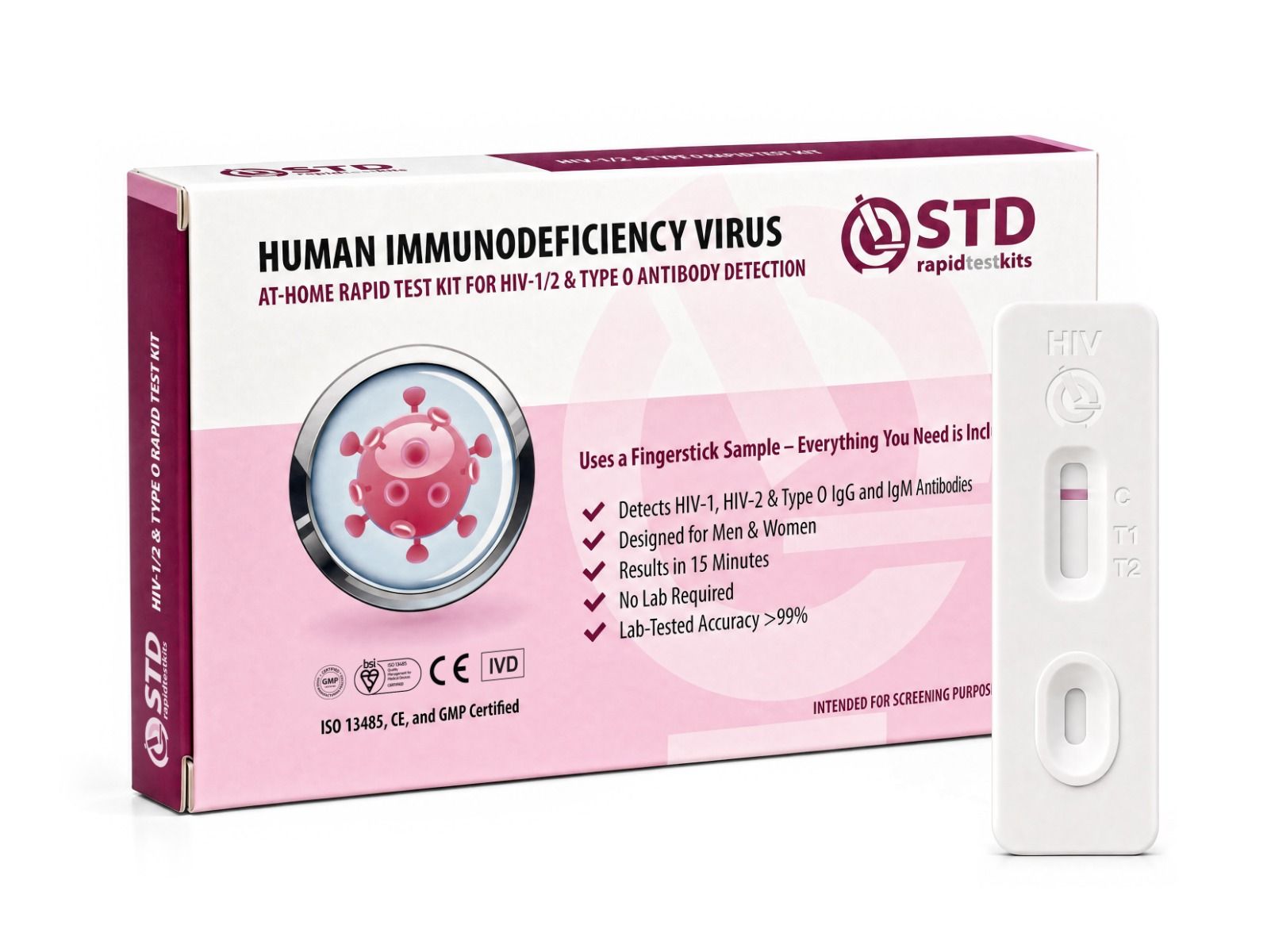
At-home rapid HIV tests are lateral-flow blood antibody tests. You collect a fingerstick sample, apply it to a cassette, and read a result line in 15 to 20 minutes. FDA-cleared rapid HIV antibody tests are highly accurate when used after the full window period, and the CDC notes that any reactive home result should be confirmed by lab follow-up testing (CDC HIV testing guidance).
At-home rapid kits trade an early-detection window for convenience. Rapid antibody tests reach full accuracy at around 90 days post-exposure. They are not designed to catch the earliest infections in the first weeks. Clinic-administered NAAT and 4th-generation combo tests close that gap, at the cost of needing a lab visit and lab processing.
Layering tests covers the gap. Use an at-home rapid kit for the 90-day confirmation, and consider a clinic NAAT or 4th-generation combo if you need an answer earlier than that, especially for a high-risk exposure where PEP is also being considered. This site sells rapid at-home HIV tests; the kit linked below is the product discussed in this section.
PEP, PrEP, and multiple exposures
If you started PEP (post-exposure prophylaxis) within 72 hours of exposure, your testing schedule changes. PEP can suppress detectable virus during treatment, so the CDC recommends baseline testing followed by retests at 4 to 6 weeks, 3 months, and sometimes 6 months after the exposure event (CDC HIV prevention). On PrEP (pre-exposure prophylaxis), routine retesting every three months is the standard, both to confirm continued HIV-negative status and to monitor for any breakthrough infection.
If you had multiple potential exposures over a stretch of time, the testing window restarts with the most recent exposure. A negative test at day 25 covers an exposure 25 days ago, but it does not cover a separate exposure that happened seven days ago. Use the most recent date as your timeline anchor.
PEP retesting schedule at a glance
- Baseline test when you start PEP
- Retest at 4 to 6 weeks after the exposure event
- Retest at 3 months
- Optional retest at 6 months for high-risk exposures
When health anxiety takes over the testing cycle
Repeated negative tests do not always quiet the worry. Some people end up testing five, ten, or more times across months, convinced something has been missed. This is sometimes called HIV-related health anxiety, and it shares features with the broader illness anxiety disorder recognized in clinical literature.
The pattern is consistent. A real exposure event triggers reasonable concern, but the worry persists past the point at which retesting can change the answer. If you are testing repeatedly outside what CDC guidance recommends, talking with a therapist who works with health anxiety tends to help more than another test will. Retesting is calibrated to give you an accurate answer at the right time, not to silence anxiety on its own schedule.

What if your retest comes back positive?
A positive result is the start of a treatment path, not the end of options. Modern antiretroviral therapy (ART) is highly effective. People who start treatment promptly typically reach an undetectable viral load within months, and the CDC's Undetectable equals Untransmittable (U=U) position confirms that an undetectable viral load means HIV cannot be sexually transmitted (CDC HIV treatment).
The next steps after a reactive home test are practical: confirmatory lab testing (an HIV-1/HIV-2 differentiation immunoassay plus a NAAT), then linkage to care. Ryan White HIV/AIDS Program clinics, state health departments, and many community health centers offer low-cost or no-cost access regardless of insurance status.
Access does not require insurance. The HIV.gov locator at hiv.gov/locator finds nearby clinics that accept walk-ins. The Ryan White HIV/AIDS Program supports treatment for low-income people regardless of insurance status. State and county health departments and many community health centers also provide low-cost or free care.
Bottom line on retesting
A first negative HIV test is often a snapshot, not a diagnosis. If you tested in the first two weeks, schedule a follow-up at day 28 for a 4th-generation lab test, or at day 90 for an at-home antibody kit.
No HIV test can detect HIV immediately after infection. If you think you have been exposed, get tested, then get tested again after the window period for the test you have used.
Frequently asked questions
- How long after exposure can an HIV test be trusted?
- It depends on the test. NAAT (nucleic acid amplification) can detect HIV as early as 10 days after exposure, and is reliable by about 33 days. A 4th-generation antigen and antibody lab test reaches strong accuracy at 18 to 45 days. At-home rapid antibody tests are most reliable at 90 days. A negative inside any of those early windows should be paired with a follow-up test once the window has fully passed.
- I tested negative at day 12. Can I stop worrying?
- Not yet. At day 12, even a sensitive 4th-generation combo test can miss a recent infection. The result is a useful baseline, but it is not conclusive. Plan a retest around day 28 for a 4th-generation lab test, or at day 90 for an at-home antibody kit, before treating the negative as final.
- Why do I feel sick if my HIV test came back negative?
- Acute HIV symptoms (fever, sore throat, fatigue, swollen lymph nodes, rash) overlap with everything from a common viral cold to anxiety to dehydration. Symptoms alone cannot diagnose HIV, and many people in the window period have no symptoms at all. If you are still inside the window, retest at the appropriate point. Do not rely on how you feel.
- What is the window period, and why does it matter so much?
- The window period is the time between exposure and the point at which a given test can reliably detect HIV. Antibody tests need your immune system to produce detectable antibodies. Antigen tests need viral protein levels to rise. NAAT tests need viral RNA above the detection limit. Testing inside the window can produce a real result, but it is not yet a complete answer.
- Which HIV test detects infection earliest?
- NAAT. It is almost always ordered through a clinic, since cost and access are real constraints, but if you have a high-risk exposure and need a signal before day 28, it is the only option that can provide one. Any reactive NAAT should be confirmed with a second clinic test.
- Do I need to retest if I am on PEP?
- Yes. PEP changes your window because the drug suppresses detectable virus during treatment. Retest at baseline, then at 4 to 6 weeks, 3 months, and optionally at 6 months. Standard window-period timing does not apply while you are on the course.
- Can stress or anxiety affect HIV test accuracy?
- No. Stress does not affect the chemistry of the test. It does affect how you interpret your result and how often you feel the need to retest. If you find yourself testing repeatedly outside what CDC guidance recommends, a therapist familiar with health anxiety is more useful than another test.
- What if my at-home test shows a faint line?
- Read the kit's instructions carefully. Some rapid tests treat any visible line as a reactive result; others warn about evaporation lines that can appear after the read window. If the result is unclear, or you saw any line where there should be none, follow up with a confirmatory lab test. Do not assume, and do not panic.
- U.S. Centers for Disease Control and Prevention. HIV testing technology, window periods by test type, and detection timelines.
- U.S. Centers for Disease Control and Prevention. HIV basics: transmission, acute infection symptoms, treatment, and the U=U position.
- World Health Organization. HIV fact sheet covering global epidemiology, testing, and treatment standards.
- UK National Health Service. HIV diagnosis, including testing process and recommended retesting timing.
- U.S. Department of Health and Human Services. HIV.gov hub for testing types, retesting schedules, and PEP/PrEP guidance.
- UK National Health Service. HIV symptoms and seroconversion illness overview.
