
Published: December 2025 | Last updated: May 2026 | Editorial review and quality control: Martina N.
Syphilis used to feel like someone else's problem. For more than a decade, public-health campaigns, testing efforts, and clinic outreach focused mostly on men who have sex with men, the group where infection rates were highest. The latest U.S. surveillance data complicates that picture. Primary and secondary syphilis cases among women in the United States climbed from 7,901 in 2020 to 14,652 in 2022, an increase of roughly 85 percent in just two years (CDC STI Surveillance, Annual Tables).
If you have been wondering whether this trend applies to you, the short answer is that it might. The longer answer involves understanding how syphilis spreads, when antibody tests can reliably detect it, and what your screening options look like before you ever set foot in a clinic.
Key Takeaways
- Primary and secondary syphilis cases among U.S. women nearly doubled between 2020 and 2022, and many early infections go unnoticed because the primary sore is typically painless or hidden.
- Blood antibody tests become reliably positive between three and six weeks after exposure, so testing immediately after a possible exposure often produces a false-negative result.
Why This Shift Matters More Than the Headlines Suggest
For years, syphilis prevention efforts focused primarily on men who have sex with men because reported incidence rates were highest there. Routine screening became more common in that group, which likely contributed to earlier detection. The more recent surveillance data show that primary and secondary syphilis among women climbed from 7,901 cases in 2020 to 12,265 in 2021 and 14,652 in 2022, with the steepest year-over-year acceleration coming in 2020 to 2021 (CDC STI Surveillance, Annual Tables). Acceleration of that scale does not happen quietly; it signals hidden transmission networks and undiagnosed cases.
When an infection spreads into populations that test less frequently, the number of asymptomatic or late-diagnosed cases tends to increase. Syphilis is notorious for being subtle in its early stages. A painless sore can be mistaken for irritation from shaving or sex. A faint rash on the palms or soles can pass for an allergic reaction. Weeks later, visible symptoms may fade entirely while the infection continues progressing internally.
Public-health researchers studying recent regional outbreaks have warned of a reservoir of undiagnosed syphilis among heterosexual populations. That warning points to a gap between testing patterns and transmission patterns rather than to universal infection; when testing lags behind spread, cases multiply quietly in populations that screen too rarely to catch them.
Primary and secondary cases in U.S. women: 7,901 (2020) → 12,265 (2021) → 14,652 (2022). Early non-primary, non-secondary cases over the same period: 7,809 → 12,674. Source: <a href="https://www.cdc.gov/sti-statistics/annual/index.html" target="_blank" rel="noopener">CDC STI Surveillance, Annual Tables</a>.
What Actually Counts as a Syphilis Test
Not all STI tests are the same, and not all testing methods detect syphilis the same way. Clarifying this matters before you decide what to order or where to go.
Syphilis is typically detected using blood-based antibody tests rather than swabs. These tests measure how the immune system has responded to Treponema pallidum, the bacterium that causes syphilis. Some tests look for treponemal antibodies, which indicate that a person has been exposed at some point. Others look for non-treponemal antibodies (commonly the RPR or VDRL tests), which clinicians use to monitor active infection and treatment response (CDC STI Treatment Guidelines: Syphilis).
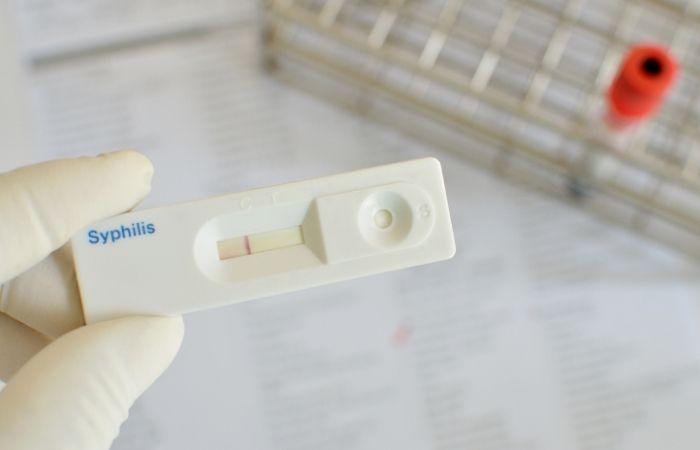
At-home rapid syphilis tests use a small fingerstick blood sample placed onto a lateral-flow cassette. Results are typically available in 10 to 20 minutes. Mail-in lab kits also use a fingerstick blood sample but are processed by certified laboratories using highly sensitive immunoassays. Clinic testing often combines a screening immunoassay with a confirmatory non-treponemal test for staging.
The point of timing comes up no matter which method you use. Syphilis does not show up immediately after exposure. The immune system needs time to produce detectable antibodies. Testing too early can produce a false-negative result; the immune system simply has not yet built antibody levels the test can measure.
The Window Period and Why Timing Is the Hard Part
When people learn that syphilis is rising, the first instinct is often immediate testing. That instinct is understandable. Accuracy, though, depends on the window period: the time between exposure and when a test can reliably detect infection.
Syphilis has two timelines worth keeping separate. The incubation period describes when symptoms might appear: chancres appear 10 to 90 days after exposure, with a median of 21 to 25 days (StatPearls: Syphilis (Treponema pallidum)). The window period describes when blood tests can detect antibodies. These two timelines overlap, but they are not identical.
Someone might develop a small painless sore within three weeks. Another person might feel nothing at all yet still test positive after several weeks. Unpredictable timing is why structured guidance matters more than a single number, and why a follow-up test belongs in any reasonable screening plan after a recent exposure.
Two timelines, often confused
- Incubation period (when symptoms might appear): 10 to 90 days after exposure, median around 21 to 25 days.
- Window period (when blood antibody tests can reliably detect infection): typically three to six weeks after exposure, with stronger reliability at six to twelve weeks.
When Should You Test After a Possible Exposure?
If you had a recent exposure and you are anxious, that is human. The pull toward immediate testing is strong. With syphilis, testing accuracy improves over time because your immune system needs time to produce detectable antibodies.
Most blood-based syphilis tests become reliably positive between three and six weeks after exposure. Some people will seroconvert earlier, but that timeline is not guaranteed for any individual. A test taken too soon can produce a false-negative result that feels reassuring at the time and is not actually definitive.
The table below summarizes how detection likelihood typically changes over the weeks following a possible exposure, alongside what an at-home or clinic blood test can actually tell you at each stage. Treat it as a decision aid, not a diagnostic rule.
This timeline reflects general antibody-based testing patterns described by the CDC and other public-health authorities. Individual variation exists, which is why retesting at six to twelve weeks remains best practice when exposure risk continues or symptoms evolve. If your exposure was within the last two weeks, testing now may give you a useful baseline result, and a follow-up at the three-to-six-week mark will give you a stronger answer.
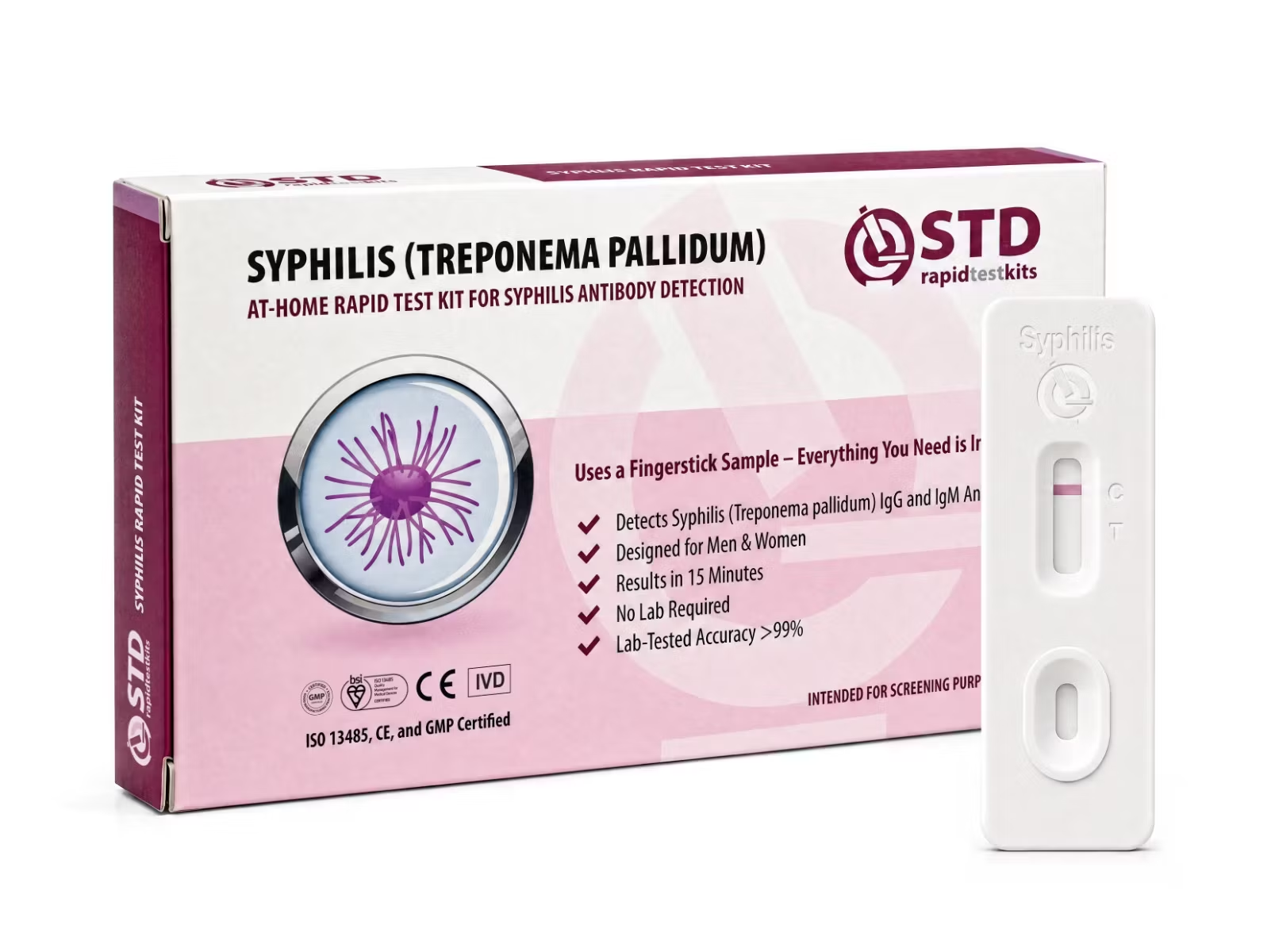
If a private at-home test fits the picture above, stdrapidtestkits.com sells fingerstick rapid lateral-flow kits for syphilis as well as multi-infection panels; the products called out below are available on that site. A positive at-home result should always be followed by a confirmatory laboratory test through a healthcare provider.
| Time Since Exposure | What's Happening in the Body | Test Reliability | Recommended Action |
|---|---|---|---|
| 0 to 7 days | Bacteria may be present, but antibodies have not yet formed. | Very low detection likelihood | Too early for accurate blood testing unless symptoms are present and severe. |
| 2 weeks | Early immune response may be beginning in some individuals. | Possible but inconsistent | Testing can be done as a baseline; plan to retest between three and six weeks. |
| 3 to 6 weeks | Antibodies typically reach detectable levels in most cases. | High reliability for screening tests | Optimal initial testing window for most exposures. |
| 6 to 12 weeks | Established immune response with stable antibody levels. | Very high detection accuracy | Confirmatory window if an earlier test was negative or exposure risk continued. |
How Rapid Home Tests Compare to Lab Testing
Not all syphilis tests are equivalent, and that does not mean one is good and another is bad. They serve different purposes. Rapid at-home tests offer quick screening from a fingerstick blood sample. Lab-based tests, whether mail-in or clinic-based, often include additional confirmatory steps and quantitative antibody titers that help clinicians monitor treatment response over time.
The comparison below summarizes the practical differences. Each method has a place; the right one depends on whether you want a fast private answer, a lab-grade confirmation, or a clinical evaluation that can also assess possible complications.
Rapid testing is best understood as a screening tool. It can reliably identify likely infections when used after the appropriate window period, and a positive result should be followed with confirmatory laboratory testing (CDC STI Treatment Guidelines). A negative result during the window period strengthens, but does not finalize, confidence, especially when exposure was recent.
| Testing Method | Sample Type | Speed of Results | Accuracy When Timed Correctly | Best For |
|---|---|---|---|---|
| At-home rapid test | Fingerstick blood | 10 to 20 minutes | High for screening once past the window period | Private, immediate answers and early screening |
| Mail-in lab kit | Fingerstick blood (mailed to lab) | 1 to 3 days after lab receipt | Very high sensitivity and specificity | Lab-grade confirmation without an in-person visit |
| Clinic testing | Venous blood draw | Same day to several days | Very high with confirmatory reflex testing | Symptomatic cases, pregnancy screening, or complex follow-up |
Why Rising Rates Among Women Signal Hidden Infections
Surveillance data showing rising syphilis among heterosexual women has a second, less obvious implication: many cases are probably going undetected. Routine syphilis screening has historically been recommended for pregnant people and for groups with statistically higher incidence, including men who have sex with men. When infection spreads into populations not routinely screened, silent transmission becomes more likely (WHO Syphilis Fact Sheet).
Syphilis can move through clinical stages quietly. Primary infection may cause a painless ulcer (a chancre) that resolves on its own within three to six weeks. Secondary infection can produce a faint rash that resembles eczema or a viral exanthem, often on the palms or soles. Latent stages may produce no visible symptoms at all. Through each of these stages the bacterium can still transmit to partners and, during pregnancy, to a developing baby (Mayo Clinic: Syphilis).
The surveillance data is a detection story, not a behavior story. When heterosexual women are not routinely screened, infections go unnoticed until later stages or until pregnancy testing catches them, and prevention starts to intersect with urgency.
If you have had a new partner, multiple partners, or unprotected sex within the last three months, testing is maintenance rather than accusation, similar in spirit to a routine blood panel or a Pap smear that produces information you can act on at your next checkup.
Syphilis is a sexually transmitted infection that can cause serious health problems without treatment. The early stages of syphilis can be easy to miss, but the infection itself is preventable, treatable, and curable.
If a Test Comes Back Positive, Here's What Actually Happens Next
A positive syphilis test is a medical finding, not a moral verdict. The overwhelming majority of cases, especially when detected early, are treatable with antibiotics, and treatment for early-stage infection is usually straightforward.
Per current CDC treatment guidelines, early syphilis (primary, secondary, or early latent) is typically treated with a single intramuscular injection of benzathine penicillin G. For people with a documented penicillin allergy, alternative regimens such as doxycycline may be used depending on stage and clinical context. For late latent or unknown-duration syphilis, three weekly injections of benzathine penicillin G are standard (CDC STI Treatment Guidelines). The earlier the infection is detected, the simpler the regimen and the lower the risk of long-term complications. Untreated late syphilis can damage the brain, nerves, eyes, heart, and blood vessels. The neurological form, neurosyphilis, can develop months to years after the initial infection and cause symptoms ranging from headache and confusion to hearing loss, vision changes, and rare paralysis in a small proportion of untreated cases.
If you receive a positive result from an at-home rapid test, confirmatory laboratory testing is recommended. That can happen through a primary care provider, a sexual-health clinic, or a laboratory-based mail-in kit. Confirmatory testing helps determine the stage of infection and guides follow-up care.
After treatment, blood tests are usually repeated at intervals your provider recommends to confirm that non-treponemal antibody titers decline appropriately. Testing too soon after treatment can detect residual antibodies rather than active infection, which is why your provider may recommend waiting before retesting. Treponemal antibodies often remain detectable for life, which is normal and does not indicate ongoing infection.
For pregnant people, parenteral penicillin G is the only therapy with documented efficacy for syphilis during pregnancy; people with a documented penicillin allergy are desensitized and treated with penicillin rather than substituted to a different drug (CDC STI Treatment Guidelines: Syphilis in Pregnancy). Early detection and treatment dramatically reduce the risk of passing infection to the baby.
Early syphilis (primary, secondary, or early latent): one intramuscular dose of benzathine penicillin G. Late latent or unknown-duration syphilis: three weekly intramuscular doses of benzathine penicillin G. Neurosyphilis or ocular syphilis: intravenous aqueous crystalline penicillin G under specialist care. Pregnancy: penicillin G, with desensitization if a penicillin allergy is documented. Source: <a href="https://www.cdc.gov/std/treatment-guidelines/syphilis.htm" target="_blank" rel="noopener">CDC STI Treatment Guidelines</a>.
When and Why You Might Need to Retest
Retesting after a negative result depends on timing. If you tested before the three-week mark following an exposure, a follow-up test between three and six weeks gives a more reliable answer. If exposure risk continues, for example through new or multiple partners, periodic screening becomes part of routine sexual-health care rather than a one-time event.
Retesting after treatment follows a different logic. Non-treponemal antibody titers (RPR or VDRL) decline gradually over months following successful therapy rather than disappearing immediately. Your provider will schedule follow-up serologic testing at the intervals appropriate for your stage at diagnosis (CDC STI Treatment Guidelines).
A positive treponemal test after treatment does not automatically mean reinfection. Treponemal antibodies often persist for life after exposure, regardless of cure. Interpretation depends on titer levels, clinical context, and timing, which is why structured follow-up matters more than reacting to a single result in isolation.
In communities where syphilis rates are climbing among heterosexual women, retesting becomes part of a prevention strategy that protects partners and reduces the screening gap researchers have been warning about.
Two retesting scenarios, two different rules
- After a negative test taken within three weeks of exposure: retest between three and six weeks for a more reliable answer.
- After treatment: expect titers to decline over months. Follow-up testing is typically scheduled at intervals your provider recommends; a still-positive treponemal test alone does not mean reinfection.
How Discreet At-Home Testing Changes Who Gets Screened
One of the quiet barriers to syphilis testing among heterosexual women has been perception. The internal monologue that says this does not apply to me is something clinicians and STI counselors hear regularly. The second barrier is visibility. Sitting in a clinic waiting room can feel exposing, even when no one is judging anyone.
At-home rapid testing shifts that dynamic. Discreet packaging, private results, and the absence of insurance statements arriving in shared mailboxes can matter a great deal, especially for people in rural areas, people without reliable transportation, or people balancing work, childcare, or caregiving responsibilities for older relatives.
Home testing does not replace clinical care when symptoms are severe or complications are suspected. What it does is create a bridge, a way to move from uncertainty to information without delay. Home testing is precisely what the screening-gap research has called for: a way to reach people who screen rarely without requiring a clinic visit.
When syphilis rates climb in populations that screen infrequently, reducing the friction of testing is part of how spread slows; that practical accessibility is doing real prevention work even before treatment ever enters the picture.
What at-home testing removes
- No clinic waiting room and no insurance statements in shared mailboxes.
- Discreet shipping; results stay private to you.
- Accessible in places where the nearest sexual-health clinic is hours away.
What the Surveillance Data Is Really Warning Us About
The 2022 surveillance data does not suggest behavior changed overnight. It suggests that screening patterns lag behind transmission patterns. When an infection expands into populations that test less frequently, diagnoses occur later. Later diagnoses increase the risk of complications, including congenital syphilis during pregnancy. Reported congenital syphilis cases in the United States have now risen for twelve consecutive years, with 3,773 reported cases in 2022 and nearly 4,000 in 2024 (CDC STI Surveillance, Annual Tables). Undiagnosed maternal infection is the direct driver here; congenital syphilis cases rise when expectant parents are not screened and treated before delivery. The numbers below put the downstream cost in plain view.
If infection patterns shift, screening habits need to shift with them. That is alignment work rather than fear work.
The shorthand that says I am straight should not determine whether someone gets screened, and the shorthand that says I have only had one partner does not guarantee absence of risk. Transmission depends on partner networks rather than identity labels. Someone whose current partner had a previous untested partner is exposed regardless of how either of them identifies.
Syphilis has always been an infection that exploits silence, and rising rates among heterosexual women break that silence by appearing in surveillance reports. A blood test taken three to six weeks after a possible exposure, with a follow-up if risk continues, is the step that converts a surveillance warning into a prevented case.
Reported congenital syphilis cases in the United States have risen for twelve consecutive years, reaching 3,773 in 2022 and nearly 4,000 in 2024 (<a href="https://www.cdc.gov/sti-statistics/annual/index.html" target="_blank" rel="noopener">CDC STI Surveillance, Annual Tables</a>). Each of those cases traces back to an adult infection that was not detected and treated before delivery, which is why screening adults at risk is what prevents the downstream toll on newborns.
Frequently Asked Questions
- Can I have syphilis without feeling anything?
- Yes, and it is part of what makes syphilis hard to spot early. The primary sore (chancre) is typically painless, and many people miss it entirely. After the sore heals on its own, the infection can enter a latent stage with no visible symptoms while still progressing internally. Rising rates among heterosexual women are partly driven by these quiet infections: no dramatic symptom, no urgent reason to test, just slow spread through networks that screen infrequently.
- I tested at two weeks and it was negative. Am I in the clear?
- Two weeks is still early for antibody detection in many people. A negative at that point is reassuring but not definitive. Retesting between three and six weeks after exposure produces a more reliable answer. Think of the first test as a snapshot taken too soon, and the second as the actual answer.
- What does a primary syphilis sore feel like?
- Often, it feels like nothing. The classic primary sore (called a chancre) is firm, round, and painless. People commonly mistake it for a shaving nick, an ingrown hair, or local irritation. Because it does not hurt, it does not feel urgent. Painless, however, does not mean harmless.
- Is there always a rash with syphilis?
- Not always. When a rash does appear (in the secondary stage), it can be faint, non-itchy, and may show up on the palms or soles, which is unusual for most other rashes. Many people never notice it, or attribute it to a viral illness or allergy. Comparing photos online late at night is rarely conclusive; a blood test is more useful.
- Is syphilis actually curable?
- Yes. Early-stage syphilis is curable with appropriate antibiotic treatment, typically benzathine penicillin G. The earlier the infection is caught, the simpler the regimen and the lower the risk of complications, which is why detection timing matters so much during a period of rising case rates.
- Can syphilis be passed through oral sex?
- Yes. If a partner has a syphilis sore in the mouth, on the lips, or on the genitals, direct contact during oral sex can transmit infection. Condoms and dental dams reduce risk but do not eliminate it when sores are located outside the covered area.
- I am pregnant. Should I be more worried?
- Pregnancy is a reason to test, and not a reason to panic. Routine syphilis screening during pregnancy exists because untreated infection can pass to the baby and cause congenital syphilis, which is preventable with timely penicillin treatment. Most prenatal care includes at least one syphilis screen and often a second one in the third trimester. Ask your provider when yours is scheduled.
- How often should I get tested?
- If you have had a new partner within the last year, annual screening is a reasonable baseline. If you have multiple partners or inconsistent condom use, every three to six months makes sense. Testing frequency reflects attention to your own health rather than an assumption of risk.
Screening for More Than One Infection
Many people exposed to syphilis were also exposed to other STIs at the same time, simply because contact happened with the same partner during the same window. If your exposure history covers more than one possible infection, or if you want a broader baseline before starting a new relationship, a multi-infection panel that bundles syphilis with other common screens can be more efficient than ordering single tests one by one.
The kit below combines fingerstick blood tests for blood-borne infections (syphilis, HIV, hepatitis B, hepatitis C) with swab-based tests for chlamydia and gonorrhea in a single private package. It is not a substitute for clinical care if you have active symptoms, but it works well as a baseline check after a new exposure or before a new partnership.
How we sourced this article: This piece was developed using current public-health surveillance data from the U.S. Centers for Disease Control and Prevention, the World Health Organization fact sheet on syphilis, the current CDC sexually transmitted infections treatment guidelines, the StatPearls clinical reference for Treponema pallidum infection, and the Mayo Clinic syphilis page. Statistical claims, window-period guidance, and treatment information are cited inline. Our editorial team summarizes current public-health and peer-reviewed clinical literature into plain-English explanations; we do not provide clinical diagnosis. For symptoms that concern you, please see a licensed provider.
- U.S. Centers for Disease Control and Prevention. Sexually Transmitted Infections Surveillance, Annual Tables. Year-by-year U.S. case counts including primary and secondary syphilis in women and congenital syphilis trends.
- U.S. Centers for Disease Control and Prevention. Syphilis (main topic page). Overview of stages, transmission, screening, and prevention.
- U.S. Centers for Disease Control and Prevention. Sexually Transmitted Infections Treatment Guidelines: Syphilis. Recommended antibiotic regimens by stage, serologic follow-up, and the statement that parenteral penicillin G is the only therapy with documented efficacy in pregnancy.
- StatPearls. Syphilis (Treponema pallidum Infection). Clinical reference, including the 10-to-90-day incubation period with a median of 21 to 25 days before chancre appearance.
- World Health Organization. Syphilis Fact Sheet. Global epidemiology, screening recommendations, and complications of untreated infection.
- Mayo Clinic. Syphilis: Symptoms and Causes. Clinical reference covering presentation across primary, secondary, latent, and tertiary stages.
