Published: October 2025 | Last updated: May 2026 | Editorial review and quality control: Martina N.
Primary oral syphilis typically appears as a single, firm, painless ulcer on the lip, tongue, gums, or tonsil, 10 to 90 days after exposure, healing on its own in 3 to 6 weeks while the infection continues. A fingerstick blood antibody test confirms syphilis wherever the sore is, usually from 3 to 6 weeks after exposure.
A painless sore on your lip, tongue, or tonsil that sits there for a week or two after oral sex is the textbook presentation of primary oral syphilis. Most readers who land here will not have it. The most common cause of a mouth sore is mechanical irritation, a viral aphthous ulcer (canker sore), or oral herpes. But syphilis cases in the U.S. have been rising for more than a decade, oral lesions are easy for both patients and clinicians to miss, and the infection is fully curable when treated early.
This guide walks through how oral syphilis presents, how it is diagnosed when the lesion is in the mouth or throat, when an at-home blood test is useful, and when the right move is a clinic visit instead.
Key Takeaways
- Oral syphilis is usually a single, painless, firm ulcer on the lip, tongue, gum, or tonsil that heals in 3 to 6 weeks even though the infection is still active in the body.
- A fingerstick blood antibody test detects syphilis whether the sore is genital or oral; the typical detection window is 3 to 6 weeks after exposure, with reliable detection by 12 weeks.
Why this isn't a "down there" infection
Syphilis is caused by a corkscrew-shaped bacterium called Treponema pallidum. It moves between people through direct contact with a syphilitic lesion, and that lesion can sit anywhere skin or mucous membrane gets exposed. Mouth, lips, throat, anus, vulva, penis, scrotum, fingers if a cut is involved. Anywhere bacteria meet a thin or broken surface.
That biology has a practical consequence. If your partner has a chancre on their genitals and you give them oral sex, the bacterium can colonize your mouth. If the chancre is in someone's mouth and they give oral sex, it can transmit to a partner's genitals. The CDC notes that in one study of men who have sex with men diagnosed with syphilis, about one in five reported only oral sex as their exposure (CDC, About STI Risk and Oral Sex). Oral transmission is not theoretical and not rare.
The cultural problem layered on top of the biology is that oral sex is widely treated as low-risk by patients and sometimes by clinicians, so a sore in the mouth rarely triggers a syphilis workup. Many people never mention oral exposures to their provider, and providers do not always ask. The result is delayed diagnoses and silent transmission.
In a CDC-cited study of men who have sex with men diagnosed with syphilis, about 1 in 5 reported oral sex as their only exposure route. The route is documented across all sexual orientations and genders, just less commonly counted because patients and clinicians both tend to skip past it.
What oral syphilis looks and feels like
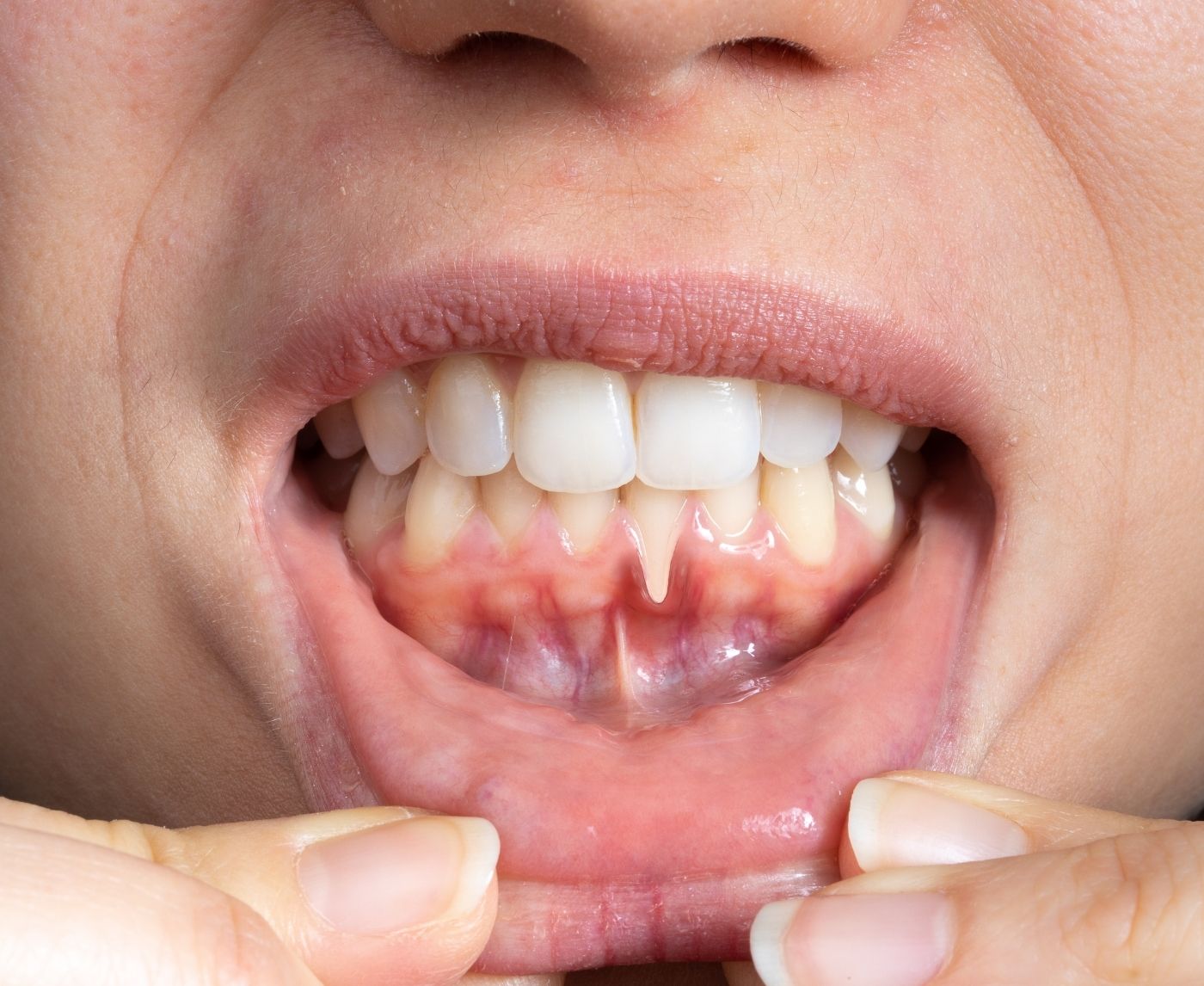
The hallmark of primary syphilis is the chancre: a single, round or oval, firm ulcer with a clean base and a raised, rolled border. It typically measures 0.5 to 2 cm across and is described in clinical literature as indurated, meaning the rim feels firm and rubbery to the touch, almost cartilaginous. The base is flat and may look grayish, yellowish, or red. The incubation window runs 10 to 90 days after exposure, with about three weeks as the typical onset (Mayo Clinic, Syphilis). The CDC describes that primary sore as firm, round, and painless, and notes it usually lasts 3 to 6 weeks before healing on its own (CDC, Syphilis).
The chancre is usually painless. That is the trait that fools people. A canker sore stings when salt or citrus touches it. A herpes vesicle burns and tingles before it appears. A syphilis chancre often produces no sensation at all, which is why a person can carry one on their tonsil for two weeks without seeing a doctor. There may be mild swelling of the local lymph nodes (under the jaw, behind the ear, or along the neck), and the gland often feels firm and rubbery rather than tender.
Common locations and what is usually mistaken for what:
- Lip (vermillion border): firm round ulcer often mistaken for a chapped patch or healing cold sore.
- Tongue (dorsal surface or underside): painless rough patch or shallow ulcer often blamed on spicy food or biting the tongue.
- Gums or hard palate: a red sore or white patch frequently chalked up to gingivitis or aggressive flossing.
- Tonsils or posterior pharynx: one-sided sore throat, sometimes a single ulcer on a tonsillar pillar, frequently misdiagnosed as strep or mononucleosis.
- Inside cheek: firm flat lesion that gets attributed to an accidental bite.
Once the chancre heals (3 to 6 weeks, untreated), the infection enters its secondary stage. This is when the body-wide signs appear: a coppery rash that often involves the palms and soles, mucous patches inside the mouth and on the tongue (grayish-white slightly raised plaques), patchy hair loss, swollen lymph nodes, fatigue, and low-grade fever (CDC, Syphilis). These signs are nonspecific. People often blame allergies, viral illness, or stress, and the original mouth sore is forgotten. If left untreated past secondary, the infection can go latent for years and, rarely, reach a tertiary stage that damages the heart, brain, and nervous system. Treatment at any point before tertiary disease prevents those complications.
How the chancre compares to other mouth sores
Most mouth sores are not syphilis. The single most useful sorting question is whether the sore hurts. A chancre is painless and firm; almost every common look-alike stings, burns, or aches. A canker sore (aphthous ulcer) has a white-yellow center ringed by a bright red halo and is sharply painful, especially with acidic food. A cold sore from HSV-1 begins with a tingle, then erupts as a cluster of small blisters that crust over. Oral thrush appears as creamy white patches that wipe off and leave raw tissue underneath. A bite or burn leaves a ragged, tender ulcer that clears in a few days. The table below compares the features that separate them.
| Condition | Pain level | Typical look | Where it sits | Heals without treatment |
|---|---|---|---|---|
| Oral syphilis chancre | None | Smooth round ulcer, gray or yellow base, raised firm rim | Lip, tongue, tonsil, palate, gums | Yes, in 3 to 6 weeks, but the infection persists |
| Canker sore (aphthous ulcer) | Often sharp, worse with food | Small white-yellow center with a bright red halo | Inside cheek, soft palate, under tongue | Yes, in 1 to 2 weeks |
| Cold sore (HSV-1) | Tingling, burning, then painful | Cluster of fluid-filled blisters that scab over | Outside lip at the vermillion border | Yes, in 7 to 10 days, but HSV-1 stays for life |
| Oral thrush (Candida) | Mild discomfort, altered taste | Creamy white patches that wipe off, leaving red tissue | Tongue, inside cheek, palate | No, it needs antifungal medicine |
| Trauma ulcer | Painful when irritated | Irregular, ragged edges | Where you bit a cheek or burned the tongue | Yes, in 3 to 7 days |
When it shows up as a sore throat
One of the most under-recognized presentations of primary oral syphilis is a one-sided sore throat that does not respond to antibiotics for strep. The CDC explicitly lists the throat as a possible site of syphilis infection from oral sex (CDC), and case reports describe single chancres on a tonsillar pillar that look indistinguishable from tonsillitis on first exam.
What tends to differ from a viral or bacterial sore throat:
- Pain is often localized to one side rather than diffuse across both tonsils.
- There is usually no fever, or only a low-grade one, even when the throat looks dramatically inflamed.
- An ulcer or a gray-white patch may be visible on a single tonsil or the back of the throat. The patch does not scrape off the way oral thrush does.
- Symptoms do not improve on amoxicillin or azithromycin prescribed for strep.
- There may be a swollen lymph node on the same side of the neck.
If a sore throat has lingered past 10 to 14 days, did not respond to a course of antibiotics, and the past three months included unprotected oral sex, syphilis belongs on the differential. So does pharyngeal gonorrhea, which we do not sell a home test for. A clinic visit for a throat swab and a blood draw is the right step. Our home blood test for syphilis is useful as a parallel screen, alongside the clinic-collected swab.
| Feature | Strep throat | Viral pharyngitis | Oral syphilis (throat) |
|---|---|---|---|
| Onset | Sudden | Gradual | Gradual, persistent |
| Fever | Often present, 38.5C+ | Low-grade or none | Usually none or low-grade |
| Pain location | Both tonsils | Diffuse | Often one-sided |
| Visible lesion | Pus on both tonsils | Redness, no ulcer | Single ulcer or gray-white patch on one tonsil |
| Lymph nodes | Swollen, both sides | Mild swelling | Often swollen on the affected side |
| Antibiotic response | Improves in 2 to 3 days on amoxicillin | No response (viral) | No response to standard strep antibiotics |
How oral sex moves the infection
The bacterium needs direct contact with a chancre, a mucous patch, or another active lesion. It does not survive on objects, glasses, or toilet seats. The spirochete passes through the mucous membrane at the contact site, multiplies in the regional lymph nodes, and within hours has entered the bloodstream. The chancre that develops at the entry point is the body's local reaction; the systemic infection is already underway by the time the lesion is visible.
The routes that transmit it:
- Mouth-to-genital and genital-to-mouth contact during oral sex. This is the dominant route for oral lesions.
- Direct kissing of a person with a chancre or mucous patch on the lip, tongue, or inside the mouth. Less common than genital-oral contact, but documented.
- Anal-oral contact with a perianal chancre.
- Genital-to-genital contact (the more familiar route, included here for completeness).
- Shared un-sanitized sex toys after contact with an active lesion.
Condoms reduce syphilis transmission risk, but they only protect the skin they cover. A chancre at the base of the penis, on the scrotum, or on the vulva is not contained by a condom. Dental dams during oral-vaginal or oral-anal contact lower risk for the giver, but few people use them. Syphilis spreads efficiently in a population that thinks oral sex is automatically safe.
A person with a primary chancre is highly contagious for the entire 3 to 6 weeks the sore is present, and they often do not know it is there. Partners frequently both test reactive when one is diagnosed for this reason.
Condoms reduce the chance of transmission, but they only protect the skin they cover. A chancre on the scrotum, the base of the penis, the vulva, or the perianal area sits outside the covered zone. Skin-to-skin contact in those regions during sex can transmit the infection even when a condom is used correctly. Dental dams during oral-vaginal or oral-anal contact close part of that gap, but they are rarely used in practice.
Why "painless" is the most misleading thing about it
Pain is the body's most reliable signal that something needs attention. Syphilis short-circuits that signal. The chancre is painless because Treponema pallidum does not trigger the inflammatory cascade that normally produces nerve sensitization around an injury. The lesion looks angry, but it feels neutral. The mismatch explains why syphilis has been called "the great imitator" for over a century, and it is the practical reason people wait too long before testing. The disease is also far from rare: the World Health Organization estimates about 8 million adults aged 15 to 49 acquired syphilis worldwide in 2022 (WHO, Syphilis), and U.S. cases have climbed for more than a decade.
Clinicians document a small set of repeating misdiagnosis patterns that come from exactly this trap. A non-healing ulcer on the cheek or palate gets attributed to mechanical trauma and treated with a topical rinse; the ulcer eventually disappears on its own; months later a body-wide rash and swollen lymph nodes bring the patient back, and a serology test reveals secondary syphilis. A lip chancre at the vermillion border gets treated as a recurrent HSV-1 outbreak even though the chancre never vesiculates and never produces the tingling prodrome that herpes does. A secondary-stage mucous patch on the tongue gets called oral thrush, and a failed antifungal course is the only clue that something else was going on. A partner is diagnosed first; the other partner has had no symptoms but tests reactive on serology because antibodies have already developed from a prior unnoticed primary infection.
The reasonable response to any of these patterns is a blood test rather than a watch-and-wait. The cost of a false alarm is one fingerstick. The cost of a missed diagnosis can be a body-wide secondary infection, or years later, neurological involvement. Catching syphilis at any stage before tertiary disease prevents the long-term complications entirely, which is the strongest argument for screening even an asymptomatic suspicion.
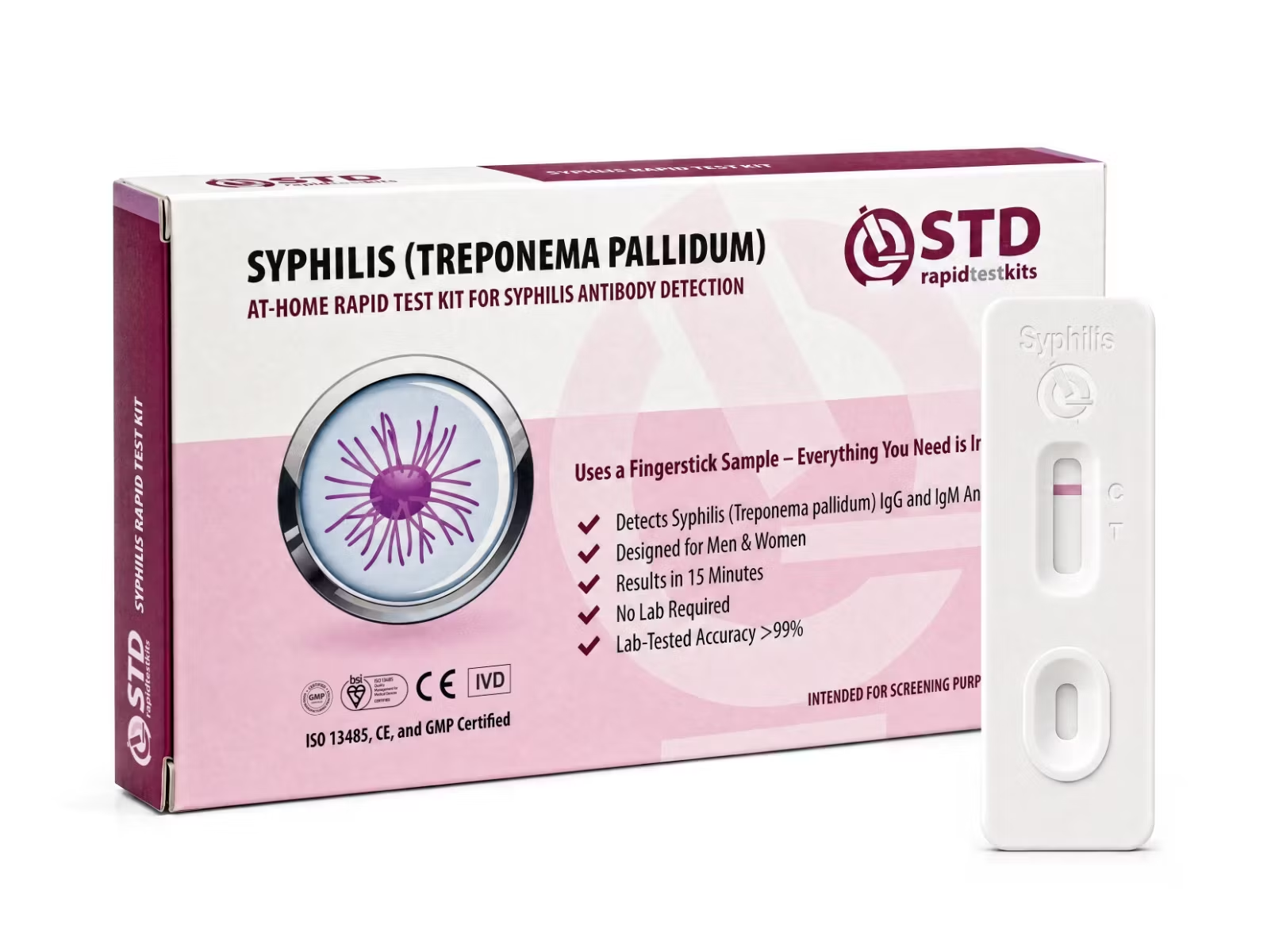
This article is published by stdrapidtestkits.com, which sells at-home rapid testing kits including a fingerstick blood antibody test for syphilis. We recommend the test because a syphilis blood antibody screen detects systemic seroconversion regardless of where the lesion is, which is exactly the question someone with a suspicious mouth or throat sore needs answered. We do not sell a swab test for an oral lesion itself; that needs a clinic.
How to test for oral syphilis at home
The single most useful thing to know about syphilis testing is that you do not need to swab the lesion to get a diagnosis. Syphilis is a systemic infection. Once the bacterium enters the body, the immune system makes antibodies that circulate in the blood. A blood test detects those antibodies whether the chancre is on a tonsil, a tongue, or a genital surface. This is different from oral gonorrhea and oral chlamydia, which stay localized in throat tissue and genuinely do require a throat swab, something a clinic provides and we do not sell.
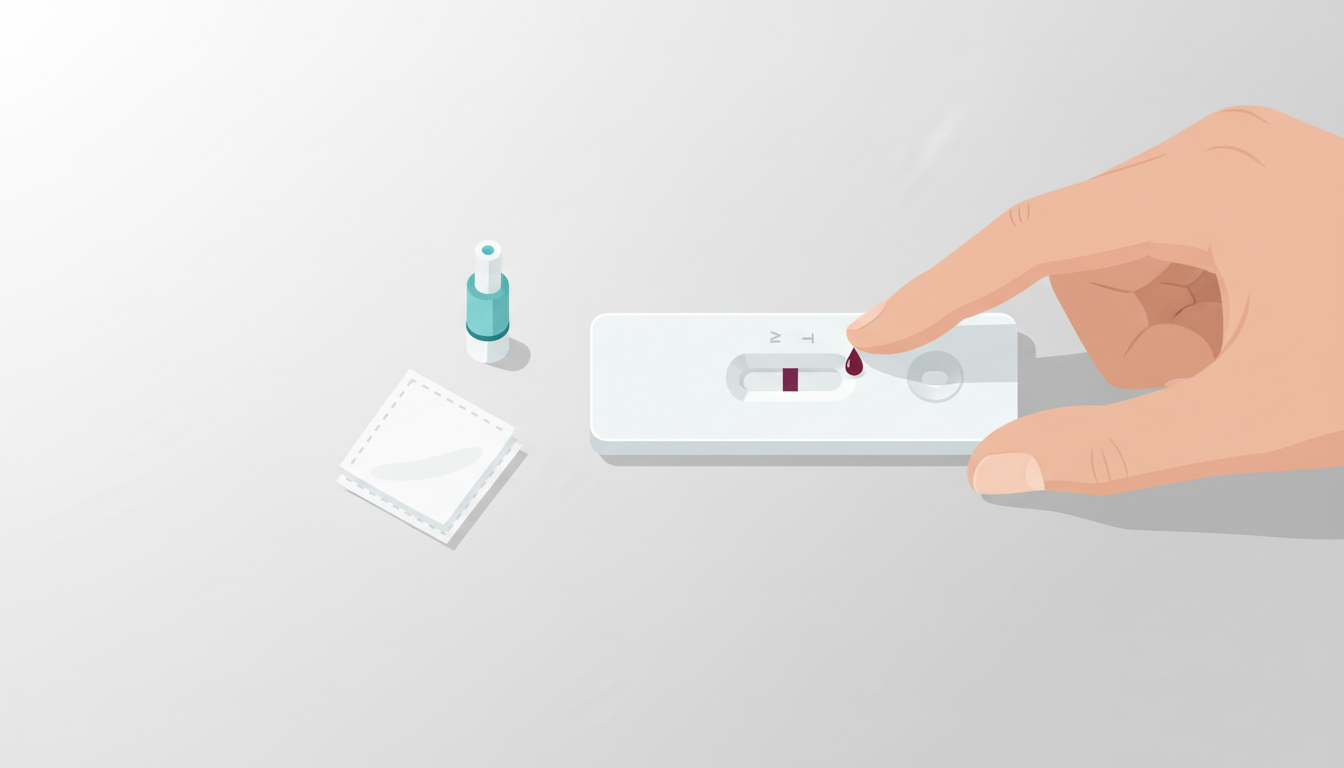
An at-home rapid syphilis test works on exactly that mechanism: a fingerstick lateral-flow assay detecting antibodies against Treponema pallidum. A reactive result is a strong signal to seek confirmatory testing and treatment. A non-reactive result during the window period (the first 3 to 6 weeks after exposure) does not rule the infection out; you need to retest after the window closes. Standard antibody-window practice is to repeat at 6 weeks and again at 12 weeks if exposure was recent and the first test was non-reactive.
Lab testing is more sensitive than any home rapid test, especially for early infection. Lab workups typically include both a treponemal test (specific for syphilis antibodies, stays positive for life) and a non-treponemal test like RPR or VDRL (reflects current activity, used to track treatment response). For a newly active oral lesion, a clinician may also use darkfield microscopy or PCR on a lesion swab. Our home blood test is a screening tool, and confirmatory lab work is the next step after a reactive result.
Test types and the windows they cover
The table below lays out what each common syphilis test detects and roughly when it becomes reliable. The windows are typical ranges; individual seroconversion timing varies.
| Test type | What it detects | Typical window | Where it fits |
|---|---|---|---|
| Rapid treponemal antibody (fingerstick, at-home or clinic) | Antibodies to Treponema pallidum | About 3 to 6 weeks after exposure | Initial screen; convenient and private at home |
| RPR or VDRL (lab non-treponemal) | Antibodies to lipoidal material released by damaged cells | About 3 to 6 weeks after exposure | Confirming active infection; quantitative titer used to track treatment response |
| FTA-ABS or TP-PA (lab treponemal) | Specific antibodies to T. pallidum | About 3 to 6 weeks | Confirming a positive RPR; stays positive for life |
| Darkfield microscopy / PCR on lesion swab | Bacterium itself or its DNA | Available immediately if a lesion is present | Direct identification when a chancre is visible; clinic-only |
If your test comes back reactive
First, take a breath. Syphilis is one of the most treatable bacterial STIs. The CDC's STI Treatment Guidelines name penicillin G as the preferred drug for every stage of the infection, with stage-specific dosing protocols (CDC STI Treatment Guidelines, Syphilis). Primary, secondary, or early-latent syphilis is typically cured by a single intramuscular injection of long-acting benzathine penicillin G at the dose specified by CDC stage-based protocols, given at a clinic. Late-latent or tertiary disease requires three weekly doses. People with a documented penicillin allergy may be desensitized (the only option during pregnancy, since penicillin is the only treatment proven to prevent vertical transmission to the fetus) or, depending on the stage, treated with doxycycline under clinical supervision.
A reactive at-home rapid test is a screen, and the next step is a confirmatory blood draw at a clinic or a sexual health service, which usually pairs a treponemal test with a non-treponemal RPR titer. The titer is the number that tracks treatment success: clinicians follow it down at 6 and 12 months after treatment, and a fourfold drop or greater confirms an adequate response in early syphilis. Treponemal antibody tests stay positive for life and are not used to assess cure.
Recent partners need notification. The CDC partner-services protocol uses stage-based look-back windows: contacts from approximately the past three months plus the duration of symptoms for primary syphilis, about six months plus the duration of symptoms for secondary, and roughly twelve months for early-latent infection. Most local health departments offer anonymous notification services if telling someone directly feels impossible, so the conversation does not have to come from you.
A couple of practical points often get missed in the rush after a reactive screen. You remain contagious in the early days of treatment, so avoid sex (including oral) until the lesion has healed and your provider tells you the titer has dropped. And an exposure that put syphilis on the table often put other STIs there too. Many clinicians who diagnose primary syphilis run a broader STI panel at the same visit because co-infection (gonorrhea, chlamydia, HIV, hepatitis B, hepatitis C) is common from the same encounter. If you tested at home and the result was reactive, ask the confirmatory clinic to run the wider panel. If you tested at home and the result was non-reactive but you want broader coverage from the same exposure, the option below covers six common infections in a single test session.
The chancre disappearing on its own does not mean the infection is gone. Untreated syphilis progresses through latent and tertiary stages over years, with potential damage to the heart, brain, and nervous system. Tertiary syphilis is rare in the antibiotic era because most people get caught earlier, but the cases that do reach it are almost always cases that were never tested.
When it is safe to have sex again
The lesion needs to be fully healed before you resume any sexual contact, including oral, and your provider should confirm that treatment worked before you consider the infection cleared. The NHS advises avoiding all sexual contact until treatment is finished and a follow-up confirms the infection has cleared (NHS, Syphilis). For primary or secondary syphilis treated with a single penicillin dose, that typically means waiting at least 7 to 10 days after the injection and ideally until the follow-up RPR titer has begun to fall. Latent infections require longer.
Condoms reduce but do not eliminate transmission risk for syphilis because chancres can sit outside the area a condom covers. The most reliable post-treatment protection is full sexual rest until you are medically cleared, then routine retesting at 3, 6, and 12 months as your provider directs. Reinfection is possible: clearing syphilis once does not give immunity.
Several STIs (i.e., syphilis, gonorrhea, and intestinal infections) that are transmitted by oral sex can spread in the body. Therefore, infections acquired in the throat may lead to the same health problems as infections acquired in the genitals or rectum.
Talking about oral STDs without shame
Oral STIs carry a particular kind of stigma because mouths feel personal in a way that other anatomy somehow does not. Add the cultural assumption that oral sex is automatically safe, and a lot of people delay testing for symptoms they would not ignore anywhere else on their body. The delay drives community transmission.
A useful framing for the conversation, with a partner or a clinician: a sore that has been in your mouth for more than two weeks deserves the same workup as a sore on any other body surface. Asking your provider for an STI panel that includes a syphilis blood test is a normal request and one most clinicians honor without question. If you would prefer to start with a private screen at home, that is what an at-home rapid test is for.
For a partner conversation, simple is usually best: "I picked up a positive on a syphilis screen and I am getting treated. It is curable. I wanted to tell you so you can test too." That sentence has been said many times. It is not the worst thing anyone has heard.
With a partner: "I am getting tested for syphilis after a recent exposure. Wanted to give you a heads up so you can decide whether to test too."
With a clinician: "I had unprotected oral sex about [X weeks] ago and have a sore that has not healed. Can we include a syphilis blood test in the workup?"
If you would rather not say it out loud first: many local health departments offer anonymous partner notification services that contact recent partners on your behalf without naming you.
Your next step
Timing matters because the test looks for antibodies, and antibodies take a few weeks to build. If you have a painless mouth ulcer that has lasted more than two weeks, or a partner who tested positive, a fingerstick test taken about three weeks after the suspected exposure is a reasonable first step, and it becomes more reliable by six weeks. A non-reactive result during that early window does not rule the infection out; repeat at six weeks and again at twelve. Some situations call for a clinic rather than a home kit, so use the quick check below.
Should you test at home, or see a clinic now?
Are you pregnant, or do you have a body-wide rash, vision changes, or a severe headache?
Yes: See a clinician in person now rather than waiting for a home result. Untreated syphilis in pregnancy can pass to the baby, and eye or neurological symptoms need urgent in-person evaluation.
Has it been at least 3 weeks since the possible exposure?
Yes: A fingerstick antibody test is worth taking now, and it becomes more reliable by 6 weeks. A reactive result is your trigger to call a clinic to confirm and treat.
No: It may be too early for antibodies to show. You can still test, but plan to repeat at 6 weeks and again at 12 weeks if the first result is non-reactive.
Guidance only. A healthcare provider can advise based on your specific situation.
Frequently asked questions
- Can you actually catch syphilis from kissing?
- Yes, but it requires direct contact with an active syphilitic lesion on the lip or inside the mouth. Casual closed-mouth kissing of someone without a visible chancre is very low risk. Open-mouth or deep kissing of someone with a primary chancre on the lip, tongue, or inside the cheek can transmit. The catch is that chancres are usually painless, so neither person may know one is there.
- How soon would oral syphilis symptoms show up after exposure?
- The chancre typically appears 10 to 90 days after exposure, with about 3 weeks being the average. Some people never notice the primary lesion at all and only seek care once secondary-stage symptoms (rash, fatigue, swollen lymph nodes) appear, which is usually 4 to 10 weeks after the chancre would have started.
- Is every mouth sore a sign of an STD?
- No, and most are not. The four features that flag syphilis specifically are: painless, firm to the touch, a single ulcer rather than a cluster, and persistence past 10 to 14 days. Most mouth sores have none of these. Aphthous ulcers (canker sores), oral herpes, and mechanical trauma from biting the inside of your cheek account for the vast majority of mouth sores people see.
- Does syphilis in the mouth hurt?
- Usually no. Treponema pallidum does not trigger the inflammatory cascade that normally sensitizes nerves around an injury, so the chancre produces no pain signal even when visibly ulcerated. A canker sore stings on contact with food. A herpes vesicle burns and tingles. A syphilitic chancre usually does neither, even when it is large and obvious to the eye.
- Can a fingerstick rapid test catch oral syphilis?
- Yes. Syphilis is a systemic infection, so the antibodies it produces circulate in the bloodstream regardless of where the original sore is. A fingerstick rapid antibody test detects those antibodies once seroconversion has occurred, typically 3 to 6 weeks after exposure with reliable detection by 12 weeks. The location of the lesion does not change what the test detects. You do not need a throat swab to screen for syphilis.
- Would a dentist notice oral syphilis during a routine check-up?
- Sometimes. Dentists are trained to identify unusual oral ulcers and lesions, and a clinically alert dentist may flag a suspicious sore and refer you for medical workup. They will not run a syphilis test themselves. If your dentist mentions a sore that does not look right, take it as a prompt to seek testing.
- How do I tell oral herpes apart from oral syphilis?
- Herpes is painful, usually appears as a cluster of small fluid-filled vesicles, and tends to recur in the same spot. Syphilis is usually a single, painless, firm ulcer with a clean base and an indurated rolled border. They can look similar in healing stages, and visual inspection alone is not reliable. A blood test (and a clinician-collected swab if a lesion is present) is the only way to be sure.
- Do syphilis antibodies stay positive forever after treatment?
- The treponemal antibodies (the kind a rapid fingerstick test detects) typically remain positive for life, even after successful treatment. Providers therefore track the non-treponemal RPR titer instead, which falls after effective treatment and is used to monitor cure. A fourfold drop in the RPR titer by 6 to 12 months indicates an adequate treatment response in early syphilis.
- U.S. Centers for Disease Control and Prevention. About STI Risk and Oral Sex. Discusses oral transmission of syphilis and gonorrhea, the throat as an infection site, the finding that 1 in 5 men who have sex with men diagnosed with syphilis reported oral sex as their only exposure, and that throat infections can spread systemically.
- U.S. Centers for Disease Control and Prevention. STI Treatment Guidelines: Syphilis. Names penicillin G as the preferred drug across all stages, and gives stage-based partner-notification look-back windows (primary: 3 months plus duration of symptoms; secondary: 6 months plus symptoms; early latent: 1 year).
- U.S. Centers for Disease Control and Prevention. Syphilis. Describes the primary sore as firm, round, and painless, lasting 3 to 6 weeks, and the secondary-stage rash that can involve the palms and soles plus mouth sores.
- Mayo Clinic. Syphilis: Symptoms and Causes. Incubation period of about three weeks (range 10 to 90 days), primary sores that can appear on the lips or tongue, and self-resolution of the chancre as a common reason primary syphilis is missed.
- NHS. Syphilis. Patient-facing description of symptoms, transmission, treatment, and post-treatment retesting for the U.K. audience.
- World Health Organization. Syphilis fact sheet. Global epidemiology (about 8 million adults aged 15 to 49 acquired syphilis in 2022) and treatment overview.
