
Published: June 2025 | Last updated: May 2026 | Editorial review and quality control: Martina N.
Dating apps haven't created a new public-health crisis on their own. They've accelerated an existing one. Multiple studies now show that people who use dating apps are more likely to report unprotected sex, more sexual partners in the past year, and longer gaps between STI screenings than people who don't. None of this means apps are bad. It means the way most people use them (fast matches, casual encounters, partners you may never see again) removes a few of the friction points that used to slow STI transmission down.
The honest version of this conversation has two parts. First, your individual exposure risk depends on what you actually do, not on which app you opened. Second, the testing tools you have at home in 2026 are vastly more accurate, faster, and less awkward than the screening choices a typical adult had even five years ago. Both parts matter. This guide walks through what the research shows, which infections are climbing fastest, when to test after a new partner, and how to fold screening into a dating life so routinely that it becomes invisible.
How much higher is STI risk if I use dating apps?
People who use dating apps report STI diagnoses at elevated rates compared with non-users in recent peer-reviewed studies, with some surveys finding roughly two to three times the rate. The driver is behavior, not the app: more partners, less consistent condom use, longer gaps between screens. After a new partner from any source, plan a screen at three weeks for chlamydia and gonorrhea, three to six weeks for syphilis, and three months for HIV using a rapid antibody home test. Routine screening every three months is a reasonable baseline for active app users.
Key Takeaways
- Dating app users report STI diagnoses at elevated rates compared with non-users; the gap tracks partner count and condom inconsistency rather than the app itself.
- Wait three weeks before testing for chlamydia and gonorrhea after a new partner, three to six weeks for syphilis, and three months for HIV using a rapid antibody home test. Earlier results can be falsely negative even when an infection is present.
Why Dating Apps Change the STI Math
Three behavioral shifts show up consistently across recent dating-app research, and together they explain the higher STI rates. Partner velocity is the first. App users meet more partners per year, on average, than people who rely on social circles or in-person meetings. More partners means more exposure events, even when the per-encounter risk stays flat.
Information asymmetry is the second. In a traditional dating context, you and a partner share friends, workplaces, or community ties; people you both know vouch (silently or otherwise) for sexual histories. App-mediated dating skips that web. You meet someone whose recent test history, partner count, and risk behavior are entirely opaque unless you ask directly. Most people don't.
Compressed timing is the third. Dating-app encounters tend to shorten the window from match to sex. There's less of a window for either partner to schedule a screening before the encounter, and less reason to talk about screening at all when the connection is short. The result is that app users often come away from an encounter without ever having had a conversation that could have flagged a recent positive test or an untreated infection.
Not every app user lives at the high-risk end of this distribution. A monogamous couple that met on Hinge two years ago carries the same risk profile as any monogamous couple. The signal in the data concentrates among people with multiple new partners and inconsistent barrier use.
Researchers consistently find that the elevated STI rates among app users are explained by what people do, not which platform they use. Two app users with the same partner count and condom-use pattern have similar risk profiles whether one is on Hinge and the other on Grindr.
What the Research Actually Shows
The strongest signal comes from large surveys of sexually active adults that compare app users with non-users on the same set of behaviors. Across these studies, app users consistently report higher partner counts in the past twelve months, lower rates of condom use during casual encounters, and a longer median interval since their last STI screening. Estimates of the elevated diagnosis rate vary by population and study design; some surveys report rates roughly two to three times those of non-users, with smaller and larger effects in different cohorts. When researchers control for age, sexual orientation, and relationship status, app use still independently predicts higher reported STI diagnoses.
The U.S. Centers for Disease Control and Prevention has separately tracked overall STI incidence climbing year on year for most of the past decade (CDC STI surveillance). Combined cases of chlamydia, gonorrhea, and syphilis have crossed 2.5 million reported diagnoses in recent surveillance years, with the steepest rises in syphilis and in congenital syphilis (transmission from a pregnant person to a fetus). The CDC attributes the overall rise to reduced public-health funding, fewer clinic visits during and after the pandemic, and shifts in sexual networks, with dating apps among several contributing factors.
What this means in practice: if you're a casual app user with one or two new partners a year and you use condoms consistently, your individual risk hasn't changed dramatically. If you're someone with multiple recent partners, inconsistent barrier use, and no recent screening, you're squarely inside the population the surveillance data is most worried about.
Don't try to read your individual risk off a CDC bar chart. National surveillance data measures population-level trends. Your personal screening cadence should reflect your own number of new partners, condom use, and time since your last test, not what the headlines say.
The STIs That Show Up Most Often After App-Mediated Encounters
Four infections drive the bulk of new diagnoses linked to casual sexual networks: chlamydia, gonorrhea, syphilis, and HIV. Each has a different transmission profile, a different testing window, and a different reason it can be hard to spot without a screening.
Chlamydia and gonorrhea are the volume drivers. Both are bacterial, both spread through unprotected vaginal, anal, or oral sex, and both can sit in the throat or rectum without causing any symptom for months. The CDC recommends annual screening for sexually active women under 25, and for older women and men with risk factors (CDC STI screening recommendations). Active app users with multiple recent partners fit that profile regardless of age.
Syphilis is rarer but harder to spot. The first stage is a single painless ulcer that often appears somewhere a person doesn't routinely look (inside the vagina, on the cervix, in the mouth). The ulcer heals on its own in three to six weeks, which is why it gets missed. The infection then progresses to a secondary stage with a body rash that's also easy to misattribute, before going latent. Untreated syphilis is one of the few STIs with serious long-term consequences (cardiovascular and neurological damage years later), so screening is non-negotiable for active casual daters.
HIV gets the most fear and the most clinical investment. Modern fourth-generation laboratory tests detect HIV reliably about three weeks after exposure; rapid antibody-only tests need longer windows, up to three months for full reliability (CDC HIV testing). Acute HIV infection can present with a flu-like illness about two to four weeks after exposure, but a substantial fraction of people have no symptoms during seroconversion (the period when the body first begins producing HIV antibodies) and learn their status only through a routine screen.
The table below summarizes what to know.
| Infection | Symptom likelihood | Earliest reliable test window | Routine sample type |
|---|---|---|---|
| Chlamydia | Often asymptomatic, especially in throat and rectum | About 1 to 2 weeks after exposure | Genital swab (or urine in clinic) |
| Gonorrhea | Often asymptomatic in women; symptomatic urethritis common in men | About 1 to 2 weeks after exposure | Genital swab (throat/rectum need clinic swab) |
| Syphilis | Painless ulcer in primary stage, often missed | 3 to 6 weeks after exposure for blood antibody test | Fingerstick blood antibody test |
| HIV | Acute flu-like illness in some, asymptomatic in others | 3 weeks for 4th-gen lab test; up to 3 months for rapid antibody tests | Fingerstick blood (rapid) or venous blood (lab) |
When to Test After a New Partner
The window period is the single most important number in home testing. It's the interval between exposure and the point at which a test can reliably detect an infection, and testing earlier than the window almost always wastes the kit. A negative result inside the window doesn't mean you're not infected; it means the test couldn't see the infection yet.
For chlamydia and gonorrhea, the practical window is about two weeks after exposure for nucleic-acid amplification tests run in a lab, with a small additional buffer for at-home rapid tests that use lateral-flow chemistry. Three weeks is a defensible target for at-home screening after a new partner.
For syphilis, the antibody response takes three to six weeks to develop reliably. A blood antibody test at three weeks may catch most infections; six weeks is more conservative and is closer to standard clinical practice.
For HIV, the answer depends on the test. A modern fourth-generation antigen-antibody test (the kind used in clinics) detects HIV reliably from about three weeks after exposure. Rapid lateral-flow antibody-only home tests typically need longer; the CDC's HIV testing guidance recommends a follow-up test at three months for full reliability after a high-risk exposure. If you've had a high-risk exposure (condomless sex with a partner of unknown HIV status), discuss post-exposure prophylaxis (PEP) with a clinician within 72 hours; PEP can prevent HIV infection from establishing if started promptly.
For hepatitis B and C, the windows are longer (one to three months for hepatitis B antibody response, six weeks to six months for hepatitis C). These aren't usually the first tests someone reaches for after a casual encounter, but they belong in any comprehensive panel for someone with frequent new partners.
Don't take a too-early negative as the final answer. Repeat the test once you've cleared the window for the infection in question. For HIV after a high-risk exposure, the standard guidance is a screen at six weeks plus a confirming screen at three months. The kits linked below are sold by this site.
Special Considerations for LGBTQ+ App Users
The base-rate STI risk is not evenly distributed across populations. Gay, bisexual, and other men who have sex with men (MSM) carry disproportionately high incidence of HIV, syphilis, and pharyngeal gonorrhea, and the CDC's screening recommendations reflect that. The current guideline is at least annual screening for chlamydia, gonorrhea, syphilis, and HIV in sexually active MSM, with three- to six-month intervals for individuals with multiple or anonymous partners.
App-using MSM in particular benefit from including a throat and rectal screen alongside genital screening when sexually active in those routes; pharyngeal and rectal infections are often asymptomatic and require clinic-administered swabs (we sell genital and bloodwork tests at home, not throat or rectal swabs). Pre-exposure prophylaxis (PrEP) is also worth a conversation with a clinician. PrEP is a daily oral medication that substantially reduces HIV acquisition risk when taken consistently, and the CDC recommends offering it to anyone at substantial risk of HIV (CDC HIV resources).
For lesbian and bisexual women, the public-health data is sparser but the screening logic still applies: chlamydia and HPV screening intervals don't change based on partner gender, and any partner with shared genital or oral contact is a potential transmission route.
For trans and non-binary daters, the testing logic follows anatomy more than identity. Use the screening that matches the body parts involved in your sexual contact. The CDC's STI screening guidelines now include specific guidance on trans-affirming care; clinics specializing in trans healthcare can also help.
The CDC recommends chlamydia, gonorrhea, syphilis, and HIV screening at least annually for sexually active MSM, with three- to six-month intervals for individuals with multiple or anonymous partners. Add a clinic-administered throat and rectal screen when relevant to your sexual contact routes.
Building Testing Into Your Dating Routine
Routine screening is the part of sexual health that's easy in principle and hard in practice. The principle is simple: test on a fixed cadence regardless of whether you think you've been exposed, and treat it like a dental cleaning rather than a crisis response. The practice fails because life is busy and there's always a reason to put it off another month.
Anchor testing to an existing rhythm. Pick the first weekend of every quarter, the start of your billing cycle, the date you renew a gym membership, anything you already pay attention to. Schedule the test there and forget about it the rest of the time.
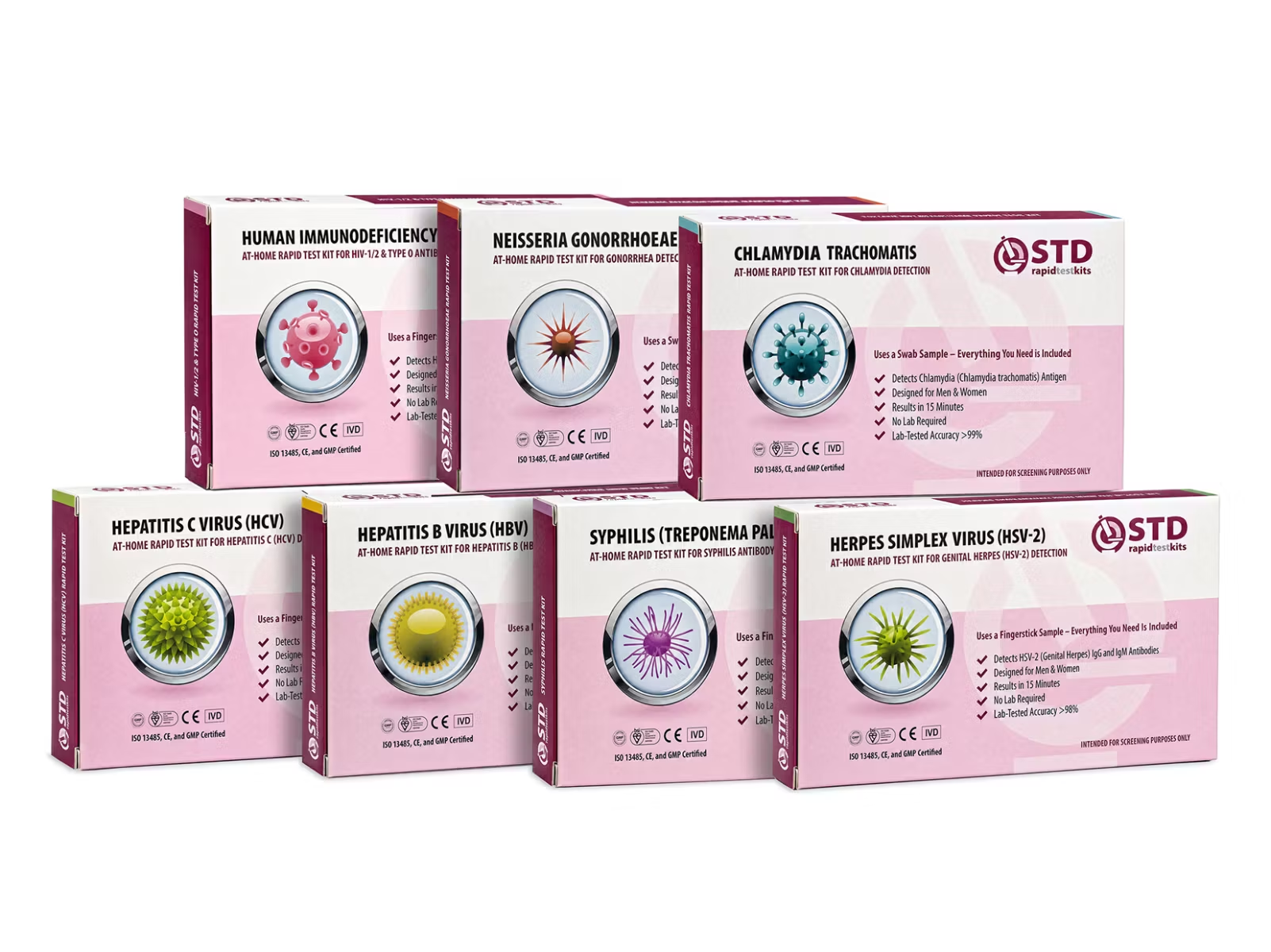
Keep kits in the house. The biggest barrier to home testing is procurement: by the time you've thought about ordering a kit, the moment has passed and another month goes by. A two-pack of swab kits and a multi-infection blood kit in a drawer make screening possible in fifteen minutes any evening, no scheduling required.
Decouple testing from any specific encounter. If you only test after a high-risk event, every test feels emotionally loaded. If you test on a calendar regardless of who you've been with, the act becomes neutral data collection rather than a verdict on someone you slept with last weekend.
When a result comes back positive, follow up with a clinician for confirmation and treatment, and notify recent partners. Most jurisdictions have anonymous partner-notification services through the local health department if you'd rather not handle it yourself. A reasonable cadence for active casual daters is every three months.
Talking About Testing Without Killing the Vibe
The conversation about STI testing is awkward exactly once. After that it's a habit. The phrasing that works best in both app messaging and in person anchors the question in your own routine rather than putting a partner on the defensive about theirs. Something like "Hey, I tested last month and came back negative across the board, what's your latest?" makes the conversation symmetric and removes the implication that you suspect them of something. Pre-empting the conversation before sex is even on the table tends to land softer too. A casual "I'm a regular tester, what's your deal?" inside the first few hundred messages on an app reads as self-disclosure rather than high-stakes interrogation, and it sets the tone for any future encounter.
What doesn't work: assuming a partner is fine because they look fine, because they say they're "clean," or because they tested at some point in the past. Most STIs are asymptomatic, and a six-month-old test result is not the same as a current test result. "Clean" is also a loaded word that implies the alternative is dirty; "negative" is the medically accurate version and the one most public-health communicators now prefer.
If a partner pushes back hard on the question, take that as information about how they handle testing. People who test regularly are usually happy to talk about it.
Many STIs have mild or no symptoms, so you might not know if you have one. Getting tested is the only way to know for sure.
Where Home Testing Helps and Where It Doesn't
Home testing is excellent for routine screening of asymptomatic adults. Lateral-flow rapid tests for the major STIs report specificity in the high 90s when used inside their validated window periods, meaning a positive result is usually a real positive. Sensitivity (the ability to detect a true infection) varies more by infection and by sample quality, which is why a negative result during the window or just after it warrants a confirming test if you remain symptomatic or if exposure was high-risk.
Home testing has real limits. Lateral-flow chemistry is not the same technology as the lab-based nucleic-acid amplification tests (NAAT) that clinics run. Labs detect infections at lower bacterial or viral loads, which matters for early-window cases and for low-grade chronic infections. A positive at-home test is reliable evidence to seek confirmation and treatment from a clinician; a negative at-home test in someone with persistent symptoms, recent high-risk exposure, or multiple partners is best paired with lab confirmation.
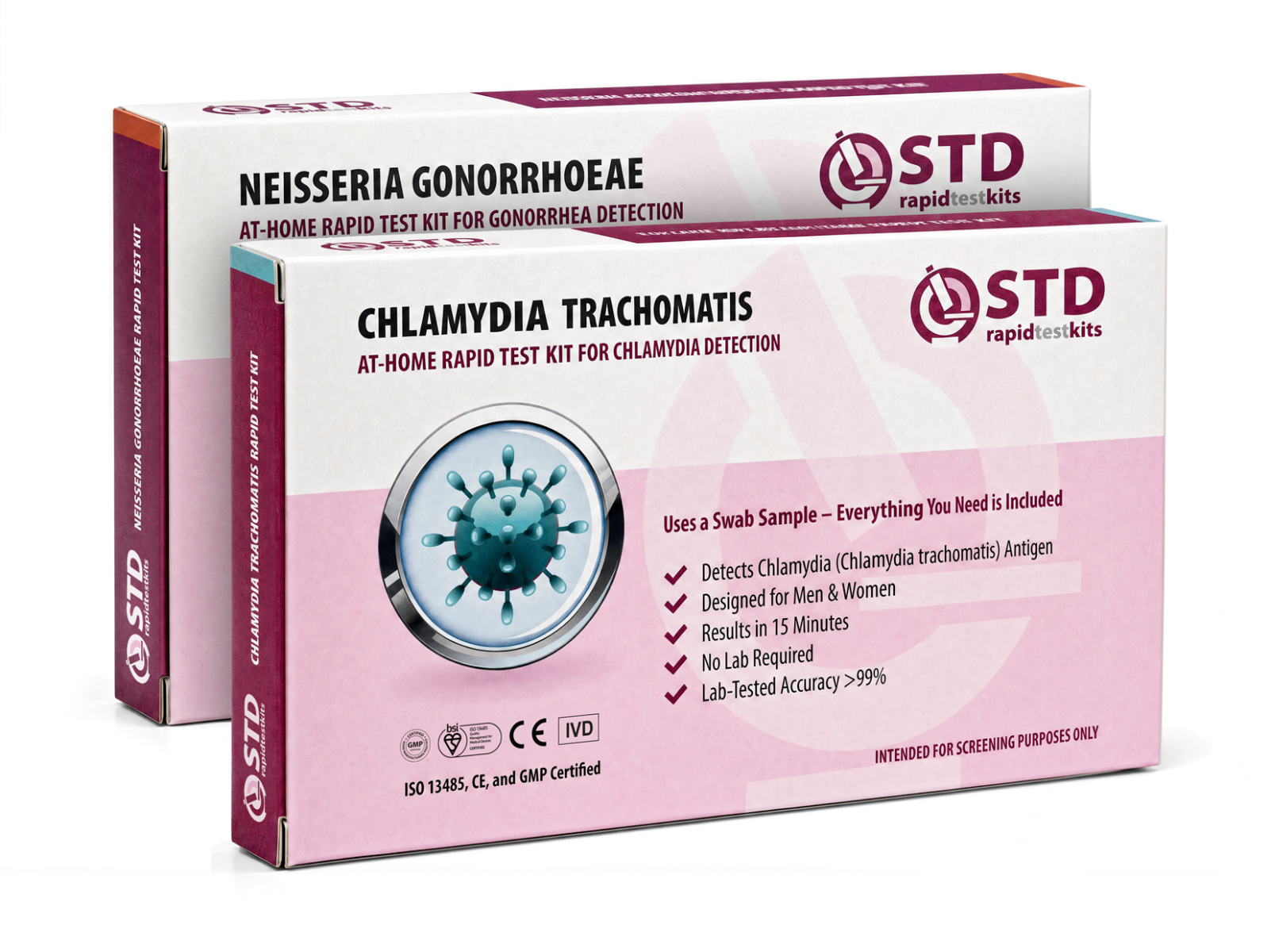
Home testing also doesn't cover every sample type. We sell self-collected vaginal and penile swab tests for chlamydia, gonorrhea, trichomoniasis, and HPV (the trichomoniasis and HPV swabs are validated for vaginal self-swab only; men needing those tests should see a clinic), and fingerstick blood tests for HIV, syphilis, hepatitis B and C, and herpes. We don't sell pharyngeal (throat) or rectal swab tests; those need a clinic visit. If your sexual contact has included throat or rectal exposure, plan a clinic screen for those routes alongside whatever home screening you run.
And home testing isn't a substitute for clinical follow-up after a positive. Every positive at-home test should lead to a clinician visit for confirmatory lab testing, treatment, and partner notification.
An at-home rapid test and a clinic NAAT are complementary, not equivalent. The home rapid kit is fast, private, and reliable for routine screening; the clinic NAAT detects lower bacterial or viral loads and is the standard for confirming a positive result, evaluating persistent symptoms, or working up a high-risk exposure that the home test couldn't yet see.
Common questions about app-related STI risk
- How soon after a new partner should I test?
- Three weeks for chlamydia and gonorrhea using a swab-based home test. Three to six weeks for syphilis using a blood antibody test. Three weeks for HIV with a fourth-generation lab test, or three months for full reliability with a rapid antibody-only home test. Earlier results are not reliable inside those windows.
- Do dating apps actually cause higher STI rates?
- Apps don't cause infections; behaviors do. Apps correlate with higher partner counts and lower condom use in some populations, which is what drives the higher reported diagnosis rates in app users. The same behaviors carry the same risk regardless of how partners meet.
- Is one negative test after a hookup enough?
- Usually yes for chlamydia and gonorrhea if you tested at three weeks or later. For HIV after a high-risk exposure, plan a screen at six weeks and a confirming screen at three months. For syphilis, six weeks is the conservative target.
- Can you get an STI from oral sex?
- Yes. Gonorrhea, chlamydia, syphilis, and HSV-1 transmit readily through oral sex. HIV transmission through oral sex is possible but uncommon, and the per-act risk is much lower than through vaginal or anal sex. Pharyngeal infections are often asymptomatic and need clinic-administered throat swabs to detect.
- How accurate are at-home STI tests?
- Lateral-flow rapid home tests typically report specificity in the high 90s and sensitivity in the mid-to-high 90s when used within their validated window periods. They're reliable for routine screening; positive results should always be confirmed by a clinician for treatment and partner notification.
- How often should I test if I'm actively dating?
- Every three months is a reasonable baseline for adults with multiple recent or new partners. The CDC recommends at least annual chlamydia and gonorrhea screening for sexually active women under 25 and for sexually active men who have sex with men, with shorter intervals for higher-risk profiles.
- What if my partner says they were just tested?
- Ask when, what infections, and what the results were. "Tested" alone doesn't mean what people think it means. A urine test for chlamydia and gonorrhea doesn't cover syphilis or HIV. A test from six months ago doesn't cover anything they've been exposed to since.
- Should I be on PrEP if I'm using dating apps?
- If you're at substantial risk of HIV (condomless sex with partners of unknown HIV status, multiple new partners, recent STI diagnosis), the CDC recommends a conversation with a clinician about pre-exposure prophylaxis. Daily oral PrEP substantially reduces HIV acquisition risk when taken consistently.
The Bottom Line
Dating apps haven't rewritten the rules of STI prevention. They've changed the tempo and the social context in which those rules apply. The work is the same: know your partners, talk about screening before sex, screen on a calendar regardless of perceived risk, and treat positive results promptly. The tools are better than they used to be (rapid home kits work, results in fifteen minutes, no clinic visit needed for routine screening), but the discipline still has to come from you.
If you're an active app user reading this without a recent screen on the books, schedule one this week. Infections caught early are reliably treatable; the ones that go undetected become much harder to address months later.
For a single new partner, a chlamydia and gonorrhea swab covers the two most likely infections. For someone with multiple recent partners or no recent screen, a multi-infection panel covering chlamydia, gonorrhea, syphilis, HIV, and the hepatitises gives a more complete baseline and is what the CDC's annual-screening guidance points active casual daters toward.
- U.S. Centers for Disease Control and Prevention. STI screening recommendations for sexually active adults including age- and risk-based intervals.
- U.S. Centers for Disease Control and Prevention. Sexually transmitted infections root resource and surveillance overview for chlamydia, gonorrhea, and syphilis trends.
- U.S. Centers for Disease Control and Prevention. HIV testing types, test windows, and recommended follow-up after high-risk exposure.
- U.S. Centers for Disease Control and Prevention. HIV prevention resources including PrEP eligibility and effectiveness data.
- World Health Organization. Sexually transmitted infections fact sheet covering global incidence, transmission, and screening.
- U.K. National Health Service. Overview of sexually transmitted infections, testing, and treatment in adult populations.
