
Published: November 2025 | Last updated: May 2026 | Editorial review and quality control: Martina N.
Can I still test positive after finishing antibiotics?
Yes, and it usually is not reinfection or treatment failure. The most common causes are residual bacterial DNA that sensitive lab tests still detect, retesting too soon, or an untreated partner re-exposing you. Antibody tests for herpes, syphilis, and HIV stay positive for life by design. The CDC advises waiting at least four weeks after chlamydia treatment before a test of cure.
Finishing every dose of antibiotics and still seeing a positive result on your follow-up test is one of the most disorienting moments a patient can have. The instinct is to assume the medicine did not work, or that something is wrong with your body, but most of the time neither is true. The usual causes are mechanical: a hyper-sensitive test still picking up dead bacterial DNA, a retest run too early, or an untreated partner re-exposing you. Each scenario has its own answer, and almost all of them resolve with the right timing, a second course of treatment, or a clearer read of which kind of test you are looking at.
Key Takeaways
- A positive result after treatment can be residual DNA, not active infection. CDC guidance is to wait at least four weeks after chlamydia treatment before a NAAT test of cure, then rescreen separately at three months.
- Reinfection from an untreated partner causes most repeat positives, not antibiotic failure. Both people need to finish treatment and clear symptoms before resuming sex.
What a 'still positive' really means
A positive STD test after a completed course of antibiotics tends to trigger one of two assumptions: the antibiotics failed, or you somehow caught the infection again without realizing it. Both are possible. Both are also less common than the boring middle option, which is that the test is doing its job a little too well, the timing of the retest was off, or the test you used measures something that does not turn negative even after a cure.
Five mechanisms explain most repeat positives:
- Residual nucleic acid. Modern molecular tests detect bacterial or parasitic DNA, not living organisms. Dead bacteria leave DNA behind for weeks.
- Retest timing. Sampling too soon after treatment catches that residual DNA. Sampling much later, after new sexual contact, can catch true reinfection.
- Reinfection from an untreated partner. The most common reason a follow-up test stays positive when you have followed every step yourself.
- True treatment failure. Real, but the rarest of the bacterial four. It usually points to a resistant strain, a missed dose, or a site the original regimen could not reach.
- An antibody test that is supposed to stay positive. Herpes IgG, treponemal syphilis tests, and HIV antibody tests all record lifelong immune memory. A positive years after treatment is expected.
Sorting which of these caused your positive starts with three questions: which kind of test did you use, how long ago did you finish treatment, and did your partner finish their own course of treatment in the same window?
Before assuming the worst, answer these: Which kind of test did you use (DNA, antigen, or antibody)? How long ago did you finish treatment? And did your partner finish a full course of their own in the same window? The answers point to the cause far more often than a resistant strain does.
Residual DNA: when 'positive' is not 'active infection'
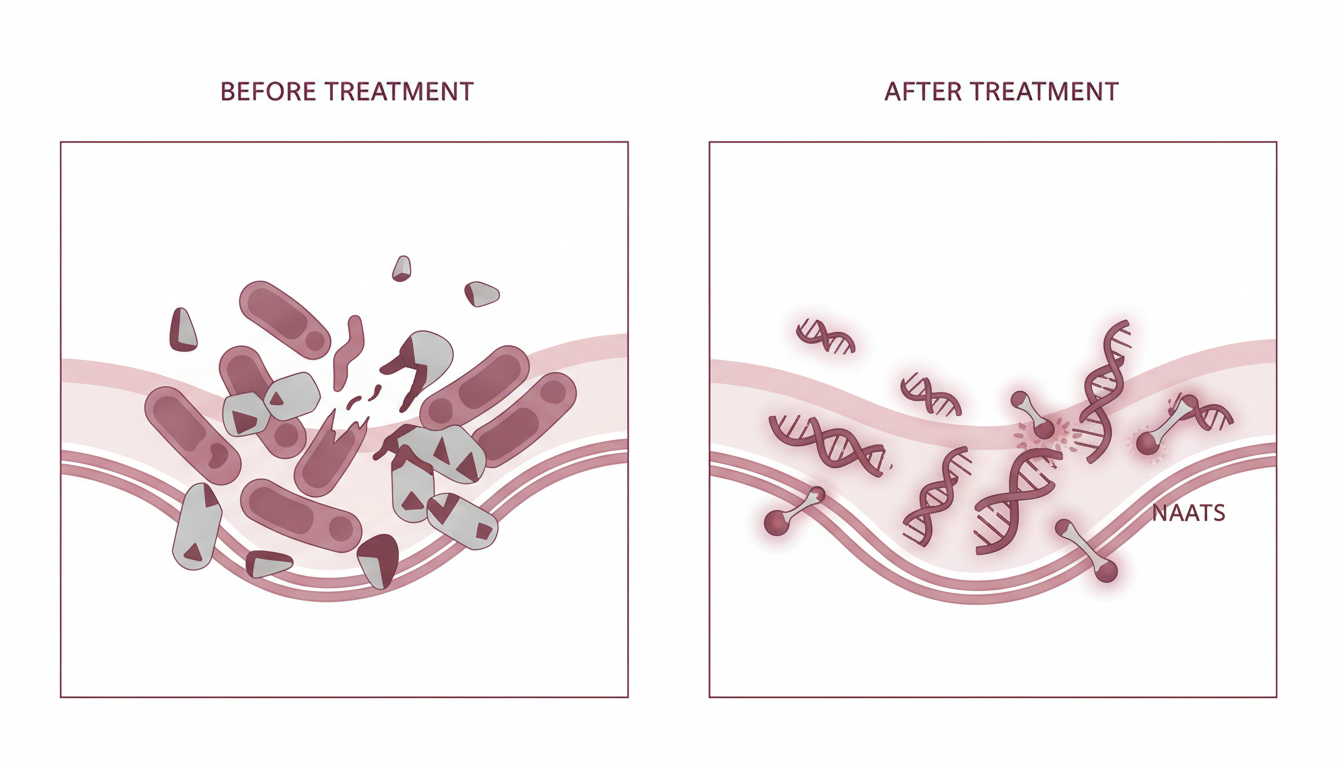
The standard laboratory test for chlamydia, gonorrhea, and trichomoniasis is a nucleic acid amplification test, often shortened to NAAT. NAATs work by amplifying tiny fragments of bacterial or parasitic DNA until there is enough material to detect. They are extraordinarily sensitive, which is what makes them the laboratory standard. It is also what causes the residual-DNA problem after treatment.
Antibiotics kill bacteria. They do not instantly clear the genetic material those bacteria leave behind. Dead nucleic acid lingers in mucosal tissue for weeks while your body breaks it down. A NAAT taken in that window can return positive even though no live infection remains. The CDC's chlamydial infection treatment guidance states that using chlamydial NAATs at less than four weeks after completion of therapy is not recommended, because the continued presence of nonviable organisms can lead to false-positive results.
The clinical literature is consistent on this pattern. A meaningful share of patients still have detectable chlamydial DNA on NAAT for two to three weeks after a successful azithromycin or doxycycline course, despite no viable infection remaining. The test is catching the body's mid-cleanup state, not a treatment failure.
Retest timing windows by infection
The right retest window depends on which infection you were treated for and which kind of test will be used. The table below summarizes CDC-aligned guidance for the infections most often involved in retest confusion. Hitting these windows protects you from two opposite failure modes at once: a residual-DNA false positive on the early end, and a reinfection-driven real positive on the late end. If you plan to use one of our at-home STI test kits for the recheck, the same timing rules apply.
| Infection | Earliest reliable NAAT retest | Three-month rescreen? | Why the window matters |
|---|---|---|---|
| Chlamydia | 4 weeks after treatment | Yes, recommended | Per CDC, NAATs run earlier than four weeks can read positive on residual DNA. |
| Gonorrhea | 1 to 2 weeks (if test of cure ordered) | Yes, recommended | False positives are common in the first 7 days; pharyngeal sites often need a longer window (2 to 3 weeks). |
| Trichomoniasis | 2 to 3 weeks after treatment | Yes (women) | CDC recommends rescreen at 3 months for women given high reinfection rates. |
| Mycoplasma genitalium | 3 to 4 weeks after final regimen | Symptom-driven | Resistance testing may be needed if symptoms persist after treatment. |
| Syphilis | Non-treponemal titer (RPR/VDRL) at 6 and 12 months | Titer trend, not yes/no | Treponemal tests stay positive for life; the non-treponemal titer trend tells you whether treatment worked. |
| Herpes (HSV-1, HSV-2) | Symptom monitoring, not retesting | Not applicable | Antibody (IgG) tests stay positive for life; flare-ups occur without new exposure. |
Untreated partners are the most common cause of repeat positives
If a partner was not treated alongside you, your own treatment success is irrelevant to whether you stay positive. The infection lives in the partner, transmits back during the next sexual contact, and shows up on your retest as if your antibiotics had failed.
Two facts make this scenario unusually common. First, most genital chlamydia and gonorrhea infections are asymptomatic, especially in women and at oropharyngeal or rectal sites. The UK's NHS notes that most people with chlamydia have no symptoms at all, so a partner who feels fine reasonably assumes they do not need treatment. Trichomoniasis is similar: the CDC's trichomoniasis overview reports that about 70 percent of people with the infection have no signs or symptoms. Second, even when partners are willing to test, single-site urine or genital swabs miss extragenital colonization. A partner whose only positive site is the throat or rectum can pass a genital screen and still re-infect orally or anally.
The CDC's solution, recommended in its 2021 STI Treatment Guidelines, is to treat sexual partners of patients diagnosed with chlamydia, gonorrhea, or trichomoniasis presumptively, even without testing first. The same guidance recommends abstaining from sex for seven days after a single-dose treatment, or until both partners have finished a multi-day regimen, whichever applies. Resuming sex during this window is a common reinfection trigger. Condoms lower the odds of passing the infection back and forth in the meantime, though they protect less against skin-contact infections like herpes and syphilis, where sores can sit outside the area a condom covers.
Many U.S. states allow a workaround called expedited partner therapy (EPT), where the diagnosed patient receives a second prescription or pack of medication to deliver to a partner who cannot or will not visit a clinic. EPT is legal for chlamydia and gonorrhea in most states, with rules varying by jurisdiction. Ask your prescriber whether it is available where you live.
Editorial note: stdrapidtestkits.com sells at-home rapid STI test kits. The product callouts in this article link to our own catalog; we recommend each kit based on fit for the topic, not commercial benefit.
Expedited partner therapy lets a patient diagnosed with chlamydia or gonorrhea bring home medication for their sexual partner, so the partner does not need a separate clinic visit. The CDC supports EPT, but state laws vary. The CDC's <a href="https://www.cdc.gov/sti/php/ept-legal-status/index.html" target="_blank" rel="noopener noreferrer">Legal Status of Expedited Partner Therapy</a> page tracks where it is fully permitted, partially permitted, or restricted, with the most recent CDC summary noting EPT is permissible in 48 states plus the District of Columbia.

Drug resistance: real, but rarer than people think
Antibiotic resistance is the cause patients fear most when a positive result comes back, and it is also the cause that gets the most headlines. Both make resistance feel more common than it actually is in everyday cases.
For chlamydia, clinically significant resistance to doxycycline or azithromycin remains uncommon. Most repeat positives in chlamydia patients trace back to retest timing or partner reinfection rather than a resistant strain. Failed absorption (vomiting within an hour of an oral dose, severe diarrhea) and missed doses are far more frequent culprits than resistance.
For trichomoniasis, an apparent treatment failure is more often a dosing issue than true resistance. The CDC's trichomoniasis treatment guidance now recommends a multi-day metronidazole course for women (500 mg twice daily for seven days), because that regimen left about half as many women still positive at a one-month recheck as the older single two-gram dose did. If your first treatment was a single dose, switching to the longer course often clears it.
For gonorrhea, resistance is a serious and growing public health concern. The CDC classifies drug-resistant gonorrhea as an urgent threat, and the World Health Organization has documented multi-drug resistant gonorrhoea strains spreading across several countries. Current first-line treatment in the United States is a single 500 mg intramuscular dose of ceftriaxone, with the dosing increased in recent years in response to declining ceftriaxone susceptibility. Genuine ceftriaxone treatment failure does occur, particularly in pharyngeal infections, but it is rare. The much more common pattern is reinfection after ceftriaxone successfully cleared the original episode.
For syphilis, resistance to penicillin G remains essentially nonexistent; treatment failures usually come from underdosing, an incorrect stage assessment, or a re-exposure during the serologic follow-up window.
A single positive retest is rarely enough to call resistance. Retest timing and the partner's treatment status are the first two things to rule out. If both have been ruled out, that is when a clinician can move on to culture-based susceptibility testing or alternative regimens.
Most apparent treatment failures are not resistance. Common alternatives include vomiting within an hour of an oral antibiotic dose, severe diarrhea reducing absorption, missed or skipped doses, or interactions with antacids and supplements that bind oral antibiotics. Mention any of these to your prescriber before pursuing a culture-and-sensitivity workup.
Mycoplasma genitalium and the resistance you may not know about
Mycoplasma genitalium, often shortened to M. gen or Mgen, is the resistance story most patients have never heard of. It is a sexually transmitted bacterium that causes a meaningful share of urethritis cases in men and cervicitis or pelvic inflammatory disease in women. Many infections are asymptomatic.
Mgen is also the most resistance-prone STI in routine testing. The CDC's Mycoplasma genitalium treatment guidance documents that markers for resistance to azithromycin (a macrolide) range from 44 to 90 percent across the United States, Canada, Western Europe, and Australia, and that resistance to moxifloxacin (a fluoroquinolone) is climbing.
The reason this matters for the wider repeat-positive conversation is that Mgen is frequently misdiagnosed. Its symptoms overlap with non-gonococcal urethritis, with chlamydia, and with pelvic inflammatory disease. A patient treated for chlamydia who continues to have urethral discharge or burning may actually have Mgen that no one tested for. The retest comes back negative for chlamydia (because chlamydia was real and got cured), the symptoms persist, and the patient is left to wonder what is happening.
If you have lingering urethritis or cervicitis symptoms after a completed course of doxycycline or azithromycin, ask whether Mgen testing is appropriate. It is a separate NAAT and is not bundled into most standard panels.
Per CDC guidance, the recommended Mycoplasma genitalium regimen is sequential. Doxycycline first, to lower bacterial load and reduce overall antibiotic burden. Then either azithromycin (if resistance testing shows the strain is macrolide-sensitive) or moxifloxacin (if macrolide-resistant or sensitivity is unknown). Resistance testing is preferred where available, since markers for macrolide resistance range from 44 to 90 percent across comparable populations.
Herpes behaves nothing like a bacterial infection
Antibiotics are irrelevant for herpes, because herpes is a virus and antibiotics only kill bacteria. People who were treated for chlamydia or gonorrhea and later told they have HSV-1 or HSV-2 antibodies sometimes panic when a future antibody test still reads positive. That positive result is expected. It will almost certainly never turn negative.
Herpes simplex virus enters nerve cells, retreats into latency, and stays there for life. As MedlinePlus puts it, there is no cure and the virus stays in the body permanently, though antivirals like valacyclovir suppress outbreaks and reduce transmission risk. The standard herpes blood test detects IgG antibodies, which the immune system makes after exposure and keeps making indefinitely. A positive HSV-2 IgG a year after a single outbreak is expected. It records immune memory, similar to the way the immune system still remembers chickenpox decades after the rash cleared. A dedicated at-home HSV-2 antibody test measures that same lasting immune memory; it does not detect an active lesion.
The pattern clinicians commonly see: someone is diagnosed with genital herpes years ago, has one or two outbreaks early on, then experiences nothing for several years. A period of acute stress (a job loss, a breakup, a poor sleep stretch, an unrelated illness) triggers a flare-up. The person panics, assumes they have been reinfected, and a difficult partner conversation follows. The virus is not new; it was there all along and simply reactivated.
There is also a quirk in herpes IgG testing worth knowing about. The CDC's genital herpes overview confirms that blood tests can identify HSV antibodies. In clinical practice, low-positive index values (roughly between 1.1 and 3.5) carry a meaningful false-positive rate, so a borderline result is typically interpreted alongside the patient's exposure history and symptoms and often confirmed with a Western blot or a second IgG assay before any treatment decision.
Herpes IgG antibodies stay positive for life. A positive result years after a single outbreak is expected, not a sign of active infection. Antivirals like valacyclovir suppress outbreaks and reduce viral shedding, but they do not clear the virus or turn the antibody test negative.
What kind of test you took matters as much as the result
A positive STI test does not mean the same thing across infections. The three test categories you will encounter measure very different things, and 'still positive' carries a different weight depending on which one ran.
Syphilis testing has its own logic worth pulling out, because it confuses people who have been treated. Non-treponemal tests like RPR and VDRL measure non-specific antibodies that gradually fall after a cure, and a fourfold drop in their titer is what confirms treatment worked. Treponemal tests (TP-PA, syphilis IgG immunoassays) detect specific antibodies that typically stay positive for life. A positive treponemal test years after treatment is expected and does not indicate active infection. Your clinician watches the non-treponemal titer trend, not the treponemal result, to judge whether treatment cleared the infection. The CDC's syphilis treatment guidance walks through the expected serologic response after benzathine penicillin G.
| Test type | What it detects | Typically used for |
|---|---|---|
| NAAT / PCR (laboratory) | Genetic material from the organism | Chlamydia, gonorrhea, trichomoniasis, Mycoplasma genitalium |
| Antigen test (rapid lateral-flow) | Proteins from active infection | Chlamydia, gonorrhea, trichomoniasis (home kits); HIV (some rapid kits) |
| Antibody test (IgG / IgM) | Immune response to past or current infection | Herpes (HSV-1, HSV-2), syphilis, HIV, hepatitis |
False positives, false negatives, and missed coinfections
True false positives on a NAAT are uncommon. The dominant reason a NAAT reads positive when no infection is present is the residual-DNA window discussed earlier. Outside of that window, contamination of the sample, lab error, or specimen handling problems can produce a genuinely false positive, but the rate is low enough that confirmation is usually a repeat NAAT rather than dismissal of the original. Rapid at-home antigen tests can likewise read positive if used too soon after treatment, because leftover proteins from killed organisms linger in the sample for a while.
False negatives are a different story and arguably a bigger practical risk. They occur when:
- The sample was collected during the infection's window period before bacterial load was high enough to detect.
- The wrong anatomical site was swabbed (a urine NAAT misses pharyngeal or rectal gonorrhea).
- Self-collection was incomplete or the swab did not contact the right tissue.
- The infection itself was at low shedding density at the moment of collection.
Missed coinfections are the third common scenario. Many people are diagnosed and treated for one STI when in fact they have two. Trichomoniasis often coexists with bacterial vaginosis or with chlamydia. Mgen often coexists with non-gonococcal urethritis from another cause. If symptoms continue after treatment, asking for additional tests is appropriate and clinically warranted.
If chlamydia or gonorrhea was the original diagnosis and symptoms continue after a completed treatment course, ask the clinician about Mycoplasma genitalium testing (a separate NAAT not bundled into most standard panels), trichomoniasis testing if not already done, and bacterial vaginosis or yeast cultures for vaginal symptoms. Coinfection is common enough that a single-pathogen workup can leave the actual cause untested.
Symptoms that linger after the infection is gone
Successful antibiotic treatment kills the pathogen. It does not instantly repair the inflammation that pathogen caused. For some patients, the irritation, discharge, burning, or pelvic pain that came with the original infection lingers for one to four weeks after the bacteria are gone. The clinical names for this pattern are post-infectious urethritis in men and post-treatment cervicitis or vaginal dysbiosis in women.
Antibiotics also disrupt the body's normal flora. After a course of treatment, women in particular may experience a flare of bacterial vaginosis or vulvovaginal candidiasis (yeast infection). Both produce STD-like symptoms (discharge, odor, itching) without any sexually transmitted organism present. A retest for chlamydia or gonorrhea will be negative; a swab for bacterial vaginosis or yeast may be positive.
Two practical implications:
- Persistent symptoms after a negative retest are real, but they are usually not the same infection coming back. Ask about bacterial vaginosis, candidiasis, or post-infectious inflammation as differentials.
- If symptoms persist and the retest is positive, the question becomes one of timing or partner status, not lingering inflammation.
Tracking the symptom timeline helps your clinician interpret what is happening. Worsening symptoms over the days after treatment point toward active infection that needs review.
Most post-treatment irritation fades within a few weeks. Seek care sooner if you develop a fever, pelvic or lower-abdominal pain, painful or swollen testicles, abnormal bleeding, or symptoms that worsen rather than improve. Those can signal pelvic inflammatory disease, epididymitis, or an untreated second infection, all of which carry fertility risk if left unmanaged and deserve prompt evaluation rather than another home retest.
When you have done everything right and the test still won't turn negative
If retest timing was correct, your partner was treated, you abstained from sex through the treatment window, and the test still comes back positive, the differential narrows. Several less-common possibilities are worth raising with a clinician, summarized in the list that follows.
Each of these requires a clinician's evaluation. At-home testing can confirm the persistence of a positive result and help track timing, but the next step (alternative antibiotics, culture testing, infectious-disease referral) belongs in a clinical setting. If your provider is dismissive, asking specifically for culture and sensitivity for gonorrhea, or for a Mycoplasma genitalium resistance NAAT, can move the conversation forward.
Less-common causes of a persistent positive after correct treatment
- True antimicrobial resistance. More likely with gonorrhea or Mycoplasma genitalium than with chlamydia. Confirmed with culture-based susceptibility testing where available.
- Insufficient dose or absorption. Vomiting within an hour of an oral antibiotic, or significant gastrointestinal disease that interferes with absorption, can leave bacterial load high enough to persist.
- An anatomical site missed during the original treatment. Pharyngeal gonorrhea is harder to clear than urogenital gonorrhea and sometimes requires an extended or alternative regimen.
- Co-infection with a different organism. A second STI sharing the same symptoms can mimic ongoing infection from the first.
- Biofilm formation. Some bacteria form protective communities that resist standard antibiotic concentrations. Biofilms are most relevant in chronic urinary tract infection biology, but can come up in stubborn Mgen cases.
Curable vs manageable: a quick map
Whether 'still positive' is a problem to solve or a baseline to expect depends on what kind of infection you are managing. STIs split into two practical categories: those antibiotics can eliminate, and those that become a long-term management situation. The table below summarizes which is which, and what 'still positive' actually signals for each.
| Infection | Curable? | Can it recur or relapse? |
|---|---|---|
| Chlamydia | Yes (antibiotics) | Yes, by reinfection from an untreated partner |
| Gonorrhea | Yes (antibiotics) | Yes, by reinfection; rising drug resistance is a separate concern |
| Trichomoniasis | Yes (antibiotics) | Yes, often via untreated partners or under-dosed treatment |
| Mycoplasma genitalium | Yes (sequential antibiotic regimen) | Yes, particularly when macrolide resistance is present |
| Herpes (HSV-1, HSV-2) | No, but manageable with antivirals | Flare-ups expected; antibodies stay positive for life |
| HIV | No, but suppressible with ART | Not transmitted if viral load stays undetectable (U=U) |
| Syphilis | Yes in early stages (penicillin) | Reinfection possible; treponemal tests stay positive for life |
When and how to retest
For most patients, the right cadence is two checkpoints, not one:
- Test of cure (selective). Four weeks after a chlamydia treatment, two to three weeks after a trichomoniasis treatment, or one to two weeks after a gonorrhea treatment, but only if a clinician specifically asks for it. Routine test of cure is no longer recommended for uncomplicated genital chlamydia or gonorrhea in non-pregnant adults; pregnancy and persistent symptoms are the typical triggers.
- Three-month rescreen. Recommended for everyone treated for chlamydia, gonorrhea, or trichomoniasis. This is not a test of cure. It is a check for reinfection from a partner you did not know was infected.
Home test kits are valid tools for the three-month rescreen and for partner screening. The lateral-flow rapid tests sold for home use are screening assays that use the same swab sample type as lab NAATs; a positive result is worth confirming with a lab NAAT when one is accessible. Either way, a positive home result outside the residual-DNA window is a reason to call a clinician, not a reason to repeat the same kit five times in a row.
Persons treated for chlamydia or gonorrhea should be retested approximately three months after treatment, regardless of whether they believe their sex partners were treated.

Why the shame loop is worth breaking
Testing positive again, especially after believing you were cured, can feel humiliating. People describe crying in the bathroom, feeling like they did something wrong, feeling 'dirty.' That reaction is universal. It is also wrong about the biology. STIs respond to organisms and immune systems; they do not respond to character. A herpes flare-up after a stressful month is the immune system reprioritizing. A chlamydia reinfection after partner contact is microbiology. Getting retested at the recommended interval is the same kind of follow-up care as a blood-pressure recheck after starting a new medication: routine rather than punitive. The shame, isolation, and silence cycle is what makes a recurring or persistent positive feel worse than it actually is.
A flare-up or a reinfection is a biological event to interpret and act on, not a verdict on your character. Routine retesting after treatment is ordinary follow-up care, the same as a blood-pressure recheck after starting a new prescription.
Still positive? Find your most likely scenario
Did you retest sooner than four weeks after finishing treatment (for chlamydia, gonorrhea, or trichomoniasis)?
Yes: Residual bacterial DNA is the most likely cause. Wait until at least the four-week mark, then retest, ideally with no new sexual contact in between.
Was the positive an antibody test for herpes, syphilis (a treponemal test), or HIV?
Yes: A positive is expected and usually needs no action. These tests record lifelong immune memory, not active infection. For syphilis, the clinician follows the non-treponemal titer trend instead.
Has your sexual partner completed a full course of their own treatment, with both of you abstaining until cleared?
Yes: If a positive still persists past the correct window with a treated partner, contact a clinician about culture-and-sensitivity testing for gonorrhea, or a Mycoplasma genitalium resistance NAAT.
No: Reinfection is the most likely cause. Make sure both of you finish treatment and clear symptoms before resuming sex, and ask your prescriber about expedited partner therapy if your partner cannot reach a clinic.
Guidance only. A clinician can advise based on your specific test, timing, and history.
Frequently asked questions
- Why am I still testing positive after I finished my antibiotics?
- Start with three questions: which kind of test did you use, how soon after treatment did you retest, and whether your partner was treated. The answers rule out the most common causes (residual bacterial DNA in a NAAT sample, reinfection from an untreated partner, or an antibody test that is supposed to stay positive for life), and clarify whether genuine treatment failure or antibiotic resistance is worth investigating. Most repeat positives trace back to those first three categories, not to the antibiotics failing.
- How long should I wait before retesting after treatment?
- For chlamydia, the CDC advises waiting at least four weeks after treatment before a NAAT to avoid residual DNA. For gonorrhea, the typical retest-of-cure window is one to two weeks if your clinician orders one. For trichomoniasis, two to three weeks is standard. Separate from any test of cure, CDC recommends a three-month rescreen for chlamydia, gonorrhea, and trichomoniasis to catch reinfection.
- I have not had sex since treatment, so how can I test positive again?
- Almost certainly not reinfection. The most likely explanation is residual bacterial DNA still being detected by a sensitive NAAT, especially if the retest was within four weeks of finishing treatment. If you were tested for an infection with an antibody-based assay (herpes, syphilis treponemal, HIV), the positive can also reflect lifelong immune memory rather than active infection. Less commonly, a sample-handling error or a true treatment failure can produce a persistent positive even without re-exposure.
- My partner says they feel fine. Do they still need to test or be treated?
- Yes. Most genital chlamydia and gonorrhea infections cause no symptoms, especially in women and at throat or rectal sites. About 70 percent of trichomoniasis cases are also asymptomatic per CDC. An asymptomatic partner can still be carrying and transmitting the infection. CDC guidance is to treat partners of diagnosed patients presumptively, even without testing first. Skipping this step is the single most common reason a follow-up test stays positive.
- Will my herpes test ever go negative?
- No. HSV IgG antibody tests measure immune memory, not active viral load, and immune memory is permanent. The test will read positive whether you had one outbreak five years ago or a flare-up last week. Antivirals like valacyclovir reduce outbreak frequency and lower transmission risk, but no treatment clears the virus or reverses the antibody response.
- What is expedited partner therapy and can I use it?
- Expedited partner therapy (EPT) is when your clinician prescribes a second course of medication for you to deliver to a partner who cannot or will not visit a clinic themselves. EPT is legal for chlamydia and gonorrhea in most U.S. states and is supported by the CDC. The CDC's Legal Status of Expedited Partner Therapy page (https://www.cdc.gov/sti/php/ept-legal-status/index.html) tracks where it is fully permitted; ask your prescriber whether it is available where you live.
- Could the bacteria be drug-resistant?
- For gonorrhea and Mycoplasma genitalium, yes, this is a real and rising concern. For chlamydia, true resistance is uncommon and most repeat positives have a different cause. Confirming resistance requires culture-based susceptibility testing, which most home tests and walk-in clinics do not perform. If retest timing and partner status are both ruled out, ask your clinician about a culture-and-sensitivity workup.
- How long should I wait before having sex again after treatment?
- At least seven days after a single-dose treatment, and through the full course for a multi-day regimen. Both partners need to have finished treatment and be free of symptoms first. For herpes, avoid sexual contact during warning (prodromal) symptoms and active outbreaks, when shedding and transmission risk are highest.
- What if my symptoms came back but the retest is negative?
- Persistent symptoms with a negative retest usually point to something other than the original infection. Common causes include post-infectious inflammation (urethritis or cervicitis that takes one to four weeks to resolve), bacterial vaginosis or yeast triggered by the antibiotics, or a missed coinfection (Mycoplasma genitalium, trichomoniasis, or BV often go undiagnosed when chlamydia or gonorrhea is the headline diagnosis). A clinician can swab specifically for these.
- U.S. Centers for Disease Control and Prevention. 2021 Sexually Transmitted Infections Treatment Guidelines, including recommendations on partner therapy and abstention windows.
- U.S. Centers for Disease Control and Prevention. Chlamydial infections treatment guidance, including the recommendation against chlamydial NAAT retesting at less than four weeks after therapy and the three-month rescreen.
- U.S. Centers for Disease Control and Prevention. Trichomoniasis treatment guidance, including the recommended multi-day metronidazole regimen for women (500 mg twice daily for seven days).
- U.S. Centers for Disease Control and Prevention. Syphilis treatment guidance, including the expected serologic response to benzathine penicillin G and the role of non-treponemal titer trends vs. lifelong treponemal positivity.
- U.S. Centers for Disease Control and Prevention. Mycoplasma genitalium treatment recommendations, including the 44 to 90 percent macrolide-resistance marker range and the sequential doxycycline-then-azithromycin-or-moxifloxacin regimen.
- U.S. Centers for Disease Control and Prevention. Drug-resistant Neisseria gonorrhoeae provider information, including the single 500 mg ceftriaxone first-line regimen.
- World Health Organization. Multi-drug resistant gonorrhoea fact sheet, documenting the international spread of resistant strains and implications for first-line therapy.
- UK National Health Service. Chlamydia overview, including that most people with chlamydia have no symptoms and that recent sexual partners need testing.
