
Published: November 2025 | Last updated: May 2026 | Editorial review and quality control: Martina N.
You read the result twice. Positive for chlamydia. Your partner of eighteen months says they have not slept with anyone else. You have not either. So who brought it home?
That is the question that detonates trust in long-term relationships every week. The honest answer almost never matches the one our first instinct reaches for.
Chlamydia rarely announces itself. According to the U.S. Centers for Disease Control and Prevention, most people who have chlamydia have no symptoms. That single fact is what makes a positive test in a stable relationship feel like proof of betrayal, when it usually is not. This guide walks through what the science actually says, how to handle the conversation, and where to test if you want answers fast.
Key Takeaways
- A positive chlamydia test in a long-term relationship is most often the result of an undetected pre-relationship infection, not new infidelity.
- Most carriers feel nothing at all, so routine screening every 6 to 12 months matters more than memory of any past “I tested clean” moment.
The STD That Doesn’t Knock: Why Chlamydia Stays Hidden
The most disorienting part of a chlamydia diagnosis is its quietness. The World Health Organization notes that most people with chlamydia have no symptoms or only mild ones. The bacteria can settle in the cervix, urethra, throat, or rectum, multiply for weeks, and never push a single warning sign to the surface. So a person can carry it through a checkup, a Pap smear, even a routine doctor visit, and still walk out unaware.
This is how an infection ends up in a long-term relationship without anyone cheating. One partner picked it up before the relationship started, the early test either missed it or was never ordered, and the body never raised an alarm. Eighteen months later, an unrelated test catches it. The bacteria did not multiply faster because of bad behavior. It just kept doing what chlamydia does in a body that is not paying attention.
Standard physicals do not detect chlamydia. A nurse cannot see it. A Pap smear cannot find it; that test screens for cervical cell changes, not bacterial infection. Even an STI panel can miss chlamydia if the right molecular test was not requested, or if the patient was tested too early after exposure. The lab tests that find chlamydia best are nucleic acid amplification tests (NAATs), which the CDC describes as the recommended diagnostic method across urogenital, rectal, and pharyngeal sites.
| Scenario | Could Chlamydia Be Missed? | Why It Matters |
|---|---|---|
| Routine physical with no STI panel ordered | Yes | Visual exams cannot see chlamydia |
| Pap smear without a separate NAAT | Yes | Pap smears check for cervical cell changes, not bacterial infection |
| Tested within days of exposure | Yes | The infection may not yet be detectable |
| Symptom-based testing only | Yes | Many infections never produce symptoms at all |
When a Diagnosis Feels Like Betrayal
Imagine the math from inside the relationship. If chlamydia is here, someone brought it home. If it was not me, it must have been you. That logic is intuitive, fast, and almost always wrong about timing.
Chlamydia does not timestamp itself. A positive test confirms presence today; it cannot tell you which week, month, or partner introduced the bacteria. A clinical overview on the U.S. National Library of Medicine’s NCBI Bookshelf describes asymptomatic chlamydia infections that can persist undetected for a long time without producing symptoms or visibly clearing on their own. So when the test result lands today, the actual exposure window stretches back much further than most couples assume.
The emotional fallout often runs faster than the science. The partner who tests positive feels exposed and afraid. The other feels accused. Both dig into versions of the truth they can defend, and both miss what the biology is saying: this could have been here all along, with neither of you tracking it. The honest opening sentence sounds something like, “Neither of us has a reliable way to know when this started, so let’s both get treated and figure out the rest together.”
Most people who have chlamydia have no symptoms. If you do have symptoms, they may not appear until several weeks after you have sex with an infected partner.
The Past-Negative Trap: Why “I Tested Clean” Is Not a Promise
Couples also get stuck on earlier negative tests. “But I tested before we got together.” “We both got tested early on.” These are not lies. They are also not the same as a current clean bill of health.
Chlamydia has a window period. Test too early after exposure and the infection may not yet be detectable, even by a NAAT. The standard practice is to repeat the test about two weeks after a known exposure if the first result was negative, because early-window false negatives are well documented.
Even with perfect timing, a single test only describes that moment. People often stop testing once they enter a committed relationship. They assume monogamy equals safety, which works mathematically only if both partners walked in with confirmed-clean results from properly timed tests, and neither has had any new exposure since. Drop one variable and the math breaks. The honest version of “I tested clean” is, “I tested clean as of this date, this site, this method.”
| Test Timing | Risk of Missed Chlamydia | What to Do |
|---|---|---|
| Tested within 3 days of last exposure | High | Repeat the test about 2 weeks later |
| Tested once before a new relationship, never again | Moderate | Retest if any new exposure or symptom |
| No symptoms, no testing during the relationship | High | Both partners test now, regardless of who feels at risk |
| Routine testing every 6 to 12 months | Low | Continue the schedule; retest sooner if risk changes |
How Chlamydia Hijacks the Conversation
Once the shock fades, most couples land at one of three doors: talk it through, fight it out, or drift into silence. Silence is the most damaging because it hardens whatever each person is privately concluding. The infection becomes a placeholder for unspoken resentment instead of a treatable medical event.
Couples often default to accusation, which puts one person on trial and the other on defense. Couples therapists working with STI diagnoses tend to coach a different opening: an observation followed by an open question. “I am scared and confused. Can we walk through the timeline together?” Same content, different temperature.
The two practical commitments that move couples forward are summarized below. Treating both partners is also what the CDC recommends to prevent reinfection, including through expedited partner therapy where a clinician can prescribe for the partner without an in-person visit in many U.S. states.
1. Skip the timestamp question. No test can prove who had it first, and trying to prove it usually keeps both partners stuck. Accept that as a starting condition.
2. Test and treat together. Both partners get tested and treated regardless of whose result returned positive first. That is the only way to prevent passing the bacteria back and forth.
After the Shock: What Chlamydia Treatment Involves
Chlamydia is curable, and that is the part that makes the rest of this manageable. The CDC’s current first-line treatment for chlamydia in non-pregnant adults is doxycycline 100 mg taken orally twice a day for 7 days. Azithromycin as a single 1 g oral dose is the alternative when doxycycline is not appropriate, including in pregnancy. No surgery. No hospital stay. A short course of pills.
The medical concern is what happens if the infection sits untreated. The World Health Organization confirms that untreated chlamydia in women can lead to pelvic inflammatory disease, infertility, and ectopic pregnancy. In men, untreated infection can lead to epididymitis, an inflammation of the tube at the back of the testicle that can cause pain and, rarely, fertility problems. Catching it early prevents almost all of that.
Both partners need treatment, even if one of them tests negative. Single tests in early window periods are unreliable, and untreated partners simply pass the bacteria back. Some clinicians prescribe through expedited partner therapy precisely to close that loop. If your partner cannot get to a clinic, ask whether your provider can write a prescription for them.
Then comes retesting. The CDC recommends retesting roughly three months after treatment, because reinfection from untreated partners or new exposures is common, not because the antibiotics themselves tend to fail. Treat the three-month retest as a confirmation step, similar to a follow-up blood pressure check after a medication change.

Rebuilding Intimacy After a Chlamydia Scare
The medical part of a chlamydia diagnosis is short. The relational part is rarely so. Sex can feel charged. Touch can feel like a question. One partner withdraws, the other feels rejected, and physical intimacy can quietly become another casualty of the diagnosis if neither person names what is happening.
Sex therapists working with couples after STI events often suggest a phased approach. Start with non-sexual touch with no expectation of where it leads. Have at least one open conversation about what each person is afraid of and what would feel reassuring. Build a new sexual rhythm that includes explicit reassurance. Trust rebuilds through small, repeated signals, and naming that out loud removes the guesswork for both people.
One thing that helps more than couples expect is a shared testing plan. Routine testing every six to twelve months, agreed on out loud and put on a calendar, removes one of the largest sources of background anxiety: the worry that something is silently happening again. The CDC’s screening guidance for sexually active adults supports a similar cadence in many situations, and the U.K. NHS lists comparable advice on its chlamydia overview. Replace “we tested clean once” with “we test on a schedule, like the dentist.” That kind of routine costs almost nothing emotionally and removes most of the suspicion that builds up between checks.
The Emotional Toll of Not Knowing
For many couples, the hardest part is not the antibiotics or even the arguments. It is the uncertainty about who had it first, how long it has been there, and whether trust can fully come back.
This is where resentment grows. Some couples stay together but never quite reconnect. Others split and carry the unresolved confusion into their next relationship. In both cases, the bacteria becomes a stand-in for something larger, a symbol of betrayal, of regret, or of a caution that did not exist before.
The reframe that helps most is small but real. Chlamydia is a medical event, not a moral verdict. It is treatable with one of the most reliable antibiotic regimens in modern medicine. It is also incredibly common; the WHO estimates over 128 million new chlamydia infections worldwide each year in adults aged 15 to 49. Pretending it is rare or shameful does not make handling it any easier.
Couples who navigate this well usually describe a different kind of trust on the other side. It is not the trust of certainty, because certainty was never on the table. It is the trust that comes from knowing your partner showed up, told the truth as best they could, and made medical decisions with you instead of around you.
The World Health Organization estimates over 128 million new chlamydia infections worldwide each year in adults aged 15 to 49. Treating it as a rare or shameful event does not match the math, and it tends to make the conversation harder than it needs to be.
You Can Heal This, Together or Apart
Chlamydia is treatable, common, and frequently silent. Those three facts together are why a positive result rarely tells you what you initially fear it does. Whether the relationship survives is a separate question from whether your health and your partner’s health get cleared up. Get both treated. Schedule the three-month retest. Decide what to do with the relationship from a place of full information instead of from the worst-case story your mind built in the first hour.
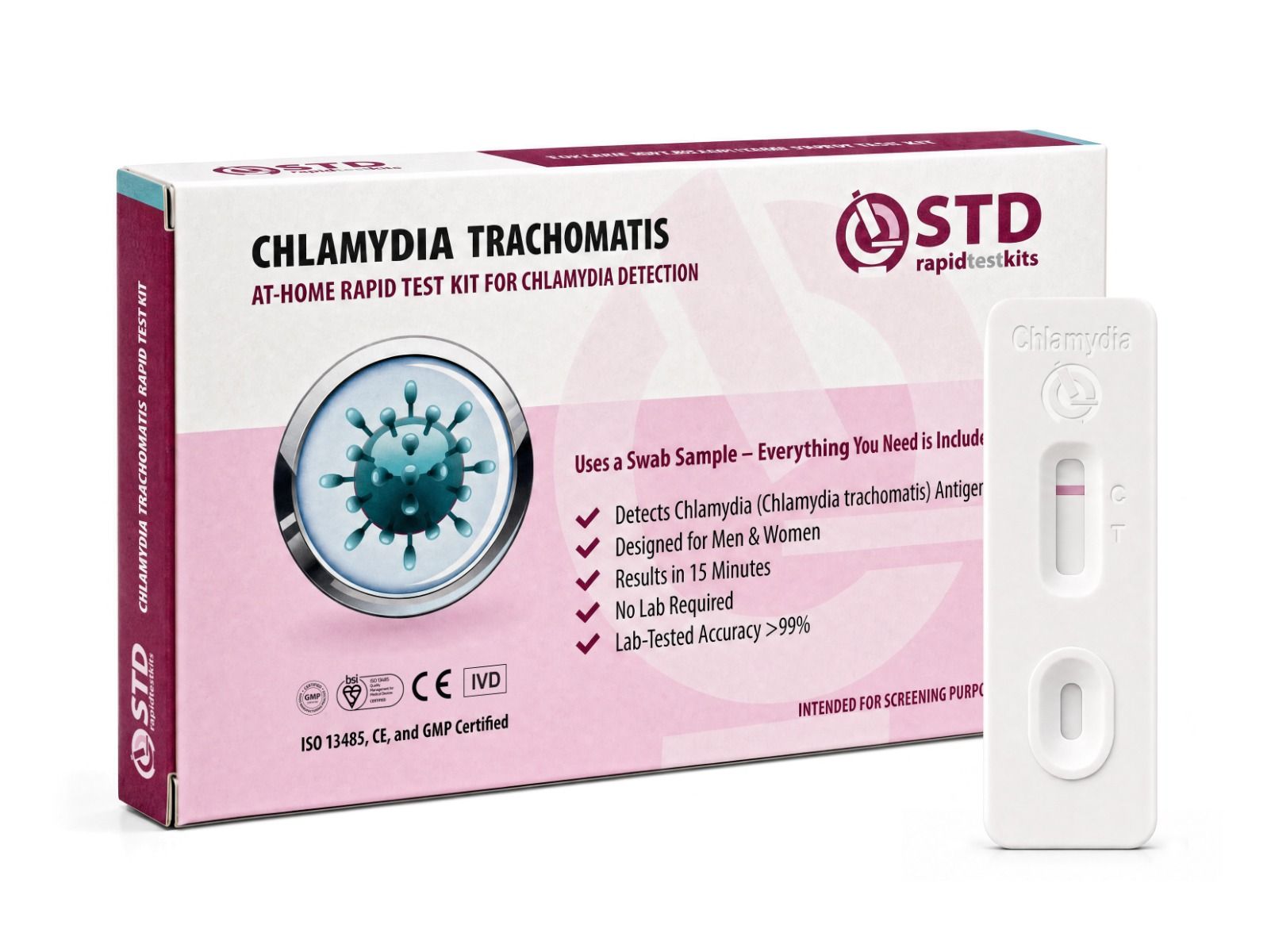
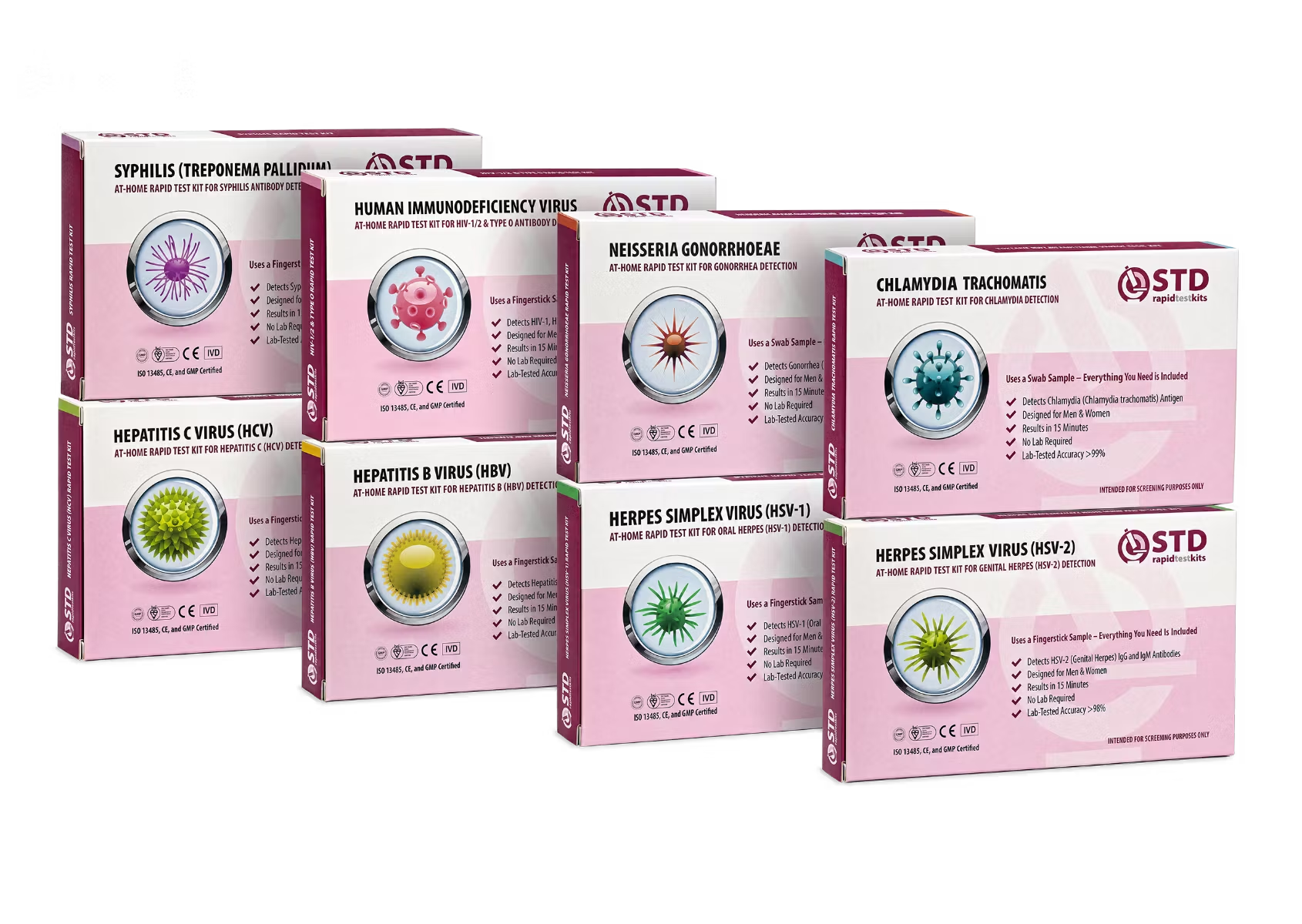
If you and your partner want answers without sitting in a clinic waiting room, an at-home test can give you a starting point in a few days. The multi-STI combo panels we sell are useful for couples who want broader screening at the same time, and a confirmatory clinic NAAT is sensible after any positive home result. The antibiotic course takes a week. The three-month retest is a calendar entry. The harder part is the conversation, but that too is something most couples can get through.
FAQs
- Can someone have chlamydia and feel completely normal?
- Yes, and that is the most common scenario. The CDC and WHO both report that the majority of people with chlamydia notice no symptoms at all. The bacteria can colonize the cervix, urethra, throat, or rectum without producing pain, discharge, or any other warning sign. That is why routine screening matters even when nothing feels off.
- If we both tested negative early in the relationship, how can one of us be positive now?
- A past negative test describes one moment in time. It does not extend forward through the entire relationship. Possible explanations include an early test taken before the infection was detectable, a test that did not cover the right anatomical site (for example, a urine test that missed a throat or rectal infection), or a missed retest after a possible exposure. None of those scenarios require infidelity, although infidelity is also possible. The test alone cannot tell you which.
- Does a positive chlamydia test mean my partner cheated?
- Not necessarily. Chlamydia can lie undetected from before the relationship began, sometimes for many months, and routine physicals or Pap smears do not detect it. Before treating the diagnosis as proof of cheating, talk through testing timelines and exposures from before the relationship started. Confirming who was tested when, with what test, and at which sample site is more useful than asking who is lying.
- How long after exposure does chlamydia show up on a test?
- NAATs, the most sensitive lab tests for chlamydia, can detect infection from about one to two weeks after exposure for most people. Testing earlier than that increases the chance of a false negative. If you tested within a few days of a possible exposure, plan to retest about two weeks later for a more reliable result.
- Can a test miss chlamydia even if you have it?
- It can, especially if the test was taken inside the window period or if the wrong sample site was used. Throat or rectal infections require swabs from those sites; a urine sample alone may miss them. If symptoms appear later, or a partner tests positive after you tested negative, retest using the appropriate sample type.
- What does treatment look like?
- Most non-pregnant adults complete a 7-day course of doxycycline taken twice daily. A single-dose azithromycin alternative exists for cases where doxycycline is not suitable, including pregnancy. Both partners should finish treatment before resuming sex, because untreated partners can pass the bacteria back.
- When is it safe to have sex again after treatment?
- Wait until both partners have completed treatment. For the 7-day doxycycline course, that means waiting at least 7 days after both partners finish the antibiotics, and longer if either of you still has symptoms. The CDC recommends abstaining until then to avoid reinfection.
- Can untreated chlamydia affect fertility?
- Yes. In women, untreated chlamydia can lead to pelvic inflammatory disease, which can cause blocked fallopian tubes, ectopic pregnancy, and infertility. In men, untreated infection can cause epididymitis and chronic discomfort, and may affect fertility in rare cases. Early treatment prevents almost all of these complications, which is why a quick antibiotic course is the most useful response after a positive test.
How We Sourced This Article: We combined current guidance from leading public-health organizations (the U.S. Centers for Disease Control and Prevention, the World Health Organization, and the U.K. National Health Service) with peer-reviewed clinical summaries on the U.S. National Library of Medicine’s NCBI Bookshelf. Editorial framing on relationship and communication patterns draws on widely accepted guidance from couples and sex therapists; it does not constitute clinical advice for any individual situation. For symptoms that concern you, see a licensed provider.
- U.S. Centers for Disease Control and Prevention. About Chlamydia. Asymptomatic infection, transmission, and screening overview.
- U.S. Centers for Disease Control and Prevention. Chlamydial Infections Treatment Guidelines. First-line doxycycline regimen, alternatives, and retesting interval.
- World Health Organization. Chlamydia fact sheet. Global incidence, asymptomatic patterns, and complications including PID and infertility.
- U.S. Centers for Disease Control and Prevention. Expedited Partner Therapy clinical guidance.
- National Center for Biotechnology Information StatPearls. Chlamydia trachomatis natural history and clinical presentation.
- U.K. National Health Service. Chlamydia overview, symptoms, and testing.
