
Published: September 2025 | Last updated: May 2026 | Editorial review and quality control: Martina N.
Is STD stigma still a real barrier to testing in 2026?
Yes, just quieter. Private FDA-cleared at-home rapid tests have removed almost every logistical obstacle, but internalized shame still adds weeks or years of delay before people test. About 13 percent of the roughly 1.2 million people living with HIV in the U.S. do not know their status, per CDC surveillance.
STD shame in 2026 has not disappeared. It has just gotten better at hiding. Same-day chlamydia tests sit on bathroom shelves now, FDA-cleared and unbranded. Telehealth covers what most clinics used to gatekeep. Discreet mailers arrive at apartment doors with no labels and no questions. And yet, for many people, the hardest part of testing is still the pause before ordering one.
That pause is what stigma looks like in 2026. Quieter than it used to be, more internal, harder to name. This article walks through where the shame still lives, what has measurably shifted since the 2010s, why HIV testing in particular still gets delayed for years at a time, and what helps people move through the pause faster. The shorter version is simple: you are not dirty for catching something a body can catch, and testing is a normal piece of self-care, the way checking blood pressure is.
Key Takeaways
- Stigma in 2026 mostly lives inside us. Even with private, FDA-cleared at-home tests widely available, internalized shame still adds weeks or years of delay before people test. About 13 percent of the roughly 1.2 million people living with HIV in the U.S. do not know they have it, per CDC surveillance.
- Testing is information, and information opens up choices. The longer someone waits, the more anxiety fills the gap, usually for a result that turns out to be manageable or fine.
Stigma didn't vanish, it got quieter
If we had truly outgrown STD shame, the testing numbers would tell that story. CDC STI surveillance data tracks chlamydia, gonorrhea, and syphilis diagnoses every year, and the data consistently shows that a meaningful share of those diagnoses happen later than they should. People are not avoiding tests because tests are hard to get. They are avoiding the moment of admitting they need one.
The shame today does not always look like a raised eyebrow at a clinic counter. Sometimes it sounds like a friend casually saying "I'm clean, are you?" Sometimes it lives in a dating bio that reads "disease-free," as if anyone who has ever had a routine infection has been permanently marked. Most of the time, it lives in your own head: in the pause before ordering the kit, the delay before telling a partner, the quiet doubt the morning after a hookup.
Language carries more of the weight than people usually notice. Listen to how people talk about the infections themselves and you can hear where the cultural shame has settled.
We never whisper "I got strep throat." We still whisper "I tested positive for herpes." Both are infections. Only one carries an identity tax.
How shame shows up in 2026
The shame people describe falls into a few recognizable shapes: internal, social, and procedural. Most readers carry at least one. Many carry all three at once, blending into a single hesitation that delays the obvious next step.
The composite names in the stories below are drawn from common patterns surfaced in forum threads and reader interviews, not real interviewees. The themes they capture, though, repeat constantly across the way people talk about testing in their own words.
Dalia, 34, had been in a monogamous relationship for years when she started noticing unusual discharge. She did not want to believe it could be an STD. She felt embarrassed, as if her body had done something wrong by being a body. Even with discreet at-home options sitting open in her browser tab, she let weeks pass before ordering one.
Mikhael, 22, nonbinary and dating through apps, tested positive for chlamydia after a casual encounter. The diagnosis itself was minor. The harder part was the fear of confirming a stereotype they did not want to validate. They waited almost a month, worried that someone in the building lobby might recognize an unmarked mailer for what it was, even though it was blank.
The social-judgment layer also shows up in small, geographically specific ways. Skipping a free screening at a community health event because a neighbor is volunteering at the same table. Avoiding the primary-care doctor because the test will go on a chart a parent might see. Picking the pharmacy in the next town over rather than the one across the street from work. None of these decisions are about science. They are about how visible you feel in your own community.
| Form of Stigma | How It Shows Up in 2026 | Impact on Testing |
|---|---|---|
| Internalized shame | Believing an STD means you are "dirty" or "irresponsible" | Delays or avoids testing entirely |
| Social judgment | Fear of friends, neighbors, or partners finding out | Secrecy around testing; non-disclosure to partners |
| Healthcare discomfort | Negative past experiences with clinics or doctors | Avoids in-person testing even when symptoms are present |
| Geographic visibility | Small town, shared waiting room, clinic near work | Pushes testing onto an indefinite "later" list |
What's actually improved since the 2010s
Real progress is worth naming. At-home STI testing in 2026 is no longer niche, fringe, or unregulated. Most major rapid kits are FDA-cleared, packaging arrives without identifying marks, and telehealth follow-up is standard rather than rare. For people in rural areas, people without insurance, and people whose local clinic feels unsafe to walk into, that shift has been life-changing. It is the single biggest reason testing rates have moved at all in the past decade.
But access is not the same as ease. Per CDC's prevalence and incidence estimates, about 20 percent of the U.S. population, roughly one in five people, had an STI on any given day in 2018. The current burden is enormous, and the population of people who could benefit from earlier testing is correspondingly large. Technology solved the logistics of getting a test into a person's hands. Culture has been slower to catch up on the question of when people feel ready to use it.
These feelings can keep people from getting tested and treated for HIV.
Why herpes, HPV, and HIV still carry more shame
Not every STI gets the same cultural treatment, and the imbalance shapes who tests early and who waits. Chlamydia and gonorrhea now read in mainstream conversation as routine, antibiotic-treatable, mildly embarrassing at worst. Herpes, HPV, and HIV still carry a heavier emotional load that has more to do with cultural baggage than clinical severity.
Herpes is the clearest example. Late-night jokes, dating-app disclaimers, and decades of fear-driven sex education have framed it as a permanent social disqualification rather than a common skin condition that millions of people manage with minimal disruption. CDC estimates 572,000 new genital herpes infections among people aged 14 to 49 in 2018 alone, and many of those infections happen without obvious symptoms, which is part of why the cultural fear outpaces the typical clinical reality. HPV follows a similar pattern: very common, mostly cleared by the immune system on its own, still treated socially as a confession. HIV, despite enormous treatment advances that make it possible to live a normal lifespan and reach undetectable viral loads, still carries enough stigma to delay both testing and treatment, which is exactly what CDC's Let's Stop HIV Together campaign exists to push back on.
Hundreds of thousands of new genital herpes cases happen in the U.S. each year per CDC surveillance, and the majority of people who carry HSV-2 have either no symptoms or symptoms mild enough to mistake for something else. The clinical course for most people is manageable with antivirals. The social cost of the label, in dating, in self-talk, in disclosure conversations, is consistently heavier than the medical course of the infection itself.
The HIV avoidance spiral: feeling fine is not a clean bill of health
HIV deserves its own section because the delay pattern is unusually long. Rafiq, 29, in a composite drawn from common forum threads, thought about getting an HIV test for almost five years before he finally booked one. He was not sick, he had no symptoms he could point to, but after a relationship ended in college, a quiet worry settled in and refused to leave. Every time he came close to testing, he found a reason to wait.
This pattern has a name in public-health writing: the testing avoidance spiral. The most common reasons people give for delaying are predictable and rational on the surface.
- "I feel fine." No fever, no rash, no swollen lymph nodes. The logic concludes nothing is there. HIV's long asymptomatic phase makes this logic look right for years at a time, even when it is wrong.
- "I don't want to know." A positive result feels like a future you cannot unsee. Not testing keeps the future open, even if the cost is constant low-grade anxiety.
- "What if someone sees me?" Clinics in small towns, shared waiting rooms, the receptionist who knows your family. Privacy worries push testing onto the indefinite "later" list.
- "I'll deal with it after this stressful month." The plan exists. The month just never ends.
Each reason is reasonable in isolation. Together they form a feedback loop. The longer you wait, the bigger the unknown becomes, and the harder it gets to walk in cold and ask for a test. About 13 percent of the roughly 1.2 million people living with HIV in the U.S. do not know they have it, per CDC surveillance data.
You do not have to test first to start moving. Free confidential support is available before any kit ships. The CDC-INFO line (1-800-232-4636) answers questions about testing options 24 hours a day in English and Spanish, and <a href="https://www.hiv.gov/hiv-basics/hiv-testing/learn-about-hiv-testing/who-should-get-tested" target="_blank" rel="noopener noreferrer">HIV.gov's testing guidance</a> explains who should get tested and links to free local testing options. Talking to one person, anonymous or not, often loosens the spiral enough to take the next step.
What HIV feels like, or doesn't
One of the strongest drivers of the avoidance spiral is the assumption that you would feel HIV if you had it. The biology does not cooperate with that assumption.
Roughly two to four weeks after exposure, some people experience acute HIV: a flu-like episode with fever, sore throat, swollen lymph nodes, a non-itchy rash on the trunk, and fatigue. It looks exactly like dozens of more common viral illnesses, and it passes on its own in days to a few weeks. The body is making antibodies during this period, and once those appear, the obvious symptoms recede.
Then nothing, for years. NIH's stages of HIV infection overview describes this clinical latency stage as the time when the virus is reproducing at low, stable levels and a person typically has no specific symptoms attributable to HIV. People exercise, work, date, plan trips. The immune system is taking gradual damage in the background.
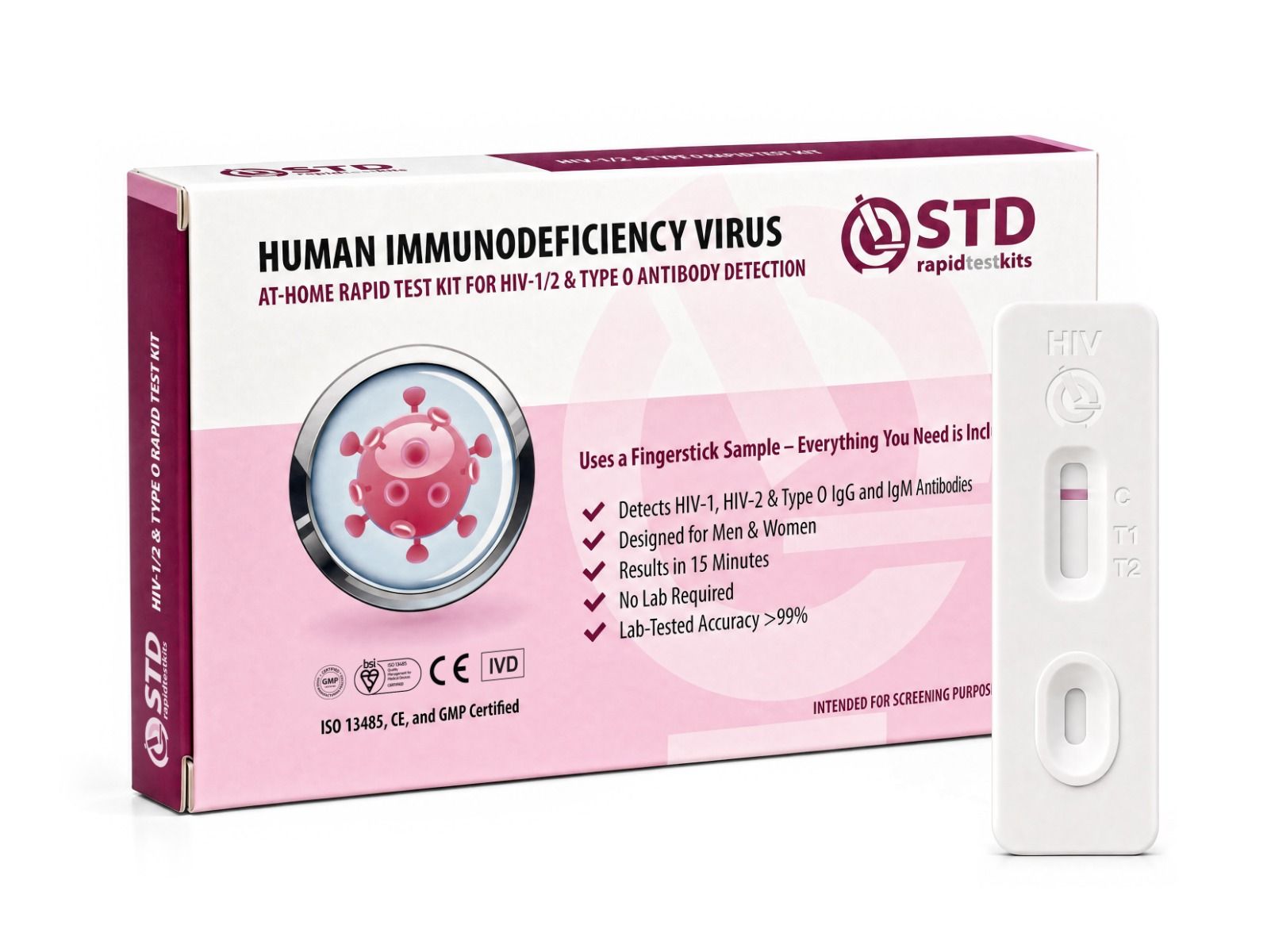
By the time identifiable symptoms return (persistent night sweats, weight loss, recurrent thrush, opportunistic infections like Pneumocystis pneumonia or tuberculosis), CD4 counts (the immune-system cells HIV targets) are typically well below where they should be. Modern antiretroviral therapy still helps a great deal at that point, though immune recovery takes longer and complications are more common. A meaningful share of new HIV diagnoses in the U.S. each year are still classified as "late diagnoses," meaning the person had already progressed to AIDS or near-AIDS at the moment they tested positive. Routine testing, before any symptom shows up, is what keeps that number from climbing, which is why CDC's HIV testing guidance recommends at least one HIV test for everyone aged 13 to 64 as part of routine care, and more often for people with ongoing risk factors.
The micro-delay that quietly costs everything
Most people do not consciously refuse to get tested. They say "I'll do it next week." Then next week becomes next month. The symptom fades a little, or it stays the same, and life keeps moving around it. The window for early diagnosis closes quietly, without anyone explicitly deciding anything.
Andre, 31, in another composite drawn from common patterns, noticed small sores he kept telling himself were razor burn. He did not want it to be herpes, so he let the thought live as razor burn for months. When he finally tested, the result was manageable and the medical impact was small. The harder cost was the months he spent quietly anxious about something he could have had an answer to much sooner.
Stigma in 2026 operates this way: quietly, through soft delay rather than open confrontation. The delays accumulate in small increments most people do not notice until weeks have slipped by. Untreated chlamydia can lead to pelvic inflammatory disease in women, which develops in a meaningful share of untreated cases and can scar the fallopian tubes. That scarring raises the risk of ectopic pregnancy and long-term fertility complications. Antibiotic treatment clears the infection, but it cannot reverse tissue damage already done. Undetected HIV cannot benefit from antiretroviral treatment, which is what makes the virus untransmittable when taken consistently. Early HIV infection also carries the highest viral load most people will ever have, which is why the undiagnosed weeks are often the highest-transmission weeks.

What helps: scripts, self-talk, and normalization
If stigma is partly internal, part of the answer is too. Fear-based campaigns do not move people toward testing. What seems to help is concrete language, lower-pressure environments, and small social proofs from people they trust.
Start with how you talk to yourself. "What if I'm disgusting?" can become "What if I'm just a person?" A positive test is evidence that you tested, which is the opposite of avoidance. Reframing testing as routine care, similar to a dental cleaning or an eye exam, removes some of the moral weight without dismissing the emotional reality of the moment.
Normalize it among friends if you can. One Reddit user described their group treating new test kits like a small ritual: they post the unboxed kit the way someone might post a skincare haul. It sounds silly. It also works, because shame thrives in silence and shrinks when people see other people moving through the same thing.
If you are working out how to bring this up with a partner, the script in the callout below has worked for a lot of people.
"I care about us, so I want us both to feel covered. I used an at-home test this week. Is that something you'd be open to doing too?"
It centers care rather than blame, and most partners respond to it well. If a partner reacts with defensiveness or shaming instead, that response itself is useful information about how they handle hard conversations.
How at-home testing cuts through stigma
The single biggest stigma-reducer of the last decade has been the at-home test kit. Privacy reduces the activation energy of testing. You do not have to schedule a clinic visit, sit in a waiting room, or explain your sex life to a stranger. The kit arrives in an unmarked mailer. You swab or fingerstick. You read a result fifteen minutes later.
The reason this matters for stigma is that it shortens the time between "something feels off" and "I know what is going on." Most of the emotional benefit lives in that shortening. The hours and days people spend Googling symptoms while debating whether to test usually weigh more on them than the actual diagnosis would. Information replaces speculation, and speculation is what most people are afraid of in the first place.
A few notes on what at-home rapid tests can and cannot do. They are lateral-flow screening tests, not lab confirmation. Any positive result is treated as preliminary and confirmed with a follow-up lab test. They have a window period, the time between exposure and reliable detection: roughly twelve weeks for antibody-based HIV rapid tests, shorter for swab-based bacterial infections like chlamydia and gonorrhea. FDA-cleared rapid tests are designed for direct consumer use, and each kit publishes its own sensitivity and specificity figures on the product label. Check the individual product page for the figures that apply to the specific test you plan to use.
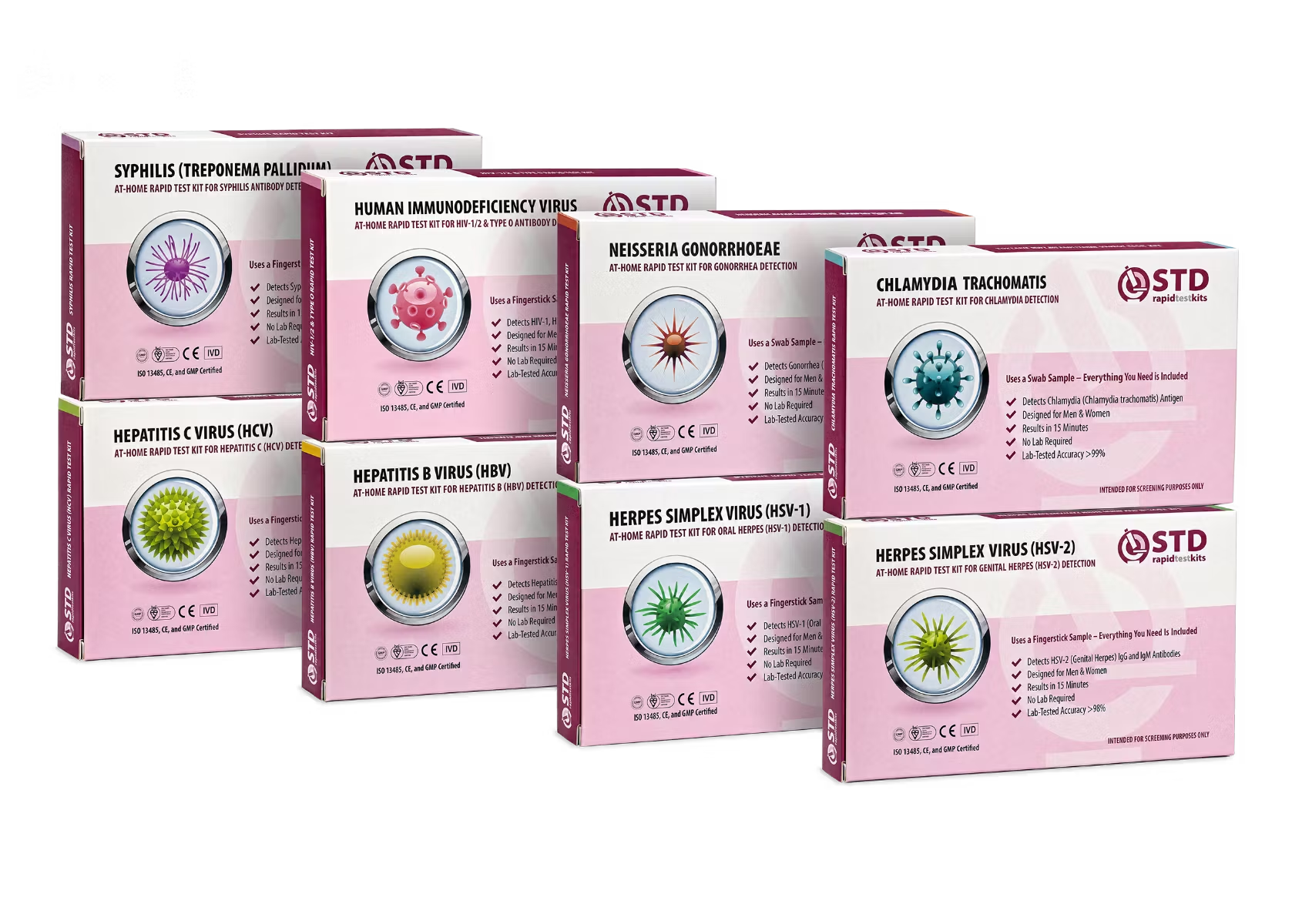
A multi-infection panel is often the right starting point. A multi-infection home test kit lets you screen for several infections in one go, which is useful when a symptom or a risk event could plausibly match more than one. Pick the panel that covers what you might reasonably be exposed to, not the longest possible list.
What no one tells you after a positive test
If a test comes back positive, the next twenty-four hours are usually quieter and more manageable than people expect. The catastrophe most people brace for does not arrive. There is a diagnosis, there is a treatment plan or a management plan, and there is the rest of a normal life on the other side of it.
Rina, 27, another composite figure built from common patterns, tested positive for HPV after assuming her routine pap had covered every screening she needed. The thing that hit hardest was not the diagnosis. It was the way she started talking to herself, replaying old shaming language she did not even realize she had absorbed. She caught it. She did the follow-up. The infection cleared on its own, as most HPV infections do. A year later she had become the friend other people came to when they were scared, because she had been through it without going to pieces.
A useful framing after a positive test: this gives you more information than you had yesterday, and information gives you choices. Concrete next steps usually look like a confirmatory retest when the kit recommends one, a conversation with a clinician about the specific infection, and a treatment or management plan tailored to it. For HIV specifically, modern antiretroviral therapy started promptly lets most people reach an undetectable viral load. Once viral load is suppressed, the virus is untransmittable to sexual partners. This is the U=U principle (undetectable equals untransmittable), now established public-health consensus and central to CDC's current HIV messaging.
A positive result opens a treatment plan. Dating, intimacy, and self-respect remain available, and none of them close because of a three-letter diagnosis.
You're not dirty. You're informed.
Shame was never part of the cure for anything. It did not slow transmission, it did not help anyone heal faster, and it has not made a single hard conversation easier. The only thing shame has consistently done is keep people quiet longer than they needed to be quiet, and sicker longer than they needed to be sick.
If you are reading this with a hand hovering over a test kit you have not yet ordered, you are already most of the way past the hardest part. Deciding to know is the work. The test itself is the easy bit.
A confidential combo test kit arrives in an unmarked mailer with no commentary, no judgment, and no record of you having ordered it beyond the receipt you keep or delete. The test gives you information. What you do with it from there is entirely up to you.
Testing is what people who care about themselves do. Ordering the kit is the decision. The result is just information.
How to break the spiral, one small step at a time
If reading this far has made testing feel slightly more possible and slightly less terrifying, that is the spiral loosening already. Most people do not go from full avoidance to confident testing in one move. It happens in smaller steps, summarized below. Most of the spiral is the difficulty of moving from "I'm going to do this" to "I'm doing it now." The kit and the science are the easy parts.
Six steps from worry to result
- Name the worry out loud, even just to yourself. The avoidance gets weaker once the fear stops being invisible.
- Tell one person. A friend, a sibling, a therapist, an anonymous helpline. The first time you say "I've been avoiding getting tested" is the hardest, and almost always followed by relief.
- Buy the kit before you commit to using it. Letting a kit sit on a shelf for a week is a normal halfway step, a pacing choice rather than a failure of nerve.
- Pick a window of time you control. Weekend morning, partner out of the house, a podcast you trust playing in the background.
- Read the instructions once, then again, then do it. A rapid kit is designed for non-clinical use. Most readers complete one in fifteen to twenty minutes.
- Have a plan for either result. If negative, you are done. If positive, the confirmation pathway is a lab test and a conversation with a clinician about treatment. Both are routine, both are survivable, both are the start of feeling better.
FAQs
- Is STD stigma really still a thing in 2026?
- Yes, just in a quieter form. Public conversations about sexual health have gotten more open, but the internal voice that asks "what does this say about me?" still shows up before people order a test. Stigma did not vanish in 2026. It went internal, which is harder to see and harder to name.
- Can I have HIV and not know it?
- Yes, and the asymptomatic phase is exactly why. About 13 percent of the roughly 1.2 million people living with HIV in the U.S. do not know their status, per CDC surveillance. The virus can stay clinically silent for years, which means feeling healthy is not a reliable status check. A test is the only way to know.
- How accurate are at-home HIV rapid tests?
- FDA-cleared at-home rapid tests are highly accurate when used after the recommended window period. Sensitivity and specificity figures vary by test and are published on each individual product's label and product page. Any positive result needs lab confirmation, and any test taken too soon after a possible exposure should be repeated once the window period has passed.
- How long after exposure can a rapid antibody test detect HIV?
- Per CDC HIV testing guidance, most antibody-based rapid tests, including at-home kits, are most reliable about 12 weeks (three months) after a possible exposure. Some people develop detectable antibodies sooner, but the 12-week point is where a negative result is considered conclusive for these test types. Lab-based fourth-generation antigen-antibody tests can detect HIV earlier, typically within 18 to 45 days after exposure.
- I'm scared to tell my partner I want to get tested. What do I say?
- Lead with care rather than accusation. Something like: "I want us both to feel covered, and I tested this week. Are you open to doing the same?" That framing invites the conversation. If a partner reacts with defensiveness or shaming, that response is information about how they handle hard conversations in general.
- If I test positive, am I stuck with this forever?
- It depends on the infection. Chlamydia and gonorrhea clear with a single course of antibiotics. Trichomoniasis usually clears the same way. HSV-2 stays in the body but can be managed with daily medication for many people, and outbreaks tend to become less frequent over time. HIV is now a manageable long-term condition with daily medication that often suppresses the virus to undetectable levels. A positive test starts a treatment plan, which most people move through without much disruption to their lives.
- Why do people say "clean" when they mean "STD-negative"?
- Because the opposite of "clean" is "dirty," which is a moral frame applied to a medical event. Calling a body "dirty" for catching an infection imports the morality of the word into a medical event where it does not belong. Better phrasing is "tested negative on [date]" or "recently tested." Swapping the word out in your own vocabulary is a small change that reduces some of the shame people pick up from the surrounding culture.
- Does feeling healthy mean I don't have HIV?
- No. Feeling healthy is one of the worst indicators of HIV status, because the virus's clinical latency stage produces no specific symptoms for years. Many late diagnoses happen in people who felt fine right up until the moment they did not. Routine testing is the only reliable check.
How we sourced this article: Our editorial team combined current guidance from the CDC, NIH HIVinfo, HIV.gov, and NHS with peer-reviewed research on stigma and care-seeking behavior, plus lived-experience reporting drawn from public forum threads and support communities. The composite reader stories described in this piece (Dalia, Mikhael, Rafiq, Andre, Rina) are fictionalized patterns, not real interviewees. This article is published by stdrapidtestkits.com, which sells at-home STI testing kits. We recommend products based on fit for the reader's concern, not commercial benefit.
- U.S. Centers for Disease Control and Prevention. Sexually Transmitted Infections (STI) Statistics, the agency's annual surveillance hub for chlamydia, gonorrhea, syphilis, and other reportable STIs.
- U.S. Centers for Disease Control and Prevention. Let's Stop HIV Together, the public-information campaign on HIV stigma as a barrier to testing and treatment.
- U.S. Centers for Disease Control and Prevention. STIs Prevalence, Incidence, and Cost Estimates, source of the figure that about 20 percent of the U.S. population, roughly one in five people, had an STI on any given day in 2018.
- U.S. Centers for Disease Control and Prevention. Genital Herpes Information, source of the figure of 572,000 new genital herpes infections among people aged 14 to 49 in 2018.
- U.S. Centers for Disease Control and Prevention. Fast Facts: HIV in the United States, surveillance estimates of HIV prevalence and the share of people with HIV who do not know their status.
- U.S. Centers for Disease Control and Prevention. HIV Testing. Source for the recommendation that everyone aged 13 to 64 be tested for HIV at least once as part of routine health care, and at least annually for people with ongoing risk factors; also covers window-period guidance for antibody and antigen/antibody assays.
- U.S. Centers for Disease Control and Prevention. HIV Treatment. Source for the U=U principle (undetectable equals untransmittable) as established public-health consensus.
- U.S. Department of Health and Human Services, HIV.gov. Who Should Get Tested for HIV. Federal testing guidance referenced in the support-resources callout.
- U.S. National Institutes of Health, HIVinfo. The Stages of HIV Infection. Source for the clinical latency phase description and the long asymptomatic course of untreated HIV.
- UK National Health Service. Pelvic Inflammatory Disease (PID). Source for the complication pathway from untreated chlamydia and gonorrhea to PID, ectopic pregnancy risk, and long-term fertility implications.
