
Published: December 2025 | Last updated: May 2026 | Editorial review and quality control: Martina N.
One encounter is enough. That answer feels harsh, but it is the honest one. Sexually transmitted infections do not work on a frequency model where you accumulate exposure until risk becomes real. They are pathogens, and pathogens transmit on contact when the conditions are right. A single instance of unprotected oral, vaginal, or anal sex can be enough for chlamydia, gonorrhea, syphilis, herpes, HPV, trichomoniasis, or HIV to move between two bodies.
That said, "can" is not "will." The actual probability for any one encounter depends on the specific infection, the type of contact, whether either partner has symptoms, viral load when a virus is involved, and whether protection was used correctly from start to finish. This guide walks through what current public-health guidance says about per-encounter risk, when each test becomes accurate, what symptoms to watch for, and what to do if a result comes back positive.
The point is not to alarm anyone. It is to give you the same baseline a clinician would: a clear sense of what is plausible, what is unlikely, and what the next reasonable step is.
Key Takeaways
- Yes, one unprotected sexual encounter can transmit an STI. Per-act probability ranges from well under 1% for HIV to over 50% for gonorrhea, depending on the infection and the type of contact.
- If you test too soon, the result can be a false negative even when an infection is present. Reliable testing windows fall between 1 and 12 weeks after exposure depending on the STI.
Why one encounter is enough for transmission
STIs are not graded on a curve. The biology is simple: a pathogen needs a route from an infected partner's body fluids or skin to a mucosal surface, a small break in skin, or the inside of the urethra, vagina, rectum, or pharynx. One sexual encounter provides every one of those opportunities. The number of partners a person has had does not change the underlying mechanics; it changes the probability of having ever met someone infected, but it does not change what happens when you do.
This is why public-health agencies frame the message in terms of contact rather than count. The CDC's overview of sexually transmitted infections describes STIs as spreading through vaginal, anal, or oral sexual contact, with no minimum number of encounters required (CDC, About Sexually Transmitted Infections). The first encounter and the hundredth encounter follow the same biological rules.
- Several STIs spread through skin-to-skin contact rather than fluid exchange. Herpes, HPV, and syphilis can transmit even when no body fluids are involved and even when the infected area is asymptomatic.
- Ejaculation is not required for many infections, including chlamydia and gonorrhea. Pre-ejaculatory fluid and mucosal contact are sufficient routes.
- Condoms reduce risk substantially for fluid-borne infections but do not cover every area where a skin-to-skin pathogen might live.
Per-encounter risk by infection
Per-act risk numbers are estimates pulled from observational studies, partner studies, and modeling. They vary widely by methodology, which is why most published ranges are wide. The CDC's HIV Risk Reduction Tool, for example, is built on a systematic review of per-act HIV transmission probabilities and reports figures well under 1% per act for most exposure types (CDC, HIV Risk Reduction Tool). Bacterial STIs sit higher because they reproduce locally and spread more efficiently per exposure. The table below summarizes commonly cited ranges; treat them as orienting figures, not personal predictions.
| STI | Can one-time exposure transmit? | Typical route | Estimated per-act risk |
|---|---|---|---|
| Chlamydia | Yes | Vaginal, anal, oral | ~10–20% |
| Gonorrhea | Yes | Vaginal, anal, oral | ~20–50% |
| Herpes (HSV-1/HSV-2) | Yes | Skin-to-skin, oral-genital | ~5–30% |
| HIV | Yes | Anal and vaginal mainly; rare oral | ~0.04–1.4% per act |
| Syphilis | Yes | Skin-to-skin, oral-genital | ~10–60% per partnership |
| HPV | Yes | Skin-to-skin, vaginal, anal | High (commonly cited up to ~60% per partnership) |
| Trichomoniasis | Yes | Vaginal | ~5–30% |
Window periods and when each test turns positive
After a one-time exposure, one concept anchors every useful testing decision: the window period. That is the gap between when an infection takes hold and when a given test can reliably detect it. A test taken inside that window can return negative even when the person is genuinely infected, because the bacterial DNA, viral RNA, or antibodies are not yet at detectable levels. The NHS and CDC both recommend pacing tests to the relevant window rather than testing as soon as possible (NHS, Sexually Transmitted Infections).
Bacterial infections like chlamydia and gonorrhea become detectable within roughly 1 to 2 weeks. Antibody-based blood tests for HIV, syphilis, and herpes take longer because the body needs time to produce a measurable antibody response. The figures below match current public-health guidance.
| STI | Most accurate testing window | Earliest a test can be useful | Confirmatory retest? |
|---|---|---|---|
| Chlamydia | 14 days post-exposure | Sometimes from 7 days | Yes if early test was negative |
| Gonorrhea | 7–14 days post-exposure | From around 5–7 days | Yes |
| HIV (4th-gen Ag/Ab lab test) | 18–45 days | From around 18 days; NAAT can detect from ~10 days | Confirm at 3 months |
| HIV (antibody-only rapid test) | 23–90 days | From around 23 days | Confirm at 3 months |
| Syphilis (antibody) | 3–6 weeks | Earlier with visible chancre on dark-field exam | Yes if high-risk |
| Herpes (HSV-2 antibody, blood) | 12+ weeks for type-specific antibody | 21 days for some assays; 6+ weeks more reliable | Yes; some labels recommend 16 weeks |
Can you get an STD from sex one time?
Yes. A single unprotected oral, vaginal, or anal encounter is enough for any of the common STIs to transmit. Per-act probability runs from well under 1% for HIV to roughly 20–50% for gonorrhea, depending on the type of contact and whether the infected partner has symptoms. For chlamydia and gonorrhea, wait until about 14 days post-exposure to test. For HIV, the 4th-generation lab test is reliable from around 45 days; antibody-only rapid tests need up to 90 days. For herpes blood antibody tests, allow at least 12 weeks.
Why so many infections stay silent
One of the harder facts about STIs is how often they cause no symptoms at all. Most chlamydia infections in women and a sizable share in men are asymptomatic. Many genital herpes infections produce only mild or atypical symptoms that get attributed to friction, ingrown hairs, yeast, or razor burn. HPV almost never announces itself. Even gonorrhea, which has a reputation for obvious discharge, can be silent in the throat or rectum.
This matters in two directions. The partner who transmitted the infection often did not know they were infected. And the person reading this article, after one encounter, may have an infection right now and feel completely normal. Public-health guidance from the CDC notes that many STIs cause no symptoms or only mild ones that go unrecognized, which is one of the main reasons routine screening exists (CDC, About Sexually Transmitted Infections).
The practical implication: "I feel fine" is not a reliable signal that nothing happened.
Roughly 70% of women and 50% of men with chlamydia have no recognisable symptoms, according to CDC surveillance summaries. Two-thirds of people with genital HSV-2 are unaware they carry it. HPV is asymptomatic in most cases. Asymptomatic carriage is the rule for these infections, which is why testing on the right schedule matters more than testing only when something feels wrong.
Symptoms in the days and weeks after exposure
When symptoms do appear, they tend to follow patterns shaped by the pathogen's biology. Bacterial infections in the urethra or vagina show up as burning urination or unusual discharge. Skin-to-skin viruses produce sores or growths. Systemic infections can produce flu-like illness as the immune system mounts a response. The timeframes below reflect standard clinical symptom windows summarised in NHS and CDC condition fact sheets (NHS, Sexually Transmitted Infections).
If any of these show up after a recent encounter, treat it as a reason to test rather than a reason to panic. Many of the same symptoms have non-STI causes: yeast infections, urinary tract infections, friction, contact dermatitis. A test simply rules in or rules out the STI possibility so you can move forward with the right treatment.
| Symptom | Possible STI(s) | Timeframe after exposure |
|---|---|---|
| Burning during urination | Chlamydia, gonorrhea, trichomoniasis | 2–21 days |
| Genital sores or ulcers | Herpes, syphilis | 4–21 days (herpes); 10–90 days (syphilis primary chancre) |
| Abnormal discharge | Chlamydia, gonorrhea, trichomoniasis | 3–14 days |
| Flu-like symptoms (fever, body aches, lymph node swelling) | HIV (acute), syphilis (secondary), herpes (primary) | 7–30 days |
| Warts or skin growths | HPV | Weeks to months |
| Sore throat after oral sex | Pharyngeal gonorrhea, pharyngeal chlamydia | 2–14 days |
What if you used a condom?
Condoms move the dial considerably for fluid-borne infections. Used correctly and consistently, latex or polyurethane condoms reduce the per-act risk of HIV, chlamydia, and gonorrhea substantially. The CDC's prevention guidance places condoms among the most effective tools for reducing STI transmission when used correctly (CDC, STI Prevention).
They are less protective for skin-to-skin pathogens that live outside the area a condom covers (herpes, HPV, syphilis), for any contact that happens before the condom goes on (oral sex or genital-to-genital foreplay still counts as exposure), and if the condom breaks or slips mid-act. A condom that was used correctly from the start and stayed in place puts you in a meaningfully lower risk band, but not zero. If your encounter falls into one of those scenarios, treat the protection as partial.
- Skin-to-skin pathogens outside the covered area: herpes, HPV, and syphilis can live on the base of the penis, the labia, the perineum, and the inner thighs.
- Contact before application: oral sex without a barrier, or genital-to-genital foreplay before the condom goes on, still counts as exposure.
- Breakage or slippage: if the condom broke, slipped off, or came off mid-act, that segment of the encounter was unprotected.
What it looks like if your test is positive
A positive result on an at-home rapid test, especially after a single encounter, is jarring. A single rapid result is rarely the final word, though. Lateral-flow tests are screening tools; they work well as a first signal, and a positive screen should be confirmed with a laboratory test, typically a NAAT for bacterial infections or a confirmatory antibody/antigen test for viral infections.
Most STIs are highly treatable. Chlamydia, gonorrhea, syphilis, and trichomoniasis are bacterial or parasitic and clear with a short course of antibiotics or antiparasitic medication. HIV is a chronic infection but is well-controlled with modern antiretrovirals; people on effective treatment with an undetectable viral load do not transmit HIV sexually. Herpes is lifelong but episodic and managed with antivirals when needed. About 90% of HPV infections clear on their own within two years, according to the CDC; cervical and anal screening catch the persistent high-risk strains that need clinical attention, and HPV vaccination addresses the strains that cause most cervical and oropharyngeal cancers.
From a positive screen, book a clinician visit or telehealth appointment for confirmatory testing, prescription, and a follow-up plan.
Untreated chlamydia and gonorrhea can progress silently. In women, the bacteria can ascend to the uterus and fallopian tubes and cause pelvic inflammatory disease (PID), which scars reproductive tissue and contributes to roughly 1 in 8 cases of tubal-factor infertility, per CDC surveillance. In men, the same bacteria can cause epididymitis, with rare but documented cases of impaired fertility. A short course of antibiotics taken as soon as the infection is detected effectively eliminates this long-term risk, which is why early testing is a fertility-protection step, not just an immediate-symptom one.
Telling the person you slept with
If a confirmatory test comes back positive, current partners and recent sexual contacts need to know so they can test and, if needed, treat. This is the single biggest lever for stopping onward transmission. Many state and local health departments run partner services through Disease Intervention Specialists who can contact a partner on your behalf without naming you, and several online services offer the same anonymous-message function.
If you prefer to handle it directly, the message can be brief. Something like: "I tested positive for [infection]. You may have been exposed and might want to get tested." That is enough. The conversation does not need to assign blame, recount the timeline, or include an apology. The recipient mostly needs the name of the infection and a prompt to test.
Two things worth keeping in mind. First, partners often respond with thanks, not anger; they wanted the same information you did. Second, you do not owe anyone the rest of your sexual history.

Reducing risk going forward
One encounter does not require a complete behavioral overhaul, but it is a useful prompt to put a few practical tools in place. WHO's prevention guidance and the CDC's STI prevention page both emphasize the same handful of measures (WHO, Sexually Transmitted Infections fact sheet).
- Keep condoms or dental dams accessible. The biggest single risk factor for inconsistent use is not having them on hand.
- Talk about testing history before sex rather than after. "When were you last tested?" is a reasonable question and most people answer it.
- Build routine screening into your year. The CDC recommends annual chlamydia and gonorrhea screening for sexually active women under 25 and at-risk men, and HIV testing at least once for adults aged 13 to 64.
- Get vaccinated where eligible. HPV vaccination is recommended through age 26 routinely and through age 45 with shared clinical decision-making. Hepatitis B vaccination is a routine adult vaccine if you were not immunized as a child.
- Ask a clinician about PrEP if you have ongoing HIV exposure risk. Daily oral PrEP and long-acting injectables are both highly effective when taken as prescribed.
The WHO's fact sheet on sexually transmitted infections notes that the majority of STI cases globally are asymptomatic, and that people commonly transmit infections without knowing they carry them (<a href="https://www.who.int/news-room/fact-sheets/detail/sexually-transmitted-infections-(stis)" target="_blank" rel="noopener">WHO, Sexually Transmitted Infections fact sheet</a>). That is the practical case for testing after any unprotected exposure: you cannot rely on symptoms in yourself or in a partner as a reliable signal.
Frequently asked questions
- Is it really possible to get an STI from sex just once?
- Yes. STIs transmit on contact when the conditions are right; they do not require repeated exposure. A single unprotected oral, vaginal, or anal encounter with an infected partner is enough for any of the common STIs. The probability per act varies widely by infection, from well under 1% for HIV to roughly 20–50% for gonorrhea.
- I have no symptoms. Should I still test?
- Yes, if there was unprotected contact or contact outside the area a condom covered. Several common STIs are asymptomatic in most cases. Chlamydia, herpes, HPV, and pharyngeal gonorrhea routinely cause no symptoms while still being transmissible. Testing rules the question in or out instead of leaving it open.
- We used a condom. Does that make me low-risk?
- Lower-risk, not zero-risk. Condoms substantially reduce transmission of fluid-borne infections like HIV, chlamydia, and gonorrhea when used correctly. They are less protective against herpes, HPV, and syphilis, which can live on skin a condom does not cover. If the condom broke, slipped, or went on after foreplay had begun, treat that segment as unprotected.
- I tested 3 days after sex and it was negative. Can I trust it?
- Probably not as a final answer. Most STIs have a window period before they are detectable. Chlamydia and gonorrhea are most reliably caught at around 14 days post-exposure. HIV antibody tests reach reliability between 23 and 90 days; 4th-generation antigen/antibody tests, between 18 and 45 days. A test before the window closes can return negative even if you are infected. Plan a confirmatory retest at the right time.
- It was oral sex only. Am I still at risk?
- Yes. The CDC notes that gonorrhea, chlamydia, syphilis, herpes, and HPV all have documented oral transmission routes, though the per-act probability varies (<a href="https://www.cdc.gov/sti/about/about-sti-risk-and-oral-sex.html" target="_blank" rel="noopener">CDC, About STI Risk and Oral Sex</a>). HIV transmission via oral sex is documented but considered low. Brushing teeth, mouthwash, and avoiding ejaculation in the mouth do not reliably eliminate risk.
- Do I have to tell the person I slept with?
- If your confirmatory test is positive, yes. The other person needs the chance to test and, if needed, treat. You can either tell them directly with a brief factual message or use anonymous partner-notification services run by clinics and state health departments. The latter contact the person on your behalf without naming you.
- If it was my first time ever, can I still have caught something?
- Yes. Number of partners is not a protective factor in any direction. The first encounter and the hundredth follow the same biology. If your first partner was carrying an infection, transmission is possible from the first encounter onward. This is not a failure of judgment; it is simple statistics.
- How do I pick the right test?
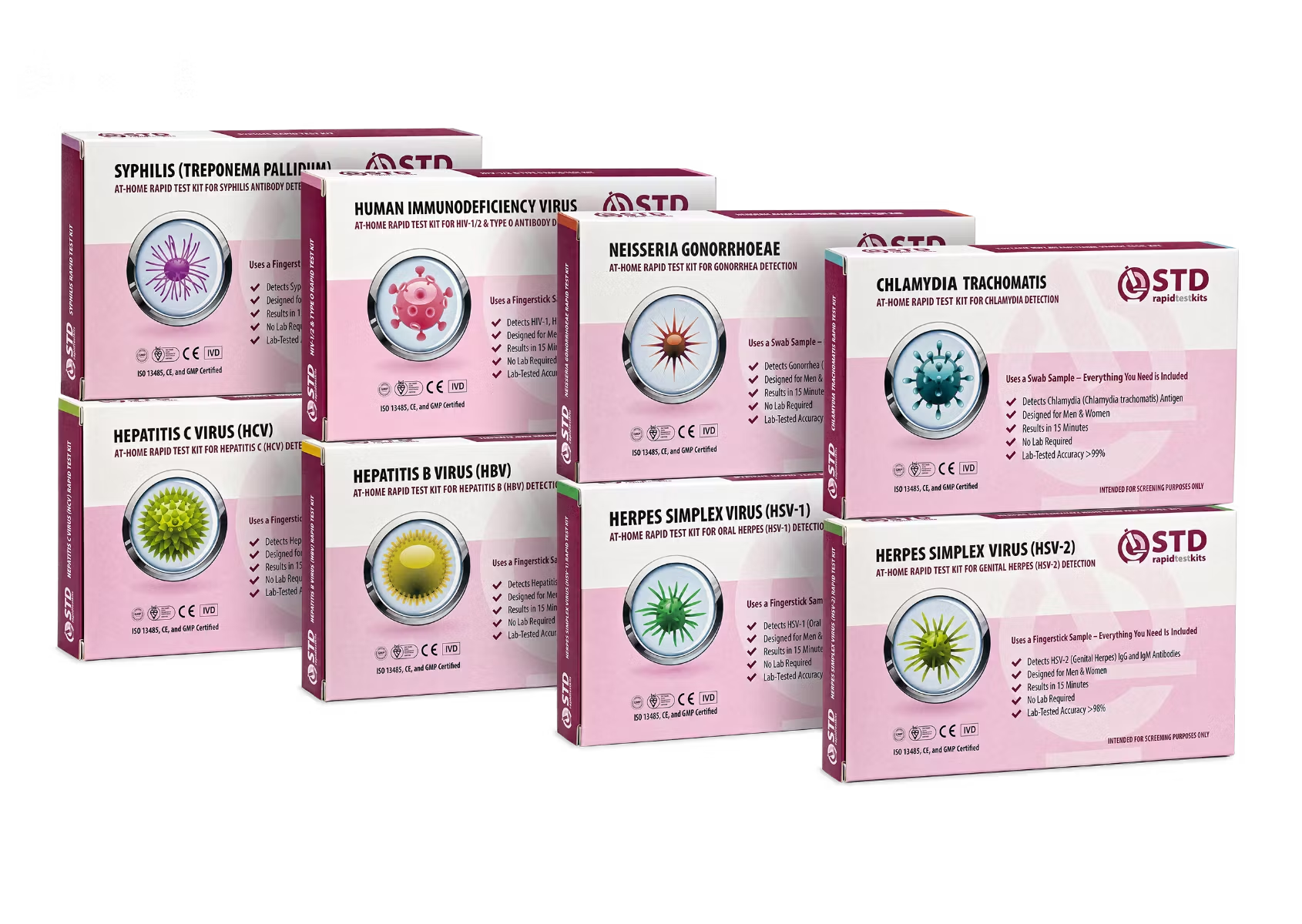
- Match the kit to two things: which infection you may have been exposed to, and how far past exposure you are. If you are still inside the first two weeks post-exposure, starting with chlamydia and gonorrhea makes sense, since they turn positive soonest. Plan a second test at 6 to 12 weeks to catch HIV, syphilis, and herpes, which need longer windows. If you do not know what your partner may have had, a combination panel is more useful than guessing at a single-infection kit, since it screens for several common infections at once. Combination kits do not replace lab confirmation if a result is positive.
- U.S. Centers for Disease Control and Prevention. About Sexually Transmitted Infections. General STI overview, transmission routes, and asymptomatic-carriage framing.
- U.S. Centers for Disease Control and Prevention. About STI Risk and Oral Sex. Source for oral-sex transmission claims for gonorrhea, chlamydia, syphilis, herpes, and HPV.
- U.S. Centers for Disease Control and Prevention. HIV Risk Reduction Tool. Source for per-act HIV transmission probability estimates.
- U.S. Centers for Disease Control and Prevention. STI Prevention. Source for condom effectiveness and prevention guidance.
- World Health Organization. Sexually transmitted infections (STIs) fact sheet. Source for global asymptomatic-carriage framing.
- UK National Health Service. Sexually transmitted infections (STIs). Source for testing-window guidance and symptom timing in plain language.
