Published: December 2025 | Last updated: May 2026 | Editorial review and quality control: Martina N.
Many people open a tab to order an STI test, then close it. The body senses something the calendar reminder does not: this errand is loaded. There is a real number on the other side of the swab or the fingerstick, and the brain treats not-yet-knowing as a kind of protection. So the appointment slides another week. Then another. Then a month.
If you have been here, you are not unusual and you are not failing at adulthood. Testing anxiety is one of the most well-documented barriers to sexual-health care. Public-health research and clinical literature consistently identify stigma, shame, and emotional overwhelm as core reasons people delay screening they actually want to do. This piece is for the part of you that wants to push through, and the part that needs a softer entry point.
Key Takeaways
- Avoiding an STI test does not keep you safe; the uncertainty itself usually generates more stress than the result, and most results are either negative or treatable.
- Home rapid kits exist because clinics are not the only safe path; for people working through anxiety, depression, or trauma history, privacy is a clinical tool, not a workaround.
Why your brain treats an STI test like a threat
Booking a test should feel like flossing or scheduling a dental cleaning. For a lot of people it feels closer to opening a stamped letter from a court. Clinical psychologists describe this as a stigma-anticipation response: your mind models the worst version of the next thirty days (the result, the disclosure conversation, the partner reaction, the cost) and tries to push the whole package away. That is your brain doing what it evolved to do, prioritizing emotional survival in the short term over abstract future health.
Researchers studying STI screening report that perceived stigma is one of the strongest predictors of whether people test on schedule, separate from age, gender, or income. The fear is rational on its own terms. It tracks decades of cultural silence around sex and the lingering association between an infection and a moral verdict. Even when the rational mind knows none of that holds up, the limbic system has not gotten the memo.
This matters because the cure for avoidance is information, privacy, and a smaller first step than the one your dread is imagining. You are not aiming for a flu shot from the doctor today. You are aiming for the click that loads the cart page, or the question you type into a search bar. Both count.
Stigma-anticipation is the brain rehearsing every social and emotional consequence of a positive result before the test has even happened. Researchers tracking sexual-health screening have repeatedly identified perceived stigma as one of the strongest predictors of whether people test on schedule, independent of age, gender, or income.
The fear of knowing versus the relief of knowing
A common version of testing anxiety has little to do with the test itself. It is fear of the result. People say things like, "I can handle most days, but a positive result right now would tip me over." If that resonates, it is worth knowing that this fear is unusually well studied, and the data points in a counterintuitive direction.
Adherence research on HIV testing in particular has tracked what happens to people in the days and weeks after they get a result, including a positive one. The pattern is consistent: the imagined version of being told is usually worse than the actual experience of being told. People plan. They learn what the diagnosis means. They start treatment, often the same week. The static buzz of "maybe" gets quieter. Many describe a strange kind of relief; the news may not be good, yet there is finally a next step to take.
The in-between place, where you suspect something and do not know, is the part that is genuinely corrosive. It keeps your sleep shallow. It hijacks your sex life. It edits how you talk to a partner without you noticing. Testing replaces a moving threat with a fixed fact, and fixed facts can be acted on.
Many sexually transmitted infections produce no symptoms. Testing is often the only way to know if you have one.
When depression or anxiety paralyzes the first click
For some readers, the obstacle is not really fear. It is the part of depression, ADHD, or chronic anxiety where the executive function that organizes daily life simply stops cooperating. You open the order page. You stare at it. You close the tab. Twenty minutes later you cannot remember why you opened it. A test that should take fifteen minutes feels like climbing a mountain because your nervous system is already running in survival mode.
This is real, it has a name (executive dysfunction), and it is not a character problem. The National Institute of Mental Health notes that anxiety disorders can interfere with daily life and routine activities, including the kind of multi-step planning that ordering a test requires.
The workable response involves shrinking the task so far down that it stops triggering the protective shutdown. Starting smaller than "get tested" usually works: reading one product page tonight, sending a friend a text saying you plan to order this weekend, or adding a kit to your cart and closing the laptop until tomorrow. Each small completion builds momentum for the next one, with permission to pause between them. If you live with a clinician or therapist, looping them in for a single supportive conversation can also unstick the click.
This article is published by stdrapidtestkits.com, which sells at-home STI testing kits. We recommend products based on fit-for-purpose for the reader's concern, not commercial benefit.

How at-home testing changes the math
The reason rapid home kits matter has little to do with being cooler than clinics. It is that they remove the four things people consistently name as triggers: the receptionist conversation, the public waiting room, the chair-time with a stranger, and the multi-day wait for results. For someone working with social anxiety, depression, or a trauma history, removing those four is the difference between an action that happens and one that does not.
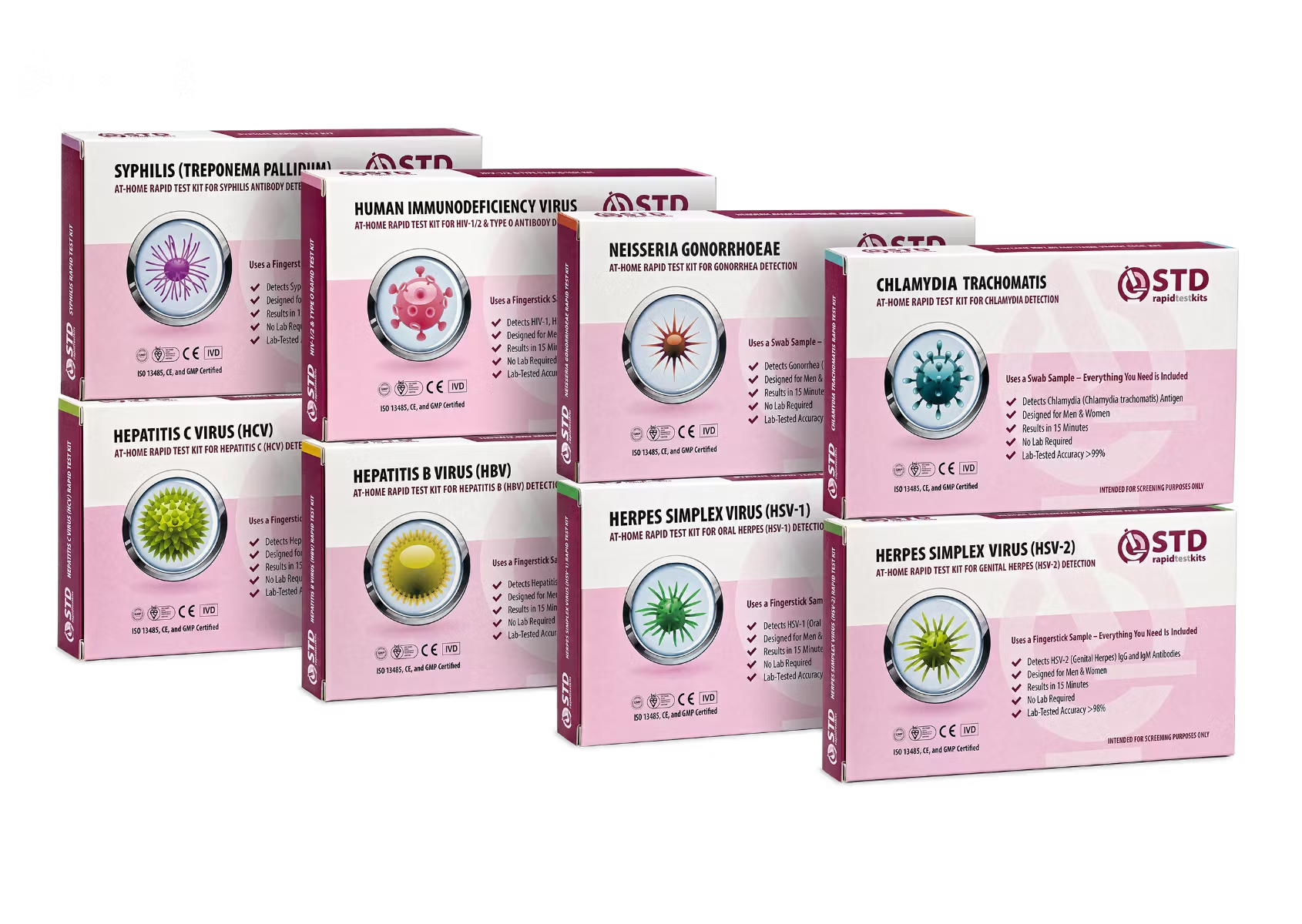
The mechanics are straightforward. You order online. The kit ships in plain packaging. You collect the sample at home (a swab for some infections, a fingerstick for others). The test runs on a lateral-flow strip similar to a rapid pregnancy test or a COVID home test, with a visible result line in roughly fifteen minutes. There is no portal login waiting period. There is no envelope from a lab arriving days later. The information arrives in the same room where you took the test.
Lateral-flow rapid tests use different technology from the lab NAATs used in clinics; they are a screening-grade tool that gives you a fast answer and a clear next step. If you get a positive result on a home rapid, you confirm with a clinic or lab, and a confirmation appointment is much easier to keep than a cold-start screening appointment. If you get a negative result and you tested inside the right window after exposure, you have what you came for. The CDC's screening guidance treats regular testing as routine care; home kits are one of the ways readers actually make that routine happen.
How do I get tested for STIs if I cannot make myself go to a clinic?
Order a private at-home rapid test kit, which removes the receptionist, the waiting room, and the public exposure that drive most clinic avoidance. Modern home kits screen with a fingerstick blood sample, a self-collected swab, or both, and give a visible result in about 15 minutes. If the order button feels too heavy in one sitting, break it into smaller steps spread across a few days: read the kit description tonight, add it to your cart tomorrow, complete checkout the day after. Each step is itself a form of testing.
| Testing path | Privacy | Best for | Emotional load |
|---|---|---|---|
| In-clinic visit | Low to moderate | People who already have symptoms or need same-day treatment | Higher: waiting rooms, intake forms, in-person disclosure |
| Mail-in lab kit | High | People who want lab-grade NAAT results and can tolerate a few days of waiting | Moderate: privacy is high, but the wait raises baseline anxiety |
| At-home rapid lateral-flow test | Very high | People who want fast, private answers in the same room they took the test in | Lowest: results in about 15 minutes, no external triggers |
"I feel fine" is the quietest form of avoidance
One pattern is louder than fear: the version where you do not feel anxious about testing at all because nothing feels wrong. No symptoms, no burning, no rash, no discharge. So the test slides off the to-do list. The body sends no signal, and the brain reads that as permission to wait. This is one of the most common reasons people delay screening, and it is the riskiest, because most STIs do not flag themselves early.
Chlamydia and gonorrhea, the two most commonly reported bacterial STIs in the U.S., are frequently asymptomatic, especially in women. HIV often produces no noticeable symptoms during the earliest months when transmission risk is highest. Syphilis can move through a long silent stage between the initial sore and later complications. The WHO STI fact sheet spells this out clearly: a substantial share of infections never produce visible signs at all, which is exactly the case routine screening is built to catch.
There is also a psychological shortcut at work here called optimism bias: the brain's quiet default that bad outcomes happen to other people. It serves us well when we need to get out of bed during a hard week. It serves us poorly when we have had an exposure and rely on a body cue that may never come. Screening exists precisely for the quiet case, the one where the body sends no signal and only a test can answer the question.
Chlamydia and gonorrhea, the two most reported bacterial STIs in the U.S., are frequently asymptomatic, especially in women. HIV also commonly produces no noticeable symptoms during the highest-transmission early phase. Feeling well is not a substitute for a test result.
Shame whispers, and most of what it says is wrong
Shame around STI testing rarely shows up as a thought you would say out loud. It shows up as a tone in your inner voice: I am dirty, I should have known better, this is what I get. These are not facts about you. They are echoes of decades of public-health messaging that framed sex as risk and infection as punishment, plus whatever specific scripts you absorbed from family, religion, or school.
The reframe that actually moves people goes beyond saying "you are not dirty" louder. It involves recognizing that getting tested is the responsible thing, the same kind of routine maintenance as a cervical cancer screen or a cholesterol check. People who screen on schedule are the people doing the boring, careful, unglamorous work of looking after their own body, full stop.
If shame is the part keeping you frozen, it can also help to talk to one person who already has a healthy attitude about testing. A friend who treats it as routine, a partner who has done it themselves, a community-clinic counselor on a chat line. You do not need a therapist to start; you need one person whose calm about this is louder than yours is anxious.

Telling a partner you want a test
For people in relationships, testing is rarely just about the test. It is about the conversation that has to happen around it. Will they think I am accusing them of cheating? What if my result is positive and theirs is negative? Do I want to know if knowing would change us?
The honest framing is that testing is not an accusation. It is a baseline care move, the same as agreeing on contraception or sharing a list of medications you take. For new relationships, testing together sets a foundation of practical honesty. For long relationships, it can open conversations that were overdue anyway: about monogamy agreements, about whether PrEP would be useful, about what "safe" actually means in your specific arrangement.
If the conversation itself is the part you are dreading, scripts help. Try, in your own voice: "I have been thinking about my sexual health lately, and I want both of us to get tested at the same time. It is not about you. It is something I would feel better doing as a baseline." If a partner responds with defensiveness instead of curiosity, that is information about the relationship rather than about whether the test was the right idea. Your right to know what is going on inside your own body does not depend on someone else's comfort with the question.
Testing after sexual or medical trauma
For survivors of sexual assault, intimate-partner violence, or invasive medical procedures that went badly, STI testing is something closer to body memory than everyday anxiety. The cold table, the latex gloves, the asking-to-take-clothing-off, the loss of control over what happens to your body next. Standard clinical workflows are often not designed with any of that in mind, and many people who have been hurt avoid screening for years because the test itself feels like a re-exposure to what they survived.
This is one of the most concrete cases for at-home testing existing. You can stay clothed, work alone or with a chosen support person, and set your own pace. A fingerstick blood draw or a self-collected swab does not require anyone else to touch you. If you do end up needing a clinic later (for confirmation of a positive home result, or for a sample type our kits do not cover such as pharyngeal or rectal swabs), you can ask ahead about whether the clinic advertises trauma-informed care, and you can bring a friend or therapist with you.
If your trauma is more recent and you have not done formal recovery work yet, a few options help: the NHS sexual-health overview describes what testing involves in plain language, and many cities have community health centers with named trauma-informed providers. Testing does not undo what happened to you, though it can be a quiet step toward owning your own body again.
FAQs
- I know I should get tested, so why do I keep avoiding it?
- Because your brain is protecting you, even when the protection is misplaced. When testing feels like a threat to your health, your identity, or your relationship, your mind hits pause. That does not make you broken. It makes you a person with a working stress response. Staying in "maybe" mode usually generates more anxiety than knowing does, so the move is to shrink the next step until it stops triggering the freeze. Open the kit page. Read one paragraph. That is testing too.
- Is it normal to panic when I hover over the order button?
- Yes. That moment of holding the cursor over the button is the most common anxiety spike in the whole sequence. People have left that tab open for days. The reason is that clicking it makes the abstract concrete, and the body reacts. The good news is that once you click, the spiral usually loosens, because the unknown shrinks into a fixed timeline.
- What if I get a positive result and cannot handle it?
- First: most common STIs are curable with a short course of antibiotics, including chlamydia, gonorrhea, syphilis, and trichomoniasis. The infections that are not curable (HIV, herpes, hepatitis B in some cases) are manageable with modern treatment that lets most people live a normal, healthy life. You may feel a wave of fear for a few days. Then you will read, plan, and start the next step. If your mental health is fragile, line up one person to call before you take the test rather than after. That single piece of scaffolding makes a real difference.
- How do I bring up testing with a partner without sounding accusatory?
- Lead with your own body rather than theirs. Something like: "I have been thinking about my health, and I want to get tested. I would feel better if we both did it as a baseline." Frame it as shared care. If they react with defensiveness rather than curiosity, that tells you something about the relationship and not about whether the test was right.
- I have no symptoms. Do I still need a test?
- Asymptomatic does not mean uninfected. Chlamydia, gonorrhea, and early-stage HIV routinely produce no noticeable symptoms, which is exactly why routine screening exists for people who feel completely fine. If you have had a new partner, a partner with other partners, or unprotected sex, the screening guidance applies to you whether or not your body is sending a signal.
- I live with depression. Testing feels like too much. What do I do?
- Honor the size of the task your nervous system is registering. Break it into smaller pieces: read this article (done), look at one product page, add a kit to a cart, finish checkout. Each step is allowed to take its own day. If you have a therapist or a trusted friend, a single supportive text exchange while you complete the order often unfreezes the click.
- What if I have trauma around being touched or examined?
- A self-collected swab or fingerstick test means no one needs to touch you; you work at your own pace in your own space. If you ever need a clinic for confirmation or a sample type our kits do not cover, calling ahead to ask about trauma-informed intake usually makes a significant difference, and bringing a friend or therapist with you is always allowed.
- When should I test after a possible exposure?
- For most bacterial infections (chlamydia, gonorrhea, syphilis), a test about two weeks after exposure is a reasonable starting point. HIV antibody tests reach reliable accuracy by about 23 to 90 days depending on the assay generation. If you test early and the result is negative, plan a retest at four to six weeks to close the window. Read the specific window-period note that ships with your kit.
You deserve answers, not a permanent question mark
If you have read this far, here is the takeaway worth keeping: avoiding the test does not protect you, and it is almost certainly costing you more than the test ever could. The freeze is your nervous system doing its job, and your job is to give it a smaller next step than it is currently dreading.
You can take a long route, break the order across three days, ask someone to sit with you while you complete checkout, or test while still scared. All of those count as moving forward, and the information on the other side is yours to do something with once you have it.
- U.S. Centers for Disease Control and Prevention. STI screening recommendations: routine screening intervals and risk-based screening guidance.
- U.S. Centers for Disease Control and Prevention. HIV testing overview: window periods, test types, and recommended follow-up testing.
- World Health Organization. Sexually transmitted infections fact sheet: prevalence, asymptomatic cases, and the role of routine screening.
- National Institute of Mental Health. Anxiety disorders overview: how anxiety and related conditions interfere with daily life and routine activities.
- NHS. Sexually transmitted infections (STIs) overview: when to test, what testing involves, and how to access services privately.
- U.S. Centers for Disease Control and Prevention. STD prevention: information on reducing risk, testing access, and follow-up care.
- U.S. Centers for Disease Control and Prevention. About sexually transmitted infections: transmission routes, prevention methods, and the importance of testing.
