

Published: December 2025 | Last updated: April 2026 | Editorial review and quality control: Martina N.
You are reading this with one of two questions in mind. Either something feels off and you want to know what it might be, or nothing feels wrong at all and you are wondering whether you even need to do anything. Both versions are reasonable. Both deserve a real answer.
The reality is that symptoms tell you very little on their own. Many sexually transmitted infections cause no signs whatsoever, especially in the first few weeks. Others cause symptoms that look like a dozen different things you have already had. So the right test rarely tracks how your body feels. It tracks what kind of contact happened, when it happened, and whether anyone you were with has tested positive since.
This article walks through both situations. We will look at what symptoms can and cannot rule out, what the silent side actually looks like in the data, and how to pick a test that matches your exposure rather than your worry level.
Symptoms or no symptoms: which test should I order?
Both situations call for testing, and the choice depends on exposure rather than how you feel. For most any-gender contact in the past month, a swab-and-blood combo covering chlamydia, gonorrhea, syphilis, and HIV is a practical starting point. Test about 14 days after exposure for bacterial infections; revisit blood tests at 6 to 12 weeks for syphilis and hepatitis confidence, and allow 90 days for full HIV rapid-antibody confidence. If a partner has tested positive for something specific, test for that infection now, regardless of how you feel.
Key Takeaways
- Feeling fine is not the same as being uninfected. The WHO reports that the majority of chlamydia and gonorrhea cases produce no obvious symptoms, and early HIV often feels like a mild cold or nothing.
- Match the test to the exposure and the calendar, not the sensation. Most bacterial STIs become reliably detectable around 14 days after contact; syphilis and hepatitis need 6 to 12 weeks for full confidence; HIV rapid-antibody tests reach full confidence at 90 days.
When Your Body Speaks: What Symptoms Can and Cannot Tell You
Symptoms are loud but not specific. A burn when you urinate could be gonorrhea or chlamydia, but it could also be a urinary tract infection or simple post-sex irritation. A rash on your palms could be secondary syphilis, or a reaction to a new soap. A genital sore could be herpes, or it could be friction from a condom. The body gives clues. It does not deliver diagnoses.
That ambiguity is why testing usually goes broader than the symptom in front of you. If chlamydia is in the picture, gonorrhea often is too, since people who carry one frequently carry the other. If you have a sore that could be herpes, blood testing for syphilis and HIV is reasonable, because co-infection is common and several infections share the same anatomy. Symptoms shape urgency. They rarely shape the test list on their own.
Clinicians describe the same delayed-testing pattern repeatedly: someone notices a mild sting after a recent encounter, calls it dehydration, waits a few days, and returns when discharge or pain make the original symptom impossible to ignore. The earlier link in that chain is always the better one to act on. Mild signals are not less worth testing. They are simply easier to rationalize away.
| Symptom | Most Likely STIs | Other Causes to Consider | Test Approach |
|---|---|---|---|
| Burning when urinating | Chlamydia, Gonorrhea | UTI, post-sex irritation, soap reaction | Genital swab plus blood panel |
| Unusual discharge | Chlamydia, Gonorrhea, Trichomoniasis (women) | Yeast infection, bacterial vaginosis | Genital swab; combo panel if multiple risks |
| Genital sores or blisters | Herpes (HSV-1 or HSV-2), Syphilis | Friction, ingrown hair, contact dermatitis | Blood antibody test for HSV and syphilis |
| Rash on palms or soles | Secondary syphilis | Allergic or viral rash | Syphilis blood antibody test |
| Flu-like illness 2 to 4 weeks post-exposure | Acute HIV | Common viral illness, COVID, mono | HIV antigen/antibody test at the right window |
| Itch or mild irritation | Trichomoniasis, herpes prodrome | Shaving, friction, eczema | Combo panel based on exposure history |
When Your Body Stays Quiet: The Silent Side
Now consider the harder situation. The one where everything feels normal. No itching, no discharge, no fever, nothing visible. You shower, you check, you look. You feel fine. And yet the question keeps circling back to that night.
Public-health surveillance tells a sobering story here. The majority of chlamydia infections in women cause no noticeable symptoms, and many gonorrhea infections in both sexes are equally silent (WHO STI fact sheet). Early HIV often shows as a mild flu-like phase that can pass for a regular cold, or sometimes shows nothing at all. Syphilis may produce a single painless sore that disappears on its own without treatment, then reappears as a body rash weeks later. Trichomoniasis frequently stays quiet in men while passing back and forth between partners.
Asymptomatic infections matter for two reasons. First, untreated chlamydia or gonorrhea can scar fallopian tubes or cause epididymitis even when nothing hurts. Second, you can pass these infections to a partner without ever feeling sick yourself. Routine screening catches infections that surveillance shows would otherwise stay hidden until complications appear.
The majority of chlamydia infections in women and a significant share of gonorrhea infections produce no obvious symptoms (<a href="https://www.who.int/news-room/fact-sheets/detail/sexually-transmitted-infections-(stis)" target="_blank" rel="noopener">WHO STI fact sheet</a>). Trichomoniasis is frequently silent in men. Acute HIV may present as a mild flu lasting a few days, or nothing at all. "Silent" does not mean uncommon, and it does not mean low risk to a partner.
Why Timing Matters More Than How You Feel
People often confuse two different timelines: the incubation period and the window period. Incubation is how soon symptoms might appear. The window period is how long after exposure a test can reliably detect infection. They are not the same number, and one is much more useful than the other.
Picture someone who has unprotected sex on Saturday and tests on Tuesday. Negative. They breathe out. Two weeks later, on a follow-up test, they come back positive for chlamydia. Nothing changed about the infection. The first test was simply too early. The bacteria had not yet multiplied to detectable levels in the sample, no matter how the person felt.
The same principle works in reverse. Some people develop mild irritation a few days after exposure, well before the test can pick anything up. The symptom is real, the test is too early, and the negative result is misleading. Match the test to the calendar, not the sensation. The table below gives realistic windows for the infections an at-home panel covers.
| Infection | Earliest Detection | Reliable Test Window | Sample Type |
|---|---|---|---|
| Chlamydia | 7 to 14 days | About 14 days | Genital swab |
| Gonorrhea | 7 to 14 days | About 14 days | Genital swab |
| Syphilis | 3 to 6 weeks | 6 to 12 weeks | Fingerstick blood antibody |
| HIV (rapid antibody) | 23 days | 90 days for full confidence | Fingerstick blood |
| HSV-2 antibodies | 6 to 8 weeks | 12 weeks (most assays) | Fingerstick blood |
| Hepatitis B | 3 to 6 weeks | About 9 weeks | Fingerstick blood |
| Hepatitis C | 4 to 10 weeks | About 12 weeks | Fingerstick blood |
| Trichomoniasis (women) | About 7 days | 2 to 4 weeks | Vaginal swab |
Match the Test to the Kind of Contact
Not every exposure carries the same risk profile, and not every exposure points to the same test. A condom slipping during vaginal sex puts chlamydia, gonorrhea, syphilis, and HIV on the list. Receptive anal contact adds rectal-site considerations that no at-home rapid kit fully covers. Oral contact carries a smaller but real risk for pharyngeal gonorrhea and chlamydia, which a clinic-collected throat swab handles better than a self-collected genital swab can.
A self-collected genital swab plus a fingerstick blood draw covers vaginal, penile, and bloodwork concerns from a typical mixed-genitals exposure. For throat-only or rectum-only worries after oral or anal contact, see a clinic where a trained provider can collect site-specific samples. The two paths are complementary, not interchangeable. Anyone selling you a single self-swab as a complete oral or rectal screen is overstating what the technology does.
The illustration below maps the most common contact patterns to the test type that fits each. Use it as a starting point, not a substitute for talking with a clinician if your situation is more layered.
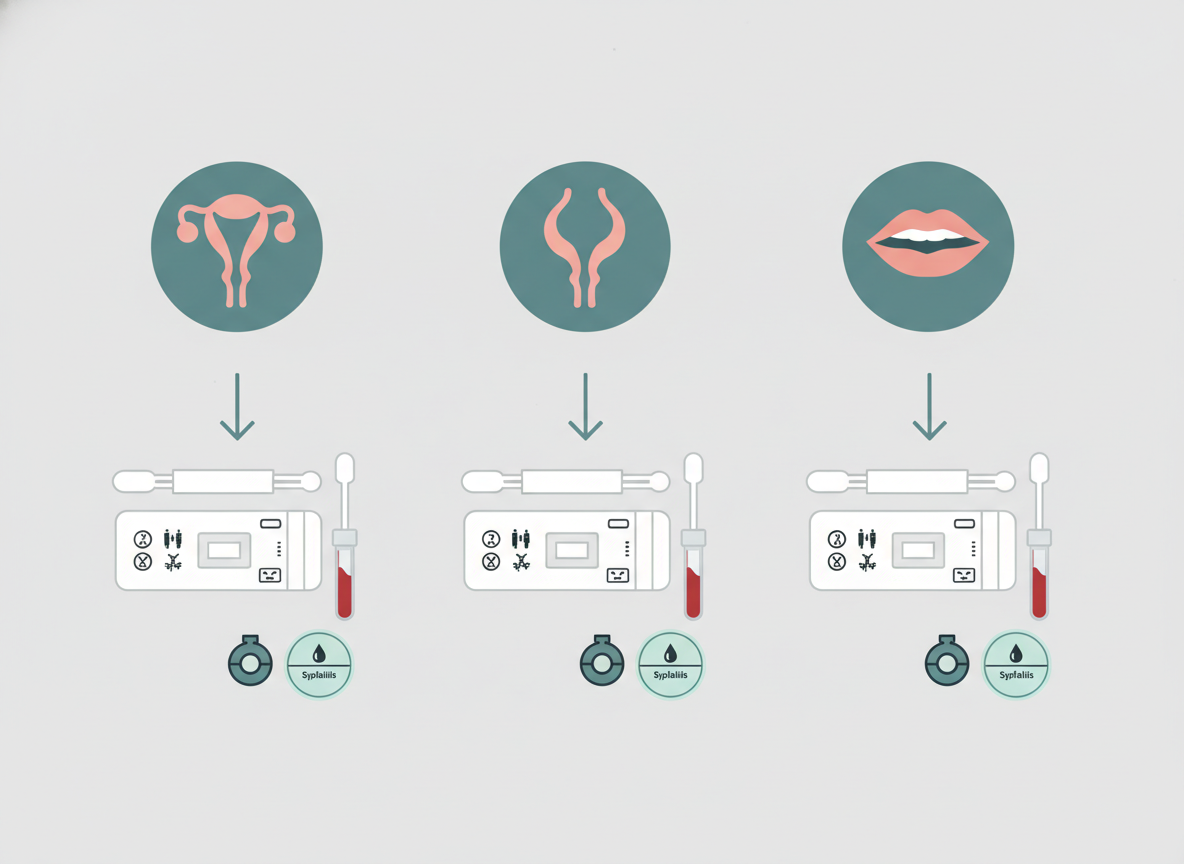
For a single-partner unprotected vaginal episode roughly two weeks ago, a chlamydia and gonorrhea swab combined with a syphilis and HIV blood test is the typical screening set. For a partner who has tested positive specifically for one infection, lead with that test, then add the rest of the panel because co-infections are common.
For oral-only exposure with no other contact, the at-home panel covers your bloodwork (HIV, syphilis), but not the throat itself. Book a clinic appointment for a pharyngeal swab if oral was the only route. Be explicit about the type of contact when you book; site-specific testing is what they need to know to set up the right swabs.
Your Partner Tested Positive and You Feel Fine
This message arrives in a thousand different ways, but the structure is similar: someone you have been with has tested positive, and they are letting you know. Your stomach drops. You feel completely fine. You replay the encounter and start scanning your body for signs you would have noticed before.
If a partner tests positive, you test, even without symptoms. Transmission does not require visible signs. You can carry chlamydia or gonorrhea without feeling anything at all, and early HIV often feels like nothing more than a mild cold, if anything. The CDC's approach is consistent here: partner notification and testing are part of standard treatment, not a courtesy.
Targeted testing for the known infection is the immediate priority. Comprehensive testing is the wise next step, because partners often had not been screened in some time before their result came back, and overlapping exposures are common. A combo panel that screens for several infections at once is usually the practical choice over single-infection testing in this scenario.
Test for the specific infection your partner reported, today if possible. Add a combo panel covering chlamydia, gonorrhea, syphilis, and HIV at the same time, because co-infections are common and partners are often overdue on broader screening. Do not wait for symptoms; transmission can happen without any visible sign on either side. If you tested too early in the window period, plan a follow-up at the optimal timing for the relevant infection.
Home Rapid Test vs Clinic Lab Test: What Each One Actually Does
Different tools answer different questions. Home rapid kits use lateral-flow technology to deliver a result in about 15 minutes from a self-collected genital swab or fingerstick blood drop. They are fast, private, and well-suited to screening after an exposure or before a new partnership. Clinic-based testing typically uses NAAT or PCR, which has higher analytical sensitivity and can pick up smaller amounts of pathogen DNA. Lab tests also support site-specific sample collection from the throat or rectum that home kits do not cover.
The two approaches are complementary. A home rapid result is a useful first signal you can act on immediately. A positive home result is worth confirming with a clinic NAAT for treatment-decision purposes, and a negative result early in the window may still warrant a follow-up at the optimal timing. The home rapid kit delivers an answer the same day; a clinic NAAT adds the analytical precision needed for treatment decisions.
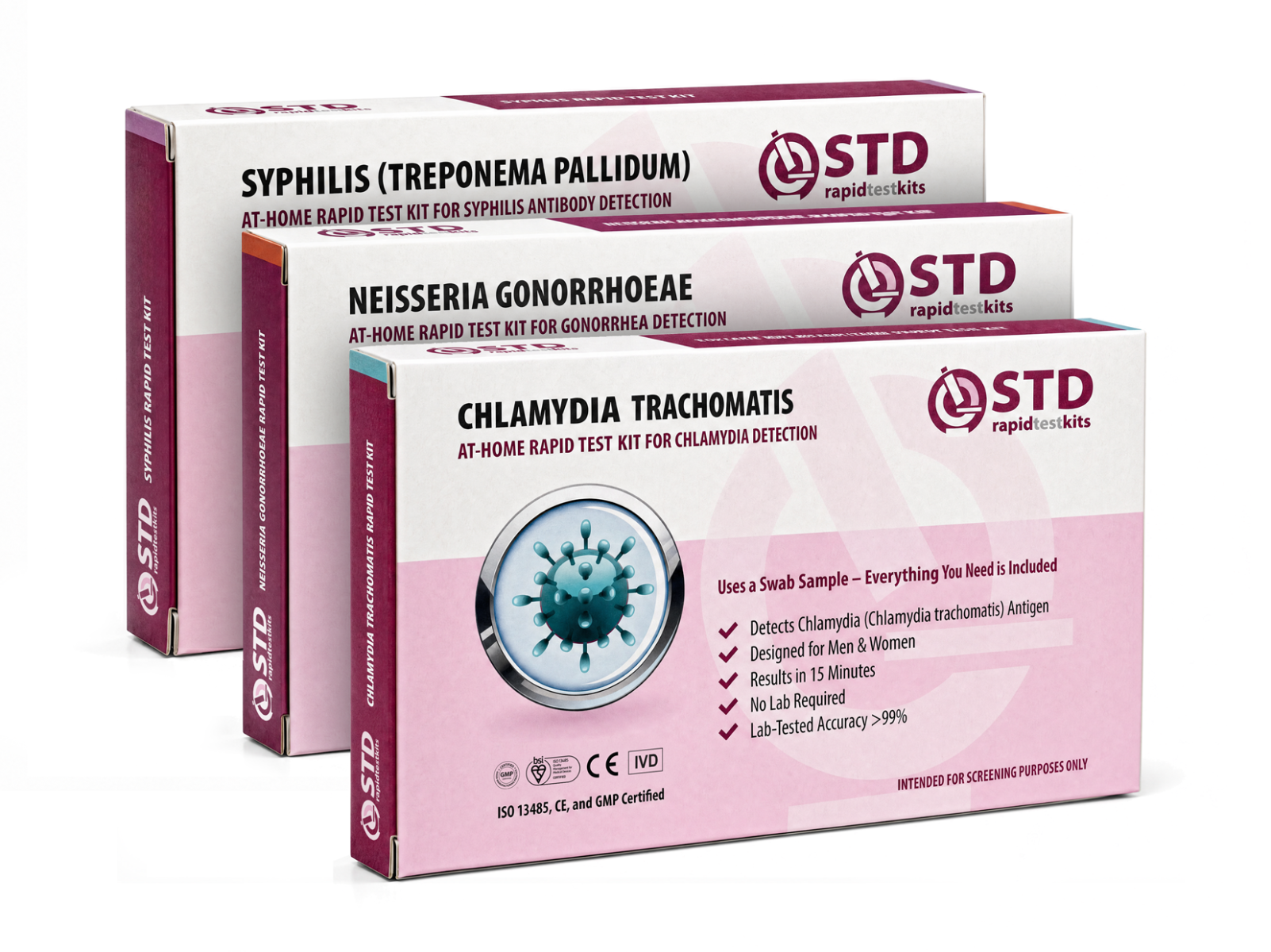
Our rapid lateral-flow kits cover self-collected genital swabs (chlamydia, gonorrhea, plus trichomoniasis and HPV for women) and fingerstick blood antibody tests (HIV, syphilis, hepatitis B, hepatitis C, HSV-1, HSV-2). We do not sell urine-sample tests, throat or pharyngeal swabs, rectal swabs, or mail-in lab NAAT panels. If your only concern is a throat or rectal exposure, see a clinic, because site-specific swabs are the right tool there.
Testing as a Routine, Not a Reaction
One change worth making is reframing testing from a reaction to a habit. The cultural script around STI testing is overwhelmingly reactive: something happened, something feels wrong, something needs ruling out. The script that actually keeps people healthy is closer to dental cleanings or annual physicals. Sexually active adults with new or multiple partners benefit from screening every 3 to 6 months, regardless of how they feel between visits.
This rhythm becomes easier the more it becomes routine. The first home test feels like an event. The fourth one feels like changing the smoke-alarm batteries. That shift, from event to habit, is what catches infections early and keeps them from quietly spreading. Couples opening up a relationship, partners deciding to stop using condoms, friends in non-monogamous arrangements: many build testing into their calendar the same way they would track a medication refill. None of this is paranoia. It is maintenance, and it is also a way to remove the anxiety of guessing.
Worth saying clearly: testing when you feel fine is not dramatic, and a negative result on a routine screen is not a wasted test. It is a baseline. The next time something feels off, that baseline is what makes the next test more interpretable.
Most chlamydia infections cause no symptoms. Annual screening is recommended for sexually active women under 25 and for older women with new or multiple partners.
If a Result Comes Back Positive
Take a breath. Most bacterial STIs, including chlamydia, gonorrhea, and syphilis caught early, are treatable with a short course of antibiotics. Trichomoniasis is treated similarly. Hepatitis B has a vaccine and modern antiviral options when chronic. HIV is now manageable with treatment that reduces the virus to undetectable levels, keeping people healthy and protecting partners (CDC HIV testing overview).
A positive test is information, not a verdict. The next steps are concrete: confirm the result with a clinic NAAT if needed, begin treatment promptly, notify any recent partners so they can test too, and avoid sexual contact until a clinician confirms you are clear. A clinic visit also gives you a chance to ask about partner-treatment options and follow-up testing schedules.
For broad coverage in one session, the 8-in-1 kit covers the eight infections most commonly screened across both men and women, mixing self-collected swab and fingerstick blood components in a single panel.

Frequently asked questions
- Can I have an STI without any symptoms at all?
- Yes, and it is the most common scenario for chlamydia and gonorrhea. Public-health surveillance from the WHO and CDC shows the majority of chlamydia cases in women are silent. Early HIV may pass as a mild cold or feel like nothing. Feeling fine is not a clearance, and asymptomatic infections still transmit to partners and still cause complications if left untreated.
- How soon after exposure should I test?
- About 14 days for bacterial STIs (chlamydia, gonorrhea) is when a swab becomes reliable. Syphilis and hepatitis B and C reach full confidence at 6 to 12 weeks. HIV rapid-antibody tests reach full confidence at 90 days, the CDC's standard 3-month window. HSV-2 IgG antibodies typically clear the window at around 12 weeks for most assays. Testing earlier than the window is fine, but treat that early result as a baseline and plan a follow-up at the optimal timing.
- My partner tested positive but I feel fine. Should I still test?
- Yes, immediately, regardless of how you feel. Transmission does not require visible symptoms. Test for the specific infection your partner has, then test broadly because partners often had not screened in some time, and overlapping exposures are common. A combo panel is usually a better choice than a single-infection test in this scenario.
- Are home rapid tests as accurate as clinic lab tests?
- Home rapid kits use lateral-flow chemistry and deliver a result in about 15 minutes. Clinic NAAT and PCR tests have higher analytical sensitivity, especially for low-level asymptomatic infection. They are complementary, not equivalent. A home rapid result is useful as a screen and a fast first signal; a positive result is worth confirming with a clinic NAAT for treatment decisions.
- If I had only oral sex, do I still need to test?
- Yes, and the test type matters. Oral exposure can transmit gonorrhea and chlamydia to the throat, and pharyngeal infections are usually silent. A self-collected genital swab does not screen the throat. For oral-only exposure, see a clinic for a pharyngeal swab. Our at-home blood tests still cover HIV and syphilis worries from oral contact.
- If I test negative once, am I done?
- Maybe. If you tested at the optimal window for what you were exposed to and have had no new contact since, that result is meaningful. If you tested early, plan a follow-up at the right window. If you have ongoing risk (new partners, multiple partners), routine retesting every 3 to 6 months is the recommended pattern, not a single annual test.
- I always use condoms. Do I still need routine testing?
- Condoms reduce transmission risk substantially but do not eliminate it. Skin-to-skin infections like HSV and HPV can transmit from areas a condom does not cover. Routine screening fills the gap that barrier protection cannot, and is recommended for sexually active adults with new or multiple partners regardless of consistent condom use.
- Is it normal to feel anxious about testing even when nothing is wrong?
- Common, yes. The anxiety usually drops sharply once the test is in motion, because uncertainty is the harder part of the loop. Most people describe testing as an act that returns control rather than removes it. A negative result is a real piece of information; a positive result, while harder, comes with a plan. Either way, the worry shrinks.
- U.S. Centers for Disease Control and Prevention. Sexually Transmitted Infections Treatment Guidelines, including partner notification and treatment protocols.
- CDC. STI screening recommendations by population and risk category, including frequency guidance for sexually active adults.
- CDC. STI testing overview, including what tests are available and how often to screen.
- CDC. HIV testing types, window periods, and the 3-month standard for rapid-antibody confidence.
- UK National Health Service. Overview of sexually transmitted infections, including symptom variability and when to seek testing.
- World Health Organization. Sexually transmitted infections fact sheet, including global asymptomatic-prevalence data.
