
Published: October 2025 | Last updated: May 2026 | Editorial review and quality control: Martina N.
The textbook image of an STD or STI in a woman is discharge, itching, or visible irritation. Most real infections look nothing like that. Many cause no symptoms at all. When something does show up, it might be a sore throat that won't clear, a faint rash on the palms, swollen glands in the neck, or a stretch of unexplained fatigue. None of those scream 'sexual health.' All of them can mean exactly that.
This guide walks through the non-vaginal patterns that get missed most often: which infections tend to cause them, how soon after exposure they appear, and when testing becomes reliable enough to trust. Use it to read your own timeline; the aim is calm clarity rather than alarm.
Key Takeaways
- Most chlamydia and gonorrhea infections in women cause no obvious symptoms at all, so 'no discharge' does not mean 'no infection.'
- Sore throat, body rash, swollen lymph nodes, flu-like symptoms, pelvic ache, and unexplained fatigue can all be early STI signs in women, and timing relative to a sexual exposure is often the most useful clue.
Why so many women miss the early signs
Women's sexual-health messaging has historically centered on three things: discharge, itching, and visible sores. Those happen, but they're not the rule. The Centers for Disease Control and Prevention notes that most people with chlamydia have no symptoms at all, and a similar silence is common with gonorrhea. The infection is doing its work; the warning system simply hasn't been triggered.
Even when symptoms do appear, they don't always localize to the genitals. Oral sex can lead to throat infections. Skin-to-skin contact can trigger rashes far from any original exposure site. An immune system reacting to a new virus or bacterium can make the whole body feel like it's coming down with the flu. Scanning only your underwear for clues means missing most of what your body might actually be saying.
Sorting symptoms into the wrong bucket is what delays testing most often. A sore throat lands in the cold bucket, fatigue lands in the stress bucket, and a faint rash gets blamed on detergent or heat. Each of those guesses is usually correct in isolation. When several non-specific symptoms cluster within a few weeks of a new sexual encounter, the bucket they belong in may not be the obvious one.
One vague symptom on its own is usually nothing. The combination that warrants screening is two or more non-specific signs (sore throat, fatigue, body rash, swollen nodes, low-grade fever) appearing within roughly 2 to 6 weeks of a new sexual partner or a condom failure.
Non-vaginal STD symptoms women report most often
The symptoms below all share one thing: none of them require vaginal discharge or itching to exist. Any of them can show up while the rest of your body feels and looks normal.
| Symptom | What It Can Feel Like | Possible STIs Associated |
|---|---|---|
| Sore throat after sex | Persistent scratchiness, swollen tonsils, pain swallowing | Chlamydia, Gonorrhea, Herpes |
| Rash on body | Flat red spots on palms, torso, or soles; not always itchy | Syphilis, early HIV |
| Flu-like symptoms | Fever, chills, body aches, fatigue | Early HIV, primary Herpes |
| Swollen lymph nodes | Tender lumps in neck, groin, or armpits | Herpes, HIV, Syphilis |
| Pelvic or lower back pain | Dull ache, cramping unrelated to period | Chlamydia, Gonorrhea (possible PID) |
| Eye redness or discharge | Irritated, painful eye resembling pink eye | Gonorrhea, Chlamydia |
| Extreme fatigue | Exhaustion that feels disproportionate | Early HIV, systemic infection |
When it's in your throat and you didn't think that counted
Oral sex counts. It always has. Culturally, it still gets treated like a loophole, a technicality that doesn't 'really' expose anyone to sexually transmitted infections. That belief is part of why sore throats after sex get dismissed so easily.
Both chlamydia and gonorrhea can infect the throat through oral contact. Many women with throat infections have zero genital symptoms; some have no symptoms at all and the infection is only discovered through screening. When throat soreness does appear, it tends to be persistent, doesn't respond to the usual cold remedies, and lacks the runny-nose context of a viral illness.
One practical limit worth knowing: the at-home rapid tests on this site are validated for genital swab samples and fingerstick blood draws. They are not pharyngeal swab kits. If your concern is throat-specific and you want a result that targets that anatomy, a clinic visit for a pharyngeal swab is the right tool. The at-home rapid kits still cover the parallel genital and bloodwork risk from the same exposure event, which is often what people need alongside a clinic throat swab.
Can you have an STD without vaginal symptoms?
Yes, often. Chlamydia and gonorrhea are usually silent in women. Early HIV typically presents as a flu-like illness 2 to 4 weeks after exposure, not as a vaginal symptom. Syphilis can appear as a painless rash on the palms or soles. Testing decisions should be driven by exposure history and incubation windows, not by whether something feels wrong 'down there.'
Rashes that don't itch (and why that matters)
Not every STI rash burns or itches. The rash from secondary syphilis often appears as flat reddish or brown spots on the palms of the hands or the soles of the feet, and it may not itch at all. That makes it easy to mistake for stress, a detergent reaction, or heat rash.
Early HIV can also cause a body rash during the acute infection phase. It tends to look like a viral rash, with small red patches across the trunk, and shows up alongside fever and fatigue. Many women interpret the whole cluster as a bad flu and move on without testing.
Context tells you more than the rash itself. Did symptoms begin within weeks of a new sexual encounter? Are they paired with swollen lymph nodes or body aches? When the timeline lines up with a known incubation window, the picture changes even if each individual symptom looks ordinary in isolation.
When it feels like the flu (but the timing is suspicious)
You wake up achy. Your throat hurts. Your temperature is slightly elevated. You feel exhausted in a way that's deeper than a bad night's sleep. The instinct is to call it a virus, stress, burnout, or maybe a lingering cold. Almost no one thinks 'sexually transmitted infection' when the symptom list looks like influenza.
But early HIV infection, called acute or seroconversion illness, can look exactly like the flu. The CDC describes the typical presentation as fever, chills, rash, swollen lymph nodes, headache, and muscle aches starting 2 to 4 weeks after exposure. If a new sexual encounter fell inside that window, the immune response your body is mounting might not be a seasonal bug.
Primary herpes outbreaks can also cause full-body symptoms the first time. Women sometimes report feeling feverish, achy, and fatigued before any visible sores develop. Sometimes the sores are small enough or internal enough that they're never clearly noticed at all.
| Infection | Possible Early Systemic Symptoms | Typical Symptom Onset After Exposure | When Testing Becomes Reliable |
|---|---|---|---|
| HIV | Fever, rash, swollen lymph nodes, fatigue, sore throat | 2 to 4 weeks | Antigen/antibody tests: about 18 to 45 days; nucleic acid tests earlier |
| Herpes (HSV-1 or HSV-2) | Body aches, fever, swollen glands | 2 to 12 days | Lesion swab when present; blood antibody tests after several weeks |
| Syphilis | Rash, swollen lymph nodes, mild fever | 3 to 6 weeks | Blood tests typically reliable after 3 to 6 weeks |
| Chlamydia / Gonorrhea | Often none; sometimes pelvic pain or low-grade fever | 1 to 3 weeks | Lab NAAT (urine or swab) reliable after about 7 to 14 days |
Pelvic or back pain without discharge: the quiet warning
Not every sexually transmitted infection stays in the cervix. Untreated chlamydia and gonorrhea can ascend into the uterus and fallopian tubes, leading to pelvic inflammatory disease (PID). The part that catches women off guard is that, according to Mayo Clinic's guidance on PID, the condition does not always cause noticeable discharge.
Instead, it tends to show up as dull lower abdominal pain, deep pelvic pressure, pain during sex, or a low backache. Some women describe it as 'period cramps that never quite leave.' Others describe a pulling sensation deep inside that lasts past the cycle window where cramps would normally subside.
Because there's no dramatic external sign, PID pain often gets normalized for weeks or months before testing happens. PID is treatable, but every week of delay raises the risk of long-term complications like infertility, ectopic pregnancy, and chronic pelvic pain.
Swollen lymph nodes: the body's alarm system
Lymph nodes are part of the immune system's early warning network. When they swell, especially in the neck, armpits, or groin, the body is reacting to something. That something can be a cold. It can also be a new infection.
Women with early HIV, herpes, or syphilis often report tender lymph nodes before any classic genital symptom appears. The swelling is sometimes discovered accidentally in the shower; sometimes it's a vague soreness on the side of the neck. Paired with fatigue or rash after a new sexual partner, swollen nodes deserve attention rather than panic.
Tender swollen nodes that appear 2 to 4 weeks after a new sexual exposure, especially in the neck or groin, deserve a check even if they resolve on their own. Acute HIV and primary herpes both commonly cause regional lymph swelling before any other localized sign.
Eye symptoms and other overlooked clues
Sexually transmitted infections can affect the eyes. Both gonorrhea and chlamydia can cause conjunctivitis if bacteria are transferred from the genital area to the eye, often via hand contact. It may look like a stubborn case of pink eye: redness, discharge, and irritation that doesn't respond to standard treatment within a few days.
This is uncommon, but when it happens it tends to go undiscussed because the symptom feels so disconnected from sex. The same applies to occasional joint pain that can accompany systemic STIs. Linking those symptoms to a recent exposure is the only way they get caught early.

When there are truly no symptoms at all
It's also possible, and common, to have an STI with no vaginal symptoms and no non-vaginal symptoms at all: no sore throat, no rash, no fatigue. The CDC's routine-screening guidance exists precisely because asymptomatic chlamydia and gonorrhea are more common in women than symptomatic cases.
'Can you have an STD without vaginal symptoms' is one of the highest-volume sexual-health search phrases for a reason. People often sense that something has shifted: a partner disclosed a previous infection, a condom broke, or the anxiety just won't settle. Screening in those cases is straightforward preventive care, the routine answer to a reasonable question.
The CDC recommends annual chlamydia and gonorrhea screening for sexually active women under 25, plus older women with new or multiple partners. Because most cases never produce symptoms women would notice, routine testing remains the main way these infections get found.
Timing matters more than symptom location
One of the biggest mistakes in self-assessment is using symptom location as the only filter. 'It's not vaginal, so it can't be an STD.' That logic fails because incubation periods vary widely between infections, and because the most common presentation in women, for several major STIs, is not local at all.
Some infections show up within days. Others take weeks. Several show no symptoms ever. What matters more than location is the timeline between exposure and testing. Testing too early can produce a false-negative that feels reassuring; waiting too long can allow complications that earlier treatment would have prevented. Matching the symptom onset date to the known incubation window of each infection is more informative than checking which body part is involved.
STD or something else? How to tell the difference
Not every sore throat is chlamydia. Not every rash is syphilis. Not every pelvic ache is PID. The goal is pattern recognition rather than paranoia. When women search 'flu like symptoms STD female' or 'pelvic pain but no discharge STD,' the real question underneath is usually: how do I know this isn't just something normal?
The dividing line is usually timing and clustering. One vague symptom on its own is rarely informative. Several non-specific symptoms appearing within weeks of a new sexual partner, especially if any of them include the palms-and-soles rash pattern or pelvic pain past your usual cycle window, is information worth acting on.
| Symptom | Common Non-STD Cause | When to Consider STI Testing |
|---|---|---|
| Sore throat | Cold, allergies, strep | If symptoms begin 1 to 3 weeks after oral sex or don't improve normally |
| Body rash | Heat rash, detergent reaction, viral rash | If rash includes palms/soles or follows a new sexual partner |
| Pelvic pain | Menstrual cramps, ovulation pain | If pain persists, worsens, or follows unprotected sex |
| Fatigue | Stress, anemia, lack of sleep | If paired with fever, swollen nodes, or recent exposure |
| Swollen lymph nodes | Cold or viral infection | If accompanied by rash, fever, or new sexual exposure |
Why location-based thinking is dangerous
For decades, sexual-health messaging focused almost exclusively on genital symptoms. Posters warned about discharge. Pamphlets showed sores. Sex education rarely discussed systemic or oral infections in women in any detail. That narrow framing produced what we'll call location-based thinking: if it isn't in the vagina, it isn't an STI.
That belief delays testing for throat infections, blood-borne infections, and systemic illnesses that don't begin with visible genital changes. Many women with throat gonorrhea have no genital infection at all, and many women with early HIV feel sick before any localized sign appears. The gap between what someone assumes about an exposure and what their body is actually doing is where delayed testing happens.
That includes oral sex, skin-to-skin contact, long-term partnerships, and the encounters someone still files away as 'just one time.' Anything that introduces new sexual contact also introduces the question of whether new screening makes sense.
When to test (even if you're not sure)
Testing decisions don't require certainty. They require exposure awareness. If you've had a new partner, a condom break, oral sex without barriers, or a partner who later disclosed an infection, screening is reasonable even if symptoms are mild or absent.
For chlamydia and gonorrhea, the CDC's diagnostic guidance describes lab NAAT as typically reliable about 1 to 2 weeks after exposure. For HIV, fourth-generation antigen/antibody tests are reliable by roughly 18 to 45 days after exposure, with nucleic acid tests detecting earlier. Syphilis blood tests generally become reliable within several weeks of exposure.
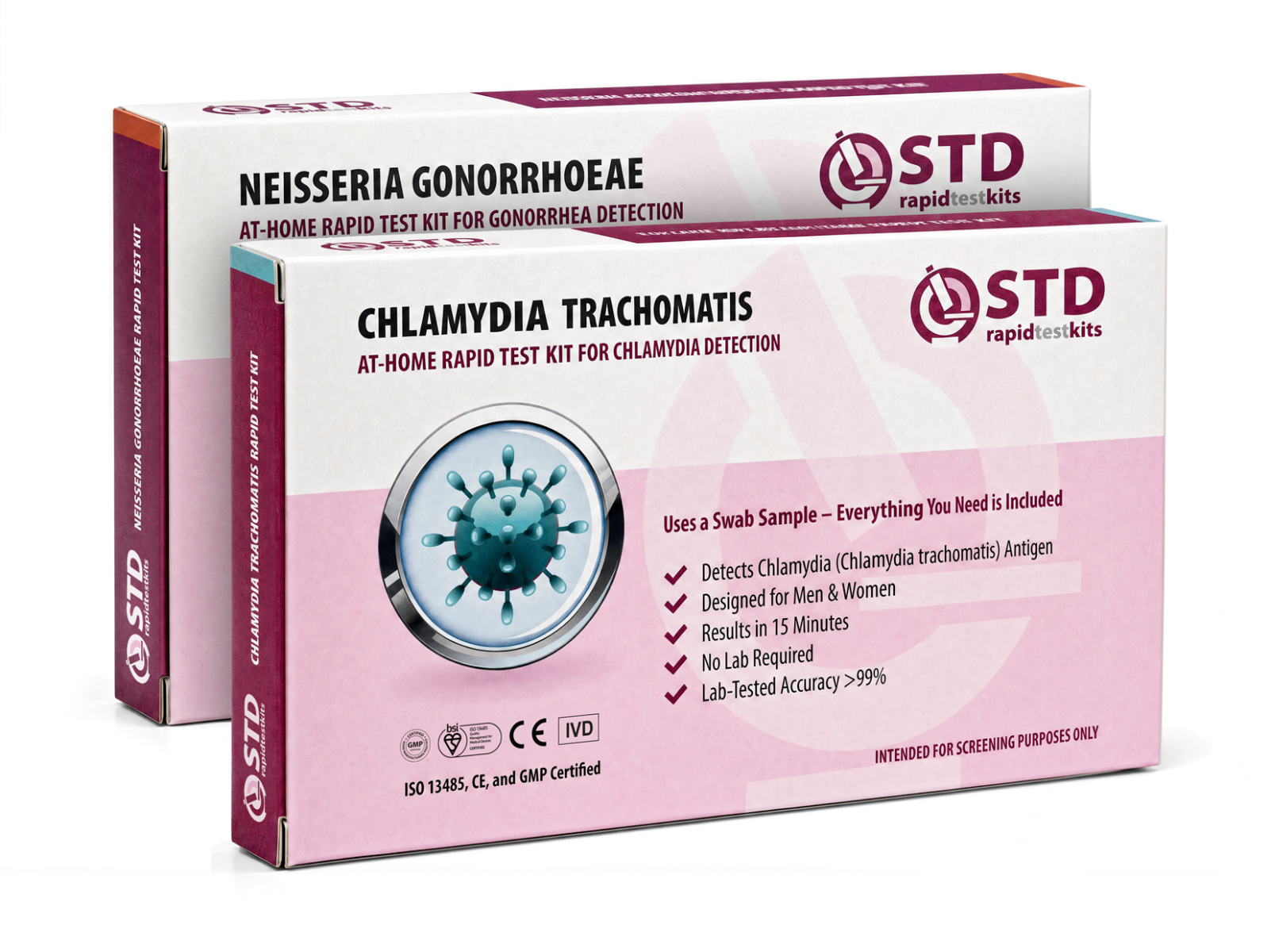
The at-home rapid kits sold on this site use lateral-flow chemistry on a self-collected genital swab (for chlamydia, gonorrhea, trichomoniasis, HPV) or a fingerstick blood draw (for HIV, syphilis, hepatitis B/C, HSV-1, HSV-2). They are screening tools designed for privacy and speed. A positive home result is worth confirming with a lab-grade NAAT or follow-up clinical work-up, and a negative result early in the window may need to be repeated once you're past the reliable testing point.
Shame is the loudest symptom, and the least helpful
Most sexually active adults will eventually face an STI scare. It doesn't make anyone reckless or 'dirty.' It means living in a body. Women tend to internalize extra layers of shame, especially when symptoms don't match expectations: 'I should have known.' 'I should have been more careful.' That self-blame delays care more often than lack of access does.
Testing belongs in the same category as checking blood pressure or cholesterol, a routine health decision with no moral weight attached. The body simply reacts to whatever it has been exposed to. When symptoms show up outside the vagina, in the throat, on the skin, in lymph nodes, or in unexplained fatigue, they deserve the same seriousness as any other sign.
Most people who have chlamydia have no symptoms.
If something feels off, that's enough
You don't need textbook symptoms to justify testing. You don't need discharge, itching, or visible sores to take your health seriously. If you've had a new partner, if a condom failed, if a sore throat showed up two weeks later and won't quit, that context is enough on its own.
STI symptoms in women aren't always vaginal. They can show up as fatigue, a rash that doesn't itch, pelvic pain that lingers past the usual cycle window, or no noticeable sign at all. The most useful move is getting tested at the right point in the window so you have actual information to work with rather than ongoing uncertainty.
FAQs
- I don't have discharge or itching. Could I still have an STI?
- Yes, and this is the part that doesn't get explained clearly enough. Many infections don't announce themselves with dramatic vaginal symptoms. Chlamydia and gonorrhea are often completely silent in women. Early HIV can feel like the flu. Syphilis can show up as a rash that doesn't even itch. No discharge doesn't mean no infection; it just means the body chose a quieter route.
- My only symptom is a sore throat. Could that really be an STI?
- It can be. If you've had oral sex, throat infections from chlamydia or gonorrhea are possible, and many women have zero genital symptoms at the same time. Most sore throats are still harmless. If yours started a week or two after a new partner and won't clear like a normal cold, getting tested is reasonable. A pharyngeal swab at a clinic is the right tool for a throat-specific result; at-home rapid kits cover the parallel genital and bloodwork risk from the same exposure.
- I feel run-down and achy. How do I know if it's stress or something like HIV?
- Context is everything. Stress is common. Viruses are common. If flu-like symptoms hit within a few weeks of a sexual exposure that already made you uneasy, that timing matters. Acute HIV can cause fever, swollen lymph nodes, fatigue, and rash typically 2 to 4 weeks after exposure. The only way to separate anxiety from biology is testing once you're inside the reliable window.
- What does an STI rash actually look like?
- There isn't one single 'STI rash.' The rash from secondary syphilis often appears on the palms of the hands or soles of the feet and may not itch at all. Early HIV can cause a flat red rash across the torso. If a rash shows up after a new sexual encounter, especially alongside fever or swollen nodes, it deserves attention even if it looks mild.
- Can pelvic pain really happen without discharge?
- Yes. If chlamydia or gonorrhea travel upward into the reproductive organs, they can cause pelvic inflammatory disease (PID). That may feel like dull cramps, deep pressure, or lower back pain, sometimes without noticeable discharge. If the pain lingers or worsens after unprotected sex, it's worth checking sooner rather than waiting for a louder symptom.
- I feel completely normal. Am I overthinking this?
- Maybe, maybe not. Many STIs are asymptomatic, especially in women. Screening isn't about proving something is wrong. It's about confirming that things are okay, or catching something early before it causes complications. Peace of mind is a valid reason to test.
- How soon is too soon to test?
- The earliest reliable check for chlamydia or gonorrhea is generally about a week after exposure for lab NAAT; the at-home rapid swab assays follow a similar window. HIV antigen/antibody tests need longer, with reliable detection by roughly 18 to 45 days. Testing the day after exposure usually won't be accurate because each infection has a measurable window period before it becomes detectable. An early negative may need a follow-up once you're past the reliable window.
- If I test positive, does that mean my life is over?
- No. Most STIs are curable with a short course of treatment. The ones that aren't fully curable, like herpes or HIV, are very manageable with modern treatment. People date, marry, have sex, have children, and live full lives. A diagnosis is information, and information is what gives you options.
How we sourced this article: We built this guide from current public-health and clinical guidance from the U.S. Centers for Disease Control and Prevention, the World Health Organization, and the Mayo Clinic, then translated incubation windows, symptom patterns, and testing-window math into plain English. We do not provide clinical diagnosis. For symptoms that concern you, see a licensed provider.
- U.S. Centers for Disease Control and Prevention. About Chlamydia, including symptom frequency in women.
- U.S. Centers for Disease Control and Prevention. About Gonorrhea, including pharyngeal infection notes and screening recommendations.
- U.S. Centers for Disease Control and Prevention. About Syphilis, including secondary-stage rash presentation on palms and soles.
- U.S. Centers for Disease Control and Prevention. About HIV, including acute infection (seroconversion) symptoms and 2 to 4 week onset window.
- World Health Organization. Sexually transmitted infections (STIs) fact sheet, including global prevalence and asymptomatic-presentation guidance.
- Mayo Clinic. Pelvic inflammatory disease (PID) symptoms and causes, including that PID symptoms can be mild or absent.
