Published: August 2025 | Last updated: May 2026 | Editorial review and quality control: Martina N.
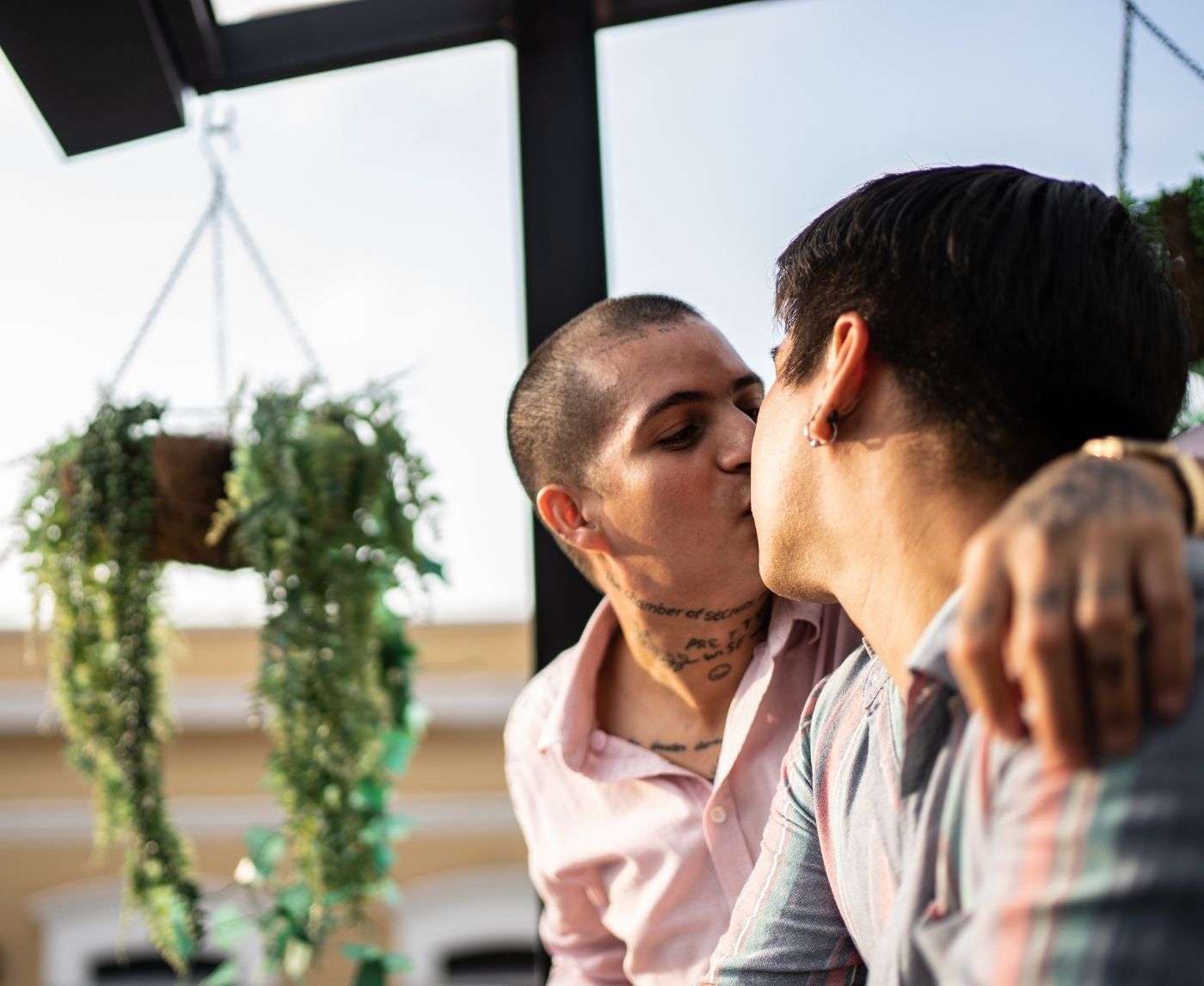
There's a reason 'can you get herpes from kissing' trends on Google every weekend. Not everyone has penetrative sex. Not everyone plans to hook up. But kissing happens, casually, chaotically, sometimes drunkenly, and the anxiety afterward is real. This guide is for the person rereading text messages at 2 a.m. and inspecting their lip in the bathroom mirror, not for clinicians who already know the answer.
Here is the honest, calm version up front. A few infections can pass through saliva or mouth-to-mouth contact. The biggest is herpes simplex virus type 1 (HSV-1), the virus behind most cold sores, carried by roughly two thirds of adults under 50 globally (WHO herpes simplex virus fact sheet). Mono (Epstein-Barr virus, sometimes called the 'kissing disease') is close behind. Syphilis and pharyngeal gonorrhea can pass during deep kissing, but documented rates are low. The infections people fear most, HIV, chlamydia, HPV, and trichomoniasis, do not spread through saliva or casual kissing; they require sexual or fluid contact with specific mucous membranes or blood.
For most people who Google this after a Friday night, the realistic worst case is a cold sore. For a smaller group, it is a manageable infection that responds well to treatment. For most, nothing happens at all. The sections below walk through what actually transmits, what early signs look like, when testing is worth it, and how to tell a sore throat from something that needs a clinic visit.
Key Takeaways
- Herpes (HSV-1) is the most common STI that spreads through kissing, and it can transmit even when no cold sore is visible.
- HIV, chlamydia, HPV, and trichomoniasis do not spread through saliva or kissing; they require different kinds of contact.
What Can Actually Spread Through a Kiss?
You cannot get chlamydia from kissing. You cannot get trichomoniasis, HPV, or HIV either. Those infections require contact with genital fluids, blood, or specific mucous-membrane exposure, not the standard spit exchange of a kiss. But there are exceptions, and they matter.
Herpes is the headline. Mono is the runner-up. Syphilis and pharyngeal gonorrhea sit in the 'rare but documented' column. The table below summarizes which infections actually transmit through kissing, how they do it, and how often.
| Infection | Spreads Through Kissing? | How It Happens | Real-World Risk |
|---|---|---|---|
| Herpes (HSV-1) | Yes | Skin-to-skin and saliva contact; viral shedding can occur even without a visible sore | Common, especially when one partner has a history of oral cold sores |
| Mono (Epstein-Barr virus) | Yes | Saliva exchange; once called the 'kissing disease' in college populations | Common in teens and young adults |
| Syphilis | Rare | Direct contact with a primary mouth sore (chancre) | Low but documented |
| Gonorrhea (pharyngeal) | Rare | Deep mouth-to-mouth contact with a partner who carries it in the throat | Documented mainly in high-turnover sexual networks |
| HIV, chlamydia, trichomoniasis, HPV | No | Require sexual or fluid contact; do not spread through saliva | No known risk from kissing alone |
Herpes Is the One to Actually Understand
When people Google 'can I get an STD from kissing', what they are usually afraid of is herpes. That fear is reasonable. According to the World Health Organization, an estimated 3.8 billion people under age 50 (about 64% of that age group) carry HSV-1 globally, the virus that causes most oral herpes (WHO 2023 fact sheet). Many people who carry it have no idea, because they have never had a visible cold sore.
Here is the part that surprises most readers. HSV-1 can transmit even when there is no sore on the carrier's mouth. The virus periodically sheds from skin cells around the lips and mouth, even on days the carrier feels and looks completely normal. This is called asymptomatic shedding, and it explains why HSV-1 is so widespread despite most exposures being unintentional (CDC about genital herpes).
So yes, a single kiss can transmit oral herpes, even from someone who feels fine and shows nothing visible. That said, a transmission event in any given encounter depends on three things: whether the other person is shedding at that moment, whether either party has small breaks in the skin or mucosa (chapped lips, recent dental work, a bitten cheek), and chance.
The more common picture is the one that holiday parties and first dates produce every year. Someone with no prior cold-sore history kisses a new person, notices a tingle on the upper lip about four to seven days later, and develops their first cold sore within a day or two of that tingle. Confirming acquisition with a blood antibody test requires waiting roughly 12 to 16 weeks for seroconversion. That window comes from FDA-cleared HSV type-specific antibody assay labelling; results taken earlier can come back negative even when infection occurred.
A first cold sore is not a moral verdict. It does not mean either person was reckless or dishonest. HSV-1 is genuinely common, and most carriers were exposed in childhood through non-romantic contact with a relative. Antiviral creams shorten outbreaks, and prescription oral antivirals (acyclovir, valacyclovir) can both treat active flares and reduce future ones when outbreaks become frequent.
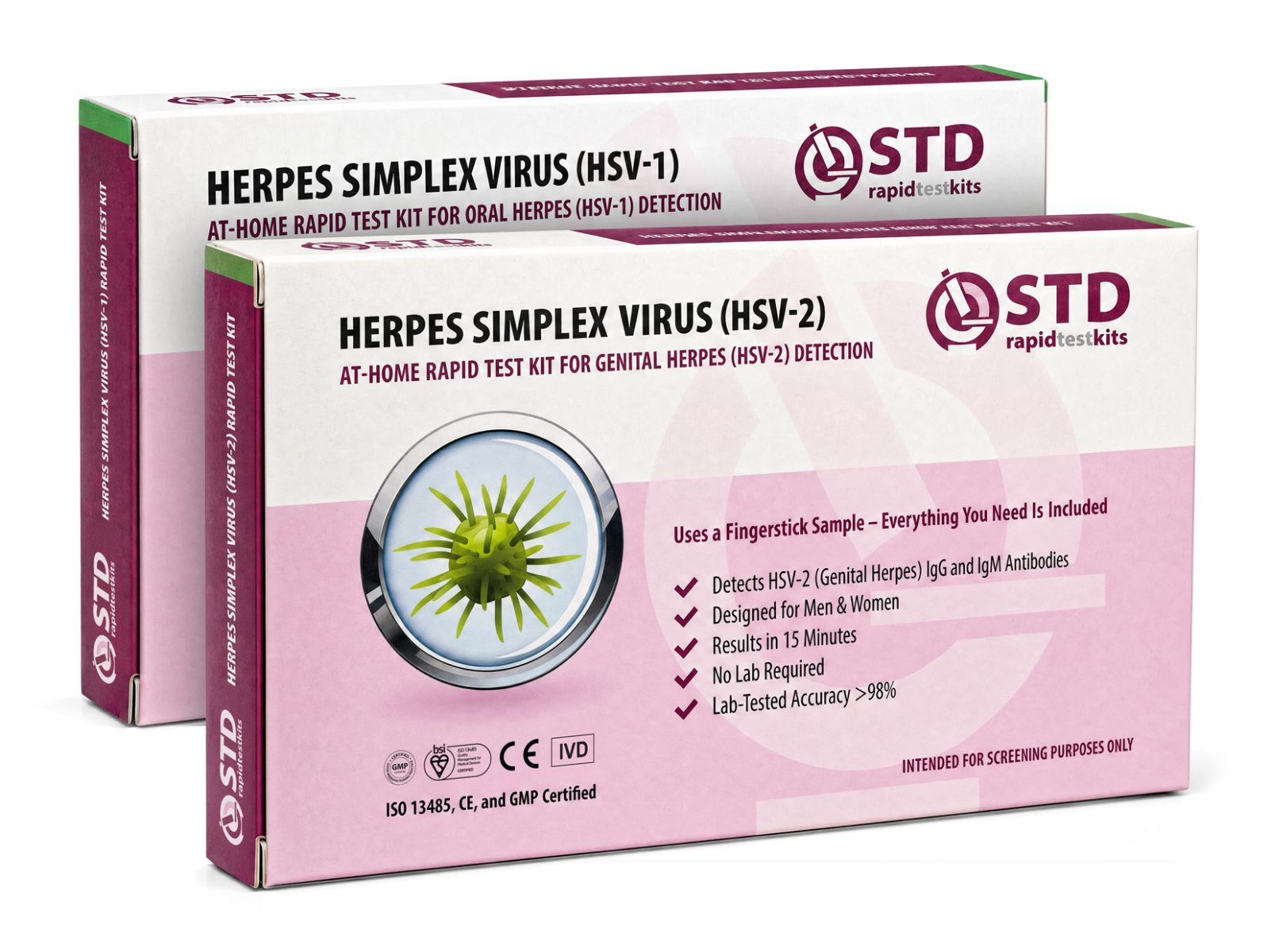
Our at-home tests are fingerstick blood draws or self-collected genital swabs. We do not carry a pharyngeal (throat) swab, so throat screening for gonorrhea or strep requires a clinic visit.
An estimated 3.8 billion people under age 50 (64%) have HSV-1 infection globally, the main cause of oral herpes.
What About a Sore Throat After Kissing?
A sore throat after a night of kissing is usually not an STI. Loud venues, shouting over music, smoke, alcohol, late nights, and breathing through the mouth all irritate the throat. So does an ordinary viral cold, which spreads the same way kissing does: through saliva.
That said, mono is real, and pharyngeal gonorrhea is real. Both can present as a sore throat. Focus instead on whether your symptoms and exposure history point toward an infection. That is the question worth asking your provider.
Patterns worth taking seriously include a sore throat that lasts more than five to seven days, fever, swollen glands behind the jaw, white patches on the tonsils, unusual fatigue lasting more than a week, or a sore throat that follows oral sex with a partner whose status is unknown. None of these are conclusive on their own, but together they justify a clinic visit and, where indicated, a throat swab.
- Sore throat lasting more than 5 to 7 days, or getting worse instead of better.
- Fever above 100.4°F (38°C) with throat pain.
- Swollen, tender glands behind the jaw or in the neck.
- White patches, pus, or ulcers visible on the tonsils.
- Unusual fatigue lasting more than a week (possible mono).
- Recent oral sex with a partner whose status is unknown.
Our at-home product line does not include a pharyngeal swab. Throat screening for gonorrhea or strep requires a clinic visit or a provider-supervised mail-in panel.
Can You Really Get Gonorrhea From Kissing?
The short answer is: rarely, but yes, it is documented. Oral gonorrhea (clinical term: pharyngeal gonorrhea) lives in the back of the throat and can spread through deep kissing with someone who carries it there. A 2019 cohort study of men who have sex with men in Melbourne, published in Sexually Transmitted Infections, found that kissing alone was associated with pharyngeal gonorrhea acquisition, independent of oral sex. The risk-per-kiss is small, but the population-level signal was real enough to shift how some sexual-health clinics counsel their patients.
The important caveat. The documented kissing-to-gonorrhea risk is concentrated in populations with high partner turnover and high background prevalence of pharyngeal infection. For someone worried after one unfamiliar kiss at a wedding, the absolute risk is very small. The CDC recommends routine pharyngeal gonorrhea screening for men who have sex with men based on oral exposure history (CDC STI treatment guidelines). It does not recommend pharyngeal screening for the general population on the basis of a single kissing exposure.
Practical takeaway. If you have a persistent sore throat (more than a week) and you have had any oral sexual contact, ask your provider for a throat swab. If your only exposure was a brief kiss with no other sexual contact, the right response is usually watchful waiting unless symptoms persist or worsen. Pharyngeal gonorrhea, when found, is treatable: the CDC recommends a single 500 mg intramuscular injection of ceftriaxone for adults under 150 kg, with follow-up testing about one to two weeks later to confirm clearance.
The kissing-transmission signal is real but heavily concentrated in sexual networks with high partner turnover and high background pharyngeal prevalence. A single unfamiliar kiss at a wedding, a bar, or a party, with no other sexual contact and no persistent symptoms, carries a very small absolute risk. The realistic action for low-risk readers is watchful waiting; testing makes sense when symptoms persist or when oral sexual contact was layered on top of the kiss.
Why Timing Matters More Than You Think
The most common mistake after any worrying exposure (sex, oral, or a long kiss) is testing too soon. STIs do not appear in the bloodstream or on a swab the morning after. The virus or bacterium has to multiply enough to be detected, and for blood tests, your body has to build enough antibodies to register. This delay is called the window period, and it varies by infection.
If you kiss someone on a Friday night, feel a tingle on Sunday, panic-buy a herpes test Monday, and run it Tuesday, you have a real chance of a falsely negative result. The result can come back negative even when infection occurred, because your body has not yet had detectable antibodies. The same logic applies to syphilis blood tests run within the first few weeks, and to gonorrhea swabs taken within 24 to 48 hours of exposure.
The table below summarizes realistic window periods for the infections that can transmit through kissing. These are conservative ranges drawn from CDC guidance and FDA test labelling; specific kit instructions can differ slightly.
| Infection | Sample Type | Window for Reliable Result | Notes |
|---|---|---|---|
| HSV-1 / HSV-2 antibody (blood) | Fingerstick blood | About 12 to 16 weeks post-exposure | Earlier results can be falsely negative; retest at the right window if uncertain |
| HSV swab from an active sore (clinic) | Lesion swab (PCR) | 1 to 7 days during an outbreak | Most accurate when a fresh blister is still present |
| Pharyngeal gonorrhea (clinic) | Throat swab (NAAT) | 5 to 14 days post-exposure | Not available as an at-home test; clinic visit required |
| Syphilis (rapid antibody) | Fingerstick blood | 3 to 6 weeks after a primary sore appears | Confirm any positive rapid result with full clinic serology |
| Mono (Epstein-Barr virus) | Blood draw (clinic) | 1 to 4 weeks after symptoms begin | Treatment is rest, not antibiotics |
What Testing Actually Looks Like
For HSV-1 and HSV-2, at-home testing is a fingerstick blood test that detects antibodies your body produces in response to herpes infection. The home blood test is useful from roughly 12 weeks post-exposure, when seroconversion is reliably detectable. If you have an active sore right now, the most accurate test is a swab from the lesion analyzed by PCR at a clinic, which detects viral DNA directly. The home blood test answers 'have I ever been infected with this virus' rather than 'is this specific sore active right now.'
For syphilis, testing is bloodwork. At-home rapid lateral-flow tests detect antibodies; clinics use treponemal plus non-treponemal serology to confirm and stage infection. The reliable window is roughly three to six weeks after a primary sore appears.
For pharyngeal gonorrhea, screening requires a throat swab analyzed by NAAT or culture at a clinic. As mentioned above, our at-home product line does not include a throat swab. A clinic visit or a provider-supervised mail-in panel is the correct route here.
For mono, blood tests look for heterophile antibodies and Epstein-Barr-specific antibodies (CDC about EBV). Mono is generally screened at clinics rather than at home, and a positive result is managed with rest, not antibiotics.

What If You Test Positive After Kissing?
A positive test for an oral-transmissible infection is not a life sentence. It is information. The next steps depend on which infection.
For HSV-1, the vast majority of carriers manage outbreaks at home with over-the-counter antiviral creams (docosanol, acyclovir cream) or prescription oral antivirals (acyclovir, valacyclovir) for active flares. Many carriers never have a symptomatic outbreak after the initial one. Daily suppressive antiviral therapy is an option for people with frequent flares or who want to lower transmission risk to a regular partner.
For pharyngeal gonorrhea, the CDC recommends a single 500 mg intramuscular injection of ceftriaxone for adults under 150 kg (CDC STI treatment guidelines). Treatment is fast and highly effective. Follow-up testing about one to two weeks after treatment confirms clearance.
For syphilis, primary and secondary infection are treated with a single intramuscular injection of benzathine penicillin G, per the CDC STI treatment guidelines linked above. Treatment is highly effective when given early, and the earlier the better for preventing long-term complications (CDC about syphilis).
For mono, there is no antiviral that shortens the course. Rest, hydration, and time are the treatment. Most adults feel substantially better within two to four weeks, with full energy returning over a longer recovery period.
A positive result is also a conversation about partner notification. Telling a recent partner is generally the right thing to do, but it does not have to be elaborate. A short, factual message ('I tested positive for X. I wanted you to know in case you want to test yourself') is usually enough.
Before You Spiral, Here Is What to Do Next
If you are reading this at 2 a.m. and inspecting your lips for the third time, work through the practical sequence below. For someone whose only worry is kissing and whose timeline supports it, the highest-value test is the herpes antibody panel, run roughly 12 to 16 weeks after exposure. For someone with broader exposure concerns, a combo kit that covers HIV, syphilis, hepatitis B and C, plus chlamydia and gonorrhea (genital, not pharyngeal) makes more sense. For pharyngeal screening specifically, the answer remains a clinic visit. You do not need to apologize for caring about this. Sexual-health testing is healthcare, and at-home kits exist precisely so the decision to test does not have to be tied up in clinic schedules, embarrassment, or judgment.
Your three-question decision tree
- Step one: Do you have symptoms right now? If yes, what are they, and how long have they been present? Symptoms shape which test makes sense.
- Step two: When was the exposure? Within the last week, most blood-based STI tests are not yet reliable; plan to retest at the proper window.
- Step three: Was there other contact (oral sex, vaginal or anal sex) layered on top of the kiss? If yes, those are the bigger testing concerns, not the kiss itself.
FAQs
- Can you actually get an STI from kissing?
- Yes, but only a few. Herpes (HSV-1) is the most common, and it can spread even when no sore is visible. Mono (Epstein-Barr virus) also spreads through saliva. Syphilis and pharyngeal gonorrhea can transmit during deep kissing, but documented rates are low. Chlamydia, HPV, trichomoniasis, and HIV do not spread through saliva or casual kissing.
- I kissed someone at a bar and now my throat feels off. Should I worry?
- Probably not yet. Loud venues, smoke, alcohol, dehydration, and ordinary viral colds all irritate the throat. If the soreness lasts more than five to seven days, comes with fever, swollen neck glands, or white patches on the tonsils, see a provider. If you also had oral sex (not just a kiss) with someone whose status you do not know, mention that during the visit; a throat swab may be the right test.
- What if I kissed someone with a cold sore?
- That is the highest-risk kissing scenario for HSV-1 transmission, but it is still not guaranteed. The virus sheds most heavily when a sore is present or just about to appear. Watch for a tingle, burning, or small blister on the lip or around the mouth over the next four to twelve days. If symptoms develop, an antiviral cream from a pharmacy will shorten the outbreak. To confirm whether you actually acquired the virus, wait roughly 12 to 16 weeks and run a blood antibody test.
- Can you really get gonorrhea from kissing?
- It is documented but rare. A 2019 cohort study of men who have sex with men in Melbourne found kissing alone was associated with pharyngeal gonorrhea acquisition, independent of oral sex. The risk-per-kiss is low and concentrated in populations with high partner turnover. The CDC recommends pharyngeal screening based on oral sexual exposure history, not routinely after a single kiss.
- Can herpes spread if there is no visible cold sore?
- Yes, through a process called asymptomatic shedding. Even on days with no visible sore, live virus can be present on the skin around the lips. Daily antiviral medication lowers this shedding risk, and avoiding contact during the prodrome (the tingling phase before a sore appears) helps further, though neither eliminates transmission risk entirely.
- I tested negative five days after kissing. Am I clear?
- Not necessarily. Most blood-based tests need weeks to produce a reliable result because they detect antibodies your body has to build. For HSV antibodies, the window is roughly 12 to 16 weeks. For syphilis, three to six weeks. A test taken five days post-exposure can be a true negative or a false negative; you usually cannot tell the difference without retesting at the right window.
- Are all cold sores herpes?
- Yes. A cold sore on or around the lip is, by definition, an HSV outbreak, almost always HSV-1. The virus lives in the trigeminal nerve and reactivates intermittently under stress, illness, sun exposure, or hormonal changes. Some people have one outbreak in a lifetime; others flare repeatedly. Topical and oral antivirals make outbreaks shorter and milder.
- Should I tell someone I kissed that I tested positive?
- For HSV-1 specifically, it is courteous but not always essential, because the virus is so widespread that most adults have already been exposed. For pharyngeal gonorrhea or syphilis, the answer is yes; both are treatable, and your partner needs to know so they can be tested and, if needed, treated. Keep it short and factual.
- U.S. Centers for Disease Control and Prevention. About genital herpes; transmission, symptoms, and asymptomatic shedding.
- World Health Organization. Herpes simplex virus fact sheet; global HSV-1 prevalence (3.8 billion under age 50) and transmission via oral contact.
- U.S. Centers for Disease Control and Prevention. About Epstein-Barr virus; mononucleosis transmission and diagnosis.
- U.S. Centers for Disease Control and Prevention. STI treatment guidelines (2021) landing page; pharyngeal gonorrhea screening, ceftriaxone dosing, and benzathine penicillin G for primary and secondary syphilis.
- U.S. Centers for Disease Control and Prevention. About syphilis; stages, transmission, and clinical overview.
- U.S. Centers for Disease Control and Prevention. About gonorrhea; transmission, symptoms, and screening recommendations.
