
Published: August 2025 | Last updated: May 2026 | Editorial review and quality control: Martina N.
Do I have to tell my partner right away?
Tell partners within days of a positive test or credible exposure. CDC guidance recommends notifying anyone inside the look-back window: 60 days for chlamydia and gonorrhea, up to 12 months for early-latent syphilis, and back to your last negative test for HIV. If direct contact feels unsafe, anonymous tools and public health partner services can notify them without naming you.
Telling a partner about an STD diagnosis is one of the hardest conversations in adult life. The reasons people delay are familiar: shame, fear of rejection, worry about being blamed, and the quiet hope that staying silent might make the problem disappear. None of those reasons slow the infection. They just delay a conversation that almost always goes better when it happens early.
This guide is for the moment after a positive test (whether from a clinic or an at-home rapid test), after a worried text from a former partner, or after symptoms that finally crossed the line from background anxiety to active concern. It covers who needs to know (with the infection-specific CDC look-back windows public health departments use), what to say (with scripts for four common situations), three legitimate notification routes including anonymous options, the legal shortcut called Expedited Partner Therapy, and the retesting milestones that prevent reinfection. The framing throughout draws on current CDC, WHO, and NHS guidance.
(This article is published by stdrapidtestkits.com, which sells at-home STI test kits. Products referenced below are recommended based on fit for the reader's situation, not commercial benefit.)
Key Takeaways
- Tell partners as soon as practical after a positive test or credible exposure; CDC partner-services programs can notify someone confidentially on your behalf when a direct conversation feels unsafe.
- You have three legitimate routes: in person, free anonymous online tools, or your local health department's Disease Intervention Specialists. The right choice depends on logistics and safety.
Why partner notification matters
Three things make notification disproportionately useful relative to how uncomfortable it feels. The first is silent infection. CDC guidance on chlamydia and gonorrhea notes that both infections often produce no symptoms even while they cause damage. Untreated bacterial STIs can progress to pelvic inflammatory disease (an infection that spreads from the cervix to the uterus and fallopian tubes) and tubal-factor infertility in people with female reproductive anatomy (NHS: pelvic inflammatory disease). Without notification, a partner has no signal that anything is wrong, no reason to test, and no path to treatment.
The second is the reinfection cycle. Even when you complete treatment perfectly, sleeping with an untreated former partner reinfects you with the same organism. Public health workers call this the ping-pong effect, and it happens often enough with chlamydia and gonorrhea that the CDC recommends a routine retest at three months after treatment for both infections.
The third is network spread. STIs travel through sexual networks, not isolated pairs. A single untreated case can seed the next wave of infections through anyone the partner has slept with since exposure. The WHO STI fact sheet treats partner treatment as an essential component of STI case management for exactly this reason.
Think of disclosure as a clinical step in stopping a chain of transmission, not as a moral confession. The goal is to give someone the same information you would want about your own health.
Untreated syphilis can damage the cardiovascular and nervous systems over months to years. Undiagnosed HIV without treatment carries higher transmission risk and worse long-term outcomes. Neonatal transmission of syphilis, HIV, gonorrhea, chlamydia, or herpes during pregnancy or delivery can cause permanent disability or death. Prompt notification gives partners time to test and start treatment before complications develop.
What counts as exposure
You do not need a confirmed positive test to start the conversation. Exposure means there was a credible chance of transmission and that the partner has a real reason to test. Common scenarios that warrant a heads-up:
- A current or recent partner tells you they tested positive.
- You develop symptoms consistent with an STI: genital sores, unusual discharge, painful urination, or a non-itchy rash consistent with secondary syphilis.
- You receive a positive test result and have had sex with anyone in the relevant look-back window.
- You learn of bloodborne exposure (shared injection equipment, condom failure with a partner of unknown status).
Some infections, including herpes, HPV, and syphilis chancres, can transmit through skin-to-skin contact even when condoms are used, because they affect areas outside the condom's coverage. If there was a realistic chance of transmission, the partner should have the information they need to decide whether to test.
You do not have to be certain to start the conversation. A short, calm heads-up that says "there is a chance you were exposed, here is what I know, here is what I am doing about it" gives the other person what they need to make their own testing decision. A false alarm is recoverable. An unnotified exposure that turns into an untreated infection is not.
The look-back windows: which partners need to know
The first practical decision after a positive test is figuring out who needs to hear from you. Public health uses infection-specific time windows for this, anchored to each organism's biology. The window asks: how far back could you plausibly have been infectious? Anyone you had sexual contact with inside that window belongs on the notification list.
The CDC's STI Treatment Guidelines and partner-services guidance inform the standard look-back windows used by Disease Intervention Specialists across U.S. health departments. These are the same windows your local STI clinic will work from if you ask them to handle notifications on your behalf. If you cannot remember exact dates, approximate timing works; most clinicians work with rough timeframes. When in doubt about whether a partner falls inside or outside the window, include them.
| Infection | Look-back window | Why this window |
|---|---|---|
| Chlamydia | 60 days before symptoms or diagnosis | Average incubation plus the contagious period; often asymptomatic |
| Gonorrhea | 60 days before symptoms or diagnosis | Same logic as chlamydia; the two frequently co-occur |
| Syphilis (primary) | 3 months plus duration of symptoms | Covers the typical 10 to 90 day incubation before a chancre appears |
| Syphilis (secondary) | 6 months plus duration of symptoms | Secondary symptoms emerge later; the at-risk window is wider |
| Syphilis (early latent) | 12 months before diagnosis | Asymptomatic but still infectious; covers the full estimated period |
| HIV | Last documented negative test, or the full estimated infectious period | Prompt antiretroviral therapy and partner testing improve outcomes |
| Herpes (HSV-1, HSV-2) | Before any sexual contact in a new relationship | Transmits between visible outbreaks; informed consent matters for ongoing partners |
| Trichomoniasis | Current and recent partners (no formal window) | Easily treated, but reinfection is common when only one partner is treated |
How to decide who to notify and how
Once you have your list of partners from the look-back window, the next question is how to reach each one. The choice depends on two things: whether direct contact is realistic, and whether it is safe.
Choosing a Notification Route
Can you contact this partner directly, and is it safe for you to do so (no history of violence, threats, or coercion)?
Yes: Tell them in person or by direct message. Name the infection, give a clear next step (get tested this week), and keep the conversation practical. Use one of the scripts below.
No: If direct contact is unsafe or not possible, move to the next question.
Do you have at least partial contact information for this partner (phone number, email, or dating-app handle)?
Yes: Send an anonymous notification through TellYourPartner.org or DontSpreadIt.com. The service delivers the message without revealing your identity.
No: Call your local health department's STI clinic and ask for partner services. Disease Intervention Specialists can sometimes locate partners from partial details and will handle the notification confidentially.
Your safety comes first. Any of these routes counts as responsible notification.
Scripts that work in real conversations
Most people know they need to say something; the harder part is finding the words. The CDC's communication guide on how to talk about STDs reinforces three principles the best disclosures share: name the infection, give a clear next step, and skip the apology spiral. Apology framing puts the partner in the position of accepting or rejecting the apology instead of focusing on the medical information. Practical framing lets them respond to what they actually need: a reason to test. The scripts below are starting points; edit them for your relationship, your tone, and the specific infection.
Negative reactions happen and are usually shorter than people fear. Anger or stunned silence in the first hour often softens within a day. If a partner becomes hostile or threatening, step back from direct contact and use a public health intermediary instead. If you are in a controlling or abusive relationship, the CDC recommends anonymous notification tools or clinic-led partner services rather than direct disclosure.
Current or recent partner: "I want to tell you something important. I tested positive for chlamydia. I'm being treated, and it's curable, but you should get tested as soon as you can. I wanted to be upfront so we can both take care of this. I'm here if you want to talk through what to do next."
Suspected exposure, results pending: "A previous partner let me know they tested positive for an STI, and we were intimate within the relevant window. I haven't tested yet, but I wanted you to know now so you can decide whether to get tested too. I'll share my result as soon as I have it."
Casual or one-time partner: "Hi. This may feel awkward, but I think it's the right thing to do. There's a chance I exposed you to an STI. You might want to get tested. I just didn't want to leave you without the information."
New partner, existing diagnosis: "Before things go further, I want to share something. I have HSV-2 (or HPV, or another diagnosis). I'm on suppressive treatment, transmission risk with precautions is low, and I'm happy to answer questions or wait while you take time to think."
Three ways to deliver the news
You have three legitimate options, and they are not ranked by moral worth. The right choice depends on the relationship, the timeline, and whether direct contact is safe.
1. In person or by direct message. You can answer questions in real time, give context about timing, and make clear you handled your own testing and want the same for them. Choose this when the relationship has enough trust to absorb the news and you have the energy to do it well.
2. Anonymous online notification. Free services like TellYourPartner.org (run by Cicatelli Associates with U.S. health-department support) and DontSpreadIt.com let you enter a partner's email or phone number and the infection involved. The service sends a neutral, templated message recommending testing. Your name is not included unless you choose to add it. These tools work well for former partners, casual encounters, or any situation where direct contact would create safety concerns.
3. Public health partner services. Every U.S. state and most counties have Disease Intervention Specialists (DIS) at the local health department who will do the notification for you. The CDC's partner-services program is the umbrella under which most state-level programs operate. You provide names and contact information; they reach out without revealing who gave the information, offer testing, and connect partners with treatment. In some jurisdictions this route is required for syphilis and HIV reporting. To start, call your local health department's STI clinic directly. The conversation is confidential and free.
When a partner is hard to reach. If you have lost contact with someone inside a look-back window, public health partner services can sometimes find them using partial information: a first name, a dating-app handle, or a last-known location. Call your local STI clinic and explain the situation. If contacting a partner is unsafe because of abuse or coercion, do not attempt direct contact; tell the clinic, and they will route the notification through Disease Intervention Specialists without pressuring you toward a direct conversation.
Partner services help find sex or needle-sharing partners of people with HIV, syphilis, gonorrhea, or chlamydia, so those partners can be tested and, if needed, treated.
Expedited Partner Therapy: the legal shortcut for chlamydia and gonorrhea
For chlamydia and gonorrhea specifically, U.S. clinical practice includes an option called Expedited Partner Therapy (EPT). EPT lets the clinician treating you write a prescription (or hand you the medication directly) for your partner to take without requiring that partner to come in for a separate visit. The bottleneck in partner treatment is rarely the medication; it is getting the partner through a clinic door. EPT removes that barrier.
EPT is permissible in most U.S. states for chlamydia and gonorrhea and is endorsed by the CDC because it substantially reduces reinfection rates. It works best when a partner refuses to seek care, lives far from a clinic, or faces insurance barriers. A full clinic visit is still the better outcome when realistic, since it catches co-infections that EPT does not. If your clinician does not bring up EPT and your state allows it, you can ask.
A partner using EPT skips a full clinical exam. They are not screened for HIV, syphilis, hepatitis, or anything else they might be carrying alongside the chlamydia or gonorrhea you tested positive for. EPT is a useful shortcut when a clinic visit is impractical; it is not a substitute for a complete sexual-health workup when one is realistic.
How partners typically react
Reactions to disclosure vary widely, and most of the variation is about the partner, not about you. Common responses include gratitude, fear, confusion, anger, and temporary withdrawal. Public health experience with partner-notification programs consistently shows that timely disclosure improves testing uptake and limits reinfection compared to delayed or absent disclosure. Whatever the response, your job is to deliver clear information calmly and step back from any conversation that turns hostile.
- Anger or blame. Stay calm. The reaction is about the news, not about you specifically. Many STIs are asymptomatic for months, so tracing the exact chain of transmission is often impossible. Refocus on practical next steps: testing, treatment, and prevention.
- Accusations of cheating. HSV and HPV can go undetected for years. Bacterial STIs are often silent for weeks to months. A new positive result rarely pinpoints when or from whom the infection came. Share the clinical context calmly and offer to take the testing step together.
- Ghosting. If they choose not to respond, the choice is theirs. You have given them what they need to protect their own health.
- Threats or violence. Stop direct contact and switch to anonymous notification or clinic-led partner services. If you are in immediate danger, contact the National Domestic Violence Hotline at 1-800-799-7233.
After the conversation: treatment, retesting, and prevention
Disclosure is the start of the medical process, not the end. The next steps are concrete.
Treatment. Bacterial STIs (chlamydia, gonorrhea, syphilis, trichomoniasis) are curable with antibiotics. Viral STIs (HIV, HSV, HPV, hepatitis B) are managed with antivirals, and hepatitis C is now curable with direct-acting antiviral courses. The CDC recommends abstaining from sex for seven days after starting treatment for chlamydia or gonorrhea, and until both partners have completed treatment and any symptoms have resolved (CDC chlamydia treatment guidelines). For a partner using EPT, the same seven-day clock starts the day they take the medication.
The 3-month retest. The CDC does not routinely recommend a test-of-cure for typical genital chlamydia or gonorrhea in non-pregnant adults, because the standard regimens are effective and an early follow-up positive usually represents reinfection rather than treatment failure. What the CDC does recommend is retesting at three months, and it is the step most people skip. Even after successful treatment, both you and your partner should retest for chlamydia and gonorrhea at the three-month mark, regardless of symptoms. For syphilis, follow-up blood tests track titers on a schedule set by your provider, typically at 6 and 12 months for early-stage cases (CDC syphilis treatment guidelines). Pharyngeal gonorrhea, rectal infections, and pregnancy each have their own follow-up rules; ask your clinician about your specific situation.
Prevention going forward. Condoms substantially reduce risk for fluid-borne STIs (HIV, gonorrhea, chlamydia) and provide partial protection for skin-to-skin infections (HSV, HPV, syphilis). HPV vaccination is recommended through age 26 for routine vaccination, with shared clinical decision-making through age 45, per ACIP guidance. Suppressive antiviral therapy for HSV-2 reduces both outbreak frequency and transmission to partners. For people at substantial HIV risk, pre-exposure prophylaxis (PrEP) is highly effective and worth discussing with a clinician.
Routine screening. For sexually active adults with multiple partners, the CDC recommends screening every 3 to 6 months for chlamydia, gonorrhea, syphilis, and HIV. Annual screening is the minimum for most other sexually active adults. Routine screening normalizes testing and removes much of the emotional weight from any single disclosure conversation.
Day 0: positive result; treatment starts.
Day 0 to 7: notify partners; partners begin treatment or use EPT.
Day 1 to 7 after starting treatment: avoid sex.
3 months later: both you and your partner retest for chlamydia and gonorrhea, regardless of symptoms.
6 and 12 months: blood-titer follow-up for early-stage syphilis, scheduled by your provider.
Testing together as a reframe
For couples on stable ground, an invitation often lands better than a confession. "Want to get tested together?" reframes the moment from "I did something wrong" to "we both deserve clarity." Couples who test together tend to stay engaged with treatment and safer-sex practices, and the shared step removes the asymmetry that fuels blame.
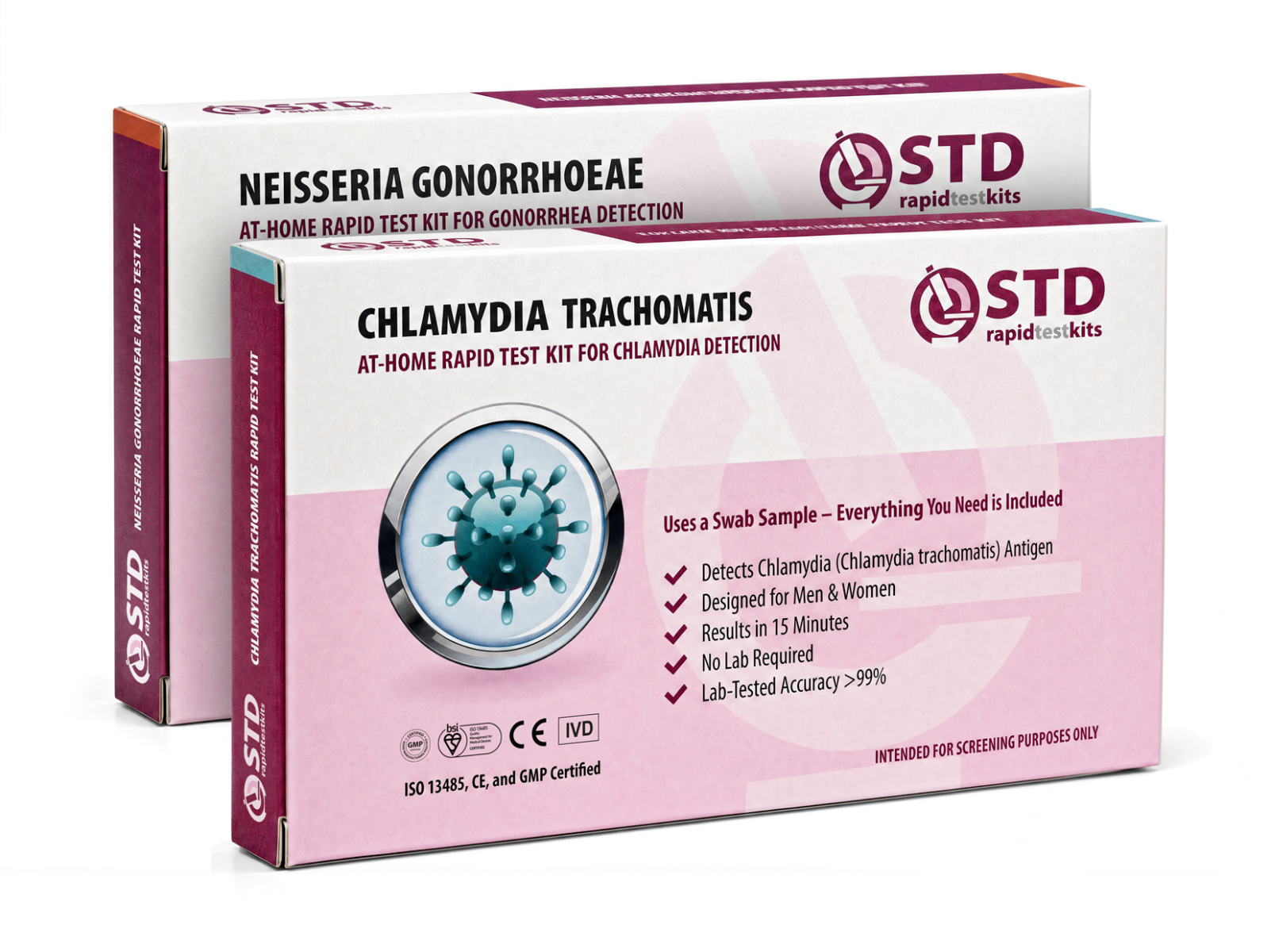
At-home rapid kits make paired testing practical without scheduling two separate clinic appointments. Both partners can test at the same time, get results within roughly 15 minutes, and have an honest conversation grounded in the same data rather than waiting days for separate lab results.
Your Next Steps This Week
- Confirm your result with a clinician if you used an at-home test, and start treatment the same day if possible.
- Notify every partner inside your look-back window using whichever route fits the relationship: a direct conversation, an anonymous service, or your local health department's partner services.
- Abstain from sex for seven days after starting treatment for chlamydia or gonorrhea, and until both you and your partner have finished treatment.
- Mark your calendar for the 3-month retest for chlamydia and gonorrhea, regardless of symptoms. For syphilis, follow your provider's titer-check schedule at 6 and 12 months.
FAQs About Telling a Partner About an STD
- How soon after my diagnosis should I tell my partners?
- As soon as practical, ideally within a week. Bacterial STIs like chlamydia and gonorrhea are treatable in a single visit, so the faster a partner gets to a clinic, the faster the chain breaks. For HIV and syphilis, prompt notification matters even more because treatment timing affects long-term health outcomes.
- How far back should I notify partners?
- For chlamydia and gonorrhea, the CDC recommends approximately the past 60 days. For syphilis, the window scales by stage: 3 months plus symptom duration for primary, 6 months plus symptom duration for secondary, and 12 months for early latent. For HIV, the window extends back to your last documented negative test.
- Do I legally have to tell my partner about an STD?
- It depends on the infection and where you live. Several U.S. states have laws requiring HIV disclosure before sexual contact, and some extend similar provisions to other STIs. Even where disclosure is not legally required, public health guidance treats it as the standard of care, and silence can carry civil consequences in some jurisdictions. When in doubt, ask the clinic that diagnosed you.
- Can I notify a partner anonymously?
- Yes. Free anonymous services like TellYourPartner.org and DontSpreadIt.com send templated notifications without revealing your identity. Local health departments also offer confidential Disease Intervention Specialist services that contact partners on your behalf.
- What if my partner refuses to get tested?
- You cannot force a test, but you can make the next step as easy as possible. Share clinic information, mention that at-home test kits exist for many common infections, and note that some bacterial STIs can be treated without a full exam through Expedited Partner Therapy. If they still decline, your responsibility ends with informing them clearly.
- We used a condom. Am I off the hook?
- Not entirely. Condoms reduce risk substantially for fluid-borne infections like HIV, chlamydia, and gonorrhea, but they offer less protection against skin-to-skin infections like HSV, HPV, and syphilis lesions outside the condom area. If you tested positive for any of those, telling a recent partner is still the right call.
- My partner tested negative. How is that possible if I'm positive?
- Window periods explain most cases. Many STIs are not detectable for the first days or weeks after exposure. HIV antibody tests, for example, can take up to 90 days to turn positive depending on the test type. Have your partner retest at the appropriate later date rather than treating an early negative as definitive.
- Should I get retested after treatment?
- For bacterial STIs, yes. Reinfection rates after chlamydia or gonorrhea treatment are high enough that a follow-up test at the three-month mark is the standard CDC recommendation, especially when a partner was not also treated. Syphilis follow-up uses blood-based titer tracking on a schedule set by the treating clinician.
- U.S. Centers for Disease Control and Prevention. Next steps after testing positive for gonorrhea or chlamydia, including treatment timing and partner notification.
- U.S. Centers for Disease Control and Prevention. Partner services for HIV and STIs, including the clinical framework for Disease Intervention Specialists, anonymous notification programs, and intimate-partner-violence safety considerations.
- U.S. Centers for Disease Control and Prevention. STI Treatment Guidelines for chlamydial infections, including the 60-day partner-notification look-back period, the 7-day post-treatment abstinence recommendation, and the 3-month retest recommendation.
- U.S. Centers for Disease Control and Prevention. STI Treatment Guidelines for syphilis, including stage-specific partner-notification look-back windows (3 months plus symptom duration for primary, 6 months for secondary, 12 months for early latent).
- U.S. Centers for Disease Control and Prevention. Expedited Partner Therapy clinical guidance, including the rationale for use with chlamydia and gonorrhea and state-by-state legal status.
- World Health Organization. Sexually transmitted infections fact sheet, including the role of partner treatment and notification in STI case management.
- National Health Service (UK). Pelvic inflammatory disease overview, including how untreated chlamydia and gonorrhea can progress to PID and affect fertility.
- U.S. National Library of Medicine (MedlinePlus). Pelvic inflammatory disease overview, including causes from untreated STIs, complications such as tubal-factor infertility, and prevention through routine screening.
