
Published: August 2025 | Last updated: May 2026 | Editorial review and quality control: Martina N.
A sore throat the morning after oral sex usually has a boring explanation. Friction, a dry hotel room, alcohol the night before, the start of the seasonal cold that everyone at work has. Sometimes, though, a throat that stays raw for several days, develops white spots, or swells without any of the usual cold symptoms is doing something different. Certain sexually transmitted infections can take up residence in the back of the throat, and most of them are quiet enough that you would not guess what they are from the symptoms alone.
This guide covers which infections show up there, how long after exposure symptoms tend to appear, why most cases are not an STD at all, what a useful test looks like in 2026, and how to lower the risk going forward.
Key takeaways
- Most sore throats the morning after oral sex are friction or a virus, not an STD; throat infections usually need 2 to 10 days or longer to cause noticeable symptoms.
- Standard STD panels test urine and blood. They do not catch throat gonorrhea or pharyngeal chlamydia unless you specifically ask for a throat swab at a clinic.
Why the Throat Is a Quiet Site for Some STDs
The lining of the throat is mucous membrane, the same tissue type that covers the inside of the genitals and rectum. Several STIs are well adapted to that tissue, which is why oral sex can pass them in either direction. The tonsils, the soft palate, and the back of the pharynx all give bacteria like Neisseria gonorrhoeae somewhere to settle and reproduce.
Clinicians sometimes call these pharyngeal or oral STDs. Pharyngeal just means "of the throat." The infections themselves behave a little differently when they land in the throat than they do in the genitals. Genital infections often cause obvious local symptoms: discharge, burning when you urinate, visible irritation. Throat infections frequently do none of that. According to the U.S. Centers for Disease Control and Prevention STI Treatment Guidelines, pharyngeal gonococcal infections are usually asymptomatic, and most people who carry them in the throat have no idea. The same pattern, mostly silent and occasionally symptomatic, applies to throat chlamydia.
That quiet pattern is the reason "sore throat after oral sex" is a less reliable warning sign than people assume. The infection that is most likely to be there often produces nothing to feel, and the throat sometimes clears the infection on its own without anyone knowing it was there. Public-health programs still take pharyngeal carriage seriously because the throat can transmit to a partner's genitals during oral sex even when the carrier feels fine. The CDC's gonococcal-infection guidance specifically recommends annual pharyngeal screening for men who have sex with men with receptive oral exposure in the past year for exactly this reason.
The pharynx shares mucous-membrane tissue with the genitals and rectum, which is what allows the same bacterial STIs to colonize all three sites. Different anatomy, same biology.
When the Sore Throat Probably Is Not an STD
Most post-oral-sex throat irritation turns out to be nothing serious. The throat is sensitive tissue. It reacts to dry air, screaming over loud music, smoke, alcohol, postnasal drip from allergies, acid reflux, the abrasion of oral sex itself, and every common winter virus. Most "morning after" sore throats fall into one of those buckets and resolve in a day or two.
The single biggest tell is timing. Bacteria and viruses that cause STDs need an incubation period before symptoms appear, typically several days at minimum. A throat that is sore the very next morning, especially after a late night, is far more likely to be friction or a developing cold than a fresh infection. Symptoms that show up four or five days later and stick around are a different conversation.
The second tell is the company the soreness keeps. Cold viruses usually arrive with a runny nose, sneezing, congestion, or a cough. Strep throat tends to bring fever, body aches, and rapid onset of pain. A throat-based STD usually shows up alone, without the upper-respiratory symptoms a cold would produce, and without the high fever of strep. None of these patterns are perfectly diagnostic, but they help shift the probabilities. The underlying base rate still strongly favors something ordinary.
Sore throat the next morning, plus other cold symptoms, plus it clears in 1 to 3 days: almost certainly not an STD. Sore throat that starts 2 to 10 days after oral sex (well past next-morning irritation), no cold symptoms, lingers past a week: worth a throat swab.
Which STDs Can Infect the Throat
Only a handful of infections are realistic candidates when oral sex is the exposure event. Gonorrhea is by far the most common one in the throat. Chlamydia happens but tends to be quiet there. Herpes is a different category since it usually announces itself with sores rather than vague soreness. Syphilis can leave a painless ulcer in or near the mouth, but pharyngeal syphilis is uncommon. HIV is sometimes mentioned in this conversation; oral-only HIV transmission is rare but not zero, and the throat soreness people associate with acute HIV is part of a flu-like illness, not an isolated symptom. The CDC's overview of sexually transmitted infections notes that gonorrhea, chlamydia, herpes, syphilis, HPV, and HIV can all pass through oral contact, with risk levels varying sharply by pathogen and direction of contact.
| Infection | What it looks like in the throat | How often it shows symptoms |
|---|---|---|
| Gonorrhea (Neisseria gonorrhoeae) | Mild to moderate sore throat, sometimes swollen tonsils or small whitish patches resembling strep | Most cases produce no symptoms at all |
| Chlamydia (Chlamydia trachomatis) | Usually feels like nothing; occasionally mild irritation or a slightly raw feeling | Asymptomatic in the throat for the majority of cases |
| Herpes (HSV-1 or HSV-2) | Painful blisters or shallow ulcers in the mouth, on the lips, or on the back of the throat; often with swollen lymph nodes | First outbreak is usually noticeable; later outbreaks can be milder, and the virus can shed without visible sores |
| Syphilis (Treponema pallidum) | A single, typically painless ulcer (chancre) on the lip, tongue, tonsil, or back of the throat | The chancre is visible but easy to miss because it does not hurt |
| HIV (acute infection) | Severe sore throat as part of a flu-like illness, with fever, muscle aches, and swollen lymph nodes | When it occurs, several symptoms appear together rather than throat alone |
Is a sore throat after oral sex an STD?
Usually no. Most post-oral-sex throat irritation is friction, dehydration, or a seasonal virus and clears within one to two days. A throat-based STD is more plausible when soreness starts 2 to 10 days after the encounter, lasts more than a few days, comes with swollen tonsils or unusual white patches, and does not behave like a typical cold. The only reliable way to tell the difference is a throat swab from a clinician, since standard urine and blood STD panels do not check the pharynx.
What These Presentations Can Look Like
There is no single visual that confirms a throat-based STD, and that is part of the problem. The figures below give a sense of what a normal pharynx looks like and how a few of these conditions can show up. They are reference images for orientation, not a substitute for an in-person exam.
What Throat-Based STD Symptoms Feel Like
If a throat infection from gonorrhea or chlamydia does cause noticeable symptoms, the experience is rarely dramatic. People describe a persistent scratchy or raw sensation that does not improve with lozenges or rest. Some notice mildly enlarged tonsils, a tight feeling when swallowing, or small white spots that look similar to strep but without the fever and chills strep usually brings. A few people report a metallic taste or mildly swollen lymph nodes in the neck.
Herpes is the outlier in this list. When HSV-1 or HSV-2 infects the throat or surrounding lip and mouth tissue, it tends to cause real pain, often with visible blisters or shallow ulcers and a low-grade fever during a first outbreak. That kind of presentation usually sends people to a clinic on its own, which is why oral herpes is more often diagnosed than throat gonorrhea or chlamydia. Worth knowing: herpes can shed asymptomatically, meaning the virus is present on the skin without any visible blister and can still transmit to a partner.
White spots on the tonsils are also not specific to any one cause. They show up with strep, with viral tonsillitis, with tonsil stones, and occasionally with throat-based gonorrhea. Appearance alone does not tell the story. "No symptoms" is the most common presentation of all for throat gonorrhea and chlamydia; people often only find out because a partner tests positive somewhere else and asks them to get screened.
Herpes tends to announce itself: visible blisters or shallow ulcers, real pain, sometimes a low-grade fever. Throat gonorrhea and chlamydia usually produce nothing at all. The implication: symptom presence does not rule out gonorrhea, and symptom absence does not rule it out either. Testing is the only reliable sorting tool.
How Long After Oral Sex Symptoms Take to Show Up
The "incubation period" is the gap between exposure and the moment the body has enough infection to produce symptoms or a positive test. It varies by organism, and it is the single most useful number for sorting STD worry from non-STD irritation. There is also a separate concept worth knowing: the test detection window. A test can come back negative if it is taken before there is enough bacterial load, antigen, or antibody to detect, even when the infection is already present. A too-early negative result just means too early; CDC recommends a follow-up test if exposure was recent and the first result was negative. The table below summarizes the typical windows for the infections most relevant to throat exposure.
| Infection | Earliest symptoms after exposure | Test detection window | Often silent in the throat? |
|---|---|---|---|
| Gonorrhea | About 2 to 7 days | About 1 to 2 weeks | Yes, majority of pharyngeal cases |
| Chlamydia | About 1 to 3 weeks | About 1 to 3 weeks | Yes, usually silent |
| Herpes (HSV-1 or HSV-2) | About 2 to 12 days for a first outbreak | PCR or culture from a lesion when present; antibody seroconversion takes 6 to 12 weeks | Yes, particularly recurrences |
| Syphilis (primary stage) | About 10 to 90 days, average around 21 days | About 3 to 6 weeks for a reliably positive blood test | Yes, the painless chancre can go unnoticed in the mouth |
| HIV (acute symptoms) | About 2 to 4 weeks (flu-like illness when it occurs) | About 18 to 45 days for a fourth-generation antigen-antibody blood test | Not throat-specific; HIV is systemic |
Why Standard STD Panels Often Miss Throat Infections
This is the part that surprises most people. Walking into a clinic and asking for "a full STD panel" usually gets you a urine sample and a blood draw. Those tests are excellent at finding genital chlamydia and gonorrhea, HIV, syphilis, and viral hepatitis. They do not check the throat. A pharyngeal infection requires a separate sample, taken with a sterile cotton swab from the back of the throat or tonsils, similar to a strep test.
The CDC's STI Treatment Guidelines recommend throat swab testing for people who report receptive oral sex, with annual pharyngeal screening explicitly recommended for men who have sex with men who had receptive oral exposure in the past year. In practice it only happens reliably when the patient brings it up. A clinician cannot infer the right testing site from a routine intake form, and most sex-ed curricula barely cover oral sex as a transmission route, which compounds the problem; people do not think to mention oral exposure during a screening visit either.
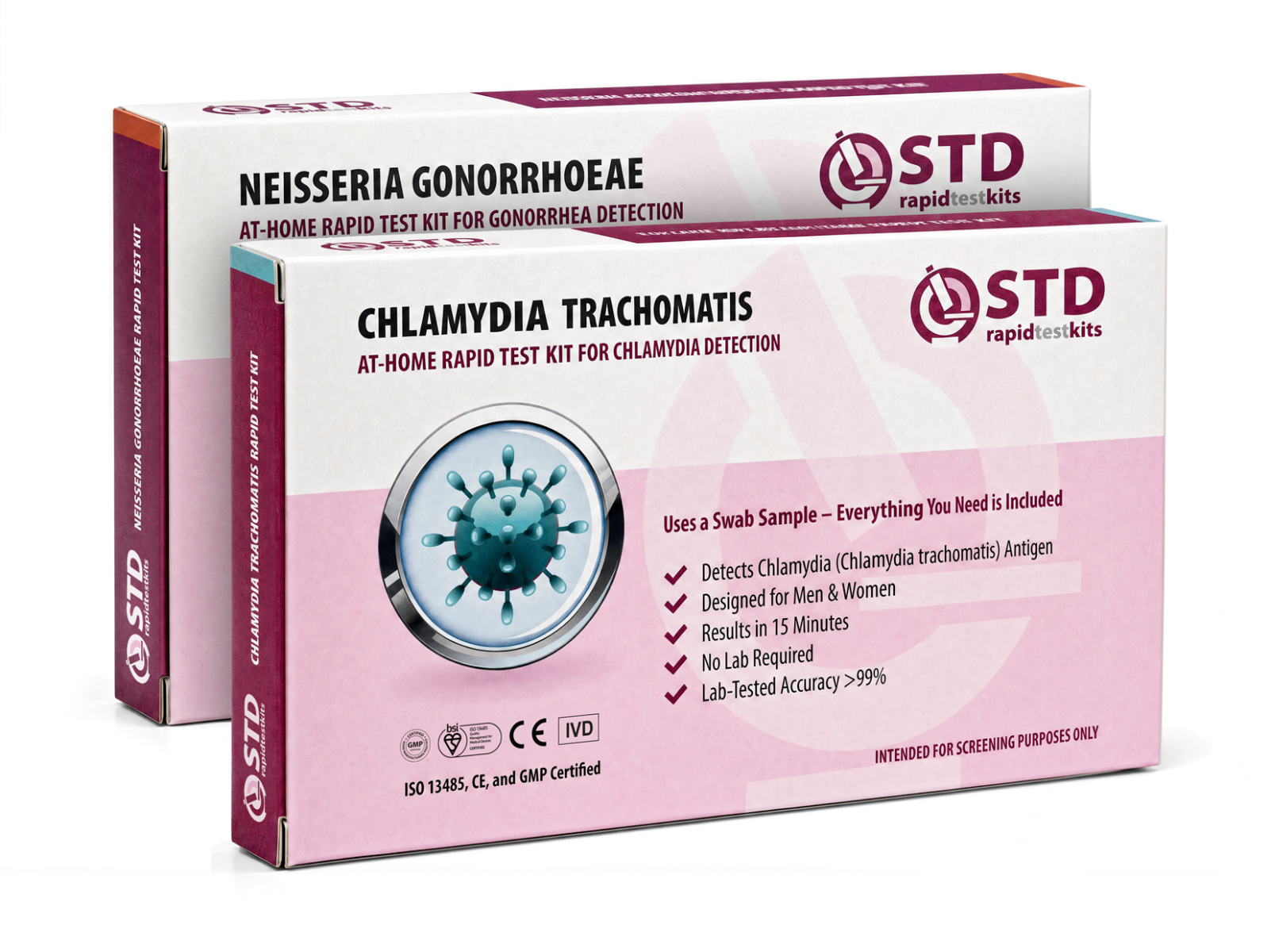
The same gap exists in at-home testing. The kits on this site are rapid lateral-flow swabs and fingerprick blood tests for genital and bloodborne STIs. We do not sell a pharyngeal swab kit you can use at home for throat gonorrhea or throat chlamydia, and selling you one as if we did would not be accurate. For a true throat-site test, the right move is a sexual health clinic, your primary care provider, Planned Parenthood, or a mail-in laboratory service that offers extragenital sample collection. What our kits do cover is the adjacent risk: anyone exposed to oral STIs almost always had genital exposure in the same encounter, and that side is screenable at home. The kit below covers that part of the picture.
The phrasing that works is direct: "I had oral exposure recently and would like a throat swab for gonorrhea and chlamydia in addition to the usual screening." That single sentence routes you to the right test in almost any clinic.
This guide is published by stdrapidtestkits.com, which sells at-home rapid swab and blood STI testing kits. We recommend products based on whether they fit the reader's actual concern, not on commercial benefit. We do not sell pharyngeal swab kits, and we say so clearly in this article rather than pretending our genital swabs are a substitute for a throat-site test.
What a Throat Swab Actually Involves
The procedure itself is short and uncomfortable for about three seconds. A clinician asks you to open wide, presses your tongue down with a depressor, and runs a long sterile swab across the back of the throat, the tonsils, or both. The sample goes to a lab for nucleic acid amplification testing (NAAT), which is the laboratory standard for chlamydia and gonorrhea. Results usually take a few days.
This is meaningfully different from the at-home rapid lateral-flow tests sold for genital screening. Lateral-flow chemistry detects antibodies or antigens in a sample on a paper strip, with a result in roughly 15 minutes. Lab NAAT detects the genetic material of the bacteria itself, which is more sensitive in low-organism samples like a throat swab. The two technologies are complementary rather than equivalent. A positive at-home rapid result is worth confirming with a lab NAAT when possible, and a throat-site sample is best handled by a lab from the start.
If a clinician offers "self-collected" throat swabs (some clinics now let patients swab their own throat in a private room), that is the same lab pathway with less awkwardness.
Pharyngeal infections with N. gonorrhoeae are usually asymptomatic. Although the role of pharyngeal infection in transmission to others is not well defined, persons with pharyngeal infection can transmit the infection to others through oral sexual contact.
Treatment Is Usually Straightforward
If a throat swab does come back positive, treatment for the bacterial infections is fast. Throat gonorrhea is treated with a single 500 mg intramuscular ceftriaxone injection per current CDC guidelines, the same first-line regimen used for genital gonorrhea. Throat chlamydia is treated with oral antibiotics, usually a one-week course of doxycycline. Both regimens have high cure rates. The throat clears the infection a little less reliably than the genital site does, which is why a test-of-cure swab roughly 7 to 14 days after treatment is recommended for pharyngeal gonorrhea specifically. For genital infections, retesting at three months after treatment is the standard to catch any reinfection from an untreated partner.
Herpes is a different model. The virus is not eliminated; it stays in the body permanently and can reactivate. Antiviral medications (acyclovir, valacyclovir, famciclovir) shorten outbreaks, reduce their frequency, and cut the risk of passing the virus to a partner. Most people with oral herpes manage it without major disruption to their lives.
Syphilis at any stage is treated with penicillin, which is highly effective when the infection is caught early (a single injection for early-stage infection, more doses for later stages). HIV is managed with antiretroviral therapy, which now allows people on consistent treatment to reach an undetectable viral load and effectively zero sexual transmission risk.
Timing matters more than anything else here. The longer an untreated bacterial infection sits, the higher the chance of passing it on, and in the case of gonorrhea, the longer it has to develop drug resistance. None of this is a moral verdict on the person who tests positive. Telling recent partners is part of the protocol, awkward as it is; most public-health clinics will help with anonymous partner notification if you would rather not handle it yourself.
| Infection | Standard treatment | Notes |
|---|---|---|
| Throat gonorrhea | Single 500 mg ceftriaxone IM injection | Test-of-cure swab at 7 to 14 days; pharynx clears slightly slower than the genital site |
| Throat chlamydia | One-week course of doxycycline | High cure rate when the full course is taken; retest at 3 months for reinfection |
| Herpes (HSV-1 / HSV-2) | Antivirals (acyclovir, valacyclovir, famciclovir) | Manages and reduces outbreaks; the virus is not eliminated |
| Syphilis | Penicillin injection | Highly effective when caught at the primary or secondary stage |
| HIV | Antiretroviral therapy (ART) | Sustained therapy can reach undetectable viral load and effectively zero sexual transmission risk |
Reducing Oral STI Risk Going Forward
Lowering throat-based STI risk does not require giving up oral sex. The practical levers are barriers, partner communication, and routine screening that includes the right anatomical sites.
Condoms reduce transmission risk for oral sex involving a penis. Dental dams (or a cut-open condom, or a thin piece of food-grade plastic wrap) work for oral contact with a vulva or anus. Neither barrier is widely used, partly because they are awkward, partly because the perceived risk feels low. They are worth the friction with new or anonymous partners, especially in higher-prevalence settings or after a recent positive result on either side.
Routine testing matters more than perfect barrier use, in practical terms. The CDC recommends sexually active people get tested at least annually, and more often (every 3 to 6 months) for people with multiple partners or in higher-risk contexts. When booking those visits, ask explicitly for swabs of every site that has been exposed (throat, genital, and rectum where relevant). Generic "full panels" usually mean blood plus a urine sample; they will miss site-specific bacterial infections at the throat or rectum every time.
The three risk-reduction levers
- Barriers: condoms for penile oral sex; dental dams or thin food-grade plastic wrap for vulval or anal oral contact.
- Routine testing: at least yearly, every 3 to 6 months with multiple partners, with swabs of every exposed site explicitly requested.
- Partner communication: knowing your partner's recent testing status before unprotected oral sex is the cheapest tool that actually changes outcomes.
When Testing Makes Sense
For most readers landing on this article because of a single scratchy morning, a test is probably not the next step. Hydrate, sleep, give it 48 hours. If the soreness clears, that was the answer.
Testing becomes worthwhile when one or more of these is true: the throat soreness has lasted more than several days without improving, it appeared 2 to 10 days after oral sex rather than the next morning, it is accompanied by white spots, sores, or visibly swollen tonsils without classic cold symptoms, or a recent partner has tested positive for any STI. Routine sexual-health screening every 3 to 6 months is also reasonable for anyone with new or multiple partners regardless of symptoms, and that screening should specifically include a throat swab if oral sex is part of the picture.
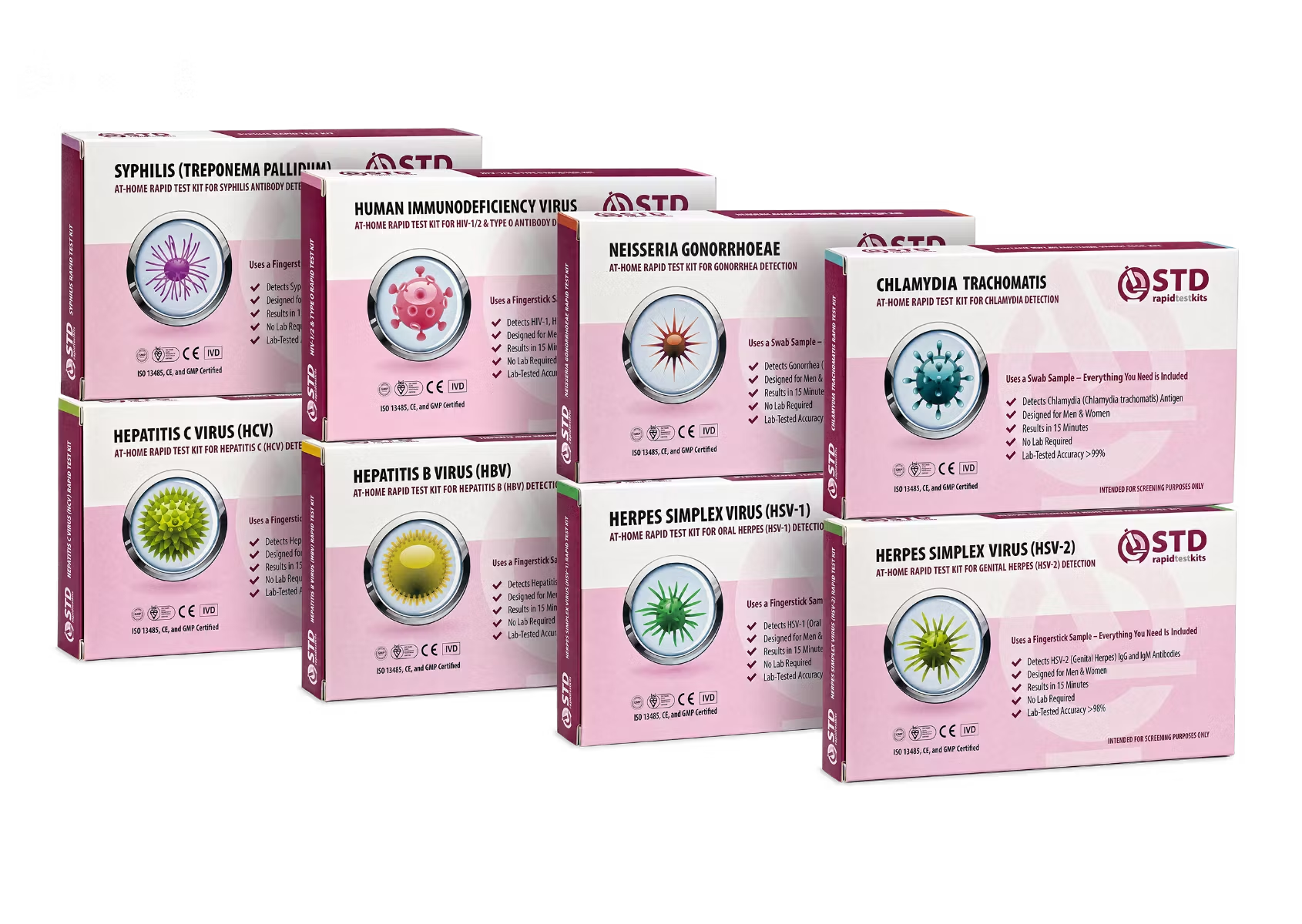
The corresponding question is what to do about other sites. The genital site is testable at home with the rapid kits we sell. Whether you ever swab your throat at a clinic or not, screening the genital and bloodwork side after a new partner is the part of the picture you can handle privately and quickly. If you would rather do a single comprehensive screen rather than a one-infection swab, the 8-in-1 kit below covers chlamydia, gonorrhea, syphilis, HIV, hepatitis B, hepatitis C, and the herpes antibody panel in one order.
Any one of these patterns is a reasonable trigger to ask a clinic for a pharyngeal swab:
- Soreness lasting more than several days without improvement.
- Onset 2 to 10 days after oral sex, well past next-morning irritation.
- White patches, sores, or visibly swollen tonsils without classic cold symptoms like a runny nose or cough.
- A recent partner has tested positive for any STI.
Frequently asked questions
- I woke up with a sore throat the morning after oral sex. Is it an STD?
- Watch the pattern over the next 3 to 5 days. If soreness fades by day 2 or 3, friction, dehydration, or a developing cold is the explanation. If it worsens or lingers past day 5 without a runny nose or cough, and especially if white patches or visibly swollen tonsils appear, that pattern is worth a throat swab at a clinic. Day-after irritation alone almost never represents a fresh STD.
- Will a regular STD test catch a throat infection?
- No, and this surprises a lot of people. Standard urine and blood panels test the genital and bloodstream sites only. To screen the throat, you need to ask a clinician for a throat swab specifically; without that request, pharyngeal infections are routinely missed even on what gets marketed as a "full panel."
- Can a throat STI transmit to my partners through oral sex, even if I feel fine?
- Yes. The throat can pass gonorrhea or chlamydia to a partner's genitals during oral sex even when the carrier has no symptoms, and oral herpes can transmit to a partner's genitals as genital herpes. Most onward transmissions come from people who never knew they were carriers. This is also why receptive oral sex with a new partner is a reasonable trigger to get screened at the genital site too, since the same encounter typically exposes both sites.
- Can I get herpes in my mouth even if my partner had no visible sores?
- Yes. Herpes can shed asymptomatically, meaning the virus is present on the skin without any visible blister. Both HSV-1 (the strain most commonly associated with oral cold sores) and HSV-2 can transmit during oral sex without obvious lesions on either partner. This is part of why herpes is so widespread.
- Do you sell a throat swab test I can use at home?
- No. Our at-home kits are rapid lateral-flow swabs for genital STIs and fingerprick blood tests for HIV, syphilis, and hepatitis. For a throat-site (pharyngeal) test, the right resource is a sexual-health clinic, your primary care provider, Planned Parenthood, or a mail-in laboratory service that offers extragenital sample collection.
- How is a throat STD treated?
- One injection clears throat gonorrhea in most cases: 500 mg ceftriaxone given as a single intramuscular dose, confirmed cured by a follow-up swab at 7 to 14 days. Throat chlamydia takes a week of doxycycline. Herpes is managed with antivirals rather than cured. Syphilis is treated with penicillin at any stage.
- How soon after oral sex can a throat swab give a reliable result?
- For gonorrhea and chlamydia, waiting at least 1 to 2 weeks after exposure improves accuracy because the bacteria need time to reach detectable levels. Testing earlier is possible if symptoms are present, but a negative result very soon after exposure may need to be repeated. For HIV, a fourth-generation antigen-antibody blood test is reliable from about 18 to 45 days; for syphilis serology, about 3 to 6 weeks.
- What if I tested negative but my throat still feels off?
- A few possibilities. The test may have been taken before the window period closed, in which case retesting two to three weeks later is the answer. The test may have covered the wrong site (a urine sample does not detect pharyngeal infection), in which case you need a throat swab specifically. Or the symptoms may be unrelated: reflux, post-nasal drip, viral pharyngitis, or strep can all linger. If the soreness persists more than two weeks, see a clinician for an exam regardless of STI status.
The Calmer Way to Handle a Sore Throat After Oral Sex
The takeaway is less dramatic than the search results that brought you here. Most sore throats after oral sex are not STDs, and the simple rules of timing and accompanying symptoms sort the worry into the right buckets quickly. When testing genuinely helps, ask for a throat swab specifically, since the standard panel does not include one. And while the throat-site test is something to handle through a clinic, screening the genital site and the relevant bloodwork after a new partner is something the kits above can take care of privately and quickly.
Next steps at a glance
- Wait 48 hours if soreness started the morning after. Friction and dehydration clear that fast; cold viruses declare themselves with congestion or a cough.
- If it persists past day 5 without classic cold symptoms, ask a clinic specifically for a throat swab for gonorrhea and chlamydia. Standard panels do not include one.
- Screen the genital and bloodwork side at home regardless. That part of the same exposure event is testable privately, and our kits cover it in under 20 minutes.
- U.S. Centers for Disease Control and Prevention. Sexually Transmitted Infections Treatment Guidelines, including pharyngeal gonococcal infection guidance, ceftriaxone 500 mg dosing, test-of-cure recommendations, and extragenital screening guidance for receptive oral exposure.
- U.S. Centers for Disease Control and Prevention. Gonorrhea basic information, transmission routes, and symptoms.
- U.S. Centers for Disease Control and Prevention. Chlamydia basic information and how the infection presents at different anatomic sites.
- U.S. Centers for Disease Control and Prevention. About sexually transmitted infections. Overview of STI categories, transmission routes, and recommended screening intervals.
- World Health Organization. Sexually transmitted infections fact sheet, including global prevalence and symptom patterns.
- NHS. Gonorrhoea overview: symptoms, transmission, testing, and treatment in the UK clinical context.
