
Published: November 2025 | Last updated: April 2026 | Editorial review and quality control: Martina N.
The simplest public-health idea that keeps STD outbreaks from spiraling is also the most ignored: regular testing. Most people who carry a sexually transmitted infection feel fine, often for months. They learn the news only after a partner is diagnosed, or after years of low-grade complications quietly add up. Routine screening flips that pattern. It catches infections during the contagious-but-symptomless window, makes treatment quick and curative for bacterial cases, and stops the chain of transmission before it spreads through a friend group, a household, or a community.
This article walks through why undiagnosed STIs drive outbreak math, what the CDC and WHO recommend for screening intervals, how at-home rapid kits fit alongside clinic care, and what to do when a result comes back positive. The goal is a calm, practical framework you can build into your routine without anxiety or guesswork.
Why does regular STD testing prevent outbreaks?
Most sexually transmitted infections spread silently, with no symptoms in the carrier for weeks or months. Routine screening at intervals matched to your sexual history finds these silent infections, gets carriers into treatment, and breaks the chain of transmission before it reaches new partners. The <a href="https://www.who.int/news-room/fact-sheets/detail/sexually-transmitted-infections-(stis)" target="_blank" rel="noopener">World Health Organization</a> reports that more than 1 million curable STIs are acquired worldwide every day; the majority would not be diagnosed without targeted screening.
Key Takeaways
- More than 1 million curable sexually transmitted infections are acquired globally every day, the WHO reports, and most carriers feel no symptoms in the early weeks.
- Routine screening at intervals matched to your sexual history catches these silent infections early, when bacterial STIs respond reliably to a single course of antibiotics.
Why undetected STIs drive outbreaks
The reason STDs spread faster through a community than many other infections is not that they are more contagious per encounter. It comes down to the time gap between infection and discovery. Chlamydia, the most common reportable bacterial STI in the United States according to CDC surveillance, often produces no early symptoms at all; the agency consistently emphasizes that the majority of chlamydia carriers feel fine in the weeks after infection. Gonorrhea behaves similarly. HIV, syphilis, and the herpes simplex viruses can all carry for months or even years without obvious signs in the person who has them.
That symptomless window is where outbreak math takes over. A single asymptomatic carrier with several sexual partners over a year can pass an infection on to multiple new people, each of whom is also asymptomatic for weeks or months. By the time the original carrier sees a clinician for unrelated reasons, or a partner gets diagnosed and traces the source back, the network has already expanded.
The World Health Organization estimates that more than 1 million sexually transmitted infections that are curable (chlamydia, gonorrhea, syphilis, and trichomoniasis) are acquired worldwide every day. Adding viral STIs such as HSV-1, HSV-2, HPV, HIV, and hepatitis B and C raises the total considerably. The CDC's most recent national STI surveillance reports rising rates of syphilis (including congenital syphilis), persistently high chlamydia and gonorrhea rates, and ongoing HIV transmission concentrated in specific demographics.
Three patterns drive the outbreak math:
- Most carriers are unaware. Without symptoms, there is no trigger to seek testing.
- Network effects compound. STIs cluster within sexual networks, so undetected infections concentrate in the exact populations where they will be transmitted next.
- Late diagnosis costs more than early diagnosis. Untreated chlamydia and gonorrhea can progress to pelvic inflammatory disease and infertility; untreated syphilis progresses through stages and can damage the cardiovascular and nervous systems; untreated HIV progresses to AIDS without antiretroviral therapy.
These three patterns reinforce each other: undetected carriers feed network spread, network spread delays diagnosis, and delayed diagnosis raises the probability of long-term complications. Each one needs its own countermeasure.
How testing breaks the transmission chain
Public-health epidemiologists describe outbreaks using the basic reproduction number, often written R0. R0 is the average number of new infections one infected person causes in a fully susceptible population. For an outbreak to grow, R0 must be greater than 1. Routine testing pushes R0 down through three concrete mechanisms.
First, treatment. Bacterial STIs (chlamydia, gonorrhea, syphilis, trichomoniasis) clear with a single course of antibiotics in most uncomplicated cases. Once a carrier is treated, they stop transmitting. The faster they are diagnosed, the shorter the contagious window.
Second, behavior change. People who learn they have an STI typically reduce sexual contact during treatment, use condoms more consistently afterward, and tell partners. This is not a moralistic claim; it is what surveillance data from STI clinics and behavioral studies repeatedly show.
Third, partner notification. Every diagnosis is also a list of contacts who should be tested. Many public-health departments offer expedited partner therapy or partner-services programs to help with this step. Without testing, none of those partners know to come in, and the chain continues.
The cumulative effect at the population level is significant. Modeling studies from the CDC and WHO have shown that sustained increases in screening rates correlate with measurable drops in incidence over the following years, especially for chlamydia and gonorrhea. That correlation is one reason why annual chlamydia screening for sexually active women under 25 has been a CDC recommendation for decades.
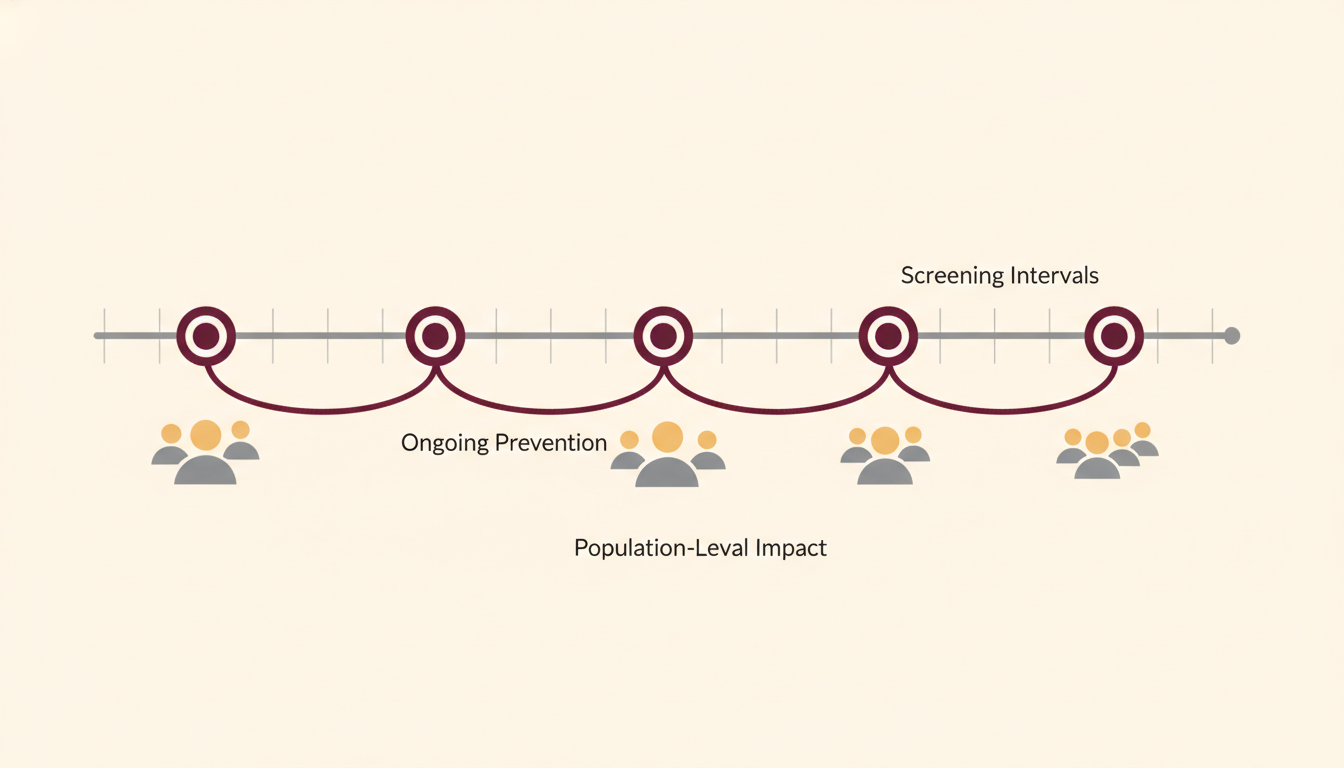
An infection caught at month 6 has, on average, six months of transmission opportunities behind it. Caught at month 1, it has one. Screening intervals exist precisely because that gap is the lever public health has to work with.
- Treatment shortens the contagious window; bacterial STIs clear after a single course of antibiotics, after which the carrier no longer transmits.
- Behavior change after diagnosis is well-documented in surveillance data: people pause sexual contact during treatment, use condoms more consistently afterward, and tell partners.
- Partner notification turns each diagnosis into a list of contacts who can be tested and treated, expanding detection through the same network the infection moved through.
Who should test, and how often: CDC and WHO guidance
Testing intervals depend on your sexual history, not just your age. The CDC publishes screening recommendations that have evolved as surveillance data has shifted. The table below summarizes the current population-level baselines drawn from CDC screening guidance for primary care and sexual-health providers.
A few important notes the table cannot capture in full:
The annual recommendation for sexually active women under 25 is for chlamydia and gonorrhea specifically. It has been the standard of care for over two decades because of how common asymptomatic infection is in this group and how effective treatment is when caught early. Women 25 and older should still test annually if they have new or multiple partners, an STI-positive partner, or other risk factors.
Men who have sex with men (MSM) typically test more frequently than the general population, often every 3 to 6 months for HIV, syphilis, chlamydia, and gonorrhea, depending on number of partners and condom use. The CDC's MSM screening guidance is the reference point. Pharyngeal (throat) and rectal swabs are clinician-collected and run as nucleic acid amplification tests at a lab; we do not sell pharyngeal or rectal swab kits, so see a clinic for those specific samples.
Pregnant people are screened at the first prenatal visit for HIV, syphilis, hepatitis B, and chlamydia, with repeat testing in the third trimester for those at higher risk. Congenital syphilis cases have risen sharply in recent years, and prevention starts with prenatal screening.
Anyone starting a new sexual relationship benefits from a baseline test, both as a personal health step and as a respectful starting point with a partner. The interval after that depends on monogamy, number of partners, and condom use.
If you take pre-exposure prophylaxis (PrEP) for HIV, you are already on a 3-month testing rhythm because PrEP requires regular HIV and renal monitoring. Adding screening for other STIs at the same visits is straightforward.
| Population group | Recommended interval | Tests typically included |
|---|---|---|
| All adults aged 13 to 64 | At least once in a lifetime | HIV |
| Sexually active women under 25 | Annually | Chlamydia, gonorrhea |
| Women 25+ with risk factors (new or multiple partners) | Annually | Chlamydia, gonorrhea, HIV |
| Men who have sex with men | Every 3 to 6 months | HIV, syphilis, chlamydia, gonorrhea (multiple sites) |
| Pregnant people (first prenatal visit) | Once per pregnancy, retest in third trimester if at risk | HIV, syphilis, hepatitis B, chlamydia |
| Anyone starting a new sexual relationship | Baseline test | HIV, syphilis, chlamydia, gonorrhea |
| People taking PrEP | Every 3 months | HIV, syphilis, chlamydia, gonorrhea, kidney monitoring |
The role of at-home rapid testing
This site sells at-home rapid STI kits; the relevant options are noted at each section where they apply, so readers know what we offer and what we do not. At-home rapid STI tests have become a useful tool between clinic visits or for people who cannot easily reach a clinic. It is worth being precise about what they are and what they are not.
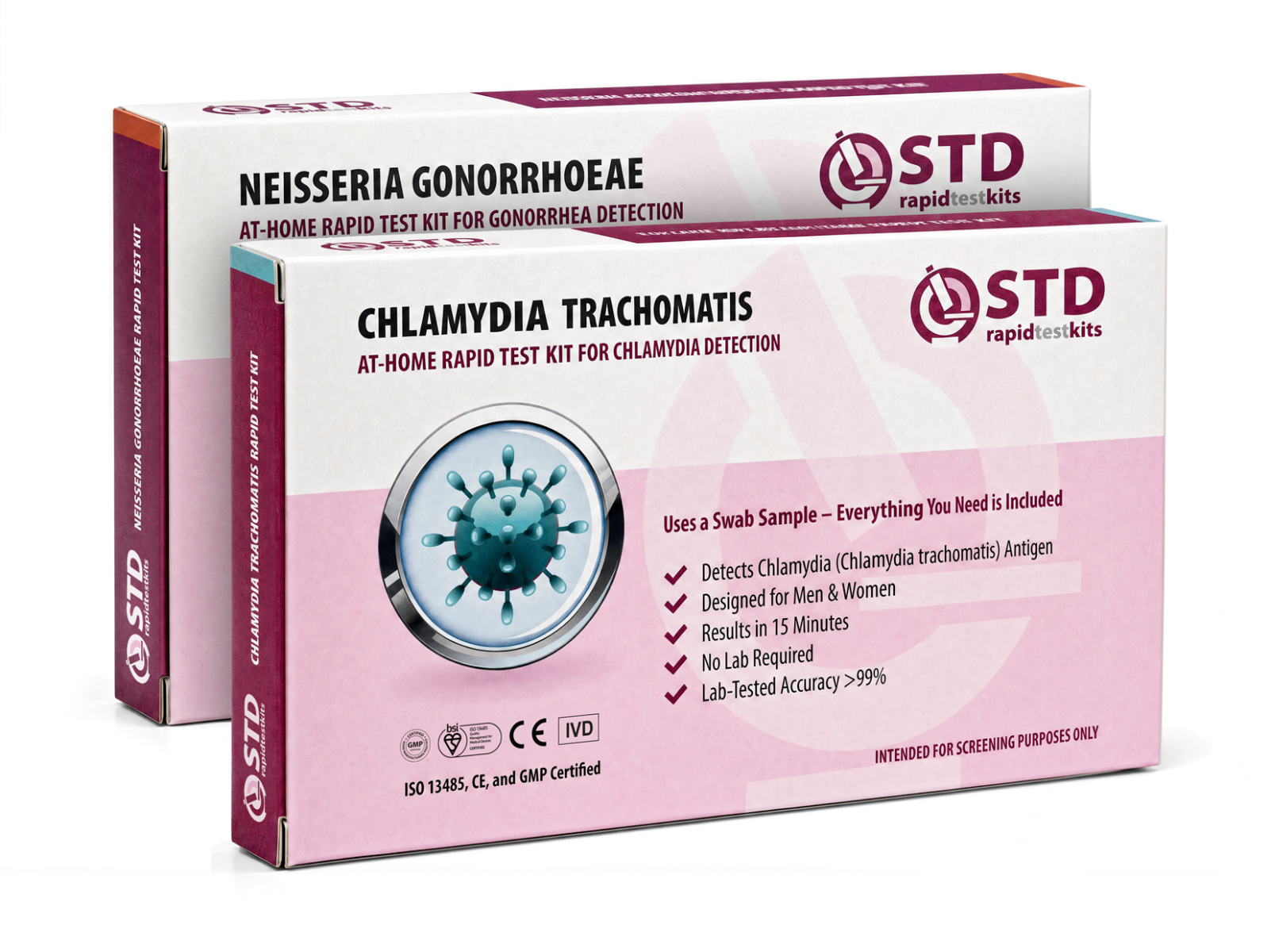
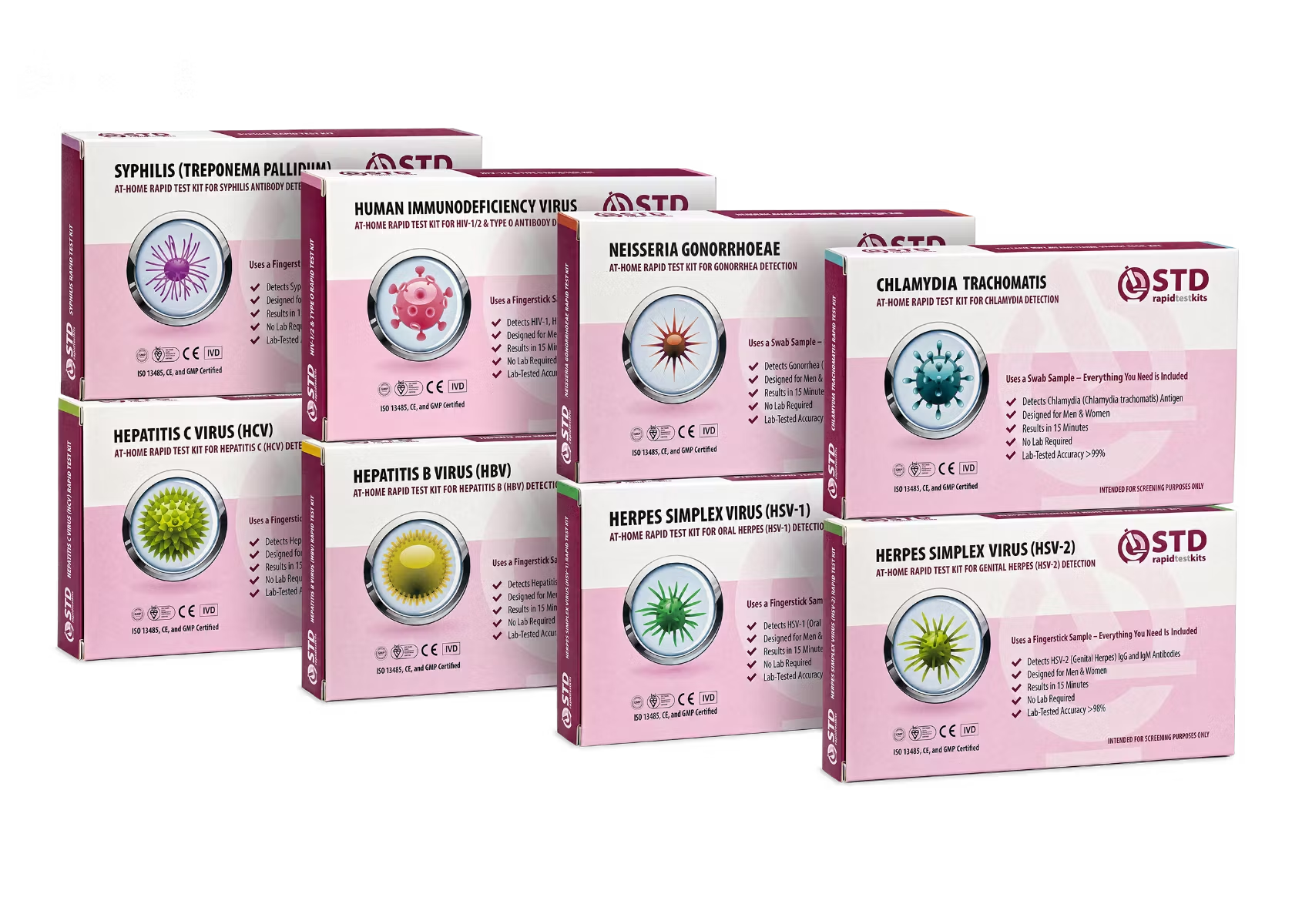
The kits sold here use lateral-flow immunoassay chemistry, the same type of strip-based detection used in pregnancy tests and rapid antigen tests. Some are swab-based (chlamydia, gonorrhea, trichomoniasis, HPV) and some are fingerstick blood tests (HIV, syphilis, hepatitis B, hepatitis C, herpes simplex). Results appear in roughly 15 minutes.
Lateral-flow chemistry is not the same as nucleic acid amplification testing (NAAT or PCR), which laboratories run as the diagnostic gold standard for bacterial STIs. NAAT detects genetic material at much lower thresholds and is what a clinic typically uses for confirmatory diagnosis. The two technologies are complementary, not equivalent. Rapid tests are well suited to routine at-home screening, especially for people who would not otherwise test at all; a positive rapid result should be followed up with a clinic visit for confirmatory NAAT and treatment.
Where at-home rapid kits fit best
- Adding screening cycles between annual clinic visits. If your routine is annual physical and nothing else, a kit at the 6-month mark adds a useful layer.
- New-relationship baseline testing where both partners want a private starting point.
- People who feel uncomfortable visiting a clinic for cultural, work-schedule, or privacy reasons.
- Geographic access gaps. Rural areas and underserved communities often lack convenient sexual-health services.
- People in the LGBTQ+ community who have experienced stigma or judgment in traditional clinic settings and want a low-friction alternative.
What at-home rapid kits do not replace
- Pharyngeal (throat) and rectal swab testing. The CDC recommends these for MSM and for anyone with oral or anal exposure; they require a clinician-collected swab and a NAAT panel that we do not sell.
- Confirmatory testing after a positive rapid result. Treatment decisions, especially for syphilis and HIV, require lab confirmation.
- Window-period awareness. Antibody tests for HIV, syphilis, and herpes have window periods of weeks to months; testing too early can produce a false-negative result. Each product page lists the recommended window for that test.
Used inside those limits, at-home rapid testing is a real public-health asset. It pulls people into the testing pool who would otherwise stay outside it.
Product: STD-6KIT-ATH-2025
Common barriers, and how to address them
The reasons people skip testing are predictable and well-documented. Each has a practical workaround.
Cost. In the United States, most private insurance covers STI screening as preventive care, often with no copay under the Affordable Care Act preventive-services rules. Title X-funded clinics, Planned Parenthood centers, and many local health departments offer free or sliding-scale testing for those without insurance. The CDC's GetTested directory lists nearby clinics by zip code.
Stigma and embarrassment. Cultural attitudes around sexual health continue to discourage open conversations. Treating STI screening like a cholesterol check, a routine health task and not a loaded conversation, is what tends to cut through the discomfort. Healthcare providers are trained to discuss these topics without judgment, and most people find that the first appointment is the hardest one. After that, it is just another health task.
Privacy concerns. Insurance Explanation of Benefits (EOB) statements can show test names that family members on the same plan might see. Workarounds include paying out-of-pocket for one visit (often $50 to $150 at a community clinic), using a free Title X clinic, or using an at-home test that ships and reports results discreetly. Healthcare providers are bound by HIPAA confidentiality.
Access. Rural areas, transportation gaps, and clinic hours that conflict with work schedules all matter. At-home testing addresses several of these directly, and telehealth platforms can handle prescription follow-up for many positive results.
Awareness. Many people do not know which infections require which tests, or what a window period is. The simplest fix is to ask a clinician at your annual physical: What STI screening makes sense for me, and how often? That single conversation tends to clarify everything.
Title X family-planning clinics, Planned Parenthood centers, and most local health departments offer free or sliding-scale STI testing. The <a href="https://gettested.cdc.gov/" target="_blank" rel="noopener">CDC GetTested directory</a> finds clinics by zip code. Cost should not be the barrier that keeps you out of the testing pool.
Many people who have an STI do not know it. STI testing is the only way to know for sure if you have an STI. Annual screening is recommended for sexually active women under 25 and for older women with risk factors such as new or multiple sex partners.
When a test comes back positive
A positive result is not an emergency, but it does call for a clear set of next steps. Here is what to do, in order.
Confirm the result. For at-home rapid tests, a positive should be followed by a clinic visit for confirmatory NAAT (for bacterial STIs), confirmatory antibody and viral-load testing (for HIV), or RPR plus treponemal testing (for syphilis). Confirmation matters because false positives, while uncommon, do happen with any screening test.
Get treatment. Bacterial STIs (chlamydia, gonorrhea, trichomoniasis, syphilis) are curable with antibiotics. The exact regimen depends on the infection, the site, and any drug allergies. HIV is treatable with antiretroviral therapy; modern regimens are often a single daily pill, and effective treatment reduces viral load to undetectable levels. The CDC endorses U=U (undetectable equals untransmittable), the principle established by clinical trials showing that a person with HIV on effective treatment with sustained undetectable viral load does not transmit HIV sexually. Hepatitis B and C have specific treatment paths, and herpes is managed with antiviral medication that reduces outbreak frequency and transmission risk.
Tell your partners. This is the step most people dread, and it is also the step that does the most public-health good. Recent partners need to know so they can test and treat. Many states allow expedited partner therapy (EPT), where a clinician can prescribe treatment for a partner without that partner being seen first. Public-health departments offer partner-notification services that can do this anonymously on your behalf.
Pause sexual contact during treatment. The course of antibiotics or initiation of antiviral therapy needs time to clear or suppress the infection. Resume after the recommended interval (typically 7 days for single-dose antibiotic treatments, longer for multi-dose regimens).
Schedule retesting. The CDC recommends retesting at 3 months for chlamydia and gonorrhea after treatment to catch reinfection from untreated partners. Syphilis follow-up serology runs at 6 and 12 months. HIV requires lifelong management with regular viral-load monitoring.
A positive result, handled this way, is a manageable health event. Telehealth platforms have also made follow-up easier; many can review results, prescribe treatment, and arrange retesting without an in-person visit, which lowers the activation cost of acting on a positive.
- Confirm with a clinic NAAT or full antibody panel, especially after an at-home rapid positive.
- Treat with the appropriate antibiotic regimen (bacterial STIs) or antiretroviral therapy (HIV).
- Notify recent partners directly or through public-health partner-services programs.
- Pause sexual contact for the recommended treatment window (typically 7 days for single-dose antibiotics).
- Retest at 3 months for chlamydia and gonorrhea to catch reinfection from untreated partners.
Making testing part of routine care
The framing that produces the best outcomes, both individually and at the population level, treats STI testing as a normal part of routine healthcare rather than a reactive event tied to a worry or a specific exposure.
In practice this looks like:
- A baseline test when entering a new relationship, alongside open conversation with the partner about their own status.
- An annual screening at your primary care visit or a sexual-health clinic, calibrated to your sexual history. For most sexually active adults this is a chlamydia and gonorrhea panel plus HIV; pregnant people, MSM, and those with new or multiple partners get more frequent and broader panels.
- An at-home test in between annual visits, especially after a higher-risk exposure or before a milestone like trying to conceive.
- Clear communication with your clinician. They do not assume you want STI testing; you have to ask. Saying I would like full STI screening at your physical is often all it takes.
Public-health systems matter alongside individual habits. Communities with accessible, affordable, low-stigma testing have measurably lower STI rates over time. Supporting Title X funding, school-based health education, and harm-reduction programs are all part of the same infrastructure that makes individual testing effective.
Pick a cadence that fits your situation, build it into a routine you do not have to think hard about, and treat positive results the way you would treat any other manageable health finding.
Frequently asked questions
- How often should I get tested for STIs if I am sexually active?
- For sexually active women under 25, the CDC recommends annual chlamydia and gonorrhea screening at minimum. Adults 25 and older should test annually if they have new or multiple partners; otherwise every few years is reasonable for monogamous low-risk couples. Men who have sex with men should test every 3 to 6 months. Pregnant people are screened at the first prenatal visit. Match the cadence to your situation, and add at-home tests in between if you want shorter intervals.
- Can STIs really spread without symptoms?
- Yes, and this is the central reason routine testing matters. The CDC notes that many STIs have no early symptoms at all, and chlamydia in particular is asymptomatic in the majority of carriers. Gonorrhea, syphilis during latent phases, HIV after acute infection, and herpes between outbreaks can all transmit while the carrier feels fine. Symptoms are not a reliable signal.
- How accurate are at-home rapid STI tests?
- Sensitivity varies by infection and by product, so check the kit's instructions or product page for published figures. Rapid lateral-flow tests for common bacterial STIs perform best when used after the recommended window period and according to the kit instructions. They are not the same as the laboratory NAAT or PCR tests that clinics use as the diagnostic gold standard. A positive rapid result should be confirmed at a clinic with a NAAT or full antibody panel before treatment decisions.
- What is a window period and why does it matter?
- The window period is the time between infection and when a test can reliably detect it. Antibody-based tests for HIV, syphilis, and herpes have window periods of weeks to months because the body needs time to produce detectable antibodies. Bacterial nucleic acid tests have shorter windows. Testing too early can give a false-negative result. Each kit and each clinic test has its own window; check the product page or with your clinician before testing.
- Will my employer or my insurance see my STI test results?
- Healthcare providers are bound by HIPAA confidentiality. Test results are not shared with employers. Insurance Explanation of Benefits statements may show that an STI screening was performed, which can matter if you share a plan with family members. Workarounds include paying out-of-pocket at a community clinic, using a free Title X clinic, or using an at-home test that ships and reports results discreetly.
- What should I do if a test comes back positive?
- Confirm the result with a clinic test (especially for an at-home rapid positive), start treatment promptly, tell recent partners so they can test and treat, pause sexual contact during the treatment window, and schedule retesting per CDC guidance (typically 3 months for chlamydia and gonorrhea). Bacterial STIs are curable; HIV is now a manageable chronic condition with effective treatment that reduces viral load to undetectable levels.
- How do I bring up testing with a new partner?
- Frame it as routine, not accusatory. Saying I get tested regularly, and I think it is a good idea for both of us to share recent results before we have sex is direct and matter-of-fact. Many people are relieved to have the conversation started for them. If a partner refuses to test or share results, that is information you can use to make your own decisions.
- Are free testing options available?
- Yes. Title X-funded family-planning clinics, Planned Parenthood centers, and most local health departments offer free or sliding-scale STI testing. The CDC's GetTested directory at gettested.cdc.gov lists nearby clinics by zip code. Many community health centers offer testing on a sliding-fee scale based on income.
- U.S. Centers for Disease Control and Prevention. Sexually transmitted infections overview, including the agency's general guidance that many STIs cause no symptoms and the case for routine screening.
- World Health Organization. Sexually transmitted infections fact sheet, including the global daily incidence figure for curable STIs.
- U.S. Centers for Disease Control and Prevention. HIV testing recommendations, window-period guidance, and U=U principle endorsement.
- U.K. National Health Service. Sexually transmitted infections overview and screening guidance.
- U.S. Centers for Disease Control and Prevention. GetTested directory of low-cost and free STI testing locations by zip code.
- U.S. National Library of Medicine, MedlinePlus. Sexually transmitted infections overview, testing context, and follow-up guidance for general readers.
