How Does Public Health Policy Affect STD Testing Access?
Funding decisions, confidentiality laws, and where clinics get built quietly decide who can actually get tested for an STI. Here is how the policy machinery works in 2026, where the real gaps still are, and what at-home testing changes about the access question for ordinary readers.




- Four federal streams (the ACA preventive-services rule, Title X, the CDC's STD Prevention Program, and the Ryan White HIV/AIDS Program) plus Medicaid do most of the work of making STI testing affordable in the United States. Their funding has been roughly flat in real dollars for over a decade while reported syphilis cases have climbed to levels not seen since the early 1950s.
- The barriers that actually keep people from testing are rarely just price. They are confidentiality (especially for minors and people on a partner's insurance), geography (rural counties without a clinic), and scheduling friction. At-home rapid tests address that friction bundle even when public funding does not.
Published: August 2025 | Last updated: May 2026 | Editorial review and quality control: Martina N.
Most articles about STD testing answer the question of which kit to use, when to test, or what the window period is. This one steps back to an earlier question: whether a person can get tested at all. That answer rarely depends on what someone wants to do. It depends on whether their state expanded Medicaid, whether their county clinic still has a federal Title X grant, whether their plan codes STI screening as a covered preventive service, and whether the local health department can keep a contact tracer on payroll this fiscal year.
Public health policy is the scaffolding for all of it. When the scaffolding is strong, people walk into a clinic or order a test online, get tested, get treated if needed, and the infection stops moving through the community. When the scaffolding has holes, people who would otherwise test simply do not, and the consequences ripple out for years: untreated chlamydia that becomes pelvic inflammatory disease, undiagnosed HIV that keeps transmitting, and congenital syphilis cases that should never have happened.
Key Takeaways
- Four federal streams (the ACA preventive-services rule, Title X, the CDC's STD Prevention Program, and the Ryan White HIV/AIDS Program) plus Medicaid do most of the work of making STI testing affordable in the United States. Their funding has been roughly flat in real dollars for over a decade while reported syphilis cases have climbed to levels not seen since the early 1950s.
- The barriers that actually keep people from testing are rarely just price. They are confidentiality (especially for minors and people on a partner's insurance), geography (rural counties without a clinic), and scheduling friction. At-home rapid tests address that friction bundle even when public funding does not.
How U.S. policy actually pays for STD testing
The United States does not run a single coordinated STI testing system. Four streams of public money do most of the work, and any one of them can shrink, expand, or change shape based on a federal budget bill or a state legislature's session.
The first stream is the Affordable Care Act's preventive services requirement. Since 2010, most private health plans and Medicaid expansion plans must cover STI screening for chlamydia, gonorrhea, hepatitis B, HIV, and syphilis without copayment for adolescents and adults at risk, when the test is ordered by a clinician. The U.S. Preventive Services Task Force's grades drive that list, and when the Task Force updates a recommendation, coverage follows.
The USPSTF, an independent panel of national experts in primary care and prevention, sets the medical standard for which preventive services merit first-dollar insurance coverage. Its grades (A, B, C, D, or I for insufficient evidence) determine which screening tests an insurer must cover without copayment under ACA. The current STI-related recommendations include annual chlamydia and gonorrhea screening for sexually active women under 25 (Grade B), HIV screening at least once in adolescents and adults aged 15 to 65 (Grade A), and syphilis screening in pregnancy (Grade A).
The second stream is Title X, the federal family planning program administered by HHS's Office of Population Affairs. Title X grants flow to roughly 4,000 service sites, including federally qualified health centers, independent reproductive-health clinics, and state and local health departments. These sites provide STI testing as part of routine family planning visits, with sliding-scale fees for patients who lack insurance.
The third is the CDC's STD Prevention Program, which sends formula grants to state and local health departments to support clinic capacity, contact tracing, disease surveillance, and the dedicated STD clinics that still exist in major cities. Those clinics are often the only place a person can walk in without an appointment, get tested, and get treated the same day, regardless of insurance status.
The fourth is the Ryan White HIV/AIDS Program, administered by HRSA, which covers care, treatment, and testing for low-income people with or at risk for HIV. It is the reason most people without insurance can still get HIV care in the United States.
Medicaid sits underneath all four streams. In states that expanded Medicaid under the ACA, working-age adults at low incomes are typically enrolled and have STI screening covered as a preventive service. In states that have not expanded, the coverage gap is real, and the local STD clinic or a Title X site is often the only option.
| Stream | Administrator | What it pays for |
|---|---|---|
| ACA preventive services | HHS rule applied by private insurers and Medicaid expansion plans | STI screening with no copayment when a clinician orders it for an at-risk adolescent or adult |
| Title X | HHS Office of Population Affairs | Sliding-scale family planning visits including STI testing across roughly 4,000 service sites |
| CDC STD Prevention Program | CDC formula grants to states and localities | Public health department capacity, contact tracing, surveillance, and remaining city STD clinics |
| Ryan White HIV/AIDS Program | HRSA | HIV care, treatment, and testing for low-income people with or at risk for HIV |
| Medicaid | States with federal CMS oversight | Preventive STI screening for enrollees, depth varying widely between expansion and non-expansion states |
Where the funding has fallen behind reported cases
CDC STD prevention funding has held roughly flat in nominal dollars for more than a decade. Adjusted for inflation, it has lost ground every year. Meanwhile, reported cases moved sharply in the opposite direction. The CDC's most recent STI surveillance reports show multi-year increases in chlamydia, gonorrhea, and syphilis. Syphilis cases have climbed to levels not seen in the United States since the early 1950s. Congenital syphilis (babies infected during pregnancy) has multiplied severalfold over the same period.
The arithmetic is plain. When real funding is flat and case counts climb, fewer dollars per case are available for testing, contact tracing, partner notification, and treatment. State and local health departments absorb the gap or cut services. Several states have closed their last freestanding public STD clinic. Some have folded STI testing into general primary care, which works for routine annual screening but loses the walk-in, same-day, no-insurance-required pathway that public clinics historically provided for the highest-need patients.
The federal STI National Strategic Plan released in 2020 and a federal advisory committee report from 2023 both called for substantial increases in dedicated STI prevention funding. Those calls translated into appropriations only intermittently. The 2024 and 2025 federal budget cycles produced modest increases for some line items and flat or reduced funding for others, depending on the year's politics. The Federal STI Prevention Coordinator role created in the executive branch in 2023 was intended to give the issue more sustained attention. Whether the budget follows the strategy in any given year is a different question.
The CDC's 2022 STI surveillance data documents continued rises in reported syphilis, gonorrhea, and chlamydia cases, with congenital syphilis recording its most dramatic increase in decades. Accessible testing, paired with timely treatment and partner notification, is the primary tool public health has to interrupt those transmission chains.
Confidentiality: the barrier that hides in the billing
A patient may have insurance, live near a clinic, and still skip a test for one reason: they do not trust the test to stay private.
Minors are the clearest case. Every U.S. state allows minors to consent to STI testing on their own, but the details vary. Some states extend confidentiality fully, with no parental notification at any stage. Others give clinicians discretion or set age thresholds. The Guttmacher Institute, which tracks minor consent laws state by state, currently lists every state and the District of Columbia as allowing minors to consent to STI testing. Where states diverge is on parental notification (does the clinician have discretion to inform a parent, or is the minor fully in control), age thresholds (some states require the minor to be at least 12 or 14), and confidentiality of records (whether the visit appears in the family's medical record or only in the minor's). The variability matters because a minor making a confidentiality decision often has to make it based on what they have heard from peers, not from a clear written rule.
The billing layer adds a second confidentiality issue. When a minor is on a parent's insurance, the explanation-of-benefits document the insurer sends to the policyholder typically shows the date of service and the provider's name. The clinical detail is not on the EOB, but a curious parent can usually piece together that a sexual-health visit occurred.
Adults face a parallel concern. A spouse or partner who is the primary policyholder receives EOBs for everyone on the plan. A patient who wants to test because of a concern they have not yet shared with the partner can rationally skip testing rather than risk inadvertent disclosure.
Several states have responded with confidential communications laws that let any covered family member ask the insurer to redirect EOBs for sensitive services to a separate address, or to suppress the EOB entirely for those services. California, Colorado, Washington, New York, and several others have versions of this protection. Implementation varies by insurer, and many patients do not know the option exists.
Title X sites and public STD clinics offer a different workaround: they accept patients on a sliding-scale, cash-pay basis, which generates no insurance trace at all. For patients whose biggest barrier is the EOB rather than the dollar cost, that pathway is the most important thing public clinics still do.
If the EOB is the barrier (not the dollar cost), there are two paths most patients can use. First, file a confidential communications request with your insurer asking for EOBs on sensitive services to be redirected to a separate address or suppressed; California, Colorado, Washington, New York, and several other states require insurers to honor these requests. Second, use a Title X site or a public STD clinic on a sliding-scale cash-pay basis, which produces no insurance record at all. Either path keeps the visit out of view of a parent or partner who holds the policy.
Geography, telehealth, and the rural gap
The closest STD clinic in a sparsely populated rural county can be two hours' drive each way. Family planning clinic networks have contracted in several states over the past decade, partly as a downstream effect of Title X rule changes (some grantees withdrew from the program in 2019 and partially returned after the 2021 rule rollback) and partly because of state-level restrictions on certain providers. Federally qualified health centers fill some of the gap, but FQHC density is uneven, and rural FQHCs often do not have on-site lab capacity for same-visit STI results.
State-level dynamics also matter. When Texas pulled out of Title X for several years in the 2010s and rebuilt a state-funded family planning program, several counties saw a measurable drop in screening volumes that took years to recover. Conversely, states like California and Massachusetts have layered state funding on top of federal grants, which produces a measurably denser clinic network and shorter wait times for testing appointments.
Mobile clinics (vans staffed by public health workers visiting on a published schedule) have been the traditional rural workaround. They work where the population density supports a regular route. They do not work where individual households are scattered across hundreds of square miles.
Telehealth visits paired with mailed-in lab kits became common during the pandemic and stuck. Many state Medicaid programs and most commercial plans extended pandemic-era telehealth flexibilities permanently or quasi-permanently after 2021. For an asymptomatic person who needs routine screening, a telehealth visit plus a mailed sample kit can substitute for an in-person clinic appointment without losing accuracy on lab-processed samples.
The CDC's Express Visit protocols, introduced in select urban STD clinics over the past decade, allow asymptomatic patients to do a self-collected sample, skip the full clinician visit, and free clinic capacity for symptomatic patients. That model is hard to scale to rural areas without internet-based logistics.

At-home testing as a quiet policy lever
The FDA authorized the first in-home HIV test (OraQuick) in 2012. Self-collected sample kits for chlamydia and gonorrhea, where the sample ships to a CLIA-certified lab, have been available longer. Rapid lateral-flow tests for at-home use, including blood-based screens for HIV, syphilis, and hepatitis, and swab-based tests for chlamydia and gonorrhea, have grown in availability through the 2020s.
What at-home testing actually solves, in policy terms, is the bundle of soft barriers that clinic-based testing cannot easily reach. These include the shift worker who cannot take a half-day off, the two-hour rural drive, the EOB visible to a partner on the family insurance plan, and the front-desk conversation a patient would rather skip. None of these are price barriers in isolation, but friction is where public-health programs historically lose people who would otherwise test.
The trade-off is that at-home rapid lateral-flow tests are screening tools, not lab-grade diagnostics. Laboratories use nucleic acid amplification tests (NAAT) and PCR for chlamydia, gonorrhea, and HPV; antibody-based confirmation algorithms for HIV; treponemal and non-treponemal sequences for syphilis. These are more sensitive in early and asymptomatic infections than a home cassette is.
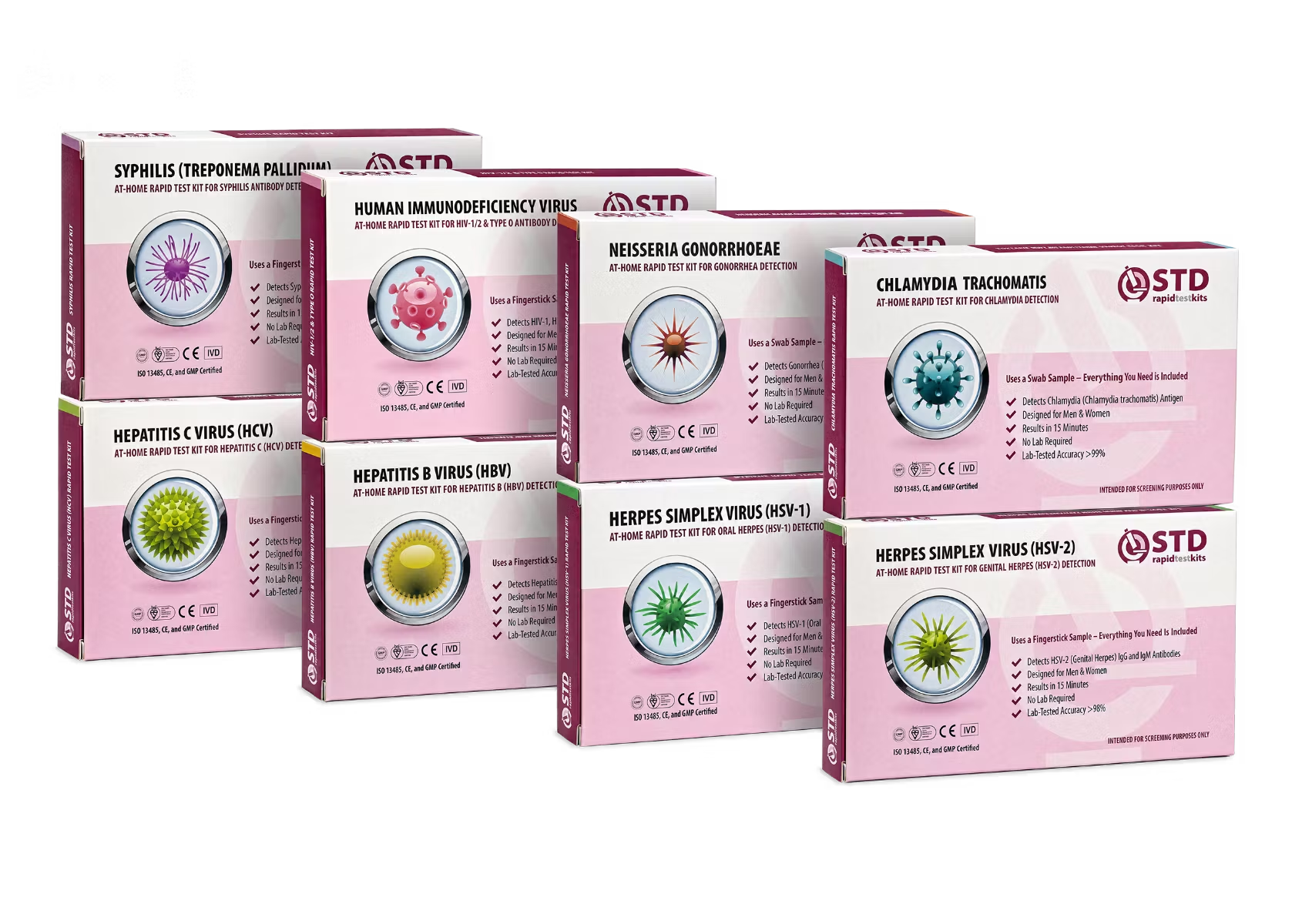
The right way to think about the two is complementary. A rapid home test that comes back positive should be confirmed at a clinic. A rapid home test that comes back negative, used inside the appropriate window period, is a reasonable screen for routine monitoring. For readers who want privacy, speed, or the option to test outside clinic hours, an at-home kit is a real option. For readers whose policy environment makes a clinic visit logistically expensive (rural, on a partner's insurance, no flexible work schedule), an at-home kit can substitute. Disclosure: stdrapidtestkits.com publishes this article and sells at-home rapid STI test kits, including the kit below; we include it on fit-for-purpose grounds, not commercial benefit.

What changed between 2020 and 2026
The COVID-19 pandemic disrupted STI testing in 2020 and 2021. Routine screening visits dropped, contact tracing capacity was redirected to COVID work, and the CDC's surveillance numbers showed an artificial undercount that has since corrected. By 2022, testing volumes had recovered in most states.
The disease burden did not recover in the same way. Syphilis kept climbing, including congenital cases. Drug-resistant gonorrhea (gonococcal strains with reduced susceptibility to ceftriaxone) became a documented concern in surveillance. The CDC's STI Treatment Guidelines, last comprehensively updated in 2021, received periodic addenda for resistance patterns.
Telehealth coverage became more durable. By 2024, most state Medicaid programs had extended pandemic-era telehealth flexibilities permanently or quasi-permanently. Several state Medicaid programs began reimbursing for at-home test kits in defined populations, particularly for HIV and hepatitis C. The federal STI Prevention Coordinator role was created in 2023, and the federal STI Implementation Plan was released the same year, building on the 2020 strategic plan.
The FDA continued authorizing additional home tests through 2024 and 2025, and the agency's regulatory framework for at-home diagnostic devices became more predictable. Doxycycline post-exposure prophylaxis (doxy-PEP) was added to CDC guidance in 2023 for select populations as a bacterial-STI prevention tool, which changed the prevention calculus for some readers in addition to changing the testing calculus.
Mpox (formerly monkeypox) emerged as a sexually-associated infection during the 2022 outbreak, and the federal response included rapid scaling of vaccination and targeted testing. The infrastructure built for that response (mass-vaccination sites coordinated with state health departments, partner notification through dating-app outreach) became a template for other STIs. Whether that infrastructure persists past the immediate Mpox response depends on funding decisions that have not yet been settled for the 2026 fiscal year.
| Year | Policy or programmatic milestone |
|---|---|
| 2020 | Federal STI National Strategic Plan released, naming explicit access and equity targets |
| 2021 | CDC STI Treatment Guidelines comprehensively updated (last full revision) |
| 2022 | Mpox outbreak; mass-vaccination and partner-notification infrastructure built and reused for other STIs |
| 2023 | Federal STI Prevention Coordinator role created; CDC issues doxy-PEP clinical advisory for select populations |
| 2024 | Most state Medicaid programs make pandemic-era telehealth flexibilities permanent or quasi-permanent |
| 2024-2025 | FDA continues authorizing additional at-home STI test devices under a more predictable regulatory framework |
What you can do without waiting for Congress
Three concrete actions.
Check what your insurance covers. Under ACA, your private plan or Medicaid expansion plan should cover annual STI screening for the panel relevant to your risk profile with no out-of-pocket cost, when the test is ordered by a clinician. The list usually includes chlamydia, gonorrhea, syphilis, hepatitis B, and HIV. Call your plan or read the preventive-services section of your benefits summary to confirm specifics for your situation.
Know your state's confidentiality posture. For a minor or for any adult concerned about EOB disclosure, look up confidential communications rules from your state's insurance commissioner. Several states allow a covered family member to request that their EOBs be redirected to a separate address or suppressed for sensitive services. Title X sites and public STD clinics will see patients on a sliding-scale, cash-pay basis, which sidesteps the EOB issue entirely.
For distance, privacy, or scheduling, use an at-home test for routine screening. At-home tests are most useful for asymptomatic monitoring at intervals that match the CDC's screening recommendations for your risk profile. Confirm any positive result through a clinic, and use the appropriate window period for whichever infection you are testing.
A fourth thing worth doing, if you have the bandwidth: track your state legislature's STI-related bills (funding line items for the state health department, telehealth scope, minor consent laws, EOB confidentiality). State-level policy is where most of the practical access decisions get made, and state-level legislators tend to be unusually responsive to constituent emails on narrow policy questions like the local STD clinic's budget. National advocacy organizations like the National Coalition of STD Directors, AIDS United, and the Reproductive Health National Training Center publish action alerts that translate broad federal goals into the specific state-level asks that move the needle in any given session.
Policy myths worth retiring
Myth: Free or sliding-scale testing at public clinics is lower quality. Public STD clinics, Title X sites, and federally qualified health centers use the same lab networks and CLIA-certified analyses as private clinics. Test accuracy is a function of the laboratory and the assay, not the funding source of the visit. Public STD clinics generally have more experience with STI testing specifically than a primary care office that sees one such visit a month.
Myth: Insurance billing always reveals STI testing to the policyholder. Coverage of confidential communications varies by state. Several states allow a covered family member to redirect or suppress EOBs for sensitive services. Even in states without explicit protections, Title X and public clinics offer a cash-pay sliding-scale path that generates no insurance trace at all.
Myth: At-home rapid tests are not accurate enough to be useful. FDA-authorized at-home tests report sensitivity and specificity that are clinically useful for screening, particularly when used inside the correct window period. A positive screen should be confirmed at a lab. A negative screen does not eliminate every possible exposure, especially recent ones, which is why retesting at the end of the full window matters.
Myth: Mailing a sample to a lab is less reliable than handing it to a clinician. Transport and storage requirements for STI lab samples are well validated for shipped samples. CLIA-certified labs that process mailed samples follow the same analytical protocols as labs receiving samples from a clinic. The accuracy is determined by the assay and the lab, not by who carried the sample to the lab door.
Myth: Only people in clearly identifiable high-risk groups need to test. The CDC recommends at least one HIV test in everyone's lifetime, annual chlamydia and gonorrhea screening for sexually active women under 25, and additional screening based on partner number and exposure type. Risk does not announce itself reliably, and most STIs are asymptomatic in the people who carry them.
Frequently asked questions
- Does the Affordable Care Act cover STI testing?
- Yes. Most private health plans and Medicaid expansion plans must cover STI screening for chlamydia, gonorrhea, hepatitis B, HIV, and syphilis with no copayment when a clinician orders the test for an at-risk adolescent or adult. The screening list comes from the U.S. Preventive Services Task Force; your clinician applies the risk criteria to your situation. If you are unsure, call the member services number on your insurance card and ask which preventive STI screenings are covered without cost-sharing.
- Can a teenager get tested for STIs without their parent's permission?
- All 50 states and the District of Columbia allow minors to consent to STI testing on their own. The main risk to confidentiality is not the consent rule, it is the explanation of benefits the insurer sends to the parent policyholder. A Title X clinic or public STD clinic on a sliding-scale cash-pay basis sees minors without insurance billing, which eliminates the EOB trail entirely. State-level rules also differ on parental notification, clinician discretion, and whether the visit appears in a shared family medical record.
- What does Title X do, in practice?
- Title X is a federal grant program administered by HHS's Office of Population Affairs. It funds roughly 4,000 service sites that provide family planning services, including STI testing, contraception, and related reproductive health care, on a sliding-scale basis to low-income patients regardless of insurance status. For many patients without insurance, a Title X clinic is the most affordable place to get tested. The OPA site has a clinic locator for sites near you.
- Are at-home STI tests as accurate as lab tests?
- At-home rapid lateral-flow tests are screening tools. They report sensitivity and specificity that are clinically useful inside the correct window period, but laboratories use NAAT or PCR analysis, which has higher analytical sensitivity in early and asymptomatic infections. A positive at-home result should be confirmed at a clinic. A negative result is reliable for routine screening at the appropriate window-period interval, and retesting is the right approach when an exposure may have been very recent.
- How can I find a free or low-cost STI clinic near me?
- Three places to look. The CDC's GetTested locator covers public STD clinics by zip code. Your state or county health department's website usually lists their STD clinic hours and walk-in availability. Federally qualified health centers are searchable at findahealthcenter.hrsa.gov. Title X sites are listed at opa.hhs.gov. Most of these accept patients regardless of insurance status and bill on a sliding scale based on income.
- Why have syphilis cases been increasing in the United States?
- Drivers include cuts to public-health funding (especially for contact tracing and partner notification), reductions in routine prenatal syphilis screening in some regions, drug use trends that overlap with sexual networks, and gaps in coverage for the highest-risk groups. Congenital syphilis, where a baby is infected during pregnancy, is the most preventable category and has risen the most sharply. The CDC's surveillance reports document the trend and the geographic distribution.
- Does Medicaid cover STI testing?
- Yes in all states, but the depth of coverage varies. In Medicaid-expansion states, working-age adults at low incomes are typically enrolled and have STI screening covered as a preventive service. In non-expansion states, eligibility is narrower, and Title X sites or public STD clinics often serve the coverage gap. Several state Medicaid programs have also begun reimbursing for at-home STI test kits for defined populations as of 2024 and 2025.
- Will my STI test show up on a partner's insurance bill?
- It depends on who the policyholder is and what confidentiality protections your state offers. The explanation of benefits sent to the primary policyholder typically shows the date of service and the clinic name, though not the specific test. Some states allow a covered family member to request that EOBs for sensitive services be redirected to a separate address or suppressed. The simplest workaround if confidentiality is the priority is to use a Title X site, a public STD clinic on a sliding-scale cash basis, or an at-home test kit ordered directly.
- U.S. Centers for Disease Control and Prevention. Sexually Transmitted Infections Surveillance reports, including chlamydia, gonorrhea, syphilis, and congenital syphilis case trends.
- HHS Office of Population Affairs. Title X Family Planning Program, including grant-site distribution and sliding-scale eligibility.
- HRSA. Ryan White HIV/AIDS Program, federal funding for HIV care and testing for low-income people.
- U.S. Preventive Services Task Force. Recommendations on STI screening, including chlamydia, gonorrhea, HIV, and syphilis grade ratings that drive ACA coverage.
- U.S. Centers for Disease Control and Prevention. Sexually Transmitted Infections Treatment Guidelines, 2021, with periodic addenda on antimicrobial resistance and doxy-PEP.
- HealthCare.gov. Preventive care benefits for adults, including STI screening coverage requirements under the Affordable Care Act.
- U.S. Centers for Disease Control and Prevention. HIV Testing Recommendations, including routine screening guidance and at-home test approvals.
- Guttmacher Institute. State-level tracker of minor consent and confidentiality laws for STI testing and reproductive health care.