Is STD Testing Confidential? HIPAA, Reporting Laws, and Your Rights
What is private, what gets reported, and how to test privately




- HIPAA keeps your STD test results between you and your provider, but mandatory state reporting laws still require positive results for HIV, syphilis, gonorrhea, and chlamydia to be sent to public-health authorities in identifiable form.
- Insurance Explanation of Benefits forms are the most common privacy leak in clinic testing. Paying out of pocket or using an at-home test kit removes that paper trail entirely.
Published: August 2025 | Last updated: May 2026 | Editorial review and quality control: Martina N.
Privacy is often the deciding factor in whether someone tests for an STI at all. Research on STI testing barriers identifies privacy concerns as a leading reason young adults delay or skip sexual health screening, and that worry is usually about specific paths of disclosure (a parent reading mail, an insurance statement arriving home, a partner finding out) rather than about the broad legal framework that supposedly protects them.
STD test results sit inside one of the most heavily regulated categories of personal data in the United States. HIPAA covers them. State medical-records laws cover them. Provider licensing rules cover them. The catch is that none of those rules are absolute, and the parts that leak are usually not the parts people worry about. Insurance billing forms expose testing far more often than chatty receptionists do. Mandatory reporting laws send specific diagnoses to state health departments by design. And the same kits that let you skip a clinic visit also remove the paper trail that creates most privacy problems.
This article walks through the actual legal framework: what HIPAA protects, what mandatory reporting covers, how minor consent works state-by-state, where Explanation of Benefits forms create exposure, and the specific situations where an at-home STI test materially changes the privacy picture. The aim is to give you enough detail to make an informed choice, not to scare you out of testing.
What HIPAA Actually Protects (and What It Doesn't)
The Health Insurance Portability and Accountability Act of 1996, known as HIPAA, is the federal floor for medical privacy. Under the HIPAA Privacy Rule, any provider, lab, insurer, or business associate handling your protected health information must limit how that information is used and disclosed. STD test results fall squarely inside protected health information, alongside lab values, diagnoses, prescriptions, and visit notes.
In practical terms, that means your doctor cannot tell your employer that you tested for chlamydia. A lab cannot sell your syphilis result to a marketing company. A pharmacy cannot post your positive test on social media. Each of those would be a HIPAA violation with civil and potentially criminal penalties attached.
Where HIPAA stops short of what most people picture as 'absolute privacy' is in the long list of permitted disclosures. The rule allows providers to share your information for treatment, payment, and healthcare operations without asking your permission for each release. Treatment includes a specialist your doctor refers you to. Payment includes the insurance company that pays the claim. Healthcare operations include the lab that processes the sample and the billing service that submits the claim. Each of those parties is bound by the same rule, but each touch is a place where information moves.
HIPAA also explicitly permits disclosure for public health activities. That is the legal hook for mandatory reporting of certain STIs, covered in the next section. It is the same hook used for cancer registries and vaccine-preventable disease surveillance. The information leaves your provider's chart and goes to a public-health authority, but it does not move outside the public-health system without a separate legal basis.
For a plain-language walkthrough of what HIPAA covers, the Office for Civil Rights at HHS publishes a consumer-facing summary. The full Privacy Rule text is on the HHS site as well for anyone who wants the original.
HIPAA allows healthcare providers to share your protected information without explicit consent for three broad purposes: treatment (referrals, consultations), payment (claims to your insurer), and healthcare operations (lab processing, audits, billing services). Each downstream party remains bound by HIPAA, but each touch is a potential point of information movement.
Confidential vs Anonymous Testing: A Legal Distinction Worth Knowing
Most clinical STI testing is confidential. Your name attaches to the sample, the result goes into your medical record, and the provider is required by HIPAA and state law to protect it. Confidential is the default and it is what private practices, urgent care clinics, federally qualified health centers, and most Planned Parenthood locations offer.
Anonymous testing is a smaller and more specific category. With anonymous testing, your name never attaches to the sample at all. You receive a code, the sample runs against that code, and you return for the result by presenting the code. The provider has no record of you specifically. Anonymous testing was historically common for HIV in the 1980s and 1990s and is still offered at some public-health clinics in a minority of states, primarily for HIV.
The legal consequence of the distinction matters in two places. First, anonymous results cannot enter your medical record, because there is no record to attach them to. That means you cannot use an anonymous positive result as the basis for a prescription or a referral without re-testing under your real name. Second, mandatory reporting still applies to anonymous testing, but the report goes to the public-health authority as a case count without identifying information the state can act on for partner notification.
At-home rapid tests occupy a third category that is closer to anonymous than confidential. You buy the kit, you run the test, the result lives on your bathroom counter. No medical record is generated at the time of the test, and no provider is involved. If you decide to confirm a positive result at a clinic afterward, the clinic generates a fresh record at that point. The decision is yours.
| Testing pathway | Name on record | EOB sent to policyholder | Mandatory reporting if positive | HIPAA applies |
|---|---|---|---|---|
| Clinic visit, billed to insurance | Yes | Yes | Yes (HIV, syphilis, gonorrhea, chlamydia, hep B/C) | Yes |
| Clinic visit, cash pay | Yes | No | Yes (same notifiable list) | Yes |
| Anonymous public-health test | No (code only) | No | Aggregate case count only | Yes (modified) |
| At-home rapid test (no clinic follow-up) | No | No | No (no provider report generated) | Not applicable |
Mandatory Reporting: Which STIs Are Reported and Where the Information Goes
Mandatory reporting is the most-misunderstood part of STI privacy. Some STIs are nationally notifiable diseases. When a clinician or lab confirms a positive case, federal and state law require them to report it to the local or state health department, which transmits case-level surveillance data to the U.S. Centers for Disease Control and Prevention.
Per the CDC's National Notifiable Diseases case-definition portal, the STIs that are nationally notifiable include chlamydia, gonorrhea, syphilis (all stages), HIV infection, chancroid, and congenital cases of several of the above. Hepatitis B and hepatitis C are also notifiable. Herpes simplex (HSV-1, HSV-2) and most routine HPV infection are generally not reportable at the federal level, although some states require reporting of HPV-associated cancers or neonatal herpes.
What gets reported is the diagnosis, the patient's name and date of birth, the provider, and a small set of demographic and clinical fields. Health departments use the information for two things: case counting (to track outbreaks and allocate resources) and partner services (to offer notification to recent sexual contacts so they can also be tested and treated). The information is not shared with employers, schools, insurance companies for non-payment purposes, or law enforcement.
The reporting requirement is on the provider and the lab. It is not on you. You are not legally required to disclose a positive result to anyone outside the healthcare system. Whether the state can identify you from a notifiable disease report depends entirely on which testing pathway produced the result. A clinic test reported under your name is identifiable. An anonymous public-health test or an at-home test that you never bring to a provider is not.
The fear that mandatory reporting leads to public exposure is largely misplaced. State health-department staff who handle notifiable disease data operate under strict confidentiality rules of their own, with penalties for unauthorized disclosure. Case-level records move through the surveillance system, but the figures that the CDC publishes publicly are aggregated and de-identified.
Minors and Consent: A State-by-State Patchwork
Across the United States, state laws broadly allow minors to consent to their own STI testing and treatment without parental permission, with the specific age and conditions varying by state. The HHS Office of Population Affairs publishes guidance for Title X clinics and other federally supported providers on adolescent confidentiality, and policy organizations such as the Guttmacher Institute have historically maintained state-by-state trackers (Guttmacher's state policy tracker for minors' STI services is currently being updated). Most states recognize minor consent for STI services at age 12 or 13.
Minor consent to care does not, however, automatically equal confidentiality from the parent. Some states explicitly allow (but do not require) providers to notify parents that a minor sought care. Others are silent on the question, which leaves the decision to the provider's professional judgment. A smaller group of states has stronger confidentiality protections that prohibit notification without the minor's permission.
Even where state law protects the visit itself, insurance billing usually leaks. If a minor is on a parent's health insurance plan and uses that insurance to pay for testing, the insurer sends an Explanation of Benefits form to the policyholder (the parent) summarizing the claim. Some states have begun requiring insurers to redirect or suppress sensitive-service EOBs at the patient's request, but coverage is uneven and the protection often has to be invoked specifically.
For a minor who needs an STI test and wants confidentiality from their parents, the practical options are a Title X clinic that does not bill insurance, a community health center using a sliding-fee scale, a school-based health center if available, or an at-home test paid for out of pocket. Each removes the EOB risk.
stdrapidtestkits.com publishes this article and sells the rapid at-home kits referenced below. Product recommendations are based on fit-for-purpose for the reader's concern, not commercial benefit.
The Insurance Explanation of Benefits: Where Privacy Most Often Leaks
An Explanation of Benefits, or EOB, is the statement an insurance company sends to the policyholder after a claim is processed. It lists the provider, the date of service, the diagnosis or service code, the billed amount, the insurance-paid amount, and any patient responsibility. EOBs are mailed or made available online for almost every paid claim, and they go to the named policyholder, not necessarily the patient who received the service.
For an adult on their own plan, an EOB is just a financial summary. For anyone on someone else's plan (a spouse, a parent, an ex on a divorce decree), an EOB is the most common privacy leak in healthcare. The diagnosis code or service description on the EOB can identify an STI test or a confirmed diagnosis to whoever opens the mail. Even a generic 'lab services' line item is enough to prompt a follow-up question in many households.
A handful of states have passed 'confidential communication' laws (sometimes called 'sensitive services' laws) that allow a covered dependent to request that EOBs and other claim communications be sent directly to them rather than to the policyholder. California, Maryland, New York, Oregon, Washington, and several others have versions of this. The protections vary in scope and trigger, and most require the patient to file a written request before any specific service.
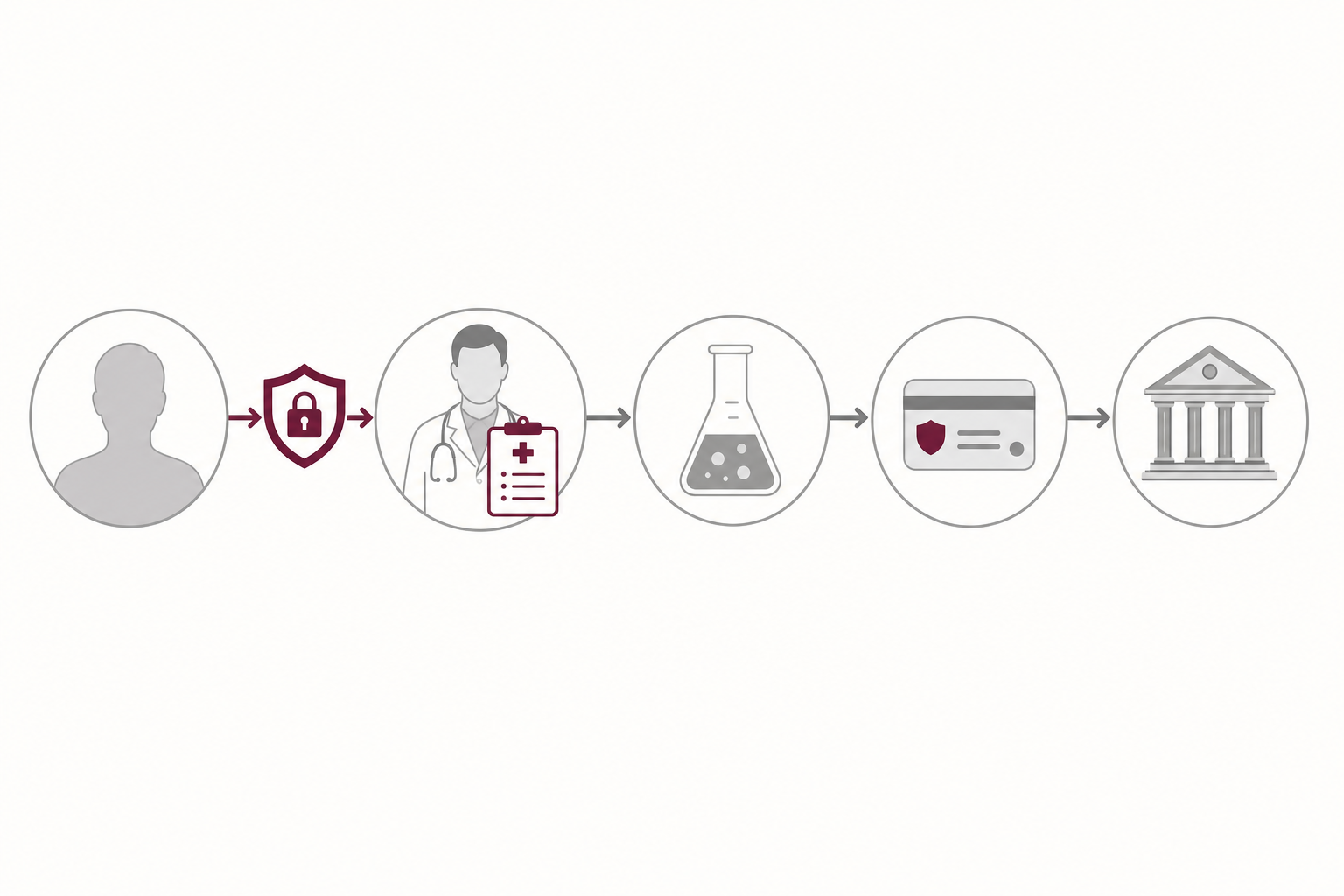
The three practical ways to neutralize EOB exposure are: pay cash for the visit, use a clinic that bills no insurance (Title X, a community health center on a sliding fee scale, some Planned Parenthood locations), or use an at-home test. An at-home kit purchased out of pocket generates no insurance claim, no EOB, and no entry in a provider's record at the time of testing. The order ships in plain packaging.
Partner Notification: How It Actually Works
Partner notification is the public-health practice of alerting recent sexual contacts of someone with a positive STI test so they can also be tested and treated. The CDC outlines the framework in its Sexually Transmitted Infections Treatment Guidelines. Three approaches exist in U.S. practice.
Patient referral asks the diagnosed person to contact their own partners directly. Provider referral asks the clinician or a Disease Intervention Specialist (DIS) employed by the health department to contact partners on the patient's behalf. The diagnosed person's name is not disclosed to the partner during provider referral. Expedited partner therapy (EPT), legal in most U.S. states, allows the clinician to write a prescription for the patient's partner without seeing the partner in person, used most often for chlamydia and in some places for gonorrhea.
Partner notification is voluntary on the part of the diagnosed person in nearly every state. You do not face legal penalties for declining to give contact information for your partners to the health department. The exceptions are HIV-specific criminal-transmission statutes that exist in some states, which can create legal exposure when a person who knows they are HIV-positive has sex without disclosing their status to the partner. Those laws are about disclosure to a sexual partner, not about cooperating with the health department.
If you test positive on an at-home kit and confirm with a clinic, partner services becomes available to you at that point and remains optional. You decide whether to participate and whether to share partner information. Public-health staff who run partner services are trained to handle the information confidentially, and the index patient's identity is protected during provider-led outreach.
Partner services are voluntary, and the index patient's identity is never disclosed to a partner during provider-led notification.
At-Home STI Testing: The Privacy Math
An at-home rapid test trades one set of privacy considerations for another. The trade-offs are worth being concrete about.
At-home testing removes the insurance claim, the EOB, the entry in your medical record at the time of testing, the in-person clinic visit, and the receptionist who may know your face. None of those generate paper that anyone else can read. The obligation does stay constant, though: a confirmed positive result still warrants clinical follow-up for treatment, and that follow-up generates a record. Mandatory reporting applies at the confirmation point, as does voluntary partner notification, and the legal protections around the eventual clinical record are the same HIPAA protections that cover any clinical encounter.
The shift is one of custody. You hold the screening result. The test cassette is yours, the result reading is yours, and what you do with that information (whether to seek confirmation, whom to tell, and when) is yours to decide on your own timeline. Some readers find that empowering. Others find the responsibility uncomfortable, and both responses make sense.
The at-home rapid tests sold at stdrapidtestkits.com are lateral-flow immunoassays. They are screening tools designed for at-home use, not laboratory-grade nucleic acid amplification tests (NAATs). A positive screening result is worth confirming with a clinic-administered NAAT or blood test before starting treatment. A negative result during the appropriate window period is reassuring but is not a substitute for periodic screening if exposure risk continues.
What changes: no insurance claim, no Explanation of Benefits, no entry in a clinical record at the time of the test, no in-person visit, no receptionist.
What stays the same: a confirmed positive still needs clinical follow-up; mandatory reporting applies at the confirmation point; partner notification remains voluntary; the clinical record generated at confirmation is HIPAA-covered like any other encounter.
What is yours to decide: whether and when to confirm a positive result, whom to tell, and how to handle the screening information in the meantime.
Practical Steps to Keep Your Testing Private
Five specific decisions cover most of the privacy question.
- Decide how you will pay. Cash, a prepaid card, an HSA or FSA card that does not generate an EOB to a separate policyholder, or an at-home kit purchased out of pocket are the cleanest options. If you must use insurance, ask the clinic at the time of booking whether they can submit the claim with a non-specific service code and whether your state has confidential communication protections you can invoke.
- Decide where the result lives. A clinic test creates a medical record under your name. An at-home test does not, unless you bring the result to a clinic for confirmation. Both are legitimate choices, and there is no single right answer.
- Ask the clinic about its specific practices. Reputable clinics have written policies on confidentiality, on EOB suppression for sensitive services in states that allow it, on whether reminders are sent to the address on file, and on how positive results are communicated (phone, secure patient portal, or mail). These questions are normal, and providers expect them.
- Know your state's rules on minors and sensitive services if relevant. The HHS Office of Population Affairs publishes guidance for Title X clinics that touches on adolescent confidentiality; state attorney general and department of health websites usually publish the local consent and confidentiality rules in plain language.
- Give yourself permission to test. The arithmetic of STI testing favors early detection at every stage. Chlamydia diagnosed at three weeks is a single dose of antibiotics. Untreated chlamydia at six months can progress to pelvic inflammatory disease and fertility consequences. Syphilis caught in the primary stage is one injection. Late syphilis is permanent organ damage. HIV diagnosed in the acute window means treatment that reliably suppresses the virus to undetectable levels. Late-stage HIV is harder to manage. The privacy concerns are real, and the testing decision is yours, but waiting almost never improves the privacy math and frequently worsens the clinical one.
Bottom Line
STD testing in the United States is more legally protected than common worry suggests. HIPAA covers the result. State medical-records laws back it up. Mandatory reporting exists but is narrow in scope and disclosed only to public-health staff who are themselves bound by confidentiality rules with their own penalties. The most-frequent privacy leak is the insurance Explanation of Benefits, which can be neutralized by paying cash or by using an at-home rapid test.
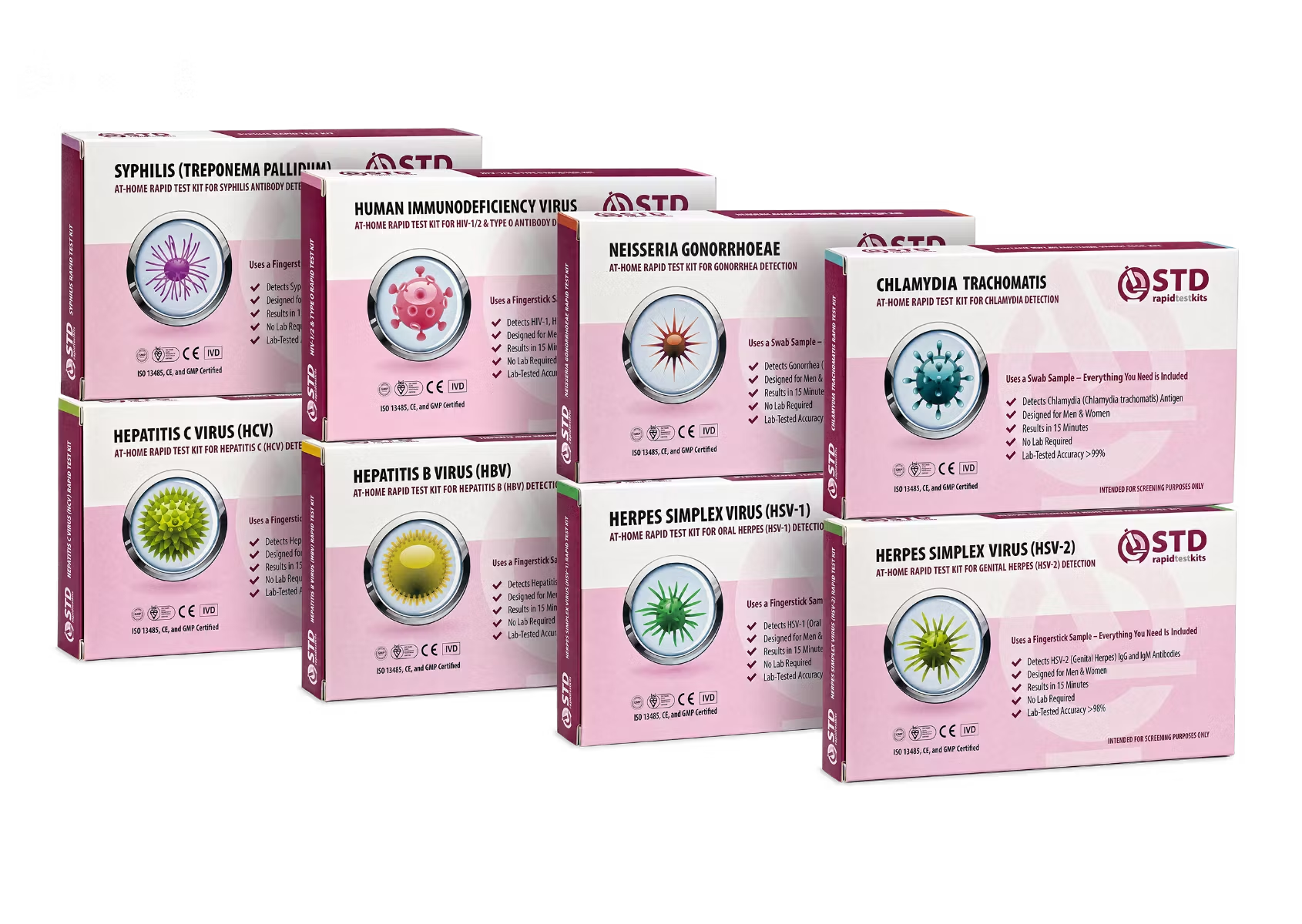
The legal framework does not remove every concern, especially for minors on a parent's insurance plan or for anyone in a controlling relationship where mail is opened by another person. For those situations, an at-home test purchased out of pocket and shipped in plain packaging is the cleanest available option. For everyone else, knowing the framework is usually enough to make a clinic visit feel less exposed than it did before reading the rules. Browse the full range of at-home combination kits if you want to see what a private, paper-trail-free screen looks like.
Decide how you will pay, decide where the result lives, ask the clinic about its specific practices, look up your state's minor-consent and sensitive-services rules, and give yourself permission to test. An at-home kit purchased out of pocket is the cleanest single-step option when an insurance trail or a household mailbox is the main worry.
Frequently Asked Questions
- Is at-home STI testing legally as confidential as a clinic visit?
- At-home rapid testing generates no medical record and no insurance claim at the time of the test, which makes it more private in practice than a clinic visit, even though HIPAA does not technically apply to a consumer product. If you later confirm a positive result at a clinic, that confirmation visit is HIPAA-covered like any other clinical encounter.
- Will my STD test show up on my insurance Explanation of Benefits?
- Almost always, yes. EOBs list the provider, date, service or diagnosis code, and amounts for every paid claim, and they go to the named policyholder. Some states allow a covered dependent to request EOBs be redirected for sensitive services, but the protections vary. The cleanest workaround is to pay cash for the visit, use a clinic that does not bill insurance, or use an at-home kit purchased out of pocket.
- Can my doctor tell my parents I got tested if I am under 18?
- States broadly allow minors to consent to their own STI testing without parental permission, but confidentiality from parents is not guaranteed in every state. Some states allow providers to notify parents at their discretion; some require parental notification under specific conditions; a smaller group prohibits notification without the minor's permission. Insurance billing is the more common path of disclosure: if you are on a parent's plan, the EOB usually reaches the policyholder.
- Which STIs must be reported to the government?
- Chlamydia, gonorrhea, syphilis (all stages), HIV infection, chancroid, and hepatitis B and C are nationally notifiable conditions per the CDC's National Notifiable Diseases Surveillance System. Providers and labs send case reports to state health departments, which transmit case-level surveillance data to the CDC through that system. The figures CDC publishes publicly are aggregated and de-identified, but the data moving through the system is case-level. Routine herpes (HSV-1, HSV-2) and most HPV infections are not federally reportable. Reporting is on the provider, not on you.
- Does HIPAA cover at-home test kits?
- HIPAA covers healthcare providers, health plans, healthcare clearinghouses, and their business associates. A consumer who buys an at-home test, runs it, and reads the result is not a HIPAA-covered entity. The privacy of an at-home test does not flow from HIPAA, it flows from the fact that no record is created. Once you bring an at-home result to a clinic for confirmation, the clinic visit and any record generated there is HIPAA-covered.
- Can I be required by law to notify my sexual partners after a positive STI test?
- In nearly every state, partner notification is voluntary on the part of the diagnosed person. You will not face civil or criminal penalty for declining to give partner contact information to the health department. The exception worth knowing about is HIV-specific criminal-transmission statutes in some states, which apply to a person who knows they are HIV-positive and has sex without disclosing that status to the partner. Those laws are about disclosure to the partner, not about cooperating with the health department.
- Are at-home STI tests as accurate as the test my doctor would order?
- Lateral-flow at-home rapid tests are screening tools. They are useful for first-line answers and are accurate when used after the appropriate window period for each infection. The laboratory tests your doctor orders (nucleic acid amplification tests for chlamydia and gonorrhea, fourth-generation antigen-antibody panels for HIV) generally have higher analytical sensitivity, especially for very early or asymptomatic infections. A positive at-home result is worth confirming at a clinic before treatment. A negative result during the appropriate window is reassuring but does not replace periodic screening if exposure continues.
- If I throw away the test cassette, can anyone trace it back to me?
- An at-home test cassette is not linked to your identity in any technical way. You bought the kit, you ran the test, you read the result. There is no name, no barcode tied to a personal account, and no electronic transmission of the result to anyone. The information exists only in the test window itself and in your own memory. Discarding the cassette in normal household trash leaves no trail.
- U.S. Department of Health and Human Services, Office for Civil Rights. HIPAA for Individuals: your rights, the Privacy Rule's permitted disclosures, and how to file a complaint.
- U.S. Centers for Disease Control and Prevention. National Notifiable Diseases case-definition portal: current list of nationally reportable infections, including chlamydia, gonorrhea, syphilis, HIV, hepatitis B, and hepatitis C.
- U.S. Centers for Disease Control and Prevention. Sexually Transmitted Infections Treatment Guidelines: framework for partner notification, expedited partner therapy, and Disease Intervention Specialist outreach.
- U.S. Department of Health and Human Services, Office of Population Affairs. Guidance for Title X clinics on adolescent confidentiality, family planning, and sexual health services.
- U.S. Centers for Disease Control and Prevention. HIV testing overview: window periods, confirmatory testing, and partner services for HIV-positive individuals.
- U.S. Centers for Disease Control and Prevention. STD prevention and screening: clinical recommendations and reporting overview.