
Published: July 2025 | Last updated: April 2026 | Editorial review and quality control: Martina N.
Burning after anal sex is one of those symptoms that pulls people in two directions at once. Half your brain says “it’s just friction, calm down.” The other half says “what if it’s herpes.” Both can be right, depending on what you actually feel and how long it lasts. The good news is that the patterns are usually distinguishable once you know what to look for. The harder news is that several of the things that cause anal burning, including hemorrhoids, fissures, herpes, gonorrhea, and chlamydia, can overlap in their early symptoms.
Reading the signal correctly is the difference between waiting it out and knowing you need a test. This guide walks through the most common causes, what each one tends to feel like, when post-sex pain crosses from normal to concerning, and what at-home and clinic-based testing actually cover for symptoms in this area.
Is anal burning after sex an STD or a hemorrhoid?
Most short-lived burning after anal sex (24 to 72 hours and steadily improving) is from friction, a small tear, or a hemorrhoid flaring up. Burning that intensifies, lasts past three days, comes with new bumps, blisters, ulcers, or discharge, or shows up days after exposure is more likely an STI. Herpes, chlamydia, and gonorrhea can all cause anal symptoms. If something feels like it should be healing but isn’t, get tested.
Key Takeaways
- Pain that improves day by day points to friction, a fissure, or a hemorrhoid; pain that gets worse over several days is the classic herpes pattern.
- At-home rapid kits can confirm HSV antibodies and bloodborne STIs after the right window. For an active anal lesion or rectal infection, a clinic swab tested by NAAT or PCR is the diagnostic gold standard.
Why the anal area reacts so strongly to sex
The skin around the anus is thin, rich in nerve endings, and not lubricated by the body the way the vaginal wall or the inside of the mouth is. The anal canal also sits over a generous network of small blood vessels, the same ones that swell into hemorrhoids when they’re irritated. All of this makes the region quick to feel pain, quick to bleed in tiny amounts, and quick to inflame after pressure or friction.
That sensitivity is also why so many things present in similar ways. A small fissure, an external hemorrhoid, and a beginning herpes outbreak all involve thin perianal skin reacting to a stressor. Burning, stinging while wiping, mild swelling, and a smear of bright red blood on the toilet paper can show up in any of them.
What the area can’t tell you on its own is which cause is which. Bodies don’t label their symptoms. The information you need to decode what’s happening is in three signals: the timing (how soon after sex did pain start, and how is it changing day to day), the appearance (smooth swelling versus a raised bump versus a cluster of small blisters), and the company it keeps (is there discharge, fever, swollen lymph nodes, a recurrence cycle).
Track three things over a few days and the picture usually clarifies itself. Timing: did the pain start within hours, within a couple of days, or later? Appearance: smooth swelling, a linear paper-cut, or a cluster of small bumps? Company: is there discharge, fever, swollen groin lymph nodes, or a recurrence cycle? The combination separates mechanical injury from an active infection more reliably than any single symptom does on its own.
The three usual suspects after anal sex
Burning that lands within hours of sex usually traces to one of three things. None of them are unusual. None of them mean anything went catastrophically wrong. They feel similar enough at the start that telling them apart in the first 24 hours is mostly guessing.
Friction and microtears. Anal sex without sufficient lubrication, with a partner whose size is much different from your usual, or after a long session without breaks, can leave the perianal skin and the anal canal lining inflamed. Microtears (tiny splits in the lining) are common after receptive anal sex even with experienced partners. They tend to show up immediately, sting most when wiping or during a bowel movement, and start improving within 24 to 48 hours.
Hemorrhoids. Internal or external hemorrhoids, swollen vessels in the cushion of tissue around the anal opening, can flare after the pressure and stretching of anal sex. Mayo Clinic describes the symptoms as itching, mild burning, swelling around the anal opening, and bright red blood on the paper or in the bowl after a bowel movement. Hemorrhoids do not form blisters, do not ulcerate, and are not contagious.
Anal fissures. A fissure is a split in the lining of the anal canal, larger than a microtear and slower to heal. Mayo Clinic notes that fissures usually cause sharp pain during bowel movements that can last for several minutes afterward, often with a small streak of blood. Acute fissures heal within about six weeks with stool softeners, sitz baths, and time.
If your symptom fits one of these three and is steadily improving day by day, the working theory is solid. If it isn’t improving, or new features show up (a fluid-filled bump, a cluster of small spots, a fever), the working theory needs a second look.
| Pattern | Friction or fissure | External hemorrhoid | Anal herpes (HSV) |
|---|---|---|---|
| Onset relative to sex | Within hours | Within hours to a day | Days to a couple of weeks after exposure |
| Day 3 trajectory | Improving | Improving with fiber and rest | Often worse, new spots appearing |
| Visible feature | Smooth split or paper-cut line | Soft swelling or skin tag | Cluster of small blisters or shallow ulcers |
| Bleeding | Streak on paper, brief | Bright red after bowel movement | Crust or weeping fluid as sores break open |
| Itching | Minimal | Common, especially after wiping | Tingling or itching often precedes sores |
| Recurrence pattern | Heals once | Flares with constipation or stress | Reactivates in cycles, often the same spot |
| Contagious | No | No | Yes, including without visible sores |
Hemorrhoid versus herpes: the patterns that actually differ
Most of the back-and-forth in online searches lands on the same comparison: hemorrhoid or herpes. They share the bullet points (burning, swelling, itch) but the underlying mechanism is different, and the patterns separate cleanly once you know what to look for.
A hemorrhoid is a vein. Specifically, it’s a swollen vessel in the cushion of tissue around the anal opening (external) or just inside the canal (internal). Hemorrhoids are not infectious. They don’t form blisters or ulcers. Mayo Clinic lists the triggers as chronic straining, sitting too long, pregnancy, low-fiber diets, and repeated pressure on the perianal vessels. After anal sex, an external hemorrhoid can flare because those vessels just got squeezed and stretched. The bump tends to be soft, smooth, and consistent in shape over time. It hurts most during a bowel movement or after a long stretch of sitting, and it improves with fiber, fluid, sitz baths, and rest.
Herpes, in contrast, is a virus replicating in skin and nerve cells. Once HSV (herpes simplex virus) establishes infection, it lives in the sensory nerves and reactivates periodically, often in the same anatomic spot. The CDC notes that most people with genital herpes have no symptoms or only very mild ones, and that the skin can release the virus and infect a sex partner even when no sore is visible. When symptoms do appear around the anus, they tend to follow a sequence: tingling or burning first, then a cluster of small fluid-filled bumps over a day or two, then those bumps break open into shallow ulcers, then crust over and heal across one to two weeks.
The biggest tells: hemorrhoids stay roughly the same shape day to day, while herpes lesions evolve through stages. Hemorrhoids don’t itch in the way herpes prodrome itches (a deep tingle that radiates a few inches from the future sore). Hemorrhoids don’t recur in the same spot in cycles tied to stress, illness, or sex; herpes does. Hemorrhoids don’t come with a low-grade fever or swollen groin lymph nodes during a first outbreak; herpes can.
Other STIs that show up around the anus
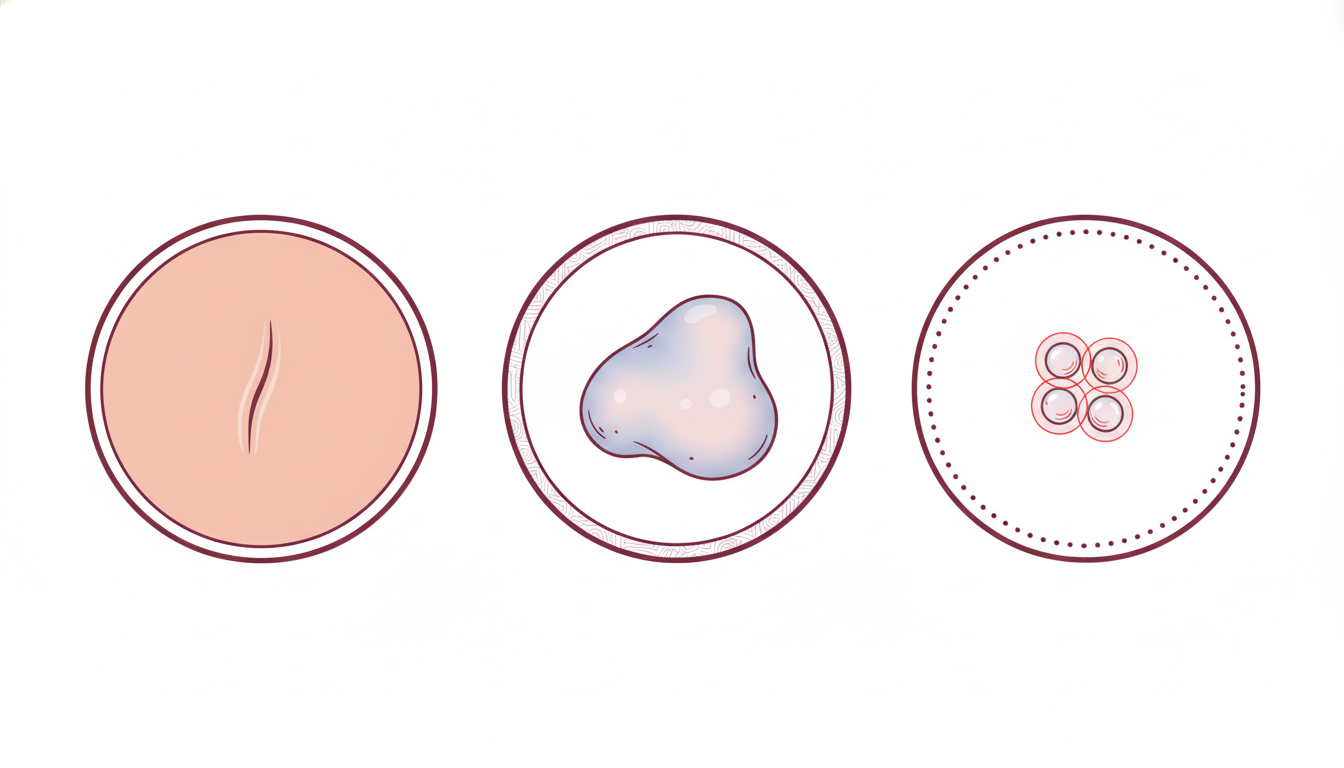
Herpes gets the most search traffic in this category, but rectal infections from chlamydia, gonorrhea, syphilis, and HPV all happen and all can be missed. The CDC notes that many rectal STIs are asymptomatic, especially in early stages, which is why screening recommendations for sexually active adults with receptive anal exposure often include rectal swab testing regardless of symptoms.
Rectal chlamydia and rectal gonorrhea can produce mucus or pus discharge, tenesmus (an aching urge to have a bowel movement), pain on defecation, and occasionally rectal bleeding. They can also produce nothing at all. The diagnostic standard is a clinic-collected rectal swab tested by NAAT (CDC chlamydia, CDC gonorrhea). The at-home rapid swab tests sold on this site are validated for vaginal or penile self-swab samples, not rectal samples. If your concern is rectal-specific, a clinic visit gets you the right sample type.
Syphilis can present as a primary chancre on or near the anus. The CDC describes the chancre as usually firm, round, and painless, lasting three to six weeks before resolving on its own. Because the anal canal can hide a chancre out of sight, syphilis can quietly enter the secondary stage before anyone notices. Blood antibody tests detect syphilis after a detection window that depends on the assay; a provider can advise the right repeat-test timing if exposure is recent.
HPV doesn’t usually cause burning. It causes warts, which can show up around the anus as small soft bumps or larger cauliflower-shaped clusters. Most are painless. Vaccination through age 26 is routinely recommended by ACIP, with shared clinical decision-making through age 45.
Proctitis is the umbrella term for inflammation of the rectal lining. It can be caused by any of the infections above and produces the classic combination of pain, bleeding, and a constant urge to have a bowel movement.
The overlap with herpes is real. The differences are mostly in the specifics of pain pattern, the presence or absence of discharge, and the timing relative to exposure.
Note: this site sells the at-home rapid test kits referenced throughout this article, and we recommend specific kits based on fit-for-purpose for the reader’s concern, not commercial benefit.
Rectal chlamydia and gonorrhea infections frequently produce no symptoms at all in the first weeks. The CDC explicitly recommends rectal screening for sexually active adults with receptive anal exposure regardless of how someone feels. If you’ve had multiple partners or unprotected anal exposure in the last 90 days, getting tested even without symptoms is the responsible move, not the paranoid one.
Healing timeline: what your body should be doing
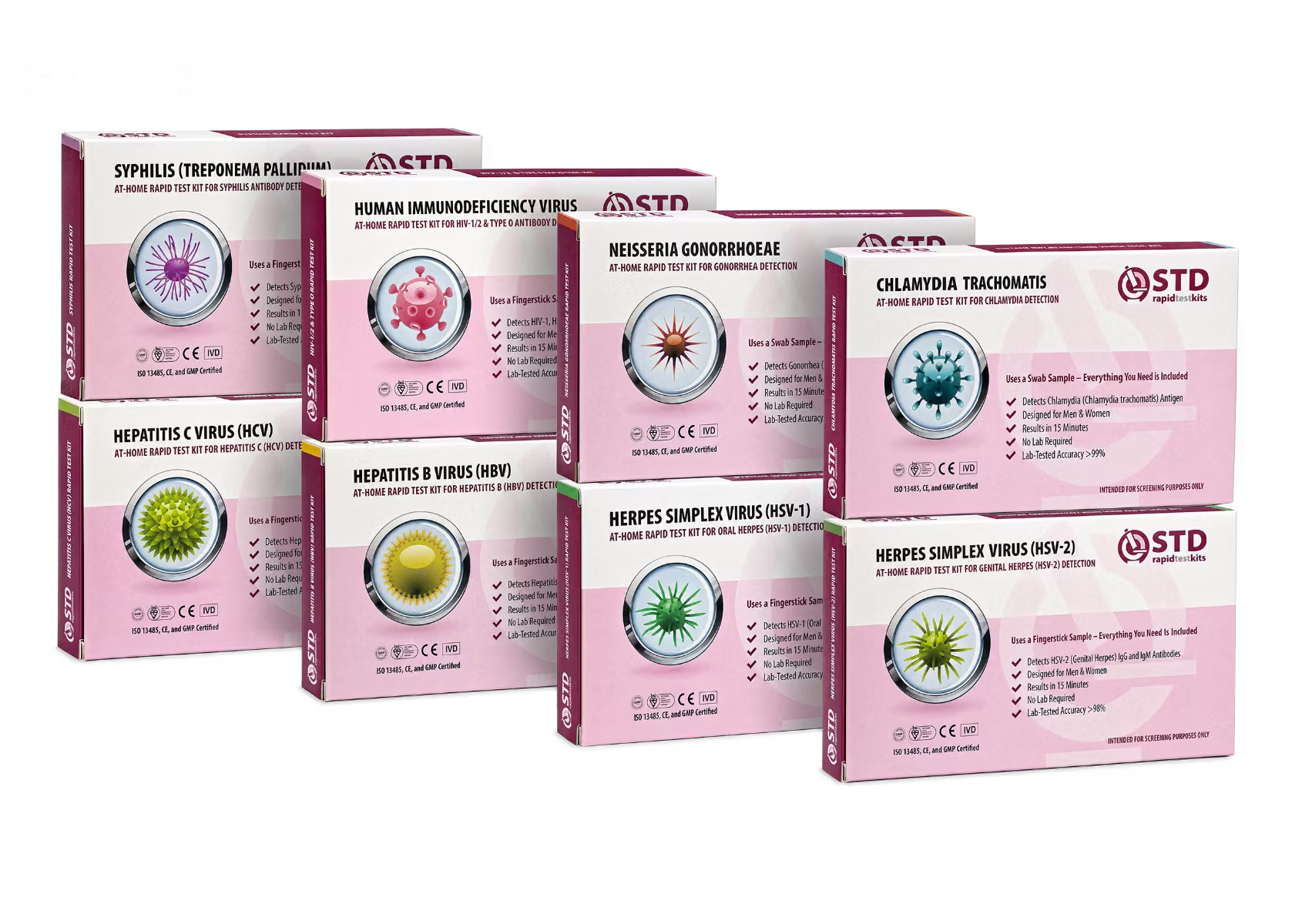
A useful frame for ambiguous post-sex pain is to track it day by day. Healing has a direction. Infection has a direction too, just the opposite one.
Day 1. Sharpest sting during a bowel movement, possible smear of bright red blood on the paper, and discomfort while wiping. Friction, microtears, fissures, and irritated hemorrhoids all match this. Early herpes can also start at day 1 if exposure was a couple of days back, although many people describe the initial sensation as more “tingly and weird” than sharp.
Day 2 to Day 3. For mechanical injuries (friction, fissure, microtear), pain should be noticeably less. For hemorrhoids, the swelling should be flattening with sitz baths, fiber, and rest. For early herpes, this is the window when prodrome (tingling, hot patches of skin) often gives way to the first visible bumps.
Day 4 to Day 7. Mechanical injuries should be most of the way healed; bowel movements may still pinch but the residual sting fades. Hemorrhoids often look much smaller. Herpes lesions, if that’s what this is, tend to be at their most painful: bumps have ruptured into shallow ulcers, the area is most tender, and a low-grade fever or swollen groin lymph nodes can show up.
Beyond Day 7. A fissure that hasn’t healed by week one is technically a chronic fissure and worth a clinical visit. Pain that has built rather than receded is the pattern for an active infection. New bumps appearing while older ones are still present is the herpes signature.
If your trajectory is “this should be over by now,” that’s the actual cue to test or be examined. The body’s healing direction is the most reliable signal you have without a swab.
Two trajectories at a glance
- Mechanical injuries (friction, fissure, hemorrhoid) get better day by day; most are noticeably improved by day three and largely resolved by day seven.
- Herpes outbreaks build before they resolve: small bumps appear over days two to three, ulcerate by day four to seven, then crust and heal across one to two weeks.
What our at-home kits cover, and what a clinic gives you
This site sells rapid lateral-flow at-home test kits. They’re useful, and they’re also not interchangeable with everything a clinic offers. For anal symptoms specifically, the honest breakdown is worth keeping straight.
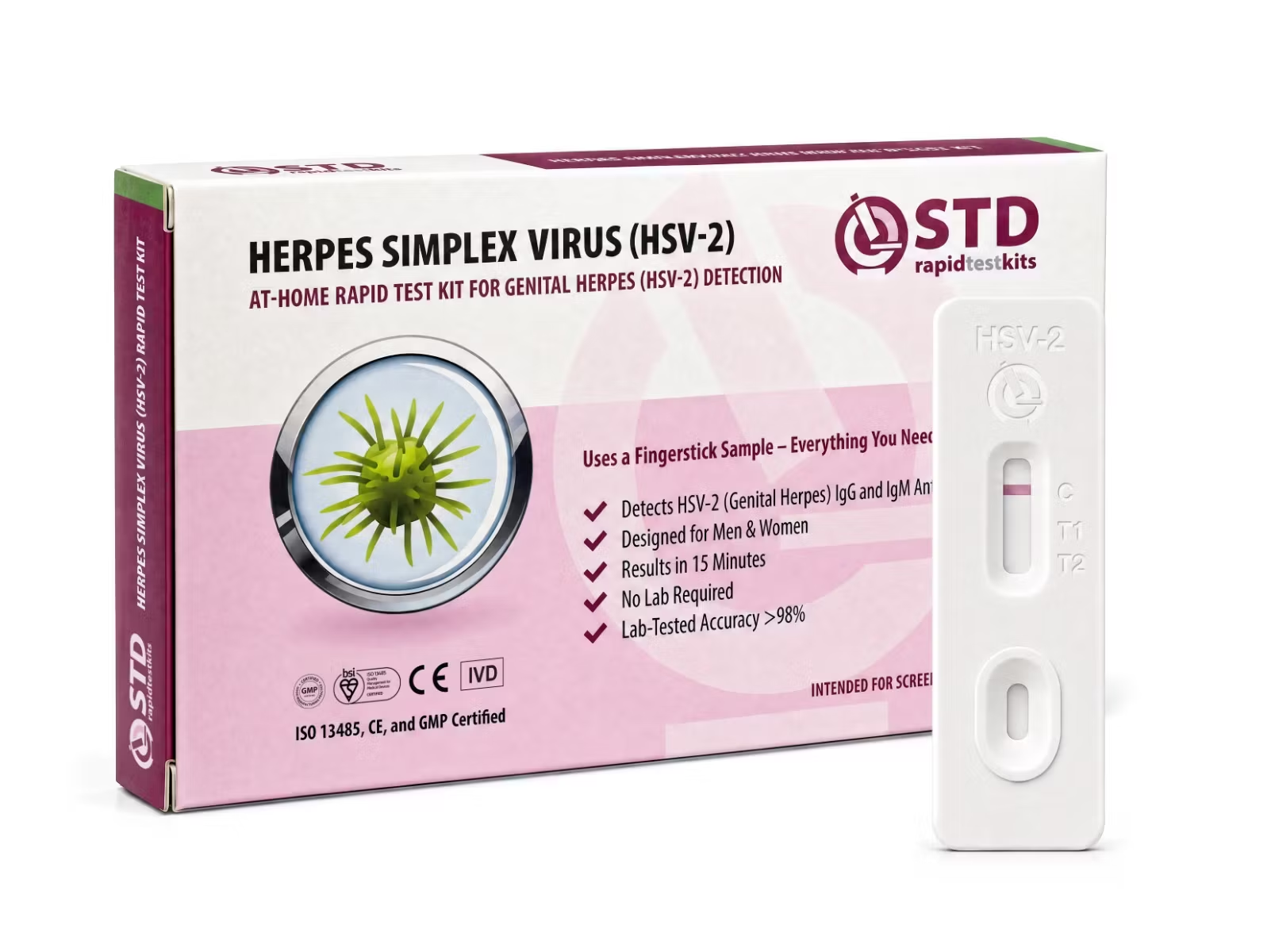
What the at-home kits do well. The HSV-2 single-infection test is a fingerstick blood antibody test. After about 12 weeks from exposure, it can confirm whether you’ve seroconverted (developed antibodies) to HSV-2, which is the herpes type most commonly behind genital and anal outbreaks. The combined herpes test reads both HSV-1 and HSV-2 antibodies. Blood antibody testing answers “have I been exposed at some point” with high specificity once the window has passed. The combo kits (the 8-in-1 for any-gender, for example) bundle bloodborne STI checks (HIV, syphilis, hepatitis B, hepatitis C, HSV) with genital swab tests for chlamydia and gonorrhea. They’re useful for a general post-exposure screen.
What the at-home kits don’t do. Our rapid swab kits for chlamydia, gonorrhea, trichomoniasis, and HPV are validated for vaginal or penile self-collected samples, not rectal samples. We don’t sell a rectal swab kit. A blood antibody test for HSV cannot tell you whether a specific lesion in front of you right now is herpes; it can only tell you whether you’ve ever been exposed. For an active sore or rectal symptoms, a clinic-administered swab tested by NAAT or PCR is the diagnostic gold standard.
For a swab of the rectum tested by NAAT or PCR (the diagnostic gold standard for rectal chlamydia and gonorrhea), a clinic visit is the right call. Our at-home swab kits are validated for vaginal or penile self-swab samples. If your symptoms are rectal-specific and you need a definitive answer, the clinic visit gets you there faster than guessing at home.
Talking to a provider without bracing for cringe
If a clinic visit is what’s needed (active lesion, rectal-specific symptoms, fever, swollen lymph nodes, persistent pain past a week), the conversation tends to go better with a few small adjustments.
Lead with the timeline, not the speculation. “I had receptive anal sex six days ago and developed sharp pain during bowel movements that has gotten worse over the last three days” is more useful than “I think I have herpes.” Providers triage by trajectory, so giving them trajectory is the fastest route to a useful exam.
Ask explicitly for the test you want. “Can we do a rectal NAAT swab for chlamydia and gonorrhea, plus a herpes PCR of the lesion if it’s still active” is a sentence that bypasses any awkward back-and-forth. If you’re in a primary-care setting that doesn’t routinely run rectal swabs, ask for a referral to a sexual-health clinic where it’s standard.
If shame is the real barrier, telehealth sexual-health platforms exist precisely for this. The conversation happens by video, swab kits arrive by mail, and lab results land in a portal. The provider has heard everything you’re worried about saying. Genuinely, they have not flinched in years.
For readers in the U.S., the CDC’s STI clinic locator and Planned Parenthood’s clinic finder both list confidential testing locations. For readers in the UK, sexual-health clinics (“genitourinary medicine” clinics) handle this routinely on the NHS.
Two sentences move the visit forward. First, the timeline: “I had receptive anal sex six days ago and developed sharp pain during bowel movements that has gotten worse over the last three days.” Second, the explicit request: “Can we do a rectal NAAT swab for chlamydia and gonorrhea, plus a herpes PCR of the lesion if it’s still active?” Skip the speculation about what it might be; let the test answer that.
Aftercare while you wait, whether for healing or for results
Whether the cause turns out to be benign or treatable, perianal skin needs gentle handling while it sorts itself out. The principles are the same across diagnoses.
Wipe softly. Unscented, dye-free wet wipes (or a small squirt bottle of warm water followed by patting dry) is a marked improvement over dry toilet paper for inflamed perianal skin.
Sitz baths help. A shallow basin of warm (not hot) water, 10 to 15 minutes, two or three times a day, soothes both fissures and external hemorrhoids. Skip soaps, bath bombs, and scented additives; plain water does more good than anything fragranced.
Soften stools. Adequate hydration, 25 to 35 grams of fiber daily, and a stool softener for a few days if needed all reduce the trauma of bowel movements while inflamed tissue heals.
Skip aggressive douches and harsh soaps near the area. They strip the protective lipid layer and slow healing.
Use barrier ointments thoughtfully. Zinc oxide and aloe-based ointments can soothe inflamed skin. Petroleum jelly traps heat and moisture, which is sometimes counterproductive on suspected herpes lesions; switch to a thinner barrier if you’re unsure.
If herpes is confirmed or suspected, wash hands carefully after touching the area, and avoid sex (including oral) until lesions have fully crusted and healed. Antiviral medications (acyclovir, valacyclovir, famciclovir) can shorten an outbreak and reduce transmission risk; a provider can prescribe them. The NHS genital herpes page has a clear summary of treatment expectations.
If you only do two things while perianal skin is inflamed, do these: a warm sitz bath two or three times a day for 10 to 15 minutes, and softer stools through extra fluid plus 25 to 35 grams of fiber. Together they reduce the trauma of every bowel movement and let irritated tissue actually heal between exposures.
Telling a partner: when, what, and why it matters
A positive STI result is hard. The conversation that follows is often harder than the result itself. A few useful frames:
Disclosure isn’t legally required for past partners in every U.S. state, but it’s a public-health recommendation and, in most cases, the right call. Anonymous partner-notification services let you alert recent partners that they should test, without your name attached.
For ongoing partners, the conversation goes better when it’s framed as care, not blame. “I tested positive for HSV-2 and wanted to tell you so you can get tested too” is information; it’s not an accusation. Many people with HSV-2 acquired it from a partner who didn’t know they had it, since the virus sheds asymptomatically. That’s not a unique failure of any one relationship; it’s a feature of how the virus moves.
For new partners going forward, disclosure norms vary. The general practice is to disclose before sexual contact. Being on suppressive antiviral therapy and using condoms substantially lowers transmission risk, and having the conversation lets the other person make an informed choice.
Most people with genital herpes do not know they are infected. The virus can be released from the skin and spread to a sex partner even when there are no visible sores or symptoms.
FAQs
- Can a hemorrhoid feel exactly like herpes in the first 24 hours?
- It can, especially when an external hemorrhoid first flares up. Both can sting while wiping, both can ache during a bowel movement, and both can come with a small smear of blood. The difference shows up over days. A hemorrhoid stays roughly the same shape and improves with fiber, fluid, and sitz baths. A herpes outbreak goes through stages (tingling, then small bumps, then ulcers, then crusting) and tends to get worse before it gets better.
- How long does post-anal-sex burning normally last?
- If the cause is friction, microtears, or a small fissure, the worst of the burning is usually within the first 24 to 48 hours and steadily improves over three to five days. If burning is the same intensity or worse on day four, that’s a useful threshold for considering an STI test.
- Can I get herpes from anal sex even if my partner used a condom?
- Yes. Condoms reduce HSV transmission risk substantially but not to zero, because the virus sheds from skin areas the condom doesn’t cover. Skin-to-skin contact in the perianal and inner-thigh region can transmit HSV during asymptomatic shedding.
- What does anal herpes look like at the very start?
- Often it doesn’t look like much. The first sign is usually a tingling, burning, or itching sensation in a specific spot, sometimes a day or two before any bump appears. The bumps that follow are small and fluid-filled, often in a tight cluster. They can sit on the perianal skin or just inside the anal opening, where they’re harder to see but still tender.
- Can the at-home rapid kits sold here test for rectal chlamydia or rectal gonorrhea?
- No. Our rapid swab kits for chlamydia and gonorrhea are validated for vaginal or penile self-swab samples. For a rectal sample, a clinic-administered NAAT swab is the diagnostic standard. The at-home option is useful for ruling out a urogenital infection from the same exposure event, but it doesn’t replace the clinic rectal swab.
- If I had unprotected anal sex, what’s the right testing plan and timing?
- A reasonable plan: a rectal NAAT swab at a clinic for chlamydia and gonorrhea about two weeks after the exposure. A fourth-generation HIV test at six weeks, repeated at three months for the conservative window. A syphilis blood test on a schedule your provider sets based on the assay used. An HSV-2 antibody test at twelve weeks if you want to know your antibody status. At-home rapid kits cover the bloodwork piece privately; the rectal swab is the clinic-only piece.
- Is bleeding after anal sex always a problem?
- A small streak of bright red blood on the paper, once, after a vigorous session, is usually a microtear or fissure and resolves quickly. Bleeding that recurs over multiple bowel movements, dark blood, blood mixed in with the stool, or any heavy bleeding warrants a clinical visit. Persistent or unexplained rectal bleeding always deserves an exam.
- Should I stop having anal sex if it’s been hurting afterward?
- Pausing for a week to let inflamed tissue heal is reasonable. When you resume, more lubricant, more warm-up, and a partner who’ll go slowly all reduce the chance of repeat injury. Pain that comes back consistently with sex (rather than just during a single flare) is a signal that something else is going on, whether a chronic fissure, undiagnosed infection, or pelvic-floor tension. A provider can help sort that out.
The bottom line
Anal pain after sex isn’t a sign of failure. It’s information. Most of the time it’s mechanical (friction, a tear, a hemorrhoid) and resolves with rest, fiber, water, and a sitz bath or two. Sometimes it’s an early infection that needs a test and a treatment plan. Either way, the body has a way of telling you which one you’re dealing with: healing moves in a direction. If your trajectory is upward (more pain, new symptoms, persistence past a week), act, don’t wait. Quiet, private testing for what’s testable at home, and a clinic visit for what isn’t.
Product: herpes-test
- U.S. Centers for Disease Control and Prevention. Genital herpes overview, including asymptomatic shedding, transmission risk, and outbreak description.
- U.S. Centers for Disease Control and Prevention. Chlamydia overview, including transmission, rectal infection note, and laboratory testing.
- U.S. Centers for Disease Control and Prevention. Gonorrhea overview, including rectal symptom presentation (discharge, anal itching, soreness, bleeding, painful bowel movements) and swab-based testing for oral and anal exposure.
- U.S. Centers for Disease Control and Prevention. Syphilis overview, including primary chancre presentation as firm, round, painless sores lasting three to six weeks.
- Mayo Clinic. Hemorrhoid symptoms and triggers, including post-pressure flares and bright red rectal bleeding.
- Mayo Clinic. Anal fissure symptoms, healing timeline, and conservative management with stool softeners and sitz baths.
