
Published: September 2025 | Last updated: May 2026 | Editorial review and quality control: Martina N.
Public health campaigns shape how people think about sex, risk, and testing. When they work, infection rates fall, stigma softens, and routine screening becomes ordinary. When they fall short, the same infections keep moving through the same gaps in access, awareness, and trust. The CDC's national STI surveillance program tracks several million reportable infections in the United States each year, and the global picture from the World Health Organization is larger still.
This article walks through what modern STI campaigns do well, where they still miss, and how the rise of at-home testing is changing the math on prevention. The goal is not to replace traditional outreach. It is to give the people campaigns reach a faster, more private route from awareness to action.
Key Takeaways
- Public health campaigns reduce STI rates most when they pair awareness with low-friction access to testing and treatment, not just one or the other.
- At-home test kits widen the campaigns' reach by removing the two biggest barriers people report: lack of privacy and lack of convenience.
What public health campaigns actually do, and why they matter
Modern STI prevention campaigns are not single ad runs. They are coordinated programs that combine education, behavior support, free or subsidized clinical services, and digital outreach. Their core goals are simple to state and surprisingly hard to deliver.
Build accurate awareness. Most adults underestimate STI prevalence and overestimate how visible the symptoms tend to be. Many gonorrhea and chlamydia infections cause no symptoms at all, which is why the CDC's screening guidance recommends annual chlamydia testing for sexually active women under 25 and routine screening for men who have sex with men. Campaigns that name those specific recommendations move readers from a vague feeling of safety to a concrete next step.
Support healthier behavior over time. Single posters and one-off PSAs rarely change conduct on their own. Multi-month campaigns, peer-led outreach, and school-based programs do shift condom use, vaccination uptake, and the share of sexually active adults who test in any given year. Social media campaigns and peer-driven digital outreach have extended reach further still, particularly among 18-to-34-year-olds who are underrepresented in traditional clinic-based recruitment. HPV vaccination coverage has risen in places that paired clinical access with steady public messaging, while in regions where the vaccine became politicized, uptake stalled.
Reduce the social cost of seeking care. Fear of judgment, from clinicians, family members, or partners, is one of the most reliable reasons people give for delaying or skipping a test. When campaigns normalize regular screening as routine health behavior rather than as evidence of risky living, the framing itself widens the door.
Make services easier to find and afford. A campaign that tells you to get tested is only half a campaign. The other half is a clear path to a free or low-cost clinic, a telehealth visit, or a rapid at-home kit shipped to a discreet address. The NHS sexual health pages are a useful model for this; every information page links directly to local services and self-testing options.
The strongest campaigns work because they bundle all four functions, not because they do any one of them brilliantly. Awareness without access is frustrating. Access without awareness goes unused. Both, without de-stigmatization, stay underused by exactly the populations who need them most.
The <a href="https://www.cdc.gov/std/" target="_blank" rel="noopener">CDC's screening guidance</a> sets specific, risk-stratified intervals rather than a single rule for everyone:
- Chlamydia and gonorrhea: annual screening for sexually active women under 25, and for older women with risk factors such as new or multiple partners.
- HIV: at least once for all adults aged 13 to 64 as part of routine care, with more frequent testing for higher-risk groups.
- Syphilis, hepatitis B, hepatitis C, and HIV: screening at the first prenatal visit for all pregnant patients.
- Men who have sex with men: at least annual screening for chlamydia, gonorrhea, syphilis, and HIV, with three-to-six-month intervals for those with multiple partners.
Campaigns that quote these specific intervals tend to convert readers into testers more effectively than campaigns that only say "get tested."
Why some campaigns still fail the people who need them most
Public health funding is finite. Campaign teams have to make trade-offs about who they reach, in what language, through which channels. Several patterns of failure repeat across the evaluation literature.
Narrow geographic reach. Big-city ad buys, university partnerships, and clinic-based outreach miss rural areas, smaller towns, and communities without a nearby Title X clinic. Recent CDC surveillance data shows STI rates rising fastest in counties with the fewest sexual-health services. People in those places want information; the information often is not coming to them.
Cultural and language mismatch. A campaign written in English for a college-aged audience does not translate cleanly to communities where the conversation about sex is framed by religion, family expectation, or a non-English first language. When campaign content is translated literally rather than adapted, important framing gets lost and trust erodes. Effective programs hire community members as authors, not just as faces in the photographs.
Outdated tools. Many programs still rely on flyers, posters, and in-person clinic visits as the main call to action. Those formats still have reach. They miss the person who would run a fingerstick rapid test at home but never make an in-clinic appointment. The infrastructure has changed faster than most campaign playbooks.
Inconsistent or contradictory messaging. Public trust suffers when one campaign says "test every three months" and another says "test annually" without explaining why guidance differs by risk profile. Readers hear noise and disengage. CDC, WHO, and NHS guidance is generally aligned at the level of risk-stratified screening intervals; campaigns that briefly explain the reasoning retain credibility.
Stigma loops. Campaigns that lean too hard on fear (graphic images, scare language, moral framing) can reinforce the exact stigma they aim to reduce. People remember the dread, not the action step. Modern STI campaigns tend toward calm, specific, action-oriented framing for that reason.
None of these failure modes are insurmountable. Most are the result of campaign design choices that can be revised when the team has the right tools and the right partners.

How at-home STI testing closes the gaps campaigns have struggled with
At-home rapid lateral-flow tests have moved from a niche curiosity to a mainstream prevention tool in the last decade. The FDA approved the first at-home rapid HIV test, OraQuick, in 2012. Since then the available menu has expanded to cover most of the common STIs that public health campaigns talk about. The technology matters less to a reader than what it actually does for them: it removes friction.
It expands reach without expanding clinic hours. A rural reader who lives 90 minutes from the nearest Title X clinic can take a chlamydia, gonorrhea, or HIV test at home. A campaign that ships kits, partners with retailers, or directs readers to online providers reaches that reader in a way an in-clinic appointment never will. Public health research consistently identifies geographic access barriers as a primary reason underserved communities remain undertested, and self-administered kits remove the distance variable entirely.
It protects privacy. The single biggest reason adults skip STI testing, across multiple survey populations, is not cost or distance. It is the worry that someone will see them in the clinic waiting room or read the lab result in a shared medical record. Home testing removes both. A self-collected swab or fingerstick run at the kitchen counter does not show up on a partner's insurance summary or a parent's chart.
It supports honest follow-through. Once a campaign has earned a reader's attention, the next step has to be easy or the moment is lost. A rapid home kit that returns a result in 15 to 20 minutes converts an intention to act into an actual action. That same evening, the reader has either a clean result and reassurance, or a positive result and a clear next step toward confirmation and treatment.
It supports regular screening, not just panic testing. People who test only when they are worried miss the asymptomatic infections that account for a large share of community transmission. Routine quarterly or semi-annual testing is easier to sustain when the test does not require an appointment. Campaigns that frame at-home kits as part of an ongoing self-care routine, similar to a dental cleaning or an annual physical, normalize regular screening in a way poster campaigns never managed.
At-home testing is not a replacement for the in-clinic services campaigns also support. Some infections need clinical confirmation, some need on-site treatment, and some need the partner-notification work that public health programs do better than any individual reader can.
Practical integration: what works when programs adopt at-home testing
The campaigns that have integrated at-home testing well tend to share a few habits. None of them are radical. They are the kind of operational choices that pay off over a multi-year program.
Partner with vetted kit providers and clear confirmation pathways. A campaign that ships home kits also needs a follow-up route for positive results. The strongest partnerships pair a vetted at-home test brand with a state STD program, a telehealth provider that handles treatment, and a local clinic network for in-person needs. Each piece reinforces the others.
Subsidize for the populations who would otherwise skip. Test kits remain a barrier when cost lands on the same households where insurance, transportation, and time off work are already tight. Bulk purchasing and free or sliding-scale distribution are reliable ways to broaden uptake. Programs that distribute through trusted community sites (libraries, harm-reduction centers, LGBTQ+ resource centers, primary care offices) tend to see higher follow-through than mail-only programs.
Build educational content around the kit, not separate from it. Short instructional videos, plain-English fact sheets on what a positive or negative result means, and a clear pathway for confirmatory testing all increase the share of users who complete a kit correctly and act on the result. The lift is largest when content is available in the same languages the kit instructions support.
Use telehealth as the bridge to treatment. A positive home result is most actionable when the next click is a telehealth consult with a clinician who can prescribe treatment, schedule a follow-up lab confirmation, and start partner-notification logistics. Several state programs and private providers already offer this bundle. It compresses what used to be three separate appointments into one continuous experience.
Target specific groups with specific messages. A campaign aimed at young adults in college towns looks different from one aimed at rural communities, men who have sex with men, immigrant communities, or pregnant readers. Pretending one message fits all readers waters down every version of the message. The strongest programs run several parallel campaigns under one umbrella brand, each with copy and channels tuned to the audience.
Measure follow-through, not just kit shipments. A program that ships 50,000 kits and never measures how many were used, how many results were positive, and how many positives received treatment is operating blind.
This article is published by stdrapidtestkits.com, which sells at-home STI testing kits. We recommend products based on what fits a reader's specific concern, not commercial benefit. For symptoms that need in-clinic evaluation, including throat or rectal swab testing, we say so explicitly.
Measurable benefits when campaigns add at-home testing
The case for integration is not theoretical. Programs that have folded at-home testing into broader prevention work report consistent improvements across the metrics public health teams actually track.
Higher detection rates among asymptomatic readers. Most chlamydia and gonorrhea infections cause no symptoms in the affected person, especially in the early window. People who would never have walked into a clinic for an unprompted screening are the same people who will accept a kit that arrived in a discreet envelope and run it on a quiet evening. The result: infections found that would otherwise have continued spreading silently.
Lower onward transmission. Every infection diagnosed and treated is an infection that cannot be passed to another partner. Modeling work referenced by the WHO and echoed in CDC surveillance summaries suggests that even modest improvements in screening rates produce meaningful reductions in community transmission within two to three years, particularly for chlamydia and gonorrhea.
Reduced load on clinical services. Walking in for routine asymptomatic screening is expensive in clinician time, staff time, and patient time. Shifting routine screening to home kits frees clinics to focus on symptomatic visits, confirmatory testing, treatment, and partner-notification work. The clinic remains the right venue for symptomatic visits, confirmatory testing, and partner-notification work; no home kit replaces those functions.
Patient agency and ownership. Readers who run their own test, see their own result, and choose their own next step report higher engagement with their sexual health than readers who only receive results filtered through a clinician.
Better data feedback loops for campaigns. Home-testing platforms, with consent, can supply de-identified aggregate data about test uptake, positivity rates, and geographic patterns. Campaign teams get to learn faster which messages, channels, and audiences are working. Adjustments that used to require a multi-year evaluation cycle can now happen in weeks.
HIV self-testing offers a private and convenient option that can reach people who would not otherwise test, and is recommended as an additional approach alongside existing services.
Where STI prevention is heading next
The current generation of campaigns and at-home tests is already shifting the math. Several trends are likely to accelerate over the next several years, and each affects how readers should think about their own routine.
Smarter targeting through data analytics. Public health teams are starting to use aggregated, de-identified data to target outreach more precisely: which neighborhoods, which age cohorts, which language groups, which platforms. The same techniques that make targeted advertising effective are increasingly being applied to harm reduction and prevention messaging. The ethical guardrails matter as much as the targeting itself, and that conversation is ongoing.
Tighter telehealth integration. Several states already pair home-test results with same-day telehealth consults for confirmation and treatment. As reimbursement rules catch up with the technology, the round trip from worry to result to treatment will compress further. For most common STIs, the experience may eventually feel closer to a 24-hour cycle than a multi-week appointment chain.
Broader test panels. Mycoplasma genitalium, an increasingly recognized cause of urethritis and cervicitis, is starting to appear on commercial at-home test panels. Routine pharyngeal and rectal swab testing for gonorrhea and chlamydia is still primarily a clinic-administered procedure today, but research-grade self-collection protocols are advancing. Readers should expect the home-testing menu to grow rather than shrink.
Reminder-driven mobile apps. Several apps now use scheduled reminders, streak tracking, and lightweight gamification to encourage routine quarterly testing for higher-risk users. The evidence on long-term retention is mixed, but the model is improving and the user base is growing.
Public-private partnership models. Government health departments increasingly co-fund kit distribution with private at-home test providers, splitting cost between budget lines and consumer purchasing. The model is still finding its shape, but the direction is clear. Prevention is becoming less a single-payer service and more a layered, redundant system with several routes to the same outcome.
HPV vaccination as the long-term lever. Routine HPV vaccination through age 26, with shared clinical decision-making through age 45 per ACIP guidance, remains the single most consequential public health intervention available for the long-term reduction of cervical, oropharyngeal, and anal cancers.
Frequently asked questions
- How often should sexually active adults get tested for STIs?
- The CDC recommends at least an annual chlamydia and gonorrhea test for sexually active women under 25 and an HIV test at least once for all adults between ages 13 and 64. People with multiple partners or in higher-prevalence networks should consider screening every three to six months. The right interval depends on partner count, exposure type, and local prevalence rather than a one-size-fits-all rule.
- Are at-home STI tests as accurate as clinic tests?
- Modern lateral-flow rapid kits sold for home use report sensitivity and specificity in the mid-to-high 90 percent range when used correctly and after the appropriate window period. They are not identical to laboratory nucleic acid amplification tests (NAATs), which remain the diagnostic gold standard for several infections, but they are accurate enough to function as a reliable screening step. A positive home result should be confirmed by a clinician.
- Which STIs can I test for at home?
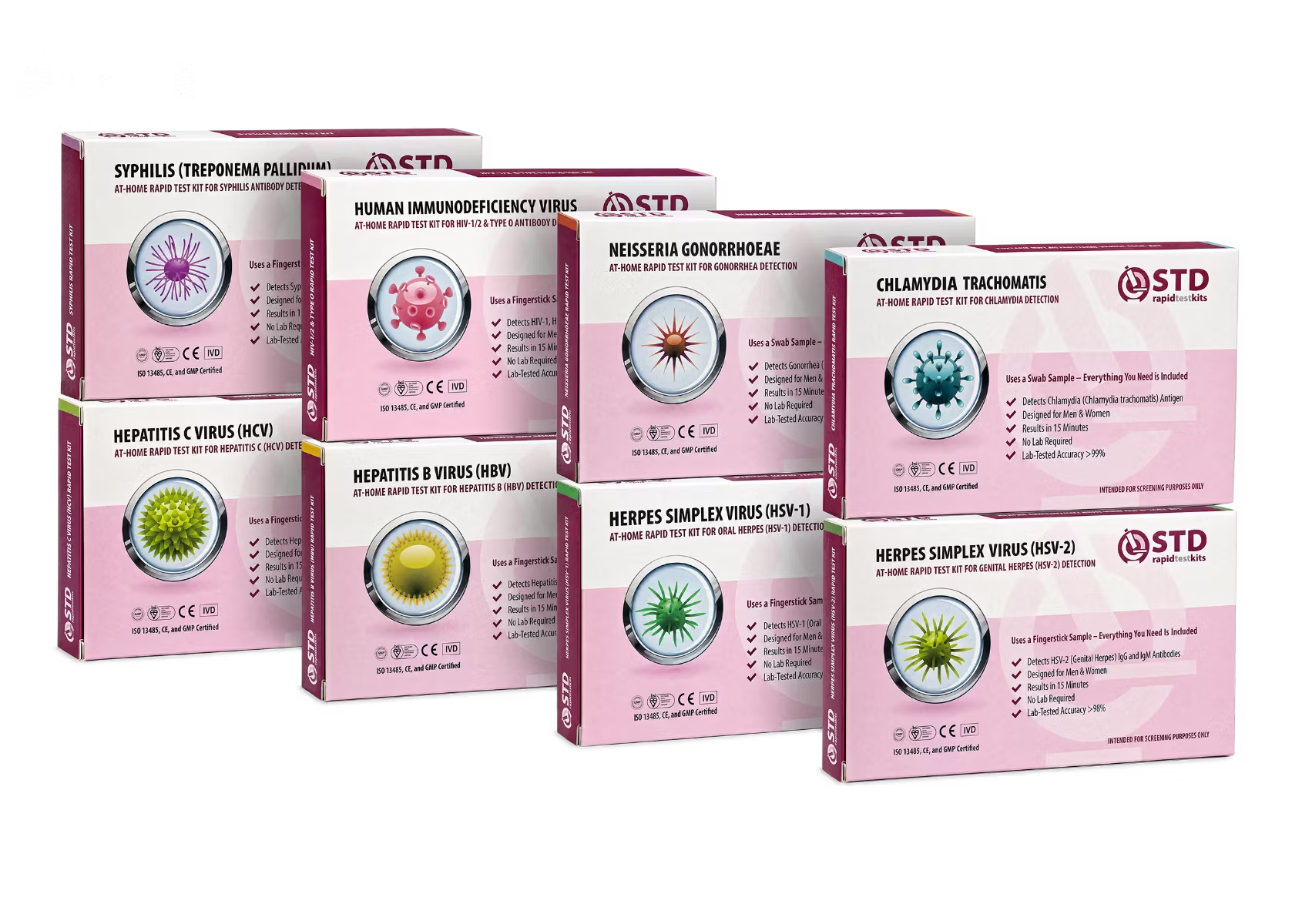
- The current at-home menu includes HIV, syphilis, hepatitis B, hepatitis C, herpes (HSV-1 and HSV-2), chlamydia, gonorrhea, trichomoniasis, and HPV, with several multi-test combination kits also available. Some infections, notably rectal and pharyngeal chlamydia or gonorrhea, still require clinic-administered swabs because no FDA-cleared home version of those sample types exists yet.
- What should I do if my at-home test result is positive?
- First, do not panic. A positive on a home rapid test is a strong signal but is usually confirmed with a follow-up clinic or laboratory test. Many home-testing companies offer integrated telehealth consults that arrange both the confirmatory testing and any treatment. If you do not have that bundle, contact a primary care provider, local public health clinic, or sexual health clinic within a week. Most common STIs are curable; those that are not are highly manageable with treatment.
- Is my privacy actually protected when I order an at-home kit?
- Reputable providers ship kits in discreet, unmarked packaging and process results through encrypted online portals tied to a personal login rather than a shared medical record. Your sample is identified by a coded ID rather than your name in the laboratory chain. If you pay out of pocket, the test does not appear on an insurance summary. Read the privacy policy of any specific provider you use; standards are generally good but do vary.
- Do at-home tests work for asymptomatic infections?
- Yes, and that is one of the strongest reasons to use them. Most chlamydia and gonorrhea infections cause no symptoms, especially early in the infection. Routine screening, including with home kits, is the only reliable way to catch those asymptomatic cases before they cause complications or are transmitted onward. Symptom-free does not mean infection-free.
- Can at-home testing help in rural or underserved areas?
- Yes. The single biggest practical benefit of home testing is that it removes geographic distance from the equation. A reader 90 minutes from the nearest sexual health clinic can run the same screening at home that an urban reader would get in an office visit. Several state health programs now distribute home kits free of charge as part of their broader prevention work; checking your state's public health website is a good starting point.
- How can I support public health campaigns beyond getting tested myself?
- Three actions are unusually high-leverage for individuals: talk openly with sexual partners about testing history, share accurate prevention information without a moralizing tone, and support local sexual health services through advocacy or volunteering. Routine, calm conversation is the single most effective stigma-reducer; campaigns can only do so much from the top down without that grassroots normalization.
- U.S. Centers for Disease Control and Prevention. National STI surveillance program and screening recommendations for chlamydia, gonorrhea, syphilis, and HIV.
- World Health Organization. Sexually transmitted infections fact sheet, including global burden estimates and prevention guidance.
- U.S. Centers for Disease Control and Prevention. HIV testing recommendations, including the at-least-once routine testing recommendation for adults aged 13 to 64.
- U.K. National Health Service. Sexually transmitted infections overview and direct links to local sexual health services and self-testing options.
- U.S. Centers for Disease Control and Prevention, Advisory Committee on Immunization Practices. HPV vaccination guidance for routine vaccination through age 26 and shared clinical decision-making through age 45.
- U.S. Centers for Disease Control and Prevention. STI Treatment Guidelines, the reference clinicians use for diagnosis, screening intervals, and management of common sexually transmitted infections.
