
Published: August 2025 | Last updated: May 2026 | Editorial review and quality control: Martina N.
Three decades ago, sexual health information came from a school nurse, a magazine column, or a stack of clinic pamphlets you had to pick up in person. Today it arrives on a phone screen between videos of cooking shortcuts and dance trends, and for many people under 30 social media has become the first place they look when something feels wrong, when a partner discloses an exposure, or when curiosity outpaces the comfort of asking a doctor.
The shift is doing real public-health work, but algorithm-driven feeds reward emotional engagement over accuracy, so a viral TikTok claiming chlamydia is harmless can reach a million people before a verified CDC post reaches a thousand. This article maps how that landscape works in practice: which platforms do the heavy lifting, where misinformation enters, how to spot the reliable accounts, and how at-home testing fits into a digital-first approach to sexual health.
Key Takeaways
- Social media is now a primary channel where adults under 30 first encounter STI information, with measurable upsides (reach, anonymity, lowered barriers) and real risks (misinformation, algorithmic bias, harassment of credible creators).
- A simple three-source filter (CDC, WHO, NHS) plus at-home rapid testing lets a reader move from a viral video to a verified result the same day, closing the gap between awareness and action.
The Role of Social Media in Sexual Health Education
Social platforms are now a primary information channel for the demographic most affected by sexually transmitted infections. CDC surveillance data consistently shows that people aged 15 to 24 account for about half of all new STI diagnoses in the United States, and survey research consistently finds that a large majority of adults under 25 use at least one major social-media platform daily. The overlap matters. These platforms have become the public-health channel where most sexual education now happens.
What is different from a clinic pamphlet is the form. Short videos, infographics, and creator question-and-answer sessions let people learn in the same passive scroll they use for entertainment, which lowers the barrier to absorbing health information they would never seek out actively. A 22-year-old worried about a rash on her thigh is far more likely to type the question into TikTok than to call her primary care office.
Three structural advantages keep social platforms central to sexual-health communication:
- Accessibility. Platforms are free, work on any phone, and require no appointment or insurance.
- Anonymity. A viewer can learn about herpes, HPV vaccination, or pre-exposure prophylaxis without anyone knowing they were curious.
- Community. Marginalized groups, including LGBTQ+ people and sex workers, find peer-led spaces that meet them where traditional clinics often fail.
The reach matters because U.S. STI rates remain near record highs. The CDC STI surveillance program publishes annual reports tracking chlamydia, gonorrhea, and syphilis cases, and combined case counts across the three infections have run in the millions every year for the past decade. A communication channel that reaches young adults inside their daily scroll has moved from optional to central in sexual-health education planning.
People aged 15 to 24 account for roughly half of all new U.S. STI diagnoses according to CDC surveillance data, and the same age band is the heaviest daily user of TikTok, Instagram, and YouTube. That overlap is the reason public-health agencies have moved most adolescent and young-adult outreach onto social platforms; it is where the highest-incidence population spends its attention.
Benefits of Digital STD Awareness Campaigns
Public-health agencies have learned to use social platforms as a real-time intervention layer, not just a brochure replacement. The advantages are measurable.
Real-time response. When the 2022 mpox outbreak emerged, CDC and WHO posted updated symptom information within days, and infectious-disease clinicians on social media reached affected communities faster than traditional channels could. The same playbook now works for resurgent syphilis in young women and rising congenital syphilis cases.
Anonymity at scale. One of the durable barriers to STI testing is the fear of being seen entering a clinic. Social platforms let people consume sexual-health content privately, including the specific information that prompts them to test. Recent CDC HIV-prevention communications have emphasized digital outreach as a way to reach populations who had not previously accessed in-person services, particularly young Black and Latino men who have sex with men.
Targeted messaging. Platform algorithms direct content to users likely to find it relevant. A campaign promoting HPV vaccination can be shown to parents of preteens and to young adults under age 26, the age group covered by ACIP (Advisory Committee on Immunization Practices) routine recommendations. A campaign about doxycycline post-exposure prophylaxis can reach men in dense urban areas where the intervention is most effective. The same targeting precision that worries privacy advocates is also why a well-designed public-health campaign can find its audience without wasting reach.
Cost-effective outreach. A statewide TikTok campaign about chlamydia testing typically costs a fraction of a single bus-shelter ad placement and reaches a younger, denser audience. Health departments with shrinking budgets have moved most adolescent outreach online for this reason alone.
Campaigns promoting at-home STI test kits have benefited from these same dynamics. Removing the in-person clinic step from the testing pathway, combined with private peer recommendations on social platforms, has made testing accessible to people who would otherwise delay or skip it entirely.
Well-designed campaigns do three concrete things: they reach the highest-incidence age band on the platforms they already use, they let viewers consume sensitive information without being seen, and they convert awareness into action by lowering the friction between watching a video and ordering a test. The combination is why digital outreach has moved from a supplement to a primary channel in adolescent and young-adult sexual-health work.
Challenges and Risks: Where Misinformation Enters
The same algorithmic dynamics that make social media powerful for outreach also make it efficient at spreading wrong information. Three repeated patterns emerge.
Engagement over accuracy. Platforms reward content that triggers strong emotional responses, which means a creator confidently claiming chlamydia goes away on its own (it does not, and untreated chlamydia is a leading cause of female infertility) can outperform a careful CDC explainer about treatment guidelines. The engagement signal pushes the misinformation higher, and corrections rarely catch up.
Sponsored content disguised as advice. Wellness influencers routinely promote unproven herbal remedies, immune-boosting supplements, and detox protocols as alternatives to antibiotics for bacterial STIs. None of these treat gonorrhea, chlamydia, or syphilis. According to the WHO STI fact sheet, the only effective treatment for bacterial STIs is appropriate antibiotic therapy, and delayed treatment increases the risk of pelvic inflammatory disease, infertility, and onward transmission to partners.
False reassurance about symptoms. A common misinformation pattern is the post that downplays specific symptoms as probably nothing. Asymptomatic infection is the rule, not the exception, for chlamydia and gonorrhea. The CDC notes that many STIs, including chlamydia and gonorrhea, have no symptoms or only mild symptoms, which means anyone who relies on symptom-spotting alone for screening will miss the majority of their infections.
Beyond misinformation, three structural problems persist:
- Algorithmic bias. Sexual-health content is flagged disproportionately as adult or explicit, even when it is plainly educational. Creators who specialize in sexual-health education routinely report their videos being demonetized or removed.
- Access inequality. A meaningful share of U.S. adults still do not use the internet at home, and the rural-urban broadband gap remains significant. A communication strategy that exists only online leaves real populations behind.
- Harassment of creators. Health educators who discuss STIs, contraception, or LGBTQ+ sexual health face coordinated harassment, which deters the very experts whose voices add accuracy to the platform.
These problems are real, but they call for better literacy among readers rather than abandoning social media as a sexual-health channel.
Three claims appear repeatedly in viral sexual-health content and are wrong every time: that bacterial STIs like chlamydia or gonorrhea can be cleared with herbal or detox protocols (they cannot, antibiotics are the only effective treatment); that an absence of symptoms means an absence of infection (most chlamydia and gonorrhea cases are asymptomatic); and that a single negative test rules out infection regardless of timing (each infection has a specific window period, and tests run before that window can return false negatives).
How to Spot Reliable Sexual Health Content
Most readers can develop a quick filter for trustworthy posts. The screen takes about ten seconds and works across TikTok, Instagram, YouTube, and X.
Check credentials and citations. A clinician posting about syphilis treatment should be willing to name their license type and link to a primary source like the CDC, WHO, or a peer-reviewed guideline. Posts that make specific claims without naming a source are the highest-risk category. Editorial guidance for clinicians on social media now explicitly recommends that any quantitative claim include a linked citation.
Watch for commercial conflicts. A creator selling an unverified supplement or a natural alternative to antibiotics has a financial reason to make the supplement seem more effective than it is. This does not automatically invalidate their content, but it shifts the burden of proof.
Compare against three primary sources. The CDC, WHO, and NHS all publish plain-language STI guides. If a viral claim contradicts all three, it is almost certainly wrong. If it contradicts one but matches the others, the disagreement may reflect regional guideline differences worth understanding rather than misinformation.
Be skeptical of single anecdotes. A creator who says they tested negative three weeks after exposure and you can too is sharing one data point, not a clinical recommendation. Testing windows vary by infection, and as a general rule the figures used by U.S. public-health clinics are approximately: 14 days post-exposure for chlamydia and gonorrhea, 3 to 12 weeks for syphilis, and 23 to 90 days for HIV antibody tests. These windows reflect when each infection becomes reliably detectable; testing earlier raises the chance of a false-negative result. Specific window guidance for each infection is published on the CDC STI program hub and in the test manufacturer's labeling.
Use the platform info panels. TikTok and Instagram now attach verified-source links to health-related videos. These panels usually point to authoritative sources and are a faster way to verify a claim than copying the video caption into a search engine.
None of these checks require medical training. They are the same media-literacy skills that work for political news; the only adjustment is knowing which three or four organizations to trust as the reference set for sexual health.
Reliability Checklist (10-second filter)
- Credentials and citations: does the creator name their license type and link to a primary source?
- Commercial conflicts: is the creator selling a product whose effectiveness depends on the claim being true?
- Three-source comparison: does the claim hold up against CDC, WHO, and NHS pages on the same topic?
- Anecdote skepticism: is the post a single personal data point being presented as a clinical recommendation?
- Platform info panels: does the platform's auto-attached verified-source link agree with the post's claim?
Leveraging Digital Tools: The Role of At-Home STD Test Kits
This site sells rapid at-home STI test kits, and the product recommendations below come from that catalog. We try to match the kit to the question the reader actually has rather than push the biggest panel by default. With that disclosure on the table, the case for at-home testing as a complement to social-media awareness is the same as it is for clinic-based testing: the fastest path from concern to answer is the one that gets used.
At-home rapid testing solves one of the durable problems that social media surfaces but cannot fix: the gap between someone realizing they should test and getting tested. Social posts can motivate the decision, but if the next step is calling a clinic, booking a slot, taking time off work, and sitting in a waiting room, a meaningful fraction of motivated readers drop off.
Three advantages of home testing make it the natural complement to social-media awareness campaigns:
- Convenience. The kit ships to the door. The sample is collected in a bathroom in under five minutes. The result is read at home, usually within 15 minutes for rapid lateral-flow tests.
- Discretion. There is no clinic check-in, no paperwork visible to housemates or family members, and no insurance claim that might surface on a parent policy statement.
- Speed. Rapid antigen and antibody tests deliver results within minutes. A reader who watches a TikTok about an exposure event can test the same day and have an answer before evening.
The honest framing matters here. Home rapid lateral-flow tests are screening tools, not laboratory-grade NAATs (nucleic acid amplification tests). A reactive (positive) result should be confirmed at a clinic using a NAAT or, for HIV, a fourth-generation lab assay. A non-reactive result well inside the appropriate testing window is reassuring for screening purposes. Anyone with ongoing symptoms or a high-risk exposure should follow up with a clinician regardless of the home result.
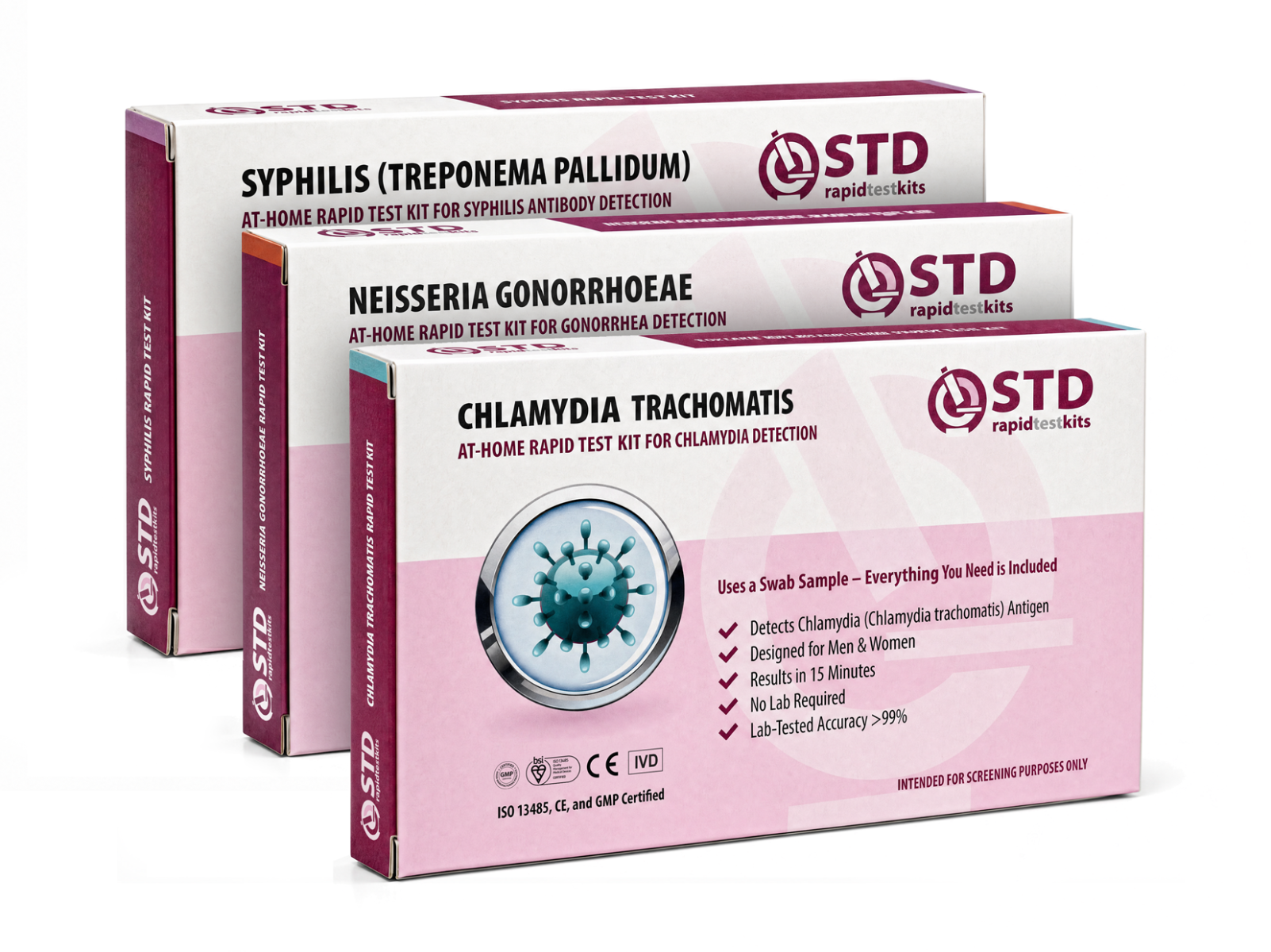
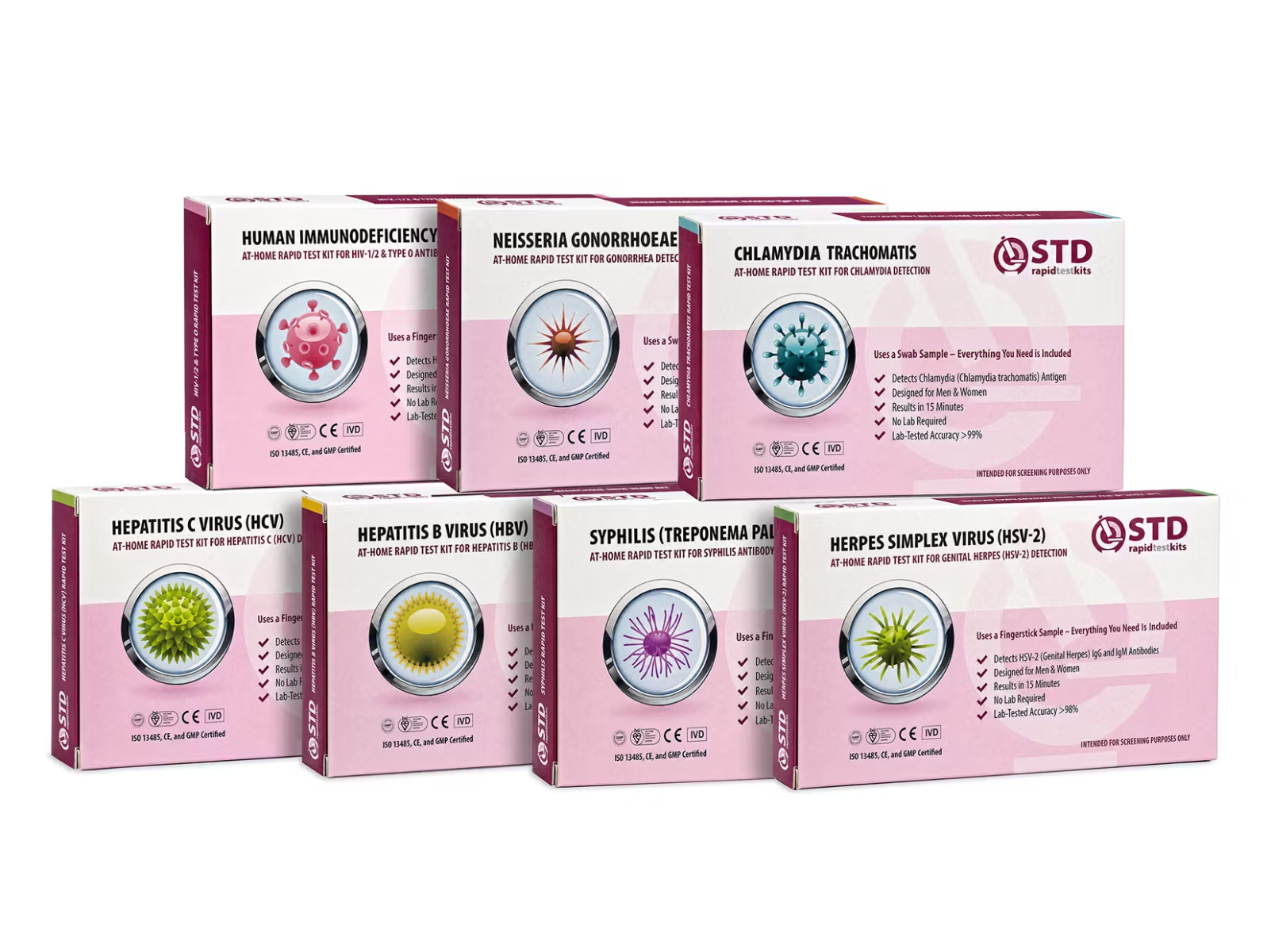
Sample type also matters. Rapid at-home kits for chlamydia, gonorrhea, trichomoniasis, and HPV use a self-collected swab. HIV, syphilis, hepatitis B, hepatitis C, and herpes (HSV-1 and HSV-2) kits use a small fingerstick blood sample. Combination panels covering 6, 7, 8, or 10 infections package the relevant swab and blood components together for a single sitting. Note that the at-home HPV and trichomoniasis kits are validated for vaginal self-swab only; male readers who need screening for either should see a clinic.
For a reader who has just watched a social-media post about a specific exposure risk and wants to act on it the same evening, a combination home kit is often the right starting point. It covers the most common infections in one session and avoids the cost of stacking multiple single-infection kits when the actual exposure risk is broader than any one pathogen.
Case Study: TikTok and the Normalization of Testing
TikTok has become a surprising leader in STI awareness, partly because the platform short-video format suits how young adults process health information in 2026. A 60-second clip with humor and a clear takeaway lands more reliably than a 10-minute explainer.
A pattern that has worked at scale is the test-with-me video, in which a creator walks viewers through a home test kit on camera. The format does several things in one minute: it shows what the kit looks like, demystifies sample collection, normalizes the act of testing, and ends with a verified result. Observers of health communication on TikTok have noted that this format appears to reduce perceived stigma around testing more reliably than text-based campaigns, though the comparative evidence base is still developing.
Three patterns from successful TikTok campaigns are worth naming, because they show what credibility looks like on the platform:
- Real practitioners, not actors. Campaigns that feature licensed nurses, pharmacists, and public-health staff outperform those using paid influencers without health credentials. The audience can tell the difference within the first few seconds.
- Specific, not aspirational. A video saying go get tested is forgettable. A video saying here is exactly what the test feels like and here is my result gives the viewer a script they can use.
- Linked to action. Successful campaigns end with a clear next step: a clinic finder, an at-home kit link, or a partner-notification service.
The risk in any case-study framing is overstating the result. TikTok cannot replace clinical care, and the platform has its own well-documented misinformation problems. What it can do, when used well by credentialed creators, is move someone from I should probably test to I am testing right now, which is the single hardest behavioral step in any prevention pipeline.
Promoting Awareness Through Collaboration
Sustainable digital sexual-health campaigns are not solo creator efforts. They are partnerships between healthcare organizations, platform trust-and-safety teams, and credible creators with established audiences.
Three collaboration patterns have produced visible results:
- Partnership with named clinicians. When a state health department partners with a verified nurse or public-health physician on a TikTok account, the resulting content carries both institutional credibility and platform-native reach. The CDC Let's Stop HIV Together campaign and the British Association for Sexual Health and HIV social-media programs both use this model.
- Verified-source labeling. Platforms attaching a verified-health-source badge to STI-related videos has been associated with lower engagement on unverified posts about the same topics. The mechanism is simple: when a verified post sits alongside an unverified one in a comparison feed, viewers tend to pick the verified one.
- Interactive campaigns. Hashtag challenges that ask users to share their testing reminders or normalize partner conversations work because they convert passive viewers into participants. A reader who has posted about testing is far more likely to follow through.
The pattern public-health agencies are converging on is hybrid: institutional accounts that publish the canonical content, plus a paid or volunteer network of credentialed creators who translate that content into platform-native formats. This is the structure that lets a state health department chlamydia awareness post reach a 19-year-old For You page on TikTok the same week it is published.
More than 1 million curable sexually transmitted infections (STIs) are acquired every day worldwide in people 15-49 years old, the majority of which are asymptomatic.
Take Charge of Your Sexual Health
Digital sexual-health awareness is doing real work. It reaches the people most affected by STIs, it normalizes conversations that were previously shame-coded, and it lowers the barrier to testing in a way no in-person clinic alone can match. The risks of misinformation are real, and the response is to use the channel with a working filter: verified sources, named clinicians, and primary-source citations.
The action step that closes the loop, after the awareness, after the scroll, after the moment of decision, is testing. At-home STI test kits let you act on what you learned in the time it takes to watch one more video. Rapid lateral-flow tests give a result in about 15 minutes, in private, with no clinic visit and no insurance trail.
If a recent post made you wonder whether you should test, the simplest next step is the right one: order the test, take it, and either rule out the concern or get the result that lets you start treatment.
FAQs
- Is social media a reliable source of sexual health information?
- It depends on the source. Verified health organizations like the CDC, WHO, and NHS, plus licensed clinicians posting under their real credentials, publish reliable content. Anonymous accounts, wellness influencers without health training, and posts promoting 'natural alternatives' to antibiotics for bacterial STIs are not reliable. Treat social media as a starting point that points you toward primary sources, not as the source itself.
- How can I tell if a sexual health post on TikTok or Instagram is accurate?
- Three quick checks. Does the creator name their credentials? Does the post link to a primary source like the CDC, WHO, or NHS? Does the claim match what you find on at least one of those three organizations' websites? If all three pass, the post is probably reliable. If any fails, verify before acting on the advice.
- Does social media help reduce STI stigma?
- Yes, with limits. Public conversation about testing, treatment, and partner notification has measurably normalized the topic among younger adults. The limit is that stigma reduction online does not always translate to clinic-level behavior change; many young adults still delay testing despite being comfortable discussing STIs in their social feeds.
- Are at-home STI test kits as accurate as clinic tests?
- Rapid home tests work well as a first-line screen when used inside the correct exposure window, but their lateral-flow chemistry has lower analytical sensitivity than lab-based nucleic acid amplification methods, which are the laboratory gold standard for several infections. A reactive (positive) home result should be confirmed at a clinic. Approximate windows to keep in mind: about 14 days for chlamydia and gonorrhea, 3 to 12 weeks for syphilis, and 23 to 90 days for HIV antibody tests.
- What should I do if I see misinformation about STIs online?
- Report it through the platform's report function, comment with a link to a primary source (CDC, WHO, or NHS) if you have one handy, and avoid resharing the post even to dunk on it. Reshares boost the misinformation's reach, including to people who will not read the dunk caption.
- Why do young people prefer online sexual health content over clinics?
- The main driver is lower friction. A TikTok video takes 60 seconds, costs nothing, and does not require an appointment or insurance. A clinic visit requires time off work or school, transportation, and sometimes a copay. The privacy is also higher; clinic visits can appear on insurance statements visible to parents.
- Can social media campaigns actually prevent STIs?
- They can, indirectly. Campaigns increase awareness and reduce stigma around testing, both of which correlate with higher screening rates. Higher screening rates lead to earlier treatment, which prevents onward transmission. The CDC has documented increases in HIV pre-exposure prophylaxis uptake following well-designed digital campaigns.
- Where should I go for trustworthy sexual health information online?
- The CDC's STI pages, the WHO's fact sheets, and the NHS conditions library are the three most reliable English-language references. For U.S.-specific clinical guidelines, the CDC STI Treatment Guidelines and Planned Parenthood's educational pages are widely trusted. For at-home testing options, look for products that publish their sensitivity and specificity figures and that are FDA-cleared.
- U.S. Centers for Disease Control and Prevention. About sexually transmitted infections, including symptoms, asymptomatic infection patterns, and testing guidance.
- U.S. Centers for Disease Control and Prevention. STI program hub linking to chlamydia, gonorrhea, syphilis, HIV, and HPV condition pages with screening and testing guidance.
- U.S. Centers for Disease Control and Prevention. National STI surveillance program, source for annual chlamydia, gonorrhea, and syphilis case-count reports.
- World Health Organization. Sexually transmitted infections fact sheet, including the global daily incidence figure for curable STIs in people aged 15-49.
- United Kingdom National Health Service. Sexually transmitted infections overview, symptoms guide, and testing pathways.
- U.S. Centers for Disease Control and Prevention. HIV program hub, including prevention, testing, and treatment resources.
- U.S. Centers for Disease Control and Prevention. HPV program hub, covering vaccination and ACIP routine and shared clinical decision-making guidance.
