
Published: October 2025 | Last updated: May 2026 | Editorial review and quality control: Martina N.
Most adults can recall about one week of sex education from school. A film, a chapter buried in biology, an awkward teacher reading from a script. For many of us, that week was the only formal instruction we ever received on sexually transmitted infections, and most of it focused on what to avoid rather than how transmission, testing, and treatment actually work in real life.
Years later, a positive test result fills in the gaps. By then the lesson costs more than embarrassment. This piece walks through what global sex education has historically left out, why those gaps persist across very different countries, and what young people, parents, and adults can do to close them now. We are framing this practically: where are the holes, and how do you fill them?
Key Takeaways
- Less than 40% of U.S. middle and high schools teach all 20 sexual health topics the CDC identifies as essential, including how to access STD testing services.
- The World Health Organization estimates more than 1 million curable sexually transmitted infections are acquired worldwide every day, and most of them produce no symptoms.
How sex ed failed an entire generation
Sex education and STD education are not the same subject. Many curriculums fold them together, with most class time spent on anatomy, reproduction, and consent basics. STI prevention, transmission routes, testing windows, and treatment usually get a slide or two. Many graduates can label a fallopian tube but cannot describe what an asymptomatic chlamydia infection actually does in the body, or how long after exposure a test will pick it up.
Gaps look different in different countries. In the United States, fewer than 40% of middle and high schools cover all 20 sexual health topics the CDC identifies as critical, including how to find STD testing services (CDC Division of Adolescent and School Health). State-level variation is severe. Some states require evidence-based instruction. Others require abstinence-until-marriage messaging by law. A few have no statewide standard at all.
In parts of South Asia, the Middle East, and sub-Saharan Africa, formal sexual health instruction often runs into religious and cultural pressure. Teachers face quiet or open consequences for raising the topic, and the word "condom" never enters many lesson plans. UNESCO's International Technical Guidance on Sexuality Education, co-developed with WHO, UNICEF, UNFPA, UN Women, and UNAIDS, documents that comprehensive sexuality education remains the exception rather than the rule in many low- and middle-income school systems (UNESCO).
Europe is uneven. The Netherlands, Sweden, and Germany sit consistently near the top of global comparisons for evidence-based programs that start early and continue through secondary school. Other European countries lag, particularly in rural areas where local school boards retain wide discretion. Japan, Korea, and several other Asian systems have formal curriculum standards but allocate very little time to STI prevention compared with reproductive biology.
Where formal teaching falls short, young people fill the gap on their own. Surveys by youth-health organizations consistently find that pornography, social media, peer conversations, and forums account for a meaningful share of what teenagers believe about sex and STIs. Some of that information is accurate. Much of it is not. The CDC reports that people aged 15 to 24 account for roughly half of all new STIs diagnosed each year in the United States, despite representing a much smaller share of the sexually active population (CDC STD prevention).
People aged 15 to 24 represent a small share of the sexually active population, yet they account for roughly half of all new STIs diagnosed each year in the United States. Most of that gap traces back to testing access, symptom recognition, and accurate prior instruction.
What effective STD education actually does
Comprehensive, science-based STI education is grounded in measurable public-health outcomes. Programs that meet the criteria UNESCO and the WHO have set out share several traits: they start before the average age of first sexual experience, they use medically accurate language, they include LGBTQ+ students in the material rather than treating their experiences as exceptions, and they continue across multiple school years rather than appearing in a single one-week unit.
When that combination is in place, students leave school able to do four practical things. They can identify the most common STI symptoms (including the inconvenient truth that many infections cause no symptoms at all). They know that chlamydia, gonorrhea, and HPV can be present without any outward sign. They understand the difference between bacterial infections, which are usually curable with antibiotics, and viral infections like herpes and HIV, which are managed rather than cured. And they know how to access testing without going through a parent or family doctor.
Programs of this quality correlate with later first sexual experiences on average, more consistent condom use during first intercourse, and higher rates of routine STI screening among adolescents and young adults. Comparative analyses of European adolescent health consistently place the Netherlands among the lowest for teen pregnancy rates and highest for contraceptive uptake at first intercourse, supported by formal sexuality education that begins in primary school and continues through secondary school.
Two effects in particular tend to compound. The first is that testing becomes a routine health behavior rather than a confession. When students are taught that an annual STI test is part of normal adult care, like a dental cleaning or a Pap smear, they are far more likely to actually do it as adults. The second is that LGBTQ+ students stop relying on guesswork. Most national curriculums historically assumed a heterosexual cisgender student. Inclusive programs explicitly cover same-sex transmission risks, hormone-related considerations, and the specific screening sites (oral, anal) that abstinence-focused or anatomy-focused curriculums tend to skip.
Four outcomes of comprehensive STI education
- Students can identify the most common STI symptoms, including the fact that many infections produce no symptoms at all.
- Students know that chlamydia, gonorrhea, and HPV can be present without any outward sign.
- Students understand the difference between bacterial infections (usually curable with antibiotics) and viral infections (managed long-term, not cured).
- Students know how to access testing on their own, without going through a parent or family doctor.
Why STD education keeps failing
Decades of peer-reviewed evaluations support comprehensive STI education. Why do so many systems still get it wrong? Four reinforcing reasons stand out, and they show up across very different countries.
Cultural and religious pressure
In many regions, even saying "condom" out loud in a classroom is a political act. Teachers in parts of Asia, Africa, the Middle East, and the more conservative U.S. states face real professional risk for raising contraception or LGBTQ+ topics. Pressure comes from beyond school boards alone. Parents, religious leaders, and local councils can all derail a curriculum, sometimes overnight. Adults end up with a habit of avoidance that protects them from awkwardness while leaving teenagers misinformed.
Abstinence-only policy
Despite three decades of evaluations showing it does not delay first sexual activity or reduce STI rates, abstinence-only-until-marriage education remains the official or favored approach in many U.S. states and in dozens of national systems globally. The Guttmacher Institute tracks U.S. state-by-state policy on what schools must teach about sex and HIV education, including whether the material is required to be medically accurate, and documents wide variation across states (Guttmacher Institute, Sex Education in the United States). Programs in the abstinence-only category typically withhold information about contraception and STD risk, use fear-based framing, and exclude LGBTQ+ students entirely.
Teacher preparation
Even in countries with strong written curriculums, teachers asked to deliver the material often have not been trained in it. Health teachers may have last reviewed STI material in their own training years or even decades earlier. Many report feeling unequipped to answer specific questions about same-sex transmission, oral or anal exposure, or the at-home testing options now available. An excellent official curriculum still fails in the classroom if the teacher quietly skips the parts that make them uncomfortable.
Misinformation in the void
When school silence creates a vacuum, social media fills it. Common beliefs that show up in teen surveys today include the idea that you cannot catch an STI from oral sex, that condoms are unnecessary if both partners look healthy, and that a single visible test (a quick look at a partner's body) is sufficient screening. None of these are true. Herpes, gonorrhea, syphilis, HPV, and HIV can all transmit through oral exposure (NHS STI overview). The most common STIs frequently produce no visible signs at all. And there is no reliable way to assess a partner's STI status without a test.
Disclosure: stdrapidtestkits.com publishes this article and sells the at-home rapid tests referenced below. Product mentions are chosen for fit to the article's topic.

A teenager who learns about STIs from short-form video or peer chat usually picks up a mix: some accurate basics, several stubborn myths, and no working knowledge of testing windows or where to actually get screened. The clinical cost of that mix shows up years later as missed early infections, delayed treatment, and avoidable transmission to partners. The single biggest practical lever for an adult reading this is shrinking the gap between "I should probably get tested" and actually doing it, which is what the at-home options below exist to address.
What works: the Netherlands model and what it teaches the rest of us
Comparative studies consistently single out the Dutch approach as the strongest counter-example to abstinence-only programs. Formal sex education in the Netherlands begins in primary school, at around age four, with age-appropriate material about bodies, feelings, and consent. It continues across both primary and secondary years, deepening as students grow. By the time Dutch teens reach the age of first sexual experience, they have had roughly a decade of normalized, evidence-based instruction.
Dutch teenagers consistently report higher rates of contraceptive use at first intercourse, lower teen pregnancy rates than most peer countries, and lower rates of STI acquisition than many neighbors. They also describe sex more often as a positive, planned experience rather than an accident or a regret. Sweden and Germany show similar patterns under similar approaches.
Compare that with countries where instruction is heavily restricted. In Uganda, where formal sex education has historically been censored or absent, the country continues to face high adolescent HIV rates and significant teen pregnancy burden. The pattern is consistent across many low- and middle-income contexts: where the official curriculum prohibits the material, the population pays for it in clinical outcomes a decade later.
Dutch design is not magic. Three choices do most of the work. First, it starts early enough that there is no "first awkward conversation" because the conversation has been going on the whole time. Second, it treats young people as future adults who will make decisions, rather than as people to be scared into abstinence. Third, it does not pretend that LGBTQ+ students do not exist, which gives those students information that most curriculums either ignore or actively suppress.
Each day, more than 1 million curable sexually transmitted infections are acquired worldwide, the majority of which are asymptomatic.
How to fill the gap yourself (and for the people you care about)
Most adults reading this article cannot change a national curriculum. Plenty can change in your own household, friend group, or workplace, and that is where the four practical moves below fit.
Have the conversations schools won't
If you are a parent, guardian, mentor, or older sibling, do not wait for a school to catch up. Conversations that matter are not one-off. They are small, repeated, and matched to the age of the listener. For a younger child, that might mean accurate vocabulary for body parts and a baseline understanding of consent. For a teenager, it means concrete information about how STIs are transmitted, why testing matters even without symptoms, how to use condoms and dental dams correctly, and the difference between bacterial infections that antibiotics can clear and viral infections that need long-term management. Silence reads as shame. Calm, steady information shifts the dynamic.
Learn the symptoms and the myths
Most common STIs either produce no symptoms or produce symptoms easy to misread. Chlamydia and gonorrhea are often silent in both men and women, particularly in early infection. Syphilis can announce itself with a single painless sore that disappears on its own, which fools many people into thinking the infection cleared. HSV-1 and HSV-2 can be transmissible during periods of asymptomatic viral shedding (when the virus is active and contagious even though no lesions are visible). HPV usually has no visible signs at all in its early stages, though some strains cause cervical, anal, and oropharyngeal cancers years later.
The widely repeated myths that keep STIs spreading are the same ones every clinic still hears: you cannot get an STI the first time, you can tell if someone is infected by looking, oral sex is risk-free. None of these are true. If something feels off, test. If you have had a new partner or unprotected exposure, test. If your last screening was more than a year ago and you are sexually active, test.
Use the testing options your school never mentioned
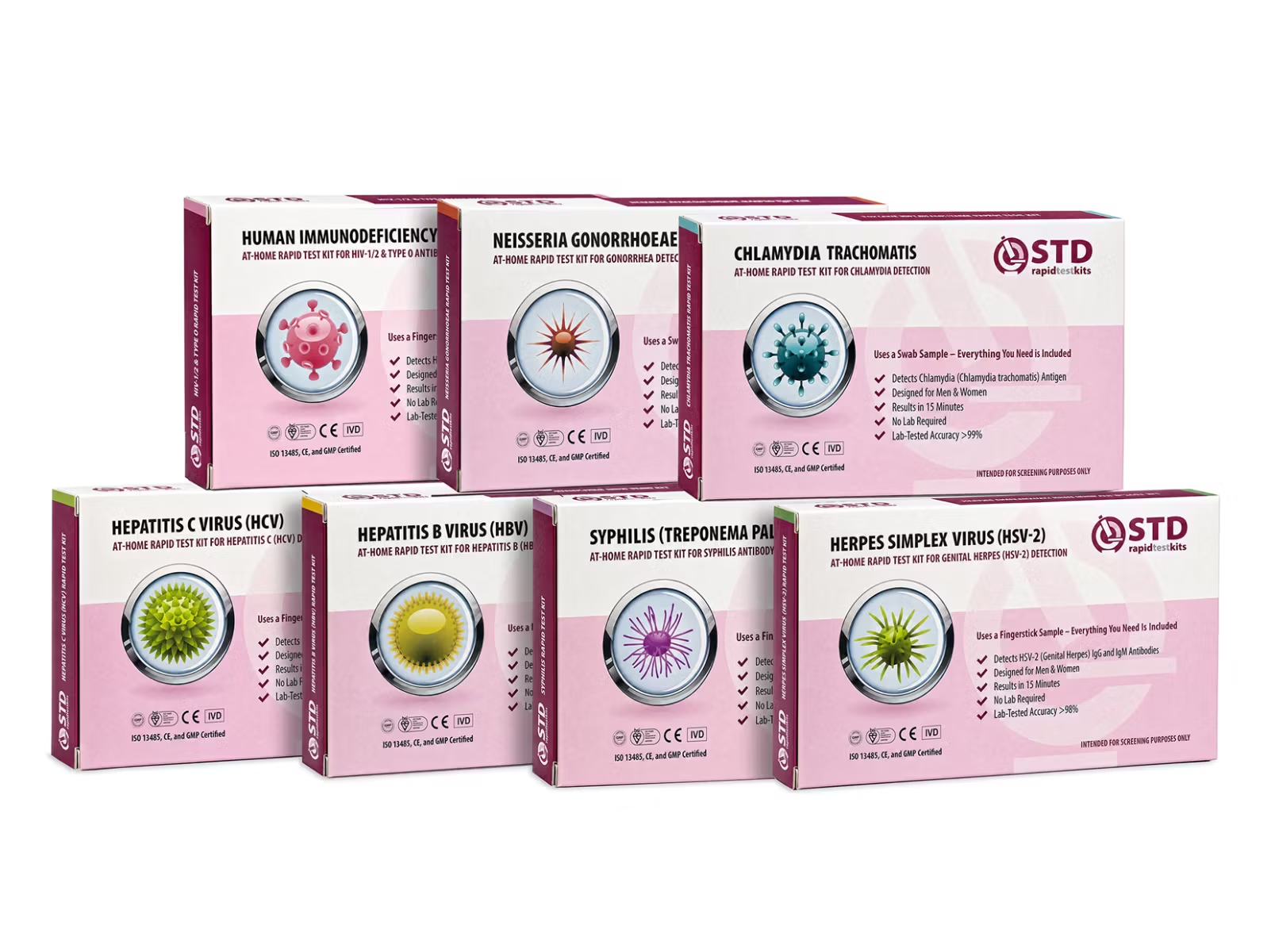
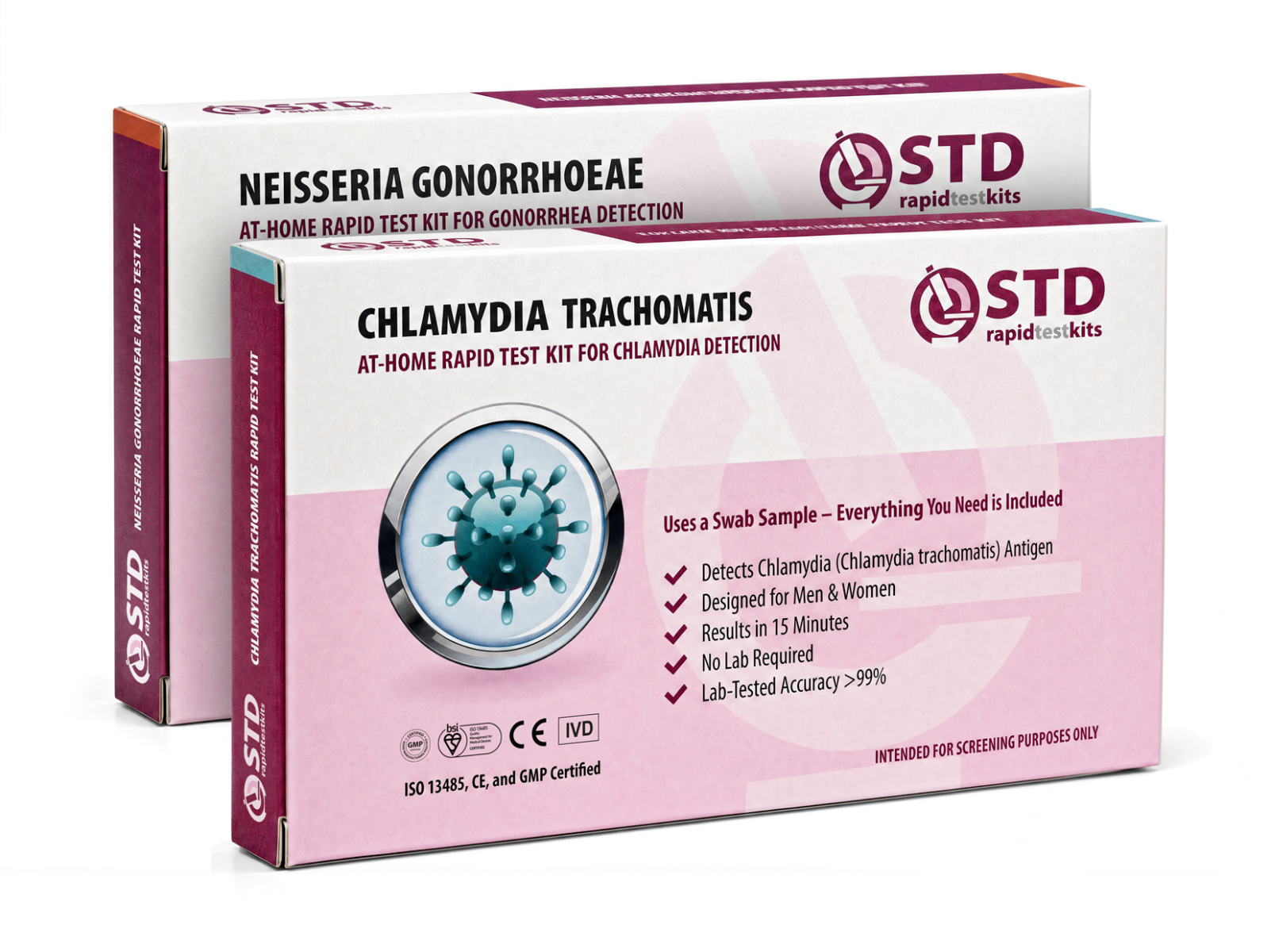
One of the most useful changes in the past decade is that you no longer need to walk into a clinic to get tested. Rapid lateral-flow home tests now cover the most common STIs, with private at-home collection and results in around 15 minutes. They are screening tools rather than laboratory diagnostics. They answer one practical question: do I have a reason to follow up with a clinic? You can use them from home, in private, with no in-person visit required (combo STD home test kits). A positive home result is worth confirming with a lab, and knowing you should ask for that confirmation is the entire point.
Talk about it out loud
Articles like this one only matter if the people reading them pass the information along. Send a link to a friend, a partner, a younger sibling who is heading off to college. Suggest that local schools update their materials. Science on this has been settled for decades.
Four practical moves, in plain language
- Have small, repeated, age-matched conversations rather than one big sit-down. Silence reads as shame; steady information does not.
- Assume no symptoms means no information. Chlamydia, gonorrhea, and HPV are often silent; herpes can transmit during asymptomatic viral shedding.
- Use at-home rapid lateral-flow kits to remove the friction that keeps people from screening at all. Confirm any positive result with a clinical lab.
- Pass the information to one person who needs it. Articles like this one only work if they leave your screen.
The bigger picture: what poor STD education costs everyone
Sexually transmitted infections are often discussed as personal problems. They are also a measurable public-health and economic burden, and the share attributable to preventable knowledge gaps is substantial.
Healthcare costs
The CDC has estimated that the lifetime direct medical costs of sexually transmitted infections acquired in a single year in the United States run to roughly $16 billion (CDC STD prevention program). Treatable bacterial infections like chlamydia and gonorrhea, if missed long enough, can lead to pelvic inflammatory disease (a serious infection of the uterus, fallopian tubes, or ovaries), infertility, ectopic pregnancy, and chronic pelvic pain. Untreated syphilis can progress to neurological damage years later. HIV acquired without early detection carries lifelong medication costs and risks. Most of these downstream costs are preventable with screening that is already cheap, fast, and available.
Workforce and economic impact
Chronic conditions caused by untreated STIs disproportionately affect young adults in the early career years and women in their reproductive years. In countries where young adults make up the bulk of the labor market, these health burdens slow national economic growth in measurable ways. Pelvic pain, fertility complications, and the management of chronic viral infections all generate missed work, additional medical visits, and increased reliance on insurance systems that are already stretched.
Mental health
When someone is diagnosed with an STI they did not know existed, or were not taught how to prevent, the diagnosis often arrives with guilt, shame, and isolation that have nothing to do with the underlying infection. Patients regularly report depression and anxiety following a herpes or HPV diagnosis that they could have processed more easily with accurate prior framing. These consequences come from how sexual health is framed in the surrounding culture. Patients who are taught early that STIs are a routine medical topic process a diagnosis more easily than those taught they reflect a moral failing.
The compounding effect
Most of these costs never appear in a budget line. Adults who were taught nothing tend to teach their own children nothing. The same silence transmits across generations, and each generation pays for the previous one's avoidance in late diagnoses, preventable complications, and clinical visits that should have happened five years earlier.

Where to go from here
If your school left these lessons out, that gap is not your fault. The choice now is what to do about it. Three concrete next steps cover most of what matters: get current on your own STI knowledge, take any overdue testing seriously, and pass accurate information to anyone in your circle who might still be relying on what they picked up online.
For most sexually active adults, annual screening is a sensible default, with additional testing after any new partner or unprotected exposure (once the relevant window period has passed). Home tests work alongside clinical care. They remove the most common barriers that keep people from screening at all: embarrassment, scheduling friction, and out-of-pocket cost.
Systems that failed an entire generation of students will not fix themselves quickly. Household-level fixes work faster. Talk about it. Test when you should. Share what you have learned.
1. Get current on your own STI knowledge using the CDC, NHS, and WHO root pages linked in the Sources section below.
2. Test if your last screening was more than a year ago and you are sexually active, or sooner after any new exposure once the window period has passed.
3. Share this article with someone in your circle who is still relying on what they picked up online.
Frequently asked questions
- At what age should STD education actually start?
- UNESCO's International Technical Guidance on Sexuality Education recommends age-appropriate sexuality education starting around age 5 and continuing through age 18, with content matched to each developmental stage. STI-specific content typically becomes age-appropriate around ages 10 to 12, before most students become sexually active.
- Do condoms protect against every STI?
- Condoms substantially reduce the risk of fluid-borne infections like HIV, chlamydia, gonorrhea, and hepatitis B and C when used correctly and consistently. They are less protective against infections spread by skin-to-skin contact in areas a condom does not cover, including HPV, herpes, and syphilis. Condoms remain the most useful single tool, though no single tool is complete on its own.
- Can you really get an STI from oral sex?
- Yes. Gonorrhea, chlamydia, syphilis, herpes (both HSV-1 and HSV-2), HPV, and HIV can all transmit through oral exposure under the right conditions. Pharyngeal gonorrhea in particular is often missed because it usually produces no symptoms and requires a throat swab rather than a urine or genital swab to detect.
- How often should a sexually active adult get tested?
- For most sexually active adults under 25, the CDC recommends annual chlamydia and gonorrhea screening. After age 25, frequency depends on risk: annual screening is still sensible if you have a new partner, multiple partners, or condomless sex outside a mutually monogamous relationship. HIV screening at least once in adulthood is recommended for everyone, with more frequent testing if exposure risk is higher.
- What happens if an STI goes untreated?
- Bacterial infections (chlamydia, gonorrhea, syphilis) can progress to pelvic inflammatory disease, infertility, ectopic pregnancy, neurological damage, and increased HIV susceptibility. Viral infections (HIV, hepatitis B and C, herpes, HPV) generally become more difficult to manage the later they are diagnosed. Several untreated STIs can also pass to a partner or, during pregnancy, to a newborn. Early detection and treatment matter for nearly all of them.
- Are at-home rapid STI tests reliable?
- Modern rapid lateral-flow home tests are useful screening tools rather than full laboratory diagnostics. Sensitivity and specificity vary by infection and kit, with most products reporting agreement with lab tests in the mid- to high-90% range when used correctly after the right window period. A positive home result is worth confirming with a clinical laboratory test; a negative result during the window period is worth repeating later.
- Are LGBTQ+ students included in most sex education curriculums?
- Historically, no. Most national curriculums have been written with a default heterosexual cisgender student in mind. This has left LGBTQ+ youth, who often face higher rates of certain STIs, without targeted information about same-sex transmission routes, hormone-related considerations, or anatomy-specific screening sites. Inclusive curriculums are spreading but remain the exception rather than the rule in many regions.
- Why don't more schools just teach comprehensive sex ed if the evidence supports it?
- Three reinforcing reasons. First, sustained political and religious pressure in many regions makes the topic costly for school boards to handle openly. Second, abstinence-only policies remain entrenched in dozens of national and state-level systems despite decades of evidence they do not work. Third, even where the official curriculum is strong, the teachers asked to deliver it often have not been trained or supported to do so confidently.
- World Health Organization. Sexually Transmitted Infections (STIs) fact sheet, including global incidence estimates and the figure that more than 1 million curable STIs are acquired worldwide each day.
- U.S. Centers for Disease Control and Prevention. STD prevention program, including national surveillance data, screening recommendations, and the lifetime direct-medical-cost estimate for new STIs acquired in a single year.
- U.S. Centers for Disease Control and Prevention, Division of Adolescent and School Health. School Health Profiles tracking what U.S. middle and high schools teach on the 20 critical sexual health topics.
- UNESCO. Source organisation for the International Technical Guidance on Sexuality Education, co-developed with WHO, UNICEF, UNFPA, UN Women, and UNAIDS, documenting the global prevalence and design of comprehensive sexuality education programs.
- Guttmacher Institute. Sex Education in the United States fact sheet, tracking state-by-state policy on what schools must teach about sex and HIV education and the variation in medical-accuracy requirements across states.
- NHS. Sexually transmitted infections (STIs) overview, including transmission routes, symptom variability, and testing guidance.
