How to Reduce STD Stigma Through Awareness and Education
STD stigma still shapes who gets tested, who gets treated, and who tells a partner. The evidence from public-health research is consistent: education and accessible testing reduce stigma, but only when used together. This guide covers what works, what does not, and what you can do in your own conversations and community to lower the cost of the question, 'should I get tested?'



- Stigma is one of the strongest barriers to STI testing and treatment in the United States and globally, with surveys consistently linking perceived shame to delayed care and undiagnosed infections.
- Comprehensive sex education and accessible private testing are the two interventions with the most consistent evidence for reducing stigma and increasing testing rates over time.
Published: September 2025 | Last updated: May 2026 | Editorial review and quality control: Martina N.
For many people, the hardest part of a possible STI exposure is not the medical test. It is the worry about what other people will think, what a clinic visit will look like to a friend or coworker, what a partner might say. That worry has a name in public-health research: STI-related stigma. The evidence shows it changes behavior in measurable ways, mostly by keeping people away from testing and treatment they would otherwise seek.
Stigma and misinformation are different problems that reinforce each other. Inaccurate beliefs about who gets infected and how feed shame. Shame keeps the topic off the table, which lets inaccurate beliefs spread. Breaking that cycle is the work of comprehensive sex education, public-health communication, and accessible testing options that meet people where they already are. This article draws on current guidance from the U.S. Centers for Disease Control and Prevention, the World Health Organization, and the UK National Health Service.
Why STD Stigma Persists
Stigma around sexually transmitted infections has roots that go back further than the infections themselves are recognized in clinical literature. Historians of medicine trace much of the moralizing around STIs in the United States to nineteenth-century public-health framing that linked infection to character rather than exposure. That framing persisted through early HIV-era panic, and it still shows up today in casual conversation, media coverage, and sometimes in clinical settings.
Three forces keep stigma in place. First, sex remains a culturally protected topic. Many adults in the US report they were never taught how to talk about sexual health in school, with friends, or with partners. National surveys consistently find that sex education coverage is uneven and patchy across the country, with some states mandating medically accurate curricula and others leaving content decisions to individual school districts. Second, STIs are visible in ways other infections are not. A diagnosis is not just a medical fact; it raises questions about who infected whom, how, and when. Third, misinformation thrives in the absence of comfortable conversation. If people cannot ask basic questions out loud, the answers they form come from rumor or anecdote.
Stigma also operates at three levels, which public-health researchers describe separately: structural, social, and internalized. Structural stigma is the result of policies and institutions, such as a school district that bars discussion of contraception or an insurance form that lists STI testing under a separate, visible billing code. Social stigma is the judgment people fear from peers, family, and partners. Internalized stigma is what people feel about themselves after a diagnosis or even after a routine test. Reducing one level helps but does not by itself solve the others. Effective stigma-reduction efforts work on all three.
What stigma feels like in practice varies. A teenager may avoid the school nurse out of fear that a parent will be told. A working adult may put off a clinic visit because the only available appointment is during their lunch break, when colleagues might see them go. A patient in a small town may travel an extra hour to a clinic where they are not recognized. The cost of these decisions is rarely visible to the people around them, but it adds up to delayed care, missed treatment windows, and ongoing transmission to partners who did not know they were at risk.

How Stigma Affects Testing and Treatment Decisions
Stigma changes specific behaviors at specific points. Researchers track those points because each one is a place where an intervention can help. The first is whether a person agrees to be tested at all. The second is whether they pick up the result. The third is whether they start and finish treatment. The fourth is whether they tell partners, who might also need testing and treatment.
At each of these points, the percentages drop when stigma is high. The CDC publishes annual STI surveillance data showing that a substantial fraction of new chlamydia and gonorrhea cases in the US are diagnosed in people who had not been tested in the prior twelve months, even when guidelines recommended annual screening (CDC sexually transmitted infections overview). Similar gaps appear in HIV care; the agency consistently reports that a meaningful share of people living with HIV in the United States are unaware of their infection, which means they are neither receiving treatment nor able to take precautions to prevent transmission (CDC HIV basics).
These gaps are not evenly distributed. Stigma tends to be stronger in communities where conversations about sexuality are already constrained, including some religious settings, some rural areas, and some immigrant communities where health-seeking carries social cost. Stigma is also amplified in groups that already face discrimination, including men who have sex with men, transgender people, and young women in some cultural contexts. Public-health reviews of rural Americans with STI concerns have documented stigma layered on top of geographic barriers; many drive past a closer clinic to reach one where they will not be recognized.
There is one more behavior that stigma shapes, which is partner notification. Telling a partner that you have an STI, or that you tested positive, is awkward at the best of times. Stigma makes it harder. The result is that some sexual partners do not learn they may have been exposed, which means they do not test, which means transmission continues. Many public-health departments now offer anonymous partner notification services, sometimes by text, which sidestep the most uncomfortable parts of the conversation.
Public-health researchers track four discrete points where stigma blocks care, each of which is a place an intervention can help:
- Agreeing to be tested in the first place
- Returning to pick up the result
- Starting and finishing prescribed treatment
- Informing sexual partners who may also need testing
The Evidence That Education Reduces Stigma
Comprehensive sex education is the intervention with the most consistent evidence for reducing STI-related stigma over time. The word "comprehensive" carries weight here. Researchers distinguish it from abstinence-only programs, which national reviews have repeatedly found less effective at changing behavior. Comprehensive programs cover anatomy, contraception, consent, communication, and the basics of STI prevention and testing. They do not assume that talking about sex encourages it; the research is consistent that the opposite is closer to the truth, with comprehensive programs associated with delayed initiation of sexual activity and increased rates of contraceptive use among those who do become sexually active.
What does education actually change? It shifts what people believe is normal. A student who hears, in a calm classroom voice, that STIs are common across all demographic groups is less likely to treat a diagnosis as a personal failure. Students who practice talking through awkward scenarios, even in role-play, are more likely to have those conversations in real life. Education also shifts what people think other people believe, which social psychologists call the "perceived norm" effect. If you think most of your peers consider STI testing routine, you are more likely to consider it routine yourself.
Several national programs offer real-world data. The Netherlands' Lang Leve de Liefde (Long Live Love) curriculum has been studied for over two decades, and Dutch teen pregnancy and STI rates are among the lowest in the developed world. Sweden's national approach, integrated into the broader school curriculum since the 1950s, follows a similar pattern, with consistently low adolescent STI diagnoses across reporting periods. The United Kingdom's Relationships and Sex Education curriculum, mandatory in English secondary schools since 2020 per NHS guidance, is too recent to evaluate in full, but the early implementation data is encouraging.
In the United States, sex education coverage varies state by state, and the evidence reflects that fragmentation. States that mandate medically accurate, comprehensive curricula tend to report lower teen pregnancy and adolescent STI rates than states that mandate abstinence-only content or leave the curriculum to individual districts, according to ongoing surveillance work published by the U.S. Centers for Disease Control and Prevention.
Stigma associated with HIV stops some people from getting tested and treated, and prevents them from sharing their status with sex and drug-injection partners.
Community Campaigns Built to Normalize STI Conversations
Education is upstream. Community awareness campaigns work downstream, reaching adults who are already out of school and may have grown up without much sex education at all. The best campaigns share a few features: they are factual, they treat the audience as adults, and they use channels people already use.
The CDC's HIV testing outreach work, including campaigns such as "Doing It," used social media, transit ads, and community partnerships to push the message that getting tested is a normal part of being a sexually active adult. Local health departments have run variations on this theme. New York City's public-health communications work has been studied for its effect on testing rates; the city's "Get Yourself Tested" and related initiatives correlate with measurable increases in routine screening at city clinics, particularly among younger residents.
What does not work is also worth naming. Campaigns that lead with fear or shame produce short-term attention but do not change long-term behavior. The classic scary-photo approach used in some anti-tobacco campaigns has been tried for STIs and consistently underperformed. Campaigns that lecture without giving the viewer a clear next step (where to go, what to ask, what to expect) similarly fail to move testing numbers. The successful pattern is calm, specific, and ends with a concrete option.
Workplaces and community organizations also matter. Some employers now include STI testing in workplace health benefits or provide it during routine wellness visits, which removes the "I have to take a day off" obstacle. Some community-based organizations partner with mobile clinics that bring testing into neighborhoods rather than requiring residents to come to a fixed site. The combination of place-based outreach and routine integration has been more effective at reducing stigma than any single message, because it changes what the act of testing looks like in practice.
For readers who want to support stigma reduction in their own communities, the most useful thing is often the smallest. Mentioning that you test regularly, in the same voice you would use to mention a dentist appointment, signals to people in your social circle that the act is normal. Research on social norms consistently finds that people calibrate their behavior to what they think their peers do, and a single open conversation can shift that calibration for the people who hear it.

Sorting Fact from Myth
Stigma is fed by specific factual errors. Naming them directly is part of the work.
STIs occur across every demographic group. The CDC's surveillance data is consistent on this point. STIs appear across all income levels, all education levels, and all relationship structures. Long-term monogamous partners can transmit infections that one of them acquired years earlier and never knew about. People with one lifetime sexual partner can have an STI. The pattern of who gets diagnosed reflects who gets tested at least as much as who gets infected.
You cannot tell by looking. Most STIs are asymptomatic for most people most of the time. Chlamydia, the most commonly reported STI in the United States, is asymptomatic in the majority of women and roughly half of men according to CDC clinical references. Gonorrhea is similarly silent in many cases. HIV after the acute phase produces no specific symptoms for years. Hepatitis C may be silent for decades. The absence of symptoms does not mean the absence of infection, and the presence of symptoms is rarely specific enough to identify a particular infection without a lab test (Mayo Clinic STD overview).
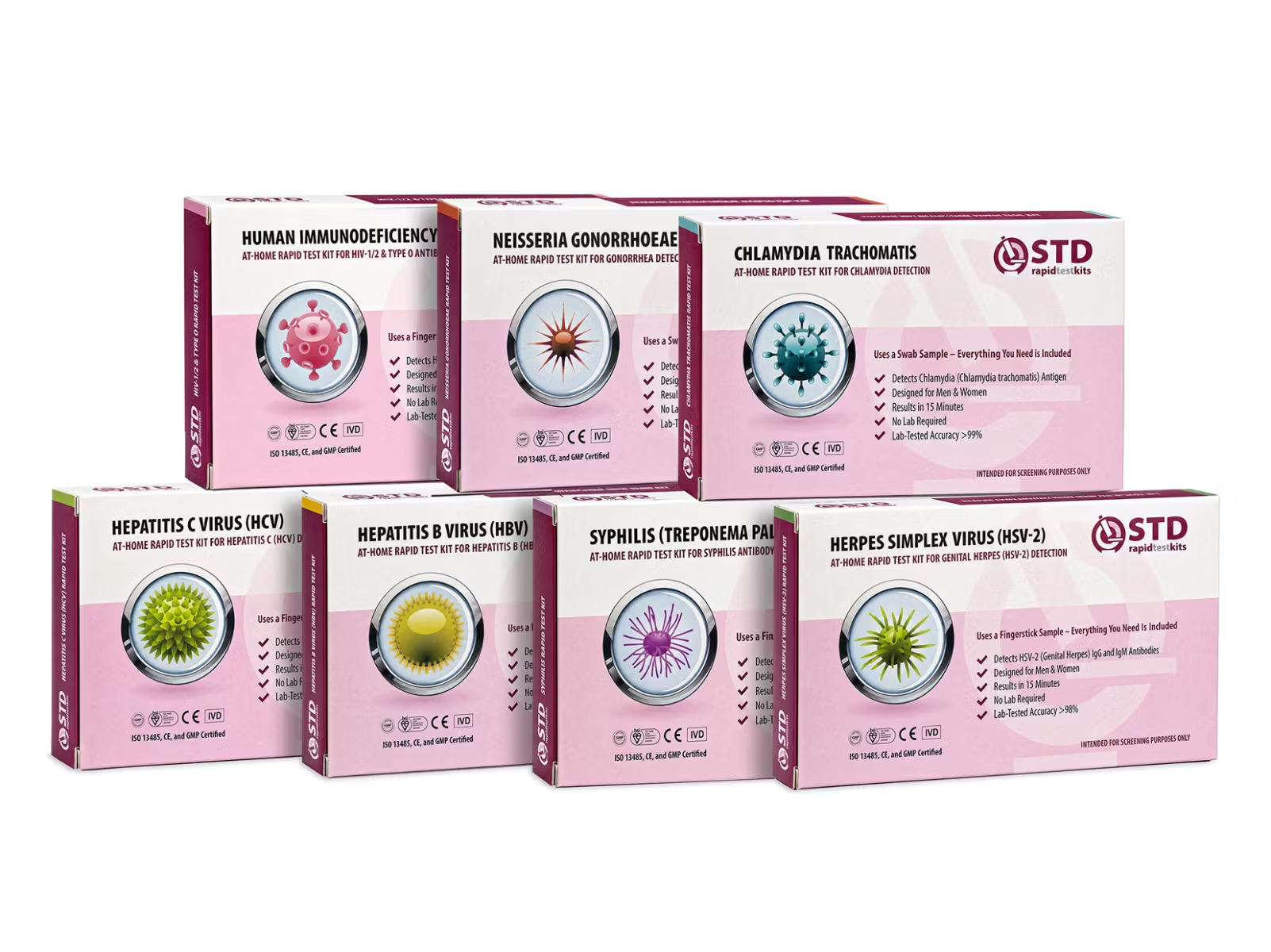
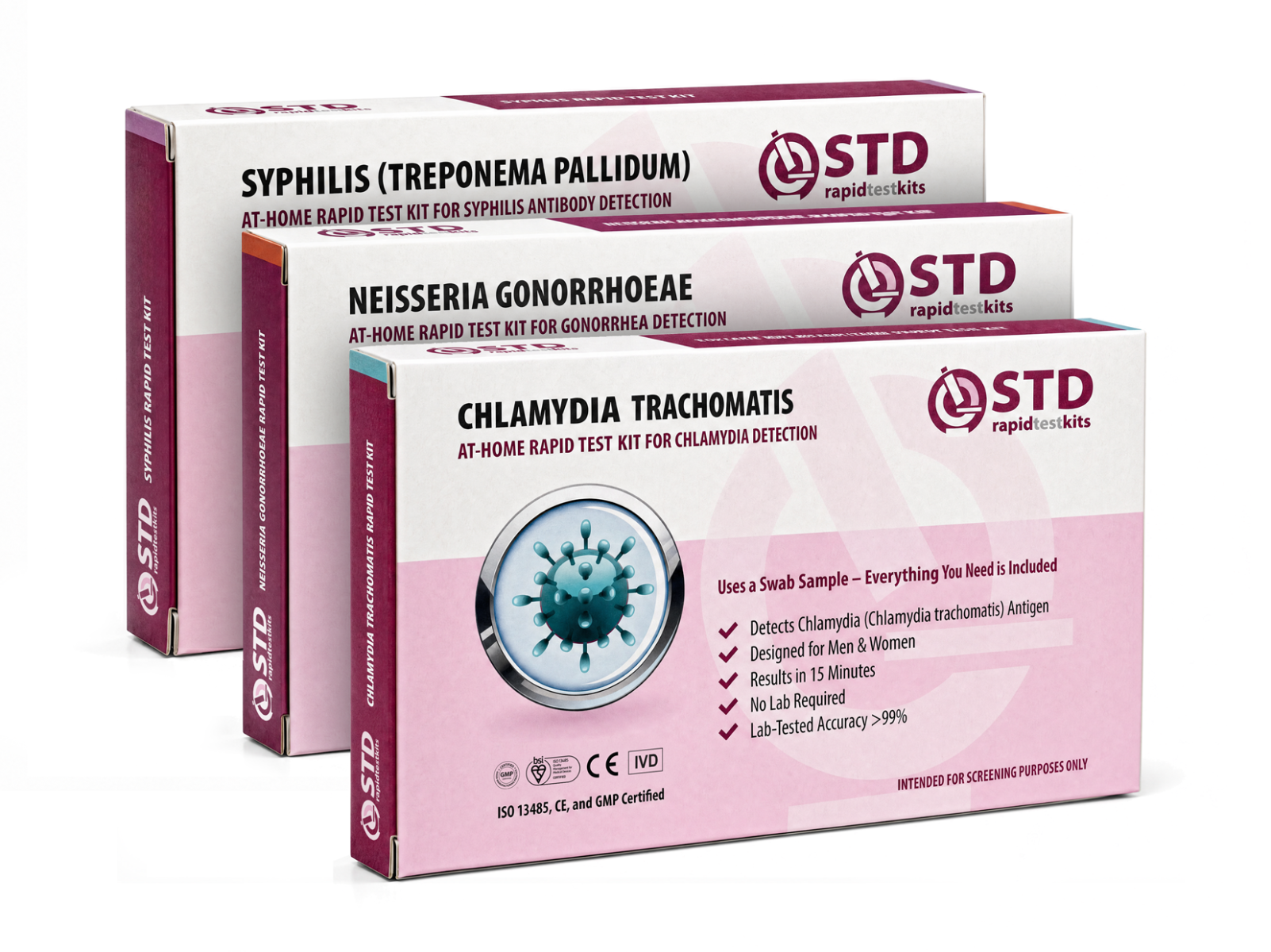
Testing today is not invasive. For most current STI tests, sample collection is a urine cup, a fingerstick, or a self-collected swab. None of these involves the pelvic exams or other procedures that older generations associated with STI testing. The current generation of at-home rapid tests, including the lateral-flow products this site sells, reduces the experience to something closer to a home pregnancy test.
A diagnosis does not define future relationships. Most bacterial STIs (chlamydia, gonorrhea, syphilis, trichomoniasis) are cured with a standard course of antibiotics. Hepatitis C is now curable with direct-acting antivirals in most cases per current CDC and FDA-labeled treatment guidance. HIV is a chronic condition managed by daily medication, with people living near-normal lifespans on treatment. Herpes and HPV are common, manageable, and not by themselves a barrier to ongoing intimate relationships. Each of these facts can be looked up in five minutes on a CDC fact sheet, and each one undermines the assumption that a diagnosis is a life-defining event.
Discussing testing gets easier with practice. It can feel awkward the first time. With repetition it becomes routine, in the same way other adult health conversations become routine.
How At-Home Testing Fits Into Stigma Reduction
At-home testing exists for a specific reason. Many people who would benefit from testing do not get tested. The barrier is rarely the cost; many clinics offer free or low-cost testing. The barrier is often the act of walking into a building, being seen, having a conversation with a stranger about a topic that feels exposing. At-home tests remove most of those frictions.
The science of at-home rapid tests has advanced significantly in the past decade. Modern lateral-flow rapid tests use the same antibody or antigen detection chemistry as point-of-care tests used in many clinics. For some infections, results are available in fifteen minutes. For others, the test format produces a result with sensitivity and specificity in ranges published on the product's data sheet. Home rapid tests are screening tools, not diagnostic confirmations; a positive result is a reason to see a healthcare provider for confirmatory testing and treatment. A negative result during the appropriate window period after exposure is reassuring, with the caveat that some infections require longer to produce detectable antibodies.
At-home testing serves stigma reduction in three ways. It lowers the activation energy for testing in the first place; a test that arrives in a discreet package and is performed at the kitchen counter does not feel like a public statement. It makes routine screening more feasible, because people who test at home tend to test more often than people who rely on clinic visits. It also gives the user control over what comes next. A person who tests negative at home learns useful information and can move on. A person who tests positive at home has time to absorb the result, look up next steps, and contact a healthcare provider on their own schedule rather than receiving the news in a clinic waiting room.
There are appropriate uses and inappropriate uses for at-home testing. It is well suited to routine periodic screening, to checking after a known or possible exposure (after the relevant window period), and to ongoing self-monitoring in some contexts. It is not a substitute for clinical evaluation of active symptoms, for partner notification programs, or for prenatal care, which still requires laboratory confirmation. At-home rapid tests complement clinical care; they do not replace it. They give people one more tool that did not exist a generation ago.

What Healthcare Providers Can Do Differently
Even with at-home testing, most people will eventually interact with a clinic for confirmatory testing, treatment, or counseling. What happens in that interaction shapes whether they come back, whether they tell their friends about a good experience, and whether they engage with future routine care.
Research on stigma-reducing clinical practice keeps surfacing the same elements, and language is one of the most consistent. Asking "have you been sexually active in the past year, and would you like to be tested?" lands very differently from asking "do you have any reason to suspect an STI?" The routine-screening framing treats testing as ordinary preventive care; the suspicion framing positions it as an admission of risk-taking. Many medical training programs now teach the routine-screening default, and patient surveys consistently find it more comfortable and more likely to lead to an accepted test.
Confidentiality matters almost as much. Patients, particularly younger ones, often skip testing because they are uncertain whether a parent or partner will receive a billing statement, a phone call, or a record entry that exposes the visit. Clinics with explicit confidentiality policies, posted visibly and explained at intake, see higher return rates and higher rates of completed treatment. Some jurisdictions have moved to suppress STI-test items on Explanation of Benefits statements specifically to support adolescent and young-adult engagement, and the early experience there has been encouraging.
The way a positive test is delivered is the third place where small changes compound. Delivery shapes whether the patient follows through with treatment and partner notification or disengages from care entirely. A calm, factual conversation about treatment options and follow-up plans, with time for questions, supports the kind of follow-through that public-health departments rely on. A rushed or visibly judgmental delivery has the opposite effect. Providers who train in motivational interviewing (a counseling approach that surfaces patient goals rather than prescribing behavior) and trauma-informed care (practice that accounts for prior negative healthcare experiences) tend to report better patient outcomes on these dimensions across a wide range of demographic groups.
Practical Steps You Can Take
Stigma is everyone's problem, which means everyone has a role in reducing it. Here are the most useful things an individual reader can do, in rough order of impact.
Talk about your own testing, in passing, in normal conversation. Mention to a friend or partner that you test as part of your routine, the same way you might mention a flu shot. The goal is not to lecture; the goal is to normalize. Social-norm research consistently finds that a single peer's openness shifts what listeners consider normal.
Choose your sources. Use the CDC, WHO, NHS, Mayo Clinic, and similar primary sources when you look up sexual-health information, and link friends to those sources when the topic comes up. Avoid forwarding articles from outlets that lead with shame or fear; they make stigma worse even when their factual content is correct.
Test on a schedule that matches your situation. The CDC publishes age- and risk-based screening recommendations. For some sexually active readers, annual screening is the relevant cadence. For others, more frequent testing makes sense. Use whatever tool fits, including at-home rapid tests for routine screening between clinic visits.
Support comprehensive sex education in your community. School-board meetings, local public-health advisory groups, and parent-teacher organizations all have a role in deciding what is taught and when. Even brief, factual public comment in support of evidence-based curricula has been shown to shift outcomes in some districts.
If you receive a positive test result, treat it as a medical fact. Get treatment. Notify partners through whatever method (direct, public-health-mediated, or anonymous text service) works for your situation. Continue the conversations that brought you to testing in the first place.
Frequently Asked Questions
- Why do people feel ashamed about STIs?
- STI stigma has historical roots in moralizing public-health framing from the nineteenth and twentieth centuries, reinforced today by uneven sex education, media coverage, and cultural taboos around discussing sexuality. Most adults were not taught how to talk about sexual health, so when the topic comes up, shame fills the gap. Recognizing stigma as a learned response, not a personal failing, is the first step toward reducing it.
- How does stigma affect public-health outcomes?
- Stigma reduces testing rates, delays treatment, complicates partner notification, and lets transmission continue undetected. Public-health researchers track these effects at specific decision points: agreeing to test, picking up results, completing treatment, and informing partners. Each point is where a stigma-reducing intervention can help.
- Does comprehensive sex education actually reduce STI rates?
- Yes. Evidence from countries with long-running comprehensive curricula (Netherlands, Sweden, parts of the UK) shows lower adolescent STI and pregnancy rates compared with regions that use abstinence-only or no-formal-curriculum approaches. Comprehensive programs are associated with delayed sexual initiation, higher contraceptive use among those who become sexually active, and reduced shame around testing.
- Are at-home STI tests reliable enough to act on the result?
- At-home rapid tests are reliable screening tools when used after the appropriate window period for each infection. They use the same lateral-flow antibody or antigen chemistry as many point-of-care clinic tests. A positive result should be confirmed by a healthcare provider, and a negative result within the listed window range is reassuring with the caveat that some infections require a longer post-exposure interval to detect.
- How do I tell a partner I tested positive?
- Direct conversation works for some relationships. Public-health departments offer partner-notification assistance in many jurisdictions, including anonymous text and email services that deliver the message without identifying the sender. The most important thing is that the partner learns in time to test and, if needed, treat. The CDC's STI testing pages list partner-services options by state.
- What if my parents see a clinic visit on their insurance?
- Many states allow minors to consent confidentially to STI testing and treatment, and many insurers now suppress sensitive items on Explanation of Benefits statements. Some clinics and at-home test options bill discreetly or accept cash. Ask the clinic about confidentiality before your visit, and consider at-home options if confidentiality is the primary concern.
- Are some STIs more stigmatized than others?
- Yes. HIV, herpes, and syphilis tend to carry heavier stigma in public conversation, often because of historical framing and outdated treatment expectations. The clinical reality has changed: HIV is now a managed chronic condition, syphilis is cured with antibiotics, and herpes is common and manageable. Updating beliefs to match current medicine is one of the more direct ways to reduce stigma.
- What can I personally do to reduce stigma in my community?
- The highest-impact actions are usually small. Speak about your own testing in everyday conversation. Use primary public-health sources (CDC, WHO, NHS) when discussing sexual health. Support comprehensive sex-education curricula at the school-board level. Encourage friends to test on a schedule that matches their situation. Normalize the act, not the alarm.
- U.S. Centers for Disease Control and Prevention. Sexually transmitted infections overview, surveillance data, screening recommendations, and state-level sex-education and adolescent STI patterns.
- U.S. Centers for Disease Control and Prevention. HIV basics, stigma guidance, and undiagnosed-infection estimates.
- World Health Organization. Fact sheet on sexually transmitted infections, including global stigma and access-to-care guidance.
- UK National Health Service. Sexually transmitted infections information, including current testing and treatment guidance and the role of Relationships and Sex Education in English schools.
- Mayo Clinic. Sexually transmitted diseases (STDs) symptoms and causes, used here for clinician-reviewed plain-language descriptions of asymptomatic presentation.