HIV Transmission and Prevention: How It Spreads and How to Stay Safe
HIV transmits through specific routes (unprotected sex, shared needles, parent-to-child, exposure to infected blood) and not through the everyday contact people often worry about. This 2026 update covers what truly puts you at risk, how PrEP, PEP, and the newer DoxyPEP fit together, when to test on which schedule, and how at-home rapid kits handle the quarterly screening that PrEP follow-up requires.



- PrEP, taken as prescribed, lowers the risk of getting HIV from sex by about 99 percent and from injection drug use by at least 74 percent (HIV.gov). PEP started within 72 hours of a possible exposure prevents most infections, but the window is firm.
- A person with HIV who takes antiretroviral therapy and maintains an undetectable viral load has effectively zero risk of sexually transmitting the virus. This is the basis of Undetectable = Untransmittable (U=U).
Published: November 2025 | Last updated: May 2026 | Editorial review and quality control: Martina N.
HIV is one of the most studied viruses in modern medicine, and the science of how it spreads is settled. Even so, myths persist, and they keep people from testing or from understanding their real risk. The U.S. Centers for Disease Control and Prevention reports that over a million people in the United States are living with HIV, and a meaningful share of them do not yet know they have it.
This guide walks through what is actually known: the routes that transmit HIV, the situations that don't, the real numbers behind risk per exposure, and the prevention tools (PrEP, PEP, the newer DoxyPEP, condoms, treatment-as-prevention) that have reshaped the picture in the past decade. It closes with practical guidance on when and how to test, including at-home options that fit between clinic visits.
If you have had a possible HIV exposure in the last 72 hours, contact a clinic, urgent care, or emergency department now, before reading the rest of this article. PEP is time-critical, and a home test cannot substitute for it.
How HIV Transmits
Four routes account for nearly every case of HIV in the United States. Each one involves direct exposure to specific bodily fluids from a person whose virus is not suppressed by treatment.
Unprotected sexual contact. Sexual contact is the single most common route in U.S. surveillance. The virus passes through fluids exchanged during vaginal or anal intercourse, and it can also pass during oral sex though at much lower rates. Receptive anal sex carries the highest per-act risk because the rectal lining is thin and easily disrupted; insertive partners are at lower but real risk. Vaginal sex transmits in both directions, with women statistically more vulnerable per exposure due to the larger mucosal surface area involved.
Sharing needles or injection equipment. The virus survives in blood within a syringe long enough to infect another user. Sharing needles, cookers, cottons, or rinse water all carry transmission risk. The CDC tracks injection-related transmission as a meaningful share of new diagnoses, particularly in regions where syringe service programs are limited.
Parent-to-child transmission. A pregnant person with HIV can pass the virus to a fetus during pregnancy, to the baby during delivery, or to the infant through breastfeeding. Without treatment, parent-to-child transmission rates are substantial; with full antiretroviral therapy through pregnancy and infant prophylaxis after birth, the risk falls dramatically, per WHO guidance.
Exposure to infected blood. This includes occupational needlestick injuries (almost always healthcare workers), tattoos or piercings done with reused unsterilized equipment, and historically blood transfusions before universal donor screening began in 1985. In the United States, the blood supply is now considered extremely safe, with risk per transfusion estimated below one in a million.
Outside these four routes, HIV does not transmit. The virus is fragile outside the body and dies quickly when exposed to air. It cannot pass through intact skin, and it is not present in saliva, sweat, tears, or urine in concentrations high enough to infect another person under normal contact.
The four U.S. transmission routes at a glance
- Unprotected vaginal or anal sex with a partner whose virus is detectable.
- Sharing needles, syringes, or other injection equipment.
- Parent-to-child transmission during pregnancy, delivery, or breastfeeding.
- Direct exposure to infected blood (now extremely rare with modern donor screening; under 1 in a million per transfusion).
How HIV Does Not Spread
Public-health surveys still find that a meaningful share of adults overestimate their risk from casual contact with someone who has HIV. The CDC's outreach materials are explicit on this point: HIV does not transmit through the everyday situations people often worry about.
HIV cannot spread through hugging, shaking hands, or sharing a bathroom. It does not spread through coughing, sneezing, or breathing the same air. It does not pass through saliva alone, which means closed-mouth kissing carries no risk and even deep kissing is not considered a transmission route by major health authorities. Sharing utensils, drinks, or food has not been associated with HIV transmission. Public toilet seats, swimming pools, and gym equipment do not transmit the virus. Mosquitoes and other insects do not act as vectors; HIV only replicates in human cells.
This matters in practical terms. Misinformed fear of casual contact creates social stigma, and stigma keeps people away from testing. Most adults living with undiagnosed HIV in the United States are people who, on the available evidence, simply assumed they could not have it.
HIV is not spread by hugging, handshakes, sharing utensils or drinks, kissing (closed-mouth or deep), public toilets, swimming pools, gym equipment, coughing, sneezing, or insect bites. The virus survives only briefly outside the body and cannot pass through intact skin.
Real-World Risk per Exposure
Per-act transmission risk varies dramatically by activity, by the viral load of the source person, and by the presence or absence of barrier methods. The figures below come from CDC modeling of unprotected exposure to a partner with detectable virus, before any prevention tool is applied.
Two situations the table below cannot capture push risk down toward zero. First, when the partner with HIV is on consistent antiretroviral therapy with an undetectable viral load, sexual transmission is statistically zero. Second, when the HIV-negative partner is on daily PrEP, sexual transmission risk falls by about 99 percent. Layering both protections together creates an effectively closed loop.
Per-act numbers also obscure something important: most HIV transmission happens between partners who do not yet know one of them is infected. Acute (very recent) HIV infection produces extremely high viral loads in the first few weeks, well before standard antibody tests turn positive. This is the period during which transmission risk is highest and during which the infected partner is least likely to know to take precautions.
| Exposure activity | Estimated risk per 10,000 exposures | Notes |
|---|---|---|
| Receptive anal intercourse, no condom | 138 | Highest non-occupational route |
| Insertive anal intercourse, no condom | 11 | Lower but not negligible |
| Receptive vaginal intercourse, no condom | 8 | Increases with menstrual exposure or genital sores |
| Insertive vaginal intercourse, no condom | 4 | Lower per-act, accumulates over many encounters |
| Sharing needles for drug injection | 63 | Very high cumulative risk over time |
| Receptive oral intercourse with male partner | Low (estimates vary, generally under 10) | Risk increases with bleeding gums or oral lesions |
| Needlestick injury (healthcare) | 23 | Lower with PEP started promptly |
| Blood transfusion (modern screened supply) | Under 1 in a million | Effectively eliminated by donor screening |
How does HIV spread, and how do I lower my risk?
HIV transmits through four main routes: unprotected vaginal or anal sex with a partner whose virus is detectable, sharing needles or other injection equipment, parent-to-child transmission during pregnancy or breastfeeding, and direct exposure to infected blood (now rare in countries with screened blood supplies). Daily PrEP cuts sexual transmission risk by about 99 percent when taken as prescribed, PEP started within 72 hours prevents most infections after a one-off exposure, and consistent condom use, treatment-as-prevention, and regular testing close most of the remaining gap.
Why HIV Diagnoses Are Climbing in Younger Adults
National surveillance has flagged a slow but persistent rise in new HIV diagnoses among adults aged 18 to 34, even as overall U.S. case rates have flattened. Several factors line up to explain the pattern.
Lower perception of risk. Young adults today did not grow up with the public-health messaging campaigns of the 1990s. HIV is no longer the defining health crisis of a generation, and many people now treat it as something other people deal with. The result is fewer condom conversations, less consistent testing, and slower seeking of post-exposure care after a possible exposure.
Patchy access to PrEP. PrEP would prevent the majority of new HIV cases if everyone who would benefit from it were taking it. National data shows uptake has lagged among younger adults, particularly Black and Hispanic men who have sex with men, the populations with the highest absolute incidence rates. Insurance gaps, primary-care access, and provider familiarity with PrEP prescribing all play a role.
Reduced testing during the pandemic. Routine STI screening dropped sharply in 2020 and 2021, and screening rates have not fully recovered to pre-pandemic levels. Each missed test is a missed chance to identify someone who can start treatment and break the chain of forward transmission.
Co-occurring substance use. The opioid crisis has driven a parallel rise in HIV clusters tied to injection drug use, often outside the urban centers where harm-reduction services are concentrated. Rural HIV outbreaks have become a recurring pattern in CDC surveillance reports.
None of this means HIV is on a runaway trajectory. Treatment is effective, prevention tools work, and the medical infrastructure is in place. More people simply need to be connected to those tools.
According to CDC surveillance, only a fraction of adults who would benefit from PrEP are currently taking it, with the largest gaps concentrated in younger Black and Hispanic men who have sex with men. Closing the prescription gap is the single highest-impact lever for reducing new U.S. HIV cases.
Prevention Strategies That Work
The prevention toolkit for HIV has expanded substantially in the past fifteen years. The strategies below stack: using more than one at the same time produces better-than-additive protection.
Condoms. Latex or polyurethane condoms used consistently and correctly prevent HIV transmission with high reliability across vaginal, anal, and oral contact. Condoms also prevent most other STIs, which matters because untreated STIs (especially syphilis and herpes) raise HIV transmission risk through inflammation and broken skin. Lambskin condoms do not block HIV and should not be relied on for prevention.
Pre-exposure prophylaxis (PrEP). A daily pill (or in some cases an every-two-month injection) for HIV-negative people at ongoing risk. HIV.gov reports that daily oral PrEP, taken as prescribed, reduces the risk of getting HIV from sex by about 99 percent and from injection drug use by at least 74 percent. Three options are now available in the United States: Truvada (tenofovir disoproxil fumarate plus emtricitabine), Descovy (tenofovir alafenamide plus emtricitabine, approved for some but not all transmission routes), and Apretude (cabotegravir, a long-acting injection given every two months instead of daily pills). The injectable removes the daily-adherence problem entirely, which matters because adherence is the biggest predictor of real-world effectiveness. Oral PrEP takes time to reach maximum protection, typically less than a month, with the exact timeline varying by exposure route per your prescriber's guidance; the injectable form starts working on the prescribed schedule. PrEP requires a prescription, periodic kidney-function and HIV-status checks, and (in the United States) generally costs $0 out of pocket under most insurance plans and federal programs.
Post-exposure prophylaxis (PEP). A 28-day course of antiretroviral medication started within 72 hours of a possible HIV exposure. PEP is for emergencies: a condom break with a partner of unknown status, an occupational needlestick, a sexual assault. The 72-hour window is firm; effectiveness drops sharply with each hour of delay, and PEP is not given more than 72 hours after exposure. Emergency rooms, urgent care clinics, and many sexual health clinics can prescribe PEP same-day. The medication is generally well tolerated for the four-week course. If your exposure pattern is recurring, the standard recommendation is to transition to PrEP after completing the 28-day PEP course, with a brief medication-free gap supervised by your prescriber.
DoxyPEP for bacterial STIs. Doxycycline post-exposure prophylaxis (DoxyPEP) is a newer prevention strategy specifically for bacterial STIs (chlamydia, gonorrhea, and syphilis). A single 200 mg dose of doxycycline taken within 72 hours of condomless sex substantially reduces the chance of contracting these infections. The CDC issued formal guidelines in 2024 recommending DoxyPEP be discussed with men who have sex with men and transgender women who have had a bacterial STI in the past 12 months (CDC DoxyPEP clinical guidance). DoxyPEP does not prevent HIV (you still need PrEP if HIV is your concern) and does not prevent viral STIs like herpes or HPV. Evidence for cisgender women and heterosexual men is still being gathered, and CDC has not yet extended the formal recommendation to those groups.
Treatment as prevention. When a person living with HIV takes antiretroviral therapy consistently and reaches an undetectable viral load (sustained for at least six months), they cannot sexually transmit the virus to a partner. This is the basis of the Undetectable = Untransmittable campaign and is now considered settled science by the CDC, WHO, and the global HIV research community. It changes the math of serodifferent relationships and informs why immediate treatment is recommended for everyone diagnosed with HIV.
Hepatitis B and HPV vaccination. Two STIs have effective vaccines, and both prevent cancers and chronic infections that cannot be undone once acquired. The CDC recommends hepatitis B vaccination for all adults through age 59, and HPV vaccination through age 26 routinely, with shared clinical decision-making through age 45. Neither vaccine prevents HIV directly, but both close gaps that a PrEP-and-condoms plan alone cannot.
Harm reduction for injection drug use. Sterile needles, syringe service programs, and supervised consumption sites have measurable effects on HIV incidence in injection-drug-using populations. For people who cannot or will not stop injecting, never sharing equipment is the practical floor.
Regular testing. Testing is itself a prevention tool. People who know their HIV status make different decisions about partners, condoms, and treatment. Annual testing is the CDC recommendation for sexually active adults; quarterly testing is appropriate for higher-risk populations including men who have sex with men and people on PrEP.
Post-exposure prophylaxis (PEP) must be started within 72 hours to be effective, and sooner is better. If you had a high-risk exposure (condom break with an unknown-status partner, sexual assault, occupational needlestick), go to an emergency room or urgent care today. Do not wait for an at-home test result. PEP is a 28-day prescription course; a home test cannot substitute for it.
Access Barriers and How to Navigate Them
Multiple barriers stand between PrEP and the people who would benefit. Cost is the most visible one. Even with insurance, copays for the brand-name pills, lab work, and quarterly visits can add up to several hundred dollars a year. Without insurance, the picture is worse, though manufacturer patient-assistance programs and state HIV-prevention funds cover the medication itself for most low-income adults who apply.
Awareness is the second barrier. Surveys consistently find that a majority of adults who meet PrEP eligibility criteria have either never heard of it or have heard of it only as a thing for someone else. Healthcare providers outside sexual-health specialties often don't bring it up, especially with cisgender women, transgender people, and Black and Latino patients, all of whom are under-prescribed relative to need.
Stigma is the third. Asking a primary care doctor for PrEP requires disclosing risk factors that some patients have learned not to share with medical providers. Telehealth services that specialize in sexual health (PlushCare, Q.Care, Mistr, Nurx, and others) have built business models around exactly this gap, often providing prescription, lab orders, and home testing in a single online visit.
Geography is the fourth. PrEP-friendly providers and pharmacies that stock PEP are concentrated in urban areas. In rural counties, the nearest knowledgeable provider may be a hundred miles away. Telehealth and at-home testing close most (not all) of this gap.
1. Check whether your insurance covers PrEP under preventive services (the ACA requires zero-copay coverage for most plans). 2. If you are uninsured, apply to the manufacturer's medication-assistance program (Gilead Advancing Access for Truvada and Descovy, ViiV ConnectHIV for Apretude). 3. Look up your state HIV-prevention assistance program. 4. Try a sexual-health-focused telehealth service that bundles consult, labs, and shipping. Most patients can stack these to bring out-of-pocket costs to under fifty dollars a month, and many to zero.
HIV Testing: When and How
HIV tests fall into three categories, each with a different detection window (the period between exposure and when the test reliably turns positive). Knowing which test you are getting matters, because a negative result before the window closes does not rule out infection.
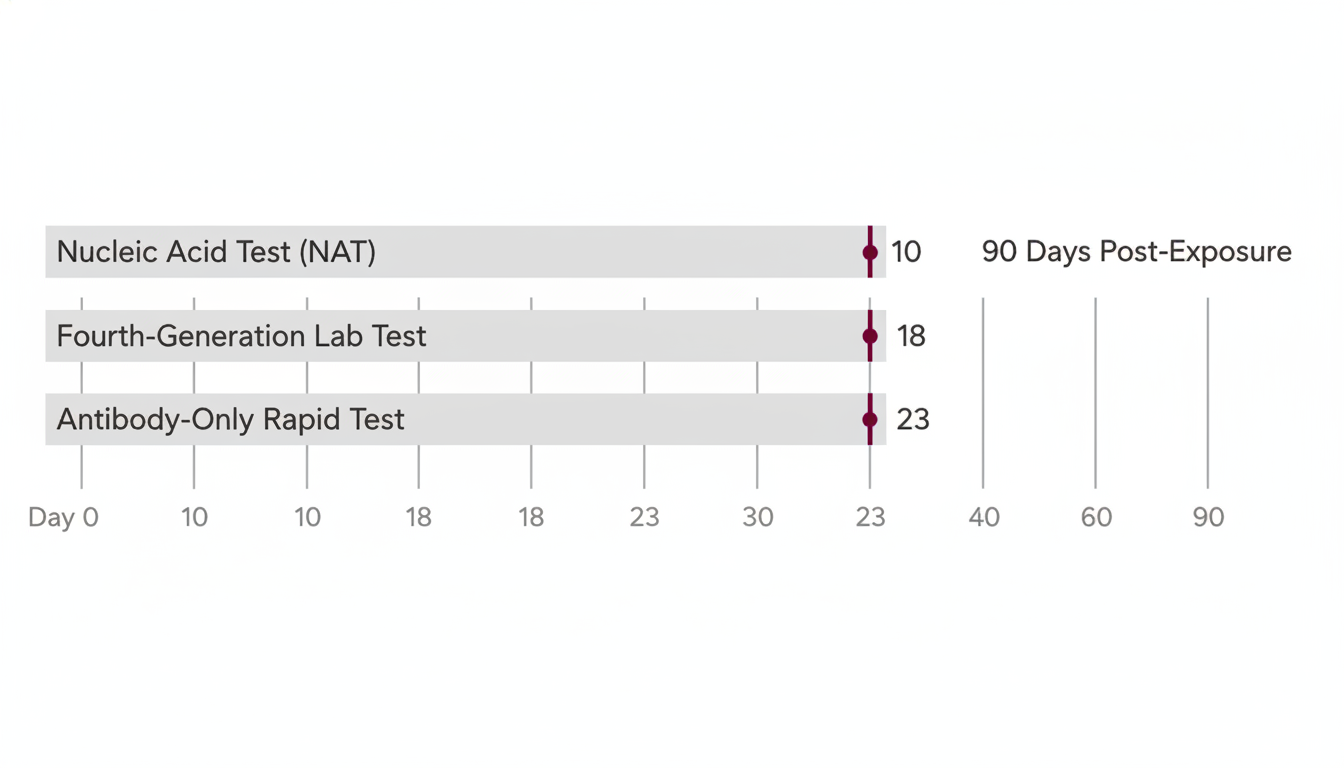
Nucleic acid tests (NAT). These look for the virus itself in blood and turn positive earliest, generally 10 to 33 days after exposure. They are expensive and used mainly when acute infection is suspected, when an early antigen/antibody test was indeterminate, or in the screening of donated blood. Most clinical settings do not order a NAT as the first-line test.
Fourth-generation antigen/antibody tests. The current standard for laboratory HIV testing in the United States. They detect both HIV antibodies and the p24 antigen, which appears earlier in the infection. The detection window is roughly 18 to 45 days after exposure. These are typically run on a venous blood draw at a clinic or lab.
Antibody-only tests. Used in most rapid point-of-care settings and at-home test kits. They detect the antibodies the body produces in response to HIV infection. Detection window is roughly 23 to 90 days after exposure depending on the specific test, with most modern lateral-flow rapid tests performing toward the shorter end of that range. A negative result before 90 days post-exposure should be confirmed with a follow-up test at the 90-day mark.
For someone with a one-time concerning exposure, the practical sequence is: test at four to six weeks post-exposure (a fourth-generation lab test will catch most infections by this point), and re-test at three months for a definitive negative. For someone with ongoing risk (multiple partners, partners of unknown status, injection drug use), test every three to six months regardless of any single exposure. People on PrEP are required to test for HIV every three months while on the medication; this same visit is the natural moment to screen for the bacterial STIs PrEP doesn't cover.
A reactive (positive) result on any HIV test is preliminary and must be confirmed with a different test type, generally a NAT and a confirmatory antibody assay. False positives on rapid tests are uncommon but not zero, especially in low-prevalence populations. Anyone with a reactive home test result should connect with a clinic for confirmatory testing within days, not weeks.
At-Home HIV Testing: What It Can and Can't Do
At-home HIV tests are a useful screening tool for people who would not otherwise test, or who test infrequently because of clinic access, scheduling, or stigma. The FDA cleared the first rapid home-use HIV test in 2012, and the technology has continued to improve since then.
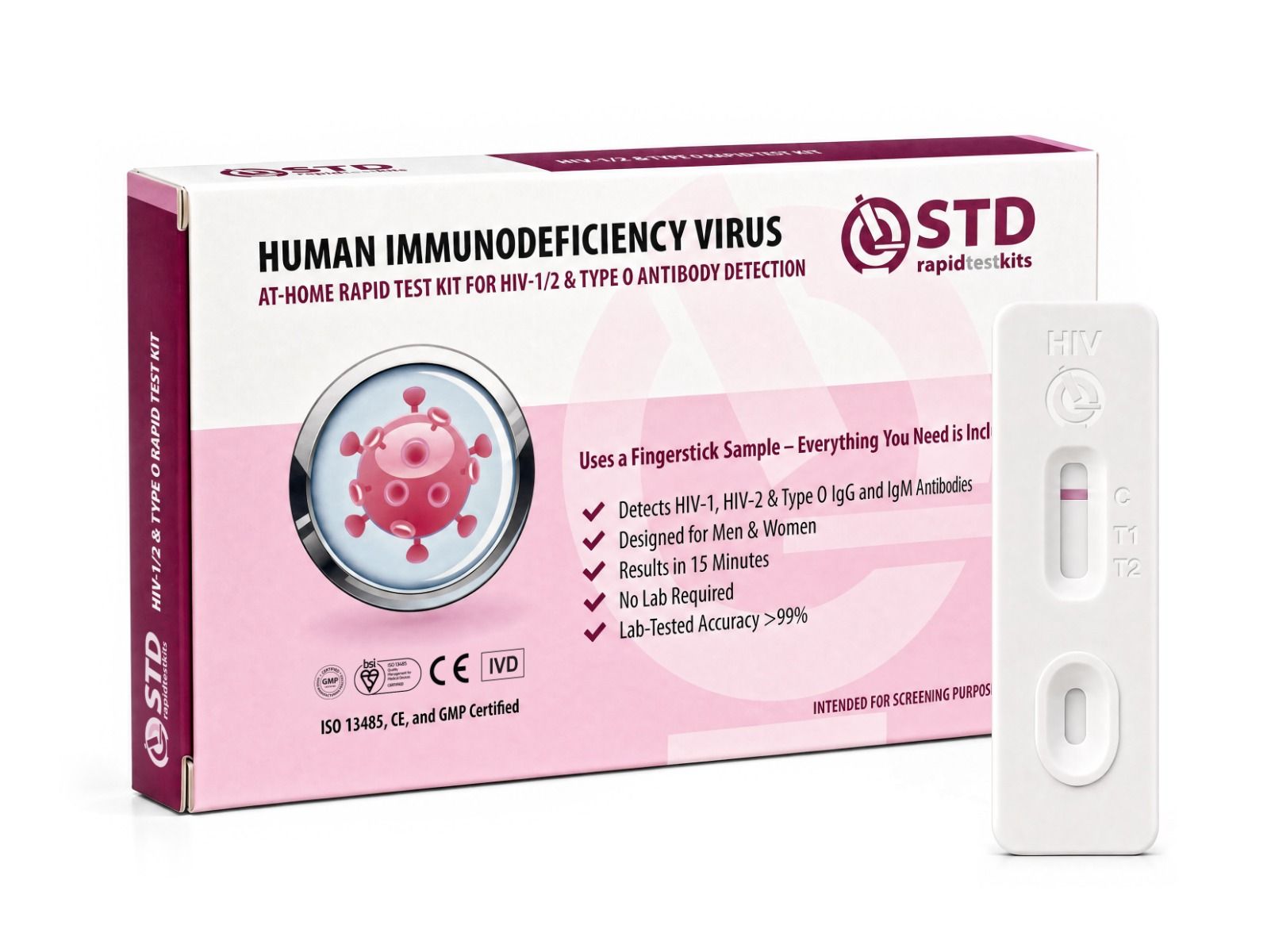
What an at-home rapid HIV test does well: it gives a screening-level antibody result in about 15 to 20 minutes from a fingerstick blood sample, with no clinic visit, no insurance involvement, and no entry on any medical record until you choose to share the result. It is private, fast, and (for the population of adults who want to know but might not otherwise test) effective at moving people from uncertainty to information. For people on PrEP, an at-home rapid HIV test is well-suited to the routine quarterly check between provider visits, with confirmatory lab testing reserved for any reactive result.
What an at-home test cannot do: it cannot replace a clinic visit when PEP is on the table, it cannot detect infection earlier than its detection window allows (so a negative result from a recent exposure is not yet definitive), and a reactive result on a home test must be confirmed with a laboratory NAT or fourth-generation antigen/antibody assay before it is treated as a diagnosis. Home tests are screening tools, and screening tools work best as part of a regular cadence rather than as a one-time event after a scary exposure.
At-home rapid HIV tests are lateral-flow immunoassays, not laboratory NAATs or PCR tests. The two approaches are complementary, not equivalent. Laboratory NAATs have higher analytical sensitivity in early infection; the rapid home format trades a bit of that sensitivity for speed, privacy, and access.
This guide is published by stdrapidtestkits.com, which sells at-home STI testing kits. We recommend products by fit-for-purpose for the reader's actual concern, not commercial benefit. Where the right step is a clinic visit (PrEP prescription, PEP within 72 hours, confirmatory NAAT), we say so plainly.
HIV and Other STIs: Why They Travel Together
HIV rarely travels alone. Untreated syphilis, herpes, gonorrhea, and chlamydia all share two things with HIV: they pass through similar routes, and they create conditions in the body that make HIV transmission more likely.
The mechanism is direct. Active syphilis chancres and herpes lesions create breaks in skin and mucosa that give HIV an easier route into the bloodstream. Inflammation from any active STI, even an asymptomatic one, recruits HIV-target immune cells to the genital area, raising both the chance of catching HIV during exposure and (for someone already infected) the chance of passing it on. Most chlamydia and gonorrhea infections are asymptomatic per CDC surveillance, which means they get caught only through routine screening rather than through symptom-driven visits. The CDC explicitly recommends testing for the major STIs alongside HIV at every screening interval.
Practically, this means a sexual health checkup is rarely a single test. The standard panel for sexually active adults covers HIV, syphilis, chlamydia, and gonorrhea at a minimum, with hepatitis B and hepatitis C added based on risk profile. Combination rapid kits screen for the full standard panel in a single at-home collection.
If a recent exposure is the trigger for testing, screening for the broader panel (not only HIV) is the better use of the visit. The reverse is also true: a positive test for any STI is a reason to get tested for HIV, even if HIV exposure itself did not feel like a concern.
People with HIV who take HIV medication as prescribed and get and keep an undetectable viral load can live long, healthy lives and have effectively no risk of transmitting HIV to their HIV-negative sexual partners.
Practical Next Steps
The high-leverage actions for adults concerned about HIV come down to three things: know your status, know your partner's status, and have a plan for each new exposure.
If you are sexually active with multiple or unknown-status partners, schedule routine testing every three to six months. If you have ongoing risk, talk to a primary care provider or a sexual-health-focused telehealth service about PrEP. If you had a possibly high-risk exposure in the last 72 hours, go to a clinic or emergency room today for PEP rather than waiting on a home test. If you tested positive for any STI, add HIV testing to the same visit. If you are in a relationship where one partner has HIV and one does not, discuss treatment-as-prevention with the HIV-positive partner's doctor and PrEP for the negative partner. If your risk profile is mostly bacterial STIs, ask a PrEP-experienced provider whether DoxyPEP fits your situation.
HIV is no longer the medical or social emergency it was thirty years ago. Diagnosed early and treated consistently, it is a manageable chronic condition. Diagnosed late or left untreated, it still progresses. The difference between those two outcomes, in most cases, is a single test result.
Frequently asked questions
- How long after exposure can HIV be detected?
- For the at-home rapid tests most people use, plan on at least 23 days and ideally 90 days after the exposure before the result is reliable. Lab fourth-generation antigen/antibody tests narrow that window to 18 to 45 days, and a NAT (used mainly when acute infection is suspected) detects HIV from about 10 days. A negative rapid-test result before the 90-day mark should be confirmed with a follow-up test.
- What is the practical difference between PrEP and PEP?
- PrEP is preventive: a daily pill (or every-two-month injection) you take ongoing while you have HIV-exposure risk. PEP is reactive: a 28-day course you take starting within 72 hours of a specific possible exposure. PEP is for one-off emergencies. PrEP is for ongoing risk. Both prevent HIV. Neither prevents other STIs. If your exposure pattern is recurring, the standard recommendation is to transition from PEP to PrEP after completing the 28-day course.
- How effective is PrEP in real-world use?
- Daily oral PrEP, taken as prescribed, reduces the risk of getting HIV from sex by about 99 percent and from injection drug use by at least 74 percent (HIV.gov). Real-world effectiveness depends on adherence: missed doses lower protection. Long-acting injectable PrEP (Apretude, every two months) addresses the adherence problem for some patients. All forms require a prescription and periodic monitoring.
- What is on-demand or 2-1-1 PrEP?
- Sometimes called event-driven PrEP, the 2-1-1 schedule is two pills 2 to 24 hours before sex, one pill 24 hours later, and one pill 48 hours after the first dose. The CDC currently recommends this approach only for cisgender men who have sex with men with infrequent or scheduled exposure events. It is not validated for receptive vaginal sex, transgender people on hormones, or injection drug use. Talk to a PrEP-experienced provider, not a general-practice doctor unfamiliar with the protocol.
- Can transgender people take PrEP?
- Yes. PrEP is safe and effective for transgender people, including those on gender-affirming hormone therapy. There are no known clinically significant interactions between oral PrEP and estrogen-based hormone therapy. Transgender women are a CDC-prioritized group for PrEP given the higher HIV incidence in this population. If a provider tells you otherwise, that is incorrect, and a sexual-health-focused telehealth service can connect you with a more knowledgeable clinic.
- Can you get HIV from oral sex?
- The risk is much lower than vaginal or anal sex but not zero. The CDC categorizes oral transmission as a low-risk route. Risk increases when the HIV-positive partner has a high viral load, when there are bleeding gums, oral lesions, or active gum disease, or when ejaculation occurs in the mouth. For someone whose only HIV concern is oral exposure with an unknown-status partner, routine testing is reasonable but PEP is generally not indicated unless additional risk factors are present.
- Do at-home HIV tests work?
- FDA-cleared rapid home HIV tests perform well as screening tools. They detect HIV antibodies in fingerstick blood within about 15 to 20 minutes. Two important caveats: results are reliable only after the antibody-detection window closes (about 23 to 90 days post-exposure depending on the specific test), and a reactive (positive) result must be confirmed with a laboratory test before it is treated as a diagnosis.
- What should I do if I think I was just exposed to HIV?
- If the exposure was within the last 72 hours, go to an emergency room or urgent care today and ask for PEP (post-exposure prophylaxis). PEP is a 28-day antiretroviral course that, if started promptly, substantially reduces the chance of infection. Do not wait on an at-home test result for this decision; tests cannot detect HIV that early. After completing PEP, follow up with HIV testing at four to six weeks and again at three months.
- U.S. Centers for Disease Control and Prevention. HIV main hub covering transmission routes, surveillance figures, and general screening recommendations.
- HIV.gov. Pre-Exposure Prophylaxis (PrEP) overview for patients, the source of the about-99 percent (sexual) and at-least-74 percent (injection drug use) effectiveness figures cited inline, plus coverage of the long-acting injectable Apretude and telehealth access pathways.
- U.S. Centers for Disease Control and Prevention. PEP overview, including the 72-hour exposure window, 28-day course, and emergency-room access pathway.
- U.S. Centers for Disease Control and Prevention. DoxyPEP clinical guidance, the 2024 recommendation for men who have sex with men and transgender women with a bacterial STI in the past 12 months.
- U.S. Centers for Disease Control and Prevention. HIV testing overview covering test types, detection windows, and screening cadence recommendations.
- World Health Organization. Global HIV/AIDS guidance, used for parent-to-child transmission and prevention context.
- U.S. Food and Drug Administration. Cleared the first rapid home-use HIV test in 2012; root domain reference for at-home test regulatory background.