Published: October 2025 | Last updated: May 2026 | Editorial review and quality control: Martina N.
HIV (the human immunodeficiency virus) spreads only through specific body fluids, and only through specific routes into another person's body. Knowing which routes carry real risk, and which don't, is the difference between unnecessary worry and confident decisions about when to test, when to start prevention medicine, and when to stop checking your skin for a rash that has nothing to do with HIV.
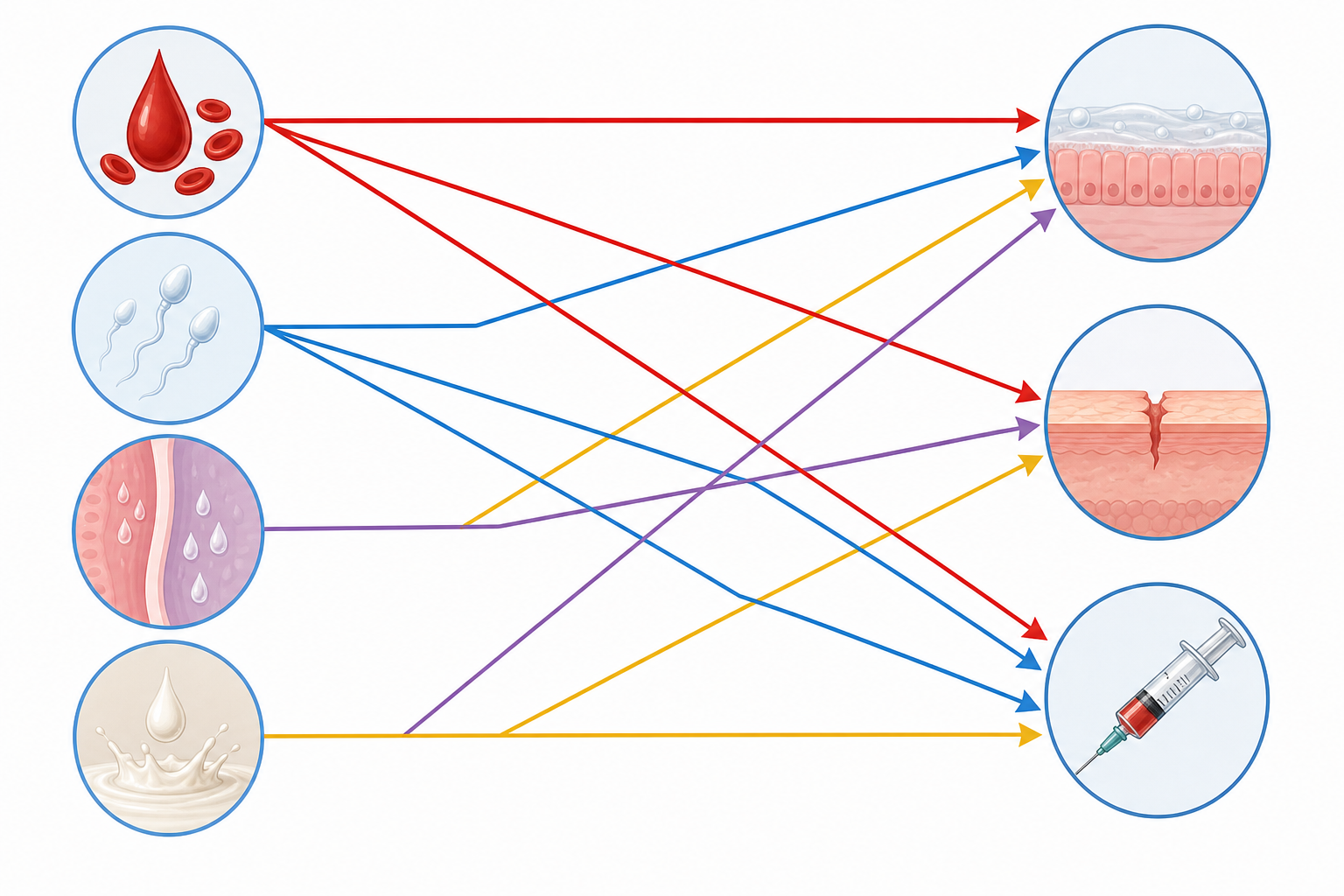
The science here has been settled for decades. The virus needs one of four fluids (blood, semen including pre-ejaculate, vaginal or rectal secretions, or breast milk) to reach one of three pathways into another person (a mucous membrane, a break in the skin, or direct injection). Saliva, sweat, and toilet seats are not on that list. What follows is what actually transmits HIV, what doesn't, and the prevention tools that push real exposure risk close to zero.
Key Takeaways
- HIV transmits only through blood, semen, vaginal or rectal fluids, and breast milk reaching a mucous membrane, broken skin, or direct injection. Saliva, sweat, urine, tears, and casual contact do not transmit the virus.
- Daily PrEP reduces sexual transmission by about 99% (CDC), and a partner with an undetectable viral load on treatment cannot pass HIV sexually (U=U). Knowing your status through regular testing is the first prevention step.
The four body fluids that can carry HIV
HIV survives in only four human fluids in concentrations high enough to infect another person, according to the U.S. Centers for Disease Control and Prevention:
- Blood, including menstrual blood and blood traces on shared injection equipment.
- Semen and pre-ejaculate.
- Vaginal and rectal secretions.
- Breast milk.
Saliva, sweat, tears, urine, and feces are not infectious in normal contact. Saliva, in particular, contains enzymes that inhibit HIV. That is why even passionate kissing has not produced a documented case of HIV transmission unless both partners have actively bleeding gums or open sores in the mouth, and even then the risk is vanishingly small.
For any of these four fluids to actually transmit the virus, they need to reach one of three entry points: a mucous membrane (the moist tissue lining the genitals, rectum, mouth, or eyes), a break in the skin large enough to allow fluid contact (an open cut, ulcer, or fresh wound), or a direct injection (a shared needle, a needlestick injury, or, very rarely now, a contaminated blood transfusion). Skin that is intact and unbroken is a remarkably effective barrier. The virus simply cannot push through it.
This is the foundation everything else in the article rests on. If a fluid is not one of the four, or if it never reaches a pathway, the biology of transmission cannot proceed regardless of how anxious the situation feels.
Four fluids (blood, semen and pre-ejaculate, vaginal or rectal secretions, breast milk) must reach one of three entry points (a mucous membrane, broken skin, or direct injection). Anything outside that fluid-and-pathway model is not a transmission route, no matter how often it appears in HIV myths.
Sexual transmission and how risk varies by activity
Most new HIV cases worldwide are sexually transmitted (WHO). But the per-act probability of transmission from a sexual exposure with a person living with HIV varies widely depending on the activity, the viral load of the person living with HIV, and the presence of other conditions that compromise the lining of the mucous membranes.
The CDC publishes per-exposure risk estimates derived from cohort studies. These are useful for comparison rather than as exact predictions; real-world risk depends on viral load (an undetectable load reduces sexual transmission to effectively zero), condom use, presence of other STIs, and circumcision status for insertive partners. Receptive anal sex carries the highest per-act risk because the rectal lining is thin and rich in immune cells the virus targets. Vaginal sex carries lower per-act risk, with the receptive partner more vulnerable. Oral sex carries a very low risk, and most documented transmissions through oral contact involved ejaculation into the mouth combined with open sores or bleeding gums.
The table below summarizes CDC per-exposure risk estimates. Real-world figures vary by viral load, condom use, and concurrent STI status (CDC per-exposure risk data).
Three factors raise the risk above the baseline numbers:
- A high viral load in the partner living with HIV, particularly during acute infection (the first weeks after they themselves acquired the virus).
- Other sexually transmitted infections such as syphilis, herpes, or gonorrhea, which create sores or inflammation that make it easier for HIV to cross the mucous membrane.
- Genital or anal trauma from rough sex, recent piercings, or untreated infections.
Three factors lower the risk dramatically:
- The partner living with HIV being on consistent treatment with an undetectable viral load (the U=U principle, covered below).
- Daily PrEP for the HIV-negative partner.
- Correct, consistent condom use.
| Exposure type | Estimated transmissions per 10,000 exposures |
|---|---|
| Blood transfusion (contaminated, pre-screening era) | 9,250 |
| Mother to child without ART (pregnancy, birth, breastfeeding combined) | 1,500 to 4,500 |
| Receptive anal sex | 138 |
| Needle-sharing during injection drug use | 63 |
| Insertive anal sex | 11 |
| Receptive vaginal sex | 8 |
| Insertive vaginal sex | 4 |
| Receptive oral sex | Low (documented cases rare) |
| Biting, spitting, throwing body fluids | Negligible |
Non-sexual transmission routes
Sex is the most common route worldwide, but HIV also moves between people through three other identified pathways. The per-act numbers in the table above for transfusion and needle-sharing assume the source is HIV-positive and not on suppressive treatment. Universal blood screening (in place in the U.S. since 1985) and viral suppression through ART have changed the real-world picture dramatically.
Shared injection equipment
Sharing needles, syringes, or any equipment that contacts blood (cookers, cottons, water for mixing) carries real risk because residual blood on the equipment can keep the virus viable for hours. Needle exchange programs and the supervised use of clean equipment are among the most effective single interventions for reducing community HIV transmission, per CDC surveillance data.
Mother to child (perinatal)
An HIV-positive person can pass the virus to their child during pregnancy, delivery, or breastfeeding. Without intervention, the transmission rate is 15 to 45 percent. With antiretroviral treatment during pregnancy and delivery, plus medication for the newborn and avoidance of breastfeeding where formula is safely available, transmission rates drop below 1 percent. This is one of the clearest success stories in HIV medicine and the reason routine HIV testing is part of standard prenatal care (WHO).
Blood transfusions and organ transplants
Before routine screening, contaminated blood products were a significant source of HIV transmission. Modern blood banks in countries with universal screening, including the U.S., U.K., and most of Europe, have made transfusion-related HIV extremely rare per CDC and WHO blood-safety guidance. Risk remains higher in regions without universal screening, which is why WHO maintains its global blood safety program.
Occupational exposure
Needlestick injuries in healthcare settings can transmit HIV. The risk per single needlestick from an HIV-positive source is approximately 0.3 percent. Post-exposure prophylaxis (PEP) started within 72 hours dramatically reduces the chance of seroconversion (CDC).
What doesn't transmit HIV, and what the science shows
HIV stigma is built on a long list of routes that have never been shown to transmit the virus despite decades of global surveillance. The list below is not a guess; it reflects what cohort data and laboratory studies have consistently demonstrated, summarized in CDC, WHO, and NHS guidance.
- Casual contact: hugging, shaking hands, touching, sitting next to someone, sharing a workspace, riding the same bus.
- Saliva exposure: kissing (including deep kissing in the absence of major bleeding gums), sharing utensils, drinking from the same cup, sharing a toothbrush in normal circumstances.
- Insect bites: mosquitoes, ticks, bedbugs, fleas. Insects do not inject one person's blood into another, and HIV cannot replicate in insect tissue.
- Toilets, swimming pools, and public surfaces: the virus is inactive within minutes on dry surfaces and cannot survive in chlorinated water.
- Sweat, tears, urine, vomit, or feces in the absence of visible blood.
- Sneezing or coughing: HIV is not airborne or respiratory.
- Donating blood: U.S. and most international donation systems use single-use sterile equipment.
- Tattooing or piercing at a licensed studio using single-use needles and proper sterilization. Risk arises only if equipment is reused or improperly sterilized.
The reason this matters beyond reassurance: stigma based on these myths drives delayed testing, social isolation for people living with HIV, and avoidance of care. UNAIDS data show the epidemic remains concentrated among populations most affected by stigma and discrimination, which is part of why public-health bodies treat anti-stigma work as a core element of HIV response.
Sharing food, hugging, kissing, or being in the same space as someone living with HIV does not create a meaningful exposure risk. If your worry is about a specific sexual or injection exposure, the questions to ask are: what fluid, what pathway, and how long ago? Those three answers point to whether testing or PEP is the appropriate next step.
Prevention: the four tools that work
HIV prevention works best as a stack of overlapping tools. Each tool reduces risk on its own, and combining them brings real-world transmission risk close to zero for most exposure scenarios.
Condoms (external and internal)
Used correctly and consistently, latex or polyurethane condoms create a physical barrier that substantially reduces HIV transmission during vaginal and anal sex. They also reduce transmission of other STIs (syphilis, gonorrhea, chlamydia, herpes) that themselves raise HIV risk. Effectiveness drops sharply with inconsistent use, breakage, or slippage. What matters for any single exposure is whether a condom was used for that specific event; general condom habits don't change the risk calculus for a one-off encounter.
PrEP (pre-exposure prophylaxis)
PrEP is a daily medication taken by HIV-negative people at higher risk of exposure (people whose partners are living with HIV, people with multiple recent partners, people who inject drugs). When taken daily as prescribed, oral PrEP reduces the risk of sexual HIV acquisition by about 99 percent, per CDC guidance. Adherence is the key variable; the protective benefit drops sharply with missed doses. Long-acting injectable PrEP (cabotegravir) is also approved and replaces daily pills with an injection every two months.
PrEP is available through primary care providers, sexual health clinics, and most U.S. insurance plans cover it without cost-sharing under Affordable Care Act preventive-services rules.
PEP (post-exposure prophylaxis)
PEP is a 28-day course of antiretroviral medication started after a possible HIV exposure (a condom break with an unknown-status partner, a needlestick, an assault). The first dose must be taken within 72 hours of exposure, and sooner is better; after the 72-hour window, the medication's window of opportunity has effectively closed. PEP is typically obtained from an emergency department or sexual health clinic. Don't wait until business hours.
U=U (undetectable equals untransmittable)
For a person living with HIV who takes antiretroviral therapy (ART) consistently, the virus is suppressed to levels too low for standard lab tests to detect (an undetectable viral load). This person cannot transmit HIV to sexual partners. The evidence base for U=U is now over a decade old, drawn from the PARTNER and Opposites Attract studies, which tracked tens of thousands of condomless sex acts in serodifferent couples with zero linked transmissions. CDC, WHO, and major HIV organizations affirm U=U as scientifically established.
Stacking the layers
Combination prevention is how most real-world risk reduction happens: a condom plus PrEP plus knowing your partner's viral status pushes residual risk to near-zero territory for most exposures. No single tool is a guarantee on its own, and stacking them is the standard of care today.
People with HIV who take HIV medicine as prescribed and get and keep an undetectable viral load have effectively no risk of transmitting HIV to their HIV-negative sexual partners.
Testing for HIV: when, how, and what kind
Knowing your status is the entry point for everything else. Two facts shape the testing decision.
1. Window periods vary by test type. No HIV test detects the virus the day after exposure. The body has to start producing detectable antibodies, or the virus has to multiply enough for direct detection:
- Nucleic acid tests (NAT) can detect HIV RNA in blood as early as 10 to 33 days after exposure. These are lab-only and not typical screening tests.
- Fourth-generation antigen-antibody lab tests detect both p24 antigen and antibodies, and reliably identify most infections between 18 and 45 days after exposure.
- Rapid antibody tests, including most at-home rapid kits, detect antibodies and are most accurate from about 23 to 90 days after exposure. A negative result inside that window does not rule out very recent infection.
2. Frequency depends on risk profile. The CDC recommends everyone aged 13 to 64 be tested at least once as part of routine care. Sexually active people with new or multiple partners should test annually. People at higher exposure risk (men who have sex with men with multiple partners, people who share injection equipment, partners of people living with HIV) should test every 3 to 6 months.
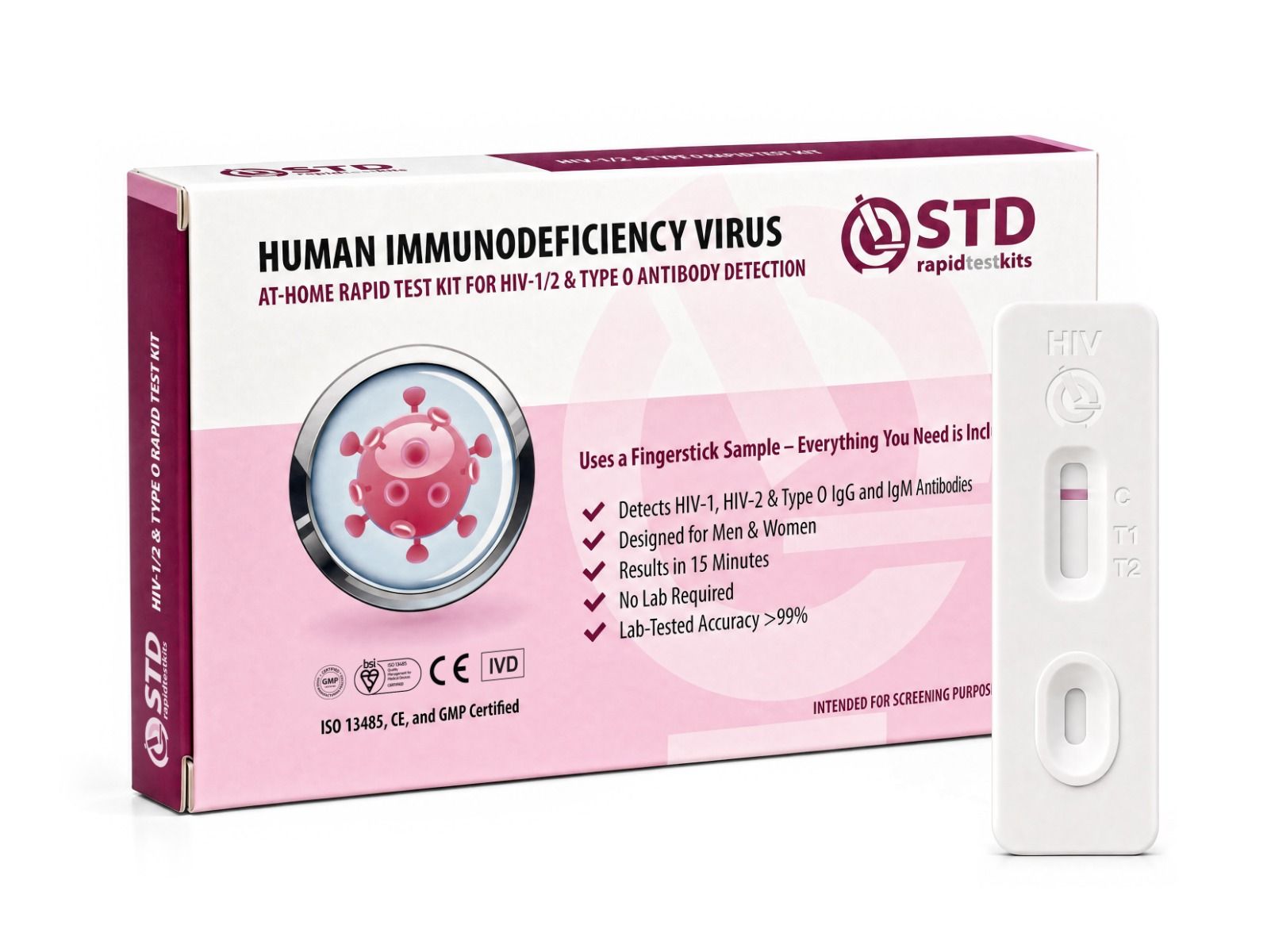
At-home rapid tests are useful screening tools. They use lateral-flow strip chemistry, which is fast and private and well-suited for routine screening, though lab-based fourth-generation and NAT tests close the detection window faster and offer higher analytical sensitivity in the acute phase. A reactive (positive) result on a home test always requires lab confirmation, because rapid tests have specificity above 99 percent but any positive must be confirmed before any treatment decision. A non-reactive result outside the window period is reliable. For very recent exposure, lab-based fourth-generation testing closes the window faster than a home rapid antibody test can, and PEP (if started within 72 hours) is more relevant than a same-week test result.
This site, stdrapidtestkits.com, sells rapid lateral-flow at-home tests that return a result in about 15 minutes. We recommend products based on fit for the reader's concern, not commercial benefit; the kit below is the relevant option when an at-home HIV antibody screen makes sense for your situation.
Why other STIs raise your HIV risk
Three things happen when another sexually transmitted infection (syphilis, gonorrhea, chlamydia, herpes, trichomoniasis) is present at the time of HIV exposure:
- Sores or ulcers from syphilis or herpes provide a direct entry route through what would normally be intact skin or mucous membrane.
- Local inflammation from any active STI draws CD4 immune cells (the cells HIV targets) to the genital or rectal tissue. More target cells in one location means a higher chance that the virus, if it gets there, finds a cell to infect.
- Asymptomatic infection means a person may not know they have an STI, so they don't take the precautions or seek treatment that would normally lower the inflammation.
This is why HIV prevention guidance generally recommends regular screening for other STIs alongside HIV, especially for people having sex with new or multiple partners. A comprehensive panel checks the most common bacterial and viral STIs in one round, which catches asymptomatic infections that would otherwise raise both HIV risk and the risk of unwitting transmission to partners.

Living with HIV today: a treatable chronic condition
An HIV diagnosis in 2026 is not the diagnosis it was in the 1990s. With consistent antiretroviral therapy (ART), people living with HIV have a near-normal life expectancy and, when virally suppressed, do not transmit the virus to sexual partners (WHO).
Modern HIV treatment in one glance
- Near-normal life expectancy on consistent ART, per WHO and CDC guidance.
- Most people achieve viral suppression within 1 to 6 months of starting treatment.
- Undetectable viral load means the virus cannot be sexually transmitted (U=U).
- Long-acting injectable ART is now available as a monthly or every-two-months option for people who prefer it over daily pills.
How treatment changes the picture
ART works by suppressing viral replication. Most people now start a single-tablet regimen taken once a day with minimal side effects after the initial adjustment period. Within 1 to 6 months of starting treatment, most achieve viral suppression (the virus drops below the lab's detection limit). The clinical goal is lifelong viral suppression, which preserves the immune system, prevents progression to AIDS, and supports the U=U principle for partner protection.
Long-acting injectable treatments (cabotegravir combined with rilpivirine) are also now approved as a monthly or every-two-months injection, eliminating daily pill burden for people who prefer it.
What hasn't changed: stigma still drives delayed diagnosis, treatment interruption, and isolation. The most useful single thing anyone can do, whether they live with HIV or not, is to treat it as the treatable chronic condition it now is and reject the assumptions that survived from a different era of the epidemic. The medicine works and the science is clear; the pathways that transmit the virus are narrow and well-understood, and the prevention toolkit is more effective today than at any point in the history of the response.
If you're worried about a specific exposure, get tested, consider PEP or PrEP, and ask a clinician or sexual health service for the next step.
Starting ART as soon as possible after diagnosis is the current standard of care. Regimens used today are simpler and better-tolerated than at any earlier point in the epidemic, and most people on consistent treatment reach an undetectable viral load within months and stay there for life. The path from diagnosis to a manageable chronic condition is well-mapped, and most U.S. insurance plans cover ART without prior authorization.
FAQs
- Can you get HIV from kissing?
- No. Saliva does not contain enough HIV to transmit the virus, and saliva contains enzymes that inhibit HIV. Even deep kissing has not produced a documented transmission unless both people have actively bleeding gums or open mouth sores, and even then the risk is extremely low.
- How long can HIV survive outside the body?
- HIV becomes inactive within minutes once exposed to air, light, or dry surfaces. It cannot survive on doorknobs, toilet seats, towels, or shared cups. The virus needs the moist, warm environment of human tissue to remain infectious.
- How effective is PrEP at preventing HIV?
- Daily PrEP cuts HIV acquisition risk from sex by roughly 99 percent when taken as prescribed. For people who inject drugs, the reduction is at least 74 percent. Adherence is the single most important variable; missed doses erode protection quickly, and clinicians typically recommend a daily routine to anchor the dose.
- Can mosquitoes spread HIV?
- No. HIV does not survive or reproduce inside insects, and mosquitoes inject their own saliva (not blood from a prior person) when they feed. Decades of surveillance have never identified a case of insect-borne HIV transmission anywhere in the world.
- When should I test after a possible exposure?
- Window periods depend on the test. A fourth-generation antigen-antibody lab test detects most infections by 18 to 45 days after exposure. A rapid antibody test (the type used in at-home kits) is most reliable from about 23 to 90 days after exposure. If you suspect very recent exposure, starting PEP within 72 hours is more important than waiting on a test result.
- Is HIV curable today?
- There is no widely available cure for HIV. There is highly effective antiretroviral therapy (ART) that suppresses the virus so completely that people on consistent treatment have a near-normal life expectancy and cannot transmit the virus sexually. Cure research, including gene editing and broadly neutralizing antibodies, is active but not yet clinically available.
- What does U=U mean?
- U=U stands for Undetectable equals Untransmittable. When a person living with HIV takes antiretroviral therapy consistently and their viral load stays undetectable on standard lab tests, they cannot transmit HIV to sexual partners. This is now affirmed by the CDC, WHO, and major HIV organizations worldwide based on more than a decade of clinical evidence.
- How effective are condoms at preventing HIV?
- Used correctly and consistently, latex or polyurethane condoms substantially reduce HIV transmission risk during vaginal and anal sex. They also reduce transmission of other STIs that can themselves raise HIV risk. The practical question is consistency: condoms only protect for the exposures during which they're used.
- U.S. Centers for Disease Control and Prevention. HIV transmission, prevention, and testing guidance, including the U=U principle and PrEP/PEP recommendations, and per-exposure risk data used in the table.
- World Health Organization. HIV/AIDS fact sheet covering global transmission, prevention, treatment, life expectancy on ART, and mother-to-child transmission rates.
- National Health Service (UK). HIV and AIDS condition guide for general public, covering transmission routes, testing, and treatment.
- UNAIDS. Global fact sheet on the HIV epidemic, including data on populations most affected by stigma and discrimination and progress toward 95-95-95 targets.
- U.S. Centers for Disease Control and Prevention. HIV testing guidance, window periods by test type, and routine screening recommendations.
