Published: November 2025 | Last updated: May 2026 | Editorial review and quality control: Martina N.
You started without a condom. Then one of you stopped, reached for it, and put it on. Maybe it was seconds. Maybe a minute. Now the encounter is over and your brain will not let it go. Does that count as exposure? Is there a real risk of an STI? What about pregnancy? Should you test now, wait, or assume you're fine?
This is a common situation, and the honest answer sits in the middle. The risk is not zero, and it is not the same as fully unprotected sex. The right next step depends on what kind of contact happened, what window period applies to each infection you're worried about, and a few decisions that are genuinely time-sensitive in the first 72 hours.
Key Takeaways
- Pre-ejaculate can carry both sperm and STI-causing bacteria or viruses, so brief unprotected contact before a condom goes on is a real, if reduced, exposure.
- Testing too early gives false reassurance. Chlamydia and gonorrhea become reliably detectable about 1 to 2 weeks after exposure; HIV with a 4th-generation antigen/antibody test by about 18 to 45 days per CDC guidance.
Why a Few Seconds Still Counts
People minimize what happened, and the phrases come up constantly: "it was just the tip," "it was barely a few seconds," "we stopped before anything happened." These framings make sense emotionally because you are trying to figure out whether what happened is the kind of thing you need to act on.
Biologically, any genital-to-genital contact without a barrier counts as exposure. That isn't the same as infection. Most brief, partial exposures do not lead to an STI being transmitted. But transmission doesn't run on a stopwatch the way many people assume it does. For fluid-borne infections, what matters is whether infected fluid reached a mucous membrane like the urethra, vaginal lining, or rectum. For skin-borne infections such as herpes simplex virus (HSV) and human papillomavirus (HPV), what matters is whether skin contact happened in an area that can shed virus.
"I told myself it didn't count because we fixed it right away. Then I couldn't stop Googling for three days."
That spiral is the cost of trying to estimate risk with no information. So instead of debating whether it "counted," it helps to look at what actually moves the risk needle: the type of contact, the fluids involved, and the partner's infection status, known or unknown.
Most brief unprotected contacts do not result in transmission. The type of contact and the partner's status are what move the risk needle, not the clock. Treat this as a reason to plan testing, not as evidence that something has already happened.
What Pre-Cum Can Carry
Pre-ejaculate, sometimes called pre-cum, is the clear fluid the penis can release during arousal, before ejaculation. Two questions about it come up over and over: can it cause pregnancy, and can it transmit STIs? The honest answer to both is yes, sometimes.
Pre-cum does not always contain sperm, but reproductive-health guidance summarized on the NHS contraception overview notes that withdrawal is much less reliable than barrier methods partly because pre-ejaculate from some people carries motile sperm. There is no reliable way to know in advance whether a particular person's pre-cum is sperm-carrying on a given day.
For STIs, the principle is similar. Pre-cum is fluid that travels through the urethra. If the urethra is colonized with chlamydia or gonorrhea, those bacteria can be in the fluid. HIV can also be present in pre-ejaculate if the person has untreated HIV, according to the CDC's HIV transmission overview, though at lower concentrations than in semen.
Skin-borne infections work differently. HSV-1, HSV-2, and HPV transmit through skin contact, with or without fluid exchange. They can shed from genital skin even when no sore or wart is visible, a phenomenon clinicians call asymptomatic shedding. A condom reduces this risk but does not eliminate it, because the condom does not cover all the skin in contact.
| Type of Transmission | What Has to Happen | Examples |
|---|---|---|
| Fluid-borne | Pre-cum or other fluid reaches the urethra, vagina, or rectum | Chlamydia, gonorrhea, HIV, hepatitis B |
| Skin-to-skin | Direct contact with infected genital skin, with or without visible sores | Herpes (HSV-1, HSV-2), HPV, syphilis chancre |
| Microscopic abrasion | Tiny tears in genital skin let bacteria or viruses enter more easily | Most STIs (increased risk) |
How Big Is the Risk, Really?
This is the part where people want a clean percentage, and real life doesn't produce one. Risk depends on at least four variables at once, and each one shifts the math. The factors below are how clinicians triage a partial-exposure question.
For chlamydia, the per-act transmission risk from infected partner to uninfected partner during unprotected vaginal sex is estimated in the range of a few percent per act in the published literature, with wide variation depending on study design and sex of the receptive partner. Brief pre-condom contact is meaningfully less than a full unprotected act, but the chance is not zero, particularly because chlamydia is a common STI per CDC chlamydia guidance, with the majority of infections producing no symptoms.
The point isn't to memorize a number. It's that the answer sits in a range. Most "started without, then used one" scenarios land in a low-to-moderate zone of risk, which is why the right testing window matters more than the urge to test immediately.
| Factor | Lower-Risk End | Higher-Risk End |
|---|---|---|
| Duration before condom | A few seconds, no thrusting | Sustained unprotected penetration before stopping |
| Ejaculation in the unprotected window | No ejaculation occurred | Ejaculation happened before the condom went on |
| Partner's testing history | Recently tested negative, low number of recent partners | Status unknown, recent new partners, no recent screening |
| Type of contact | Fluid-only concern | Skin contact in herpes or HPV-prone areas as well |
Most Cases Land in the Low-to-Moderate Zone
This is the part people don't hear enough, especially in their first sleepless hour after the encounter. The most common outcome of a partial-condom situation, statistically, is that nothing is transmitted. Many people in this exact situation test negative. That isn't permission to skip testing. It's context for the spiral your brain is doing right now.
The reason testing still matters, even when the probability is on your side, is that the consequences of an untreated infection are not symmetric with the inconvenience of testing. Chlamydia and gonorrhea, left untreated, can cause pelvic inflammatory disease in women and epididymitis in men. Both are curable with antibiotics if caught. So the math of testing is asymmetric in your favor: cheap to do, valuable if positive, reassuring if negative at the correct window.
Low-to-moderate risk, not high risk. That doesn't mean ignore it. It means follow a structured testing timeline at the right windows rather than spiraling or assuming the worst.
The Mental Spiral After the Moment Is Normal
The physical risk is one part of this. The mental loop is the other, and it's often the harder one. You replay the moment, analyze every second, and find yourself Googling symptoms that do not even apply at this stage of any infection's timeline, with every twinge and every body sensation suddenly reading as a sign of something.
This is your brain trying to regain control after uncertainty. It's not evidence that anything is wrong. The thing that interrupts the spiral isn't more reassurance from a stranger online; it's a written plan with dates, including when you'll test, what you'll test for, and what you'll do with each possible result. People consistently report that the spiral quiets once the plan exists, even before any test is taken.
"Once I had actual dates I'd test, I stopped spiraling. It gave me something solid."
If health anxiety is something you already struggle with, build a hard stop into your plan: search the topic once, write the plan, and then close the tabs. Re-searching the same question every few hours feeds the loop instead of resolving it.
(1) When you will test. (2) What you will test for. (3) What you will do with a positive result. The spiral quiets once the plan is on paper, because your brain stops trying to solve uncertainty in the background.
The First 72 Hours: What's Actually Time-Sensitive
HIV post-exposure prophylaxis (PEP) has a strict 72-hour cutoff. So does emergency contraception, if pregnancy is a concern. Most other STI decisions can wait a week or two, but these two cannot, and it's worth knowing what they involve even if you decide neither applies to you.
PEP is a 28-day course of antiretroviral medication that, when started ideally within 24 hours and no later than 72 hours after a possible HIV exposure, sharply reduces the chance of HIV taking hold. The CDC's HIV prevention guidance describes PEP as appropriate for higher-risk exposures, which generally means contact with a partner known to have HIV, or sex with a partner whose status is unknown in a setting where HIV prevalence is meaningful. A clinician (urgent care, sexual health clinic, or ER) decides whether your exposure meets the threshold. If you might want PEP, you need to be in front of a clinician within 72 hours; sooner is better.
Emergency contraception (EC) sits on a similar clock. Over-the-counter levonorgestrel EC (often called Plan B) is most effective within 72 hours, with reduced effectiveness up to 5 days. Ulipristal (ella) is effective up to 120 hours by prescription. The Planned Parenthood EC overview lays out the options. EC isn't an admission that something "definitely" went wrong; it's a backup for exactly this kind of gray-zone situation.
PEP: if HIV exposure was possible (partner status unknown or known-positive), get to a clinician within 72 hours, sooner if you can.
EC: if pregnancy is a concern, take levonorgestrel within 72 hours, or ulipristal within 120 hours by prescription.
Both decisions are made by a clinician or pharmacist quickly. Skipping the window means losing the option.
When Protection Starts Late, It Still Matters
It's easy to frame this whole situation as a mistake, and it's worth recognizing what you did right. You used a condom. That reduced overall risk for fluid-borne infections substantially, and it reduced pregnancy risk for the rest of the encounter. Protection doesn't have to be perfect to be meaningful.
This is a harm-reduction lens, not an all-or-nothing one. Real sexual health works on harm reduction. Late-but-used is statistically and practically better than not-used, even though both leave some residual risk to think about. The WHO STI fact sheet consistently frames consistent and correct condom use as one of the most effective single tools for STI prevention, and that framing applies here even though use was partial.
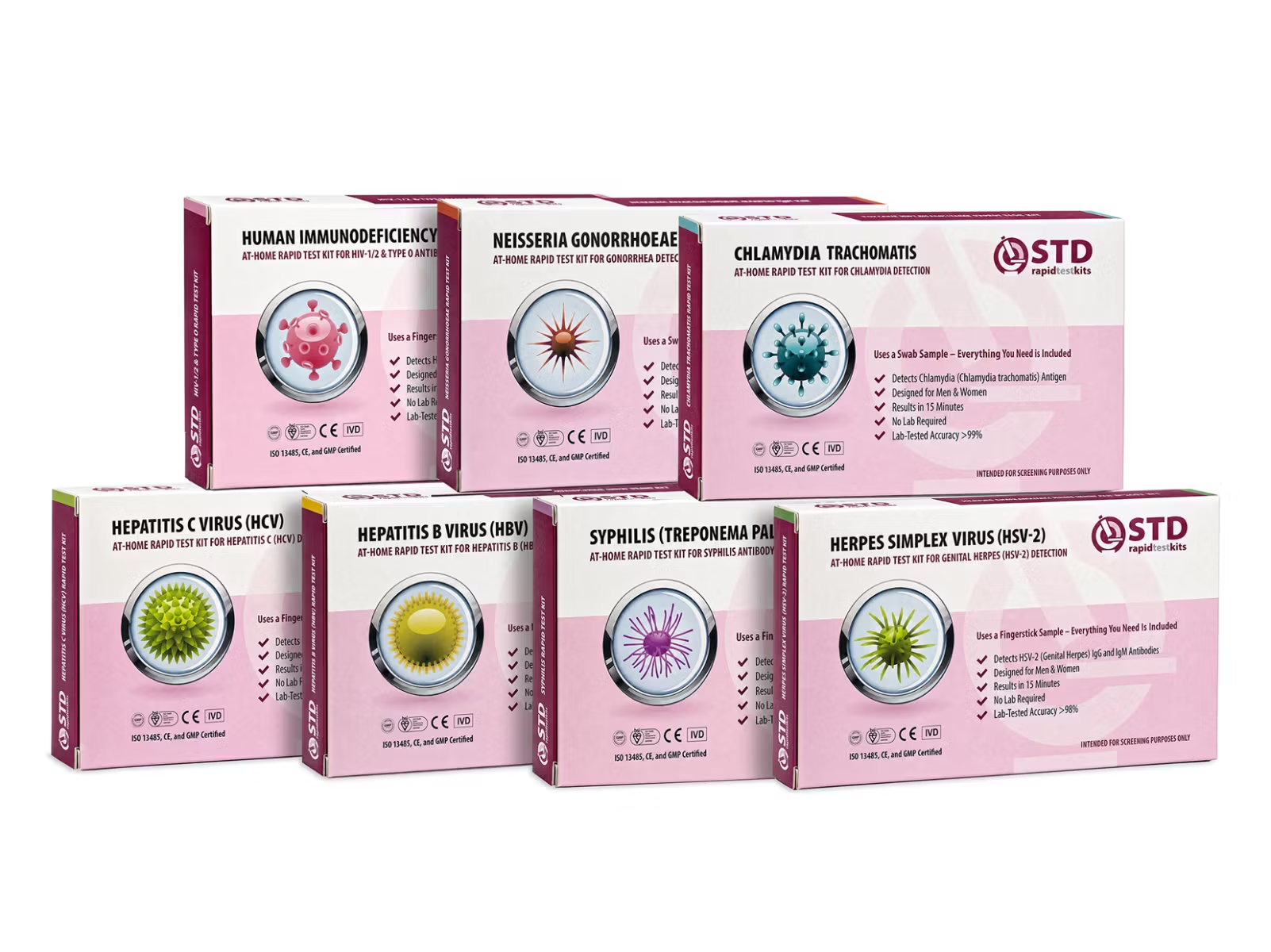
If you want a thorough screen that covers more than one infection at once, a combined panel is more efficient than ordering tests one at a time. Full disclosure: this site sells the at-home test kits referenced below; editorial guidance in this article reflects current public-health recommendations and is not contingent on which products are stocked. The kit below covers the seven infections most relevant to a typical mixed-fluid and skin-contact exposure scenario.
The Testing Timeline Most People Get Wrong
Testing is the answer, but only if you do it at the right time. Too early and you risk a false negative that gives false peace of mind. Every infection has a window period, the interval between exposure and when a test can reliably detect it. The numbers below are the practical "best time to test" windows for the most common scenarios; they come from CDC and FDA guidance for current-generation tests, including for the rapid lateral-flow tests used in at-home kits.
Two practical points. First, a negative test before the window period closes is genuinely uninformative for that infection; you'll need to retest at the right time. Second, lab NAAT (nucleic acid amplification) tests are more sensitive at the early edge of the window than rapid lateral-flow tests, which is why some people choose a clinic NAAT early and a home rapid test for repeat screening later.
| Infection | Earliest reliable detection | Practical "best time to test" |
|---|---|---|
| Chlamydia (NAAT or swab) | About 1 week | 2 weeks after exposure |
| Gonorrhea (NAAT or swab) | About 1 week | 2 weeks after exposure |
| Syphilis (antibody) | About 3 weeks | 6 weeks after exposure, with repeat at 3 months if high-concern |
| HIV (4th-gen antigen/antibody) | About 18 days | 45 days after exposure, with repeat at 90 days if high-concern |
| HIV (antibody-only rapid) | About 3 weeks | 12 weeks after exposure |
| Herpes (HSV-2 IgG antibody) | Around 6 weeks | 12 weeks for most; a retest at 16 weeks for slow seroconverters |
Pregnancy Risk: The Question Many People Hesitate to Ask
If the encounter involved penis-in-vagina contact, the pregnancy question sits underneath the STI question even when neither person says it out loud. The honest answer is that pre-cum can contain sperm in some men and not others, and there's no good way to know without specific testing that nobody does in real life. So the question isn't "is there sperm," it's "do you want a backup option in case there was."
Cycle timing matters. The fertile window is roughly the five days before ovulation plus ovulation day itself. If the encounter happened well outside that window (in the days right after a period, for example), pregnancy chance from pre-cum is genuinely low. If it happened in the middle of the cycle, the chance is higher, though still not the same as fully unprotected sex.
The reason emergency contraception exists is that nobody is good at predicting their fertile window in retrospect, and EC's risk-benefit ratio is favorable even when the pregnancy chance is modest. It is over-the-counter, it works, and it's most effective the sooner it's taken. The conservative move when there's any doubt is to take it within the first 72 hours rather than wait and second-guess later.

Herpes and HPV: Skin Is the Variable
Some of the most misunderstood risks here come from infections that don't depend on fluids at all. HSV (herpes simplex virus) and HPV (human papillomavirus) transmit primarily through skin contact in the genital area, and they can shed even when no visible sore or wart is present. This is why people who use condoms consistently throughout an encounter can still encounter these infections; the condom doesn't cover all the skin involved.
For a partial-condom encounter, the relevant question is whether genital skin made contact at all, not whether ejaculation happened. If a partner has HSV-2 or genital HPV, the risk of skin-to-skin transmission during a brief unprotected window exists but isn't usually high; transmission generally needs viral shedding to be occurring at that moment, and shedding is intermittent for both viruses. The CDC describes asymptomatic shedding of HSV in its overall STI fact-sheet pages, and most experts frame the risk as real but not the dominant concern for most exposures.
Most people with genital herpes do not know they have it. Even those without symptoms can spread the virus, which is one reason herpes is so common.
What Feeling Fine Doesn't Tell You
One of the biggest traps after a situation like this is treating the absence of symptoms as proof of safety. The CDC estimates that the majority of chlamydia and gonorrhea infections produce no early symptoms, especially in women. HIV often produces no specific symptoms in the acute phase, or produces a flu-like illness easy to attribute to anything else. Syphilis can present as a single painless sore that resolves on its own without any treatment.
Feeling normal at the 3-day, 7-day, or even 30-day mark does not answer the question. Testing answers the question. Symptom checking is useful for flagging things that need attention sooner, not for ruling things out. "I feel fine, so I'm probably okay" is the most common false-reassurance trap in this scenario, and it's the one that delays treatment of curable infections.
"I kept checking myself in the mirror every day. Nothing showed up, so I told myself I was fine. I wasn't."
Most chlamydia and gonorrhea infections produce no symptoms in the first weeks, especially in women, and early HIV is easily mistaken for the flu. Symptoms alone cannot rule these out. A test at the correct window can.
Make a Plan, Then Move On
After this kind of moment, people tend to swing in one of two directions. Some go into panic mode: testing immediately at day three, assuming the worst, spiraling through scenarios. Others go the opposite way and dismiss it entirely, telling themselves it didn't count. Neither approach helps.
The middle path is a written timeline. Acknowledge the exposure without exaggerating it. Schedule the right tests at the right windows. Stay aware of your body without obsessing over every sensation. That is what clinical guidance recommends for low-to-moderate-risk exposures.
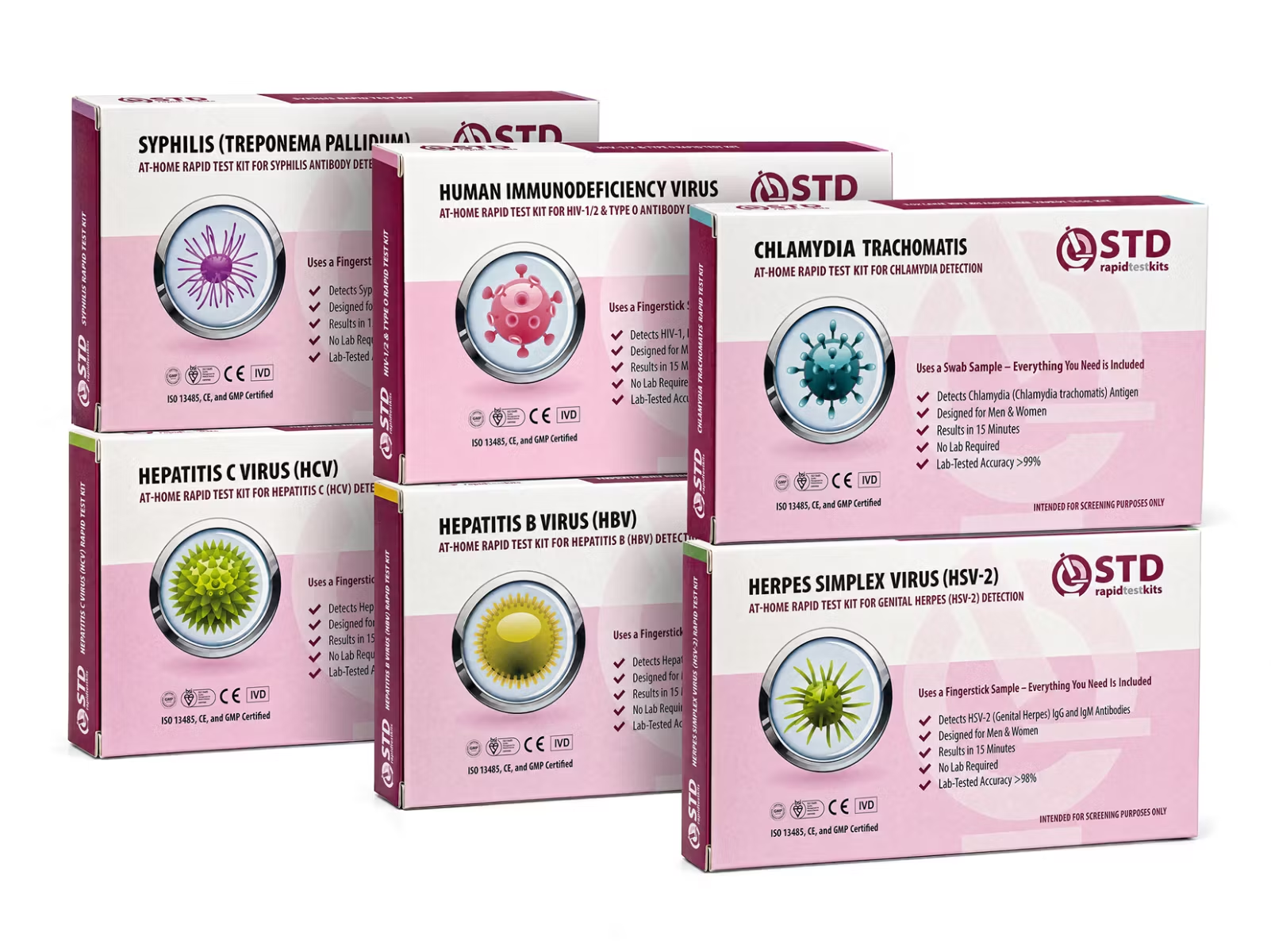
If you want to simplify the timeline and skip clinic appointments, a multi-infection home panel covers the highest-priority screens in one collection. The six-in-one kit below combines the most common bacterial and viral screens at the same windows.
FAQs
- If it was only a few seconds before the condom went on, does it really count as exposure?
- Yes, technically. Brief unprotected contact is a real (though reduced) exposure because pre-ejaculate and direct skin contact can both carry infections. That doesn't mean infection is likely; it means the right next step is a sensible testing plan, not panic.
- Can pre-cum actually transmit STIs, or is that a myth?
- It's not a myth. Pre-ejaculate travels through the urethra and can carry chlamydia or gonorrhea bacteria if the urethra is infected, and HIV at lower concentration than semen if the person has untreated HIV. Whether it carries them in any given moment is variable, which is why this situation lives in a gray zone.
- If we put the condom on quickly, doesn't that effectively cancel out the risk?
- It substantially reduces overall risk for the encounter, particularly for fluid-borne infections, but it doesn't erase what happened in the unprotected window. Think of it as moving you from one category of risk to a lower one, not back to zero.
- I feel completely fine. Should I just move on without testing?
- Feeling fine doesn't answer the question. Many chlamydia, gonorrhea, and early-stage HIV infections produce no early symptoms. The reliable way to rule something out is a test at the correct window, not a symptom check at week one.
- When should I test if I want one answer rather than a sequence?
- If you can only test once and want broad coverage, around 6 weeks after the exposure is a useful single point. Chlamydia and gonorrhea are detectable by then, and the 4th-generation HIV antigen/antibody window is closed. Add a 12-week repeat HIV test if the exposure was higher concern.
- Can herpes transmit even if a condom was used right after the unprotected window?
- For transmission to happen, viral shedding has to be occurring at that specific moment on the area of skin that made contact. Shedding is intermittent and unpredictable, which is why most brief unprotected contacts with a partner who has HSV do not result in transmission. The risk is greater than zero, but it is not the default outcome.
- What about pregnancy if there was no ejaculation?
- Pre-cum carries sperm in some people and not others, with no easy way to know in advance. Pregnancy is less likely than from full unprotected sex, but not impossible, especially if the encounter was near ovulation. Emergency contraception in the first 72 hours (up to 120 hours with ulipristal) is the conservative backup.
- Honestly, am I probably fine?
- Most people who test after this kind of exposure test negative across all infections screened. The reason testing still exists is that "most" is not "all," and infections caught at the right window are almost always treatable. So the answer is yes, probably, and the way you confirm it is one well-timed test, not weeks of guessing.
You Don't Need Perfect, You Need Clarity
Starting sex without a condom and then putting one on is not a rare event. It is human. It happens in moments that aren't scripted, where decisions are made quickly and then corrected just as quickly. The goal here isn't to label what happened as reckless or safe. The goal is to understand it clearly enough to act on it.
There was some risk, yes. It is not a life sentence, and it is not something you need to sit with for weeks of vague worry. Once you understand the timing of pre-cum exposure, the right window for each test, and the two 72-hour-window decisions (PEP and EC) that may or may not apply to your case, the situation becomes manageable. Book the 2-week chlamydia and gonorrhea test now, mark the 6-week date for syphilis and HIV on your calendar, and revisit only if something changes before then.
Your testing timeline at a glance
- Within 72 hours: decide on PEP (if HIV exposure was possible) and EC (if pregnancy is a concern).
- 2 weeks after exposure: chlamydia and gonorrhea, either NAAT at a clinic or at-home swab.
- 6 weeks after exposure: syphilis antibody and HIV 4th-generation antigen/antibody.
- 12 weeks after exposure: repeat HIV test if exposure was higher concern; HSV-2 IgG antibody if you want a herpes blood test.
How we sourced this article: Our article was constructed based on current advice from the most prominent public-health and medical organizations, including the CDC, the WHO, the NHS, and Planned Parenthood, and then molded into simple language based on the situations that people actually experience after a partial-condom encounter. Window-period figures reflect CDC and FDA guidance for current-generation rapid and laboratory tests. Pre-ejaculate, emergency contraception, and post-exposure prophylaxis information reflects current reproductive-health and HIV-prevention guidance from the CDC, NHS, and Planned Parenthood. Where the underlying number varies by study or product, we used conservative ranges from the cited organizations rather than the most aggressive figures.
- U.S. Centers for Disease Control and Prevention. Sexually Transmitted Infections (STI) overview, surveillance, and prevention guidance.
- U.S. Centers for Disease Control and Prevention. HIV transmission, testing window periods, and post-exposure prophylaxis (PEP) guidance.
- U.S. Centers for Disease Control and Prevention. Chlamydia overview and asymptomatic-infection information.
- World Health Organization. Sexually Transmitted Infections (STIs) fact sheet, including condom-effectiveness framing.
- National Health Service (UK). Contraception overview, including how withdrawal and barrier methods compare for pregnancy prevention.
- Planned Parenthood. Emergency contraception (morning-after pill) options, effectiveness, and timing windows.
- National Health Service (UK). Sexually transmitted infections (STIs) overview, including symptoms, testing, and treatment.
