

Published: October 2025 | Last updated: April 2026 | Editorial review and quality control: Martina N.
The mirror routine is familiar. Tongue pressed flat with a spoon, phone flashlight angled into the back of your throat, eyes hunting for white spots, comparing yesterday to today, half-convinced things are getting worse. The encounter that started this loop happened a few days ago, and the sore throat that followed has not behaved like a normal cold.
Here is the calmer version of what is going on. Most sore throats after oral sex are viral or mechanical irritation. A meaningful minority are sexually transmitted, and the tricky part is that the sexually transmitted versions often do not produce the dramatic symptoms a cold or strep infection does. Knowing which window applies to your timing, and which test answers which question, replaces guessing with a plan you can act on tonight.
Does a sore throat after oral sex mean I have an STI?
Usually no. Most sore throats are viral. When an STI is the cause, oral gonorrhea is the most common, with oral chlamydia, herpes, and the early flu-like phase of HIV well behind it. Throat infections from gonorrhea and chlamydia are often silent, so how your throat feels will not rule them in or out. A pharyngeal swab is the most reliable answer, taken roughly 7 to 14 days after exposure. Throat-swab testing is performed at clinics; our at-home kits screen the genital and bloodborne side of the same exposure event.
Key Takeaways
- Most pharyngeal gonorrhea and chlamydia infections cause no noticeable symptoms, so exposure timing matters more than how your throat feels.
- Throat-specific testing requires a clinic-collected swab. Our at-home kits cover the genital and bloodborne infections that often travel with the same encounter.
Why a “Cold” After Oral Sex Deserves a Closer Look
A throat infection from oral sex usually does not announce itself. There is rarely one dramatic symptom. The CDC notes that gonorrhea can be transmitted through unprotected oral sex, and pharyngeal infections are commonly picked up during routine screening rather than from a complaint. The same is true for chlamydia, which the CDC describes as transmissible through vaginal, anal, or oral sex. That asymptomatic pattern is exactly what makes them spread.
The bacteria that cause genital gonorrhea (Neisseria gonorrhoeae) and chlamydia (Chlamydia trachomatis) can colonize the soft tissue at the back of the throat after oral contact with infected genitals. Sometimes that produces a mild scratchy sensation. Sometimes a faint redness on the tonsillar pillars. Often, nothing at all that you would point to in a mirror.
Strep throat tends to be loud: sudden onset, fever, swollen glands, swallowing that genuinely hurts. Viral pharyngitis is usually slower and comes packaged with a runny nose or cough. A pharyngeal STI tends to be quieter than either, which is why people second-guess themselves.
Gonorrhea can be transmitted by having vaginal, anal, or oral sex with someone who has the infection. If you have had oral and/or anal sex, your healthcare provider may use swabs to collect samples from your throat and/or rectum.
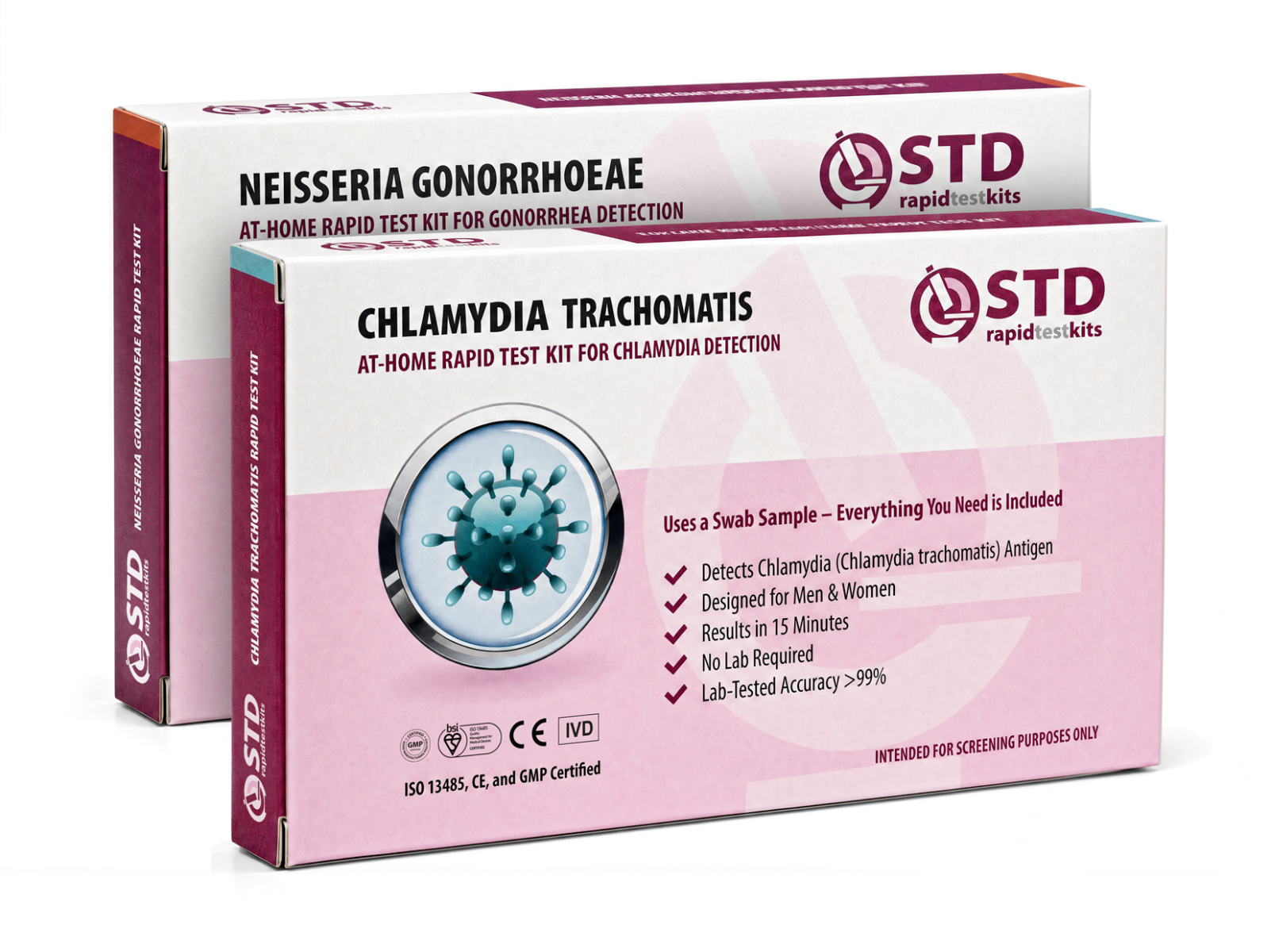
Our at-home rapid tests use vaginal or penile swabs, or fingerstick blood samples. We do not sell a pharyngeal (throat) swab kit. Throat-specific gonorrhea and chlamydia testing is done with lab-processed nucleic acid amplification (NAAT), which is the standard at sexual-health clinics and most primary-care offices. If your worry is throat-specific, a clinic visit is the right call. Our kits are useful for the genital and bloodborne side of the same encounter, which we cover later in this article.
What Throat Gonorrhea and Chlamydia Actually Feel Like
Often, nothing at all. Surveillance research consistently shows that the majority of pharyngeal gonorrhea infections produce no symptoms a person would notice. Pharyngeal chlamydia is similarly quiet. People learn they have either one because a partner tested positive, because they were screened at multiple anatomic sites during a routine visit, or because a different infection at another site prompted a fuller workup.
When symptoms do show up, they tend to look like:
- A persistent, mild scratchy throat that does not worsen the way a cold or strep does
- Mild redness on the tonsils or back of the throat
- Slight tenderness or swelling of the lymph nodes under the jaw
- Occasional discomfort when swallowing, well below the sharp pain of acute bacterial pharyngitis
Notice what is missing: high fever, dramatic white patches on the tonsils, severe swallowing pain. Those features point toward strep or another acute bacterial cause, not pharyngeal gonorrhea. The CDC's STI Treatment Guidelines also note that pharyngeal gonorrhea is harder to clear than genital gonorrhea, with few antimicrobial regimens reliably curing more than 90% of throat infections, which is one reason testing matters even when symptoms are absent.
If you are searching for descriptions of how oral chlamydia presents, the most accurate description is also the least dramatic: usually nothing visible, sometimes a vague soreness, often discovered through a partner's diagnosis rather than your own.
Strep, a Virus, Herpes, or HIV? Sorting the Overlap
Symptoms overlap. That is the hard truth, and it is the reason a single mirror inspection cannot distinguish strep from oral gonorrhea from a viral cold. Context, exposure history, and timing carry more diagnostic weight than how your throat looks today.
Strep throat typically arrives within 2 to 5 days of exposure with a fever above 38°C, pronounced white or yellow exudate on the tonsils, swollen tender lymph nodes, and no runny nose. A rapid antigen test or throat culture confirms it.
Viral pharyngitis is the most common cause of any sore throat. Onset is gradual, fever is low or absent, and the package usually includes nasal congestion, mild cough, watery eyes, or hoarseness. It resolves on its own in three to seven days.
Pharyngeal gonorrhea or chlamydia is usually mild to silent. There is rarely a fever or pronounced exudate. The main clue is timing: symptoms (or no symptoms) following an oral sex encounter within the past one to two weeks, especially with a new partner.
Primary oral herpes looks different. Many adults already carry HSV-1 from childhood and never have a primary outbreak as adults. When a primary outbreak does happen, it is intense, with fever, body aches, painful clusters of vesicles on the lips or inside the mouth, and ulcers that genuinely hurt. Mild irritation without visible vesicles is rarely a primary herpes presentation.
Acute HIV infection can include a sore throat, but only as part of a larger flu-like illness 2 to 4 weeks after exposure. The CDC describes acute HIV as flu-like symptoms within 2 to 4 weeks after infection: fever, fatigue, body aches, swollen glands, sometimes a rash. Without those systemic features, a scratchy throat alone usually points elsewhere.
| Feature | Viral cold | Strep throat | Oral gonorrhea | Oral chlamydia | Primary oral herpes | Acute HIV |
|---|---|---|---|---|---|---|
| Sudden severe pain | Uncommon | Common | Uncommon | Uncommon | Common | Uncommon |
| Fever above 38°C | Sometimes | Common | Uncommon | Rare | Common | Common |
| White/yellow exudate | Uncommon | Common | Possible, subtle | Rare | Ulcers, not exudate | Uncommon |
| Visible vesicles or ulcers | No | No | No | No | Common | No |
| Runny nose / cough | Common | No | No | No | No | Possible |
| Body aches / fatigue | Sometimes | Sometimes | Rare | Rare | Common | Common |
| Often no symptoms | Rare | Rare | Very common | Very common | Possible (recurrences) | Possible |
When Testing Will Actually Tell You Something
Testing too early is the most common mistake. A negative result feels reassuring, but if the bacteria or antibodies have not reached detectable levels yet, the negative reflects timing rather than status. Knowing the window for each infection saves you from misplaced relief.
For pharyngeal gonorrhea and chlamydia, NAAT testing reaches reliable sensitivity around 7 to 14 days after exposure. Some clinics will swab earlier when symptoms are clearly present, but the safest interpretation of an early negative is “retest at day 14 to be sure.”
For HIV, a fourth-generation antigen/antibody test detects most infections by day 18 to 45 after exposure. An HIV RNA test can pick up infection earlier, sometimes by day 10 to 14, but it is more expensive and rarely sold in a home format.
For herpes (HSV-1 and HSV-2), antibody blood tests can begin to detect seroconversion around 4 weeks after exposure and reach their most reliable range at about 12 weeks. If active sores are present, a clinic can swab the lesion directly for PCR, which provides faster confirmation than blood antibody testing.
For syphilis, treponemal blood tests usually become positive 3 to 6 weeks after exposure.
The clean version of the windows that matter:
| Infection | Earliest reliable test | Optimal window | Sample type | Where to get it |
|---|---|---|---|---|
| Pharyngeal gonorrhea | 5–7 days | 7–14 days | Throat swab (NAAT) | Sexual-health clinic |
| Pharyngeal chlamydia | 5–7 days | 7–14 days | Throat swab (NAAT) | Sexual-health clinic |
| Genital gonorrhea | 5–7 days | 7–14 days | Vaginal/penile swab | Clinic or at-home rapid kit |
| Genital chlamydia | 5–7 days | 7–14 days | Vaginal/penile swab | Clinic or at-home rapid kit |
| HIV (Ag/Ab) | 10–14 days (RNA earlier) | 18–45 days | Fingerstick blood | Clinic or at-home rapid kit |
| Syphilis | 2–3 weeks | 3–6 weeks | Fingerstick blood | Clinic or at-home rapid kit |
| Herpes (HSV antibody) | 4 weeks | 4–12 weeks (most reliable at 12+) | Fingerstick blood | Clinic or at-home rapid kit |
| Herpes lesion swab | Within 48 hr of sore | While sores are fresh | Lesion swab (PCR) | Sexual-health clinic |
How Oral STIs Actually Spread (and What Lowers the Risk)
Oral sex is real sex from a transmission perspective. Bacteria and viruses do not care how the contact happened, only that mucous membranes met fluid or tissue carrying the pathogen. The most common routes for the throat infections we have been discussing:
- Performing oral sex on a partner with genital gonorrhea or chlamydia can transmit those bacteria to your throat.
- Receiving oral sex from a partner with pharyngeal gonorrhea can transmit it to your urethra, vagina, or rectum.
- Direct oral contact with a herpes lesion can transmit HSV-1 or HSV-2, especially when sores are visible or in early healing.
Ejaculation is not required. Pre-ejaculate and mucosal contact alone are sufficient for bacterial STI transmission. The NHS gonorrhoea page lists sore throat among the symptoms that can occur when the infection affects the throat after oral sex.
Kissing alone is generally low risk for gonorrhea and chlamydia, and it is not considered a primary transmission route. Some research has examined deep kissing as a possible route for pharyngeal gonorrhea, but it has not become a major public-health concern. Herpes is the exception: HSV-1 transmits readily through kissing when sores are present or shedding, which is one reason most adults carry HSV-1 antibodies acquired in childhood.
Barrier methods reduce risk. A condom on a penis during fellatio lowers but does not eliminate transmission risk. The WHO estimates that more than one million curable STIs are acquired worldwide each day among people aged 15 to 49. Dental dams provide equivalent protection during cunnilingus and analingus and use the same one-time-use, latex-or-polyurethane principle as condoms.
Where At-Home Testing Helps and Where It Doesn't
The honest scope of an at-home rapid kit is narrower than internet ads sometimes imply. Lateral-flow rapid tests are useful screening tools, particularly for people who would otherwise not test at all because of cost, distance, or privacy. They are different from lab NAATs, with different sensitivity profiles, and the right framing is screening rather than confirmation.
What our kits can answer well:
- Genital chlamydia and gonorrhea via vaginal or penile self-swab, useful 7 to 14 days after exposure for the genital site.
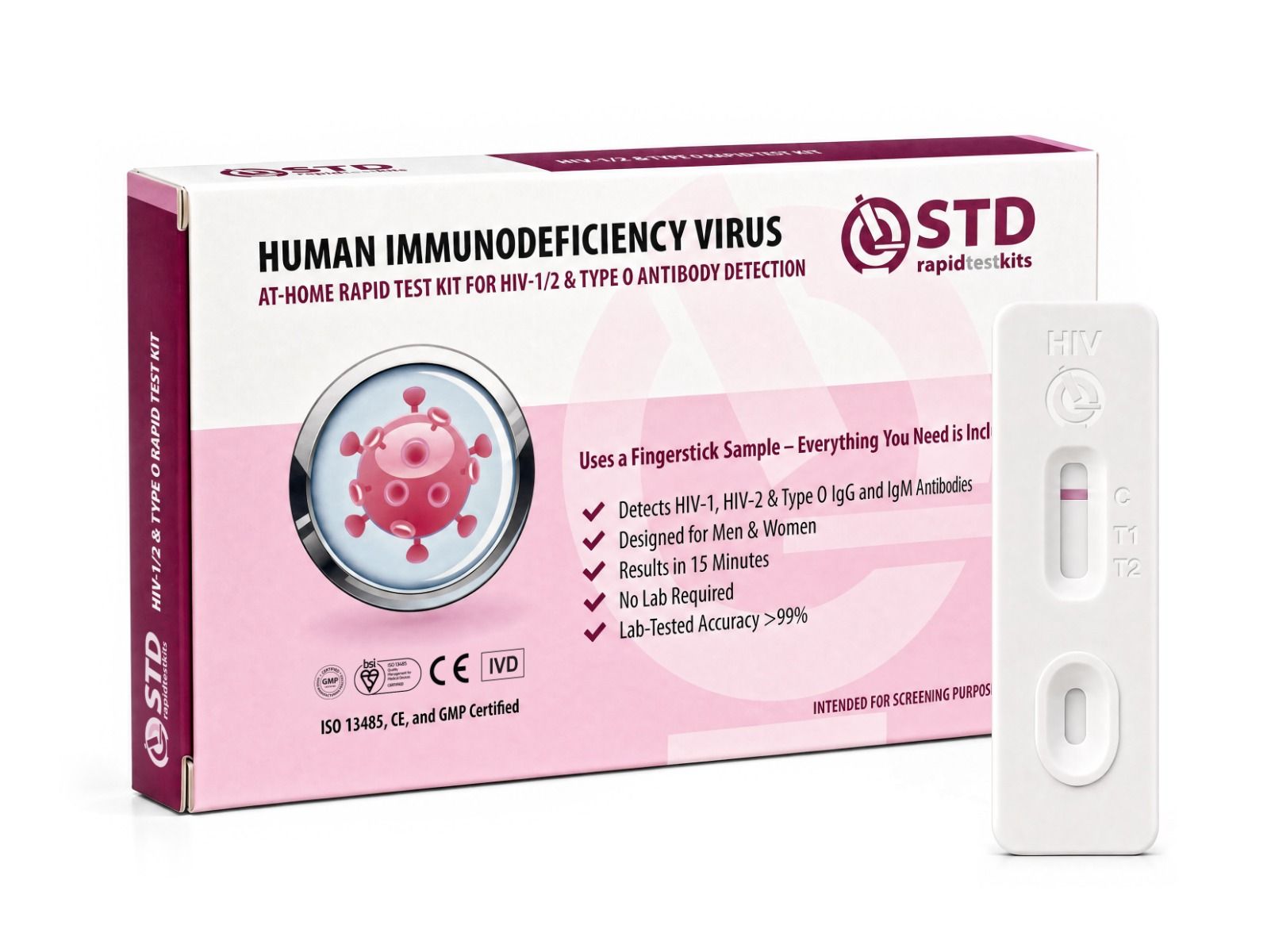
- HIV antigen/antibody status via fingerstick blood, useful from roughly day 18 to 45 after exposure.
- Syphilis, hepatitis B, and hepatitis C via fingerstick blood, useful in their respective windows.
- HSV-2 antibody status via fingerstick blood, beginning at 4 weeks post-exposure and most reliable at 12 weeks for confirmed seroconversion.
What our kits cannot answer:
- Pharyngeal (throat) gonorrhea or chlamydia. This requires a throat-specific NAAT, a clinic-administered test.
- An active oral herpes outbreak. This requires a swab of the lesion sent for PCR, also clinic-administered.
- Rectal STIs. These require a rectal swab, also clinic-administered.
If you had oral sex and your worry is throat-specific, the right path is a clinic visit for a pharyngeal swab. If the same encounter also involved genital contact, an at-home kit can answer the genital and blood side while you wait on the clinic appointment. Many users do both in parallel: place the home order tonight, schedule the clinic swab for the day-7 to day-14 window.
What If the Test Comes Back Positive?
A positive result is rarely the catastrophe it feels like in the moment of reading it. Most of the infections discussed here are treatable, often with a single course of antibiotics. The hardest part is usually emotional rather than medical.
For pharyngeal gonorrhea, the CDC currently recommends ceftriaxone 500 mg as a single intramuscular dose for adults under 150 kg. Pharyngeal infection is harder to clear than genital gonorrhea, and a test-of-cure 7 to 14 days after treatment is recommended to confirm clearance. For pharyngeal chlamydia, doxycycline or azithromycin is standard, with similar follow-up considerations.
HIV is no longer the diagnosis it was thirty years ago. Modern antiretroviral therapy started early can result in undetectable viral loads, which translates clinically to untransmittable to partners and a near-normal life expectancy. Earlier diagnosis means better outcomes, which is why testing during the right window matters even when the test feels frightening to take.
Herpes is lifelong but manageable. Antiviral medication can shorten outbreaks, reduce frequency, and lower transmission risk. Most people with HSV-1 or HSV-2 lead unremarkable sex lives with appropriate disclosure and management.
Partner notification is a separate task that feels heavier than it is medically. A direct, brief message works: “I tested positive for [X]. You should consider testing.” That is enough. Most public-health departments also offer anonymous partner-notification services if direct contact feels impossible.
Pharyngeal gonorrhea: the CDC recommends ceftriaxone 500 mg as a single intramuscular dose for adults under 150 kg, with a test-of-cure swab 7 to 14 days after treatment to confirm clearance, since throat infections are harder to clear than genital ones.
HIV: antiretroviral therapy started early can lower viral load to undetectable levels, which research now classifies as untransmittable to partners (“U=U”), and produces a near-normal life expectancy. Diagnosis in the first months matters more than diagnosis in the first weeks for prognosis, but earlier is better either way.
Sorting Worry From Action: A Decision Frame
Two questions replace the open-ended spiral with a plan. The first is about timing; the second is about exposure type.
Question one: how long has it been since the exposure?
- Less than 7 days: too early for reliable bacterial STI testing. Schedule the clinic swab for day 14 and monitor symptoms in the meantime. If symptoms worsen quickly or include high fever, seek evaluation regardless of STI status.
- 7 to 14 days: inside the optimal window for pharyngeal gonorrhea and chlamydia testing. Schedule the clinic swab now.
- 18 to 45 days: inside the optimal window for HIV antigen/antibody testing. An at-home blood test is reasonable. (An RNA test, available through clinics, can detect HIV earlier, sometimes from day 10 to 14.)
- 4 to 12 weeks: herpes antibody testing can begin at 4 weeks if sores or symptoms prompt it, and reaches its most reliable range at 12 weeks for confirmed seroconversion.
Question two: what was the exposure type?
- Oral only: pharyngeal swab at a clinic is the primary test. Adjunct genital screening if your partner had multiple partners or known status concerns.
- Oral plus genital contact: both pharyngeal swab (clinic) and genital screening (clinic or at-home swab) are appropriate.
- Anal contact involved: add a rectal swab at the clinic.
Use the frame as a starting move. The next concrete step is a phone call to the clinic or an order placed with a home kit, ideally the same evening you read this.
A Calmer Final Word
A sore throat after oral sex does not automatically mean you have an STI. Most of the time it does not. What it does mean is that the encounter has surfaced a real question worth answering, and the answer is more reachable than the spiral suggests. Time the test to the window. Pick the test that matches the exposure site. Use the clinic for throat, lesion, and rectal swabs; use a home kit for the genital and bloodborne side. Booking the clinic visit and ordering the home kit are both two-minute tasks; the rest is waiting on the windows to open.
FAQs
- I have a sore throat after oral sex but no other symptoms. How worried should I be?
- Less than your search history wants you to be. Most sore throats are viral. The pattern that should prompt testing is timing (within roughly two weeks of an oral encounter, especially with a new partner) plus exposure context, not the presence or absence of throat symptoms. Pharyngeal gonorrhea and chlamydia are often silent, so a sore throat alone neither confirms nor rules out an STI. A clinic swab at day 7 to 14 is the answer.
- Can I really not test at home for throat gonorrhea?
- Not with our rapid kits. Our at-home rapid swabs are validated for vaginal or penile sample collection, and our blood tests use a fingerstick. Throat (pharyngeal) testing requires a clinic-collected swab processed by a lab using NAAT. Some specialty labs sell mail-in throat-swab kits with self-collection, but those are still lab-processed, not the rapid lateral-flow format we sell.
- Is a sore throat an early HIV symptom?
- It can be, but rarely on its own. Acute HIV infection produces a flu-like illness 2 to 4 weeks after exposure, which can include sore throat alongside fever, fatigue, swollen glands, and sometimes a rash. A throat that feels scratchy without those systemic symptoms is far more likely to be a virus, irritation, or pharyngeal STI than acute HIV. An HIV test in the appropriate window is the only way to know.
- How long does oral gonorrhea last if it is untreated?
- Pharyngeal gonorrhea can persist for weeks to months without treatment, and during that time it can be transmitted to partners. Some infections clear spontaneously, but relying on spontaneous clearance is a gamble. Untreated gonorrhea also contributes to the broader public-health problem of antimicrobial resistance, which the CDC has flagged as an ongoing concern. Treatment is straightforward when caught.
- Can kissing pass on a throat STI?
- For gonorrhea and chlamydia, kissing alone is generally low risk and is not considered a primary transmission route. Some research has examined deep kissing as a possible route for pharyngeal gonorrhea, but the evidence is mixed. Herpes is the clearer exception: HSV-1 transmits readily through kissing when sores are present or shedding, which is one reason most adults carry HSV-1 antibodies acquired in childhood.
- Does a regular STD test at my doctor's office include the throat?
- Often it does not. A standard urine-based or blood-based STI panel checks the genital and bloodborne sites only. If you had oral sex, you have to specifically request pharyngeal swab testing, and rectal testing if relevant. Clinics will not infer your exposure sites; you have to tell them.
- What if my throat swab is negative but my throat still hurts?
- That is useful information. A negative pharyngeal NAAT in the right window means gonorrhea and chlamydia are unlikely to be your answer. Other causes worth considering: a viral infection that is still resolving, post-nasal drip from allergies, acid reflux, dehydration, or anxiety-related throat tightness. If symptoms persist beyond two weeks or worsen, follow up with your provider regardless of STI status.
- How do I know whether to use an at-home test or just go to a clinic?
- Quick rule: if your concern is throat-specific (only oral exposure, and the throat is what worries you), a clinic visit for a pharyngeal swab is the right path. If the same encounter also involved genital contact, or your worry is about HIV, hepatitis, syphilis, or genital chlamydia and gonorrhea, an at-home kit can give you a useful answer faster while you wait on the clinic. Pick by what each test can detect, not by what is more convenient.
- U.S. Centers for Disease Control and Prevention. About Gonorrhea: transmission via vaginal, anal, and oral sex; throat and rectal swab testing protocols.
- U.S. Centers for Disease Control and Prevention. STI Treatment Guidelines: Gonococcal Infections in Adolescents and Adults. Recommends ceftriaxone 500 mg IM single dose for uncomplicated pharyngeal gonorrhea; notes that few regimens reliably cure more than 90% of pharyngeal infections.
- U.S. Centers for Disease Control and Prevention. About Chlamydia: transmission through vaginal, anal, or oral sex.
- U.S. Centers for Disease Control and Prevention. About HIV: acute HIV infection produces flu-like symptoms within 2 to 4 weeks after exposure.
- U.K. National Health Service. Gonorrhoea overview: lists sore throat as a possible symptom when infection affects the throat after oral sex; recommends barrier methods for oral sex.
- World Health Organization. Sexually Transmitted Infections fact sheet: more than one million curable STIs are acquired worldwide each day among people aged 15 to 49; transmission via vaginal, anal, and oral sex.
