Published: December 2025 | Last updated: May 2026 | Editorial review and quality control: Martina N.
You took the HIV rapid test, waited the minutes, and now you are squinting at a thin, ghostly line in the test region, wondering whether it counts. That faint line is information, and how you read it changes what you do next.
This guide walks through what a faint line on an HIV rapid test typically means, how the chemistry behind the cassette works, and the handful of reasons a line might appear lighter than the picture on the instructions. You will see when to retest, what an invalid result looks like, and what to do if a confirmatory test is the right next step.
Key Takeaways
- A visible line in the test region of an HIV rapid test, even a faint one, is treated as a reactive (positive) result and should be confirmed with a lab-based test from a clinician.
- A non-reactive (negative) result soon after a possible exposure is not final; plan a repeat at 45 days for most home antibody tests, and up to 90 days for full reassurance.
What a faint line on an HIV rapid test usually means
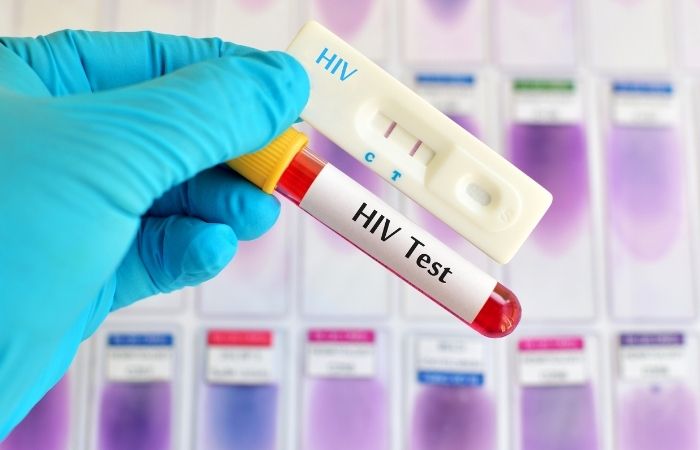
Most home HIV tests are lateral-flow immunoassays, the same general technology behind a pregnancy test. Two zones are printed on the strip: a control region (C) and a test region (T). The control line is a procedural check. If it does not appear, the test has not run correctly and the result is invalid no matter what else you see. The test line is where the actual HIV-antibody signal shows up.
Manufacturers print bold reference photos on the instructions, but real-world test lines can be faint, pink, or hard to see in low light. The chemistry is binary in one important sense: if there is any visible colored line in the test region and the control line is also present, the test has reacted to something in your sample. The strength of the line reflects the amount of HIV antibody bound to the strip; it does not change the basic interpretation. Brand-specific instructions always trump general rules, so read them once before you trust a borderline read. The table below summarizes the most common patterns and what to do next.
| Line pattern | What it usually means | What to do next |
|---|---|---|
| Control line only, no test line | Likely non-reactive (negative) | If you may still be in the window period, plan a repeat at 45 days |
| Control line plus bold test line | Likely reactive (positive) | Arrange a confirmatory lab test through a clinic or telehealth provider |
| Control line plus faint test line | Reactive, needs follow-up | Treat as positive until confirmed; book a confirmatory blood test |
| No control line | Invalid test | Discard and retest with a new kit |
| Smudged or unclear lines | Inconclusive | Read in good light, retest if still unclear |
How an HIV rapid test actually works
Most home HIV kits use a fingerstick blood sample, though some use oral fluid. You apply the sample to the cassette, add the buffer drops, and the liquid wicks along the strip toward the result window. Embedded in the strip are antibodies pre-loaded with a colored marker. If HIV-specific antibodies are present in your sample, they form a sandwich between the colored marker and a fixed line of HIV antigen in the test zone. That sandwich is what you see as the test line. The control line uses a separate binding chemistry that should react with the buffer alone, which is why a missing control line means the test failed.
Sensitivity to low antibody levels varies by manufacturer. Early in an infection, antibody titers can be just barely above the kit's detection threshold, and the test line color stays light. This is one reason a faint line is still meaningful: the chemistry is reacting, just less intensely than it will once antibody levels rise. At-home rapid tests are lateral-flow chemistry. Laboratory tests use higher-sensitivity methods like 4th-generation antigen/antibody immunoassays and HIV RNA detection, so confirming a home reactive result at a lab means running a more sensitive tool against the same question. The two technologies work as a screen-and-confirm pair, with the lab test adding analytical certainty the rapid test cannot deliver on its own.
Why a faint line might appear
A few mechanisms produce faint lines, and they are not all equally common. The most clinically important one is early infection. Antibodies take roughly three to six weeks to appear in most people after HIV exposure, and the antibody level then climbs steadily over the following weeks. A reactive line during that climb can be much fainter than the same person's test result would look two months later. People on early antiretroviral treatment or with a weaker antibody response can also show lighter lines.
The rest of the reasons are technical. Low sample volume produces less signal across the strip. Reading the cassette outside the manufacturer's time window (typically 15 to 30 minutes) can produce light lines that have not fully developed yet, or evaporation marks that look like lines but are not. Kits that have been stored above room temperature or used past their expiration date can give weak or unreliable reads.
Biological: Early in an HIV infection, antibody levels are just above the kit's detection threshold, so the test line color stays light. The same person's test would look bolder two months later.
Technical: Low sample volume, an expired kit, heat damage, or reading outside the timing window can all produce lighter test lines. Either way, treat the visible line as a prompt for a confirmatory lab test.
Common reading mistakes
The most frequent mistakes happen at the edges of the timing window. Reading the cassette before the test fully develops can show a ghost line that fades; reading it an hour later can show evaporation patterns that were not there at the proper read time. Both are easy to avoid by following the specific kit's instructions, which typically give a 15 to 30 minute read window.
Storage matters too. Heat exposure, like a kit left in a hot mailbox or a car glove box in summer, can damage the reagents or partially evaporate the buffer. If the packaging arrives damaged, if the buffer bottle looks underfilled, or if the cassette feels wet inside its foil, set it aside and use a fresh kit. The troubleshooting table below covers the most common technical issues and what to do about them.
| Issue | What it does to the result | What to do |
|---|---|---|
| Read before the time window closes | Test line may not fully develop | Wait the full time, or retest |
| Read after the time window | Evaporation lines may appear | Treat as invalid; retest |
| Expired or heat-damaged kit | Chemistry may not work correctly | Use a new, in-date kit kept at room temperature |
| Sample volume too small | Weak or absent test line | Retest using the recommended fingerstick volume |
When to test, and when to retest
The window period is the time between an exposure and when a test can detect HIV. It varies by test technology. Most at-home rapid antibody tests can detect HIV roughly 23 to 90 days after exposure, with the majority of infections detected by day 45. Newer lab-based combination tests that look for both the p24 antigen and antibodies can pick up HIV earlier, often around 18 to 45 days after exposure. RNA tests (also called NAAT), the most sensitive option, can detect HIV as early as 10 to 33 days after exposure but are rarely used as a first-line screen.
If your at-home rapid test is non-reactive within four weeks of a possible exposure, plan a repeat at 45 days, by which point most 4th-generation lab tests would also be conclusive. For full reassurance with a rapid antibody test, the window extends to 90 days, and a clinician may recommend testing at both 45 and 90 days for higher-risk exposures. A reactive result, whether faint or bold, should not wait for the window-period clock; book a confirmatory lab test as soon as you reasonably can. For routine screening between exposure events, the CDC recommends at least annual HIV testing for anyone with ongoing risk factors, more often for higher-risk groups.
Disclosure: stdrapidtestkits.com sells at-home rapid lateral-flow test kits for the infections discussed in this article. Product recommendations below are based on fit for the reader's concern, not commercial benefit.
How accurate are at-home HIV rapid tests
At-home HIV rapid tests use the same lateral-flow chemistry as professional point-of-care rapid tests. When used within the correct window period, reported sensitivity (the test's ability to catch a true infection) is between about 92 and 99 percent depending on the kit and sample type, and specificity (the test's ability to correctly identify someone who is not infected) is consistently above 99 percent for most CE- and FDA-marked products. That means a reactive result is highly likely to be a true positive. A non-reactive result close to an exposure cannot rule out HIV by itself; that is what the window-period retest is for.
It helps to compare the at-home rapid test with the lab options. Lab antibody and antigen/antibody combination tests reach sensitivity at or above 99 percent within their own window period. RNA testing, used for very early detection or in newborns, is the most sensitive option available. Screen at home first for speed and privacy, then confirm at a lab when a reactive result needs a definitive answer.
| Test type | What it detects | Reported sensitivity in window | Window period |
|---|---|---|---|
| At-home rapid antibody test | HIV antibodies | About 92 to 99 percent | 23 to 90 days |
| Lab antibody test | HIV antibodies | 99 percent or higher | 18 to 45 days |
| 4th-gen antigen/antibody combo (lab) | p24 antigen plus antibodies | 99 percent or higher | 18 to 45 days; some detect as early as 14 days |
| HIV RNA (NAAT) | Viral RNA | About 99.9 percent | 10 to 33 days |
What to do if your test reads positive
A reactive home test is not a final diagnosis. Every positive home result needs confirmatory testing through a clinic or lab, typically a 4th-generation antigen/antibody test followed by an HIV-1/HIV-2 antibody differentiation immunoassay and, if needed, an HIV RNA test. This sequence is the CDC's recommended diagnostic algorithm, and it is what moves you from "this kit reacted" to a clear, reliable answer.
If the confirmatory test comes back positive, modern HIV treatment is highly effective. Antiretroviral therapy started early can bring viral load to undetectable levels within months, and both the U.S. National Institutes of Health and the CDC confirm that an undetectable viral load means HIV is not transmitted sexually (Undetectable = Untransmittable, or U=U). Same-day-start treatment is now widely available in many U.S. jurisdictions, which makes a reactive home test less of a verdict and more of an entry point into care.
If you test in a community program or take an HIV self-test and it's positive, you should go to a health care provider for follow-up testing.
Trusting the result and verifying when needed
If you followed the instructions, used an in-date kit, collected the right sample volume, and read within the time window, your result is likely accurate. If anything felt off (damaged packaging, slow buffer flow, a line that came out only under angled light), it is reasonable to run a fresh kit before drawing conclusions. There is no medical reason to defer to a single ambiguous result if a clean repeat would give you a clearer picture.
A second test does not need to be the same product, either. Many people verify a reactive home test with a clinic-administered 4th-generation lab test, which is both more sensitive in early infection and quicker to turn around than a mail-in panel. If you are unsure where to go, most telehealth providers can issue a same-week lab order for HIV confirmation, and many U.S. health departments offer free or sliding-scale lab testing.

Disposal, privacy, and support after the test
The used cassette, the lancet, and the buffer tube can be wrapped in paper or a sealed bag and disposed of as household waste. Used lancets are sharps; some kits include a small sharps container, or you can seal the lancet in a hard plastic bottle before tossing it. Local rules vary, but the components are not biohazardous in the regulatory sense once the small blood sample has dried on the strip.
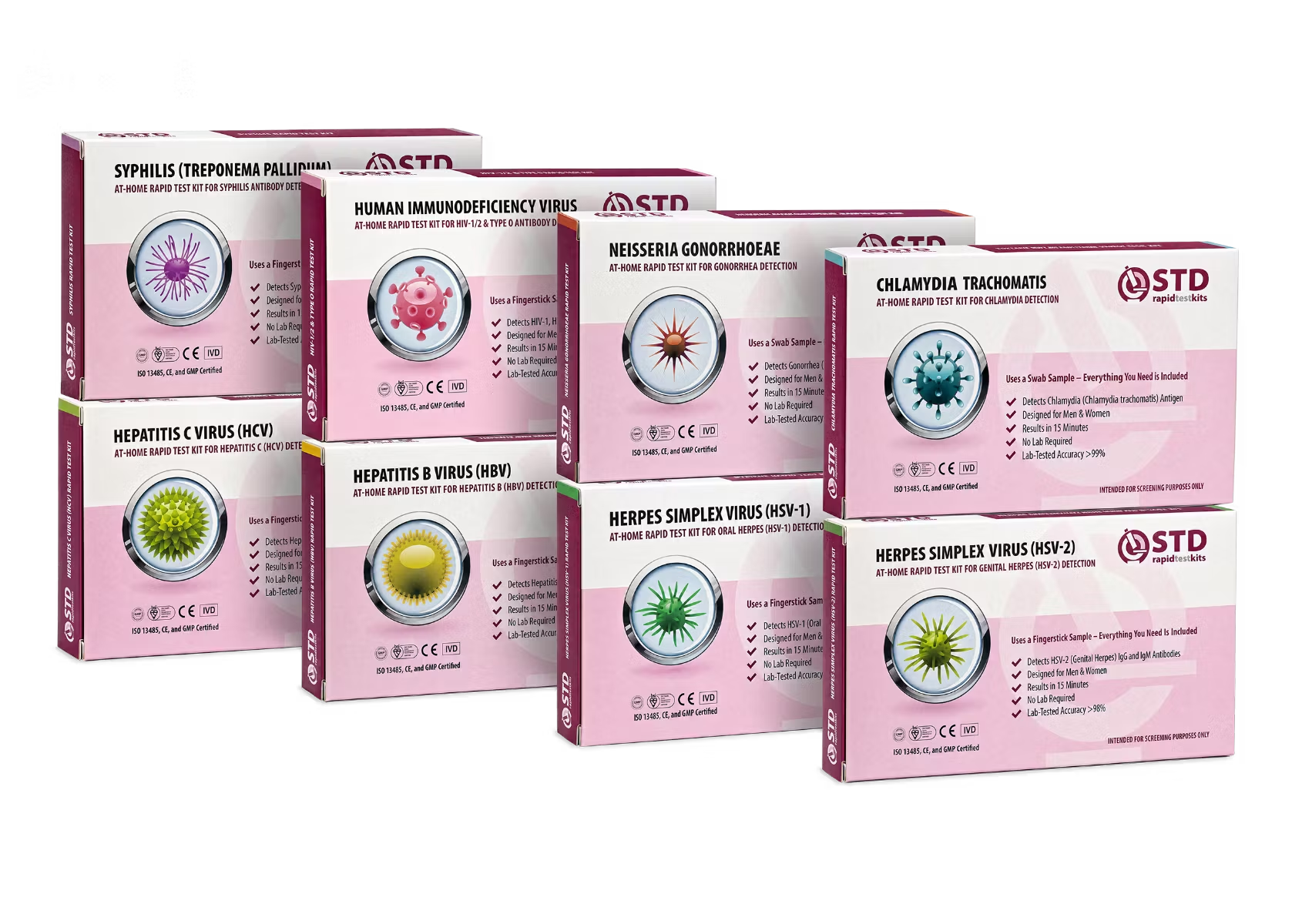
Privacy is a real concern for many readers, and self-testing exists in part for that reason. Most at-home HIV kits ship in plain packaging with no condition labels, the credit-card descriptor avoids the words "HIV" or "STI," and confirmatory care can usually be arranged through a telehealth provider without an in-person referral. If you tested reactive, holding onto the cassette for a few days is fine but not required; the lab will run its own draw rather than retesting the home strip. Many readers also find that a combined-panel test makes sense when one exposure event raises questions about more than one infection, since HIV often gets tested alongside syphilis and viral hepatitis.
Reading your test with confidence
A faint line means the test reacted to something in your sample, and a confirmatory lab test is the appropriate next step. Whether the line is bold or barely visible, the workflow is the same: read within the time window, treat any visible test line plus a present control line as reactive, and follow up with a clinician for the gold-standard confirmation. A clear non-reactive result close to a possible exposure earns the same respect: schedule a repeat at the appropriate point in the window period.
The hardest moment with an at-home test is often the few minutes between seeing the result and deciding what to do. The protocol is simpler than the moment suggests, and the callout below summarizes the three branches.
If your test is reactive (any visible test line plus a control line): Book a confirmatory lab test through a clinic or telehealth provider as soon as you reasonably can.
If your test is non-reactive within four weeks of exposure: Plan a repeat at 45 days, with a 90-day retest if the exposure was higher-risk.
If the control line is absent: The test is invalid. Discard the cassette and retest with a fresh kit.
FAQs
- Does a faint line on my HIV rapid test mean I am HIV positive?
- A faint but visible line in the test region, when the control line is also present, is treated as a reactive (positive) result. The line is reacting to HIV antibodies in your sample, which is meaningful even when it is light. Treat the result as a prompt to book a confirmatory lab test, typically a 4th-generation antigen/antibody test arranged through a clinic or telehealth provider. The home kit finds the signal; the lab test delivers the definitive answer.
- Why does the test line only show up when I tilt the cassette under a lamp?
- Faint lines can be subtle, especially in low or yellow indoor light. If a colored line is visible in the test region from any angle and the control line is present, the test has reacted. Re-read the cassette under cool, even daylight or a bright neutral lamp. If you still see a line, treat the result as reactive and arrange a confirmatory lab test.
- Could a faint line on a home HIV test be a false positive?
- False positives can occur but are uncommon for FDA- or CE-marked at-home HIV tests, which usually report specificity above 99 percent. Storage problems, expired kits, or rare cross-reactivity in the sample can produce a reactive result that is not actually HIV. That is exactly why a single home reactive result is always confirmed with a more sensitive lab test before any clinical decisions are made.
- I read my test more than an hour after running it and saw a faint line. Does that count?
- Probably not. Most HIV rapid tests are only valid for 15 to 30 minutes after the buffer is added. Lines that appear well after the read window are typically evaporation artifacts rather than true antibody signal. If you read the cassette late, the safer move is to run a fresh kit and read it within the manufacturer's specified time window.
- Can medications or alcohol affect an HIV rapid test result?
- Common over-the-counter and prescription medications do not interfere with HIV antibody chemistry. Alcohol does not change the underlying antibody response either, though being impaired during the test can lead to procedural mistakes (wrong sample volume, misreading the timer). If you are uncertain whether you followed the instructions correctly, run a clean repeat when sober.
- What if I tested very soon after a possible exposure?
- A non-reactive result in the first 23 days carries little weight, because you are still inside the antibody-detection window for most home kits. If you have fever, fatigue, sore throat, or rash within a few weeks of exposure, a lab antigen/antibody test or RNA test can pick up HIV earlier than a home kit can. For a routine retest, plan a repeat at 45 days, with a 90-day retest if the exposure was higher-risk.
- The control line did not appear. What went wrong?
- If the control line does not show, the test is invalid no matter what else you see in the test region. Common causes are insufficient sample volume, buffer that did not flow correctly, or a damaged or expired kit. Discard the cassette and retest with a fresh kit. If the second kit also fails to show a control line, contact the manufacturer or supplier; the batch may be defective.
- I cannot afford a follow-up confirmatory test. What are my options?
- Many U.S. health departments offer free or low-cost confirmatory HIV testing, often with same-day appointments. Federally qualified health centers, Planned Parenthood, and LGBTQ+ community clinics in larger cities frequently offer free testing as well. Some telehealth providers can issue a lab order for a confirmatory test at sliding-scale pricing. The HIV.gov locator tool and the CDC's testing finder can both point you to nearby free or reduced-fee options.
How we sourced this article: Our article was constructed based on current advice from the most prominent public health and medical organizations, including the U.S. Centers for Disease Control and Prevention, the World Health Organization, the U.S. National Institutes of Health, Mayo Clinic, and Cleveland Clinic. We translated that guidance into plain-English action items for at-home test users, and cross-checked each numeric claim (window periods, sensitivity ranges, confirmatory algorithm) against the cited sources.
- U.S. Centers for Disease Control and Prevention. HIV testing overview, window periods, and self-testing guidance.
- World Health Organization. HIV and AIDS fact sheet: testing recommendations and global epidemiology.
- U.S. National Institutes of Health, HIVinfo. HIV testing fact sheet, including window periods and test types.
- Mayo Clinic. HIV/AIDS overview: symptoms, causes, and diagnostic context.
- Cleveland Clinic. HIV testing: types, how often, what to expect, and result interpretation.
- U.S. Centers for Disease Control and Prevention. Treating HIV, including viral suppression and Undetectable = Untransmittable (U=U).
