

Published: August 2025 | Last updated: April 2026 | Editorial review and quality control: Martina N.
There is a quiet pattern in men's sexual health, and it is not biological. A large share of new chlamydia diagnoses in the United States happen in people who never noticed symptoms. The same goes for most pharyngeal and rectal gonorrhea cases, the early stage of syphilis, and the first weeks of HIV. The body stays silent. The mind fills the gap with a story that goes something like, 'if it were really wrong, I would know.' That story keeps testing rates lower than they should be and transmission rates higher than they need to be. This article walks through why men delay testing, what the silence costs, and what a routine, private testing habit looks like in 2026.
Why do so many men avoid STI testing even when they have access?
Roughly 70% of chlamydia infections in men cause no symptoms per CDC surveillance, so 'I feel fine' is not a reliable status check. Three additional pressures stack on top of biology: cultural scripts around masculinity that treat asking for medical help as weakness, stigma that recodes testing as a confession of past behavior, and the persistent 'I would know if something were wrong' myth. None of these reflect what testing is; it is closer to a routine dental cleaning than to a moral verdict.
Key Takeaways
- About 70% of chlamydia infections in men cause no symptoms per CDC surveillance, so screening is the only reliable way to know your status.
- Most common STIs are curable or highly manageable when caught early; the cost of waiting is rarely the diagnosis itself but what untreated infection does over the silent months.
Why most STIs in men show no symptoms
The biology of a sexually transmitted infection rarely matches what people picture. Most pathogens that spread sexually have evolved to live in the body quietly, because a host who feels fine keeps having sex, and a host who keeps having sex keeps the infection moving. Loud symptoms are the exception, not the rule.
Chlamydia is the clearest example. CDC surveillance data indicate that around 70 percent of chlamydia infections in men produce no symptoms, and the asymptomatic share is even higher in women. Gonorrhea in the urethra is more likely to cause discharge and painful urination, but a meaningful proportion of urethral cases are silent, and pharyngeal or rectal gonorrhea in men is silent more often than it is symptomatic.
Syphilis is famously unreliable as a self-detector. The primary chancre is painless, often hidden inside the mouth, under foreskin, or in the rectum, and resolves on its own within three to six weeks even without treatment. The infection has not gone away; it has moved into a longer, quieter phase.
HIV's earliest stage, called acute retroviral syndrome, looks like the flu (fever, sore throat, fatigue, swollen lymph nodes), and a meaningful percentage of newly infected people either skip the symptom window entirely or chalk it up to an ordinary virus. Antibodies and antigens also do not show up on a test the day after exposure, which is the testing window discussed below.
Chlamydia, pharyngeal gonorrhea, and early-stage syphilis typically produce no symptoms in men. Most positive results come from routine screening visits or partner notification, not from a man walking into a clinic with a complaint.
Where the silence comes from: shame, stigma, and masculinity scripts
Public-health researchers have studied this question for decades, and the answer keeps coming back as something more cultural than logistical. Reviews of perceived stigma have found that fear of judgment, especially from a clinician or a partner, is a stronger predictor of delayed testing than the absence of nearby clinics or insurance gaps.
For men, the fear runs through several overlapping channels. The broader cultural script treats medical care as something men do reluctantly and only when bleeding heavily; routine preventive visits, dental cleanings, mental-health checks, and STI screening fall in the same 'optional' bucket, even when they are not. Sexual health also carries a moral charge that other preventive care does not. Getting a flu shot is responsible. Getting an STI test, in many men's heads, gets recoded as evidence of past behavior they would rather not name. The clinic visit becomes a confession instead of a checkup.
Language does the rest. Calling an infection a 'disease' (the older STD framing) carries more blame than calling it an infection (the newer STI framing the CDC adopted in 2023). Asking 'were you with someone else?' lands very differently from asking 'when were you last tested?' Words shape how willing people are to schedule the next appointment.
None of this is about individual men being lazy or careless. It is a stack of cultural defaults that quietly makes the path of least resistance 'wait and see.' Recognizing the stack is the first step in working around it.
Published by stdrapidtestkits.com, which sells at-home STI testing kits. We recommend products based on fit-for-purpose for the reader's specific concern, not commercial benefit. Where the right test for your situation is a clinic-administered swab or a lab-processed panel, we say so plainly.
The myth that does the most damage: 'I would know'
Of all the stories that delay testing, this one is the most common and the most expensive. The body, by this logic, is supposed to throw an alarm if something is wrong, and silence is supposed to mean safety.
Reality runs in the other direction. The CDC surveillance numbers cited above show majorities of common STIs going undetected by feel alone in men. Most positive tests come from screening visits or partner notification, not from a man walking into a clinic with a complaint. Per the WHO STI fact sheet, more than one million curable STIs are acquired globally every day, and the majority are asymptomatic.
The cost of waiting for a symptom that never arrives shows up in three ways:
- Untreated chlamydia and gonorrhea progress in men to epididymitis (painful inflammation of the epididymis at the back of the testicle) and, less commonly, can affect fertility. They also continue to circulate among partners during the silent months.
- Untreated syphilis moves through latent phases that can last years before late-stage complications appear in the cardiovascular or nervous system. The window when treatment is simplest, a single intramuscular injection of benzathine penicillin, closes quietly.
- Untreated HIV without modern antiretroviral therapy progresses, but more importantly the period of highest transmission risk is the first weeks of infection, exactly the window when most people feel fine. Knowing the diagnosis early flips that risk curve down and turns HIV from a transmission hazard into a managed chronic condition.
Worth noting on that HIV point: the same early window when transmission risk peaks is also the window before home antibody tests can reliably detect it. A 4th-generation antigen-antibody test at a clinic offers earlier detection than a home antibody test for that specific exposure window.
When testing shows accurate results: timing windows
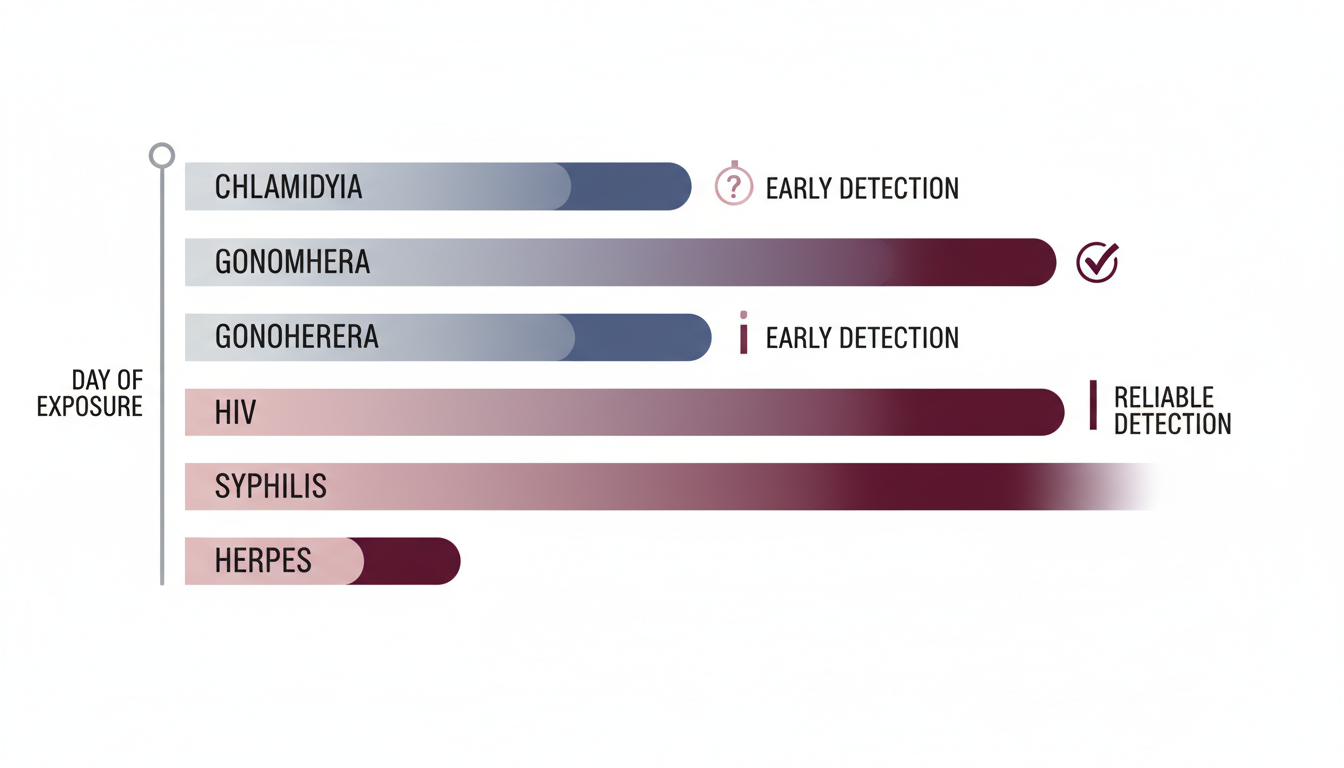
One reason to test early is so you can act on the result. One reason not to test too early is that the result will not be reliable yet. The gap between exposure and reliable detection is called the window period, and it differs by infection and by assay technology.
The general principle: bacterial STIs (chlamydia, gonorrhea) clear the window fastest because they show up directly in samples taken from the affected site. Viral infections (HIV, hepatitis B and C, herpes) take longer because most home and clinic tests look for antibodies, which take weeks to develop after exposure. Syphilis sits in the middle, with detection by treponemal antibody beginning around three to six weeks per CDC's STI clinical guidance.
If you tested very soon after a possible exposure and the result was negative, that is not a definitive negative. It is a snapshot. Schedule a retest at the recommended interval below. Retest sooner if symptoms develop in the meantime, and any time a new partner enters the picture.
| Infection | Earliest reliable test | Definitive retest |
|---|---|---|
| Chlamydia (urethral or rectal swab) | About 14 days post-exposure | 4 weeks if symptoms appear |
| Gonorrhea (urethral, rectal, or pharyngeal swab) | About 14 days post-exposure | 4 weeks if symptoms appear |
| Syphilis (RPR / treponemal antibody) | 3 to 6 weeks | 12 weeks for full clearance |
| HIV (4th-generation antigen-antibody) | 18 to 45 days | 90 days for definitive negative |
| HSV-2 (IgG antibody, blood) | 6 to 12 weeks | 16 weeks if testing very early |
Why being in a relationship does not replace testing
A common pattern in clinic intake notes: a man in a relationship of six or twelve months who has never been tested, because the relationship is monogamous and 'we both said we were clean before we started.' The relationship is doing the work that a baseline test should have done at the start.
Even a genuinely honest testing history before a new relationship has gaps, and none of the gaps require either partner to have been dishonest. If either partner tested within days of leaving their previous relationship, that test was probably too early to detect HIV, syphilis, or HSV reliably; a negative inside the window does not retire the question, it just postpones it. Long-standing chlamydia in some patients, and HSV-2 in either sex, can also carry forward silently for years from a prior partnership. Then there is the everyday pragmatic stuff: the brief separation that nobody felt like discussing, the partner who is honest now but was sleeping with someone else two years ago without realizing they had picked something up.
None of this is about blame. It is about the quiet realities that make a baseline test at the start of any new exclusive relationship a small kindness to both people. Test once at the start of the relationship, and again at any recognized reset point.
What private STI testing actually looks like in 2026
The practical objections that used to keep men out of testing have shrunk considerably in the last five years. The clinic visit (waiting room, intake form, hand-delivered urine cup, follow-up call from a number you cannot avoid) is no longer the only option, and for many readers it is no longer the most accessible one.
Three options now exist, each with a sensible use case.
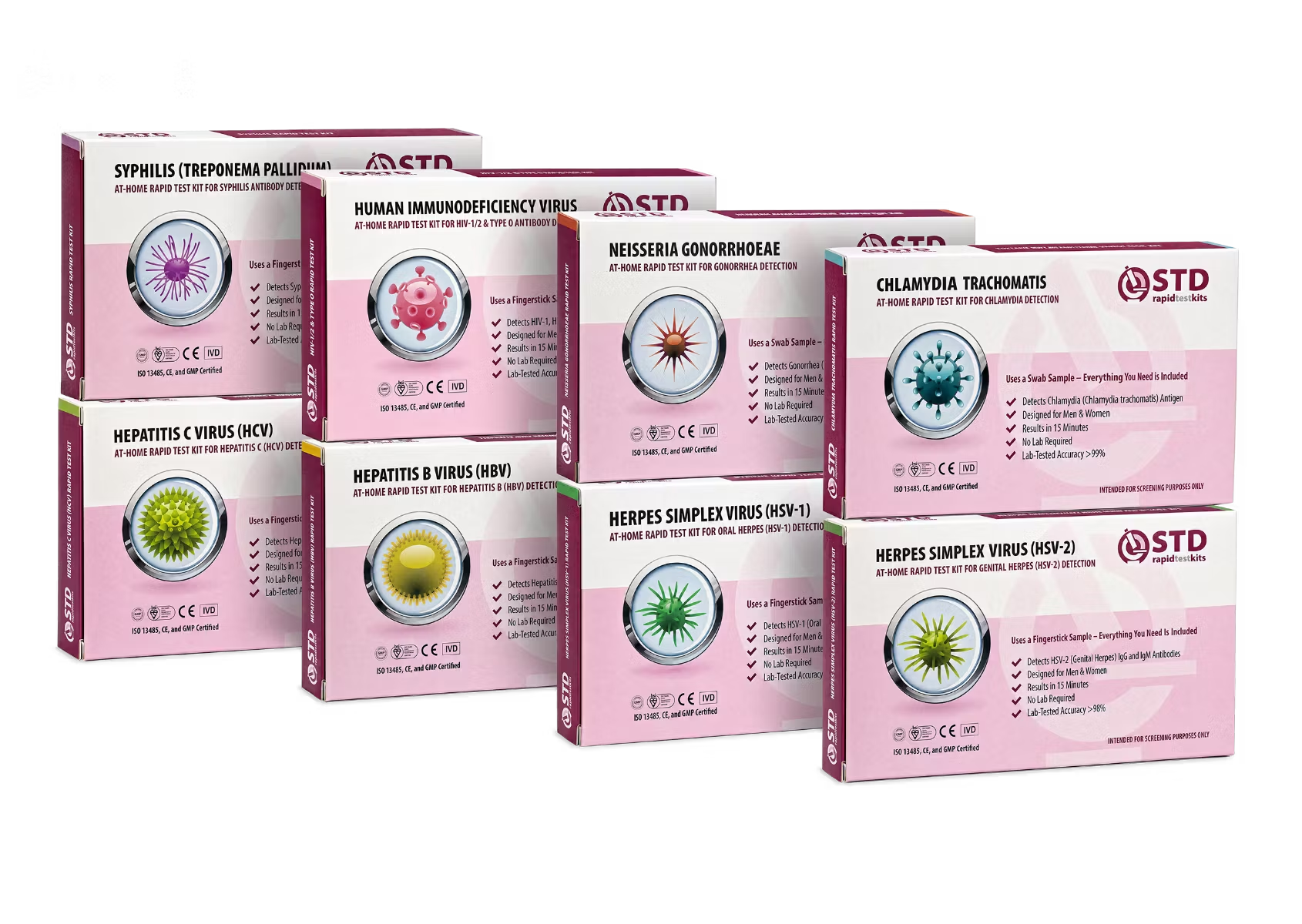
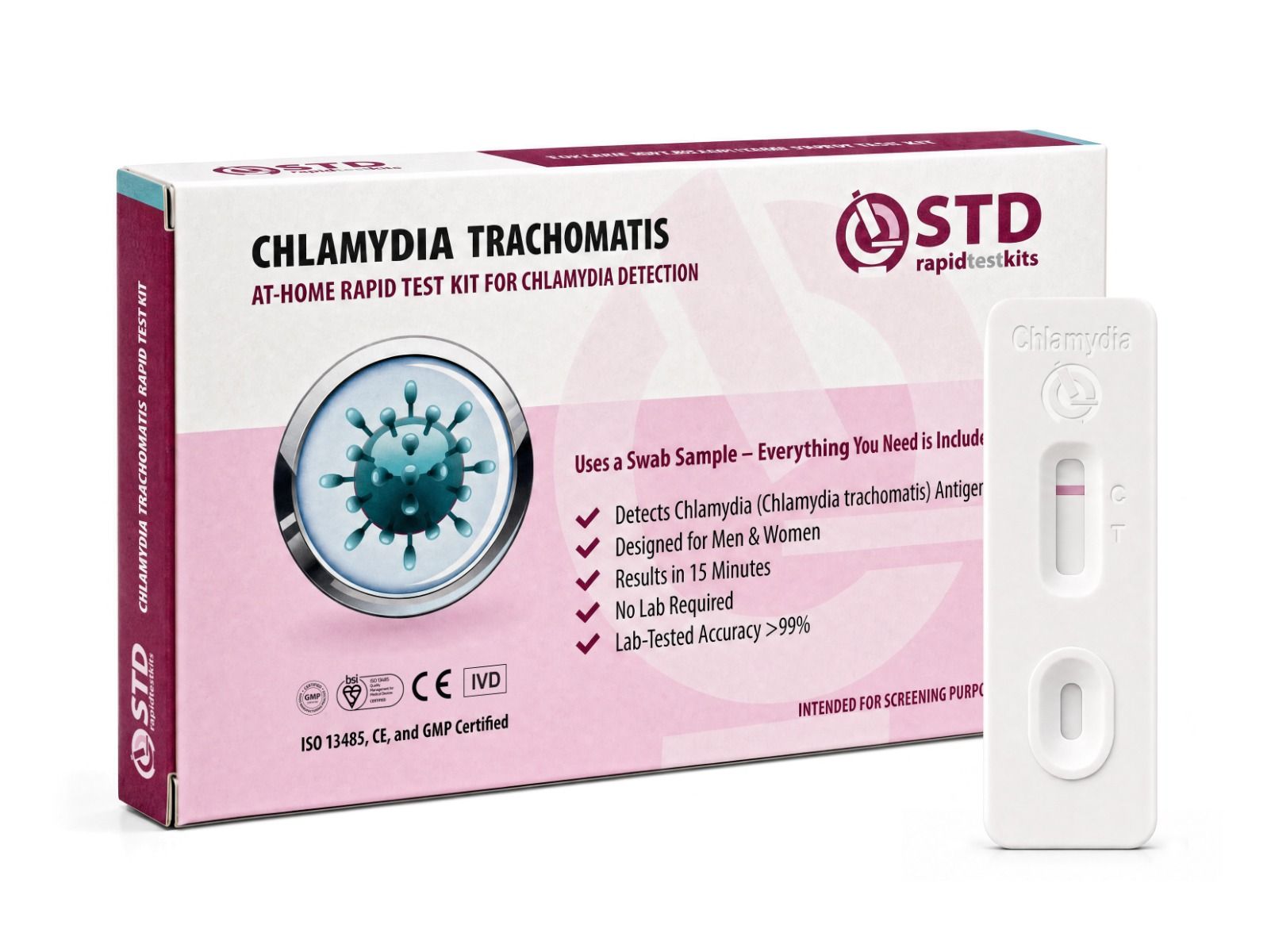
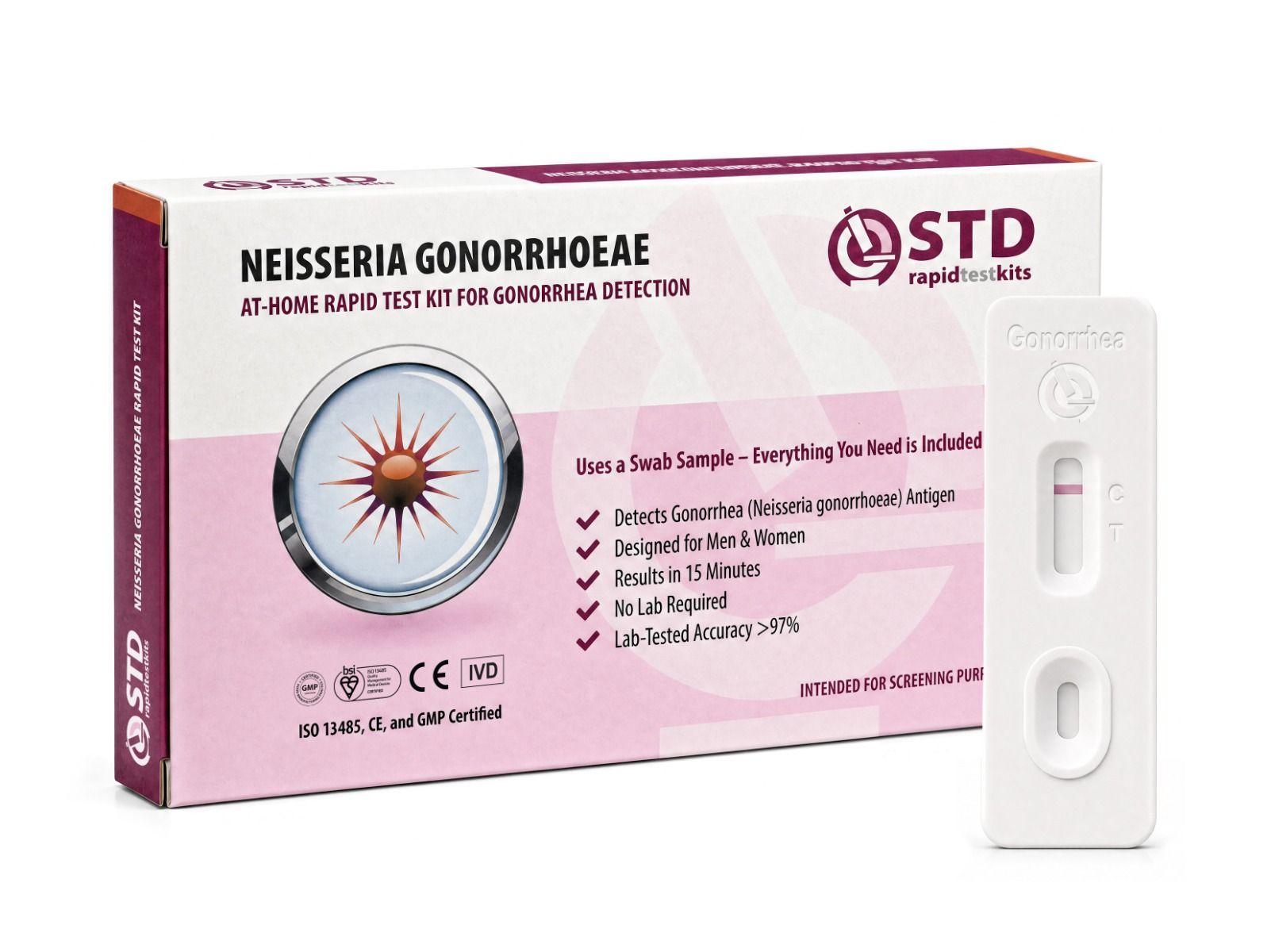
At-home rapid lateral-flow tests use the same swab or fingerstick sample type that a clinic would collect for a screening visit. You collect the sample yourself, follow the printed instructions, and read the result on the cassette in fifteen to thirty minutes. They are useful for screening (the answer to 'do I need to follow up with a clinic') and for routine quarterly checks if you are sexually active with new partners. A positive home result is worth confirming with a lab NAAT when possible.
At-home mail-in panels collect a sample at home, ship it to a contracted lab, and return results to a secure portal in a few days. Higher analytical sensitivity than a rapid lateral-flow test, but slower and more expensive.
Clinic-administered tests remain the gold standard for someone with active symptoms, a known exposure to a specific infection, or a positive home-test result that needs confirmation. Pharyngeal and rectal swab tests are clinic-only because we (and most home-test brands) do not sell those kits.
Privacy in 2026 is not a single product; it is a layered choice. Pick the layer that matches your specific question. Under HIPAA, protected health information from any clinic-administered STI test is not shared with employers, insurers that did not pay for the test, or anyone else without your written permission. At-home test results that you read on the cassette yourself never leave your house unless you choose to share them.
When a partner refuses to test
The trickiest situations are not the ones where you decide to test on your own. They are the ones where you bring it up and the conversation goes sideways. A partner who feels accused, a partner who treats the question as evidence of distrust, or a partner who simply does not see the point.
Leading with shared care rather than suspicion changes the tone immediately. Saying you want both of you to test as part of where the relationship is lands very differently from asking someone to prove something. Separating the request from any relationship verdict helps too; wanting a baseline panel is not an accusation of infidelity, and saying so out loud usually takes the heat out of the conversation. Some partners will still refuse. That refusal is information about the relationship rather than something to negotiate around.
Your sexual health belongs to you. Bringing a partner into the testing conversation when you can is the first preference; testing on your own when you cannot is the right backup.
- Lead with shared care: 'I want both of us to test as part of where we are.'
- Separate the request from any verdict: 'A baseline panel is not an accusation of infidelity; asymptomatic carry-forward from prior relationships is common.'
- Treat refusal as data: a flat refusal, especially with anger or mockery, is information about the relationship rather than something to keep negotiating.
If a result comes back positive: next steps
This is the section most articles skip, and it is the one that quietly drives the most avoidance. The fear of a positive result is usually larger than the consequences of one, because the imagined future is generic and the real future is specific.
Bacterial STIs (chlamydia, gonorrhea, syphilis) are curable. Treatment is short, often a single dose of antibiotics or a one-week course. The CDC's STI treatment guidelines provide the exact regimens, and any clinic or telehealth STI service uses them. There is no permanent record, no employer notification, no insurance flag in any state. The infection clears, you complete a follow-up test, and the chapter closes.
HIV is the diagnosis people fear most, and modern medicine has changed it the most. With antiretroviral therapy, viral load suppresses to undetectable in most patients within months. Undetectable equals untransmittable (the U=U finding from the PARTNER and PARTNER2 studies, now reflected in CDC guidance). Life expectancy on treatment approaches that of HIV-negative peers. The diagnosis is no longer the prognosis it was thirty years ago.
Genital herpes is lifelong but mild for most people, with antivirals available for outbreak suppression and partner-protection regimens. The majority of HSV-2 carriers have minimal or no recurrent symptoms after the first year.
Partner notification is where most people feel stuck. State health departments offer anonymous-notification services that contact past partners on your behalf, and Planned Parenthood and similar organizations publish structured conversation guides for the version you handle yourself.
More than one million curable sexually transmitted infections are acquired every day worldwide, the majority of which are asymptomatic.
How to talk about testing without making it weird
The tone you set in the testing conversation, with a partner, with a friend, even with yourself, has a measurable effect on whether testing happens routinely or only after a scare. A few small linguistic shifts go a long way.
Use STI instead of STD. Infections are biological events; diseases carry more moral weight in everyday speech. The newer term is also more accurate, since most STIs are infections that may or may not progress to disease.
Replace 'are you clean?' with 'when did you last test?' The question 'are you clean?' carries a moral charge that a routine health question should not; it arrives as judgment rather than logistics. The dating-app convention of 'I tested last month, results in my profile' moves the conversation from accusation to logistics.
Drop 'risky behavior' and 'one-night stand' framing in your own internal monologue. Sexual activity is just sexual activity; routine testing is part of taking care of your body, the same way bloodwork is. The framing matters because internal stigma shows up later as delay.
Tell at least one peer that you test routinely. Normalizing it inside your own social circle does more for testing rates than any public-health campaign.
FAQs
- Can I have an STI and feel completely normal?
- With most STIs, the body gives no useful signal. CDC surveillance shows roughly 70 percent of male chlamydia carriers notice nothing; pharyngeal gonorrhea and early HIV follow the same pattern. What you feel reflects how your immune system is responding right now, not whether you carry an infection. Routine screening fills that gap.
- How often should sexually active men get tested?
- CDC's general guidance is at least once a year for any sexually active person, and every three to six months for men with multiple partners or new partners since the last test. Men who have sex with men should follow the more frequent CDC screening cadence (every three to six months) including pharyngeal and rectal sites, which are clinic-only sample types.
- Is at-home testing actually accurate?
- Rapid lateral-flow at-home tests use the same sample type a clinic would collect for screening, but the chemistry is lateral-flow rather than the lab NAAT used in formal diagnostic confirmation. Sensitivity is high enough for routine screening, particularly for confirmed exposures; lab NAAT reaches higher analytical sensitivity for lower-load or early-window infections, so a positive home result is worth confirming with a lab NAAT when possible. Negative results inside the testing window are not definitive.
- If I test, will my employer or anyone else find out?
- No. STI testing in the United States is protected health information under HIPAA, whether the test happens at home or in a clinic. Results are not shared with employers, insurance companies that did not pay for the test, or anyone else without your written permission. At-home test results that you read on the cassette yourself never leave your house unless you choose to share them.
- What is the difference between a rapid home test and a lab NAAT?
- A NAAT (nucleic acid amplification test) detects the bacteria's or virus's genetic material directly in a lab and is the analytical gold standard. A rapid lateral-flow home test detects either the pathogen's surface proteins (for bacterial STIs) or the body's antibodies to the pathogen (for viral STIs) on a strip you read at home. Lab NAAT has higher analytical sensitivity, especially for low-load infections; home rapid tests trade some of that sensitivity for speed, privacy, and lower cost. The two are complementary, not equivalent.
- Is it safer to wait until I have symptoms before testing?
- No. Waiting for a symptom that may never arrive lets the silent months continue, both for your own untreated infection and for any partners during that time. Routine screening at recommended intervals catches the infections that the body is not signaling about, which is the majority.
- What about pharyngeal (throat) or rectal STI testing?
- For pharyngeal swab or rectal swab testing, see a clinic. We do not sell those at-home kits. The genital swabs and blood-based panels we do sell cover the urethral and bloodwork screens that account for most positive results in routine practice for men.
- What should I do if a home test comes back positive?
- First, do not panic; second, confirm with a clinic-administered lab NAAT or with a telehealth STI service that orders the confirmatory test. The clinic also handles treatment, which is typically a single antibiotic dose for chlamydia and gonorrhea, an injection for syphilis, or initiation of antiretroviral therapy for HIV. Partner notification can be handled through state health-department services that contact past partners anonymously if you prefer not to do it yourself.
The bottom line
Most of what stops men from testing has nothing to do with whether testing is available. It has to do with the story they tell themselves about what testing means. The story is wrong. Routine STI testing is part of basic adult health care, the same way bloodwork and dental cleanings are. The body's silence is not a verdict; it is a pause that an honest test fills with information.
Testing once a year if you are sexually active, and more often if you have new partners or symptoms, is the practical baseline. If a clinic feels too public, an at-home rapid test is a reasonable starting point; if a home test comes back positive, a clinic confirms and treats.
- U.S. Centers for Disease Control and Prevention. STI clinical guidance, screening recommendations, and surveillance summaries for sexually active adults, including chlamydia asymptomatic-share data.
- World Health Organization. Sexually transmitted infections fact sheet, including global daily incidence and asymptomatic-share data.
- U.K. National Health Service. Sexually transmitted infections overview and testing guidance.
- U.S. Centers for Disease Control and Prevention. HIV basics, testing windows, and treatment-as-prevention (U=U) guidance.
- Planned Parenthood. Get tested: clinic-versus-home testing options and partner-notification resources in the United States.
