
Published: September 2025 | Last updated: May 2026 | Editorial review and quality control: Martina N.
Walking into a lab or urgent care to get tested for STDs without insurance is straightforward, faster than most people expect, and considerably cheaper if you ask the right questions first. The pricing range is wide, anywhere from $29 to $400 for the same set of common tests depending on where you go, and clinics are often willing to discount further for cash payment at the time of service.
The CDC's most recent STI surveillance data recorded more than 2.2 million cases of chlamydia, gonorrhea, and syphilis in a single year, and the real number of infections is significantly higher because most carry no obvious symptoms. The only way to know is to test. If insurance is not part of that equation, self-pay is how it gets done, and the process is more accessible than most people realize. If you have already read our overview of how to get STD testing without insurance in the US, this article goes deeper on the walk-in cash-pay experience specifically.
Key Takeaways
- Commercial labs like Quest and LabCorp run $29–$379 self-pay with no consultation fee. Urgent care runs $45–$440 because a clinician visit is bundled in. At-home rapid kits start lower with no facility or consultation cost.
- Under the federal No Surprises Act, uninsured and self-pay patients can require a written Good Faith Estimate of charges before any service is rendered. Asking for one by name protects you from surprise outside-lab bills weeks later.
What "Self-Pay STD Testing" Actually Means
Self-pay, sometimes called cash-pay, means settling the bill directly with the provider at the time of service without involving an insurer. There are no claims to file, no prior authorizations, and no explanation-of-benefits statement landing in your mailbox three weeks later. For some people, that is a financial necessity. For others, it is a deliberate privacy choice: a cash-pay STD test leaves no trace on your insurance record and will not surface on a shared explanation of benefits that a spouse, employer, or life insurance underwriter might see later.
There is a piece of leverage here that most patients do not use. Clinics and labs are often willing to offer self-pay patients a discounted rate compared to what they would bill an insurance company, because insurance billing involves administrative overhead, claim delays, and the risk of partial payment. A self-pay patient is a guaranteed, immediate payment, and clinics know it. That negotiating position is yours to use.
Federal law backs you up. Under the No Surprises Act, CMS requires healthcare providers to give uninsured or self-pay patients a Good Faith Estimate of expected charges before services are rendered. The estimate is a written, itemized document listing what you will be charged for each test. It is your legal right to receive one. The vast majority of patients do not know how to ask. Ask, and ask before you fill out a single form.
- Privacy. Paying cash means no claim is filed, so the test never appears on an explanation of benefits seen by a spouse, employer, or insurance underwriter.
- Negotiating leverage. You are a guaranteed-payment customer, and clinics know it. Asking for the self-pay or panel rate often produces a 20–40% discount off the list price.
- A written estimate before you pay. The No Surprises Act requires providers to give you a Good Faith Estimate of all expected charges before service. Ask by name, and ask before you fill out a single form.
Where You Can Walk In and Pay Cash
The self-pay landscape covers several distinct settings, each with different pricing structures, speeds, and levels of privacy. Knowing the difference before you walk through a door is worth the five minutes it takes to understand.
Commercial labs. Quest Diagnostics and LabCorp are the two dominant national networks and the most cost-efficient option for most self-pay patients. Quest's direct-to-consumer platform, QuestDirect, lets you purchase a panel online and walk into one of their thousands of service centers (including locations inside Safeway and Walmart) for sample collection. There is no consultation fee. The STD Basic Screening Panel covering HIV, chlamydia, gonorrhea, and syphilis lists at around $139. The Expanded Panel adding hepatitis B, hepatitis C, and trichomoniasis runs approximately $269. Individual tests start considerably lower, with some single-infection screens at $29–$49. A small physician oversight fee of around $6 is charged on behalf of an independent provider who reviews the order; that is administrative, not a consultation visit.
Urgent care centers. Walk-in, fast, and widely distributed, with a different pricing structure worth understanding. Urgent care typically bundles a provider consultation fee into the self-pay rate, so you are paying for a clinician visit alongside the lab work even if you only want to hand over a urine sample and leave. That consultation can run $100–$200 on top of lab fees. Some chains publish tiered self-pay pricing: standard visits with up to two lab tests in the $180–$235 range, with comprehensive panels pushing toward $440. These can be reasonable deals when you also want a provider review and, at some locations, rapid in-house testing with same-visit results for chlamydia, gonorrhea, and trichomoniasis. They are rarely the cheapest option for straightforward screening, though. If cost is the primary concern, a commercial lab is usually the better starting point.
Planned Parenthood and community health centers. These operate on sliding-scale fee models tied to income and household size. A comprehensive package at Planned Parenthood can range from approximately $130 to $270 for qualifying patients, and for households below certain income thresholds, testing may be free entirely. Community health centers funded through HRSA's Health Center Program can reduce costs by 50–80% compared to private urgent care rates. These clinics see high volumes of STD screening, with experienced staff for whom this is routine care. Our breakdown of the cheapest ways to get tested for STDs in the US covers these options in more detail.
Telehealth and direct-to-consumer platforms. Services like STDcheck have carved out a useful middle ground: order tests online at published prices, a lab order is routed to a nearby Quest or LabCorp, and you collect your sample without speaking to anyone at any point. Privacy-focused payment options, including FSA/HSA cards and prepaid Visa cards, are standard. Your billing statement shows a generic company name rather than a clinic name. For people who want to test without in-person social friction, the model works well.
| Setting | Typical Self-Pay Range | Consultation Fee? | Speed |
|---|---|---|---|
| Commercial lab (Quest / LabCorp) | $29–$379 | No (physician fee ~$6) | 2–5 business days |
| Urgent care (chains) | $45–$440 | Yes, often $100–$200 | Same day (some rapid results) |
| Planned Parenthood (sliding scale) | ~$130–$270 | Included in visit | Same day or next day |
| Community health centers | $0–$100+ (income-based) | Included in visit | Same day or next day |
| Telehealth / D2C platforms | $29–$350 | No | 2–5 business days |
| At-home rapid test kits | Single kits from ~$29 · Panels from ~$99 | No | Minutes (results at home) |

What Happens When You Walk In, Step by Step
This is the part most articles skip. Here is exactly what happens at each type of location, including the moments where costs can quietly accumulate if you are not paying attention.
At a commercial lab like Quest: if you ordered online in advance through QuestDirect, show up with your order confirmation (a number on your phone is fine). At the front desk or kiosk, give your name and order number. They verify your identity with a photo ID. You will not be asked to fill out extensive medical history forms. A phlebotomist calls you back within a few minutes. Depending on what you ordered, they collect a blood draw, a urine sample, or a swab. The collection itself takes under 10 minutes. Then you leave. Results post to your secure online portal, typically within 2–5 business days. There is no clinician interaction and no discussion of your sexual history unless you initiate one.
If you walk in without ordering in advance, some Quest locations can process walk-ins directly, but not all, and pricing at the counter may differ from the online rate. The online rate is almost always lower. Order before you go.
"I'm self-pay, and I'd like a Good Faith Estimate in writing before I agree to any testing."
That one sentence anchors the entire visit. It signals you know the No Surprises Act applies to you, prompts the front desk to surface their itemized self-pay rate, and gives you a written document to compare against the eventual bill. Say it before you fill out intake paperwork.
At an Urgent Care Center
Check in at the front desk and state clearly that you are self-pay. This puts the clinic on notice that you are informed about your rights and that you will not accept a surprise bill. Some front desk staff will look mildly surprised. It is your legal right under the No Surprises Act, and they are required to comply.
You will be asked to fill out intake paperwork: name, date of birth, and reason for visit. You wait, then get called back to an exam room. A medical assistant takes vitals. A provider, typically a nurse practitioner or physician assistant, comes in to assess your situation. They will ask about symptoms and what you are looking to test for. This is the moment to be specific: name the infections you want screened for rather than saying "an STD panel." Vague requests give the provider latitude to order tests you may not need, all of which will appear on your bill.
Sample collection follows: blood draw, urine, or swab, depending on the infections being screened. If the clinic runs rapid tests in-house for chlamydia, gonorrhea, or trichomoniasis, you may have results within 30 minutes and can discuss them with the provider before leaving. HIV and syphilis are typically sent to an outside lab, with results the next day. Herpes antibody tests also go to an outside lab. That distinction matters for what you end up paying.
The Outside-Lab Trap and How to Avoid the Second Bill
The most common self-pay billing surprise is not the quoted price. It is the second bill that arrives weeks later from a lab you did not know was involved. Urgent care centers frequently process simple tests in-house but send blood work to Quest or LabCorp. You pay the urgent care its self-pay rate upfront, then a separate bill arrives from the lab. Both are legitimate. Neither was disclosed upfront unless you asked.
Before you agree to any testing at urgent care, ask: "Will any of my samples be sent to an outside laboratory?" If yes: "Which lab, and what is their self-pay rate for the tests being ordered?" Then call that lab directly. Both Quest and LabCorp publish self-pay pricing, and knowing what is coming eliminates the surprise entirely.
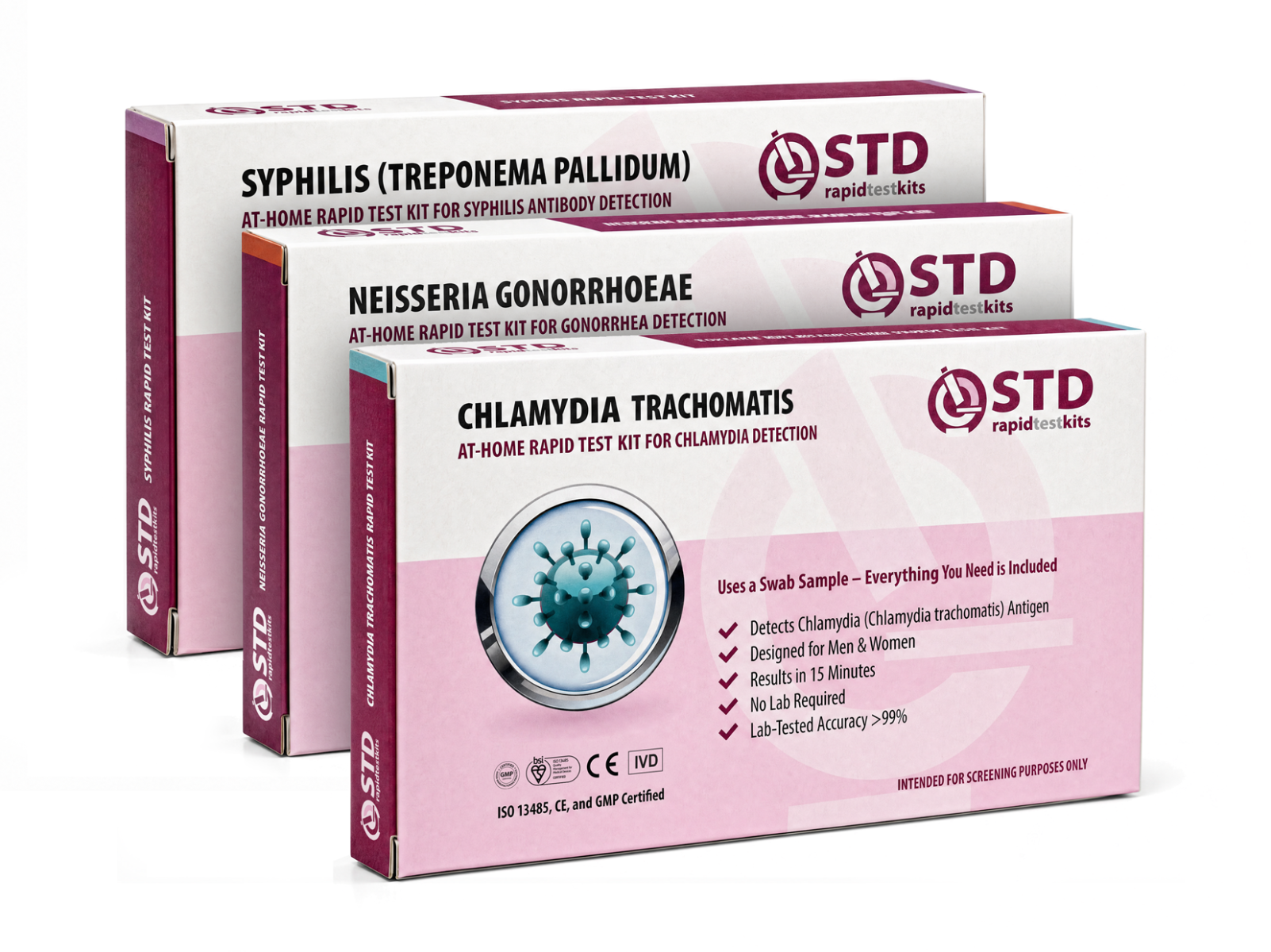
One of the clearest advantages of at-home rapid testing is the absence of this problem: no outside lab, no second bill, no hidden facility fee. The cost on the box is what you pay. Kits like the Chlamydia and Gonorrhea 2-in-1 Rapid Test Kit or the Complete 7-in-1 At-Home Rapid Test Kit use the same lateral-flow chemistry as the rapid tests urgent care runs in-house, at home, with no clinician markup. A positive result from any rapid screen is worth confirming with a lab NAAT when possible.
What Self-Pay Testing Actually Costs in 2026
The range is genuinely wide. The same tests can cost dramatically different amounts depending on where you go and what you ask for. Understanding the landscape before you commit to any location can save you $100–$200 on an identical set of tests.
At the low end, individual tests through direct-to-consumer lab services start as low as $29 for a single infection screen. A chlamydia-and-gonorrhea two-test combo through QuestDirect typically runs around $79, which makes the 4-test Basic Panel (adding HIV and syphilis) at $139 a better-value choice for anyone who would also benefit from the extra two tests. An expanded panel covering seven infections (HIV, syphilis, herpes, hepatitis B and C, chlamydia, gonorrhea, and trichomoniasis) lands in the $269–$379 range depending on the platform and scope. These prices reflect no consultation fee and no facility surcharge.
At the mid-range, Planned Parenthood's sliding-scale fee structure can land anywhere from approximately $130 to $270 for a comprehensive package, depending on income and location. For income-qualifying patients, that is a meaningful deal relative to what a private urgent care would charge for the same infections.
At the higher end, urgent care chains and hospital-affiliated clinics run $200–$440 for a full self-pay panel once the consultation fee is included. Standalone labs billing list price without any self-pay discount negotiated can theoretically exceed $1,000 for a comprehensive screen. That figure represents the worst case for a patient who asked no questions before testing.
| Test / Panel | Low End | Mid Range | High End |
|---|---|---|---|
| Single infection (e.g., chlamydia only) | $29–$49 | $75–$100 | $130–$185 |
| Chlamydia + Gonorrhea (2-test) | $49–$80 | $100–$150 | $200+ |
| HIV test | $39–$60 | $80–$120 | $150–$200 |
| Syphilis | $29–$50 | $60–$90 | $130+ |
| Basic 4-panel (Chlamydia, Gonorrhea, HIV, Syphilis) | $99–$139 | $150–$200 | $250–$350 |
| Expanded 7–8 panel | $199–$269 | $300–$379 | $400–$600+ |
| Planned Parenthood (sliding-scale package) | ~$130 | ~$200 | ~$270 |
Bundled Pricing: Why It Matters and How to Ask
The price difference between buying three individual tests and asking for a bundled panel at the same location can exceed $150. That gap exists because clinics price individual tests using inflated insurance-reimbursement rates, while panel rates are flat fees designed for cash-pay volume. Bundled pricing is widely available, rarely advertised, and almost never volunteered unless you initiate the conversation.
Labs set individual test prices based on historical insurance reimbursement schedules, which are artificially high because they are subject to negotiation and clawback by insurers. For self-pay patients, those list prices are often inflated relative to what the same lab charges an insurance company after contracted discounts. The panel rate, a flat fee for a defined set of tests, bypasses that list-price structure entirely. Clinics offer it because volume beats margin on individual tests, and because a cash-pay patient completing a panel visit is more predictable revenue than insurance billing on five separate line items.
Urban facilities typically charge 20–40% more than rural locations for equivalent tests. Walk-in surcharges of $25–$50 are common at clinics that also offer appointments. Scheduling rather than walking in unannounced can reduce your bill without changing a single test ordered. These are structural pricing factors that have nothing to do with the quality or scope of your testing.
Scripts for negotiating self-pay STD testing prices
When you call ahead to check pricing, say: "I'm a self-pay patient looking to get tested for [name the infections]. Do you offer a bundled or panel rate for those tests? I'd like the self-pay price before I come in." Most clinics have this rate. They simply do not put it on their website.
If the quoted price is higher than expected or higher than a competitor's, say: "I got a quote of [lower price] from [another location]. Is there any flexibility on your self-pay rate if I pay at the time of service?" Independent and non-chain urgent care centers have the most flexibility here. Cash payment on the spot eliminates accounts-receivable overhead, which is worth something to them.
If they say pricing is fixed and non-negotiable, the next question is: "Is any of the lab work sent to an outside laboratory? If so, which one, and what do they charge self-pay patients separately?" This protects you from the surprise second bill and signals that you are tracking every cost in the chain. Providers who know a patient is watching the billing tend to be more careful about what gets ordered.
If you receive a Good Faith Estimate and see a line item you do not recognize, say: "Can you explain what this charge covers? Is it required for the tests I've asked for, or is it discretionary?" Facility fees, specimen handling fees, and provider review fees all appear on GFEs. Some are unavoidable. Others are waivable at the provider's discretion, particularly at independent clinics.
One underused discount: if you have a Health Savings Account or Flexible Spending Account, STD testing qualifies as a reimbursable expense under both. Paying with pre-tax dollars reduces your real cost by your marginal tax rate. This applies to lab visits, urgent care testing, and most direct-to-consumer platforms. Price comparison tools like Healthcare Bluebook and Sesame can also show you what self-pay patients in your area are paying for specific tests before you commit anywhere.
Most providers and facilities must give a Good Faith Estimate to individuals who don't have insurance or who are not using insurance, of the expected charges for the items and services.
Testing Windows: When to Go, Not Just Where
Whether you are heading to a lab, an urgent care, or testing at home, the biology of detection windows does not change based on where you test. Testing too early produces a false negative even when an infection is present, and a false negative is worse than no test at all because it creates a false sense of clearance.
The table below lists the earliest a typical test can detect each infection and when to retest for confirmation. If you are within these windows and considering going in anyway because the anxiety is unbearable, a provider at urgent care can help contextualize a preliminary result. Make sure they document the exposure timeline so an early negative is understood as preliminary, not definitive.
| Infection | Earliest Reliable Test | Confirmation / Retest |
|---|---|---|
| Chlamydia | 14 days after exposure | Not typically needed if negative |
| Gonorrhea | 3 weeks after exposure | Not typically needed if negative |
| Syphilis | 6 weeks after exposure | 12 weeks for full reliability |
| HIV (antibody/antigen) | 6 weeks after exposure | 12 weeks for certainty |
| Herpes HSV-1 / HSV-2 (antibody) | 6 weeks for early indication | 12 weeks for confirmation |
| Hepatitis B | 6 weeks after exposure | Repeat at 3 months if high-risk |
| Hepatitis C | 8–11 weeks after exposure | Repeat at 6 months if high-risk |
How Your Window Affects Which Setting to Choose
The timing question also factors into which setting you choose. If you are within the window and want a same-visit result on the most likely infections (chlamydia and gonorrhea), an urgent care center with rapid in-house testing gets you that on the same day. If you are past the window and testing for confirmation, a commercial lab panel is faster to book, cheaper overall, and does not require a consultation. If you want to test at home the moment your window opens, the Complete 7-in-1 At-Home Rapid Test Kit delivers results in minutes with no appointment needed. Our article on STD testing at a clinic vs. at home covers the trade-offs in detail.
Test From Home, Rapid Results Without the Walk-In
If the walk-in process does not fit your situation, whether for timing, cost, or privacy, at-home rapid testing covers most of the same infections with clinical-grade lateral-flow accuracy and results in minutes rather than days. For routine screening after a new partner or unprotected encounter, at-home testing is often faster, more private, and less expensive than any clinic option.
The Complete 7-in-1 At-Home Rapid Test Kit covers HSV-2, chlamydia, gonorrhea, syphilis, HIV, hepatitis B, and hepatitis C using lateral-flow chemistry, with no waiting room and no consultation fee. For women who want comprehensive coverage including HPV 16 and 18 and trichomoniasis, the Women's 10-in-1 Complete Kit screens for all ten of the most common STIs in a single kit, validated for vaginal self-swab. If you are targeting the two most commonly reported bacterial infections specifically, the Chlamydia and Gonorrhea 2-in-1 Rapid Test Kit delivers fast results at a fraction of the walk-in cost. A positive result from any at-home rapid screen is worth confirming with a lab NAAT and followed up with a clinician for treatment.
There is one situation where an in-person visit beats home testing: when you need a prescription on the day you test. Urgent care can run a rapid in-house chlamydia or gonorrhea test, confirm a result, and write the antibiotic prescription in a single appointment. At-home rapid testing gives you clarity about whether to seek treatment; it does not prescribe treatment itself. If you already have symptoms and want same-day antibiotics, a clinic visit is the faster path.
FAQs
- Can I walk into any urgent care and ask for an STD test without insurance?
- Yes, almost all urgent care centers accept self-pay patients for STD testing. State at check-in that you are self-pay and ask for the self-pay rate before agreeing to anything. Some chains publish self-pay pricing online; others quote it at the front desk. Always confirm the price before providing a sample.
- Do I need a doctor's order to get tested at Quest or LabCorp?
- No referral needed. Buy the panel directly on QuestDirect.com (or the equivalent LabCorp OnDemand service), receive an order number by email, then walk into any service center and present the order number. The only provider charge is a $6 physician-oversight fee tacked onto the receipt; there is no exam, no waiting-room visit, no consultation. You only speak to the phlebotomist who collects your sample.
- What does a Good Faith Estimate actually include?
- An itemized written estimate of every charge for the services being provided: lab tests, facility fees, provider fees, and any other expected costs. Under the No Surprises Act, providers must give this to self-pay patients before care is rendered. Request it by name, review every line, and ask about any charge you do not recognize before agreeing to proceed.
- Is it realistic to negotiate STD test prices at urgent care?
- Yes, particularly at independent or non-chain centers. Mentioning a lower quote you received elsewhere, offering immediate cash payment, or asking specifically for panel pricing rather than individual test pricing can all reduce your cost. The worst outcome is they say no. A realistic best case is 20–40% off the initial quote.
- How do I know if my bill will include charges from an outside lab?
- Ask before you test: "Will any of my samples be sent to an outside laboratory?" If yes, get the lab's name and call them directly to find out their self-pay rate for the tests being ordered. Never assume the urgent care fee covers everything; at most centers, it does not.
- How much does Planned Parenthood charge for STD testing without insurance?
- Planned Parenthood uses a sliding-scale model based on income and household size. A comprehensive package can range from approximately $130 to $270, depending on your income and location. Some patients qualify for free testing. Call their national line at 1-800-230-PLAN to check eligibility in your area before visiting.
- What is the cheapest option for testing multiple STDs at once?
- Direct-to-consumer lab panels through QuestDirect (Basic Panel around $139, Expanded Panel around $269) are typically the lowest cost for multi-infection walk-in screening without income qualification. At-home rapid test kits can be more cost-effective for the same infections, with results in minutes and no facility or consultation fees. For income-qualifying patients, Planned Parenthood and community health centers can be cheaper still, and sometimes free.
- How soon after exposure should I get tested?
- For the most common bacterial infections, chlamydia and gonorrhea, wait 14–21 days before testing. HIV and syphilis need at least 6 weeks for a reliable result, with a retest at 12 weeks for certainty. Hepatitis C needs 8–11 weeks. Testing earlier than these windows can produce a false negative even when infection is present, regardless of which setting or test type you use. The detection-window table in the Testing Windows section above lists every infection covered in this article.
Our article was constructed based on current advice from the most prominent public health and medical organizations, and then molded into simple language based on the situations that people actually experience, such as walking into urgent care without insurance, getting a surprise bill from an outside lab, or needing to negotiate down an opaque self-pay quote. In the background, our pool of research included more diverse public health advice, clinical advice, and medical references, but the following are the most pertinent and useful for readers who want to verify our claims for themselves.
- U.S. Centers for Disease Control and Prevention. Sexually Transmitted Infections Surveillance, with national case counts for chlamydia, gonorrhea, and syphilis used in this article's opening figure.
- U.S. Centers for Medicare & Medicaid Services. No Surprises Act overview, including the Good Faith Estimate requirement for uninsured and self-pay patients cited throughout this article.
- U.S. Health Resources & Services Administration. Health Center Program describing federally qualified community health centers and the sliding-fee structure referenced in the pricing section.
- U.S. Centers for Disease Control and Prevention. HIV testing overview covering antibody, antigen/antibody, and NAT test types, with the window-period guidance used in the detection-window table for HIV.
- U.S. Centers for Disease Control and Prevention. STI Treatment Guidelines (2021), the source for screening cadence and infection-by-infection clinical guidance referenced throughout this article.
- Planned Parenthood Federation of America. Sexual and reproductive health services overview, used for context on sliding-scale pricing and clinic-based testing pathways referenced in this article.
