
Published: January 2026 | Last updated: May 2026 | Editorial review and quality control: Martina N.
Where can you get an STD test with no insurance?
County health departments, FQHCs on a sliding scale, Planned Parenthood, and AHF Wellness Centers all test for free or low cost with no coverage and no referral. At-home rapid kits ship to your door from about $18.99, with results in 15 to 20 minutes and no paper trail.
Not having health insurance is the most common reason Americans skip STD testing, and it is also one of the most fixable. The US has a layered system of free and low-cost sexual health services built specifically for uninsured people, with no referral, no income paperwork at the front desk, and no Explanation of Benefits sent to anyone. The two real challenges are knowing which option fits your situation and not letting the friction of finding it stop you from testing at all. This guide walks through every realistic path: county health departments, federally qualified health centers, Planned Parenthood, AHF Wellness Centers, mobile testing vans, and at-home rapid kits shipped to your door.
According to the CDC's 2024 STI surveillance report, more than 2.2 million combined cases of chlamydia, gonorrhea, and syphilis were reported in the United States in 2024, about 9 percent fewer than 2023 but still well above where the numbers sat a decade ago. Cost and coverage remain a real barrier to getting tested, and that barrier has consequences for individual health and for onward transmission.
Key Takeaways
- County health departments, FQHCs, Planned Parenthood, and AHF Wellness Centers all provide free or sliding-scale STD testing with no insurance, no referral, and no income paperwork required at the front desk.
- At-home rapid lateral-flow kits deliver results in 15 to 20 minutes with no medical record, no insurance claim, and no Explanation of Benefits mailed to anyone on a shared policy.
Can You Get STD Testing Without Insurance?
Yes, and far more easily than most people expect. County health departments, federally qualified health centers, Planned Parenthood, and AHF Wellness Centers all provide free or sliding-scale STD testing with no insurance required. You do not need a doctor, a referral, or a coverage card, and at-home rapid test kits need nothing except an order.
Availability varies significantly by where you live. Someone in a major metro area like Los Angeles, Chicago, or New York has dozens of walk-in options within a short transit ride. Someone in a rural county might have one clinic with limited hours and a two-week wait. Understanding your local landscape, plus the national options that ship to your door, is what determines whether testing actually happens.
The uninsured population is not a small or unusual group at STD clinics. A 2015 analysis in the American Journal of Public Health found that almost half of all STD clinic patients (49.9 percent) were uninsured, a proportion that reflects the early post-ACA landscape, and that the most common reasons patients chose public clinics over private facilities were walk-in same-day access, low cost, and expert care.
Nearly half of all STD clinic patients were uninsured, and the most common reasons they chose public clinics over private facilities were walk-in access, low cost, and expert care.
Free and Low-Cost STD Clinics: Your Main In-Person Options
Several types of facilities in the US offer STD testing at reduced or zero cost for uninsured patients. They operate differently, serve different populations, and have different testing menus, so knowing which is which helps you get to the right place the first time.
County and state health departments are the most consistently free option for uninsured Americans. Most operate sexual health clinics that test for chlamydia, gonorrhea, syphilis, and HIV at no charge, regardless of income. Some charge a nominal fee, typically under $30, for comprehensive panels, and many waive even that for patients who cannot pay. HIV and syphilis testing are almost universally free at public health departments, even in counties where other tests carry a small fee. Hours and availability vary by county, and some clinics require appointments booked days in advance. Search "[your county] health department sexual health clinic" or use the CDC's testing locator at gettested.cdc.gov.
Federally Qualified Health Centers (FQHCs) are community health clinics that receive federal funding through the Health Resources and Services Administration to serve uninsured and low-income patients on a sliding-scale fee structure. Your cost is calculated based on household income, and if your income is low enough, testing is free. FQHCs serve tens of millions of patients annually across some of the country's most underserved areas. They typically offer broader services than a county STD clinic, including primary care, treatment, and referrals. Find one nearby through the HRSA Health Center Finder at findahealthcenter.hrsa.gov, then filter for sexual health.
Planned Parenthood operates roughly 600 health centers nationally and explicitly serves patients regardless of ability to pay or insurance status. Sliding-scale fees apply based on income, and some services, particularly HIV and syphilis screening, are frequently available at no cost. Planned Parenthood also offers comprehensive STI panels covering chlamydia, gonorrhea, herpes, hepatitis, and more. Call your local center ahead of time to confirm what is covered and what your fee estimate would be, since services and pricing vary by state.
AIDS Healthcare Foundation (AHF) Wellness Centers operate across the US and offer completely free STD and HIV testing with no insurance required and no appointment necessary. Walk-in access, same-day rapid results, and zero cost regardless of income make AHF one of the most accessible options for uninsured Americans in cities where centers are located. Find the nearest AHF location at freestdcheck.org.
Free and charitable clinics, separate from the FQHC network, are volunteer-run nonprofit facilities that provide primary care to uninsured patients at no charge. Testing availability varies by location, but many offer STD and HIV screening. The National Association of Free and Charitable Clinics operates a zip-code-based finder at nafcclinics.org.
One practical note for 2026: federal funding pressure on some FQHCs and community health centers has reduced hours or services at certain locations. Calling ahead before visiting is always worth the two minutes.
| Resource | Typical Cost (No Insurance) | How to Find It | Walk-In? |
|---|---|---|---|
| County / State Health Department | Free to $30 (often waived) | gettested.cdc.gov or search "[county] health dept STD" | Varies, often appointment required |
| Federally Qualified Health Center (FQHC) | Sliding scale, can be $0 | findahealthcenter.hrsa.gov | Many accept walk-ins |
| Planned Parenthood | Sliding scale, can be $0 | plannedparenthood.org/find-a-health-center | Yes at most locations |
| AHF Wellness Center | Always free | freestdcheck.org | Yes, no appointment needed |
| Free & Charitable Clinics | Free | nafcclinics.org | Varies by location |
Mobile Clinics and Sexual Health Vans That Come to You
In many US cities, STD and HIV testing does not require you to walk into a building at all. Mobile sexual health clinics, vans or converted vehicles staffed by public health workers, run regular routes through neighborhoods, often parking near community centers, transit hubs, and areas with limited clinic access. Testing is free and confidential, and many mobile units offer rapid HIV and syphilis results on the spot.
New York City runs one of the most extensive mobile testing programs in the country, with vans operating across all five boroughs on a published weekly schedule. Los Angeles County deploys mobile units through the Department of Public Health, and Chicago, Houston, Philadelphia, and Atlanta all run similar programs. Rural areas are less consistently served, though community health organizations in many states have secured funding for regional mobile units that serve multiple counties on a rotating basis.
The CDC's locator at gettested.cdc.gov lists mobile units where they have been registered. Your county health department's website is typically the best source for a current weekly schedule, since mobile units update locations week to week and third-party listings drift out of date.
Sexual health clinics in some cities also offer services beyond basic testing. San Diego's sexual health clinics, for example, charge a flat per-visit fee that includes risk assessment, comprehensive STI and HIV testing, treatment, and vaccinations, with a full waiver available for patients who cannot pay.
Start with the CDC's testing locator at <a href="https://gettested.cdc.gov" target="_blank" rel="noopener noreferrer">gettested.cdc.gov</a> for registered sites, then cross-check your county or city health department's sexual health page for the current week's mobile-van route. Schedules shift, and the local page is usually more current than any third-party aggregator.
At-Home Rapid STD Test Kits With No Insurance Required
A quick disclosure before this section: STD Rapid Test Kits, the site you are on, sells these kits directly, so the accuracy and pricing figures below come from our product pages and CE/FDA documentation rather than from independent labs.
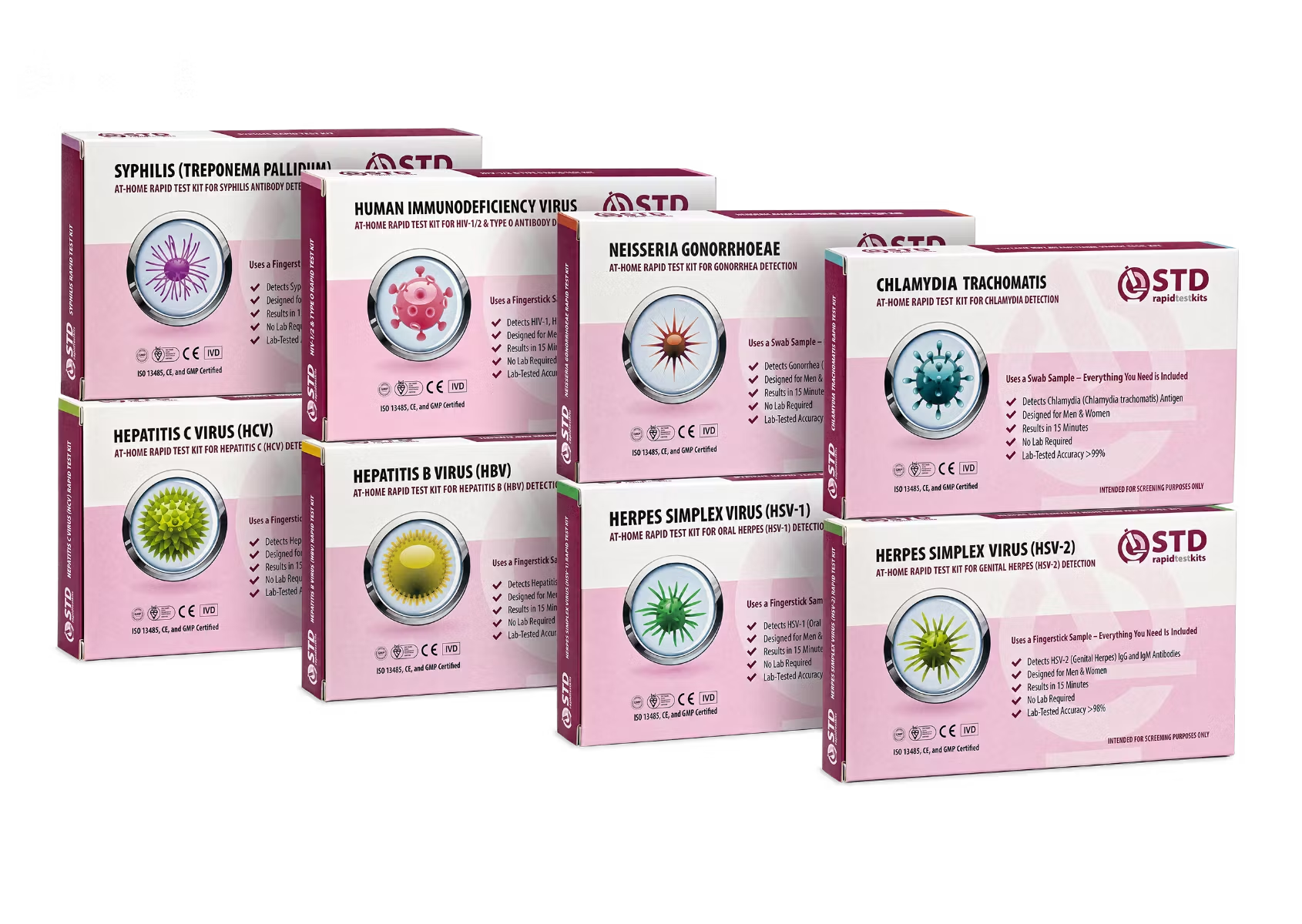
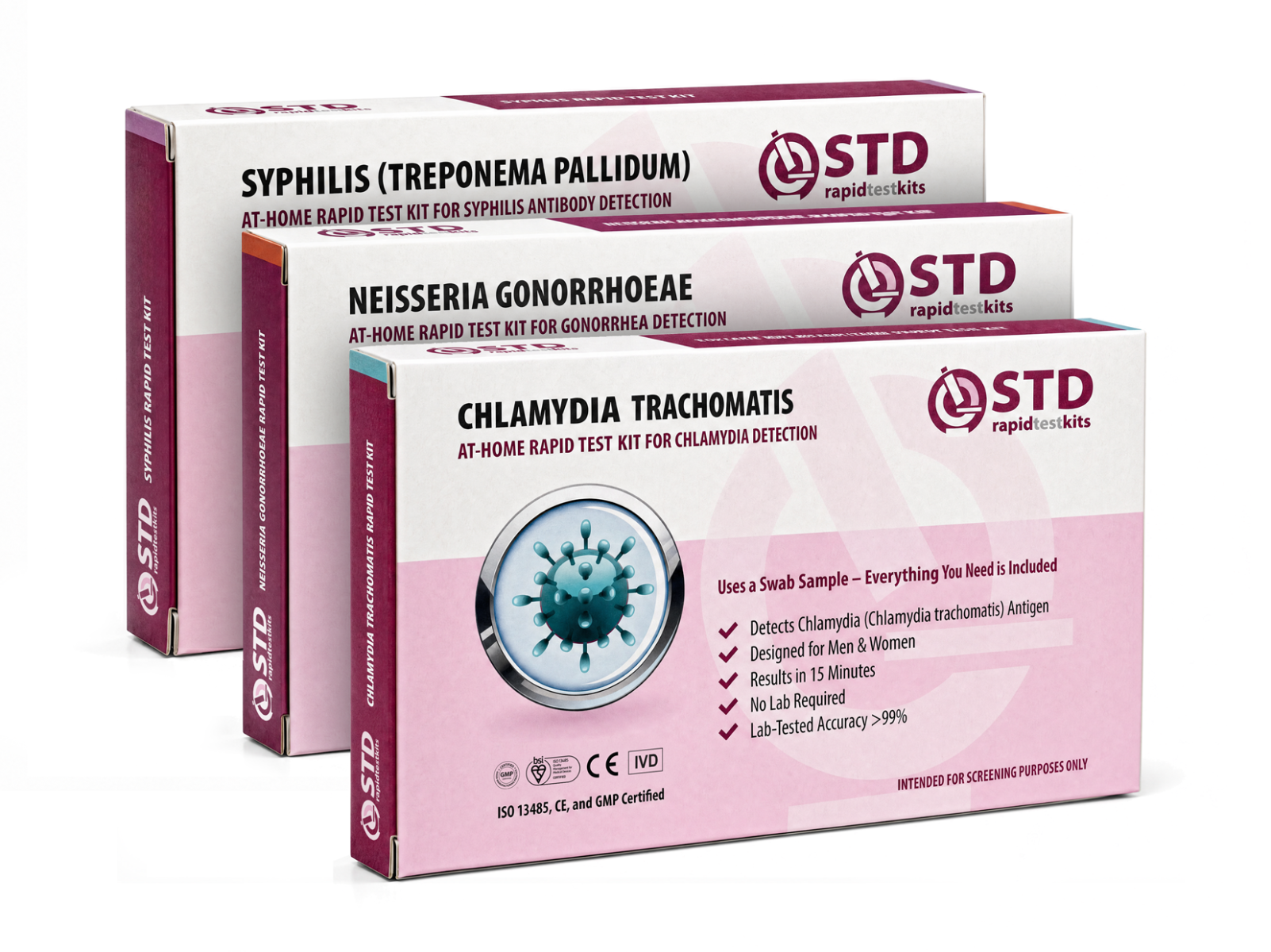
If a clinic visit is not realistic for you, whether because of distance, scheduling, anxiety, or privacy, at-home rapid kits exist for exactly that situation. They use clinically validated lateral-flow immunoassay technology to deliver results in 15 to 20 minutes from your own bathroom. No insurance, no doctor, no appointment, no hidden fees, no paper trail: the kit arrives in plain packaging, you test in private, and the result is yours alone to read.
A single rapid test starts at $18.99, compared with roughly $75 or more at an urgent care center before consultation and lab fees are added. Validated sensitivity sits consistently in the high 90s across the panel, comparable to clinical lateral-flow testing at a fraction of the cost. For the full pricing breakdown, see our guide to how much STD testing costs and how to pay less.
It is worth being precise about what these kits do and do not do. At-home rapid tests are lateral-flow immunoassays, the same chemistry many clinics use for rapid HIV and syphilis screening. They are not the same as laboratory NAAT or PCR testing, which has somewhat higher analytical sensitivity for certain bacterial infections. For most uninsured Americans who would otherwise wait weeks or skip testing entirely, an at-home rapid kit is a meaningful, accurate screening option, and a positive result is always worth confirming at a lab when possible.
For women who want the most comprehensive screening, the Women's 10-in-1 At-Home STD Test Kit adds trichomoniasis and HPV 16 and 18 to the full eight-infection panel. Our trichomoniasis and HPV rapid swabs are validated for vaginal self-collection only, so men needing those specific tests should see a clinic instead.
| Kit | Infections Covered | Results In |
|---|---|---|
| Chlamydia At-Home Rapid Test | Chlamydia | 15 to 20 minutes |
| Gonorrhea At-Home Rapid Test | Gonorrhea | 15 to 20 minutes |
| Syphilis At-Home Rapid Test | Syphilis | 15 to 20 minutes |
| HIV 1 & 2 At-Home Rapid Test | HIV 1 & 2 | 15 to 20 minutes |
| Chlamydia, Gonorrhea & Syphilis 3-in-1 | Chlamydia, Gonorrhea, Syphilis | 15 to 20 minutes |
| 7-in-1 Complete Kit | HSV-2, Chlamydia, Gonorrhea, Syphilis, HIV, Hep B, Hep C | 15 to 20 minutes |
| Complete 8-in-1 Kit | HSV-1+2, Chlamydia, Gonorrhea, Syphilis, HIV, Hep B, Hep C | 15 to 20 minutes |
| Women's 10-in-1 Kit | Adds Trichomoniasis + HPV 16/18 (women only) | 15 to 20 minutes |
Students, Fee Waivers, and the Intake Conversation
You are standing at the front desk of a public health clinic, clipboard in hand, and the intake form asks about insurance. You write "none." What happens next is less complicated than most people expect. A simple opener helps: "I don't have insurance, and I'm wondering about your sliding-scale or reduced-cost options." That one sentence starts the conversation at nearly every public health clinic in the country.
At county health departments, FQHCs, and most sexual health clinics, a staff member asks for a basic estimate of household income and uses it to calculate a sliding-scale fee or confirm a full waiver. You do not need tax returns or pay stubs at most locations; a verbal estimate is typically all that is required. At dedicated STD clinics, as opposed to general community health centers, fees are often waived entirely for uninsured patients with no income verification at all.
If you are a currently enrolled college or university student, your campus health center is almost certainly offering free or deeply subsidized STD testing as part of your existing student health fees. Most university health centers test for chlamydia, gonorrhea, syphilis, and HIV as standard, with herpes antibody testing and hepatitis screening available on request. Results are confidential and do not go to parents, housing, or any academic office. One limitation: campus health centers close during breaks and cut hours in summer. If you need testing outside the academic year, the clinic and at-home options in this article all apply.
If the in-person intake conversation feels like too much friction, whether because of anxiety, scheduling, or the waiting room itself, that is a completely legitimate reason to test at home instead. An at-home rapid kit gets you a result in the time it takes to make a cup of coffee, with no intake form and no front desk. For a broader look at the tradeoffs, see STD testing at a clinic vs. at home.
When You're Undocumented, Trans, or Don't Want to Show ID
This is where access intersects with fear, legality, and identity. Not everyone feels safe walking into a clinic, especially if you are undocumented, trans, or have been denied care before. Some clinics still ask for government-issued ID even when it is not legally required to access STD testing.
The reality is that most public testing programs in the US do not legally require proof of citizenship, insurance, or income. Many use internal coding systems or anonymous registration processes to protect patient privacy. Mobile clinics operating under Title X federal grants explicitly cannot turn patients away for lack of documentation. Organizations like the LA LGBT Center and Apicha Community Health in New York City run dedicated programs with explicit no-ID testing policies, and many community-based organizations in major metros operate the same way.
If you have been denied care or have legitimate fears about a clinic visit, calling ahead is reasonable. If a clinic's policy does not fit your situation, an at-home rapid kit removes the question entirely; no ID is involved in ordering one.
When you call a clinic ahead of time, ask these two questions explicitly:
- "Do you require government ID for STD testing?"
- "Is testing anonymous, or confidential under HIPAA?"
Most public health clinics will give a clear yes-or-no on both. If either answer makes you uncomfortable, the at-home kit removes both questions from the equation.
When to Test After Exposure: Window Periods by Infection
Whether you are using a free clinic, a mail-in program, or an at-home rapid kit, testing too early after exposure can produce a false negative. The infection simply takes time to reach a detectable level in the body. Every STD has its own biology and its own window period.
If you test before the relevant window has passed and get a negative result, that result does not tell you what you need to know. Wait the correct amount of time, then test. Two specifics worth flagging before the table: for herpes, the CDC's herpes testing guidance notes that current antibody tests can take up to 16 weeks or more after exposure to turn positive. For hepatitis C, the CDC's hepatitis C testing page recommends a NAT for HCV RNA rather than an antibody test when exposure occurred within the past 6 months, since the antibody window can extend well beyond the early weeks after infection.
| Infection | Test From | Notes |
|---|---|---|
| Chlamydia | 14 days after exposure | Most common bacterial STI in the US |
| Gonorrhea | 3 weeks after exposure | 543,409 cases reported in 2024 per CDC, down about 10 percent from 2023 and the third straight year of decline |
| Syphilis | 6 weeks after exposure | Primary and secondary syphilis declined in 2024 but remain a significant burden |
| HIV | 6 weeks for a first read; retest at 12 weeks for certainty | Per CDC HIV testing guidance, a negative at 6 weeks is reassuring; 12 weeks is definitive for most assays |
| Herpes HSV-1 & HSV-2 | 12 weeks for a first read; up to 16 weeks for certainty | Per the CDC herpes testing page, current antibody tests can take up to 16 weeks or more after exposure to detect infection. A negative at 12 weeks is informative; 16 weeks is more reliable. |
| Hepatitis B | 6 weeks after exposure | Vaccination is available and highly effective |
| Hepatitis C | Antibody window varies; see notes | Viral infection (HCV). The CDC recommends a NAT for HCV RNA rather than an antibody test if exposure occurred within the past 6 months. Antibody-based rapid kits may not detect early infection; confirm a negative with a provider if exposure was recent. |
Privacy Considerations: Testing Without a Paper Trail
Many readers care just as much about privacy as cost. If you are on a parent's plan, a spouse's plan, or any insurance policy where someone else might see the Explanation of Benefits, testing at a clinic under that insurance creates a record. At public health clinics and health departments, you can often test completely anonymously, with your results linked to a number rather than your name. This is separate from confidential testing, where your name is recorded but legally protected under HIPAA, the federal health privacy law.
Ask specifically when you call: "Is your testing anonymous or confidential?" The distinction matters if you are worried about who might see what. Both are far more private than a standard clinic visit billed to insurance.
At-home rapid kits sit in their own category. Your name is attached to a website purchase, the same as any online order, but no medical record is created, no insurance claim is filed, and no Explanation of Benefits reaches a shared mailbox.
Anonymous testing means no name is ever attached to the result. Your result is linked to a code or number instead. Available at some county health departments, AHF Wellness Centers, and many mobile units.
Confidential testing means your name is on the record, but disclosure is legally restricted under HIPAA. Standard at most clinics. Far more private than insurance-billed testing because no Explanation of Benefits is generated.
What If You Test Positive?
This is the question that keeps a lot of people from testing in the first place: what if it is positive, and can I afford treatment?
The reassuring part is that most common STIs are highly treatable with short, affordable antibiotic courses. Chlamydia, gonorrhea, trichomoniasis, and syphilis are all curable. HIV and herpes are not curable but are well-managed with long-term care. Catching any of these early reduces both health complications and total out-of-pocket cost. An untreated chlamydia infection that progresses to pelvic inflammatory disease, for example, costs vastly more to treat than the initial test would have, in both money and risk to fertility.
If you test positive at a public health clinic, they will often treat you on the spot, sometimes for free. Treatment at county health departments and FQHCs is also offered on a sliding-scale or zero-cost basis for uninsured patients. If you test positive at home, you will need to bring your result to a provider for prescription and follow-up. Many telehealth services now offer treatment based on at-home test results for $15 to $35 per prescription, and many work with discount pharmacy programs that further reduce that cost.
If privacy is critical, look for Title X-funded clinics; these can legally treat you without billing insurance or revealing your identity to a policyholder.
Curable with antibiotics: chlamydia, gonorrhea, syphilis, trichomoniasis.
Manageable with long-term care: HIV (antiretroviral therapy keeps viral load undetectable), herpes HSV-1 / HSV-2 (antiviral suppression reduces outbreaks and transmission), hepatitis B (antivirals plus monitoring).
Curable in most cases with direct-acting antivirals: hepatitis C.
Retesting After Treatment
Testing negative once does not always mean you are in the clear. If you tested too soon after exposure, if you have had new partners since, or if your symptoms change, retesting is more than reasonable: the CDC's STI screening recommendations specifically advise retesting roughly three months after treatment for chlamydia and gonorrhea to catch reinfection, which is common when partners are not treated at the same time.
The practical barrier for uninsured people is that retesting can feel like spending the same "affordable" option twice. At-home kits help here because there is no clinic visit, no intake form, and no front desk: ordering a second test costs the kit's price and nothing more. Whether you retest at a clinic or at home, the point is to confirm that treatment worked and that no reinfection has occurred from a partner who skipped treatment.
Treat retesting as part of your routine, not a sign of failure. The biology of reinfection has nothing to do with personal worth; it is about whether everyone in the loop got treated. Acknowledging that openly with partners is part of how transmission cycles get interrupted.
Per CDC screening guidance, anyone treated for chlamydia or gonorrhea should retest roughly three months after completing treatment, regardless of whether their partner reports testing. Reinfection from an untreated partner is the single most common reason a previously treated infection comes back.
Your Next Step: Which Option Fits You?
You now know every realistic route to getting tested without insurance. The practical question is which one to start with. For most people it comes down to three things: whether you have symptoms right now, whether a free clinic is within reach, and how much privacy matters to you. The short walk-through below points you to a sensible first step, and none of these options locks you out of the others, so if your first choice falls through, move to the next one.
Find Your First Step to Getting Tested
Do you have active symptoms right now, such as genital sores, unusual discharge, or pelvic or testicular pain?
Yes: See a clinic in person. A county health department or FQHC can examine, test, and often treat in one low-cost or free visit. Active symptoms need a physical exam that a home test cannot replace.
No symptoms, but you want a free in-person test and have a clinic you can reach?
Yes: Start with an AHF Wellness Center (always free, no appointment) or your county health department. The CDC's testing locator can find the nearest site.
Is privacy, distance, scheduling, or anxiety the main thing standing in your way?
Yes: An at-home rapid kit fits: no clinic visit, no insurance claim, no Explanation of Benefits, and a result in 15 to 20 minutes.
No: Any route here works for routine screening. Match the testing window to the infection using the window-period table above, then pick whichever option you are most likely to actually follow through on.
Guidance only. A local clinic or provider can confirm what fits your exact situation.
FAQs
- Can I really get free STD testing with no income and no insurance?
- Yes. AHF Wellness Centers ask for nothing at all: no income verification, no appointment, no insurance card. County health departments and FQHCs use a sliding scale that can reach $0, and the intake conversation rarely requires more than a verbal income estimate. The system is set up specifically for people in this situation; you are not asking for an exception.
- How accurate are at-home rapid STD test kits compared to clinic tests?
- Comparable to a clinic rapid test for HIV or syphilis, and somewhat less sensitive than a laboratory NAAT for bacterial infections. Per-product sensitivity sits in the high 90s across our panel. For asymptomatic chlamydia or gonorrhea specifically, a lab NAAT has a modest edge; a positive at-home result is always worth confirming with a lab.
- Is it safe to test for STDs at home without a doctor involved?
- Yes, for screening and routine testing, at-home rapid kits are accurate and reliable when used after the correct window period. If you test positive, following up with a healthcare provider for confirmation and treatment is the appropriate next step, and free clinics can help with that too. Testing at home does not prevent you from getting treatment; it just moves the first step into your own hands.
- Does Planned Parenthood test for STDs without insurance?
- Yes. Planned Parenthood offers STI testing on a sliding-scale fee based on income, and many services, including HIV and syphilis screening, are available at no cost for patients below certain income thresholds. Call your local center to confirm what is covered and what your fee estimate would be.
- How long after exposure should I wait before testing?
- Window periods vary by infection. Chlamydia: 14 days. Gonorrhea: 3 weeks. Syphilis, HIV (first read), and hepatitis B: 6 weeks; HIV retest at 12 weeks for certainty. Herpes: 12 weeks for an initial read, up to 16 weeks for certainty per the CDC. For hepatitis C, the CDC recommends a NAT for HCV RNA rather than an antibody test if exposure occurred within the past 6 months. Testing before the relevant window has passed can produce a false negative even when an infection is present.
- Can I get tested without showing ID or giving my name?
- Often yes. Many county clinics, AHF Wellness Centers, and mobile units operating under Title X federal grants offer anonymous registration. Ask specifically when you call: "Do you require ID?" and "Is testing anonymous?" At-home rapid kits remove the question entirely since no ID is involved in ordering.
- Can teens get tested without their parents knowing?
- In most US states, yes. Minors have legal rights to confidential sexual health services including STD testing and treatment without parental notification. Specifics vary state to state; calling a clinic anonymously and asking is the fastest way to confirm. Campus health centers are confidential for enrolled college students of any age.
- What if I test positive and can't afford treatment?
- Treatment at county health departments and FQHCs is offered on a sliding-scale or zero-cost basis for uninsured patients, frequently in the same visit as the positive result. Title X-funded clinics can treat without billing insurance. Telehealth services offer STI prescriptions for $15 to $35, and many pharmacies have discount programs that reduce that further.
- U.S. Centers for Disease Control and Prevention. Sexually Transmitted Infections Surveillance, 2024: more than 2.2 million combined chlamydia, gonorrhea, and syphilis cases (about a 9 percent decline from 2023) and 543,409 reported gonorrhea cases.
- American Journal of Public Health (via PMC), 2015. Continuing Need for STD Clinics After the Affordable Care Act: found 49.9 percent of STD clinic patients were uninsured and documents why patients choose public clinics (walk-in access, low cost, expert care). Reflects the early post-ACA landscape.
- Health Resources and Services Administration. Find a Health Center directory for FQHCs offering sliding-scale care to uninsured patients across the United States.
- U.S. Centers for Disease Control and Prevention. Genital Herpes Testing: notes that current antibody tests can take up to 16 weeks or more after exposure to detect infection.
- U.S. Centers for Disease Control and Prevention. Hepatitis C Testing: recommends a NAT for HCV RNA rather than an antibody test for exposures within the past 6 months.
- U.S. Centers for Disease Control and Prevention. STI Treatment Guidelines, Screening Recommendations: advises retesting approximately 3 months after treatment for chlamydia and gonorrhea to detect reinfection.
