
Published: October 2025 | Last updated: May 2026 | Editorial review and quality control: Martina N.
You finished the course of antibiotics, the pharmacy bottle is empty, the symptoms have faded, and the clinic told you the medications usually work. So why does the question keep nagging? Most people landing on a page like this are doing the part of treatment the system rarely emphasizes in the appointment: finishing the medication, then circling back at the right time to confirm the infection is gone and that they have not picked it up again. The follow-up is where most reinfection gets caught and where most false alarms get sorted out.
The good news, before any of the timing rules below: first-line antibiotic regimens for the common bacterial STIs clear the great majority of cases when taken as prescribed. A second positive after treatment is far more often a reinfection or a mistimed test than an antibiotic failure. The rest of this guide is about telling those situations apart.
Key Takeaways
- The standard retest after chlamydia, gonorrhea, or trichomoniasis treatment is at 3 months, not 3 weeks. Reinfection from an untreated partner is the most common reason a retest is positive.
- Antibody tests for syphilis, HIV, and herpes can stay reactive for months or years after a real cure. The titer trend over time is the cure signal, not whether a single test still reads positive.
Why a Retest Is Part of Treatment, Not Bonus Care
Antibiotics work on most bacterial STIs, but treatment ends in success only if two things happened: the medication killed the original infection, and you did not get re-exposed before the partners around you finished theirs. That second condition is where most retests come back positive. Reinfection rates after chlamydia treatment are high enough that the CDC builds a routine 3-month rescreen into standard care for every treated patient (CDC clinical retesting guidance).
The CDC's clinical retesting page tells providers to rescreen any person treated for chlamydia, gonorrhea, or trichomoniasis at about 3 months. The point is to catch a brand new infection, not to verify that the pills worked. The pills usually do work. What changes between courses is the world around you.
This framing also matters emotionally. A positive retest at 3 months is not a verdict on your hygiene, your relationship, or your decision making. Public-health programs build the retest into their treatment protocols because untreated partners and asymptomatic carriers are extremely common, and most repeat infections cause no symptoms at all.
Reinfection from an untreated partner, not treatment failure, is the most common reason a 3-month retest comes back positive. The CDC routine rescreening protocol is built around that reality, not around an expectation that first-line antibiotics will fail. First-line doxycycline (for chlamydia) and ceftriaxone (for gonorrhea) clear the great majority of infections when taken as prescribed.
Routine Retest vs Test-of-Cure: Two Different Things
The two follow-up tests answer different questions and use different timing windows. Mixing them up is the single most common avoidable error after STI treatment.
A test-of-cure asks: did the antibiotic regimen clear the infection? It is performed about 3 to 4 weeks after treatment. The CDC explicitly states that a test-of-cure is not routinely recommended for non-pregnant adults treated for genital chlamydia or gonorrhea with a first-line regimen. It is recommended when (a) you are pregnant, (b) the infection was pharyngeal gonorrhea, (c) symptoms persist after treatment, (d) adherence is in question, or (e) a non-recommended regimen was used (CDC 2021 STI Treatment Guidelines: chlamydia).
A routine retest asks something different: have you picked the infection up again since the original episode? It is performed about 3 months after treatment for chlamydia, gonorrhea, and trichomoniasis. This is the test most people Googling at midnight are being asked to schedule.
Testing at 1 to 2 weeks is too early for either purpose. It is too soon for the routine reinfection check, and it can produce a false positive on the test-of-cure because nucleic acid amplification tests (NAATs) used in clinics still pick up fragments of dead bacterial DNA shed in the days after the bacteria themselves are killed.
| Infection | Earliest Useful Retest | Recommended Retest Window | What the Test Checks |
|---|---|---|---|
| Chlamydia | 3 weeks (if at all) | 3 months after treatment | Reinfection, not cure |
| Gonorrhea (genital) | 3 weeks (if at all) | 3 months after treatment | Reinfection (TOC not routinely needed with ceftriaxone first-line) |
| Gonorrhea (pharyngeal/throat) | 7 to 14 days | 7 to 14 days (test-of-cure) | Cure confirmation. Throat infections clear less reliably; we do not sell a pharyngeal swab kit, see a clinic |
| Trichomoniasis | 2 to 4 weeks if symptomatic | 3 months after treatment (women) | Reinfection. High rate in heterosexual partners; partner treatment essential |
| Syphilis (early) | 6 weeks | RPR or VDRL titer at 6, 12, and 24 months | Four-fold titer drop confirms cure. Treponemal tests stay reactive for life |
| HIV (post-exposure) | 18 days (4th-gen Ag/Ab combo, p24 antigen component) | 12 weeks closes the window for almost everyone | Diagnostic confirmation, then viral suppression on ART. Antibody-only home tests have a longer detection window of 23 to 90 days for most seroconversions |
| Hepatitis B | 8 weeks | HBsAg at 6 months after acute infection | Chronic vs cleared. About 5% of acute adult infections become chronic (CDC) |
| Hepatitis C | 6 weeks (HCV RNA) | 12 weeks (antibody) | RNA testing detects infection earlier than antibody testing |
| Herpes (HSV-1, HSV-2) | N/A for asymptomatic retest | No cure test exists; retest only if seroconversion needs confirming | IgG antibody tests stay positive for life |
| HPV | N/A | Per cervical screening schedule | Most clear naturally within 1 to 2 years |
How long after STD treatment should you retest?
For chlamydia, gonorrhea, and trichomoniasis, the CDC recommends rescreening about 3 months after treatment to catch reinfection, which is the most common reason a repeat test comes back positive. A test-of-cure at 3 to 4 weeks is reserved for specific situations: pregnancy, pharyngeal gonorrhea, persistent symptoms, suspected non-adherence, or treatment with a non-first-line regimen. Syphilis follow-up is serologic at 6, 12, and 24 months (the cure signal is a four-fold drop in the non-treponemal titer). HIV uses window-period rules (4th-generation Ag/Ab tests close the window at about 12 weeks), and herpes and HPV are managed by symptom monitoring or routine cervical screening rather than a cure test.
What a Positive Retest Probably Means
A positive result after treatment falls into one of four buckets, and the timing window tells you which is most likely.
The first bucket is residual nucleic acid. Lab NAATs (PCR-style tests) are extremely sensitive. They detect genetic material from the bacteria, and that material can persist in tissue for up to about three weeks even after the bacteria themselves are dead. A NAAT done at 1 to 2 weeks after treatment can therefore read positive when the infection is genuinely gone. This is well documented for chlamydia and gonorrhea, and it is exactly why the CDC sets the routine retest window at 3 months rather than 3 weeks.
The second bucket is reinfection. If you resumed sex with an untreated partner, or with a new partner who happened to be carrying the same infection, your retest is reading a brand new infection that looks identical to the old one in lab results.
The third bucket is true treatment failure, which is uncommon for chlamydia and trichomoniasis with first-line regimens but increasingly relevant for gonorrhea given antibiotic-resistance trends. Resistant strains are why gonorrhea is monitored more aggressively than chlamydia.
The fourth bucket is laboratory or specimen handling error, which is rare but real and is one reason a confirmatory retest is sensible after a surprising result.
A practical rule that comes out of these four buckets:
- 0 to 21 days after treatment: avoid retesting unless your provider specifically asked for a test-of-cure. Earlier results can mislead.
- 3 weeks to 3 months: retesting is reasonable if symptoms return, you learned a partner was not treated, or there has been a new exposure. Otherwise wait.
- At 3 months: retest even without symptoms, per the CDC.
Your Test Type Changes Everything
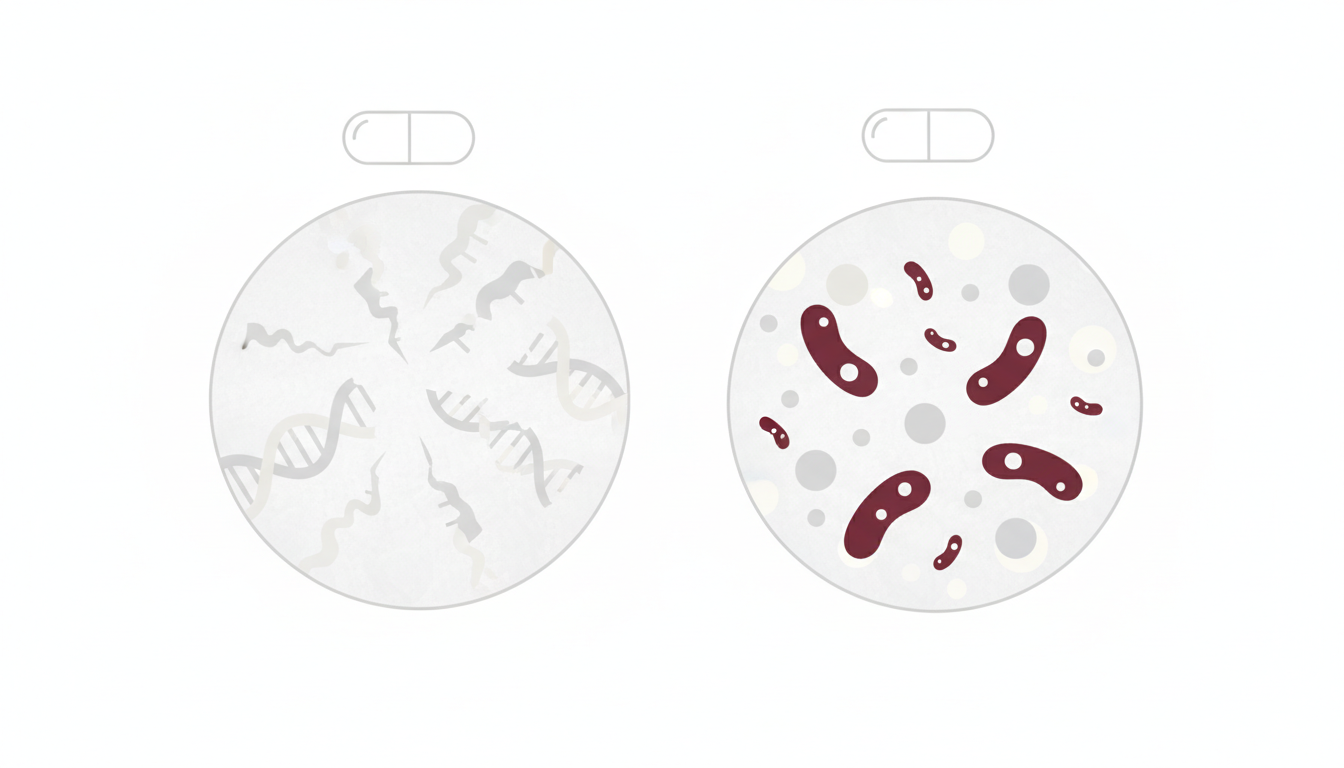
The same infection can give wildly different post-treatment results depending on what the test is looking for. Four major test technologies are in use, and each behaves differently after treatment.
- NAAT and PCR (genetic material). The most common technology in lab-based STI testing for chlamydia, gonorrhea, and trichomoniasis. Detects bacterial DNA or RNA. Stays positive for two to three weeks after the infection is cleared because dead-bacteria fragments take time to flush from tissue.
- Antibody tests (your immune response). Used for HIV, syphilis, herpes, and hepatitis B and C. Once your immune system makes antibodies, they often persist for years, sometimes for life. A reactive result years after a successful treatment is normal here; the cure signal is a falling titer over time, not a binary negative.
- Antigen tests (parts of the pathogen itself). Used in some rapid kits and as one component of 4th-generation HIV combo panels. Generally clear within days to weeks of successful treatment.
- Rapid lateral-flow tests (the at-home kits sold on this site). Use either antigen or antibody chemistry on a paper strip. Fast and reasonably accurate, with lower analytical sensitivity than a lab NAAT or 4th-generation HIV combo. Useful as screening tools at the right point in the timeline; confirm any positive at a clinic with the appropriate confirmatory test for that infection.
One practical consequence: the same Sunday-afternoon retest, read by a NAAT on Tuesday morning, can come back positive on residual DNA from an infection that was actually cleared a week earlier. Read the same kind of sample with an antigen-based rapid lateral-flow strip and the result is more likely to reflect what is happening right now.
| Test type | What it detects | Stays positive after treatment? | Best for |
|---|---|---|---|
| NAAT or PCR | Genetic material (DNA/RNA) | Yes, for about 3 weeks | Chlamydia, gonorrhea, trichomoniasis |
| Antigen test | Parts of the pathogen itself | Rarely, clears in days to weeks | Some rapid kits, 4th-gen HIV |
| Antibody test (IgG, IgM) | Your immune response | Yes, often for years or life | Syphilis, herpes, HIV, hepatitis B and C |
| Ag/Ab combo test | Early antigen plus antibodies | Depends on the infection timeline | 4th-gen HIV, hepatitis B and C |
| Rapid lateral-flow (at-home) | Antigen or antibody on a strip | Mirrors the underlying chemistry | Screening, retesting at the longer windows |
When Symptoms Stick Around After Treatment
The discharge has not fully cleared. There is a residual ache, a faint odor, a low-grade burn when you pee. The instinct is to assume the infection is still there. Often it is not. Bacterial STIs cause inflammation, and inflammation takes longer to settle than the bacteria take to die. The cervix, the urethra, the rectum, and especially the throat can all stay irritated for a couple of weeks after the organism is cleared, particularly if the original infection was symptomatic.
That said, persistent or worsening symptoms are one of the few clear indications for an early test-of-cure. The CDC's chlamydia treatment page lists symptom persistence alongside pregnancy, suspected non-adherence, and treatment with a non-recommended regimen as the situations where retesting at 3 to 4 weeks is appropriate (CDC 2021 STI Treatment Guidelines: chlamydia).
There is one specific cause of post-treatment urethritis that deserves naming, because standard NAAT panels do not look for it: Mycoplasma genitalium (MG). A meaningful minority of men with non-gonococcal urethritis still have symptoms a month after first-line chlamydia or gonorrhea therapy, often because MG was the actual organism. If symptoms persist past four weeks despite a negative retest for chlamydia and gonorrhea, ask a clinician specifically about MG-targeted testing. The antibiotic regimen for MG is different from the first-line chlamydia and gonorrhea regimens, and resistance is a growing concern.
Bacterial vaginosis, urinary tract infections, candida, and contact dermatitis from a new soap or laundry detergent also produce symptoms that overlap with cervicitis or urethritis, and any of these can flare during the same window when the original infection was being treated.
- Pelvic pain that is sharp, worsening, or interferes with movement
- Fever, chills, or unexplained fatigue beyond a week post-treatment
- New rashes, sores, or genital lesions appearing after treatment
- Bleeding between periods or with sex (women) or testicular pain (men)
- Any symptom that is clearly getting worse rather than slowly improving
- Persistent urethritis or cervicitis past four weeks (ask about Mycoplasma genitalium testing)
The Untreated Partner Problem
The biggest single driver of repeat positive tests is a partner who never finished, never started, or never picked up the prescription. Public-health teams know this so well that many U.S. states allow Expedited Partner Therapy (EPT), the practice of letting a clinician hand the index patient an extra prescription or pre-packaged medication for a partner without examining that partner first (CDC: Expedited Partner Therapy). EPT exists precisely because the alternative, asking the partner to schedule their own visit, has a low completion rate.
The conversation about retesting can be uncomfortable, and how you frame it matters. The most useful approach is to lead with the medicine, not the relationship. Reinfection through an incompletely treated partner is the single most common reason a follow-up test reads positive, and that is a clinical fact, not an accusation. Most chlamydia and gonorrhea infections cause no symptoms in men, which means a partner can genuinely feel fine while still carrying the infection. Their experience of feeling fine does not contradict your positive test.
A version of the conversation that tends to land sounds like this: "My follow-up test came back positive. The most common reason that happens is reinfection because one partner did not complete treatment, which is something we both have a stake in fixing. Can we both retest at the same time, and both finish a full course before we resume sex without protection?" That framing is medically accurate, does not assume anyone cheated, and gives both people a clear next step.
If you cannot verify that your partner was treated, assume you can be re-exposed and plan accordingly. Couples who treat the follow-up as a shared task (scheduling the 3-month retest on a joint calendar, for example) are more likely to complete it on schedule. One scenario that traps people is the asymptomatic partner whose same-day test came back negative. A NAAT done before the organism has reached detectable levels can read negative on an early exposure, so the safer rule when one partner tests positive is to treat both partners simultaneously and retest both at 3 months.
The products linked below are sold by stdrapidtestkits.com, which sells at-home STI testing kits. We recommend them based on fit-for-purpose for the reader's concern, not for commercial benefit; our at-home kits are rapid lateral-flow immunoassays, not clinic-grade NAATs, and a positive home result is best confirmed by a lab.
Higher-priority groups for routine retesting
- Anyone under 25, especially women, treated for chlamydia or gonorrhea. Reinfection rates run highest in this group in the first year after a positive.
- Pregnant patients diagnosed with chlamydia, gonorrhea, syphilis, or HIV. A third-trimester rescreen is standard antenatal care on top of any earlier follow-up.
- Men who have sex with men, who carry higher background prevalence of bacterial STIs and benefit from quarterly to semi-annual screening regardless of any single positive result.
- People on PrEP, who are tested for HIV, syphilis, chlamydia, and gonorrhea on the standard PrEP follow-up schedule (typically every 3 months).
- Anyone with persistent symptoms past four weeks of treatment.
- Anyone whose partner was not confirmed tested and treated during the same window.
Pregnancy and Reduced Immunity Change the Timing
Standard retesting rules assume an immunocompetent, non-pregnant adult. Two groups need closer follow-up.
The first is pregnancy. The CDC recommends a test-of-cure at approximately 4 weeks after treatment for chlamydia in pregnancy, on top of the routine 3-month rescreen, because untreated or inadequately treated chlamydia can cause neonatal conjunctivitis (ophthalmia neonatorum, which can cause permanent blindness if untreated) and pneumonia (CDC chlamydia treatment guidance). Gonorrhea and syphilis are also tested again later in pregnancy depending on local risk and prior history. If you are pregnant and were treated for any STI during the pregnancy, do not skip the 4-week follow-up; the cost of a missed reinfection is much higher than usual.
The second is reduced immune function. People living with HIV, on chemotherapy, on long-term corticosteroids, or with other significant immune compromise can clear infections more slowly and seroconvert in atypical patterns, especially for syphilis. The CDC's syphilis follow-up schedule is therefore tightened for people with HIV, with serology at 3, 6, 9, 12, and 24 months for early syphilis rather than the standard 6, 12, and 24 (CDC 2021 STI Treatment Guidelines: Syphilis Among Persons with HIV). If any of this applies to you, your retest schedule should come from your clinician.
Pregnancy: test-of-cure at approximately 4 weeks after chlamydia treatment, plus the routine 3-month rescreen. Gonorrhea and syphilis follow similar tightened schedules during pregnancy.
HIV-positive or otherwise immunocompromised: early syphilis serology at 3, 6, 9, 12, and 24 months, rather than the standard 6, 12, and 24. Other infections may also be retested more often.
Both groups should follow a clinician-set schedule rather than a generic timeline.
How Soon You Can Resume Sex
For bacterial STIs, the CDC and most clinical guidelines say to wait 7 days after a single-dose regimen, or until you have completed a multi-day regimen, AND until your partner has been treated and waited the same period (CDC chlamydia treatment guidance). Both clocks have to run out. Resuming sooner is the most common path to a positive retest at 3 weeks.
Concretely, that means the first-line chlamydia regimen is doxycycline 100 mg twice daily for 7 days (with single-dose azithromycin 1 g as an alternative when adherence is uncertain), and the first-line gonorrhea regimen is a single 500 mg intramuscular ceftriaxone dose. For the multi-day course you finish the pills first and then count seven days; for the single dose you count from the day of the injection or pill.
Practical translation: if you took a single-dose ceftriaxone injection on day 0 and your partner took theirs on day 5, the safe-to-resume date is day 12 for the partnership, not day 7 for either of you individually. Skipping the partner's seven days is the small adherence error that causes most ping-pong reinfection.
For viral STIs the rule shifts. Herpes is contagious during prodrome and outbreak, and asymptomatic shedding can transmit between outbreaks; suppressive antiviral therapy and barrier protection lower but do not eliminate transmission. HPV transmission is reduced by condoms but not eliminated, because skin-to-skin contact around the genital area outside the covered zone is enough. For HIV, viral suppression on antiretroviral therapy (an undetectable viral load) is the relevant safety marker rather than a fixed waiting period.
Both partners must finish the full 7-day window before resuming sex. If you completed treatment on day 0 and your partner started theirs on day 5, the safe-to-resume date is day 12 for the pair, not day 7 for either of you individually. Skipping the partner's clock is the most common avoidable cause of a positive retest a few weeks later.
Using At-Home Tests as Your Retest
At-home rapid STI tests are well suited to the 3-month routine retest, with one caveat. Most home rapid tests are lateral-flow immunoassays. They detect antigens or antibodies on a paper strip rather than amplifying DNA in a thermal cycler the way a lab NAAT does. Lateral-flow tests do not detect residual genetic material from dead bacteria the way NAATs can, so the early-timing false-positive risk is lower. They are not as analytically sensitive as a lab NAAT, however, which is why a positive home result is worth confirming with a lab visit.
A reasonable rule of thumb for the 3-month follow-up: if you have easy access to a clinic and time to wait for lab results, a lab NAAT is the higher-sensitivity option, especially for throat or rectal sites we do not test from home. If access, privacy, or scheduling is the friction that would otherwise cause you to skip the retest entirely, an at-home rapid screen at the 3-month mark is a much better option than no retest at all. Completion of the 3-month follow-up visit is low in most STI clinic populations; the barrier is typically logistical rather than motivational, which is exactly the gap an at-home test closes.
Schedule the home test for the calendar date you decided on, not the day anxiety spikes. If both partners can swab at the same time, do that. If the test is negative and you remain symptom-free, that is the answer the protocol was designed to produce. If the home result is positive, treat it as preliminary, abstain from sex until you confirm, and follow up at a clinic. A confirmatory NAAT establishes whether what the rapid test caught is a true new infection or a false alarm, and a clinician can prescribe first-line antibiotics in the same visit.
Any person who has a positive test for chlamydia or gonorrhea, along with women who have a positive test for trichomonas, should be rescreened 3 months after treatment.
If Your Retest Is Positive: What Happens Next
A second positive after antibiotics is one of the more stressful results to see, especially after doing everything right. The action plan depends on which infection and which test type came back positive.
For chlamydia, gonorrhea, or trichomoniasis: a positive NAAT inside the first three weeks is most likely lingering bacterial DNA, not active infection. A positive NAAT at 12 weeks usually means reinfection, since these bacteria do not lie dormant. Treatment failure with first-line regimens is uncommon. The standard next step is a second course of the same first-line antibiotic, partner notification (using expedited partner therapy where state law allows), and another 7-day abstinence window for both partners before resuming sex. Schedule another 3-month retest from the new treatment date.
For syphilis: a reactive treponemal antibody test (TP-PA or FTA-ABS) is expected for life after a real infection, treated or not. The diagnostic question is whether the non-treponemal titer (RPR or VDRL) is dropping. A four-fold drop within 6 to 12 months (for example, 1:32 falling to 1:8) is the standard signal that treatment worked. A stable or rising titer suggests treatment failure or reinfection and warrants re-evaluation by a clinician.
For HIV: a positive 4th-generation Ag/Ab test post-exposure is almost always real and needs immediate confirmation by a viral-load (RNA) test plus linkage to care. Antiretroviral treatment started early can suppress the virus to undetectable levels within months, with normal life expectancy and zero sexual transmission risk while suppressed (the U=U principle, supported by current CDC HIV guidance).
For herpes: a positive IgG antibody result is permanent. It does not mean the person is infectious all the time; it means the immune system holds antibodies. Outbreak management with antivirals (acyclovir, valacyclovir, famciclovir) is a separate question from retesting, and most people see outbreak frequency decrease over time.
A repeat positive does not mean you have a chronic infection. Chlamydia and gonorrhea do not establish long-term latent infection the way herpes or HIV do. A chain of three or four short reinfection episodes is biologically the same as one long infection in terms of treatment, and the next step is the same as the first: complete the regimen, confirm partner treatment, and put the next retest on the calendar.
| What you did | Most likely explanation | Best next step |
|---|---|---|
| Tested less than 3 weeks after antibiotics finished, NAAT positive, no new sex | Residual bacterial DNA giving a false positive on NAAT | Wait. Repeat at 12 weeks if no new exposure. |
| Tested at 3 to 4 weeks, symptoms back, partner not treated | Reinfection from untreated partner | Confirm with a fresh sample, treat the partner before resuming sex. |
| Tested at 3 months, new partner since treatment | New infection from new exposure | Treat as a fresh diagnosis; notify the new partner. |
| Tested at 3 months, no new partners, symptoms resolved | Lab error or unusual treatment failure | Repeat using a different sample type or a different lab. |
| Pregnant, tested at 4 weeks (test-of-cure) | Either residual DNA or true treatment failure | Discuss with your prenatal provider; a positive at this window usually triggers re-treatment. |
| Reactive syphilis treponemal test 12 months after penicillin | Lifelong antibody memory, not active infection | Check the non-treponemal titer for a four-fold drop; if absent, re-evaluate. |
| Positive 4th-gen HIV Ag/Ab post-exposure | Likely a real seroconversion, especially past 4 weeks | Confirmatory viral-load (RNA) test and linkage to care immediately. |
FAQs
- Do I really need to retest if I feel fine?
- Yes. Most people who reinfect with chlamydia or gonorrhea do not feel anything when the new infection takes hold, which is one reason the CDC sets the routine retest at 3 months for everyone treated. Feeling fine is the population in which the test is most useful, because it is the population most likely to be silently passing the infection along.
- Can I get a false positive if I retest too early?
- On a clinic NAAT, yes. Residual bacterial DNA can linger up to three weeks after the bacteria themselves have died, so a positive inside that window may not reflect an active infection. Antigen-based rapid lateral-flow home tests skip the DNA amplification step, which makes them less prone to that specific false positive; their overall analytical sensitivity is also lower than a lab NAAT, so a negative is less definitive than a clinic-run NAAT negative.
- What is the difference between a test-of-cure and a routine retest?
- Different timing, different audience. A test-of-cure happens at 3 to 4 weeks and is reserved for pregnancy, pharyngeal gonorrhea, persistent symptoms, suspected non-adherence, or non-first-line regimens. A routine retest happens at 3 months and applies to every patient treated for chlamydia, gonorrhea, or trichomoniasis, regardless of how the original treatment went.
- What if my partner says they got treated but I am not sure?
- Treat the uncertainty as a reason to retest at 3 months and to use barrier protection in the meantime. Many U.S. states allow Expedited Partner Therapy, where a clinician gives you a second prescription to hand to the partner without their needing to attend an appointment. If your provider has not mentioned EPT, ask about it; it exists precisely for the situation you are describing.
- How soon after treatment can I have sex again?
- Seven days minimum from your last dose, and your partner's 7-day window must also close before you can resume together. For the 7-day doxycycline course, finish the pills first and then add the wait. Partners who started on different days each need to clear their own full window, which is why a date that feels safe for one person may still be too early for the pair.
- Can I use an at-home test for the 3-month retest?
- Yes, with the understanding that home rapid tests are screening tools rather than confirmatory diagnostics. A negative result in a person without symptoms and with treated partners is reassuring. A positive result should be confirmed with a clinic-administered lab test before re-treatment, because the regimen depends on the confirmed organism and a confirmatory NAAT rules out the small possibility of a false positive.
- Why is my syphilis test still reactive a year after penicillin?
- The titer is the signal, not the binary reactive flag. Treponemal tests (TP-PA, FTA-ABS) stay reactive for life after any real syphilis infection, which is expected and not a sign of ongoing disease. What matters is whether the RPR or VDRL titer drops four-fold within 6 to 12 months of treatment. If it has, the penicillin worked. A stable or rising titer is what warrants a return visit.
- Do I need to retest if I am pregnant?
- Yes, and on a tighter schedule. Chlamydia in pregnancy gets a test-of-cure at approximately 4 weeks after treatment in addition to the routine 3-month rescreen, because untreated chlamydia can cause neonatal conjunctivitis and pneumonia. Gonorrhea and syphilis follow similar tightened schedules during pregnancy. Your prenatal provider sets the exact timing.
- U.S. Centers for Disease Control and Prevention. Clinical Retesting guidance from the STI Treatment Guidelines, including the 3-month rescreening recommendation for chlamydia, gonorrhea, and trichomoniasis.
- U.S. Centers for Disease Control and Prevention. 2021 STI Treatment Guidelines, chlamydial infections section, including the doxycycline 100 mg BID for 7 days first-line regimen, test-of-cure recommendations for pregnancy, and the 7-day post-treatment abstinence window.
- U.S. Centers for Disease Control and Prevention. 2021 STI Treatment Guidelines, gonococcal infections among adolescents and adults; source for the 500 mg single-dose intramuscular ceftriaxone first-line regimen and the 7-to-14-day pharyngeal test-of-cure recommendation.
- U.S. Centers for Disease Control and Prevention. 2021 STI Treatment Guidelines, Syphilis Among Persons with HIV subpage; source of the tightened follow-up serology schedule for early syphilis in HIV-positive patients (3, 6, 9, 12, and 24 months).
- U.S. Centers for Disease Control and Prevention. Expedited Partner Therapy guidance for clinicians and the rationale for partner treatment without an examination visit.
- U.S. Centers for Disease Control and Prevention. HIV testing and treatment topic library, including window-period guidance for 4th-generation Ag/Ab tests and the U=U treatment-as-prevention principle.
