
Published: August 2025 | Last updated: May 2026 | Editorial review and quality control: Martina N.
New Mexico's primary syphilis case counts climbed to levels the state hasn't seen in roughly two decades over the 2022-2024 reporting window, according to the New Mexico Department of Health. The pattern shows up across very different settings: Albuquerque urgent cares, small towns along I-40, and tribal communities where the nearest STI clinic can be a two-hour drive away. Most of these infections start the same way. A single, painless sore appears, fades on its own in a few weeks, and gets blamed on a bug bite, a razor nick, or chafing from desert dust and tight clothing.
This article walks through what primary syphilis actually looks like, why it spreads so quietly, where at-home rapid antibody tests fit (and where they fall short), and what to do after a positive screening result. The goal is calmer reading and clearer action, whether you live two blocks from a clinic or two hours from one.
Key Takeaways
- Primary syphilis usually appears as a single painless ulcer called a chancre at the site where the bacteria entered the body. The sore heals on its own within 3 to 6 weeks even without treatment, while the bacteria continues spreading internally.
- A rapid at-home antibody test can be falsely negative if you're inside the window period. If your last possible exposure was less than three weeks ago, retest at six weeks and three months for confidence.
Why Primary Syphilis Is Climbing Across New Mexico
The recent surge isn't unique to New Mexico, but the state has been hit harder than most. National CDC data show a sustained rise in primary and secondary syphilis rates over the past decade, with New Mexico among states tracking above the national average. The New Mexico Department of Health has tracked the trend through repeated public health alerts since 2023.
Public health officials point to several converging factors. Routine STI screening dropped during the pandemic and has been slow to recover, especially in rural counties where one of the state's STI clinics may also be the only one open at all. Dating-app use expanded the partner pool faster than testing access did. Methamphetamine use in some communities has been linked to riskier sexual behavior and to delays in seeking care. And in tribal and frontier areas, the combination of long drive distances, limited Indigenous Health Service capacity, and worry about being identified at a small-town clinic produces a structural delay in diagnosis.
The state has reported some encouraging recent data, with primary and secondary syphilis incidence falling in 2024 and into 2025 after the multi-year run-up. The encouraging trend is also a fragile one. Past surges have rebounded fast when testing access slipped, so the current focus is keeping screening normalized, not declaring the surge over.
What The First Sore Actually Looks Like (And What It Gets Mistaken For)
The classic primary syphilis lesion is called a chancre. Per CDC clinical guidance, the chancre appears at the site where the bacteria entered the body, usually within weeks of exposure, and lasts about 3 to 6 weeks before healing on its own with or without treatment. It is typically:
- Single in most cases, though multiple chancres can occur.
- Painless, which is why so many people ignore it.
- Round, with a clean, sharply defined raised border.
- Firm to the touch, almost cartilage-like under the surface.
- Located at the site of exposure: the penis, vulva, vagina, anus, rectum, lips, mouth, or occasionally the fingers, depending on where the bacteria entered the skin.
Because the sore doesn't hurt and tends to sit in places that aren't easily visible (the vaginal canal, the cervix, the anal verge, the back of the throat), it commonly gets missed entirely. When it is noticed, the everyday assumptions are almost always something else: a cold sore, an ingrown hair, a heat-rash blister, a friction sore from cycling, a bug bite from a hike, or a hangnail from dry desert air. The chancre then heals on its own within three to six weeks even without treatment, but the visible sore disappearing does not mean the infection has cleared. The bacteria has already entered the bloodstream by then, and the infection continues progressing toward its secondary stage.
For lesions you can see, the differential matters. A herpes sore is usually painful, presents as a cluster of small blisters that crust over, and recurs in roughly the same spot. A chancroid ulcer is painful and has soft, ragged borders. A primary syphilis chancre is the quiet one in that line-up: painless, firm, well-defined, and singular. If you find a sore on or near the genitals, mouth, or anus that doesn't hurt and doesn't behave like a typical pimple or razor bump, that pattern alone is enough reason to test.
A herpes sore is painful, typically appears as a cluster of small fluid-filled blisters that crust over, and tends to recur in roughly the same spot. A primary syphilis chancre is painless, firm to the touch, well-defined, and usually a single round ulcer. If the sore on or near your genitals, mouth, or anus does not hurt, treat that as a reason to test for syphilis.
What Happens When Primary Syphilis Goes Untreated
Syphilis progresses through stages, and the longer the bacteria (Treponema pallidum) has been replicating, the harder the infection is to clear with a single short course of treatment. The CDC's syphilis information page describes a typical clinical trajectory:
- Primary stage (weeks after infection). The chancre appears at the site of exposure, then heals without treatment over 3 to 6 weeks.
- Secondary stage (weeks to a few months after the chancre fades). A non-itchy rash often appears on the palms and soles, sometimes with mucous patches in the mouth or genital area, flu-like symptoms, low fever, swollen lymph nodes, sore throat, hair loss in patches, and headaches. This stage is highly contagious.
- Latent stage (no symptoms, can last for years). The infection is still detectable by blood test but not visible. Early latent infections are still transmissible.
- Tertiary stage (years to decades later, if never treated). Can damage the cardiovascular system, the nervous system, and other organs.
Two complications deserve their own emphasis. Neurosyphilis can occur at any stage and affects the brain or spinal cord, presenting as severe headaches, vision changes, muscle weakness, or memory problems. Congenital syphilis happens when an untreated person who is pregnant transmits the infection to the fetus. The U.S. has seen a sharp rise in congenital syphilis cases over the last decade, which is why prenatal screening is now recommended multiple times during pregnancy in higher-incidence areas.
Primary syphilis is fully curable with a single intramuscular injection of long-acting penicillin (benzathine penicillin G) when caught in the first year of infection. The longer the bacteria has been in your system, the longer the treatment course required and the higher the chance of complications. If the chancre has already healed, that doesn't mean the infection has cleared. It means it has moved on. A blood test is the only way to know.
Why Distance, Stigma, And Privacy Slow Down Testing Across New Mexico
New Mexico is the fifth-largest state by area and one of the most sparsely populated. For someone living in McKinley County, Catron County, or large parts of the Navajo Nation, the closest dedicated STI clinic can be 60 to 120 miles away. That distance gets worse when winter weather closes routes or when the only available appointment is during work hours. Add the social texture of small towns (you know the nurse, you know the receptionist, you know whose car is parked outside the clinic), and the privacy cost of walking in feels substantial.
The structural delay has a measurable cost. Public health workers describe "ripple chains" where a single undiagnosed primary infection spreads through a dating-app network or a tight social circle before anyone notices. By the time the index case is identified (often during a prenatal visit, a separate emergency-room workup, or a routine screening for something else), several partners may have already been exposed and may themselves be in early latent stages with no obvious symptoms.
Stigma is the second slowing force. The World Health Organization notes that stigma and fear of judgment are significant barriers to STI screening for many people worldwide. People who would readily get a flu test from a clinic often won't get an STI test from the same clinic for the same logistical effort. None of this means anyone is doing anything wrong. It means the system around testing needs to meet people where they actually are, which is often at home and on their own schedule.
The New Mexico Department of Health's partner-services program will notify your recent sexual contacts on your behalf, anonymously, at no cost to you. You give the program the contact information; a public health worker reaches out without naming you. For partners you don't feel comfortable telling directly, this is the fastest and least stressful way to close the loop.
Where At-Home Rapid Antibody Tests Fit (And Where They Don't)
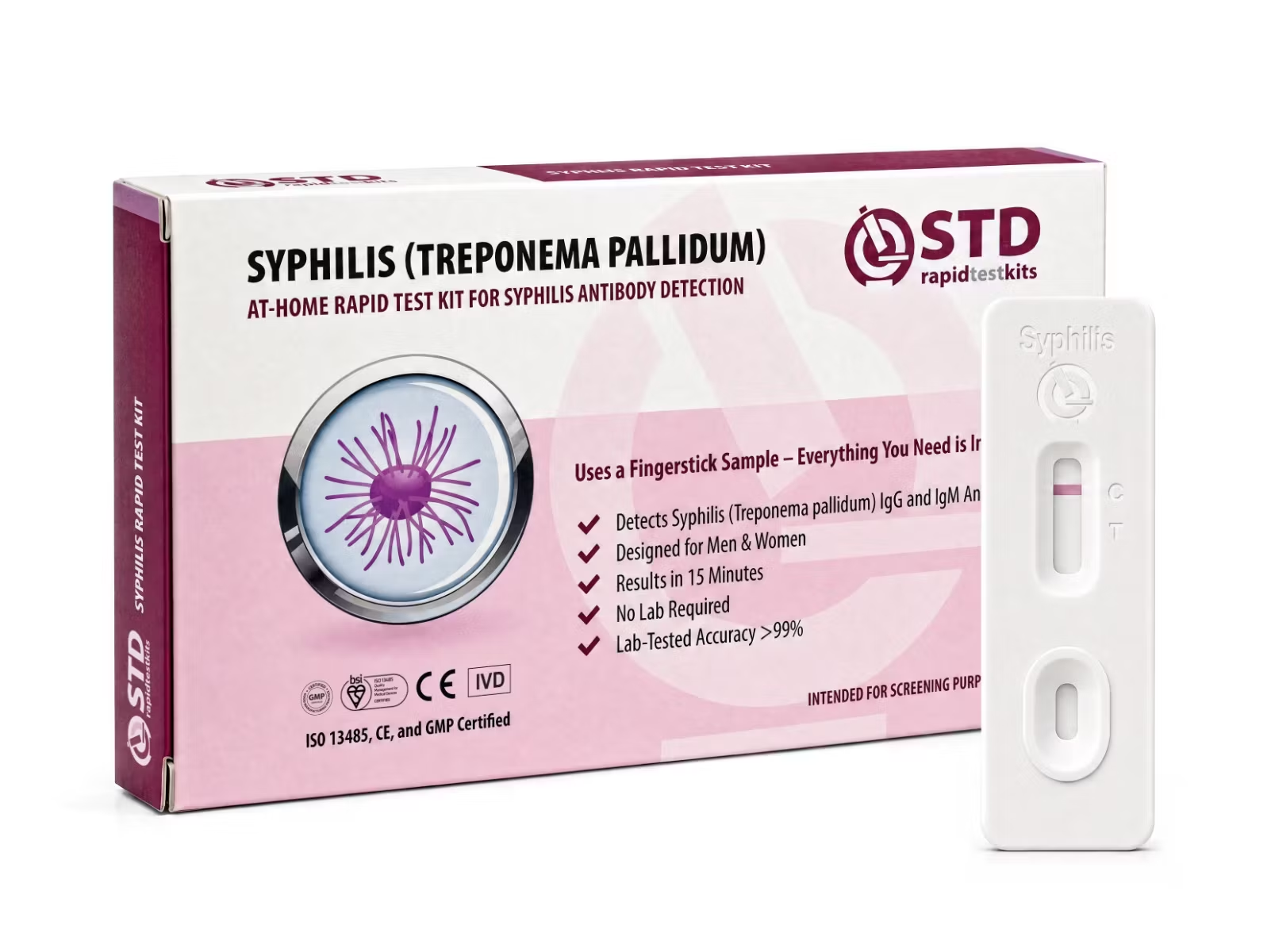
An at-home syphilis rapid test uses lateral-flow immunoassay chemistry, the same general technology family as a rapid COVID antigen test or a home pregnancy test. You collect a fingerstick blood sample, apply it to the cassette with buffer, and read the result in roughly 15 minutes. What the test detects is antibodies that your immune system has produced in response to Treponema pallidum. It is a screening tool, not a confirmatory diagnostic.
The distinction matters for two reasons. First, antibody tests have a window period. Your body needs time to seroconvert (produce detectable antibodies). For syphilis, that window is roughly 3 weeks to 3 months after exposure, with most people testing positive by 6 weeks. If you test the day after a possible exposure, a negative result tells you very little. The right strategy is: test now to establish a baseline, then retest at 6 weeks and again at 3 months if any exposure was recent. Second, treponemal antibodies generally remain detectable for life even after successful treatment. So a positive rapid result tells you that you have been infected at some point, not that the infection is currently active. A clinic-administered RPR (rapid plasma reagin) or VDRL test is the next step there. Those non-treponemal tests measure active infection markers that should fall after treatment.
Where at-home rapid antibody testing wins is in the screening role itself. If you live two hours from the nearest clinic, an at-home test is the difference between getting screened this week and getting screened sometime next quarter. A positive at-home result is a clear, actionable signal to seek a confirmatory clinic test and treatment. A negative result at the right point in the window period is real reassurance. The two technologies are complementary, not competing.
This article is published by stdrapidtestkits.com, which sells at-home STI testing kits. We recommend products based on fit-for-purpose for the reader's concern, not commercial benefit. The kit linked below is from our own catalog.
What An At-Home Positive Means And What Comes Next
If your at-home rapid test reads positive, the immediate next step is to call a clinic or your primary-care provider and tell them you have a presumptive positive syphilis screen. You don't need to bring the cassette. Most providers will book you for two things: a confirmatory blood test (typically a treponemal test like FTA-ABS plus a non-treponemal test like RPR to assess active infection), and a treatment visit.
Treatment for primary, secondary, and early latent syphilis is straightforward when caught early. The CDC's current treatment guidelines recommend a single intramuscular injection of benzathine penicillin G (Bicillin L-A) at 2.4 million units for adults. People with a documented penicillin allergy may be desensitized or treated with alternatives like doxycycline, depending on stage and pregnancy status. For late latent or tertiary stages, three weekly injections are typical. Treatment costs are often covered by state STI clinics at low or no charge for low-income patients in New Mexico (call 211 to find the nearest local resource).
After treatment, you will be asked to return for follow-up RPR testing at 6 and 12 months. The titre (a numeric measure of antibody level) should fall by a defined amount, which is how providers confirm the infection has been cleared. Sexual contact should be paused until the lesion has fully healed and the recommended testing follow-up has happened.
Most people infected with syphilis do not realize it because their symptoms are mild, hard to see, or absent. Testing is the only way to know for sure.
Talking To Partners Without Making It Strange
The CDC and most state health departments operate or fund partner-services programs that can notify recent sexual contacts anonymously on your behalf. In New Mexico, the Department of Health's STD program does this routinely and at no cost to the patient. You provide the contact information, the public health worker reaches out, and your name is not disclosed. For many people, the anonymous route is a relief, especially when the partner list includes someone with whom the conversation feels difficult.
For partners you want to tell directly, the most useful framing is functional, not emotional. "My recent screening came back positive for syphilis. I'm starting treatment this week. You should get tested too, because we may have been exposed at the same time." The script does not require apology, blame, or a relationship audit. It requires that the other person now also gets a blood test and, if needed, treatment. Most people respond reasonably to that framing, though some don't. Either way, the act of telling closes the loop on transmission and is by far the most effective public-health intervention in the chain.
For new partners going forward, normalizing mutual testing before a relationship becomes sexual works far better than treating it as a single uncomfortable disclosure. "Let's both test before this gets further" is a request that, when offered without weight, almost always lands well. It also surfaces information you both deserve to have.

What New Mexico Is Doing About The Surge
The state has responded with both clinical and structural moves. The New Mexico Department of Health issued a series of public health alerts beginning in 2023 expanding the indications for syphilis screening, particularly for pregnant patients (now recommended at the first prenatal visit, at 28 weeks, and at delivery in counties with elevated incidence). The state has also funded mobile testing units that travel to rural counties and to tribal communities where geographic access is limited.
The University of New Mexico's Project ECHO, which uses tele-mentoring to build rural provider capacity, has applied its model to infectious-disease management including STI care. Building primary-care capacity in lower-volume rural clinics matters here: it lets local providers identify, treat, and follow up on syphilis cases without having to refer everything to a distant specialist.
The work isn't done. Congenital syphilis cases (the most preventable and arguably the most heartbreaking complication) are still elevated nationally and in New Mexico, and the CDC has flagged it as one of the most urgent gaps in current STI prevention. The fact that prenatal syphilis screening is now standard at three points in pregnancy in New Mexico is partly a response to that gap.
How New Mexico is responding
- Expanded prenatal syphilis screening at three points during pregnancy (first prenatal visit, 28 weeks, and delivery) in higher-incidence counties.
- State-funded mobile testing units that travel to rural counties and tribal communities where geographic access to clinics is limited.
- University of New Mexico's Project ECHO tele-mentoring to build rural primary-care capacity for identifying, treating, and following up STI cases locally.
- Continued focus on reducing congenital syphilis, which the CDC flags as one of the most urgent remaining gaps in STI prevention.
What To Do This Week If You're Worried
If any of this applies to you (a recent new partner, an unexplained sore that came and went, a sense of unease about the last six months), the practical sequence is short:
- Establish a baseline today. Order an at-home rapid syphilis test or any combo kit that includes syphilis. If you have any active visible lesion, photograph it and call a clinic the same day for an in-person evaluation, since some primary syphilis sores can be swabbed for direct testing in a way an at-home kit cannot.
- Retest at 6 weeks and 3 months if any recent exposure was less than 3 weeks ago, so you cover the antibody window period.
- If you test positive at home, call a clinic or your provider to book a confirmatory blood test and treatment.
- Notify partners directly or through the New Mexico Department of Health's partner-services program (free, anonymous on your behalf).
- Return for follow-up at 6 and 12 months after treatment to confirm the infection has cleared by falling RPR titre.
If you'd rather screen for a wider STI panel in a single round (chlamydia, gonorrhea, HIV, hepatitis B and C alongside syphilis), a combination kit makes the round a single one rather than five separate tests. That is usually the right call when an exposure was unprotected and partner status is unknown.

Frequently Asked Questions
- Can you have syphilis without any symptoms?
- Yes, very often. Primary syphilis can present as a single painless sore in a place you can't easily see (the vaginal canal, the cervix, the anal verge, the back of the throat). Secondary and latent stages may also be entirely asymptomatic. Per the CDC, blood testing is the only reliable way to know your status.
- How soon after exposure can a rapid syphilis test detect infection?
- Antibody tests have a window period of roughly 3 weeks to 3 months. Most people seroconvert (produce detectable antibodies) by 6 weeks. If your possible exposure was very recent, test now to establish a baseline and retest at 6 weeks and 3 months.
- How accurate are at-home rapid syphilis tests?
- Modern lateral-flow rapid antibody tests for syphilis report high sensitivity and specificity when used outside the window period and according to the kit instructions. They are screening tools and any positive result should be confirmed at a clinic with a treponemal test (FTA-ABS) plus a non-treponemal test (RPR or VDRL) that also measures active infection.
- Do I still need to see a clinic if my at-home test is positive?
- Yes. A clinic visit is essential for two things the at-home test cannot do: confirm with a non-treponemal RPR or VDRL test that the infection is currently active, and administer treatment (typically a single intramuscular benzathine penicillin G injection for early-stage infection).
- What does a syphilis chancre actually look like?
- Typically a single round ulcer with a clean raised border. Firm to the touch. Painless. Located at the site of exposure (genitals, anus, mouth, lips, occasionally fingers). It heals on its own in 3 to 6 weeks even without treatment, but the infection has by then moved into the bloodstream.
- Is syphilis curable?
- Yes. Primary, secondary, and early latent syphilis are cured with a single intramuscular injection of benzathine penicillin G (Bicillin L-A) in non-pregnant adults. Late latent and tertiary stages require three weekly injections. Penicillin-allergic patients have alternative regimens depending on stage and pregnancy status.
- How is syphilis transmitted?
- Through direct contact with a syphilis chancre or mucous patch during vaginal, anal, or oral sex. Pregnant patients can transmit it to the fetus, causing congenital syphilis. It is not transmitted through toilet seats, shared utensils, swimming pools, or casual contact.
- Should I tell my partner if I test positive?
- Yes, and the simplest path is the New Mexico Department of Health's partner-services program, which will notify your recent contacts anonymously on your behalf at no cost. If you prefer to tell them yourself, a brief functional script works best: state the result, that you're being treated, and that they should also get tested.
- U.S. Centers for Disease Control and Prevention. Syphilis: basic information, clinical stages, transmission, treatment, and congenital syphilis overview.
- U.S. Centers for Disease Control and Prevention. Annual STI surveillance report covering primary and secondary syphilis incidence trends.
- U.S. Centers for Disease Control and Prevention. STI Treatment Guidelines, syphilis section, including recommended benzathine penicillin G regimens.
- New Mexico Department of Health. State-level public health alerts and STD program guidance on syphilis testing and partner services.
- World Health Organization. Sexually transmitted infections fact sheet, including global epidemiology of syphilis and barriers to screening.
- University of New Mexico Project ECHO. Tele-mentoring model for building rural primary-care capacity across health conditions including infectious disease.
