
Published: November 2025 | Last updated: May 2026 | Editorial review and quality control: Martina N.
Burning when you pee is hard to ignore. Most people assume it is a urinary tract infection, hand over a urine sample, and wait for the lab to confirm. When the dipstick comes back clean, the natural follow-up question is: so what is this?
The answer most often missed is a sexually transmitted infection. Chlamydia, gonorrhea, and trichomoniasis can all inflame the urethra in ways that feel almost identical to a bladder infection. The catch is that a standard UTI test is not designed to detect them. According to the U.S. Centers for Disease Control and Prevention, dysuria (the clinical word for painful urination) is one of the most common presenting symptoms of these infections, even when other signs like discharge are absent.
This article walks through what is actually being tested when you submit a urine sample at urgent care, which infections can mimic a UTI and how their timelines differ, when to test for each, and what to do when both UTI and STI tests come back negative. The aim is to turn vague worry into a clear next step.
Key takeaways
- A negative urine culture rules out common bladder bacteria. It does not rule out chlamydia, gonorrhea, or trichomoniasis, which need a separate lab NAAT or a rapid swab test.
- If burning lasts more than a few days after a negative UTI test, especially after recent unprotected sex, STI screening is the next step rather than waiting it out.
When “No UTI” Does Not Mean “No Infection”
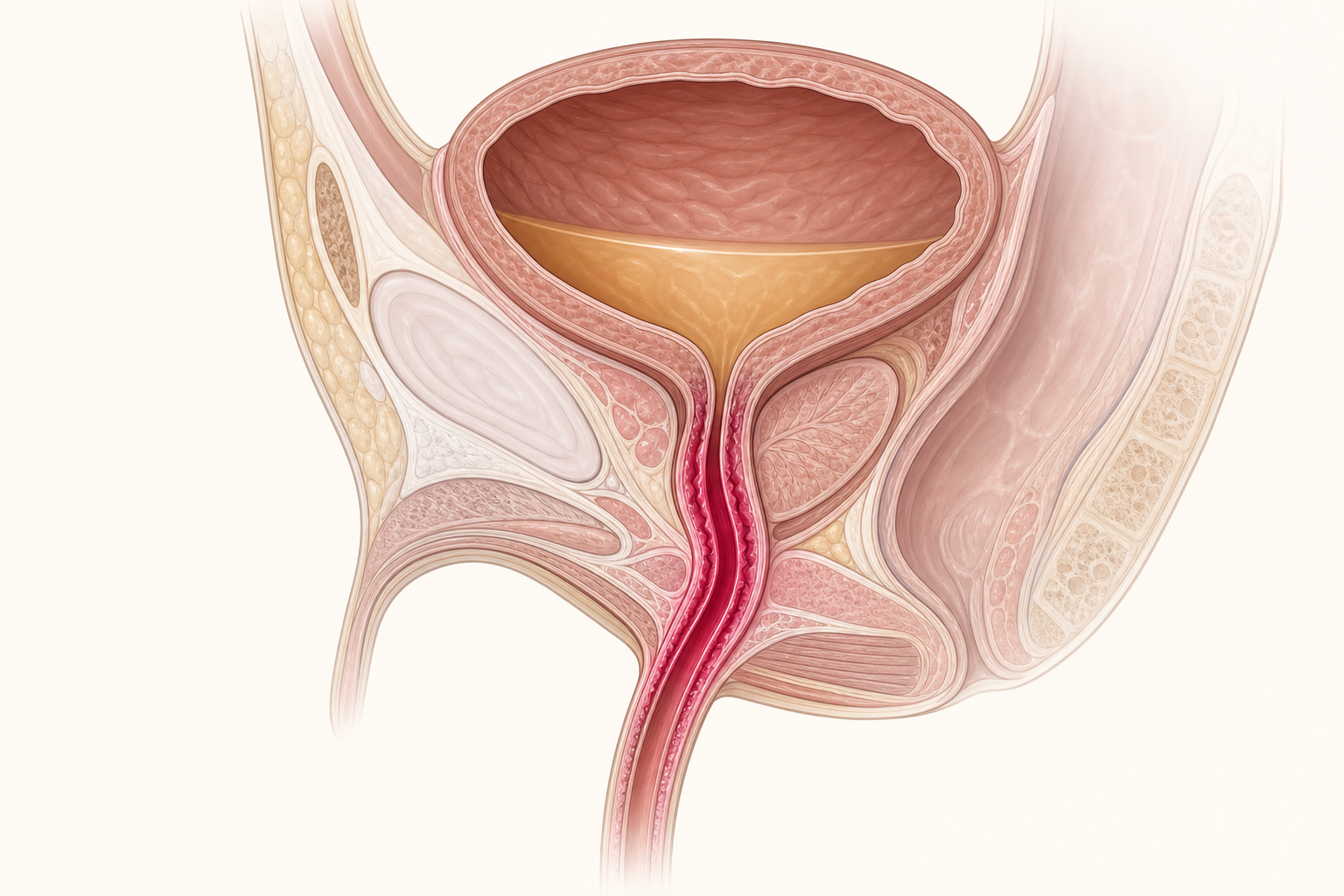
A standard urine dipstick or culture looks for the bacteria that typically cause bladder infections, mostly E. coli and a short list of related species. The test reads nitrites and leukocyte esterase, then grows out colonies if any common urinary pathogens are present. It works well for what it is designed to do.
What it does not do is detect chlamydia or gonorrhea. Those infections live in the lining of the urethra and reproductive tract and require nucleic acid amplification testing (NAAT) on a urine sample, urethral swab, or vaginal or cervical swab to be identified. Trichomoniasis is similar: a wet mount or NAAT, not a dipstick. The CDC's STI testing guidance is plain about this. STI screening is a separate request the clinician has to order. If burning is the only symptom and a UTI panel is the only thing run, an active STI can be missed entirely.
So when a provider says “no UTI,” that statement is accurate within its frame. It means no common bladder bacteria were found. The phrase that does not get spoken out loud is the second half: this test did not look for sexually transmitted infections, and if you want that information you need to ask for it specifically by name.
If your UTI dipstick comes back negative, ask the provider directly to add a NAAT for chlamydia and gonorrhea. It is a separate test order; the lab does not run it automatically alongside a urine dipstick.
The STIs That Most Often Cause That Burn
Three sexually transmitted infections account for most cases of STI-related dysuria, and each behaves a little differently.
Chlamydia. The most commonly reported bacterial STI in the United States. Per the CDC's chlamydia information page, most people who carry it have no symptoms; when symptoms do appear they often start within several weeks of exposure. Burning during urination, mild pelvic discomfort, and a faint discharge that is easy to overlook are the typical clues. In people with vaginas the cervix is often the primary site; in people with penises the urethra is.
Gonorrhea. Shorter incubation in most reported cases, generally within two to seven days, with a slightly more pronounced presentation when symptoms occur. The CDC's gonorrhea page notes that urethral discharge is more common with gonorrhea than with chlamydia, though plenty of cases are silent, especially in people with vaginas. Burning urination is one of the most reliable early signals.
Trichomoniasis. Caused by a parasite, not a bacterium. The CDC's trichomoniasis page describes a wider symptom window of about five to twenty-eight days. Itching, frothy or yellow-green discharge, and dysuria are typical in people with vaginas; men more often carry it asymptomatically and only notice mild urethral irritation if anything.
Genital herpes belongs in this conversation too, but the mechanism is different. HSV produces sores rather than urethral inflammation, and when those sores are internal (high in the vagina, just inside the urethral opening), the only sign a person notices may be sharp burning during urination. Herpes is a blood antibody test, not a urine NAAT, which is part of why it gets missed in standard STI panels.
| Condition | What it infects | Standard UTI test detects it? | Right test |
|---|---|---|---|
| UTI (bladder infection) | Bladder | Yes | Urine dipstick / culture |
| Chlamydia | Urethra, cervix, rectum | No | Lab NAAT or rapid genital swab |
| Gonorrhea | Urethra, throat, cervix, rectum | No | Lab NAAT or rapid genital swab |
| Trichomoniasis | Vagina, urethra | No | NAAT, wet mount, or rapid swab |
| Herpes | Skin and mucous membranes (sores) | No | Blood antibody test or lesion swab |
Reading the Timeline: How Symptoms Show Up Differently
One of the more useful clues is when the burning started in relation to recent sex or recent UTI risk factors (dehydration, sex without urinating after, holding urine for hours). UTIs tend to follow a fast trigger-to-symptom curve, often within a day or two. STI-related urethritis usually takes longer to show up because the organisms need time to multiply.
Picture the rough timeline. You have unprotected sex on a Friday. The weekend feels normal. By Wednesday or Thursday you notice a faint sting when you pee. You assume UTI, get a urine sample run, and it is clean. By the following week the burning is still there, no worse but no better. That delay between exposure and onset is a classic pattern for chlamydia and gonorrhea, and it is exactly the pattern a UTI test cannot explain.
The opposite mistake also happens. Burning starts the morning after sex. The reflex is to suspect an STI, but a few days of friction-related irritation is more likely if there are no other symptoms and exposure was with a regular partner whose status is known. That gap is the main reason a clean UTI test taken a few days after exposure does not close the question of whether an STI is present.
| Condition | Typical onset after exposure | Other common signs | Frequently asymptomatic? |
|---|---|---|---|
| UTI | 1 to 3 days | Urgency, frequency, cloudy urine, lower abdominal pressure | Rare |
| Chlamydia | Often within several weeks | Mild discharge or none, faint pelvic ache | Yes, in most cases |
| Gonorrhea | 2 to 7 days in most reported cases | Urethral discharge, sometimes pelvic pain | Sometimes |
| Trichomoniasis | 5 to 28 days | Itching, frothy discharge in women | Often, especially in men |
| Herpes (first outbreak) | 2 to 12 days for clinical symptoms; 12+ weeks for blood antibody seroconversion | Genital sores, internal lesions, tingling, fever during primary outbreak | Yes, after the first outbreak |
When There Is No Discharge, Just the Burn
One of the most persistent myths about STIs is that they always announce themselves with thick discharge, strong odor, or visible sores. The reality is the opposite. Per CDC chlamydia data, the majority of chlamydia infections are asymptomatic, and when symptoms do appear they are often subtle: a faint sting that comes and goes, a small change in vaginal or urethral discharge that is easy to chalk up to normal variation. Gonorrhea is similarly quiet in many cases, particularly in people with vaginas.
The practical implication is uncomfortable but useful. Burning urination on its own, with no discharge or odor, is still enough to warrant STI testing. Chlamydia and gonorrhea are often symptom-light across every sign except the burn itself, and a steady low-grade burn that lasts beyond a couple of days after a new sexual contact fits that pattern.
That is also why screening guidelines from the CDC recommend annual chlamydia and gonorrhea testing for sexually active people under twenty-five and for older adults with new or multiple partners, even when there are no symptoms at all.
Why Catching It Early Matters
Untreated chlamydia and gonorrhea do not stay confined to the urethra. In people with uteruses, infection can ascend into the upper reproductive tract and trigger pelvic inflammatory disease (PID), a condition the CDC describes as a leading preventable cause of infertility, ectopic pregnancy, and chronic pelvic pain. In people with penises, the same organisms can spread to the epididymis and cause swelling, deep testicular pain, and rarely affect fertility.
None of this is meant to alarm. The clinical picture is reassuring on the front end: the majority of bacterial STIs respond well to a short antibiotic course when caught promptly. The risk profile changes when infections are left to sit untreated for months because the burning was mild enough to ignore.
The other reason early testing matters is transmission. The WHO's STI fact sheet notes that asymptomatic and minimally symptomatic infections are a major driver of community spread precisely because the people carrying them often do not know. A test result is not just personal information; it shapes how a partner conversation can go.
Most cases of dysuria without a UTI are uncomfortable but not emergencies. Seek same-day medical care if you also have any of the following: high fever, severe pelvic or flank pain, vomiting, blood in the urine, or testicular swelling. These can signal an upper urinary tract infection, kidney involvement, or epididymitis, all of which need clinical evaluation and often imaging or stronger treatment than at-home testing can guide.
How and When to Test
Timing is the single biggest determinant of test accuracy. Testing too early, before the organism has had a chance to multiply enough to register, produces false negatives that feel like reassurance. The general windows for the most common bacterial STIs are:
- Chlamydia and gonorrhea: detectable on NAAT roughly 1 to 2 weeks after exposure; if symptoms are already present that timing is usually adequate.
- Trichomoniasis: detectable on NAAT or rapid swab within about a week of exposure.
- Herpes: clinical symptoms (sores, tingling) can appear 2 to 12 days after exposure during a primary outbreak, but a blood antibody test typically takes weeks to a few months to turn positive (the rapid blood test measures antibody seroconversion, not active lesions). A lesion swab is more reliable when a sore is present.
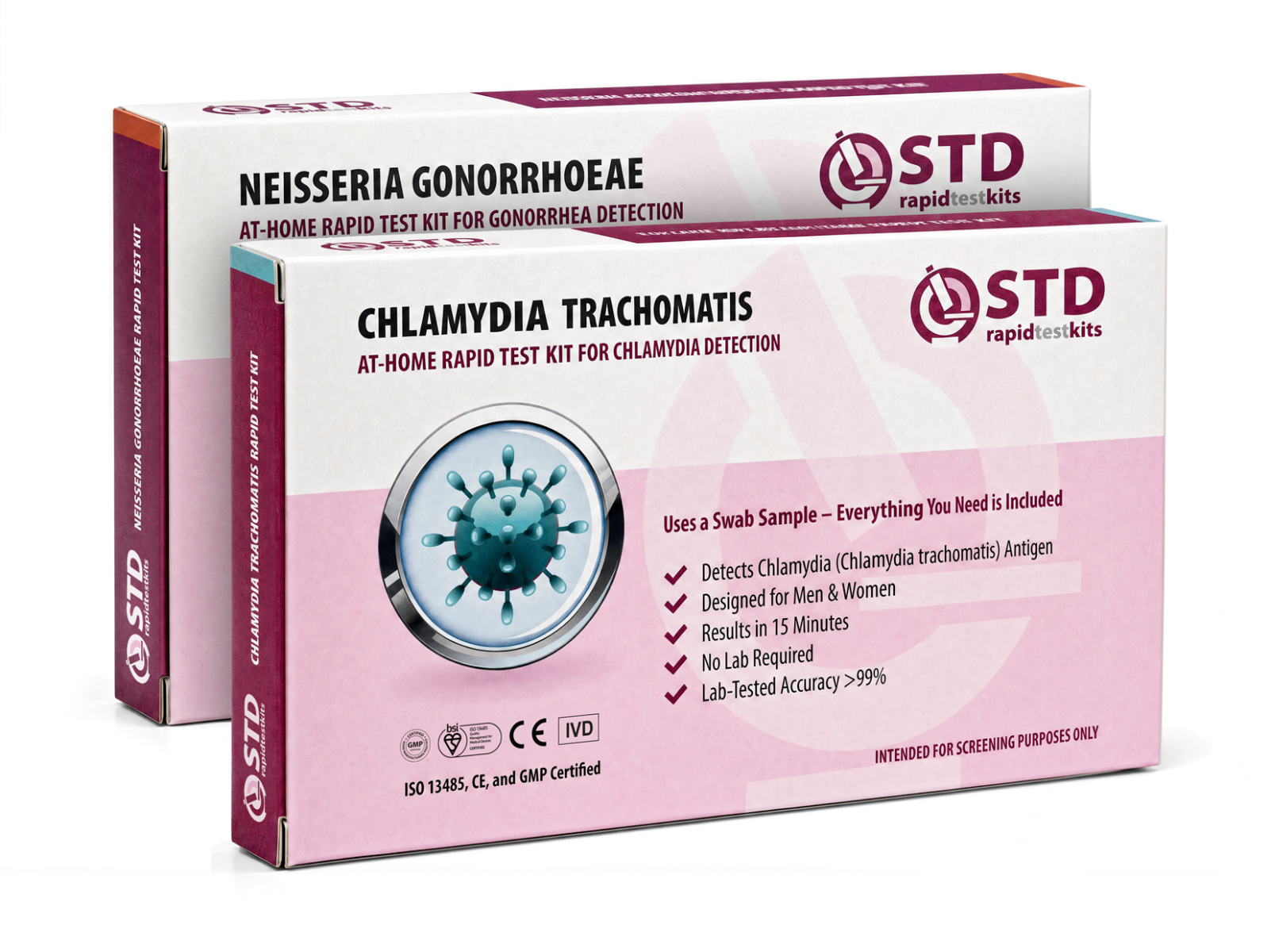
For an at-home rapid test, the swab-based products test the same sample type the lab uses (a self-collected genital swab) with lateral-flow chemistry instead of NAAT. The result is faster and private, and is most useful as a first-line screen when symptoms are present and a clinic visit is not immediately accessible. A positive at-home result is worth confirming with a lab NAAT when possible, since lab testing has higher analytical sensitivity.
If the goal is broad coverage, a multi-infection panel makes sense when several STIs are plausible from the same exposure event (a swab combo for chlamydia and gonorrhea, plus blood-based tests for HIV, syphilis, and hepatitis if exposure was unprotected with a new partner).
How long after sex should I wait to test if it burns to pee?
If you have symptoms now, testing 7 to 14 days after the suspected exposure gives the most reliable result for chlamydia, gonorrhea, and trichomoniasis. Testing earlier than that can produce a false negative because the organism has not yet multiplied to a detectable level. If symptoms started within a few days of sex and your first test was negative, retest at the 14-day mark before assuming the burning has another cause.
Burning After Sex: Friction or Infection?
Not every post-sex sting is an STI. Friction during sex, inadequate lubrication, dehydration, certain spermicides, and some scented soaps can all temporarily irritate the urethra and the surrounding tissue. Friction-related irritation has a recognizable shape: it is worst in the first 24 hours, gets better with rest, water, and gentle care, and is essentially gone within two or three days.
Infection behaves differently. The discomfort lingers, can fluctuate hour to hour, and does not fully clear with hydration. It is often most noticeable first thing in the morning when urine is concentrated, then returns with each subsequent void during the day. Persistence is the main dividing line. If the burn is still meaningful at day five with no other obvious explanation, it has stopped looking like simple friction.
When It Is Neither a UTI Nor an STI
Sometimes urine cultures and STI panels both come back negative and the burning is still there. That does not mean the symptom is imagined. It means the cause is somewhere outside the most common two categories. The Mayo Clinic's review of dysuria causes lists several non-infectious culprits worth working through with a clinician: a yeast imbalance creating external rather than urethral burning, kidney stones (usually with flank pain that radiates), interstitial cystitis (chronic, recurring bladder pain without infection), and chemical irritation from a new soap, lubricant, spermicide, or laundry detergent.
This is the point at which guesswork stops being useful. Persistent dysuria beyond two to three weeks with negative UTI and STI testing is a reason to see a clinician for a fuller workup, which may include pelvic exam, imaging, or referral to a urologist or pelvic-floor specialist depending on the picture.
| Possible cause | Typical pattern | Distinguishing clue |
|---|---|---|
| Yeast imbalance | External burning, often itching | Thick or curd-like discharge, vulvar redness |
| Kidney stone | Sharp flank or back pain, sometimes blood in urine | Pain radiates to groin or lower back, often comes in waves |
| Interstitial cystitis | Chronic, recurring bladder pain and urgency | Symptoms persist for months without infection on culture |
| Chemical irritation | Sudden onset after introducing a new product | New soap, lube, spermicide, or laundry detergent in the past week |
| Atrophic vaginitis (postmenopausal) | Burning, dryness, easy tissue irritation | More common after menopause; eased by topical estrogen under clinician guidance |
A Note for Both Sexes
UTI assumptions cut differently depending on anatomy. People with vaginas are routinely treated empirically for a presumed UTI without follow-up testing, and when antibiotics do not resolve symptoms it is worth asking specifically for STI screening rather than another empiric course. People with penises are often told UTIs are uncommon (which is statistically true), and that framing can lead to symptoms being chalked up to friction or stress when an STI is actually the more likely explanation. The same blanket rule applies in both directions: persistent dysuria after a clean UTI test is an indication for STI testing, regardless of who is asking.
Oral and anal exposure routes are also worth naming explicitly. Oral sex can transmit chlamydia and gonorrhea to or from the throat, and pharyngeal infections sometimes cause throat soreness alongside genital symptoms. Pharyngeal swab testing is a clinic procedure, not something at-home rapid kits cover; if throat-route exposure is part of the picture, a clinic visit is the right next step in addition to (not instead of) genital testing.
Most people who have chlamydia have no symptoms. If you do have symptoms, they may not appear until several weeks after you have sex with an infected partner.
Your Next Step
Painful urination without a UTI is uncomfortable to sit with because it sits in a gap: clearly something, not yet identified. The way out of that gap is information. If exposure happened in the last few weeks and the burning has lasted more than a few days, an STI screen is the most useful next move, whether that happens at a clinic, a sexual-health center, or with an at-home rapid kit. The lab and the rapid swab are looking for the same organisms with different chemistries; both move you from guessing to knowing.
If both tests come back negative and symptoms persist beyond two to three weeks, that is the right moment to see a clinician for a fuller evaluation rather than re-testing in a loop. Most of the time the answer is in one of the categories above.
Frequently asked questions
- Why does it burn when I pee but my UTI test was negative?
- The most common reason is an STI that the UTI test does not look for. Chlamydia, gonorrhea, and trichomoniasis can all inflame the urethra in a way that feels like a UTI, and they need a separate test (lab NAAT or a rapid genital swab) to be detected. A clean UTI dipstick rules out common bladder bacteria, not these infections.
- Can chlamydia really feel exactly like a UTI?
- Yes. Chlamydia urethritis can produce burning, mild urgency, and a faint sense of irritation that overlaps almost completely with bladder-infection symptoms. Per the CDC, most chlamydia cases have no symptoms at all; when they do, dysuria is one of the most common.
- Can you have an STI without any discharge?
- Yes, very commonly. Chlamydia is asymptomatic in the majority of cases, and even when there are symptoms the discharge is often mild enough to miss. Gonorrhea and trichomoniasis are similar in people with vaginas. Burning during urination on its own, without discharge, is enough to warrant testing.
- How long after sex should I wait before testing?
- Seven to fourteen days is the reliable window for chlamydia, gonorrhea, and trichomoniasis. The bacterial load needs that much time to build to a level the test can detect. If you tested at day three on symptoms that have persisted, retest at day fourteen before concluding the negative result is your answer.
- Can oral sex cause burning urination?
- Yes. Chlamydia and gonorrhea can transmit through oral sex to or from the throat or genitals. If the receptive partner during oral sex develops urethral burning, an STI is on the differential. Pharyngeal swab testing is a clinic service rather than something the at-home rapid kits cover; for throat-route concerns, clinic-administered testing is the right path.
- What if I am scared to test?
- Most bacterial STIs are treatable with a short antibiotic course when caught early, and the medical and emotional cost of waiting is higher than the cost of testing. If a clinic feels intimidating, an at-home rapid kit is private and uses the same swab sample type the lab uses. The act of testing usually lowers anxiety because it replaces speculation with a real answer.
- Should I tell my partner before I get tested?
- Test first, then talk. A conversation grounded in a real result tends to go better than one driven by suspicion. If a result comes back positive, partner notification matters because chlamydia and gonorrhea can ping-pong back and forth between partners and reinfect even after treatment if both people are not treated.
- Is it dangerous to leave it untreated?
- Chlamydia and gonorrhea can trigger pelvic inflammatory disease in people with uteruses when left untreated, which the CDC lists as a leading preventable cause of infertility. In people with penises the same organisms can spread to the epididymis and cause swelling and deep testicular pain. The reassuring side is that prompt treatment is usually a single short antibiotic course, so catching it during the symptomatic window typically prevents the complications.
How we sourced this article. This guide was constructed from current public-health guidance from the U.S. Centers for Disease Control and Prevention, the World Health Organization, and the U.K. National Health Service, alongside clinical references from the Mayo Clinic. Every quantitative claim is linked inline to its source. The article is editorial summary writing, not personal clinical advice; for symptoms that concern you, see a licensed clinician.
- U.S. Centers for Disease Control and Prevention. About Sexually Transmitted Infections (STIs). Public information hub for STI screening guidance and testing methodology.
- U.S. Centers for Disease Control and Prevention. About Chlamydia. Reference for chlamydia symptom timing, asymptomatic prevalence, and complications including pelvic inflammatory disease.
- U.S. Centers for Disease Control and Prevention. About Gonorrhea. Reference for gonorrhea symptoms (urethral discharge, dysuria) and recommended screening.
- U.S. Centers for Disease Control and Prevention. About Trichomoniasis. Reference for trichomoniasis incubation window and gender-based symptom patterns.
- Mayo Clinic. Painful urination (dysuria): causes. Differential-diagnosis reference for non-infectious causes of dysuria.
- World Health Organization. Sexually transmitted infections (STIs) fact sheet. Global epidemiology and asymptomatic-transmission context.
- U.K. National Health Service. Chlamydia. Patient-facing reference for chlamydia symptoms and testing.
- U.K. National Health Service. Gonorrhoea. Patient-facing reference for gonorrhea symptoms and testing windows.
