







Quick Answer: Pain in one testicle without a lump can be caused by infections like chlamydia, epididymitis, or even physical strain. While not all causes are dangerous, some require urgent care, especially if pain is sudden or severe. Testing for STDs is smart if you’re sexually active, even with no discharge or rash.
This Isn’t Just “Blue Balls”, And Here’s Why
Let’s start with the most common misfire: assuming any testicle pain without a lump is from arousal frustration, or “blue balls.” While that’s a real thing, called vasocongestion, it’s usually short-lived and improves after ejaculation or a few hours of rest. When pain lingers, intensifies, or seems to be coming from inside rather than surface-level, it’s time to rule out more serious possibilities.
Chris, 29, thought he’d just overdid it at the gym. “It felt like a tug on my left side, low, like near the groin. I thought maybe I yanked something doing squats.” But after three days, the ache had spread downward. Still no swelling. Still no visible signs. “I finally admitted it wasn’t going away. I’d had unprotected sex a couple weeks earlier and started to panic it might be an STD.”
Stories like Chris’s are common. Many STDs don’t show external signs, no bumps, no burning, no discharge. But inside, the inflammation can be intense. One of the most overlooked signs? A dull, persistent ache in one testicle.
STDs That Can Cause Testicle Pain, Without a Lump
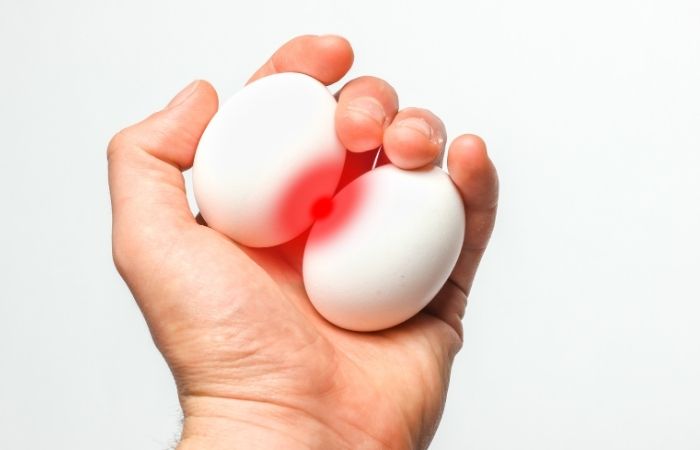
Some infections travel upward from the urethra into the reproductive tract. In men, this can inflame the epididymis (a tightly coiled tube on the back of the testicle that stores and carries sperm), leading to a condition called epididymitis. This is often the real culprit behind one-sided testicle pain, especially when it’s subtle at first, and there’s no visible swelling or mass.
Here’s how some common STDs play into this picture:
| STD | Can It Cause Testicle Pain? | Other Symptoms Always Present? | Needs Treatment? |
|---|---|---|---|
| Chlamydia | Yes – often leads to epididymitis | No – can occur with no discharge or burning | Yes – requires antibiotics |
| Gonorrhea | Yes – similar to chlamydia in presentation | Sometimes – may include discharge | Yes – needs treatment to prevent complications |
| Herpes (HSV) | Rare – possible if internal flare-up occurs | No – pain may occur without sores | Yes – antivirals help control outbreaks |
| Syphilis | Rare – advanced cases may cause discomfort | Usually painless until later stages | Yes – always treatable if caught early |
Table 1. STDs that may cause testicular pain without visible symptoms like a lump or discharge. These infections are treatable, but can damage fertility if left unaddressed.
If you’re feeling discomfort in one testicle and have had any recent sexual contact, protected or not, it’s worth testing. Even if you don’t have classic “burning when you pee” symptoms, inflammation might already be affecting your internal anatomy.
People are aslo reading: HIV Rash or Something Else? What It Looks Like on Dark Skin
But I Haven’t Had Sex Recently, Could It Still Be an STD?
It’s a fair question. Some people feel shocked to learn they can carry an STD for weeks or months without knowing, especially men. Many infections, particularly chlamydia and gonorrhea, are quietly transmissible for a long time before symptoms show. Even oral sex can transmit bacteria that travel into the testicles over time.
Case in point: Rohan, 22, was in a monogamous relationship. He hadn’t had any new partners in over six months. “So when I got this weird ache in my right testicle, I didn’t even think about STDs. I figured maybe I bumped into something or had a hernia.” After home testing, it turned out he had chlamydia. His partner had no symptoms either, but both needed treatment.
This is why pain in one testicle, even without a lump or visual clue, shouldn’t be brushed off. Time doesn’t always mean safety when it comes to STDs.
Check Your STD Status in Minutes
Test at Home with Remedium8-in-1 STD Test Kit
 For Men & Women
 Results in Minutes
 No Lab Needed
 Private & Discreet
Order Now $149.00 $392.00
For all 8 tests
Not Every Ache Is an STD, Other Possible Causes
Not all testicle pain comes from infections. Sometimes, the body sends confusing signals. The ache you feel in one testicle might actually be referred pain from another structure, like the lower back, groin, or even a pinched nerve. Still, ruling out medical causes matters, because some of them require fast intervention.
Here are other common culprits behind one-sided testicle pain without a lump:
| Condition | Key Clues | Urgency Level |
|---|---|---|
| Physical strain or sports injury | Recent lifting, twisting, impact to groin | Low – monitor unless worsening |
| Epididymitis (not from STD) | Can result from urinary tract infections or prolonged sitting | Moderate – see provider if pain increases |
| Testicular torsion | Sudden, severe pain + nausea or high-riding testicle | High – medical emergency |
| Varicocele or hydrocele | Visible fullness, heaviness, or swelling on one side | Moderate – imaging often needed |
| Nerve-related pain | No touch sensitivity, may fluctuate with position | Low – consider physical therapy or imaging |
Table 2. Not all testicle pain is caused by infection or trauma. This table outlines other anatomical or nerve-based causes, and when each should raise concern.
It’s possible to have overlapping issues, say, a mild STD flare-up paired with a pulled groin muscle, which can blur the picture. But one rule tends to help: if the pain came on gradually and lingers as a dull throb, it’s more likely to be infection or strain. If it came on suddenly, is sharp, or is paired with nausea or swelling? Call a doctor. Right away.
Case Study: The Pain Came, Then Went, Was It Nothing?
Diego, 35, woke up one morning with a tight, low ache on the right side. “It wasn’t unbearable, just annoying. I assumed I must’ve twisted weird or pulled something. But then it was gone by noon. I almost forgot about it.” But two days later, it returned, and lingered longer. Still no lump. Still no rash. Still nothing visible in the mirror. After another week of quiet discomfort, he finally ordered a home STD test.
“Turns out it was gonorrhea. I’d had it before but it didn’t feel like this. No discharge this time, no burning. Just that ache.” Diego’s story shows how symptoms can shift between flare-ups, and how easy it is to misjudge “mild” pain.
If the pain went away, it’s not necessarily gone. Many infections follow a waxing and waning cycle, especially in men who carry them silently. And if one side of the testicle or epididymis becomes inflamed, the body might respond with mild swelling that’s hard to see but still causes deep ache or pressure.
How Testing Helps, Even Without Obvious Signs
When there’s no rash, no pus, and no fever, many people assume testing will come back negative. But that’s exactly why infections linger. Silent infections are still active, and still cause internal inflammation, even when the outside looks normal.
Some men test only when they have visible signs. But testicular pain without a lump can absolutely be a sign that something’s off. And here’s the good news: home testing is fast, discreet, and doesn’t require anyone examining your balls in person (unless you want that, no judgment).
If your head keeps spinning, peace of mind is one test away. Order a combo STD home test kit to screen for the most common culprits discreetly, right from home.
You’ll swab, wait, and send, then get answers fast. No waiting room. No awkward explanations. Just clarity, right when you need it most.
When Should You Test? And When Should You Retest?
Timing matters more than most people realize. If you test too early, say, just a few days after exposure, you might get a false negative. That’s because your body hasn’t produced enough bacterial load (or antibodies, in the case of some infections) for a test to pick up.
But how soon is too soon? Let’s break it down. Here’s a general look at when accuracy starts to rise for common STD tests:
| Infection | Minimum Time to Detect | Best Time to Test | Retesting Needed? |
|---|---|---|---|
| Chlamydia | 5–7 days | 14+ days post exposure | Yes, if early test is negative but symptoms persist |
| Gonorrhea | 5–7 days | 14+ days post exposure | Yes – especially with high-risk contact |
| Herpes (HSV-2) | 10–14 days (for sores); 3–6 weeks (for blood test) | 4–6 weeks post exposure (for blood testing) | Depends – recheck if symptoms evolve |
| Syphilis | 3 weeks | 6–12 weeks post exposure | Yes, especially if exposed during early phase |
Table 3. Timing matters when testing for infections linked to testicular pain. Early testing can miss active infections. Retesting helps confirm results if symptoms linger.
If you’ve already tested negative but the pain continues, you’re not crazy for still feeling worried. It might be time to retest, especially if your first test was taken earlier than the suggested window. At-home kits can be repeated safely, or you can follow up with a clinic if anything feels off.
STD Rapid Test Kits offers discreet retest options without judgment. Sometimes, your best next step isn’t a specialist, it’s just a second look.
People are aslo reading: When to Test for Gonorrhea After Exposure
Should I Tell My Partner About the Pain?
Let’s talk about the awkward part, bringing it up. Maybe you’re in a new relationship. Maybe it’s a situationship that’s been heating up. Or maybe it’s been quiet for a while, but you had a one-time hookup and now feel unsure.
If you’re sexually active with anyone and have unexplained testicle pain, even without a lump or visible sore, it’s worth looping them in. That doesn’t mean accusing or assuming. It just means opening the door to testing together, and protecting each other before it turns into a cycle of ping-pong infections.
Marco, 33, struggled with this. “It felt weird to say ‘Hey, one of my balls hurts, maybe we should both get tested.’ But when I did, my partner was super chill about it. We both did mail-in tests, got treated, and it ended up bringing us closer.”
Transparency doesn’t have to be dramatic. A simple, “Hey, I’ve been feeling some pain and I’m going to get tested. Want to do it too?” is enough. You don’t have to explain everything. You just have to take the first step.
So When Do You Actually Need a Doctor?
Here’s where we draw the line. If the pain is sharp, sudden, or wakes you from sleep, go in. If you feel nausea with it, if one testicle sits higher than the other suddenly, or if the pain worsens rapidly over hours, go to urgent care or the ER. These are signs of testicular torsion, which can cut off blood flow and cause permanent damage in a matter of hours.
If the pain is dull, gradual, or comes and goes, it’s safe to start with testing and monitoring. But don’t let mild symptoms drag on for weeks without answers. Infections left untreated can lead to long-term pain, infertility, or complications that could’ve been handled early.
And if you’re just not sure what you’re feeling? You’re not alone. Most guys don’t grow up being taught how to interpret testicle pain. That’s why services like Combo STD Home Test Kits exist, to let you check discreetly, before small things become big problems.
Check Your STD Status in Minutes
Test at Home with Remedium7-in-1 STD Test Kit
 For Men & WomenResults in MinutesNo Lab NeededPrivate & Discreet
Order Now $129.00 $343.00
For all 7 tests
When “Not That Bad” Still Deserves Attention
Lamar, 40, brushed it off for weeks. The ache in his left testicle wasn’t terrible, just annoying. It would fade, then return, usually when he sat too long or after sex. He told himself it was nothing. “I figured, if it were serious, it would really hurt.” But the slow build turned out to be untreated chlamydia, quietly causing inflammation the whole time.
This is where a lot of men get stuck, between discomfort and denial. If you’re not doubled over, if there’s no blood, if nobody else sees it… is it even real? The truth is, testicular pain doesn’t need to be dramatic to be valid. And even minor symptoms can signal deeper issues if left unchecked.
Whether it’s something or nothing, checking gives you closure. And honestly? Knowing beats guessing every time. You don’t have to be in crisis to deserve care. Pain is your body’s way of waving a flag, not screaming, not begging, just waving, asking you to look closer.
FAQs
1. Can an STD really cause testicle pain with no other symptoms?
Yes, and it happens more than most guys realize. One-sided testicle pain with no discharge, no burning, and no rash? That’s textbook chlamydia-related epididymitis. It sneaks in quietly and inflames the back of your testicle without ever showing its face. Just because you can’t see it doesn’t mean it’s not there.
2. It’s just a dull ache. Am I overthinking this?
No, you’re not. That tugging, slightly sore feeling you keep noticing? That’s your body nudging you to pay attention. It might be mild now, but it’s how a lot of untreated infections start. You don’t need to panic, but you do deserve answers.
3. How long should I wait to test after a hookup?
If it’s been less than 5 days, testing might be too early. But 7 to 14 days? You’re in the right window for most infections. If you test early and it’s negative but the pain sticks around, retest after two weeks. Better safe than spreading something you didn’t even know you had.
4. Could it just be from rough sex or a bad position?
Totally possible. The testicles are drama queens, one weird twist, and you can be sore for days. But if the ache lingers more than 48 hours or gets worse with time? That’s not just friction. That’s your sign to test or check in with a provider.
5. I already tested last month. Do I really need to test again?
Maybe. If your last test was before the pain started, or if you had new sexual contact since, retesting makes sense. Think of it like this: testing is a snapshot, not a time machine. It tells you what was true then, not necessarily what’s true now.
6. What if my test is negative but it still hurts?
Two things. One: you may have tested too early. Two: it might not be an STD, it could be nerve-related pain, strain, or even a brewing urinary tract issue. But pain that lingers always deserves a follow-up, whether it’s a retest or a real-life visit with a urologist.
7. Can I get STDs from oral sex and still have ball pain?
Absolutely. Oral sex isn’t risk-free. Gonorrhea, chlamydia, and even herpes can hitch a ride that way. It doesn’t always hit the penis directly, it can migrate, inflame tissue deeper inside, and show up as testicle discomfort days or weeks later.
8. Is testicle pain ever a sign of cancer?
It can be, but it’s rare. Cancer usually shows up as a lump, firmness, or swelling, most often painless. That said, if you feel something hard, or the pain is deep and persistent, a quick ultrasound can rule out the scary stuff. Don’t spiral, just get it checked.
9. This happened once before. Should I be worried it’s coming back?
If this isn’t your first rodeo with one-sided testicle pain, it might be a recurring infection, or leftover inflammation from a past one. Either way, it means your body’s sensitive to something, and you shouldn’t ignore the repeat performance. Test again. Clear the air.
10. Can I really test for all this from home?
Yup. No need to drop your pants in front of a stranger. A discreet kit like the Combo STD Home Test can check for the top offenders causing pain, without leaving your house. Swab, seal, ship, done. Privacy stays intact. So does your peace of mind.
You Deserve Answers, Not Assumptions
Pain in one testicle doesn’t have to mean panic, but it shouldn’t be ignored either. Whether it's caused by a silent STD, a small strain, or something your body’s been quietly managing for weeks, getting clarity helps. You don’t need to justify concern to anyone. Your body is talking. Listening is the first step toward relief, and peace of mind.
Don’t wait and wonder, get the clarity you deserve. This at-home combo test kit checks for the most common STDs discreetly and quickly.
How We Sourced This Article: To make this guide useful, kind, and accurate, we used the most up-to-date advice from top medical groups, peer-reviewed research, and reports from people who have lived through the issues.
Sources
2. Urology Care Foundation – Testicular Torsion
3. Testicle pain causes – Mayo Clinic
4. Epididymitis: Symptoms and causes – Mayo Clinic
5. Testicular torsion: Symptoms & causes – Mayo Clinic
6. CDC – Epididymitis Treatment Guidelines
7. Acute Scrotum Pain – StatPearls / NCBI Bookshelf
8. Epididymitis — Causes, Symptoms, Diagnosis & Treatment – Cleveland Clinic
9. Testicular Torsion – StatPearls / NCBI Bookshelf
10. Epididymitis – American Family Physician (AF Guide)
About the Author
Dr. F. David, MD is a board-certified infectious disease specialist focused on STI prevention, diagnosis, and treatment. He blends clinical precision with a no-nonsense, sex-positive approach and is committed to expanding access for readers in both urban and off-grid settings.
Reviewed by: Naomi S., RN, MPH | Last medically reviewed: December 2025
This article is for informational purposes and does not replace medical advice.


