

Published: September 2025 | Last updated: April 2026 | Editorial review and quality control: Martina N.
You had sex you weren't expecting to have, or that didn't go the way you planned, and now you're trying to figure out how soon a gonorrhea test will actually tell you something useful. The honest answer: timing matters more than the test you pick. A high-end laboratory test done two days after exposure can still miss a real infection, because the bacteria simply isn't yet present in detectable amounts. Wait the right number of days, and a far cheaper at-home swab can give you a workable answer.
This guide walks through what the testing window looks like for gonorrhea, why testing too early hurts more than it helps, when retesting is the right call, and what to do if your result comes back positive.
How soon after exposure can I test for gonorrhea?
Most laboratory and at-home tests become reliable about 7 days after exposure, with peak accuracy between days 10 and 14. If your last possible exposure was less than a week ago, wait. If you're at day 7 or later, test now and plan a retest at day 14 if your first result is negative but symptoms develop.
Key Takeaways
- The optimal test window for gonorrhea is days 7 to 14 after exposure, with peak accuracy at days 10 to 14.
- The CDC recommends a follow-up retest 3 months after any positive treatment, regardless of whether your partner was also treated.
Why the day you test matters more than which test you pick
Gonorrhea is a bacterial infection. After exposure, the bacteria need time to take hold in the tissue they were deposited in: the urethra, vagina, cervix, throat, or rectum. They replicate, the immune response begins, and slowly the bacterial load rises to a level a diagnostic test can detect. Until that happens, no test will reliably catch it. Not a clinic test, not a mail-in lab kit, not an at-home rapid test.
This is the part of testing most people get wrong. They feel anxious, they want certainty, they test on day 2, the result is negative, and they conclude they're fine. They aren't necessarily fine. They're early. According to the NHS, gonorrhea symptoms usually start around 2 weeks after infection, and bacterial detection follows a similar curve.
A negative result in the first 6 days after exposure carries a high false-negative rate, even on a high-sensitivity laboratory test. Wait until at least day 7 before treating any result as meaningful, and plan a day-14 retest if your first sample was taken inside that early window.
The window period for gonorrhea, in plain language
Window period means the gap between exposure and when a test can reliably find the infection. For gonorrhea, that window opens at roughly 7 days, with peak detection between days 10 and 14. Some lab tests can pick up the bacteria slightly earlier, but the rate of false negatives in those first few days is high enough that no major guideline recommends testing inside the first week unless you already have symptoms.
Here is how the timeline tends to play out:
| Days after exposure | Symptoms (if any) | Test reliability |
|---|---|---|
| 0 to 2 days | Almost always none | Too early. Don't rely on a result yet. |
| 3 to 6 days | Possible early signs in some men | Inconsistent. False negatives are common. |
| 7 to 9 days | Symptoms may appear in those who develop them | Most tests start to work. |
| 10 to 14 days | Most symptoms emerge if they will | Peak accuracy. |
| 14+ days | Variable; many people remain asymptomatic | Reliable. |
Hour by hour: what your body is actually doing
One reason the wait feels endless is that nothing visible is happening. The hour-by-hour reality is far less dramatic than the anxiety suggests:
- Hours 0 to 24: Nothing detectable, no symptoms expected. Bacteria are establishing in the exposed tissue.
- Days 1 to 3: Still typically silent. Any sensation you notice (a tingle, slight burning, a feeling of "something is off") at this stage is much more likely to be anxiety, dehydration, or routine irritation than gonorrhea.
- Days 3 to 5: Some men with urethral exposure may begin to notice mild discomfort while urinating or thin discharge. Most people still feel nothing.
- Days 5 to 7: Symptoms become more likely if they're going to appear. Tests begin to register reliably.
- Days 7 to 14: The detection window opens fully. If you're going to develop symptoms, you usually have by now.
Many people with gonorrhea never develop symptoms at all. The CDC notes that most women with gonorrhea do not have any symptoms, and a substantial share of men also remain asymptomatic. Asymptomatic gonorrhea is common enough that public-health guidance leans on routine screening rather than waiting for symptoms to appear.
Gonorrhea timing at a glance
- Most reliable test window: days 7 to 14 after exposure.
- Peak accuracy: days 10 to 14.
- Symptoms (when they appear) typically start within 2 to 14 days, often around the 2-week mark.
- Most women and a meaningful share of men remain asymptomatic throughout the infection.
Where you were exposed changes which test you need
Gonorrhea infects whatever mucosal tissue it lands on. Vaginal or penile exposure produces a urogenital infection that responds to a urethral or vaginal swab. Oral exposure (giving or receiving oral sex) can produce throat infections that a urogenital swab will miss entirely. Receptive anal exposure produces rectal infections that need a rectal swab.
This matters for testing logistics:
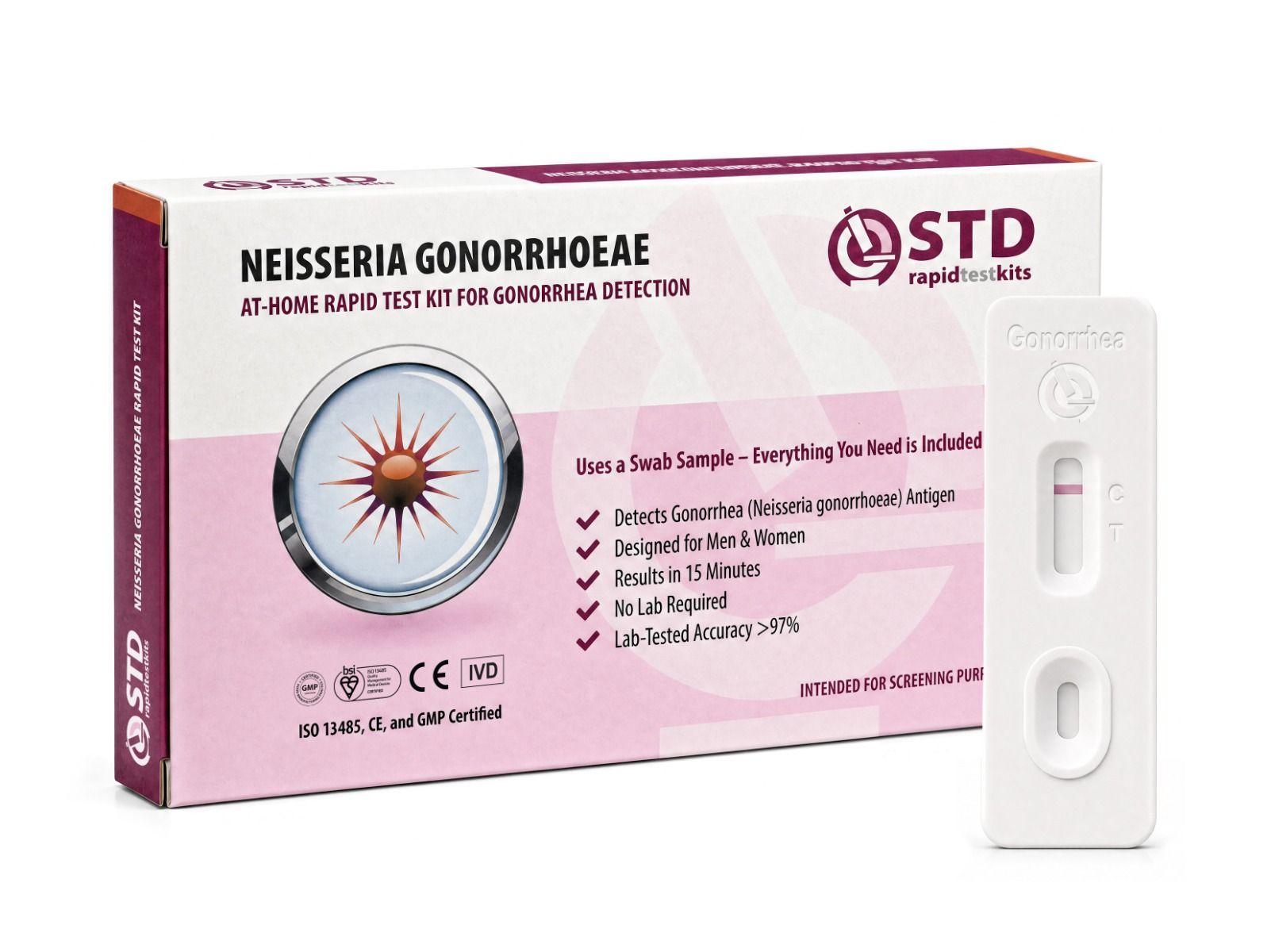
- Genital exposure (vaginal or penile): A self-collected swab from the affected area is well suited. This is what our at-home rapid kit covers.
- Oral exposure: You need a pharyngeal (throat) swab. Most home test providers, including ours, do not sell a throat-swab kit. For oral testing, see a clinic or sexual-health service.
- Anal exposure: You need a rectal swab, also typically clinic-only.
If your exposure was mixed (oral plus genital, for instance), the safe approach is to swab at home for the genital site and book a clinic visit to swab the others. Don't substitute a genital test for a throat test.
Our at-home rapid kits use lateral-flow chemistry on a self-collected genital swab. They are a good fit for vaginal or penile exposure. We do not sell pharyngeal (throat) or rectal swab kits. If your exposure was oral or anal, a clinic-administered swab of that site is the right tool, and a home genital test is not a substitute. A positive home result is also worth confirming with a lab where possible, because lab NAAT methods have higher analytical sensitivity than any rapid lateral-flow test. The rapid tests linked below are sold on this site; the timing guidance above applies regardless of where you ultimately purchase.
If you tested early and got a negative result
An early-window negative is a truthful report of the sample at that moment, but it cannot rule out an infection that hasn't yet reached detectable levels. The test is reporting accurately on what was in the swab the day you took it. The infection may not yet have been at testable levels, or it may not exist at all, and a single early test cannot distinguish the two cases.
The right move is straightforward: retest at day 14. If the second test is also negative and you have no symptoms, you're very likely in the clear. If symptoms develop at any point, retest sooner regardless of where you are in the window. Burning during urination, unusual genital discharge, pelvic pain, spotting between periods, or testicular swelling are all reasons to test again or see a clinician.
Retest decision tree after an early negative
- If symptom-free, retest at day 14 from your last possible exposure.
- If any symptoms appear (burning urination, discharge, pelvic pain, testicular swelling), retest immediately.
- If a second test is also negative but symptoms persist, see a clinician for a clinic-administered NAAT or culture.
When to retest after treatment
Gonorrhea treatment is straightforward: the CDC's first-line regimen is a single 500 mg intramuscular dose of ceftriaxone, with adjustments for body weight or concurrent chlamydia. What's less straightforward is what happens after.
The CDC recommends retesting 3 months after treatment, regardless of whether you believe your partner was treated. Reinfection is common, often within weeks of the original treatment, especially if a partner went untreated or a new partner enters the picture. The 3-month retest is a check for new infection rather than a test of cure. For pharyngeal (throat) gonorrhea specifically, the CDC additionally recommends a test of cure 7 to 14 days after treatment.
Three situations call for an earlier retest:
- Your symptoms didn't go away or returned within 1 to 2 weeks of treatment. This may signal antibiotic-resistant gonorrhea, which is a growing concern; the WHO highlights drug resistance as a major threat to gonorrhea care worldwide.
- You had sex with an untreated partner before they completed therapy.
- You took the test before day 7 and the result was negative.
Men or women who have been treated for gonorrhea should be retested 3 months after treatment regardless of whether they believe their sex partners were treated.
What to do if your test is positive
A positive result is workable. Gonorrhea is one of the most treated bacterial STIs in the world, with an estimated 82 million new infections globally in 2020 per the WHO. Treatment is a single dose of antibiotics, given by injection in most cases, and most uncomplicated infections clear quickly with no lasting damage when caught and treated early.
The actions that matter:
- Get treated. A walk-in clinic, sexual-health service, or telehealth provider can prescribe ceftriaxone. If you tested at home, take a photo of your result and bring it to the appointment.
- Tell your recent partners. The standard window is anyone you had sex with in the past 60 days. Anonymous partner-notification services exist if doing it directly isn't safe or possible.
- Pause sex until treatment is complete and your partners have also been treated. Otherwise you'll exchange the infection back and forth.
- Plan a retest 3 months out, per the CDC.
- Consider testing for chlamydia at the same time. Co-infection is common enough that providers usually treat for both unless chlamydia has been specifically ruled out.
Common questions about gonorrhea testing timing
- How long after exposure should I wait to test for gonorrhea?
- Count forward 7 days from your last possible exposure. That date is your earliest reliable test day. For the most accurate result, wait until day 10 to 14. If you tested before day 7 and got a negative, retest at day 14, or sooner if symptoms develop.
- Can I have gonorrhea without any symptoms?
- Yes. Most women and many men never notice any symptoms, which is why a single concerning exposure is sufficient reason to test rather than waiting to see if anything develops. Routine screening is recommended for sexually active women under 25 and for men who have sex with men, even when nothing feels wrong.
- Are at-home swab tests as accurate as clinic tests?
- At-home rapid tests use lateral-flow chemistry on the same kind of self-collected swab a clinic might use. Clinic NAAT (nucleic acid amplification) testing has higher analytical sensitivity, especially in low-bacterial-load infections. A home rapid test is well suited for screening when you're inside the right window; a positive result is worth confirming with a lab when possible.
- What if I had oral sex with someone who tested positive?
- Throat (pharyngeal) gonorrhea is often symptomless and needs a throat swab to detect. Most home test providers, including ours, do not sell pharyngeal swab kits. For oral exposure with throat involvement, see a clinic for a pharyngeal NAAT. A genital home swab will not catch a throat infection.
- Do I need to retest after treatment even if I feel fine?
- Yes. The 3-month retest is checking for a new infection rather than confirming the original treatment worked. Reinfection from an untreated partner is the most common reason a follow-up test comes back positive, often within a few weeks of the first round of antibiotics.
- Can recent antibiotics affect my test result?
- They can. Antibiotics taken for any reason (sinus infection, urinary tract infection, dental work) may suppress bacterial load enough to produce a false-negative result. If you started antibiotics recently and your test was negative, mention it to a clinician and consider retesting after the antibiotic course has cleared from your system.
- Is chlamydia commonly tested alongside gonorrhea?
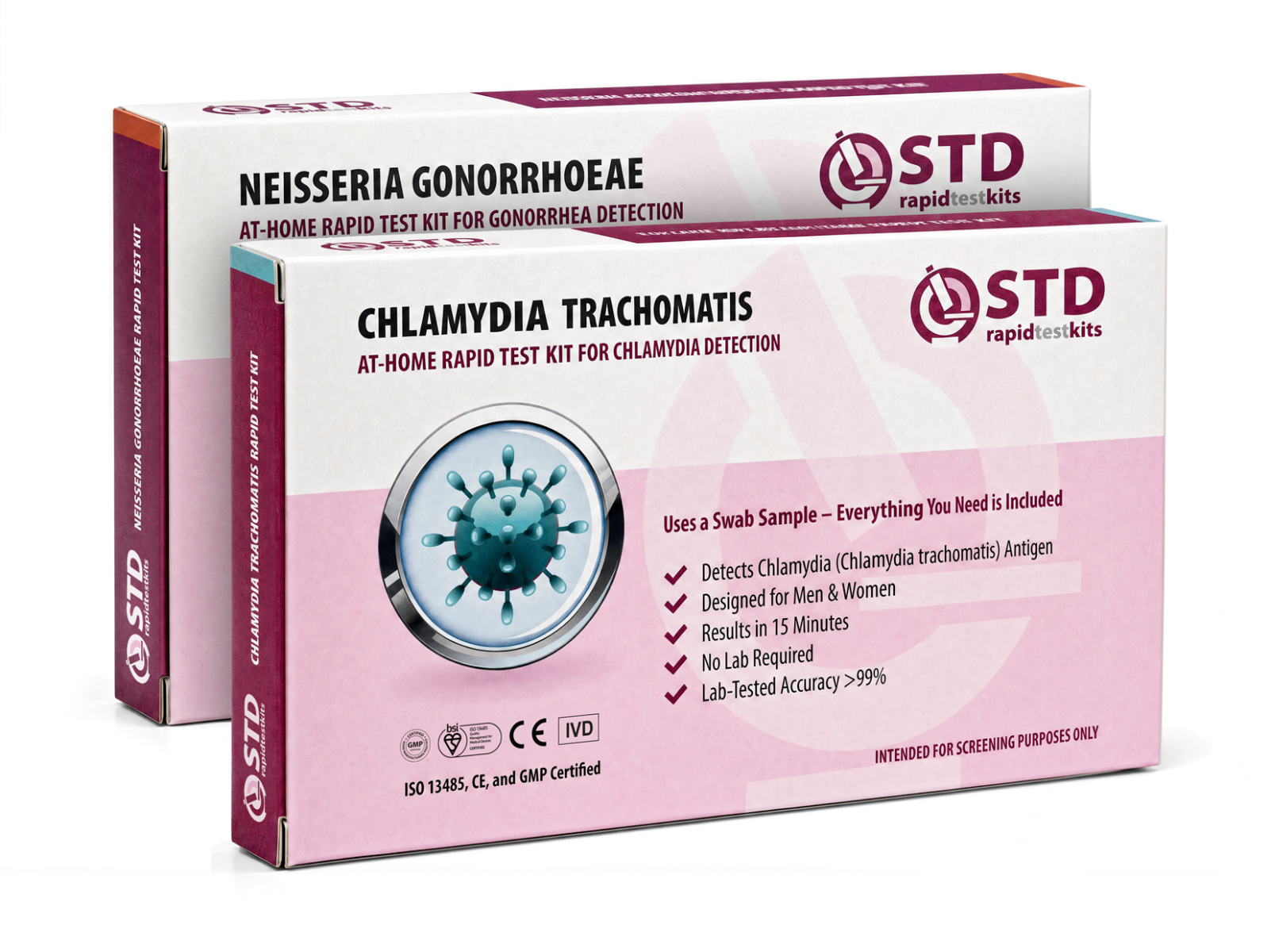
- Yes. Chlamydia and gonorrhea co-occur often enough that providers usually treat for both unless chlamydia has been specifically ruled out. A combination at-home swab kit covering both infections is a reasonable choice when you don't know which one you might have.
Product: STD-6KIT-ATH-2025
- U.S. Centers for Disease Control and Prevention. About Gonorrhea: symptoms, transmission, and asymptomatic-infection guidance.
- U.S. Centers for Disease Control and Prevention. STI Treatment Guidelines: gonococcal infections in adolescents and adults (ceftriaxone first-line dose, 3-month retest, pharyngeal test of cure).
- U.S. Centers for Disease Control and Prevention. STI Treatment Guidelines, screening recommendations for women, MSM, and pregnant patients.
- World Health Organization. Sexually Transmitted Infections fact sheet (global gonorrhea incidence, asymptomatic-majority framing, antimicrobial-resistance concerns).
- UK National Health Service. Gonorrhoea overview (typical 2-week symptom onset, retest after treatment).
