
Published: September 2025 | Last updated: May 2026 | Editorial review and quality control: Martina N.
You expected to see something. A mark, an irritation, a sore that fit what you had read about. Instead, there is nothing visible to point at, which leaves you with a quiet, uncomfortable question: if syphilis starts with a sore, and you do not see one, does that mean you are safe?
The honest answer is that you can have syphilis and never notice a sore. The sore can be painless, located inside the body, or already healed by the time you start looking. None of that means the infection has stopped. The pattern is so common that public health agencies treat it as the rule, not the exception, and it is the single biggest reason early syphilis goes undetected.
Key takeaways
- Most early syphilis sores are painless and easy to miss, especially when they form inside the vagina, rectum, mouth, or on the cervix where they cannot be seen without a clinical exam.
- Testing roughly 6 weeks after a possible exposure is more reliable than watching for symptoms, because the body needs time to produce detectable antibodies.
Can You Have Syphilis Without a Sore? Here Is the Real Answer
Yes. The first stage of syphilis usually involves a sore called a chancre, but the chancre is famous in clinical medicine for being one of the easiest infectious skin findings to miss. It is typically painless. It is usually small. It often forms inside body parts you cannot inspect without a mirror or an exam. And it heals on its own in roughly 3 to 6 weeks, with or without treatment, leaving no scar (CDC syphilis).
According to public health guidance from the CDC syphilis About page, many people with primary syphilis never notice the chancre at all, and partner notification programs frequently identify infections in people who felt perfectly well.
Two things happen as a result. A real exposure event can come and go without producing the warning sign you expected. And the absence of a sore becomes a false comfort. The thought process becomes “I would know if something happened,” but that mental shortcut is exactly how primary syphilis gets through.
Can you have syphilis without ever seeing a sore?
Yes. Test at 6 weeks after a known exposure. The primary sore is typically painless and often forms internally where you cannot see it, so waiting for symptoms is not a reliable screening strategy.
Why the First Syphilis Sore Is So Easy to Miss
Four factors stack together to make the primary chancre easy to overlook.
First, there is no pain. The chancre is firm and well-defined to a clinician’s eye, but to the person carrying it, there is usually no discomfort to draw attention. Pain is the body’s most reliable “look here” signal. Without it, most people do not search.
Second is location. The chancre forms wherever Treponema pallidum bacteria entered the body, which can be any of the following:
- The vagina, cervix, or labia
- The penis or scrotum
- The anus or rectum
- The mouth, lips, tongue, or throat
- The skin around the genitals or inner thighs, where condoms do not cover
Internal locations are essentially invisible without a speculum, anoscope, or oral exam. A cervical chancre may only ever be seen during a pelvic exam, and even then only if the clinician knows to look.
Third is appearance. Early sores often look like an ingrown hair, a small razor bump, a canker sore, or a minor friction blister. They are firm to the touch but rarely dramatic. Without surrounding redness, swelling, or weeping fluid, there is nothing visually alarming to differentiate them from a dozen ordinary skin findings.
Fourth is timing. The chancre typically appears within a few weeks of exposure and then heals on its own within 3 to 6 weeks (CDC syphilis). If you were not actively watching during that window, the visible evidence is gone before concern ever forms.
What Early Syphilis Actually Feels Like
For most people, early syphilis feels like nothing.
Even when a chancre is present, it does not produce systemic illness. There is no fever, no malaise, no general feeling of being unwell. The infection is biologically active but clinically silent at the surface.
Some people do notice mild, nonspecific signs that they later connect to syphilis after diagnosis:
- A small bump that did not hurt and went away on its own
- Slight swelling of lymph nodes near the groin
- A vague sense of being slightly off that could have been anything
The problem is that these signs match dozens of harmless explanations: a friction bump, a missed shave, a cold coming on. There is no internal compass pointing at “this is an STI,” which is why public health agencies do not treat symptom awareness as a screening tool. It catches almost nothing.
This is also why people with steady partners can be blindsided by results. A person can carry and transmit syphilis without ever realizing they have it, because they themselves never experienced anything notable, which is part of why partner notification and routine screening exist as separate safety nets.
stdrapidtestkits.com sells rapid at-home blood tests for syphilis and other common STIs. The recommendations below match the reader’s actual concern, not what is most profitable. Clinic-based testing, lab confirmation, and partner notification remain important, and we describe where home testing fits among those options.
What Happens Next: The Symptoms People Do Notice Later
If primary syphilis is not detected and treated, the bacteria move into the bloodstream. The infection enters its secondary stage anywhere from a few weeks to about 3 months after the original exposure (NHS guidance on syphilis). This is when most people finally notice something is wrong.
The classic finding is a rash, but it does not behave like the rashes you are used to. It typically:
- Does not itch
- Often appears on the palms of the hands and soles of the feet, which is rare for most rashes and makes it diagnostically important
- Looks coppery, reddish-brown, or pink, with small flat or slightly raised spots
- May appear and fade in cycles, sometimes disappearing entirely before coming back
Other secondary signs frequently include:
- Flu-like symptoms: low-grade fever, fatigue, body aches, sore throat, swollen lymph nodes
- Mucous patches: grayish-white sores in the mouth, throat, or genital area
- Condylomata lata: wart-like growths in moist body folds, often confused with HPV warts
- Patchy hair loss along the scalp, eyebrows, or beard
The most misleading feature of secondary syphilis is that the symptoms can fade entirely without treatment. The relief is convincing. The infection, however, has not gone anywhere. It has moved into the latent phase, where it can persist for years before causing the late-stage complications that affect the heart, brain, and other organs.
Syphilis is sometimes called the great imitator because its signs can mimic other illnesses, or be so mild that people never realize they are infected.
The Four Stages of Syphilis at a Glance
Syphilis progresses through four stages if left untreated. Each stage has different visibility, and the gap between stages can be long. The visible timeline does not match the biological one.
The table below shows what each stage looks like, what you might notice, and why so many cases slip past the person carrying them.
| Stage | What is happening in the body | What you might notice | Why it gets missed |
|---|---|---|---|
| Primary | Bacteria enter the body and multiply at the entry point | A small, firm, usually painless sore (chancre) at the point of exposure | Painless, often internal, heals on its own in 3 to 6 weeks |
| Secondary | Bacteria spread through bloodstream and lymphatic system | Body rash (especially palms and soles), mucous patches, fever, fatigue, hair loss, swollen lymph nodes | Symptoms resemble flu, dermatitis, or other rashes; can fade before being investigated |
| Latent | Bacteria remain in the body without active symptoms | Nothing visible or felt | Completely silent; only detectable by blood test |
| Late (tertiary) | Long-term damage to heart, brain, nerves, eyes, and bones | Neurological problems, vision loss, cardiovascular complications, large skin lesions (gummas) | Develops 10 to 30 years after initial infection; often disconnected from any sexual history |
When to Test for Syphilis After Exposure
The window for an accurate syphilis blood test is about 6 weeks after the exposure event.
Standard syphilis testing measures antibodies your immune system produces in response to Treponema pallidum bacteria. Antibody production takes time. In the first few weeks after exposure, antibody levels may be too low to detect even when infection is present. A test done too early can return a negative result that simply means the test ran too soon, not that you are uninfected.
By 6 weeks, antibody levels are detectable for most cases. A smaller share require longer, out to about 90 days, to seroconvert, which is why public health guidance from the CDC syphilis program recommends repeat testing at 3 months when the first test is negative and exposure risk is high.
Practical timing:
- Test at 6 weeks after the suspected exposure for a reliable first result
- If the exposure window is uncertain or you had multiple exposures, count 6 weeks from the most recent one
- Retest at 3 months if your first test was negative and the exposure was high risk (unprotected contact with a partner of unknown status, or with a partner subsequently found to have an STI)
Testing earlier than 6 weeks is not pointless if you have visible symptoms, but a negative result before 6 weeks does not rule out infection. Treat it as preliminary, not definitive.
How Other STI Testing Windows Compare
Syphilis is not the only STI where window timing matters. Different infections have different detection biology, and using an incorrect window for any of them can produce a misleading negative.
For a single exposure event, testing the whole panel at the longest applicable window is the cleanest single-visit option. For active symptoms, partial testing earlier can guide treatment, but any negative early result should be repeated at the correct window.
| Infection | Earliest reliable test | Why timing matters |
|---|---|---|
| Chlamydia | About 14 days after exposure | Bacteria need time to reach detectable levels in the sample |
| Gonorrhea | About 2 to 3 weeks after exposure | Similar bacterial-load consideration as chlamydia |
| Syphilis | About 6 weeks after exposure | Antibody production takes weeks; retest at 3 months if high risk |
| HIV | 4 to 6 weeks (4th-generation test); 12 weeks for full clearance | Window depends on test generation; some catch acute infection earlier |
| Hepatitis B | About 3 to 6 weeks after exposure | Surface antigen becomes detectable as the immune response develops |
| Hepatitis C | About 8 to 11 weeks after exposure | Antibody seroconversion has the longest window of the common STIs |
| HSV-2 (antibody) | Up to 12 weeks for antibody detection | Blood antibody tests miss early infection and active lesions |
What Home Testing for Syphilis Looks Like
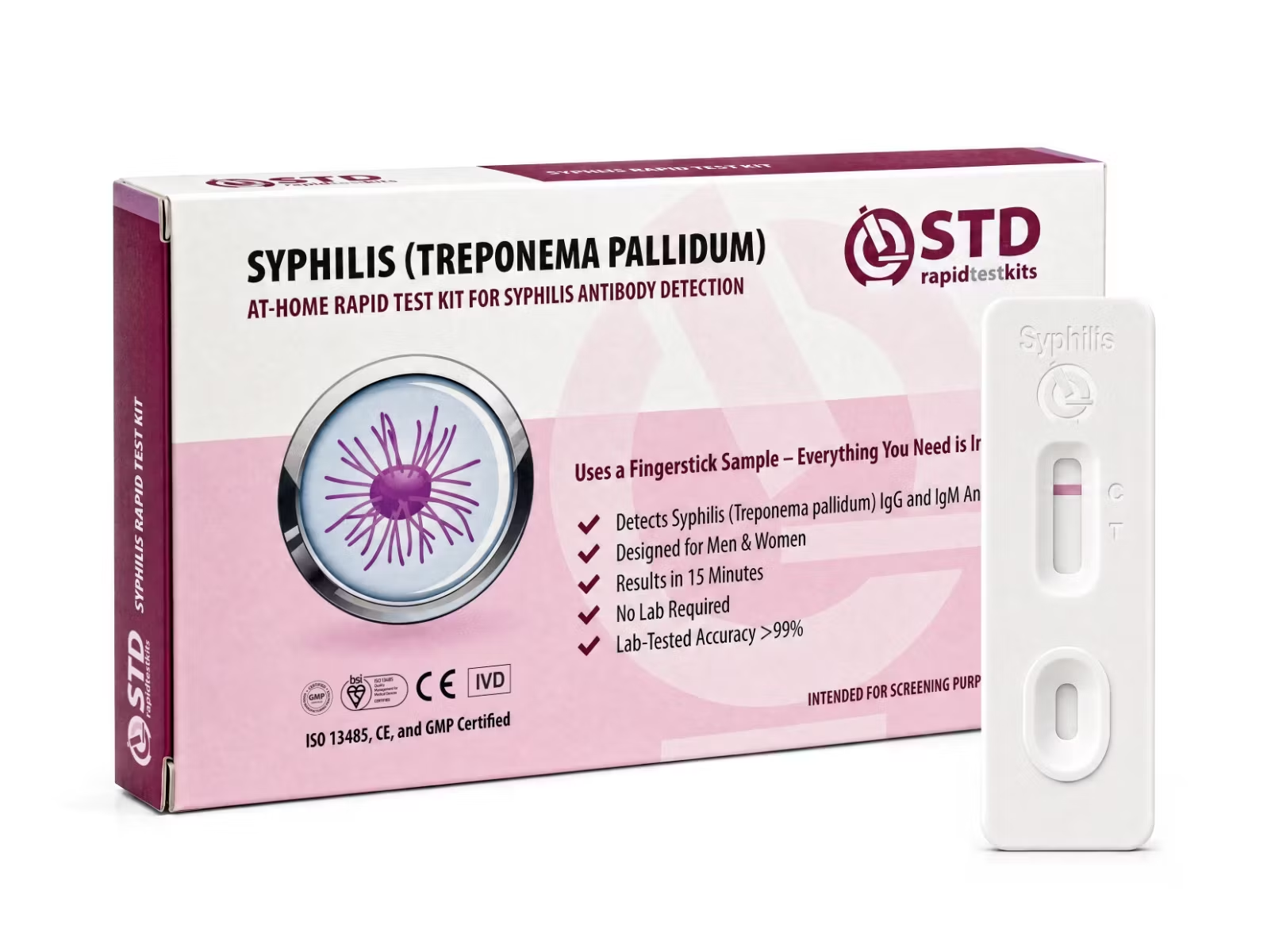
If you would rather skip the clinic waiting room, at-home rapid tests offer an alternative for syphilis and other common STIs. They use the same antibody-detection principle as lab tests, but the sample is a fingerstick of blood instead of a venous draw, and the readout is a lateral-flow strip you read at home in about 15 minutes.
What home rapid tests are good for:
- Screening when you do not have symptoms and want a private answer
- Confirming you fall outside the relevant testing window
- Couples or partners testing together before a relationship change
- Periodic checks when access to clinic appointments is hard
What home rapid tests are not designed for:
- Replacing lab confirmation of a positive result (positives should always be confirmed with a treponemal-specific test through a clinician before treatment, per the WHO syphilis fact sheet)
- Diagnosing during the symptom window before antibodies develop
- Confirming infection in a partner who already tested positive (treat the exposure; do not re-screen)
A clean home-testing workflow looks like this: wait until you reach the 6-week window, complete the test, log the result, and if it is positive, follow up with a clinician within a few days for confirmation and treatment with the appropriate antibiotic course (almost always penicillin G, per the WHO syphilis fact sheet).
Bottom Line: Test by Timing, Not by Symptoms
The most useful mental shift in this whole topic is to stop using “do I have symptoms?” as the trigger for testing.
Symptoms are unreliable. The classic syphilis sore is painless, often hidden, and gone in weeks. Secondary symptoms mimic everything from flu to eczema. Latent syphilis is silent by definition. The signal you are waiting for might never come, while the infection continues.
The reliable trigger is exposure plus timing. If you had a possible exposure, count to the relevant window (6 weeks for syphilis), test, and act on the result. That sequence works whether or not you ever felt anything wrong.
The same approach works for repeat exposures. A new partner, a condom break, partner notification from a previous relationship: any of those resets the clock. Wait the window, test, and use the result. If your exposure was broad (a partner with unknown status across multiple infections), a combination panel is the practical choice over single-test screening.

Frequently asked questions
- Can you have syphilis with no symptoms at all?
- Yes. Latent syphilis, by definition, has no symptoms while the infection remains active in the body. Even primary syphilis can pass without any noticeable sign in many people, especially when the chancre forms internally on the cervix, in the rectum, or in the throat.
- How long after exposure do syphilis symptoms appear, if they appear at all?
- The primary chancre, when present, typically appears within a few weeks of exposure, though the range can extend longer. Secondary symptoms can appear weeks to several months later. Many people never notice either stage and only learn of the infection through routine screening or partner notification.
- What does a syphilis chancre actually look like?
- A single, small, firm, round sore (typically 1 to 2 cm) with a clean smooth base and a slightly raised edge. It does not hurt, does not itch, and looks like a punched-out ulcer rather than a blister. It can appear anywhere bacteria entered the body, including internal sites.
- Can syphilis be transmitted before symptoms show?
- Yes. People can transmit syphilis during the primary and secondary stages whether or not they realize they have the infection. The infection remains transmissible during the early latent phase as well. This is the main reason syphilis spreads so quietly in communities.
- Why will not a Pap smear or routine check-up catch syphilis?
- Pap smears screen for cervical cell changes (mostly HPV-related), not syphilis. Syphilis screening is a separate blood test that has to be specifically ordered or requested. Many well-visits skip it unless you ask or you are flagged as high risk.
- If my first syphilis test is negative, do I need to test again?
- Test again at 3 months if your first test was within 6 weeks of exposure and the exposure was high risk. Antibody production can take up to 90 days, so a single early test is not a complete rule-out. After 3 months, a negative test is considered reliable for that exposure.
- Can I test for syphilis at home?
- Yes. Rapid at-home antibody tests use a fingerstick of blood and produce a result in about 15 minutes. A positive home result should always be confirmed with a follow-up clinic test (a treponemal-specific assay) before starting treatment.
- Does syphilis go away on its own once the sore heals?
- No. The sore heals on its own, but the bacteria remain in the body and continue to multiply. Untreated syphilis can progress over years to cause damage to the heart, brain, nerves, and eyes. The healed sore is the start of the infection, not the end of it.
- U.S. Centers for Disease Control and Prevention. Syphilis program landing page covering transmission, stages, testing, and treatment in patient-facing language.
- U.S. Centers for Disease Control and Prevention. Syphilis About page describing the four stages, the primary chancre, and how often early infection goes unnoticed.
- World Health Organization. Syphilis fact sheet. Global epidemiology, transmission, clinical course, and treatment standards including penicillin-based regimens.
- National Health Service (UK). Syphilis. Stages, NHS testing pathways, and treatment options described for patient self-education; states secondary symptoms may appear up to 3 months after exposure.
- U.S. National Library of Medicine, MedlinePlus. Syphilis patient-facing overview, self-care guidance, and links to related conditions.
- NCBI Bookshelf, StatPearls. Syphilis clinical overview including incubation, staging, and diagnostic workup.
