
Published: August 2025 | Last updated: May 2026 | Editorial review and quality control: Martina N.
Often either, and the symptoms overlap almost exactly. If a water-based lubricant clears the discomfort within two to three weeks, the cause was likely hormonal. If burning, unusual discharge, sores, or post-sex spotting persists, or began after a new partner, test for infection: chlamydia and gonorrhea show by 1 to 2 weeks, HIV and HSV-2 take longer.
That burning sensation after sex isn't always menopause. The itch that lingers, the spotting that came out of nowhere, the dryness that no amount of lube seems to fix: these can all be hormonal, and they can also be infections wearing the same costume.
Most women over 45 default to the menopause explanation because it's the one their bodies have been preparing them for. Sometimes that's right. Sometimes it's the wrong door, and on the other side is a treatable infection that a fifteen-minute test could have caught weeks earlier. This guide covers how to tell the two apart, why infection risk genuinely rises after menopause rather than fading, when each test is actually accurate, and what to do if you're dating again and want to stop second-guessing every twinge.
Key Takeaways
- Menopause and several STIs share the same surface symptoms: burning, dryness, itching, irregular spotting, and pain during sex. Hormones get blamed by default and infections get missed.
- STI rates in adults over 50 have climbed sharply in the past decade, and postmenopausal tissue is biologically more vulnerable to infection, so testing still matters.
Menopause and Infection Often Look Identical on the Outside
Symptoms overlap most for burning or raw sensation during or after sex, a recurring itch, discharge that smells or looks off, spotting when you haven't had a period in years, and pain during penetration. For women in their late 40s and 50s, the default explanation for any of these is hormonal, because the body genuinely is changing: estrogen levels drop, vaginal walls get thinner, lubrication slows, and tissue becomes more reactive.
That hormonal story is real. The NHS lists vaginal dryness, itching, and discomfort during sex among standard menopause symptoms (NHS guidance on menopause symptoms); clinicians often group this cluster under the umbrella terms vulvovaginal atrophy (VVA) and the broader genitourinary syndrome of menopause (GSM). The trouble is that the same surface symptoms are also how chlamydia, trichomoniasis, herpes reactivation, and gonorrhea show up in older women. The body has fewer ways to protest by middle age, so an infection often whispers instead of shouting. A bit of burning. A vague itch. Discharge a shade off from usual. Easy to wave away.
That default costs time. Postmenopausal women often take longer to land on an accurate STI diagnosis than women in their 20s and 30s, partly because clinicians also reach for the menopause explanation first. The infection keeps doing its quiet work for the extra weeks or months it takes to get to the right answer. With chlamydia in particular, that extra time can mean pelvic inflammation, persistent pain, or transmission to a new partner who also doesn't know.
Chlamydia, trichomoniasis, and gonorrhea share the surface symptoms most often blamed on hormones: burning, discharge change, irritation, and unexpected spotting. All three respond well to targeted antibiotic or antiprotozoal treatment once identified, which is why getting to the right diagnosis matters more than the symptom hint itself.
STI Rates Are Climbing Fastest in Adults Over 50
The cultural script says STIs are a young-person problem. The data disagrees. The American Medical Association has reported that rates of syphilis, gonorrhea, and chlamydia in adults age 55 and older more than doubled over the past decade, and the picture for the 65-and-older group is sharper still: between 2010 and 2023, chlamydia cases more than tripled, gonorrhea climbed roughly sixfold, and syphilis rose nearly tenfold (AMA on STIs in older adults).
Several factors drive the trend. People are dating again after long marriages or partnerships ended. Online dating made new partners easier to meet at any age. Erectile dysfunction medications have made sexual activity more accessible later in life. Condom use falls off when pregnancy isn't a concern, and many midlife women were never taught that condoms also protect against infection. Add the unspoken assumption that aging itself is some kind of immunity card, and the pieces line up. None of that is true biologically, and none of it is true statistically either.
Routine STI screening for this age band is also not standard practice in most primary care visits, so positive cases get caught later than they would in a younger patient. Providers tend to assume their older patients are not sexually active, or are in a single long-term monogamous relationship, and skip the question entirely. Dating again after a long pause puts you in the same testing population as a sexually active adult in their 20s, and you'll usually have to bring it up yourself. “I'd like to add an STI panel to today's visit, please” is a complete request and does not need an explanation.
Chlamydia often has no symptoms, but it can cause serious health problems, even without symptoms.
Why Postmenopausal Tissue Becomes More Vulnerable
The biology runs the opposite direction from the cultural assumption. Estrogen does more than regulate menstruation. It maintains the thickness, elasticity, and natural moisture of the vaginal lining, supports a slightly acidic vaginal pH that suppresses many common pathogens, and helps the local epithelial barrier stay intact. When estrogen drops at menopause, several things happen at once: vaginal walls become thinner, less elastic, and more fragile; natural lubrication declines; and the pH shifts toward neutral, which clinicians describe as part of genitourinary syndrome of menopause (GSM), making the local environment more hospitable to bacteria that previously couldn't gain a foothold.
Add those changes together, and small microscopic injuries during sex become more common. The microtears are usually too small to see or feel, but they don't need to be visible to act as entry points for the bacteria and viruses that cause chlamydia, gonorrhea, herpes, syphilis, and HIV. That's why the same exposure that might pass without incident at 30 can result in an infection at 55. Bacterial vaginosis, urinary tract infections, and STIs all become slightly more likely on the same set of behaviors.
It also means symptoms can feel more intense when an infection does take hold. Burning is sharper. Itching is more persistent. The natural inflammatory response is still there, sitting on top of tissue that's already easily irritated. Some women describe it as feeling raw all the time, which is hard to disentangle from menopause itself, which is the whole problem.
Awareness matters here more than alarm. Lubricants and vaginal moisturizers address the menopause side of this picture, and they do nothing for an infection. Two or three weeks of consistent lubrication without improvement narrows the likely cause to something a moisturizer can't fix.
Thinner vaginal tissue and a shift toward a more neutral pH after menopause make the same unprotected encounter meaningfully more likely to end in infection than it would have been before menopause. The cultural assumption that risk drops with age has the direction reversed.
Menopause or Infection? A Symptom-by-Symptom Read
Side by side, the symptom map of vulvovaginal atrophy and the symptom map of several common STIs overlap more than they diverge. The table below shows where the two stories tend to look different and where they look identical. Treat it as a starting point for noticing patterns, not as a substitute for testing when something persists.
Menopause vs. infection: symptom comparison
| Symptom | Often menopausal | Could be an infection |
|---|---|---|
| Vaginal dryness | Yes, common with low estrogen | Less typical as a primary symptom |
| Burning during sex | Yes, especially without enough lubrication | Yes, with chlamydia, gonorrhea, or trichomoniasis |
| Itching outside the vagina | Sometimes, with skin thinning | Yes, with trichomoniasis, herpes, or yeast |
| Spotting between or after periods | Possible during perimenopause | Yes, with chlamydia or cervical inflammation |
| Discharge with strong odor | Less typical | Yes, with bacterial vaginosis or trichomoniasis |
| Painful urination | Less typical without infection | Yes, with chlamydia, gonorrhea, or UTI |
| Sores or blisters | No | Yes, with herpes or syphilis |
When in doubt, the practical tell is whether two to three weeks of consistent lubrication clears the discomfort.
Symptoms That Should Prompt a Test Instead of a New Lubricant
Some symptoms are reliably hormonal. Others sit in the overlap zone where either explanation could fit. A useful rule of thumb: if the issue showed up around the time a new partner did, or if it persists past the point a hormonal cause would resolve, treat it as something to test rather than something to manage with another tube of moisturizer.
The list below captures the patterns that argue most clearly for testing. If a provider waves off any of these as “just menopause” without offering or discussing STI screening, ask directly: “Could we rule out an infection first?”
Patterns that argue for testing
Having one or more does not confirm infection. It means an infection now belongs on the differential and testing is the cleanest next step.
- Burning during urination, not only during sex Common
- Discharge that's distinctly different in smell, color, or amount from your baseline Common
- Bleeding or spotting after sex, especially more than a year past your last period Common
- Pelvic pressure or low abdominal pain that doesn't tie to a clear muscle or digestive cause Less common
- Sores, blisters, or new bumps on the vulva, vaginal opening, or upper thighs Less common
- Recurrent UTIs that don't respond to standard antibiotics, or that come back within weeks of finishing a course Less common
- Symptoms that started after unprotected sex with a new partner, or with someone whose recent testing status you don't know Common
What to Actually Test For When You're Dating Again
The infections that show up most in midlife adults track with the ones that dominate younger age groups, with a few shifts in emphasis. Chlamydia and gonorrhea are usually the highest-yield first tests because they're common, frequently silent, and easy to treat once identified. An at-home chlamydia and gonorrhea swab is often the most practical starting screen. Trichomoniasis is worth testing for in women specifically, because it's often missed and the symptoms blur into menopause. Herpes is on the list for two reasons: a first infection in your 50s is genuinely possible, and a long-dormant case can reactivate during hormonal change or stress.
Syphilis testing has become more relevant in this age group, given how sharply rates have climbed. HIV belongs on any honest screen for someone with a new partner, regardless of age. The per-act transmission risk from a single unprotected encounter is low but not zero, and several factors raise it meaningfully: a concurrent STI in either partner, being the receptive partner during anal or vaginal sex, and any visible genital sores. Hepatitis B and C round out the broader bloodwork panel for anyone with new exposure.
HPV deserves its own line. Persistent infection acquired earlier in life can stay present for years and occasionally drive cervical, vulvar, or vaginal cell changes that show up on a Pap smear or HPV test long after the original exposure (CDC on HPV). Some research also suggests HPV can reactivate later in life as immune function shifts, which is why a postmenopausal woman can occasionally test positive without a recent new partner. Persistent high-risk HPV is the main cause of cervical cancer in older women, and persistent infection is the mechanism. U.S. screening guidelines generally allow women to stop cervical cancer screening around age 65, but only after three consecutive normal Pap results (or two consecutive normal HPV co-tests) within the prior decade. If you stopped Pap and HPV screening and have since started dating again, ask your provider whether to restart.
A hysterectomy doesn't remove the risk. Removal of the uterus does not protect the vagina, vulva, urinary tract, or bloodstream from infection. A patient who has had a hysterectomy can still acquire chlamydia, gonorrhea, herpes, syphilis, HIV, and HPV. Pap testing may stop being indicated post-hysterectomy in specific clinical situations, but STI testing remains relevant for anyone sexually active with new or non-monogamous partners.
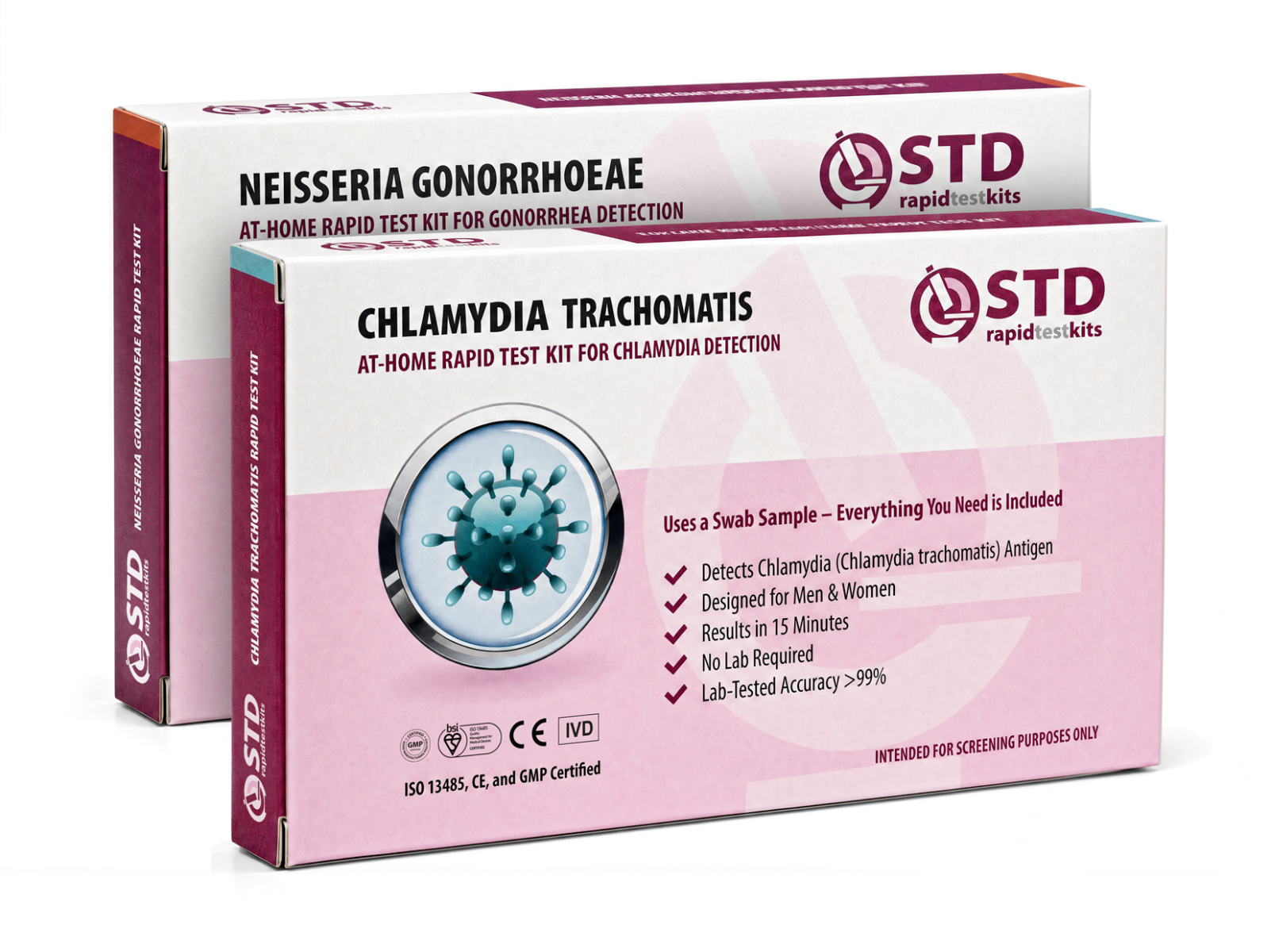
For an at-home starting point, the most useful single panel is usually a chlamydia and gonorrhea swab, because those two infections account for a high share of midlife symptomatic cases and respond well to antibiotic treatment once confirmed. Rapid lateral-flow swab tests give a result in about 15 minutes from a self-collected vaginal sample. They're a screening tool rather than a replacement for clinic-grade NAAT testing, and a positive result is worth confirming with a clinician for treatment.
This article is published by stdrapidtestkits.com, which sells at-home STI testing kits. We recommend products based on fit for the reader's concern, not commercial benefit.
Why Condoms Matter More After Menopause
Estrogen-thinned vaginal tissue tears more easily during sex, and those small tears make both fluid-transmitted infections (HIV, gonorrhea, chlamydia, trichomoniasis) and skin-contact infections (herpes, HPV, syphilis) easier to acquire. Condoms reduce both routes. They are the most effective barrier against fluid-transmitted STIs, and they meaningfully lower (though don't eliminate) transmission of skin-contact infections that spread via direct contact with sores or lesions. Both the CDC and the World Health Organization treat barrier protection as a first-line defense against fluid-transmitted infections (WHO STI fact sheet).
The cultural framing of condoms is still tied to pregnancy prevention, which is one reason their use drops sharply once pregnancy stops being a possibility. Survey data on U.S. adults consistently shows much lower condom use among adults over 50 than among younger groups, even when the older group reports new or multiple partners.
Water-based or silicone-based lubricants reduce friction and the chance of condom breakage on thinner postmenopausal tissue without damaging latex. Oil-based products do damage latex, so skip those with latex condoms. Lubricant alongside a condom is the comfort upgrade most women in this age band say made the biggest single difference.
The conversation tends to go better when it's framed as mutual care than as suspicion. “I always use protection with someone new” lands differently from a question that implies doubt. “Let's both get tested before we go without” works the same way: it makes testing a starting point for the relationship rather than a hurdle inside it. A partner who refuses both testing and condoms is showing you where they stand.

Testing Windows: When Each Test Is Actually Accurate
Detection windows are determined by the test technology and the infection's biology. They do not change based on the age of the person being tested. Testing earlier than the window produces a result that cannot rule infection out, which feels like reassurance but isn't.
- Chlamydia and gonorrhea: reliable detection from about 1 to 2 weeks after exposure. Lab NAAT testing is the analytical gold standard. At-home rapid lateral-flow swab tests are useful screening tools, with a positive result worth confirming at a clinic.
- Trichomoniasis: detectable from about 1 to 2 weeks after exposure. Self-collected vaginal swab.
- Syphilis: antibody tests can detect infection from about 3 weeks after exposure, with confirmatory retesting at 3 months for full reassurance.
- HIV: the answer depends on the test type. Lab-based fourth-generation antigen/antibody tests can detect HIV from about 18 to 45 days after exposure. Antibody-only rapid tests, which is what most at-home rapid kits use, are reliable from about 23 to 90 days after exposure, with a follow-up test at 3 months recommended for definitive results. NAT (nucleic acid) tests can detect even earlier, from about 10 to 33 days, but only in a lab setting (CDC on HIV testing).
- Hepatitis B and C: antibody tests are typically reliable from about 8 to 12 weeks after exposure, per CDC STI screening guidance (CDC STD Treatment Guidelines).
- Herpes (HSV-2): antibody tests may not reliably detect a new infection until 12 to 16 weeks or more after exposure (CDC STD Treatment Guidelines). A negative result before that point should be retested at the 16-week mark. Active lesions are tested separately by clinic-collected swab and PCR; the blood antibody test confirms past systemic infection, not the presence of a current lesion.
If you've had a known high-risk exposure (a partner with a confirmed STI), see a provider sooner rather than waiting on the window. Some infections benefit from empirical treatment before a test result can confirm them.
A negative result before the test's detection window has opened cannot rule infection out. It feels like reassurance, but biologically the antibodies or antigens may not have appeared yet. Set a calendar reminder for the retest date appropriate to the specific test you took, and use condoms in the meantime if you're sexually active.
What Hormone Replacement Therapy Can and Can't Do
Systemic hormone replacement therapy and topical vaginal estrogen creams both help with the most uncomfortable parts of vulvovaginal atrophy. They restore some tissue thickness, improve natural lubrication, and reduce painful sex. Some clinical research suggests that restoring the vaginal epithelial barrier with topical estrogen may also modestly reduce, though not eliminate, susceptibility to specific infections.
What HRT does not do is prevent STI transmission. If your partner has herpes, HPV, gonorrhea, chlamydia, or HIV, your hormone therapy will not block transmission. The only barrier that does that is a condom (or a dental dam for oral sex), and the only way to know your partner's status is testing.
Hormone replacement therapy and topical vaginal estrogen address the comfort side of postmenopausal sex: dryness, tissue thickness, and painful intercourse. Neither is a substitute for barrier protection or for STI testing with a new partner.
Reinfection After Treatment
Several common STIs (chlamydia, gonorrhea, trichomoniasis) are curable with antibiotics, but treatment does not produce lasting immunity. You can be reinfected by the same pathogen the day after treatment finishes if you have unprotected sex with an infected partner. The two most common reasons treated infections come back are a partner who was not treated and resumed unprotected sex too soon.
The CDC's STI treatment guidelines recommend retesting about three months after treatment for chlamydia and gonorrhea, regardless of whether the partner was confirmed treated, because reinfection rates are high in the first few months (CDC STD Treatment Guidelines). Concretely: complete the treatment, wait at least 7 days after both partners complete antibiotics before resuming sex (longer if your provider says so), and use condoms with any partner whose status you don't know. Gonorrhea strains with reduced antibiotic susceptibility have become more common; if symptoms persist after a completed course, ask your provider about follow-up culture and sensitivity testing.
If you tested positive and your partner tells you they tested negative on the same day, ask whether they were tested in their own window. A partner who exposed you to chlamydia six days ago might still test negative today and become positive next week.
Wait at least 7 days after both partners complete antibiotics before resuming sex (longer if your provider says so), then retest at 3 months per CDC guidance. Treatment cures the current infection; it does not block reinfection from an untreated partner.
Talking to a New Partner Without Killing the Mood
The fear that asking about testing will end the moment is one of the main reasons it doesn't get asked. The dynamic actually runs the other way: people who bring up testing early in a new sexual relationship report higher trust and more relaxed intimacy, because the question reads as care rather than suspicion. Framing matters more than timing.
Two practical points. First, a test status from a year ago isn't current; if either of you hasn't tested since the last partner, you're effectively untested for this relationship. Second, the conversation is easier in writing than in bed. A short text the day before, or a conversation that's already covered boundaries and protection, takes the pressure off the in-person ask.
Two phrasings that tend to land well: “Before we stop using condoms, can we both get tested? I'd feel more present, and I want to do this right.” Or, framed as routine: “I get tested every six months when I'm seeing someone new. I'd love it if we did that together.” Either version works because it puts the request inside a wish for something better together. Adapt the language to your own voice; the framing carries the weight.
If a partner reacts to the request as an accusation, the response itself is information.
When to Test, How Often, and What's Available at Home
The CDC recommends sexually active women under 25 test for chlamydia and gonorrhea at least once a year, and women over 25 with risk factors (a new partner, multiple partners, or a partner with an STI) follow the same schedule (CDC STD Treatment Guidelines). For midlife women dating again, that translates to: test between partners, test before deciding to stop using condoms with a new partner, and test about every six months while sexually active with new or multiple partners.
The two practical paths are clinic testing and home testing. Clinic testing uses lab-processed NAAT (nucleic acid amplification) panels, which are the highest-sensitivity option and the standard for diagnostic confirmation. Home testing uses rapid lateral-flow kits, which trade some analytical sensitivity for convenience, privacy, and a result in minutes instead of days. They're meaningfully different technologies with different sensitivity profiles, so they work best as complements rather than substitutes.
For most women in this age group, a combined approach works well: home testing as the routine screen between partners, clinic testing for confirmation of any positive result and for a comprehensive panel at major life-stage transitions (a new long-term partner, divorce, return to dating after a long pause). A multi-infection home panel is a good fit for someone who wants to cover the broadest range in one self-collection event.
The Bottom Line: Information Beats Guesswork
Sex after 50 doesn't have to come with a permanent question mark. The biology really does change. So does the dating context. Both of those facts argue for more information across the board, since the symptoms you'll likely experience are exactly the ones that look the same whether the cause is hormonal or infectious.
If something feels off and a few weeks of better lubrication hasn't fixed it, that's reason enough to test. If you're starting a new sexual relationship, testing before stopping condoms is one of the most ordinary steps you can take, and one of the easiest conversations to normalize. If a long-dormant herpes case has reactivated, or a chlamydia infection has been quietly there for months, treating it is straightforward once it's identified.
The version of this story that costs people the most is the one where they spent a year managing what they thought was menopause and missed something a fifteen-minute test would have caught. Testing is a normal part of adult sexual health, the same as any other yearly check, and you don't need permission from anyone to do it.
Lubrication that doesn't fix burning or itching after two or three weeks points to something a moisturizer can't reach. Test before stopping condoms with a new partner, every time. A rapid swab for chlamydia and gonorrhea covers the highest-yield first question; a broader panel covers the rest at major dating-life transitions.
Next steps for symptoms after 50
Have you tried a water-based lubricant consistently for two to three weeks?
Yes: Move to the next step: if discomfort persists despite consistent lubrication, the cause is likely something a moisturizer can't reach.
Did symptoms start after a new partner, or do they involve burning, unusual discharge, sores, or post-sex spotting that persists?
Yes: Test for chlamydia and gonorrhea first (the highest-yield screen for midlife women). Add trichomoniasis, syphilis, HIV, and herpes if a new or recent partner is involved. Confirm any reactive result with a clinician before starting treatment.
No: The cause is likely hormonal. Talk to your provider about topical vaginal estrogen or systemic HRT for vulvovaginal atrophy, and recheck in a few weeks if symptoms shift.
Guidance only. A healthcare provider can advise based on your specific situation.
FAQs
- Can you really get an STI for the first time in your 50s?
- Yes. Aging itself doesn't reduce susceptibility, and several factors raise it: thinner vaginal tissue, lower estrogen, and lower condom use among adults who aren't worried about pregnancy. The AMA reports STI rates more than doubled in adults 55 and older in the past decade.
- Is dryness during sex always a menopause symptom?
- Often, but not always. Dryness is one of the most common menopausal changes. It can also accompany infections, especially trichomoniasis or chlamydia, where dryness pairs with burning, discharge change, or spotting. The practical rule: if water-based lubricant resolves the discomfort within two or three weeks, it was likely dryness; if irritation, burning, unusual discharge, or post-sex spotting persists, consider testing.
- I've been with the same partner for years. Do I still need to worry?
- It depends on whether the relationship is reliably monogamous and whether you've both been tested at any point. Some STIs (HPV, herpes) can stay dormant for many years before showing up, so a partner with no symptoms may still carry an infection acquired before this relationship. One round of mutual baseline testing usually closes that question for good.
- Can I have an STI without any obvious symptoms?
- Yes. The CDC notes that chlamydia often has no symptoms. The same is true for many cases of gonorrhea, trichomoniasis, and HIV in early stages. This is the strongest argument for routine testing when there's a new partner, regardless of how you feel.
- Do I still need condoms if I can't get pregnant?
- Yes, and arguably more than before. Without estrogen, vaginal tissue is thinner and tears more easily, which makes infection transmission more likely during sex. Condoms remain the most effective barrier against fluid-transmitted STIs (chlamydia, gonorrhea, trichomoniasis, HIV) and meaningfully reduce skin-contact STIs like herpes, HPV, and syphilis. Water-based or silicone-based lubricant alongside condoms reduces friction and breakage; avoid oil-based products with latex.
- How soon after a new partner should I test?
- Two weeks covers chlamydia, gonorrhea, and trichomoniasis. For syphilis, wait at least 3 weeks for a preliminary result. For HIV, at-home rapid antibody tests are most reliable from about 23 to 90 days; lab-based 4th-generation antigen/antibody tests can detect from about 18 to 45 days. Retest at 3 months for a definitive HIV or syphilis result either way. HSV-2 antibody testing can take 16 weeks or more to turn positive after a new infection. Testing earlier than the window produces a result that cannot rule infection out; it is not a clean negative.
- Is HPV still a concern in my 50s or 60s?
- Yes. HPV can persist for years after first exposure, and persistent high-risk HPV is the main cause of cervical cancer in older women. If you stopped Pap and HPV screening some years ago and have since had new sexual partners, ask your provider whether to restart.
- Is STI testing painful for postmenopausal bodies?
- It doesn't have to be. The most common at-home kits use either a self-collected vaginal swab (less invasive than a clinic speculum exam) or a fingerstick blood sample. If pelvic exams have become uncomfortable due to vaginal atrophy, talk to your provider about smaller speculums and topical lubricant, or use at-home rapid testing for screening between clinic visits.
- How can I bring up testing with a new partner without making it awkward?
- The ask lands better when it's framed as care rather than suspicion. Try linking it to what you want more of: “Before we stop using condoms, can we both get tested?” works because it puts the request on the path toward something both partners want. A partner who reacts as if accused is also giving you useful information about how they handle other vulnerable conversations.
- American Medical Association. STI rates in adults age 55+ more than doubled over the past decade; specific 2010–2023 figures for the 65+ group (chlamydia tripled, gonorrhea ~6×, syphilis ~10×).
- U.S. Centers for Disease Control and Prevention. HIV testing guidance, including detection windows for NAT, lab-based fourth-generation antigen/antibody, and antibody-only rapid tests.
- U.S. Centers for Disease Control and Prevention. STD Treatment Guidelines: screening intervals, retest-after-treatment guidance for chlamydia and gonorrhea, hepatitis testing windows, and HSV-2 antibody seroconversion windows.
- U.K. National Health Service. Authoritative description of menopause symptoms including vaginal dryness, burning, itching, and discomfort during sex.
- U.S. Centers for Disease Control and Prevention. HPV information, transmission, persistence, and connection to cervical and other cancers.
- World Health Organization. Sexually transmitted infections fact sheet: global epidemiology and barrier-protection guidance.
