Published: September 2025 | Last updated: May 2026 | Editorial review and quality control: Martina N.
No FDA-approved herpes vaccine exists in 2026. Several candidates have moved through Phase I and early Phase II trials, including mRNA platforms similar to the ones that produced COVID vaccines, but none have reached approval and most analysts put the earliest realistic timeline at several more years.
For people who carry HSV-1 or HSV-2, waiting on news cycles is not a protection plan. The tools that prevent transmission, reduce outbreak frequency, and protect mental health are mostly available right now. This guide explains where the vaccine pipeline actually stands, what suppressive therapy can and cannot do, how at-home testing fits in, and how to handle the parts of a herpes diagnosis that medication does not touch.
Key Takeaways
- Daily antiviral suppressive therapy can roughly halve HSV-2 transmission to a susceptible partner; combined with condoms, the reduction is greater still.
- Most people with HSV-2 are not aware they have it. Asymptomatic viral shedding means transmission can happen even on days that feel completely normal.
Where the herpes vaccine actually stands in 2026
The reason there is no herpes vaccine on pharmacy shelves is not lack of effort. Herpes simplex virus establishes lifelong latency in sensory ganglia (the clusters of nerve cell bodies that sit outside the spinal cord), and during latency the virus is largely invisible to the immune system. That biology has frustrated decades of vaccine work, including several high-profile late-stage failures.
Current research is split between two categories. Therapeutic candidates aim to reduce outbreak frequency and shedding in people already infected. Prophylactic candidates aim to prevent initial infection. Several therapeutic mRNA vaccines and a handful of subunit candidates have advanced into Phase I or early Phase II trials, with some encouraging early data. The path from a successful Phase II readout to FDA approval and pharmacy distribution is typically five to ten years, sometimes longer.
HSV establishes lifelong latency in sensory ganglia, where the virus is largely invisible to the immune system. Every successful infection becomes a permanent one, and every vaccine candidate has to solve a problem the immune system itself has not solved. The timelines look long because the biology is hard, not because the work has been neglected.
What is in your protection toolkit today
Five things drive most of the realistic transmission-risk reduction available without a vaccine, and they layer well. Each does a different job. Medication lowers viral shedding on average. Barriers reduce skin-to-skin contact during sex. Timing avoids the highest-risk days. Disclosure keeps partners in informed consent. Testing tells you what you and your partner are actually managing.
Your protection toolkit (each does a different job)
- Daily antiviral suppressive therapy: reduces outbreak frequency and viral shedding for the person who carries the virus.
- Condoms or dental dams: reduce the area of skin-to-skin contact during sex.
- Avoiding sex during prodromal symptoms and active outbreaks: the highest-shedding days.
- Honest disclosure before sex: supports informed consent and removes the relational stress of secrecy.
- Testing yourself and your partner: you cannot manage what you have not confirmed.
How much suppressive therapy actually helps
The most commonly prescribed daily suppressive antivirals are valacyclovir (often sold as Valtrex), acyclovir, and famciclovir. They do not cure herpes (no medication does) and they do not eliminate viral shedding entirely. What they do is reduce both the frequency of clinical outbreaks and the amount of virus shed on days without symptoms.
A widely cited clinical trial published in The New England Journal of Medicine in 2004 found that daily valacyclovir reduced the risk of transmitting HSV-2 to a susceptible partner by about 48% over eight months, when paired with safer-sex counseling (Corey L, Wald A, Patel R, et al., NEJM 2004;350:11-20; the American Sexual Health Association's herpes resource summarizes this as a roughly 50% reduction). The CDC STI treatment guidelines reference this finding when recommending daily valacyclovir for transmission reduction in discordant heterosexual couples. The reduction is meaningful, especially when stacked with consistent condom use, which adds further protection on top.
Practical details on suppressive therapy:
- Suppressive therapy is most effective when taken consistently. Skipping days reduces the protective effect.
- Generic versions are widely available and often inexpensive (under $20 a month in many U.S. pharmacies; covered by most insurance plans).
- Side effects are uncommon; the most frequent are mild headache and nausea.
- Therapy can be paused and resumed. Many people stay on it during periods of new sexual activity and stop during stable single periods.
Suppressive therapy is a tool that lowers transmission risk and reduces outbreak frequency, and most providers will prescribe it on request for anyone with a confirmed HSV-2 diagnosis, regardless of how frequent or severe outbreaks have been.
| Strategy | Approximate Transmission Risk Reduction | Notes |
|---|---|---|
| Daily suppressive antiviral therapy alone | About 48% | Per Corey et al., NEJM 2004; depends on consistent daily use |
| Condoms or dental dams alone | Around 30 to 50% | Reduces but does not eliminate skin-to-skin contact |
| Suppressive therapy plus condoms | Higher than either alone | Layered protection adds up across days |
| Avoiding sex during outbreaks | Substantial during the outbreak window | Active lesions and prodromal periods are the highest-shedding |
Confirming your status: testing realities
The reason most people with HSV-2 do not know they have it is partly biological (a large majority of cases are asymptomatic or produce symptoms mild enough to be attributed to something else) and partly structural: the CDC does not currently recommend routine HSV-2 antibody screening for asymptomatic adults in the general population. The reasoning is that the available antibody tests produce a non-trivial rate of false positives in low-prevalence groups, which can cause more harm than the screening prevents (CDC STI treatment guidelines).
That guidance narrows the picture: testing is most valuable in specific situations.
- You have symptoms (sores, blisters, persistent burning, unexplained pelvic discomfort).
- You have a partner with a known herpes diagnosis (a serodiscordant relationship).
- You have had a possible exposure and want to know your status before continuing sexual activity.
- You are planning a pregnancy or are in early pregnancy and want a baseline.
When testing is right for you, the type of test depends on what the lab has to work with. Swab tests (PCR or culture) are most accurate when there is an active lesion to sample. Type-specific immunoglobulin G (IgG) blood tests look for antibodies to HSV-1 or HSV-2 and can detect past infection even without active symptoms, but the body needs time to develop antibodies. Test too early after a suspected exposure and you can get a false negative; the recommended retest window is at least 12 weeks after exposure. Immunoglobulin M (IgM) tests are not recommended; they have a high false-positive rate and cannot reliably distinguish recent from older infection.
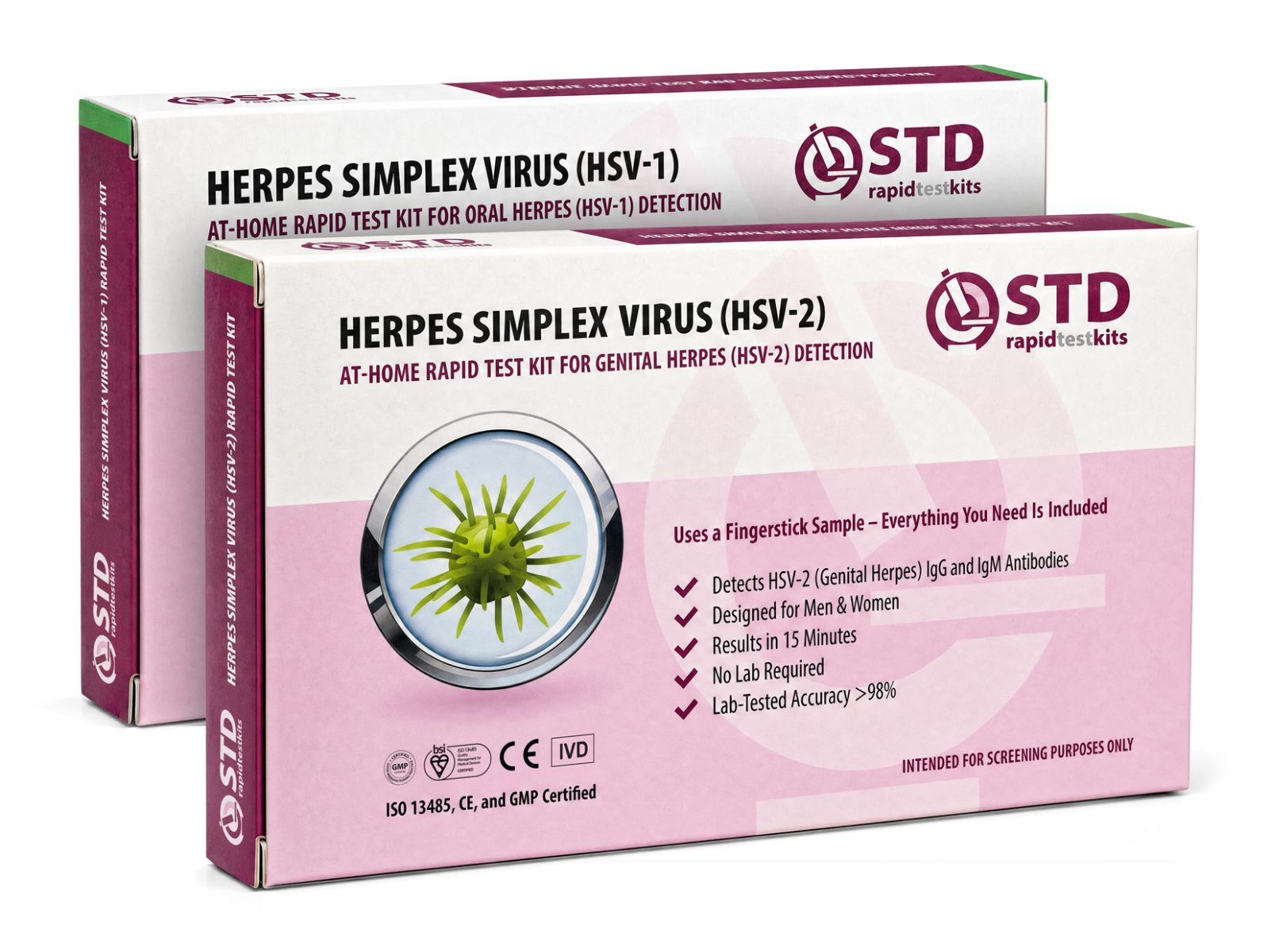
At-home rapid tests typically use the IgG antibody method. They are useful screening tools, especially if you would otherwise not test at all because of cost, time, or stigma. A positive result on a rapid antibody test should be confirmed with a clinic test (a quantitative IgG with a higher index value, or in some cases a Western blot) before being treated as definitive, because the same false-positive concern that drives CDC's screening guidance also applies here.
This article is published by stdrapidtestkits.com, which sells at-home STI test kits. We recommend tests based on fit-for-purpose for the reader's concern, not on commercial benefit.
| Test Type | Best Window | What It Detects | Limitations |
|---|---|---|---|
| Swab test (PCR or culture) | During an active lesion | Virus directly | Useless if no active lesion to sample |
| Type-specific IgG blood test | At least 12 weeks after exposure | Antibodies to HSV-1 or HSV-2 | False negatives if tested too early |
| IgM blood test | Not recommended | Early immune response | High false-positive rate; cannot reliably date infection |
| At-home rapid (IgG-based) | After the antibody window | Typically HSV antibodies | Positive results should be confirmed at a clinic |
Asymptomatic shedding and why timing matters
Asymptomatic shedding means the virus is present on skin or mucous membranes and capable of being transmitted, even though no visible sore is present and the person feels nothing. It is the single biggest reason herpes spreads more than people expect.
Shedding rates vary. They are highest in the first year after initial infection, decline gradually after that, and are higher overall for HSV-2 than for oral HSV-1. Daily suppressive therapy reduces shedding on most days, but does not eliminate it entirely. Combining tools matters precisely because of this gap: medication lowers average shedding, condoms reduce transmission on the days shedding does occur, and pausing during prodrome or active outbreaks removes the highest-risk days entirely.
Lifestyle factors also influence outbreak frequency, although the evidence base is mixed. Chronic stress, poor sleep, alcohol, friction during sex, and concurrent illness are commonly reported triggers. Sun exposure can trigger oral HSV-1 cold sores. None of these are reliable predictors for everyone, but if you notice a personal pattern, working with it is reasonable.
One reason early diagnosis and suppressive therapy matter beyond herpes transmission itself: HSV-2 mucosal inflammation increases susceptibility to HIV acquisition on exposure. The WHO estimates the increase at roughly threefold (WHO HSV fact sheet). People living with HSV-2 should include HIV in their regular STI screening rotation, especially during the higher-shedding first year after infection.

Sex and relationships when one of you has herpes
A herpes diagnosis adds a conversation, and that conversation is where most of the friction lives. The medical picture itself is usually manageable; the relational picture is where readers most often get stuck.
Partner conversations go better when you come prepared.
- Disclose before the first time you have sex with a new partner. Earlier is usually easier; the longer it waits, the higher the emotional stakes when it does come up.
- Lead with facts, not apology. "I have HSV-2. I take daily suppressive medication. We use condoms. Here is what the actual transmission risk looks like." Most people respond to information.
- Expect questions, and have answers ready. Common ones: How did you get it? How often do you have outbreaks? Are you on medication? What happens if I get it too?
- Accept that some people will walk away. That is their right. It usually says more about their readiness for adult relationships than about herpes specifically.
Within an established relationship, the conversation shifts from disclosure to planning. That includes decisions about whether to start suppressive therapy, how to handle outbreak periods, whether the susceptible partner wants to be tested at baseline and again later, and how to talk about future partners or pregnancy if those are on the horizon.
"There is something I want to share with you before we go further. I have HSV-2. I take daily suppressive medication, I use condoms, and I avoid sex during outbreaks. With those layered, transmission risk is low, and I am happy to walk through the actual numbers with you. Take whatever time you need to think about it."
The mental health side of a herpes diagnosis
The first response to a positive herpes test is often emotional rather than medical. Many people describe a period of intense shame, grief, or anxiety that has little to do with the physical reality of the virus and a lot to do with cultural stigma. That response is common, and for most people it is also temporary:
- Most people adjust within weeks to months. Initial distress does not predict long-term distress.
- Online and in-person support communities exist specifically for people with herpes, and they are particularly useful in the first few months when the diagnosis still feels enormous.
- Therapy is appropriate if the initial period is intense, prolonged, or interferes with sleep, work, or relationships. A few sessions with a sex-positive therapist can shortcut a lot of the spiral.
- A herpes diagnosis is medical information about a virus. It is not a verdict on your character, your past choices, or your future relationships.
If you are reading this in the middle of a hard week, the storm of a new diagnosis is not the rest of your life. People with herpes have full sex lives, long-term partnerships, kids, and careers. The diagnosis matters less, over time, than it feels like it does in week one.

Pregnancy and special situations
A few situations need different handling.
Pregnancy. A first-time herpes infection acquired in late pregnancy is the highest-risk scenario for neonatal herpes, which is a serious illness. Most U.S. obstetric guidelines recommend that pregnant people with a known HSV-2 history take daily suppressive therapy starting around week 36 to reduce the chance of an active outbreak at delivery. If active lesions are present at the onset of labor, a cesarean delivery is usually recommended. Discuss your specific situation with your obstetric provider.
Immunocompromised individuals. People with significantly weakened immune systems (advanced HIV, certain cancer treatments, transplant recipients) can have more frequent, severe, and prolonged outbreaks. Long-term suppressive therapy is often appropriate and the medication doses sometimes differ from standard adult dosing.
Oral HSV-1 and oral sex. Oral HSV-1 is extremely common and can transmit to a partner's genitals during oral sex, where it usually causes a less severe but otherwise similar genital herpes presentation. If you have oral HSV-1 and your partner does not, avoid oral sex during cold sore outbreaks, and consider antiviral therapy during higher-shedding periods.
Bring it up at your earliest obstetric appointment. Daily suppressive therapy starting around week 36 is the standard recommendation for reducing the chance of an active outbreak at delivery, and the obstetric plan around mode of delivery depends on whether lesions are present when labor begins. A short explicit conversation here makes a large difference in outcomes.
Putting it all together: a layered approach
The lowest realistic transmission risk comes from stacking tools, not relying on any single one:
- Confirm status for both partners where it makes clinical sense (symptoms, known exposure, serodiscordant relationship).
- Daily suppressive antiviral therapy for the partner who carries the virus, especially during higher-risk periods.
- Condoms or dental dams consistently, especially in the first year after the diagnosed partner's infection.
- Pause sex during prodromal symptoms and visible outbreaks.
- Re-test as appropriate for the susceptible partner.
- Communicate when something changes: new prodrome, missed medication, stress, illness.
You cannot push transmission risk to zero this way. You can lower it dramatically, often to a small fraction of the unprotected baseline.
If you are still establishing where you stand, a baseline test for a broader set of STIs is usually a smarter first step than testing for a single condition in isolation.
Daily suppressive antiviral therapy reduces the frequency of genital herpes recurrences and decreases asymptomatic viral shedding.

FAQs
- Is there a herpes vaccine available in 2026?
- Several years at minimum. The earliest realistic timelines being discussed in the field put a possible approval in the late 2020s to early 2030s, and even those assume that candidates currently in Phase I or early Phase II read out positively in Phase III. As of 2026, no FDA-approved herpes vaccine exists, and waiting on one is not a near-term protection plan.
- How much does daily suppressive therapy reduce transmission?
- Suppressive therapy plus consistent condom use cuts transmission risk substantially more than either alone, and pausing sex during prodromal symptoms or visible outbreaks removes the highest-risk days entirely. As a baseline figure, daily valacyclovir alone was shown to cut HSV-2 transmission to a susceptible partner by about 48% in the Corey et al. NEJM 2004 trial; the combined-strategy figure is meaningfully larger.
- Can someone have herpes without knowing it?
- HSV-2 sheds asymptomatically from skin or mucous membranes on a meaningful fraction of days, even in people who have never had a visible outbreak. The body does not always produce a visible lesion when virus is present, which is why partner-to-partner transmission can happen on a day that feels completely normal. This is the central reason testing matters even when nothing looks wrong.
- Are at-home herpes tests reliable?
- At-home IgG-based rapid tests are useful screening tools, but a positive result should be confirmed at a clinic before being treated as definitive. The antibody window is at least 12 weeks after a suspected exposure; testing earlier can produce false negatives.
- Should I get screened for herpes if I have no symptoms?
- The CDC does not currently recommend routine HSV-2 antibody screening for asymptomatic adults in the general population because the false-positive rate is meaningful at population scale. Testing is most useful when you have symptoms, a known exposure, or a serodiscordant partner, or when you are planning a pregnancy and want a baseline.
- How do I disclose herpes to a new partner?
- Disclose before the first time you have sex. Lead with facts (medication, condom use, transmission rates), and expect questions. Most partners respond to clear information; some will walk away, which is their right and usually predicts how they handle other difficult conversations.
- Does HSV-2 increase HIV risk?
- Yes. The WHO estimates that HSV-2 mucosal inflammation roughly triples the per-exposure risk of acquiring HIV. People living with HSV-2 should include HIV in their regular STI screening rotation, especially during the higher-shedding first year after infection.
- Is herpes dangerous during pregnancy?
- A first-time infection in late pregnancy carries the highest risk to the newborn. People with a known HSV-2 history are usually advised to take daily suppressive therapy starting around week 36. Active outbreaks at delivery typically prompt a cesarean. Discuss specifics with your obstetric provider.
- Can herpes be cured?
- No medication currently cures herpes. The virus establishes lifelong latency in nerve cells. What treatment can do is reduce outbreak frequency, decrease viral shedding, and lower transmission risk, often to a small fraction of what it would otherwise be.
How we sourced this article: We built this guide from current public-health guidance (CDC, WHO, NHS, MedlinePlus, ASHA) and the long-standing clinical trial literature on antiviral suppressive therapy for genital herpes, including the Corey et al. NEJM 2004 trial that established the most widely cited transmission-reduction figure. Specific numeric claims are linked to the source page that supports them. This article is published by stdrapidtestkits.com, which sells at-home STI test kits; product recommendations reflect fit-for-purpose for the reader's concern, not commercial benefit.
- Corey L, Wald A, Patel R, et al. Once-daily valacyclovir to reduce the risk of transmission of genital herpes. New England Journal of Medicine 2004;350:11-20. Canonical journal URL for the trial that established the approximately 48% reduction in HSV-2 transmission to a susceptible partner on daily valacyclovir.
- U.S. Centers for Disease Control and Prevention. STI Treatment Guidelines, genital herpes section. Source for the screening-not-recommended-for-asymptomatic-adults position, the at-least-12-week antibody retest window, and the general statement that suppressive therapy reduces transmission and asymptomatic shedding.
- World Health Organization. Herpes simplex virus fact sheet. Source for global HSV-1 and HSV-2 epidemiology and the HSV-2 to HIV acquisition-risk relationship.
- U.S. National Library of Medicine, MedlinePlus. Genital herpes overview. Plain-language summary of symptoms, transmission, and management for general audiences.
- NHS. Genital herpes overview. UK clinical guidance on symptoms, testing, and treatment, including pregnancy considerations.
- American Sexual Health Association. Herpes resource center. Patient-facing summary of valacyclovir's roughly 50% transmission-reduction figure and partner-protection guidance.
