Published: December 2025 | Last updated: May 2026 | Editorial review and quality control: Martina N.
Three days after a high-risk encounter, a faint burning sensation shows up while you pee. A small red bump appears at the base of your penis. You panic, you Google, you cancel a date. Five days later the discomfort eases. By day seven, you feel completely normal. Relief takes over and the worry fades along with the symptoms.
This is one of the most common stories in sexual health, and it is also one of the most misleading. STD symptoms genuinely come and go, even without treatment. A quiet body is not the same as a cleared infection. Several common STIs cycle through visible flares and silent phases that last weeks, months, or years while the bacteria or virus stays active and contagious.
If your symptoms vanished and you never tested, this guide explains why that happens, which infections are most likely behind it, and exactly when to retest.
Key Takeaways
- Symptom disappearance is not a cure. Many bacterial STIs (chlamydia, gonorrhea, syphilis) and viral STIs (herpes, HPV, HIV) have asymptomatic phases lasting weeks to years while remaining transmissible.
- Test 14 to 21 days after exposure for chlamydia and gonorrhea, 3 to 6 weeks for syphilis, 18 to 45 days for HIV (4th-generation lab test) or up to 12 weeks (antibody-only rapid), and 12 to 16 weeks for HSV-2 antibody confirmation. If your earlier test fell inside the window period, retest at the validated mark.
The Symptoms Faded, the Infection Often Did Not
Take the scenario above and follow it forward. The redness clears, the burning stops, the bump shrinks. Without anything obvious to keep worrying about, the brain quietly files the episode under “shaving irritation” or “dehydration” or “new laundry detergent.” The thought of a clinic visit drifts away. Two months later, an ex texts to say she tested positive for chlamydia. The next test confirms what those first symptoms had been quietly signaling all along.
This is a textbook chlamydia presentation. According to the CDC, most chlamydia infections cause no symptoms at all. When mild burning, discomfort, or discharge does appear, it can fade in a few days even while the bacteria continue replicating in the urethra, cervix, rectum, or throat. Gonorrhea behaves similarly: brief mild burning or discharge can resolve while the infection moves deeper into the reproductive tract.
Viral STIs work through different biology but produce the same misleading impression. Herpes blisters scab and heal in one to two weeks. Primary syphilis sores (chancres) heal completely without treatment in three to six weeks while the bacteria spread into the bloodstream and trigger latent disease (CDC, About Syphilis). HPV warts can flatten and disappear while the virus persists in skin cells. In each case, the visible signs fade. The microbe is still there, still capable of being passed to a partner, still capable of causing long-term damage if left untreated.
The CDC notes that many STIs cause no symptoms at all, or symptoms so mild they go unnoticed. That is why routine screening, rather than symptom-watching, drives their <a href="https://www.cdc.gov/sti/testing/index.html" target="_blank" rel="noopener">testing recommendations</a>.
Why STD Symptoms Come and Go
Three different mechanisms create the appearance of a self-healing infection. None of them mean the infection has actually cleared.
1. The immune system pauses the symptom, not the pathogen. Many viral STIs, especially herpes simplex virus and HPV, move in cycles. After an initial outbreak, the immune system suppresses active replication enough to make symptoms disappear. The virus retreats into nearby sensory nerve roots (HSV) or basal skin cells (HPV) and stays dormant. Stress, illness, hormonal shifts, sun exposure, or other immune challenges can wake it back up weeks, months, or years later. The flare ends. The infection persists.
2. The body's own inflammation, not the pathogen, was the symptom you noticed. A lot of what people call “STD symptoms” is actually the immune response: redness, swelling, mucus, mild discharge. Once the local inflammation settles, the visible signs fade. If your immune system contains the surface irritation but does not fully clear the bacteria or virus, you feel better while the infection waits for an opportunity to flare again or to spread to a new tissue site.
3. You may have had a separate, self-limiting issue at the same time as a silent STI. A yeast infection, a UTI, friction irritation from sex or new underwear, contact dermatitis from a fragranced soap, even a routine viral pharyngitis can mimic early STI symptoms and resolve on their own. If you also picked up chlamydia, gonorrhea, trichomoniasis, or HPV during that same exposure window, the unrelated symptom clears, and the actual STI quietly takes over without ever announcing itself.
This third pattern matters because most chlamydia and gonorrhea cases never produce noticeable symptoms in the first place. Per the WHO STI fact sheet, the global majority of sexually transmitted infections are asymptomatic, which is why screening (rather than symptom watching) is the foundation of STI control.

Which STDs Have Symptom-Free Periods?
Not every STI behaves the same way, but the most common infections all share extended quiet phases. The table below shows how long an infected person can typically feel completely normal while still carrying and transmitting the pathogen.
| STI | Symptoms Can Come and Go? | Typical Symptom-Free Window |
|---|---|---|
| Chlamydia | Yes | Often asymptomatic from the start; mild symptoms can fade in days while infection persists for months |
| Gonorrhea | Yes | Symptoms can fade in 1 to 2 weeks; pharyngeal and rectal infections often silent throughout |
| Herpes (HSV-1 / HSV-2) | Frequently | Weeks to years between outbreaks; lifelong infection |
| Trichomoniasis | Yes, especially in men | Often asymptomatic in men; intermittent symptoms in women |
| Syphilis | Yes | Primary chancre heals in 3 to 6 weeks; latent stage can last decades silently |
| HPV | Yes | Most infections asymptomatic; about 90% clear within 1 to 2 years, the rest can persist longer |
| HIV | Yes | Acute symptoms (if any) fade in 1 to 4 weeks; clinical latency commonly 8 to 10+ years untreated |
If my STD symptoms disappeared, am I still infected?
Often yes. Many STIs (chlamydia, gonorrhea, herpes, syphilis, HPV, trichomoniasis) have symptom-free phases that range from days to years while the infection stays active and transmissible. The only reliable way to know is to test at the correct window: 14 to 21 days after exposure for chlamydia and gonorrhea, 3 to 6 weeks for syphilis, up to 12 weeks for HIV (depending on test type), and 12 to 16 weeks for HSV-2 antibody confirmation.
Why Vanished Symptoms Drive Hidden Spread
When visible signs fade, people commonly assume the infection healed on its own. That assumption drives a meaningful share of new STI transmissions. Most STIs do not resolve without proper treatment. Even after symptoms disappear, the bacteria or virus often keeps replicating and remains contagious during sex, oral contact, and skin-to-skin transmission.
This false sense of security tends to produce three predictable outcomes:
- People stop using condoms or barriers, believing they have nothing to pass on.
- People skip screening because “no symptoms” feels like “no infection.”
- People unknowingly transmit the infection to one or more new partners before any diagnosis is made.
It is one of the main reasons the CDC's STI screening recommendations push for routine testing regardless of symptoms. Annual chlamydia and gonorrhea screening is recommended for every sexually active woman under 25 and for older women with risk factors such as new or multiple partners. Sexually active gay and bisexual men are advised to test at least once a year; those with multiple or anonymous partners should test every 3 to 6 months. Anyone with a new partner, a partner who tested positive, or any concern about a recent exposure should test even when they feel completely fine.
- Sexually active women under 25: annual chlamydia and gonorrhea screening.
- Older women with new or multiple partners: annual screening.
- Sexually active gay and bisexual men: at least annually; every 3 to 6 months with multiple or anonymous partners.
- Anyone with a new partner, a partner who tested positive, or a recent exposure concern: test even without symptoms.
A Common Pattern: When Calm Is Not Recovery
Picture a 34-year-old who develops a sore throat two days after giving oral sex at a party. Swallowing hurts for about a day and a half, then the discomfort fades. She chalks it up to yelling over loud music, or maybe a dry hotel room. Two months later she develops pelvic pain and an unusual yellow discharge. A full STI panel at her OB/GYN turns up gonorrhea at the cervix, almost certainly seeded from the original throat infection.
This pattern is well documented. Pharyngeal gonorrhea is often mild or completely silent and is frequently misread as a common cold or hoarse throat. The bacteria can persist in the oropharynx after the initial soreness fades. From there, gonorrhea can be transmitted by oral sex to a partner's genitals, or it can seed other tissues in the same person, especially the cervix or rectum. Throat and rectal infections are also less likely to be caught by the standard urine-based tests many clinics use, which makes targeted swab testing important when there has been a relevant exposure.
The general lesson holds across body sites: early symptoms in the throat, rectum, urethra, or cervix can fade long before testing crosses anyone's mind.
Throat and rectal infections require a clinic-administered site-specific swab; our at-home rapid panel covers the genital and blood-based risk from the same exposure event, not pharyngeal or rectal sample sites. If your concern is throat or rectal exposure specifically, plan a clinic visit alongside any at-home screen.
Relapse vs Reinfection: What Is the Difference?
People often describe symptoms as “coming back” without realizing they could be looking at two genuinely different events. A relapse is the same infection flaring up again after an asymptomatic interval. A reinfection is a fresh case picked up after the original infection was treated and cleared. The treatment, partner notification, and follow-up testing differ depending on which one you have.
One reason clinicians recommend a follow-up test about three months after treatment for bacterial STIs like chlamydia and gonorrhea is to catch reinfection from an untreated partner. Without simultaneous treatment of every recent partner, ping-pong reinfection is common: you treat, your partner does not, you have unprotected contact again, and the same bacterial strain returns.
| Relapse | Reinfection |
|---|---|
| Same infection that never fully cleared; symptoms return after a quiet period | New exposure after the previous infection was treated or naturally cleared |
| Common in viral STIs like herpes; occasionally trichomoniasis | Common in chlamydia, gonorrhea, and syphilis when re-exposed |
| Triggers include stress, illness, hormonal shifts, immune suppression | Often happens when a partner was not treated or a new partner is infected |
| Testing typically shows the same strain or pattern | May involve a different strain or a different anatomic site |
Herpes: The Master of Disappearing Acts
Herpes simplex virus (HSV) is the textbook example of an infection that comes and goes for life. The first outbreak typically produces clusters of painful blisters or sores at the site of contact, sometimes accompanied by flu-like symptoms (fever, body aches, swollen groin lymph nodes). After the initial blisters scab and heal in one to two weeks, the virus retreats into nearby sensory nerve roots and stays dormant.
Reactivation can happen weeks, months, or years later. Some recurrences cause noticeable lesions; many cause no visible symptoms at all but still produce viral shedding from the skin, which is when transmission to a partner can happen unnoticed.
Consider a common pattern. A person notices a small red spot on the vulva or shaft during a stressful week, assumes it is a razor bump or ingrown hair, and watches it fade in three or four days. A few months later, during another high-stress period, a more obvious cluster appears. Type-specific bloodwork confirms HSV-2.
According to the CDC, herpes cannot be cured but can be managed with prescription antiviral medication that reduces outbreak severity, frequency, and transmission risk. Diagnosing it early is what makes that management possible. Quiet phases are when type-specific antibody testing is most useful.
Common HSV reactivation triggers
- Physical or emotional stress
- Illness or fever
- Hormonal changes (menstrual cycle is a frequent trigger for women with HSV-2)
- Sun exposure (more common for oral HSV-1)
- Immune suppression from any cause, including chemotherapy or steroid use
Window Periods Confuse the Picture
Another reason people misread their status: testing inside the window period. The window period is the gap between exposure and the moment a given test can reliably detect the infection. Test too early, get a negative result, see your symptoms fade, and the picture looks like a clean bill of health. The reality might be a real infection that the test simply missed.
The table below shows approximate detection windows for the most common STIs, drawn from CDC testing guidance and assay-label data. A symptom that fades after one week does not change the underlying biology of the test. If your initial test was inside the window period and you felt better before your true window opened, you still need to retest at the validated time point.
| STI / Test | Reliable Detection Window | Earliest Recommended Retest |
|---|---|---|
| Chlamydia and gonorrhea (lab NAAT) | From about 14 days after exposure | 14 days from exposure |
| Chlamydia and gonorrhea (rapid swab) | Typically validated 7 to 14 days; optimal at 14 days | 14 days from exposure |
| Syphilis (antibody) | Reliable at 3 to 6 weeks; outliers as late as 12 weeks | 3 weeks; recheck at 12 weeks if early result negative |
| HIV (4th-generation antigen/antibody lab test) | Detects most infections by 18 to 45 days | About 4 weeks from exposure |
| HIV (antibody-only rapid test) | 23 to 90 days for reliable seroconversion | 12 weeks from exposure |
| HSV-2 antibodies | Most people seroconvert by 12 to 16 weeks after exposure | 12 to 16 weeks from exposure |
| Hepatitis B (antibody) | Reliable from about 6 to 9 weeks; confirm any positive | 6 weeks from exposure |
| Hepatitis C (antibody) | Reliable from about 8 to 11 weeks; confirm any positive | 8 weeks from exposure |
When Should You Get Tested Again?
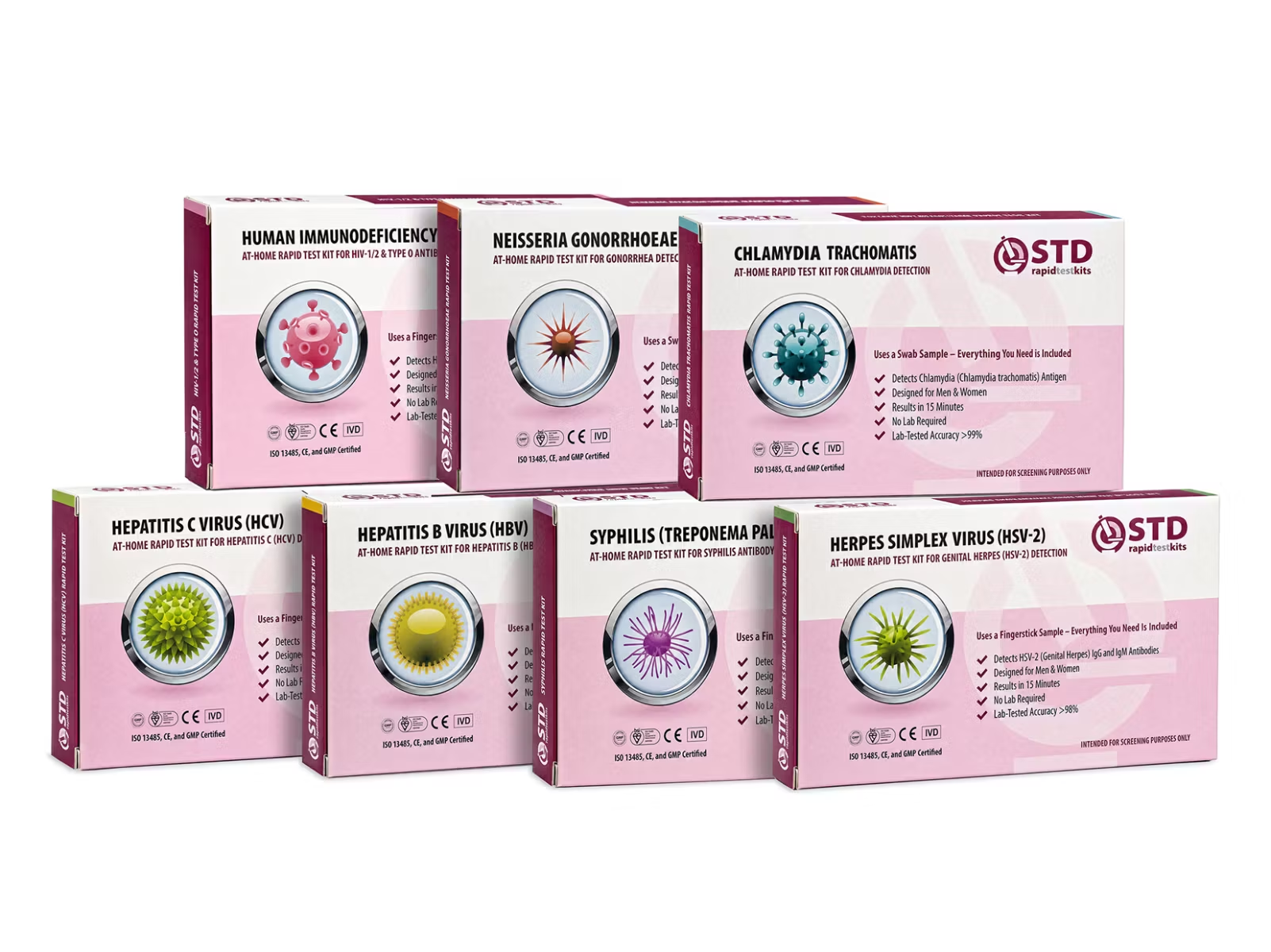
Use the timeline of your symptoms and any known or suspected exposure to choose your next testing date. The table below covers the most common scenarios. If you are not sure which scenario fits you, default to a broader screening kit covering the most common bacterial and viral infections, then schedule a retest at the proper window.
| Scenario | What It Likely Means | Testing Guidance |
|---|---|---|
| Had symptoms, now gone, never tested | Possible silent infection | Test now; if exposure was less than 2 weeks ago, retest at 14 to 21 days |
| Tested early, symptoms disappeared | Possible false negative due to window period | Retest at the validated window for the specific test |
| Partner tested positive, you feel fine | Possible asymptomatic carrier phase | Test immediately; retest in 1 to 3 months if first test is negative |
| Recurring mild symptoms weeks apart | Possible herpes reactivation or reinfection | Type-specific HSV blood test plus full panel swabs at the affected site |
| Treated, symptoms returned | Possible treatment failure or reinfection | Test again, treat partners simultaneously, follow up with telehealth |
What If You Test Positive After Feeling Fine?
It happens often. Surveillance estimates suggest that the majority of people with an active STI have no symptoms at the moment they are diagnosed (WHO STI fact sheet). A positive result after a quiet period is the screening system working as designed: testing caught what your body did not signal.
The next steps are practical and simple:
- Confirm with the recommended follow-up test. Rapid lateral-flow home tests are screening tools. A positive result should be confirmed by a clinic or telehealth provider with the appropriate confirmatory test (NAAT for bacterial STIs, type-specific serology for HSV, RNA confirmation for HIV, RPR with treponemal staging for syphilis).
- Get treatment. Bacterial STIs (chlamydia, gonorrhea, syphilis, trichomoniasis) are curable with antibiotics. Viral STIs (HIV, HSV, HPV, hepatitis B and C) are managed with long-term antivirals or monitoring. Treatment is faster, cheaper, and more effective the earlier it starts.
- Notify recent partners. Most clinics offer anonymous partner notification (sometimes called “expedited partner therapy” or “partner services”). You can let recent partners know without identifying yourself if direct contact feels too hard.
- Plan a retest. For chlamydia and gonorrhea, the CDC recommends a retest about three months after treatment to catch reinfection from an untreated partner.
A positive result gives you information you can act on. WHO estimates that more than one million curable sexually transmitted infections are acquired worldwide every day, primarily among people aged 15 to 49, so this is one of the most common health events of adult life.
Telling a Partner Even When You Feel Fine
This part can feel awkward, especially when symptoms have already disappeared and you are unsure if there ever was an STI in the first place. The general rule: if you had any symptoms that made you think “this could be an STI,” your current and recent partners deserve a heads-up that you are getting checked.
You do not need a confession. A short, factual message works:
“I had something a few weeks back that turned out fine symptom-wise, but I never tested. I am getting tested now, and I wanted to let you know in case you want to as well.”
If results come back positive for something like chlamydia, gonorrhea, syphilis, or trichomoniasis, public health departments and several telehealth services offer anonymous partner notification tools. They contact partners on your behalf without revealing your identity, and they route partners to free or low-cost testing and treatment in many areas.
For HSV or HPV, the conversation is more nuanced because these infections are lifelong. Partner notification for these is usually informal: you tell them yourself, ideally with a credible source on what type-specific risk and management actually involve.
- State and local health departments: partner services counselors contact recent partners on your behalf without naming you. Free in most U.S. jurisdictions.
- Telehealth STI services: many offer notification tools that send an anonymous text or email with testing instructions.
- Expedited partner therapy (EPT): in many states, your provider can prescribe treatment for your partner without an in-person visit, which is the standard recommendation for chlamydia and gonorrhea.
- Free third-party tools: services like TellYourPartner.org route an anonymous notification with a link to local testing resources.
What to Do If Your Symptoms Stopped
STD symptoms can flare, fade, return, and stay quiet for years at a time. The body's silence carries no information about whether the infection is still present. Testing does.
If your symptoms vanished and you never confirmed what they were, the next step is straightforward. Pick the right test for the infections most likely to fit your exposure, time it to the window period, and treat the result as data. Bacterial STIs respond to antibiotics; viral STIs respond to long-term management. The harm usually traces back to delayed diagnosis rather than to the diagnosis itself.
Order a combo STI test kit to retest from home, on your own schedule, with results in about 15 minutes.
Five-step action sequence
- Test at the validated window for the most likely infection (see the Window Periods table above).
- Confirm any positive home result with a clinic NAAT or type-specific serology.
- Get treatment promptly: antibiotics for bacterial STIs, antivirals or monitoring for viral STIs.
- Notify recent partners directly or through anonymous notification tools.
- Retest 3 months after treatment for chlamydia or gonorrhea to catch reinfection from an untreated partner.
FAQs
- I had STD symptoms that disappeared. Am I still contagious?
- Quite possibly yes. Bacterial STIs like chlamydia and gonorrhea continue replicating after symptoms fade and remain transmissible by genital, oral, or rectal contact until treated. Viral STIs like herpes and HPV can also shed virus during symptom-free periods. The only way to confirm is to test.
- Can STDs really clear on their own without treatment?
- Some viral STIs do; per CDC, about 90% of HPV infections clear within 1 to 2 years. Most bacterial STIs do not. Chlamydia, gonorrhea, syphilis, and trichomoniasis require antibiotics. Untreated bacterial STIs can persist for months or years and cause infertility, chronic pelvic pain, or systemic complications.
- How long can an STD stay in my body without symptoms?
- It varies by infection. Chlamydia can remain silent for weeks to months, syphilis can stay latent for decades, HPV often clears in 1 to 2 years but can persist longer, HSV stays for life with quiet phases between flares, and untreated HIV typically progresses over 8 to 10 or more years before clinical AIDS. Annual screening catches most asymptomatic cases.
- I tested negative right after my symptoms appeared. Should I retest?
- Yes, retest at the validated window for the specific test you used. As one example, a chlamydia or gonorrhea NAAT taken less than 14 days after exposure can return a false negative even when the infection is real. The Window Periods table earlier in this article lists the validated retest mark for each major STI.
- Can stress trigger STD symptoms to come back?
- For viral STIs like herpes, yes. Stress, illness, hormonal changes, and immune suppression can reactivate HSV from dormant nerve cells. For bacterial STIs, recurring symptoms after treatment usually mean either treatment failure (uncommon with current antibiotics) or reinfection from an untreated partner.
- How do I tell the difference between an STI and irritation?
- You generally cannot tell from symptoms alone. Yeast infections, UTIs, contact dermatitis, and friction can all mimic early STI symptoms. Lab or rapid testing is the only reliable way to distinguish them. If symptoms recur or you had a recent exposure, treat the question as a testing question.
- Can I get the same STI again after being treated?
- Yes. Treatment for bacterial STIs does not produce immunity. Reinfection from an untreated partner is the most common cause of a recurrence. CDC recommends a retest about 3 months after treatment for chlamydia or gonorrhea to catch reinfection early.
- When should I test if my symptoms already disappeared weeks ago?
- Test now and plan a follow-up retest if your initial exposure was recent. If the original exposure was less than 14 days before your symptoms appeared, your first test may have been too early; retest at 21 days from exposure for chlamydia and gonorrhea. For HIV, schedule a follow-up test 4 to 12 weeks from exposure depending on the test type. For HSV-2 antibody confirmation, the validated mark is 12 to 16 weeks after exposure.
How We Sourced This Article: We reviewed current screening, treatment, and window-period guidance from the CDC, WHO, and NIH MedlinePlus, cross-checked recurrence and asymptomatic-prevalence data with public-health surveillance summaries, and structured the article around the most common patterns clinicians describe when patients ask about disappearing symptoms.
- U.S. Centers for Disease Control and Prevention. STI screening recommendations, including annual screening for sexually active women under 25 and 3 to 6 month testing intervals for sexually active gay and bisexual men with multiple or anonymous partners.
- U.S. Centers for Disease Control and Prevention. About Chlamydia: prevalence of asymptomatic infection, transmission, and recommended retest timing 3 months after treatment.
- U.S. Centers for Disease Control and Prevention. About Genital Herpes: clinical course, viral shedding, antiviral management overview.
- U.S. Centers for Disease Control and Prevention. About Syphilis: primary chancre healing in 3 to 6 weeks, latent stage, and staging-based treatment.
- World Health Organization. Sexually Transmitted Infections (STIs) Fact Sheet: more than 1 million curable STIs acquired daily among people aged 15 to 49 worldwide, asymptomatic prevalence, and screening rationale.
- NIH MedlinePlus. Sexually Transmitted Diseases overview: symptom variability, asymptomatic carriage, and the role of testing for diagnosis.
