Published: November 2025 | Last updated: May 2026 | Editorial review and quality control: Martina N.
A blister on your lip a few days after a date can launch a long spiral of worry. Most of the time the answer is more ordinary than the panic. The majority of mouth sores that appear after kissing are cold sores caused by herpes simplex virus type 1 (HSV-1), a virus most adults already carry from childhood and that flares up under stress, sun exposure, or illness (WHO fact sheet on herpes simplex virus). A smaller number of mouth sores point to something else, usually a syphilis chancre, and the pattern looks distinct. This guide walks through how to tell the common patterns apart, when testing actually helps, and what your at-home options can and cannot answer.
Key Takeaways
- Most mouth sores after kissing are cold sores caused by HSV-1, not a new STI. The classic pattern is tingling first, then a small blister cluster on the outer lip, then crusting within about 10 days.
- A single, firm, painless ulcer that appears about three weeks or more after a new sexual partner is the syphilis chancre pattern. That one needs a blood test to confirm or rule out.
Most Mouth Sores After Kissing Aren't STIs
Start with the relief. Most mouth sores people panic over are not new sexually transmitted infections. They are cold sores, canker sores, friction irritation, dental trauma, or minor immune reactions to stress or illness. Your mouth is sensitive tissue. It reacts quickly to dehydration, spicy food, viral exposure, and small everyday things you do not even notice.
Cold sores are caused by HSV-1, one of the most common viral infections worldwide. The World Health Organization estimates that the majority of adults under 50 globally carry HSV-1, with most exposures happening in childhood through family contact, well before any sexual activity (WHO herpes simplex virus fact sheet). The virus can stay dormant in nerve tissue for years and reactivate as a lip blister during stress, illness, sun exposure, hormonal shifts, or fatigue.
So if you kissed someone Friday and a blister appeared Monday, it does not automatically mean they gave you something. It might. It might also be a virus you have carried for years finally reactivating after a stressful week.
The World Health Organization estimates that around two-thirds of the global population under 50 carry HSV-1, with most acquiring it in childhood through non-sexual contact with a parent or family member. A cold sore on your lip is almost always a virus already in your nervous system reactivating, not a brand-new infection from your most recent kiss (<a href="https://www.who.int/news-room/fact-sheets/detail/herpes-simplex-virus" target="_blank" rel="noopener">WHO herpes simplex virus fact sheet</a>).
What a Cold Sore Actually Looks and Feels Like
A true cold sore usually starts before you can see anything. There is a tingling, burning, or tight sensation in one small spot on the lip, often along the outer border where the pink of the lip meets the surrounding skin. The sensation is focused, not spread across the whole mouth. The NHS describes the sequence as tingling first, then painful blisters appearing over the next 48 hours, then bursting and crusting. Most resolve on their own within about 10 days (NHS, Cold sores).
Picture this. You kissed someone Saturday. On Monday, your lip feels oddly tight and warm in one corner. By Tuesday, tiny bubbles appear. By Thursday, they have crusted. By the following weekend, the crust has fallen off. That sequence (tingling, blister cluster, crusting, resolution) is the classic oral HSV-1 pattern.
Cold sores usually appear on the outer lip border or just outside the mouth. They are typically tender or painful. They do not usually appear deep inside the mouth on the soft inner cheek or under the tongue.
| Feature | Typical Cold Sore Pattern |
|---|---|
| Location | Outer lip border or just outside the mouth |
| Early Sensation | Tingling, burning, or tightness before any blister forms |
| Appearance | Cluster of small fluid-filled blisters |
| Pain Level | Tender or painful |
| Healing Time | About 10 days, usually without treatment |
Three Mouth Sore Patterns to Tell Apart
Most readers landing here are trying to match what they see in the mirror to one of a few patterns. Each one has a distinct look, sensation, and timeline. The comparison gallery below shows the most common visuals: a classic HSV-1 cold sore on the outer lip, an aphthous canker sore tucked inside the mouth, a primary syphilis chancre on the vermillion border, and one frequent lookalike (angular cheilitis) that is often mistaken for either of the first two. If what you see does not match any of these, an in-person clinician evaluation will tell you more than another hour of self-comparison.
Canker Sores: The Lookalike That Isn't Sexual
Canker sores (aphthous ulcers) are not caused by herpes and are not sexually transmitted. They appear inside the mouth on the inner cheek, the inner lip lining, the side of the tongue, or the soft palate. They look like shallow round or oval ulcers with a white or yellow center and a red border. They hurt, especially when eating citrus, tomato, vinegar, or anything spicy. They usually heal within a week or two.
The defining differences from a cold sore are location, sequence, and appearance. Canker sores do not blister first. They do not crust. They sit inside the mouth, not on the outer lip border. If your sore is deep inside your cheek and looks more like a small crater than a blister, you are most likely dealing with a canker sore. Common triggers include stress, accidental cheek bites, toothpastes containing sodium lauryl sulfate, and vitamin B12 or iron deficiencies.
Canker sore at a glance
- Location: inside the mouth (inner cheek, inner lip, tongue, soft palate). Never on the outer lip border.
- Appearance: shallow round ulcer with a white or yellow center and a red ring. No blister stage, no crusting.
- Contagious: no. Canker sores are not caused by herpes and do not spread by kissing or any other route.
When a Mouth Sore Could Signal Syphilis
This is where the article moves from reassurance into clarity. Most lip sores are cold sores. A small number are something else, and the one to know about is the primary syphilis chancre.
A syphilis chancre is the body's first visible response to Treponema pallidum, the bacterium that causes syphilis. It looks different from a cold sore. It is usually a single, firm, round ulcer with raised, well-defined edges. It is often painless. That detail is the one most people miss, because a painless sore feels less serious than it actually is (CDC, About Syphilis).
The chancre usually appears at the site of contact. For sexual transmission, that is most often genital tissue. When syphilis is acquired through oral sex, or more rarely through deep kissing involving a partner with an active oral chancre, the sore can appear on the lip, the tongue, or inside the mouth. The CDC notes that the chancre itself usually lasts 3 to 6 weeks and heals on its own regardless of treatment, which can be deeply misleading because the infection has not gone away. It has simply moved deeper.
If you see a firm round sore on your lip a few weeks after a new partner, and it does not burn, tingle, or hurt, the appearance and timing both point toward testing.
| Feature | Cold Sore (HSV-1) | Syphilis Chancre |
|---|---|---|
| Number of Lesions | Cluster of small blisters | Usually a single sore |
| Pain | Tender or painful | Often painless |
| Texture | Soft blister that crusts | Firm, round, raised border |
| Typical Onset | Within a couple of weeks of contact | Three weeks or more after exposure |
| Healing | About 10 days | 3 to 6 weeks without treatment, but infection persists |
| Testing Needed? | Only if diagnosis is uncertain | Yes, blood antibody test |
Is this mouth sore an STD?
Probably not. Most mouth sores after kissing are cold sores caused by HSV-1, a virus most adults already carry. The classic pattern is tingling first, then a small blister cluster on the outer lip, then crusting within about 10 days. The pattern that warrants STI testing is different: a single firm painless ulcer with a raised border, often appearing three weeks or more after a new sexual partner. That one is the syphilis chancre pattern and is confirmed with a blood antibody test.
Can You Actually Catch an STI From Kissing?
Yes, but the list of plausible infections is short. Kissing transmits oral herpes when one partner has an active cold sore or is shedding virus from the lip area. Closed-mouth kissing carries lower transmission risk than deep open-mouth kissing, but transmission can occur from saliva or skin-to-skin contact with the lesion area (CDC, About Genital Herpes).
Syphilis can transmit through direct contact with a chancre during kissing if that sore is present in the mouth. This is medically documented but uncommon, because most syphilis chancres appear on genital tissue rather than oral. The key detail is direct contact with an open sore.
Bacterial infections like chlamydia and gonorrhea are not typically transmitted by kissing alone. They spread through oral, vaginal, or anal sex. Some recent research has examined whether deep open-mouth kissing alone can pass oral gonorrhea between partners, with mixed findings, but it is not the dominant transmission route. So if your only exposure was closed-mouth kissing and a blister cluster appeared on your lip a few days later, oral HSV-1 is the most likely explanation.
| Infection | Kissing Transmission Risk | Conditions That Matter |
|---|---|---|
| Oral herpes (HSV-1) | Yes, well-documented | Active cold sore or asymptomatic viral shedding on a partner's lip |
| Syphilis | Rare but documented | Direct contact with an active oral chancre |
| Chlamydia | Not by kissing alone | Spreads via oral, vaginal, or anal sex |
| Gonorrhea | Limited, mixed evidence | Mostly via oral, vaginal, or anal sex; some studies examine deep kissing |
| HIV | Not by kissing | Saliva is not a transmission route |
The Timing Clue Most People Miss
Timing tells a story your anxiety does not. Cold sores from a new HSV-1 exposure typically appear within a couple of weeks of contact, often within the first few days, and the NHS describes blisters appearing over the 48 hours after the initial tingling sensation begins (NHS, Cold sores). The NHS notes that primary syphilis symptoms can take three weeks or more to appear after infection (NHS, Syphilis symptoms). That gap matters when you are trying to figure out what is happening on your lip.
If you kissed someone Friday and felt tingling by Sunday, the timeline fits HSV-1 far better than syphilis. If a painless firm ulcer appeared three or four weeks after a new sexual partner, the timeline points toward syphilis testing. Bacterial throat infections from oral sex, when they cause symptoms at all, usually appear within 7 to 14 days, and most commonly as a mild sore throat rather than a visible blister.
- Cold sore (HSV-1): typically within a couple of weeks of contact, often within the first few days.
- Syphilis chancre: three weeks or more after exposure.
- Pharyngeal gonorrhea or chlamydia: 7 to 14 days, when symptoms appear at all.
When Testing Makes Sense
If the sore looks like a classic cold sore (tingling, blister cluster, outer lip, crusting, healing within two weeks), testing is usually not necessary unless you want a definitive label. Many adults already carry HSV-1 and manage occasional outbreaks with rest, hydration, and over-the-counter topical antivirals.
Testing is worth doing when:
- The sore is painless, firm, and has a well-defined raised border (possible chancre)
- It has lasted longer than two weeks without healing or is growing rather than shrinking
- You also notice swollen lymph nodes, a rash on the palms or soles, or general flu-like symptoms (possible secondary syphilis)
- You had oral sex with a new or untested partner and want broader STI screening
- You want a baseline because you are starting a new sexual relationship
For syphilis, a blood antibody test is the at-home and clinical standard. For HSV-1, two main options exist: a swab of an active blister (best when the sore is fresh and fluid-filled, generally done at a clinic), or a blood antibody test that confirms whether you have been exposed to HSV-1 at some point in your life. Blood tests cannot pinpoint exactly when you acquired the virus.
What Our At-Home Tests Can and Cannot Do
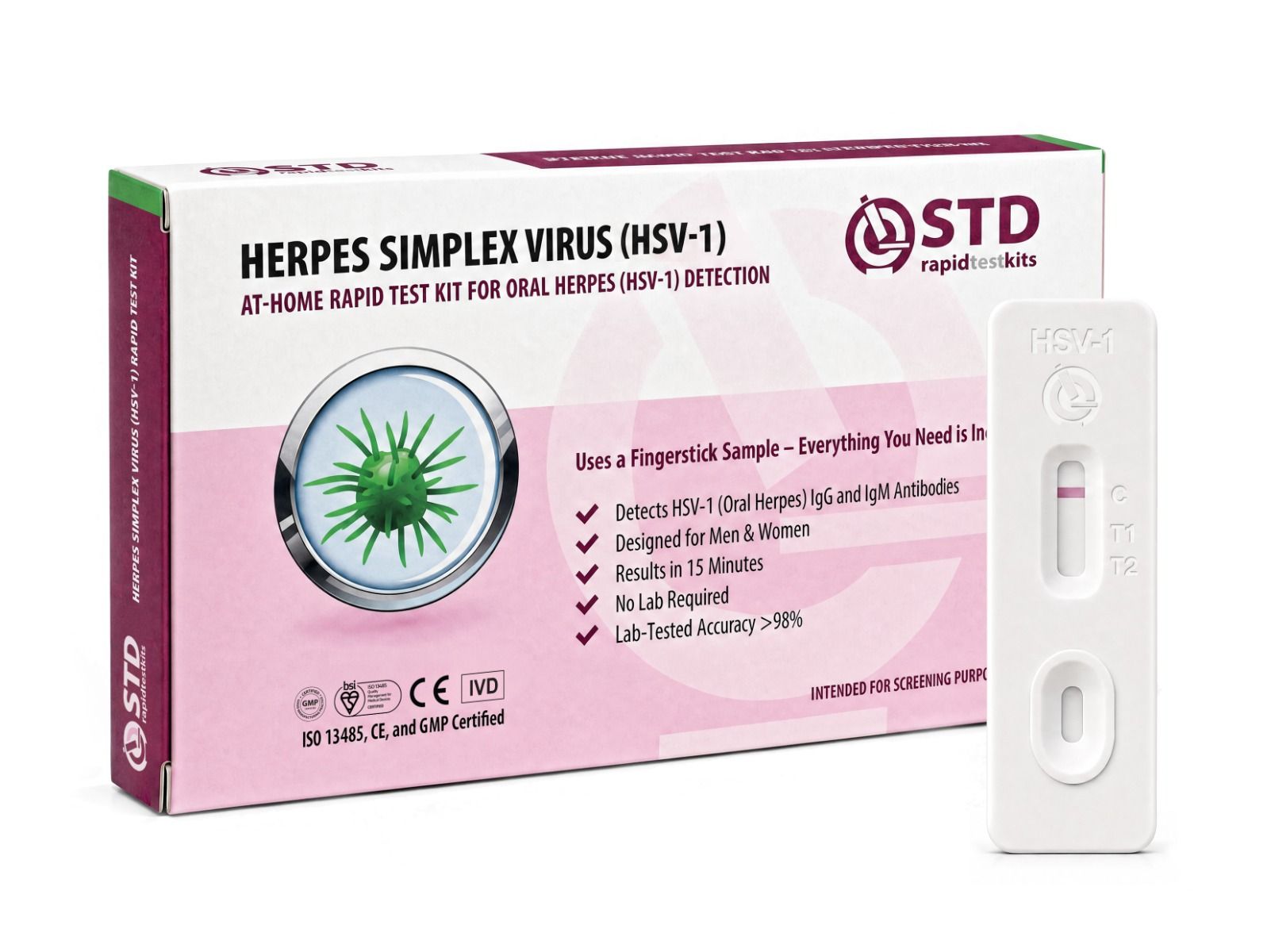
At-home rapid tests are lateral-flow immunoassays, not the molecular NAAT or PCR tests labs use. The blood-based kits screen for antibodies in fingerstick blood. The four swab-based kits look for pathogens in self-collected genital swab samples. Lab molecular testing has higher analytical sensitivity, especially in asymptomatic infections, so the two technologies are complementary rather than equivalent.
For mouth-sore concerns specifically, this means:
- For HSV-1 or HSV-2: our home kits are fingerstick blood antibody tests. Most people develop detectable antibodies within 12 weeks, and full sensitivity for some assays is reached by 16 weeks. The kit answers "have I ever been exposed," not "is this specific lesion new."
- For syphilis: our home kit is a fingerstick blood antibody test, generally reliable from about 3 weeks post-exposure, with sensitivity climbing as antibody levels rise over the following weeks.
- For oral gonorrhea or oral chlamydia: we do not sell pharyngeal (throat) swab tests. Our swab-based chlamydia and gonorrhea kits are validated for self-collected genital swabs only. If you specifically need a throat swab after oral sex, a clinic visit is the right route.
This is not a pitch for clinics. It is an accurate map of what at-home rapid testing covers.
Pharyngeal swabs for oral gonorrhea or oral chlamydia are typically performed at sexual health clinics, urgent care centers, or primary care offices. Most providers offer same-day swabbing if you describe the exposure clearly. CDC sexual health guidance recommends testing every anatomical site of sexual contact when symptoms or recent partners suggest exposure to those infections.
Oral Herpes vs Genital Herpes: The Confusion That Fuels Panic
One of the worst Google spirals starts here. You search for "mouth sore STD" and the results pull up genital herpes articles. The labels blur. HSV-1, HSV-2, oral, genital. It starts feeling much bigger than what is actually happening on your lip.
Here is the grounding picture. HSV-1 most commonly causes oral cold sores. HSV-2 most commonly affects the genital area. Both types can technically infect either anatomical location if direct contact happens through oral sex. The virus responds to contact, not to labels. But the dominant patterns are real: an outer-lip blister cluster is overwhelmingly HSV-1 oral herpes, not HSV-2 migrating to a new location.
HSV-2 specifically transmits through skin-to-skin contact during genital activity, including during periods of asymptomatic viral shedding. It is a separate clinical concern from oral cold sores, and the test for it is a separate fingerstick blood antibody test if you want confirmation.
| Feature | HSV-1 | HSV-2 |
|---|---|---|
| Most common anatomical site | Oral: lips, around the mouth | Genital area |
| Typical transmission | Skin contact, kissing, oral sex | Genital skin-to-skin contact |
| Can affect the other site? | Yes, through oral sex | Yes, through oral sex |
| Asymptomatic carriage | Very common; most adults globally | Common; many people are unaware |
| Home test | Fingerstick blood antibody test | Fingerstick blood antibody test |
Most people with HSV do not know they have the infection because they have no symptoms or only mild symptoms.
What Oral STD Testing Actually Involves
When people picture an "STD test," they often imagine a urine cup or a genital swab. Oral concerns work differently. The right test depends entirely on which infection you are checking for and what kind of exposure occurred.
For HSV, a fluid swab of an active blister gives the most direct confirmation, performed when the lesion is fresh and weeping. Once the blister crusts, swab detection becomes harder. Antibody blood tests give a yes or no on past exposure but cannot tell you whether the current sore is a brand-new infection or an old one reactivating.
For syphilis, blood antibody testing is the standard both at home and in clinics. The chancre itself can also be sampled in clinical settings using darkfield microscopy or PCR, but this is rarely done outside specialty clinics.
For oral gonorrhea or chlamydia after oral sex, a pharyngeal (throat) swab is the right test. These bacterial infections typically affect the throat rather than producing visible lip blisters. Many people with pharyngeal infections have no symptoms at all, which is one reason CDC recommends routine site-specific testing for sexually active people whenever symptoms or a recent exposure raise the question.
| Concern | Typical Test Method | Best Timing After Exposure | Common Symptom Pattern |
|---|---|---|---|
| Oral Herpes (HSV-1) | Clinic swab of active blister, or fingerstick blood antibody test | Swab during active outbreak; blood test from 12 to 16 weeks | Painful blister cluster on outer lip |
| Syphilis | Blood antibody test (at home or clinic) | 3 to 6 weeks | Single painless firm ulcer with raised border |
| Gonorrhea (oral) | Clinic throat swab | 7 to 14 days | Sore throat or no symptoms |
| Chlamydia (oral) | Clinic throat swab | 7 to 14 days | Often asymptomatic |
Retesting Windows: When One Test Isn't the End
You test. You wait. Relief, or clarity, lands. But one question often lingers quietly: do I need to test again?
For oral HSV-1 confirmation, retesting is usually unnecessary if the initial diagnosis is clear. A clinic swab during an active outbreak gives a direct answer. Blood antibody tests only tell you whether you have been exposed at some point and cannot pinpoint when.
For syphilis, timing matters more. Antibodies build over weeks after exposure. If you tested very early after a suspected exposure, repeat blood testing at about six weeks gives a more reliable reading. If you start treatment, follow-up blood testing confirms the infection is resolving, and the NHS recommends repeat clinic visits during the first 12 months after starting antibiotics (NHS, Syphilis).
For pharyngeal gonorrhea or chlamydia, clinic throat swab testing is reliable from about 7 to 14 days after exposure. Testing too early can return a falsely reassuring result because bacterial load has not yet built to detectable levels.
- HSV-1 antibody blood test: if the first test was within 12 weeks of exposure, retest at 12 to 16 weeks for full sensitivity.
- Syphilis blood test: if the first test was within 3 weeks of exposure, retest at about 6 weeks.
- Pharyngeal gonorrhea or chlamydia (clinic swab): if the first test was sooner than 7 days post-exposure, retest at 7 to 14 days.
Talking to a Partner Without Making It Weird
The hardest part of all this is often not the sore itself but the message you need to send afterward. Most adults have had some form of HSV exposure at some point, and many do not realize it until a sore appears or a blood test confirms past antibodies, so this conversation is far more common than it feels in the moment.
Keep the message direct, factual, and brief, because people respond better to calm clarity than to silence or evasion. If testing reveals something treatable like syphilis or a bacterial infection, partner notification is a meaningful act of care. It prevents reinfection and protects health on both sides. Many sexual health clinics also offer anonymous partner notification services if doing it yourself feels too hard.
If you need a starting point, this is one that works without drama:
"Hey, I noticed what looks like a cold sore and I'm getting it checked out. Wanted to keep you informed in case it matters for you. No need to do anything right now, but happy to share whatever I learn."
It is short, factual, and gives the other person room to respond without pressure. Adjust the wording to fit your relationship.
How to Protect Yourself Before the Next Kiss
Cold sores are most contagious when blisters are present. Avoid kissing or sharing utensils, lip balm, or drinks during an active outbreak, yours or a partner's. Prescription antiviral medications (acyclovir, valacyclovir, famciclovir) can shorten outbreaks. For people with frequent recurrences, daily suppressive therapy can reduce both outbreak frequency and transmission risk to partners.
Barrier methods like dental dams reduce, but do not eliminate, transmission risk during oral sex. Regular STI testing every 3 to 12 months, depending on partner number and risk profile, makes surprises less likely and conversations easier. For most sexually active adults, at least annual testing is the baseline; more frequent testing fits people with multiple partners or new partners since their last screen.
FAQs
- I kissed someone and now I have a sore on my lip. Did they give me an STD?
- Possibly, but most likely it is a cold sore caused by HSV-1, a virus you may have carried for years without knowing. If the sore started with tingling and turned into a small blister cluster on the outer lip within a few days of contact, that fits HSV-1 reactivation more closely than a brand-new STI. Kissing can transmit HSV-1, but it can also reactivate a dormant virus you already have. Timing and appearance carry more diagnostic weight than assumption.
- If it is herpes, does that mean my dating life is over?
- No. HSV-1 oral herpes is one of the most common viral infections worldwide. The WHO estimates that the majority of adults under 50 globally carry it. Most people who acquire it have infrequent outbreaks or none at all. With open communication and care during active sores, people date, partner, and have intimate relationships without complications. The cultural stigma is heavier than the medical reality.
- What is the actual difference between a cold sore and a canker sore?
- Location settles it quickly. Cold sores form on the outer lip border and arrive with tingling before any blister appears. Canker sores form on inner mucosal surfaces (cheek lining, underside of the tongue, soft palate) and look like a small crater with a white or yellow center from the start, never a blister. Canker sores are not caused by herpes and are not contagious.
- Why would a syphilis sore not hurt? That seems counterintuitive.
- It does, but biologically, primary syphilis often produces a single firm ulcer that is painless. The local immune response does not trigger the same pain signaling as a viral blister. The painlessness is part of what makes early syphilis easy to miss, especially when the chancre heals on its own in 3 to 6 weeks while the infection continues internally. A painless persistent sore after a new sexual partner is exactly the pattern that warrants a blood test.
- Can you actually catch syphilis just from kissing?
- Rarely, but yes, when a partner has an active oral chancre and direct contact with that sore happens during deep kissing. The key word is contact with an open sore. Closed-mouth kissing or kissing a partner with no oral chancre is very unlikely to spread syphilis. Genital and oral sex are the dominant transmission routes.
- Do I need to rush to a clinic the moment I notice anything?
- Not always. If the sore looks like a classic cold sore (tingling, outer lip, blister cluster, crusting), you can usually monitor it for a few days. If it is painless, persistent beyond two weeks, growing rather than shrinking, or accompanied by a rash on the palms or soles or swollen lymph nodes, testing is worth doing. And if the anxiety is louder than the symptom itself, testing for peace of mind is a valid reason on its own.
- Can oral gonorrhea or chlamydia cause lip blisters?
- No. Pharyngeal gonorrhea and chlamydia tend to cause sore throat or no symptoms at all, not visible lip blisters. If your only symptom is a blister cluster on your lip, bacterial STIs are very low on the probability list. A clinic throat swab is the right test if pharyngeal infection is the concern after oral sex.
- How long should I wait before testing after oral sex?
- For pharyngeal gonorrhea or chlamydia, clinic throat swab testing becomes reliable from about 7 to 14 days after exposure. For syphilis, blood antibody testing is most reliable from about 3 to 6 weeks after exposure, climbing in accuracy as antibody levels rise. For HSV-1 or HSV-2 antibody testing, most people seroconvert within 12 weeks and some assays reach full sensitivity by 16 weeks, so a retest at 12 to 16 weeks gives the most reliable answer.
How we sourced this article: Our article was constructed based on current advice from the most prominent public health and medical organizations, and then molded into plain language based on the situations people actually experience. Primary sources include the U.S. Centers for Disease Control and Prevention, the World Health Organization, and the UK National Health Service. Where specific figures, timing windows, or clinical patterns are quoted, the relevant authority is linked inline within the article body.
- U.S. Centers for Disease Control and Prevention. About Genital Herpes, with information on HSV-1 and HSV-2 symptoms, transmission, and shedding.
- U.S. Centers for Disease Control and Prevention. About Syphilis, including chancre appearance, duration, and progression.
- World Health Organization. Herpes simplex virus fact sheet, with global prevalence estimates for HSV-1 and HSV-2.
- UK National Health Service. Cold sores, including symptom progression and typical 10-day healing course.
- UK National Health Service. Syphilis symptoms, including the three-weeks-or-more window for primary symptoms to appear after infection.
- UK National Health Service. Syphilis overview, including testing approach and recommended retesting during the first 12 months after treatment.
