
Published: November 2025 | Last updated: May 2026 | Editorial review and quality control: Martina N.
Burning, itching, or stinging after sex can feel alarming. The first instinct is often to assume the worst. Most immediate post-sex irritation, though, is caused by lubricant ingredients, friction, or contact dermatitis, not by a sexually transmitted infection. Telling the two apart matters because the right next step depends on which one you actually have.
This guide breaks down the timing patterns, symptom progression, and discharge cues that separate a lube reaction from an early STD. Use it to decide whether you can wait the irritation out, switch products, or schedule a test.
Key Takeaways
- Lube irritation usually starts within minutes to hours after sex and improves in 24 to 72 hours. STD symptoms more often take 2 days to 4 weeks to surface and tend to persist or worsen rather than fade.
- Thick or colored discharge, blister clusters, open sores, or fever move the picture out of the lube-irritation category. Those signs deserve a test rather than watchful waiting.
Why this confusion happens so often
Genital skin is thin and reactive. Add friction, latex, bodily fluids, and a new lubricant formula to the mix, and a flare of redness or burning becomes a predictable outcome. People searching “burning after sex but no STD” are often experiencing contact dermatitis rather than an infection. The NHS describes contact dermatitis as skin inflammation caused by direct contact with an irritant or allergen, with redness, dryness, blistering, and a burning or stinging feeling at the contact site (NHS, Contact Dermatitis).
The tricky part is that early STD symptoms can also start subtly. Mild itching from a herpes outbreak can precede visible blisters. Chlamydia and gonorrhea can cause burning during urination. Trichomoniasis can produce irritation and discharge that feels like a yeast infection.
Genital skin reacts to chemical irritants and friction within minutes to hours. Bacteria and viruses need days to replicate before symptoms appear. Onset speed alone tells you a lot before any other sign shows up.
What lube irritation actually feels like
A reaction to lubricant usually shows up quickly. Sometimes within minutes, sometimes a few hours later. The discomfort tends to sit on the surface of the skin rather than feel deep or systemic. It can read as raw, stinging, or hot, and it is often most intense exactly where contact happened.
The most common culprits are glycerin, parabens, propylene glycol, warming or cooling agents, flavorings, and preservatives. Even products marketed as “sensitive” or “natural” can trigger a reaction in some people, especially when the genital skin is already a little dry, recently shaved, or recovering from a previous flare. The defining pattern is this: the discomfort improves once exposure stops. Removing the trigger, washing the area with water, and waiting usually does most of the work.
| Feature | Typical Pattern |
|---|---|
| Onset timing | Minutes to hours after sex |
| Sensation | Burning, stinging, surface itching |
| Visible changes | Redness, mild swelling, patchy rash |
| Discharge | Usually none or clear irritation-related moisture |
| Duration | Improves within 1–3 days if no re-exposure |
| Systemic symptoms | None (no fever, no body aches) |
How early STD symptoms usually behave
Infections follow biological timelines. Bacteria and viruses need time to replicate before symptoms appear. That delay, called the incubation period, is one of the biggest differences between a lube reaction and an STD. The CDC notes that chlamydia is often asymptomatic, and that when symptoms do appear they may not show up until several weeks after exposure (CDC, About Chlamydia).
Bacterial STDs like chlamydia and gonorrhea generally take several days to a couple of weeks to produce noticeable symptoms when they appear at all. Viral infections like genital herpes often cause tingling or skin sensitivity before blisters appear, with first-outbreak symptoms typically developing within a couple of weeks of exposure. Syphilis classically presents with a single painless sore about three weeks after exposure, though the range spans roughly 10 to 90 days. Some infections cause no symptoms at all, which is why relying only on how you feel can be misleading.
| Infection | Typical Symptom Onset After Exposure | Common Early Signs |
|---|---|---|
| Chlamydia | 1–3 weeks (often no symptoms) | Burning urination, mild discharge, pelvic discomfort |
| Gonorrhea | Within a few weeks | Burning urination, thicker discharge, testicular pain |
| Herpes (first outbreak) | Within a couple of weeks | Tingling, painful clustered blisters, flu-like symptoms |
| Syphilis (primary) | About 3 weeks (range 10–90 days) | Single painless ulcer (chancre) at contact site; sometimes swollen lymph nodes |
| Trichomoniasis | 5–28 days | Itching, yellowish-green discharge, fishy odor |
Progression: the clue most people miss
Irritation peaks early and then improves. Infections often start mild and then intensify. That progression curve is one of the most reliable patterns for separating a lube reaction from an STD.
If discomfort is worse on day three than it was on day one, infection becomes more plausible. If new symptoms appear over time, such as discharge, sores, or pain during urination, those are not typical of a simple allergic reaction. Clinicians commonly see people delay testing in the hope that symptoms will pass on their own. When symptoms are evolving rather than fading, testing becomes the smarter next step; clarity is more useful than waiting it out.
When anxiety is the loudest symptom
Sometimes the most intense symptom is fear, not skin. You used protection, thought you were careful, and yet the encounter keeps replaying in your head. That mental loop is common and human, and it does not by itself mean infection is present.
Protection lowers risk significantly, but does not eliminate it. Skin-to-skin viruses like herpes can spread outside the area a condom covers. That said, immediate post-sex burning, the kind that starts within an hour of sex, is overwhelmingly mechanical or chemical irritation rather than infection. The biology of bacteria and viruses simply does not produce symptoms in that timeframe.
This article is published by stdrapidtestkits.com, which sells at-home STI testing kits. We recommend products based on fit-for-purpose for the reader's concern, not commercial benefit.
Most people who have chlamydia have no abnormal symptoms. If you do have symptoms, they may not appear until several weeks after you have sex with a partner who has chlamydia.
Discharge: the symptom that changes the equation
Discharge is where the picture starts to clarify. Simple lube irritation usually does not create thick, colored, or strong-smelling discharge. You might notice extra moisture from inflammation, but it tends to be clear and mild.
Infections behave differently. Chlamydia and gonorrhea can produce yellow, green, or cloudy discharge from the penis or cervix. In people with vaginas, discharge may thicken, change color, or carry a noticeable odor. The CDC notes that trichomoniasis often produces a thin, yellowish-green discharge with a fishy smell in those who do have symptoms (CDC, About Trichomoniasis).
If the change is persistent and looks or smells distinctly different from your baseline, it is rarely caused by an allergic reaction alone; irritation calms within a few days while infection tends to produce a pattern that persists.
Rash, sores, or just friction?
A rash after sex can mean a few different things. Friction burns tend to look like uniform redness in areas of repetitive motion. The skin may feel tender, but it typically does not blister or ulcerate. Contact dermatitis from a lubricant often shows up as patchy redness or small raised bumps, sometimes with intense itching. It does not usually form fluid-filled blisters that cluster together.
Herpes is different. It often begins with tingling or sensitivity, then small painful blisters appear in a cluster. Those blisters can break open, weep, and form shallow ulcers before crusting and healing. That evolution from sensation to blister to sore is not how a simple lube reaction behaves. Syphilis can also cause sores, classically a single painless ulcer at the contact site about three weeks after exposure. Any open sore that lasts more than a few days deserves a clinical look.
| Feature | Lube Irritation / Friction | Possible STD Sign |
|---|---|---|
| Redness | Diffuse, surface-level | May surround sores or be localized |
| Blisters | Rare | Common in herpes |
| Ulcers / open sores | No | Yes (herpes, syphilis) |
| Pain progression | Improves quickly | Can worsen over days |
| Flu-like symptoms | Never | Possible with first herpes outbreak |
Anal burning after lube
Anal tissue is thinner and more reactive than vaginal tissue. Anal burning after lube is common, especially with warming or flavored products and especially after extended or vigorous activity. The area can feel raw for a day or two simply from friction or microscopic tears, with no infection involved.
Receptive anal sex can also transmit gonorrhea, chlamydia, and herpes. Rectal infections may cause discharge, bleeding, persistent pain, or a feeling of pressure or fullness, and those symptoms typically do not resolve within 48 hours without treatment. If discomfort lingers past three days, intensifies, or is accompanied by discharge or bleeding, testing is the responsible move.
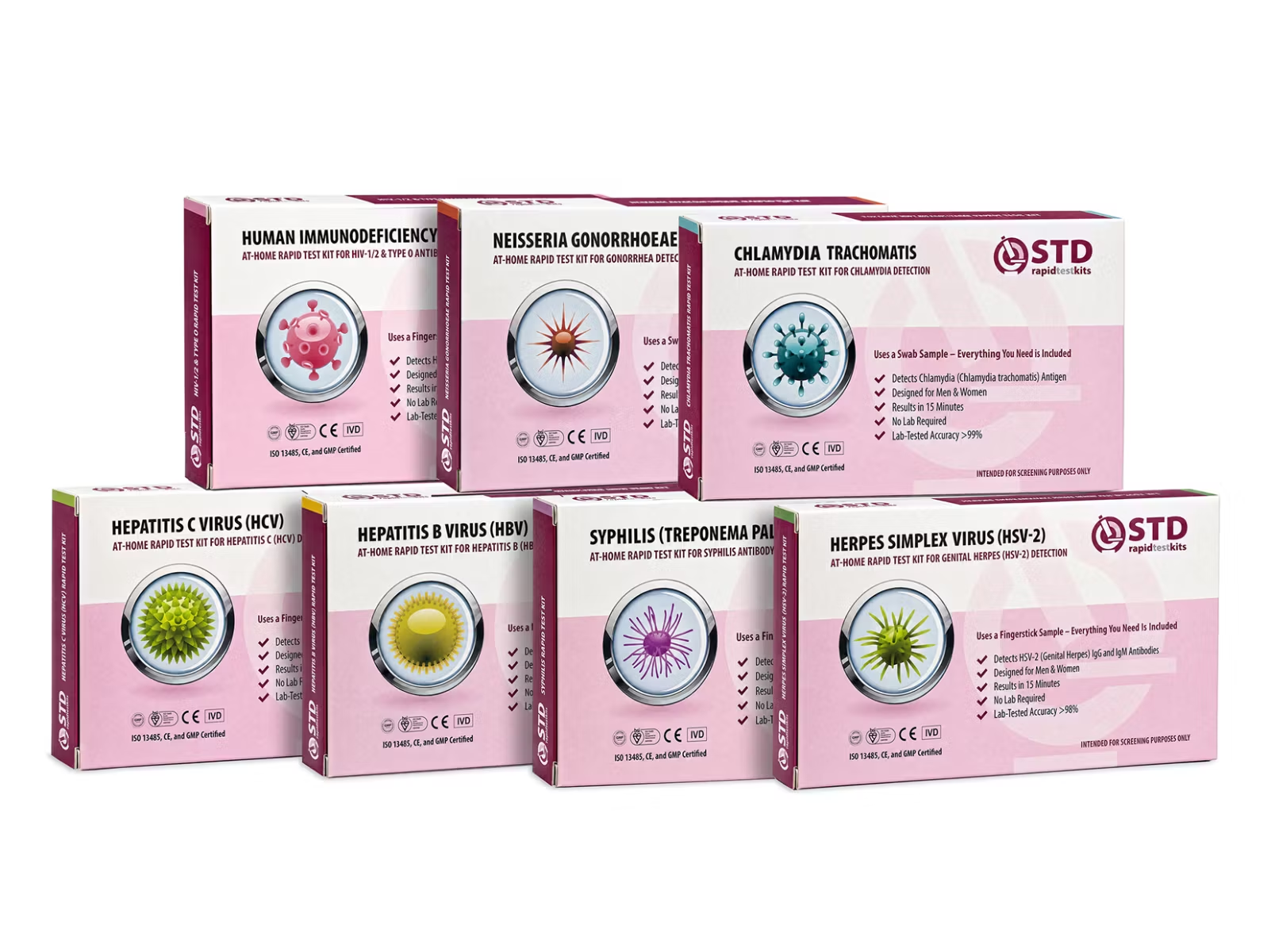
Our at-home rapid kits are validated for self-collected genital swabs and fingerstick blood samples. For a rectal-specific swab, a clinic visit is the right call. The kit below still covers the systemic and genital risk from the same exposure event.
Duration is one of the strongest clues
“How long does lube irritation last” is one of the most common search queries on this topic. In most cases, true contact irritation improves meaningfully within 24 to 72 hours once the trigger is removed. The skin heals quickly when it is left alone.
STD symptoms do not reliably disappear on their own. They may fluctuate, but they tend to persist or evolve. A burning sensation tied to a urinary or genital infection often returns or worsens with urination. A rash tied to herpes progresses through predictable stages before crusting over. If you are on day four or five and things feel the same or worse, the simplest explanation is no longer “just a lube reaction.”
24 to 72 hours: typical resolution window for a lube reaction once exposure stops. Day three or later with no improvement, or worsening: reassess for infection and consider testing.
When to test for an STD after irritation
Testing too early can produce false reassurance. Most bacterial STDs become reliably detectable about one to two weeks after exposure. Viral infections like herpes have their own timelines, and blood antibody tests for herpes typically need several weeks to register a reliable result.
If symptoms appeared within hours of sex and resolved quickly, immediate testing is rarely necessary unless you had a known high-risk exposure, such as sex with a partner who later tested positive. But if symptoms persist, evolve, or you simply cannot relax, testing is appropriate. The WHO emphasizes that many STIs are asymptomatic, and that testing is the only reliable way to know your status (WHO, Sexually Transmitted Infections).
| Infection | Earliest Reasonable Test Time | Most Reliable Testing Window |
|---|---|---|
| Chlamydia | 7 days | 14 days or later |
| Gonorrhea | 5–7 days | 14 days or later |
| Herpes (lesion swab) | When sores appear | While lesions are present |
| Herpes (blood antibody) | Several weeks after exposure | 12+ weeks for confirmation |
| Trichomoniasis | 7 days | 2–4 weeks |
Burning but STD test negative: now what?
Few things are more disorienting than ongoing irritation alongside a negative test result. You waited, you tested at the right time, the result was reassuring, and yet something still feels off. This scenario is more common than people realize.
Persistent burning with a properly-timed negative STD test commonly points to one of three things: unresolved contact dermatitis, a yeast imbalance, or friction-related irritation that has not fully healed. A confirmed negative result on a properly-timed test significantly lowers the likelihood of a bacterial STD. The focus then shifts from infection to inflammation. Sometimes the simplest explanation is the correct one: skin that needs time, gentler products, and a break from friction. A short consultation with a primary care provider or gynecologist can identify yeast, bacterial vaginosis, or eczema-type causes that look like an STD without being one.
Yeast infection, lube reaction, or STD?
Another frequent spiral is wondering whether symptoms are a yeast infection or an STD. Yeast can mimic irritation in early stages, with itching, redness, and sometimes swelling. It also tends to produce thick white discharge often described as cottage-cheese-like, and the itching persists rather than fading.
Lube irritation usually appears immediately after exposure and improves steadily once the product is stopped. Yeast often develops over several days, sometimes after a course of antibiotics or a high-sugar week. Bacterial STDs follow their own incubation timelines and may include burning urination or abnormal colored discharge. The differences are not always dramatic in the first 24 hours.
| Feature | Lube Irritation | Yeast Infection | Common Bacterial STD |
|---|---|---|---|
| Onset | Hours | 1–3 days | Several days to 2 weeks |
| Itching | Surface-level | Intense, persistent | Variable |
| Discharge | Minimal or none | Thick, white, cottage-cheese-like | Colored or cloudy, sometimes odorous |
| Improves without treatment | Often yes | Usually no | Rarely |
A simple decision framework you can actually use
When you are stuck between “it's probably nothing” and “what if it's an STD,” this framework helps. If symptoms started within hours and are already improving by day two, irritation is most likely. If symptoms began several days later and are intensifying, infection becomes more plausible. If discharge changes color, sores appear, or systemic symptoms like fever or swollen lymph nodes develop, testing becomes urgent.
If you are uncertain but the exposure involved a new partner or a condom failure, testing offers clarity. If anxiety is louder than your symptoms, testing offers peace. At-home testing can shift the experience from guessing to knowing, with no waiting rooms and no awkward conversations.
Before you panic, here's what to do next
If you remember nothing else from this article, remember this: timing and progression matter more than a single sensation. Lube irritation appears quickly and fades quickly. STD symptoms usually take days to develop and rarely resolve without treatment. Most immediate post-sex burning is irritation. The pattern over the following days is what tells the real story.
If symptoms are worsening, evolving, or simply not calming down after a few days, testing is the next logical step. A discreet at-home combo STD test kit can check for the most common infections without leaving your home, and turns hours of mental spiraling into a clear answer. Note that our at-home rapid tests are lateral-flow immunoassays, useful for screening and reassurance. A confirmed positive should be followed up with a clinic-administered NAAT or blood draw, which uses higher-sensitivity laboratory chemistry.
Decision paths at a glance
- Symptoms resolved within 72 hours and no new signs: likely irritation. Monitor, switch products on the next encounter, and skip testing unless a known high-risk exposure occurred.
- Symptoms persist past day three or are evolving rather than fading: test at the 7 to 14 day post-exposure window for bacterial STIs, longer for herpes blood antibody confirmation.
- Discharge color change, clustered blisters, open sores, fever, or swollen lymph nodes: test now or see a clinician. This is no longer in the lube-irritation lane.
FAQs
- Can lube irritation really feel that intense?
- Yes. Genital skin is thin and reactive, so a chemical reaction or friction burn can feel dramatic. Burning, stinging, even a “my skin is on fire” sensation can happen with certain lubricants, especially warming or flavored ones. The defining trait is that true irritation tends to start fast and cool off fast once the product is stopped.
- If symptoms started the same night as sex, is it probably not an STD?
- Usually, yes. Bacteria and viruses need time to replicate before symptoms appear, which is why STD symptoms generally take days to weeks rather than hours. Same-night burning is most often friction or a product reaction. If discomfort fades within 24 to 72 hours, that pattern strongly favors irritation over infection.
- What if I used protection and I am still worried?
- Protection lowers risk significantly, but anxiety does not always listen to statistics. Immediate post-sex burning after protected sex is usually friction or a product reaction. If symptoms worsen days later instead of improving, that is when testing makes more sense. If your anxiety alone is unbearable, testing for peace of mind is a valid reason on its own.
- How do I tell herpes from irritated skin?
- Irritated skin stays irritated and then heals. Herpes evolves. It often begins with tingling or tenderness, then develops into small clustered blisters that may break open into shallow ulcers before crusting. If you are not seeing blisters and the redness is fading within a couple of days, irritation is far more likely. Any clustered blister-and-ulcer pattern deserves a clinic visit.
- If symptoms go away in two days, should I still test?
- If everything resolves quickly and there was no known high-risk exposure, immediate testing is usually not necessary. If you had a new partner, a condom failure, or you cannot mentally relax, a test gives you a clear answer. Routine STI screening at the recommended intervals is a separate and good idea regardless of recent symptoms.
- What if my STD test is negative and I still feel off?
- A properly-timed negative result is powerful information. Persistent mild irritation after a clean test usually points toward sensitive skin, a yeast or bacterial vaginosis imbalance, or lingering inflammation. At that point the conversation shifts away from STDs and toward skin care, product changes, or a routine medical check for non-STI causes.
- When should I stop watching and just take action?
- If symptoms are getting worse instead of better, if you notice discharge color changes, sores, fever, or pain with urination, those are clear cues to test or see a clinician. And if the anxiety itself is taking over your day, that is also a cue. Clarity is healthier than guessing.
How we sourced this article: This guide was developed using current public-health guidance from the U.S. Centers for Disease Control and Prevention, the World Health Organization, and the UK National Health Service on STI symptom timing, herpes outbreak progression, trichomoniasis discharge patterns, and contact dermatitis. Product details were verified against the corresponding product pages on this site.
- U.S. Centers for Disease Control and Prevention. About Chlamydia. Symptom prevalence and incubation period information.
- U.S. Centers for Disease Control and Prevention. About Genital Herpes. Outbreak progression, prodromal symptoms, and lesion characteristics.
- U.S. Centers for Disease Control and Prevention. About Gonorrhea. Symptoms by anatomic site and discharge characteristics.
- U.S. Centers for Disease Control and Prevention. About Trichomoniasis. Discharge characteristics and symptom prevalence.
- UK National Health Service. Contact Dermatitis. Symptoms, triggers, and recovery timeline.
- World Health Organization. Sexually transmitted infections (STIs) fact sheet. Asymptomatic prevalence and testing guidance.
