Published: October 2025 | Last updated: May 2026 | Editorial review and quality control: Martina N.
How do I read a chlamydia rapid test correctly?
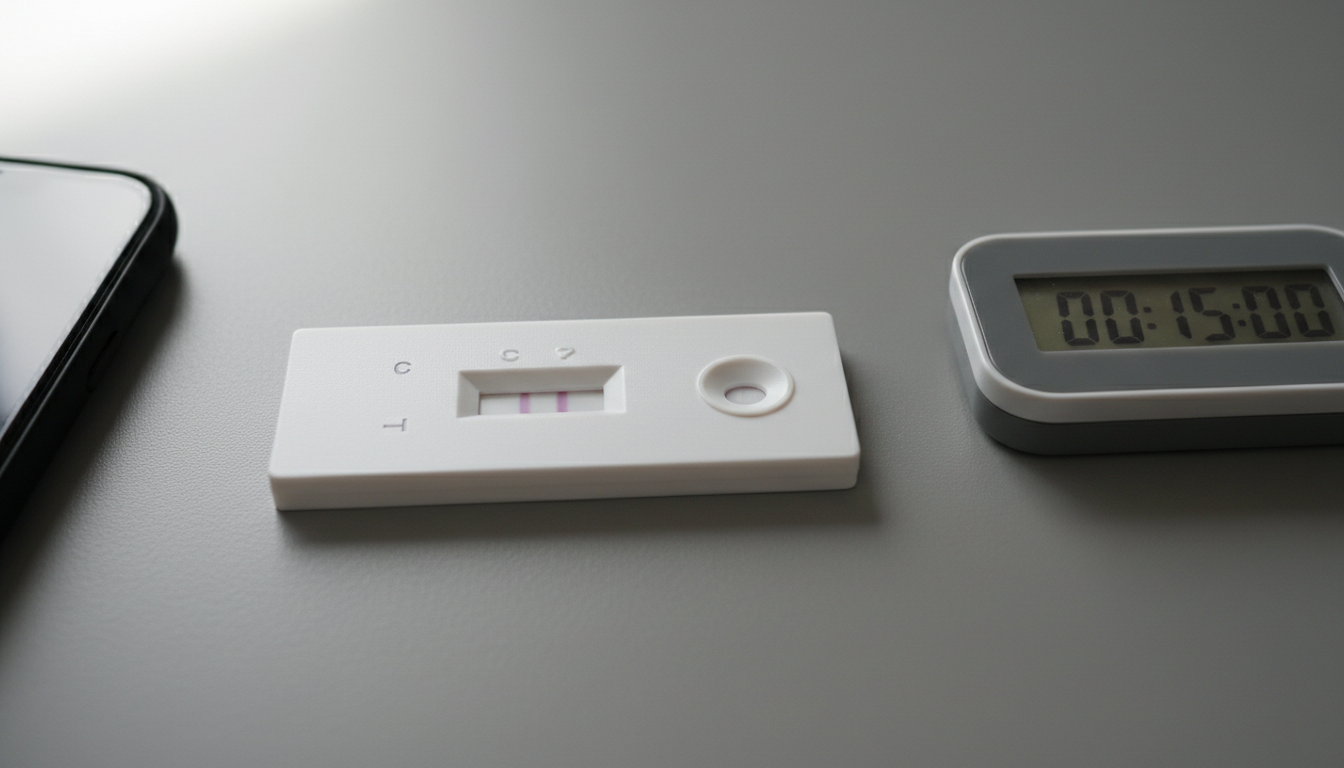
A valid result needs a sharp control line. With one present, any test line, however pale, is a probable positive: confirm it with a clinic NAAT. A control line alone, no test line, is likely negative, but only trust that if you tested at least 7 to 14 days post-exposure. No control line means the test is invalid; discard it and rerun.
You ran the test, watched the buffer wick across the strip, and now you are staring at a window with one clear band and a second band that may or may not be there. Reading a chlamydia rapid test correctly is partly about knowing what each line pattern means, and partly about knowing whether your timing gave the test a fair chance to detect the infection at all. Both pieces matter. A perfectly executed test taken three days after exposure can still miss a real infection, and a faint line at day fourteen often means more than a relieved brain wants to believe.
This guide covers what each result pattern signals, the most common ways people misread their own strips, when a negative is genuinely a negative, and when a retest or a clinic-based nucleic acid amplification test (NAAT) is the smarter next step.
Key Takeaways
- A faint line is still a line. Treat any visible test band as a probable positive and confirm with a clinic NAAT before deciding you are in the clear.
- Test timing decides accuracy as much as the strip does. Rapid antigen tests work best at 7 to 14 days post-exposure; a negative before that can be a false negative.
Why reading the test is more than "line or no line"
Most at-home chlamydia kits use lateral-flow immunoassay technology: a chemical strip that detects chlamydia antigens (the surface proteins of Chlamydia trachomatis) from a self-collected swab or first-catch urine sample. The chemistry is the same family that powers a home pregnancy test or a COVID-19 antigen test, and it gives a result in 10 to 15 minutes. Those same lateral-flow strips sit inside most at-home STI test kits. The strips are readable by anyone with no lab training, but their accuracy depends on three things you control: the timing of the test relative to exposure, the quality of the sample, and how carefully you read the result inside the manufacturer's timer window.
Two numbers describe how a lateral-flow test performs against the laboratory reference. Specificity is the rate at which it correctly clears uninfected people; on rapid chlamydia strips it is high, so a positive is usually a real positive. Sensitivity is the rate at which it correctly identifies infected people; it lands lower, which is the reason a negative deserves more scrutiny than a positive. Lateral-flow rapid tests are screening tools, not the molecular gold standard. Laboratories use NAAT-based testing for diagnostic confirmation because NAAT can detect very small amounts of bacterial DNA. The two technologies are complementary: rapid tests give you a fast, private screen at home; NAAT gives the definitive answer when stakes are high.
Lateral-flow rapid antigen tests for chlamydia are built for high specificity, which means a positive result is usually genuine. They achieve that at the cost of lower sensitivity than laboratory NAAT, so a small proportion of real infections will be missed, especially in the early days after exposure or in low-titer cases. Clinic NAAT has both high sensitivity and high specificity, which is why it remains the diagnostic standard and why a positive or borderline home result should be confirmed in clinic before treatment decisions.
What each line pattern means
Lateral-flow strips display a small number of repeating patterns. The control line tells you whether the test ran at all. The test line tells you whether antigen was detected. The combination of the two, plus where you are in the read window, gives you the actual result.
| Test strip pattern | Likely meaning | What to do next |
|---|---|---|
| Sharp control line + sharp test line | Likely positive | Start treatment planning. A clinic NAAT confirms the diagnosis and rules out coinfection. |
| Sharp control line + faint test line | Probable positive (early or low-titer infection) | Treat as positive. Confirm with a clinic NAAT within a few days. |
| Sharp control line, no test line | Likely negative IF tested at least 7 to 14 days post-exposure | If you tested earlier than that, retest at day 14 or get a clinic NAAT. |
| No control line visible | Invalid test (the strip did not run correctly) | Discard. Run a fresh kit, paying attention to buffer volume and reading window. |
| Test line only (no control line) | Invalid test | Discard. The result cannot be interpreted regardless of whether the test line is faint or bold. |
What different test patterns look like
Four reference images cover the patterns most readers will encounter. Compare the actual strip in front of you to these, then read the table above for the matching next step.
The window period: why timing decides accuracy
Chlamydia does not become detectable the moment exposure happens. The bacteria need time to multiply at the infection site and shed enough antigen for a lateral-flow strip to pick up. That gap between exposure and reliable detectability is the window period. For chlamydia, the conservative window is 7 to 14 days post-exposure, with detectability rising sharply across that range. An at-home chlamydia rapid test is most reliable from day 7 onward; testing earlier frequently produces false negatives, which is one of the most common reasons people get a clean result and then watch symptoms appear days later.
The CDC's chlamydia overview notes that symptoms, when they appear at all, may not show up until several weeks after sex with an infected partner. The WHO chlamydia fact sheet estimates 128.5 million new chlamydia infections globally among adults in 2020 and emphasizes that most people have no symptoms or only mild ones, which is why population-level screening, rather than waiting for symptoms, is the public-health standard. For an individual, that becomes a calendar problem: the window period is a screening question, not a symptom-tracking one. If you tested negative at day 3 and felt reassured, that reassurance was structurally premature; the test was not yet capable of seeing the infection.
| Days since exposure | Detection likelihood | Recommended action |
|---|---|---|
| 0 to 3 days | Very low | Wait. A test now is unlikely to be informative either way. |
| 4 to 6 days | Low to moderate | If you must test, treat a negative as inconclusive and plan a retest at day 14. |
| 7 to 14 days | Moderate to high | This is the optimal rapid-test window. A negative here is meaningful for asymptomatic screening. |
| 15 days and later | High | Reliable timing. A clear negative is generally trustworthy if your sample collection was correct. |
Common mistakes that skew the result
Most rapid-test misreads fall into a small number of recurring patterns. None of them are exotic. They are the everyday ways a tool designed for casual home use collides with anxious humans operating it for the first time. The table below covers the failure modes that come up most often, including the storage and antibiotic situations that can quietly break a kit before you even open it.
Two collection details prevent most sample-quality problems. If your kit uses urine, collect a first-catch sample (the first 20 to 30 mL of the stream) and hold your urine for at least an hour beforehand, since a freshly diluted or mid-stream sample drops the antigen concentration the strip needs. If your kit uses a swab, rotate it against the tissue for the full time the instructions specify rather than a quick in-and-out.
| Mistake | What it looks like in practice | Why it skews the result |
|---|---|---|
| Reading too early | Glancing at 5 or 7 minutes when the kit specifies 15 | Faint positives often need the full timer to develop. Early reads under-call positives. |
| Reading too late | Checking the cassette an hour after the timer ended | Lines fade or new shadows form as buffer dries. Post-window reads are unreliable in either direction. |
| Insufficient swab contact | Quick in-and-out swab, minimal rotation | Too few infected cells captured. The strip cannot detect what was not collected. |
| Mid-stream urine instead of first-catch | Treating the kit like a urinalysis sample | The first 20 to 30 mL of urine carries the highest bacterial load. Mid-stream urine is the wrong sample. |
| Diluting urine before sampling | Drinking lots of water just before urine-based collection | Dilute samples reduce antigen concentration; a common cause of false negatives in early infection. |
| Reading in dim light | Bathroom under a single overhead bulb | Faint test bands become invisible. Always read under bright, even daylight or strong indoor lighting. |
| Ignoring the window period | Testing 2 to 3 days after exposure and trusting the negative | The test runs correctly, but the infection is not yet detectable. |
| Wrong sample site | Using a genital swab kit after oral or anal exposure only | Chlamydia at one anatomical site cannot be detected by a sample from a different site. |
| Heat-damaged or expired kit | Kit lived in a hot mailbox, glove compartment, or past its expiration date | Reagents lose binding activity. Store between 36 and 86 °F, out of direct sun, and never use past the printed expiry. |
What a faint line really means
Faint lines are the single most-asked-about pattern in chlamydia rapid testing, and they are also the most misread. The instinct is to treat a faint line as ambiguous evidence: maybe it is real, maybe it is a shadow, maybe it is the plastic catching the light. In practice, on a properly run lateral-flow test read inside the timer window, a faint line almost always means the strip detected antigen at a low concentration. That is consistent with two real scenarios: an early-stage infection where antigen levels are still rising, or a low-titer infection at any stage. Both warrant follow-up.
Faint false positives exist, but they are uncommon. The much more frequent error is reading a real faint positive as "probably nothing." If you see any pink or rose color in the test-line position during the valid read window, treat it as a probable positive: photograph it within the timer, plan a confirmatory NAAT, and assume the result will come back positive while you wait. A photograph time-stamped inside the read window is far more credible evidence than the same line remembered an hour later.
When chlamydia hides behind UTI symptoms
Chlamydia and a urinary tract infection produce nearly identical first-pass symptoms in many people: burning during urination, urinary urgency, pelvic pressure, sometimes a feeling of incomplete emptying. UTIs are common and chlamydia is also common, so the natural assumption is the simpler explanation. The catch is that a urinalysis or dipstick at urgent care will not pick up chlamydia, and an antibiotic prescribed for a presumed UTI may be the wrong drug or duration to clear a chlamydial infection.
If you have UTI-style symptoms after a recent new-partner exposure, an unprotected encounter, or contact with a partner who has tested positive for an STI, ask the clinician to test specifically for chlamydia and gonorrhea (often as a combined NAAT panel) alongside any UTI workup.
A standard urinalysis or dipstick at urgent care does not detect chlamydia or gonorrhea. If you have UTI-like symptoms after a recent exposure, ask specifically for a combined chlamydia and gonorrhea NAAT panel alongside the UTI workup, so a treatable STI is not missed while a presumed UTI gets the attention.
Where your sample comes from matters: urine, swab, throat, rectum
This is one of the most consequential points in the whole reading-results conversation, and it gets the least airtime. Chlamydia infects the tissue it lands on. A vaginal swab samples vaginal and cervical tissue. A urine sample reflects urethral infection in people with penises and, less reliably, cervical or urethral infection in people with vaginas. Neither sample reaches the throat or rectum. A negative urine or vaginal-swab rapid test does not rule out pharyngeal or rectal chlamydia from oral or anal exposure.
If your exposure was oral or anal and you used an at-home swab or urine kit, the negative result speaks only to the genital site. Pharyngeal and rectal chlamydia are diagnosed in clinics with site-specific swabs run through laboratory NAAT panels. Most home-test kits, including ours, are not validated for those sites. We do not sell pharyngeal or rectal swab kits; for those, a sexual-health clinic visit is the right path. A home swab covers the genital exposure risk from the same encounter, which is often the most clinically urgent piece, but it is not a complete sweep on its own.
What each sample type can and cannot detect
| Sample type | Detects | Does not detect |
|---|---|---|
| Vaginal self-swab (home) | Vaginal and cervical chlamydia | Throat and rectal infection |
| First-catch urine (home) | Urethral chlamydia, less reliably cervical | Throat and rectal infection |
| Throat swab (clinic NAAT) | Pharyngeal chlamydia from oral exposure | Not offered in home kits; needs a clinic |
| Rectal swab (clinic NAAT) | Rectal chlamydia from anal exposure | Not offered in home kits; needs a clinic |
Home kits cover genital sites only. Oral or anal exposure needs a site-specific clinic NAAT.
Should you act on this result? A quick decision guide
If your head is spinning between line patterns and calendar math, walk the result through these questions in order. The flow assumes the control line is sharp; a missing control line means the test is invalid and you start over.
Reading your result, step by step
Is there any test line at all, even a faint one, within the kit's read window, alongside a sharp control line?
Yes: Treat it as a probable positive. Photograph the cassette inside the timer window and arrange a confirmatory clinic NAAT before starting treatment or notifying partners.
No test line, but you collected the sample within 6 days of the exposure you are checking?
Yes: Too early to trust. Treat the negative as a placeholder and retest at day 14, or get a clinic NAAT.
No test line at 7 or more days post-exposure, but you have symptoms, a partner who tested positive, or you are pregnant?
Yes: Get a clinic NAAT regardless of the strip. These situations raise the stakes above what a home screen can settle.
No: A control-line-only result at 7 or more days post-exposure, with no symptoms and no known positive partner, is a reliable negative for genital screening. Retest on your routine schedule.
Guidance only. A clinician can advise based on your specific situation.
When a home result needs a clinic NAAT, and when to skip the rapid test
Some situations push the right answer toward a clinic-confirmed NAAT rather than a home rapid result alone. Pregnancy is the clearest: untreated chlamydia in pregnancy is associated with preterm birth and neonatal conjunctivitis, and CDC treatment guidelines recommend screening at the first prenatal visit and a confirmed diagnosis before treatment. Do not screen at home in place of an obstetric workup. Active symptoms (pelvic pain, abnormal discharge, postcoital bleeding, testicular tenderness) are another: a clinic visit gives you both a diagnosis and same-day treatment, and a negative rapid test alongside those symptoms should not close the case. A third is a partner's confirmed positive: the prior probability is then high enough that empiric treatment plus a clinic NAAT is the usual path rather than waiting on your own strip.
The downstream stakes are why this matters. Untreated chlamydia can progress to pelvic inflammatory disease in women, which carries real long-term infertility risk per CDC clinical guidance. A borderline rapid result deserves a confirmatory test rather than a wait-and-see. Outside these higher-stakes scenarios, a home rapid test is a legitimate first-line screen when it is used inside its window period, with a properly collected sample, and read inside the timer. (This guide is published by stdrapidtestkits.com, which sells at-home STI testing kits; we recommend tests by fit for your concern, not commercial benefit.)
When to retest after a negative
Retesting corrects for the structural limits of a single rapid test taken at one point in time. Two patterns of negative result deserve a follow-up. The first is the early-window negative: if you tested in the first week after exposure, repeat at day 14. The second is the symptomatic negative: if symptoms persist or appear after a clean rapid test, the right move is a clinic NAAT, not a third rapid test, because something other than antigen-detection sensitivity is now in play.
One pattern shows up repeatedly in user reports and clinic intake notes. Someone tests at day 5 after an unprotected encounter, the rapid reads negative, they feel reassured, resume normal sexual activity, and weeks later a partner tests positive. A retroactive NAAT confirms the infection had been there all along. The fix is the same calendar discipline every time: treat any negative inside the first week as a placeholder, and retest at day 14 before you change behavior based on a clean reading.
Retesting after treatment: why three months
There is a third retest that has nothing to do with whether your first result was right. Everyone treated for chlamydia should be rechecked about three months later, because reinfection from an untreated or new partner is common enough that a routine recheck is now standard care. Chlamydia produces no lasting immunity, so a cleared infection does not protect you from the next exposure.
The three-month retest is a different question from a test of cure. Most non-pregnant patients do not need a test of cure (a test confirming the antibiotic worked) unless symptoms persist or there is reason to suspect the infection was not cleared. The three-month recheck is a reinfection screen, not a treatment-verification step.
Men and women who have been treated for chlamydia should be retested approximately 3 months after treatment, regardless of whether they believe their sex partners were treated.
Special situations that change how you read the result
Not every result fits neatly into the standard guidance. A few situations call for extra caution, and one is easy to miss because the medicine involved was prescribed for something unrelated.
If you are taking antibiotics for something else
Doxycycline (often prescribed for acne) and azithromycin (often prescribed for sinus or respiratory infections) both have activity against Chlamydia trachomatis. If you start one of these and then test for chlamydia, a residual or partially treated infection can produce ambiguous results: faint lines that reflect dead bacterial fragments rather than active infection, or false negatives when an early infection was suppressed before reaching detectable antigen levels. Tell your clinician what antibiotics you have taken recently when you bring any rapid test result for interpretation.
If one exposure could have transmitted more than one infection
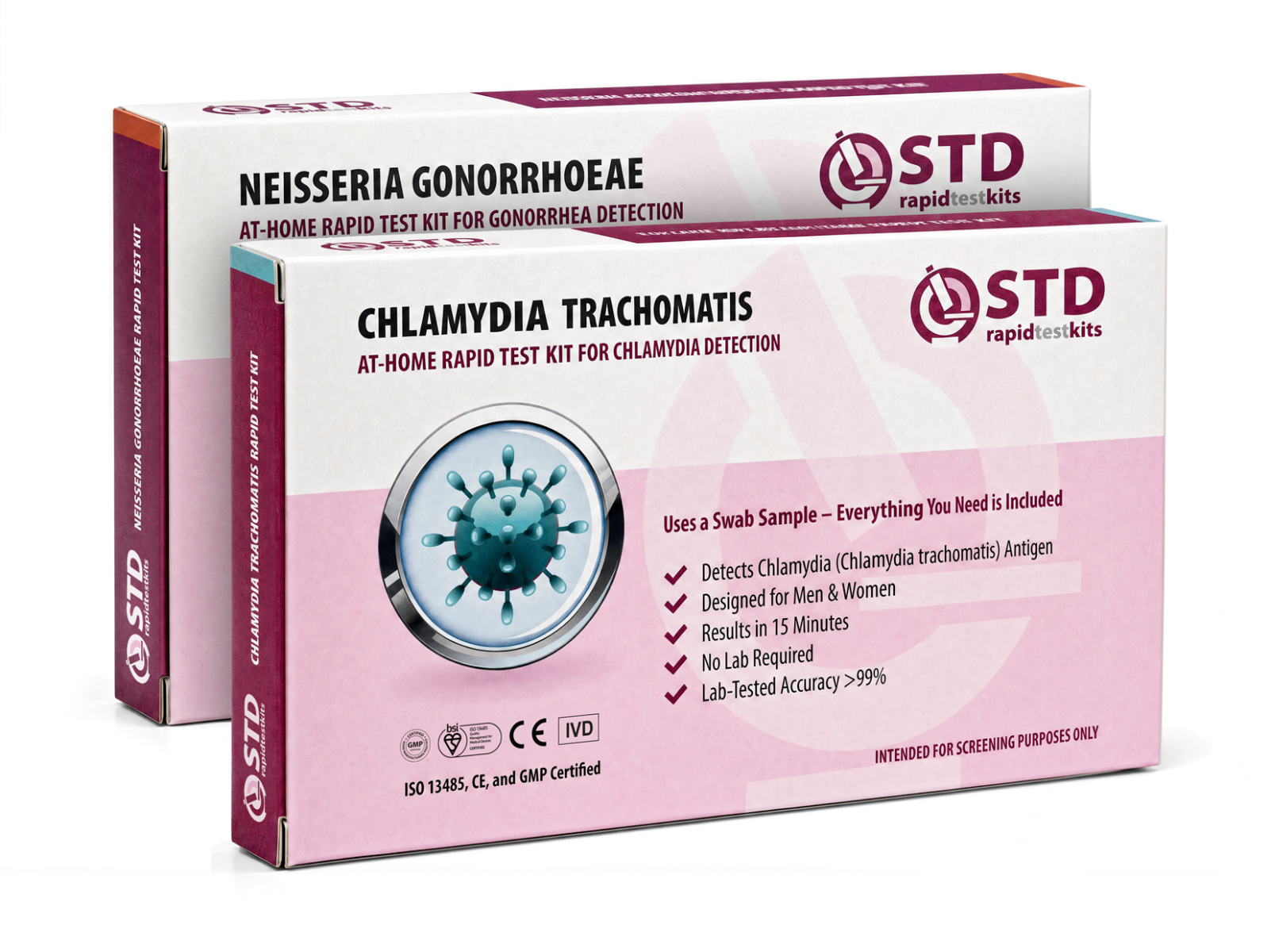
Chlamydia and gonorrhea share transmission routes and frequently occur together, which is why clinic NAAT panels test for both from a single sample. Syphilis, also a bacterial STI, often gets added when an exposure could plausibly have transmitted any of the three. A multi-infection rapid panel is the home version of that approach: cover the realistic-pathogen list from one self-collected sample rather than retesting in series. Testing both common bacterial STIs at once avoids a clean chlamydia result that quietly leaves a gonorrhea infection undiagnosed.
Partner notification and the test that comes next
A positive chlamydia result, even a faint one not yet confirmed, has implications beyond your own treatment plan. Recent partners should know so they can test and treat. The standard partner-notification window for chlamydia is the past 60 days; if your last sexual encounter was more than 60 days ago, that partner is the one to notify.
The conversation does not have to be adversarial. A simple message ("I tested positive for chlamydia and wanted you to know so you can get tested too") moves things forward without assigning blame. Treated promptly, chlamydia clears with a short course of antibiotics. Many sexual-health clinics offer anonymous partner-notification services when direct contact is not feasible.
Your next move, by result
Did the strip show any test line, even a faint one, inside the read window?
Yes: Treat it as a probable positive. Photograph the cassette within the read window, book a clinic NAAT to confirm before treatment, and notify partners from the past 60 days.
Was your result negative, but collected before day 7 or alongside ongoing symptoms?
Yes: Treat the negative as provisional. Retest at day 14, and get a clinic NAAT if symptoms persist or an oral or anal site is in scope.
Have you been treated for chlamydia in the past few months?
Yes: Book a reinfection retest at the three-month mark, regardless of whether your partner was treated.
No: A clean negative at 7 or more days post-exposure, with no symptoms, is reliable for genital screening. Retest on your routine schedule.
A short closing checklist. Guidance only; a clinician can advise on your specific situation.
FAQs
- Can a chlamydia rapid test miss a real infection?
- Yes, especially inside the window period (the first week or so after exposure) before antigen levels are detectable. Rapid tests have high specificity (positives are usually real) but more variable sensitivity (negatives can miss real infections). A negative is most trustworthy at 14 or more days post-exposure with a properly collected sample. Clinic NAAT is the gold standard when you need to be sure.
- What does a faint test line mean?
- Treat it as a probable positive. The action is the same no matter how pale the line is: photograph the cassette inside the kit's timer window and plan a confirmatory clinic NAAT within a few days. The strip is detecting bacterial surface proteins at a low level, consistent with an early or low-titer infection. Skipping confirmation because the line looked uncertain is the most common mistake here.
- What if there is no control line?
- No control line means the test did not run correctly: insufficient buffer, an expired or damaged strip, a heat-exposed kit, or a chemistry failure. The result is invalid in either direction, so you cannot read it as positive or negative. Discard the strip and run a fresh kit, watching buffer volume, storage temperature, and the instructions.
- I tested negative but I still have symptoms. What now?
- A clinic NAAT is the right next step, not a second home rapid test. Persistent symptoms after a negative rapid result can mean the infection is at a site the home test does not sample (throat or rectum), the sample collection was insufficient, or the cause is something other than chlamydia (gonorrhea, mycoplasma, or a non-STI condition). A clinic can run site-specific swabs and a broader panel.
- Will the test still work if my exposure was oral or anal only?
- Most at-home chlamydia kits, including ours, are validated for genital sampling (vaginal swab or first-catch urine). They do not detect pharyngeal (throat) or rectal infections. If your exposure was strictly oral or anal, a clinic with site-specific swabs is the right place to test. We do not sell pharyngeal or rectal swab kits and do not recommend using a genital kit as a substitute.
- Can antibiotics I am already taking affect the test?
- Yes. Doxycycline and azithromycin, both commonly prescribed for unrelated conditions like acne or respiratory infections, also have activity against chlamydia. Partway through one of these, your test may show a low-level positive from dead bacterial fragments, or a false negative if the antibiotic suppressed an early infection before it reached detectable levels. Tell your clinician what you have taken before interpreting any rapid result.
- Should I retest after I finish treatment?
- The CDC recommends retesting about three months after chlamydia treatment for almost everyone, regardless of whether your partner was treated. This is a reinfection screen, not a test of cure. A formal test of cure (verifying the antibiotic cleared the infection) is generally only needed if you are pregnant, symptoms persist, or you took an alternative antibiotic regimen.
- U.S. Centers for Disease Control and Prevention. About Chlamydia: transmission, asymptomatic infection patterns, the several-weeks symptom-onset window, and screening rationale.
- U.S. Centers for Disease Control and Prevention. STI Treatment Guidelines, Chlamydial Infections: diagnosis, treatment, three-month reinfection retesting, partner-notification scope, screening in pregnancy, and pelvic inflammatory disease as a downstream complication.
- World Health Organization. Chlamydia fact sheet: 128.5 million new infections among adults globally in 2020, the predominance of asymptomatic infection, and screening recommendations.
- U.K. National Health Service. Chlamydia patient information: symptom patterns, testing options, and partner-notification guidance.
- Mayo Clinic. Chlamydia symptoms and causes: patient-facing context on the 5-to-14-day symptom timeline and complications.
- Planned Parenthood. Chlamydia patient information: transmission, symptom recognition, and reinfection prevention.
