
Published: July 2025 | Last updated: May 2026 | Editorial review and quality control: Martina N.
Why are HIV rates higher among Black gay men, and what actually lowers the risk?
The gap is structural, not behavioral. Black gay and bisexual men report similar or fewer partners than white peers, but face higher partner-pool prevalence, PrEP access gaps, and medical mistrust. The two protective levers an individual controls: PrEP (about 99% effective when taken as prescribed) and HIV testing every three to six months.
Black gay and bisexual men in the United States carry a disproportionate share of new HIV diagnoses, and the reason has little to do with riskier sex. Research compiled across the CDC, the National Institutes of Health, and peer-reviewed journals consistently shows that Black men who have sex with men do not engage in higher-risk behavior than their white peers, and in many studies they report fewer partners on average. Yet the lifetime probability of acquiring HIV remains several times higher.
What drives that gap is structural. A high-prevalence partner pool, healthcare deserts, provider bias, gaps in PrEP access, and generations of medical mistrust shape who gets diagnosed, who gets treated, and who walks out of a clinic feeling seen. This piece walks through what the federal data actually shows, why behavior alone cannot explain the gap, and what protection looks like in practice, including testing routes a reader can use this week.
Key Takeaways
- Black gay and bisexual men accounted for about 34% of new HIV diagnoses among gay and bisexual men in the United States in 2022, despite representing a far smaller share of the population, per CDC surveillance.
- The disparity is driven by structural factors (partner-pool prevalence, PrEP access gaps, provider bias, and medical mistrust), not by higher individual risk-taking. Updated CDC modelling at CROI 2024 puts the lifetime HIV diagnosis risk for Black gay and bisexual men at roughly 1 in 3, down from a 2016 estimate of about 1 in 2.
Behind the Numbers: What CDC Surveillance Actually Shows
The headline figures land hard. In 2022, Black gay and bisexual men accounted for roughly 34% of new HIV diagnoses among gay and bisexual men in the United States, even though they represent a far smaller slice of the overall population (CDC, HIV and Gay and Bisexual Men). Black Americans make up roughly 12% of the total U.S. population and account for a disproportionately large share of new HIV diagnoses overall, with the concentration falling heaviest on younger Black MSM in the South (KFF: Black Americans and HIV/AIDS).
Updated CDC modelling presented at CROI 2024 estimates the lifetime HIV diagnosis risk for Black gay and bisexual men at roughly 1 in 3 for the 2017 to 2021 period, an improvement on the older 2016 figure of about 1 in 2. The comparable current figures are about 1 in 5 for Latino gay and bisexual men and about 1 in 15 for white gay and bisexual men (aidsmap, March 2024 reporting on the CROI 2024 update).
Diagnoses among Black gay and bisexual men have moved in the right direction over the past decade, but the gap with white peers has closed slowly, and in several Southern states it has barely closed at all. Geographic concentration matters here: more than half of new HIV diagnoses among Black MSM occur in the South, where Medicaid expansion has been most uneven and PrEP-prescribing provider density is lowest.
| Group | Estimated lifetime HIV risk (CROI 2024 update) | Share of new diagnoses among MSM (U.S., 2022) |
|---|---|---|
| Black gay and bisexual men | approx. 1 in 3 | approx. 34% |
| Latino gay and bisexual men | approx. 1 in 5 | approx. 35% |
| White gay and bisexual men | approx. 1 in 15 | approx. 25% |
More Than Behavior: What Actually Drives the Risk
One of the most damaging myths about HIV is that the disparity reflects different choices. Study after study reports that Black gay men do not have more partners or less consistent condom use than white peers (Rosenberg et al., modeling HIV care-continuum disparities between Black and white MSM, Lancet HIV, 2014). So why does the gap exist?
Partner-pool dynamics carry much of the weight. When HIV prevalence is already higher within a given sexual network, the per-encounter risk of exposure rises even when behavior is identical. Most people partner within their own community, so assortative dating patterns concentrate that risk. The math shifts before any individual decision is made.
The deeper layer is structural. Routine PrEP referral, regular asymptomatic STI screening, and culturally competent intake questions have historically reached white gay men first and Black gay men later, if at all. Each small upstream failure compounds: a missed PrEP conversation at 22, an unscreened encounter at 24, a clinic visit avoided at 26 because the last one went badly. Viral suppression rates among Black people living with HIV also remain lower than among white people living with HIV, even though the antiretroviral medications themselves work the same way regardless of race. That gap is about retention in care, not biology.
Two people with identical sex lives can face very different HIV risks if their sexual networks differ in how much undiagnosed and untreated virus is circulating. Decades of unequal access to testing, PrEP, and treatment have left Black queer male sexual networks with higher background prevalence. That is why condoms and partner conversations alone are insufficient, and why expanding testing and PrEP access (rather than lecturing on behavior) is the lever that closes the gap.
Medical Mistrust: A History That Still Hurts
The shadow of the Tuskegee Syphilis Study (1932 to 1972) reaches into present-day clinics, but the pattern of medical mistreatment of Black patients extends well before and after it. Generations of Black patients learned, by experience and by family memory, that the medical establishment sometimes withholds care, sometimes experiments, and sometimes simply does not listen. For Black gay men, that legacy intersects with queerphobia, leaving many clinic visits feeling like a calculation rather than a routine appointment.
Research compiled by the National Institutes of Health, and echoed in CDC structural-barriers literature, shows that medical mistrust correlates with lower HIV testing frequency, lower PrEP uptake, and delayed entry into care (CDC MMWR on racial and ethnic disparities in HIV PrEP coverage).
Studies of patient experience in HIV and STD services document a recurring set of patterns inside the clinic itself: providers who default to heterosexual assumptions in sexual histories and require the patient to repeatedly correct them; clinics with no visible signals (signage, intake forms, posters) that LGBTQ patients are explicitly welcome; providers who frame PrEP as a niche tool rather than a routine offer for any sexually active gay or bisexual man; and microaggressions about appearance, marital status, or assumed risk profile that mark the patient as outside the clinic's expected population. After encounters like that, many patients do not come back. Federally qualified health centers serving Black MSM track 12-month return rates as one of their core quality measures because the drop-off is steep.

Stigma at Every Turn: Church, Family, and Self
External stigma is well-documented. Church teaching that frames queerness as failure, families that quietly stop asking about dating, and cultural narratives that prize masculinity while treating vulnerability as weakness each narrow the conversations a young man can have about sex, status, and prevention before he ever reaches a clinic door. Respectability politics adds its own weight: a long-standing cultural pressure on Black men to project strength and professional success creates a high cost to admitting any health vulnerability, especially one that intersects with sexuality.
Internalized stigma travels with you. When the cultural script says HIV is a punishment, testing can feel like an admission rather than a routine health check. People go years without testing because the question of "what if" is heavier than the value of knowing. The CDC's structural-barriers work explicitly names internalized stigma as a driver of late diagnosis.
Reframing testing as a habit, similar to a routine dental check, helps in practice. Most rapid tests return a negative result. The ones that do not still leave you with options that did not exist twenty years ago: same-day linkage to care, single-tablet regimens, viral suppression reached within four to six months rather than the years it used to take.
Most at-home rapid HIV tests return a non-reactive result. For those that do not, same-day treatment linkage is now the U.S. standard of care; in many urban health systems, the gap between a reactive result and the first ART tablet has narrowed from weeks to hours.
The PrEP Gap: Prevention Is Not Reaching Everyone
PrEP (pre-exposure prophylaxis), a daily pill or long-acting injectable, reduces the risk of acquiring HIV through sex by about 99% when taken as prescribed (HIV.gov: Pre-Exposure Prophylaxis). It is one of the most effective biomedical tools available. Yet uptake among Black gay men has trailed uptake among white gay men for years, even as awareness has reached near parity (CDC MMWR, 2019, drawing on 2017 NHBS survey data from 23 urban areas).
What blocks the prescription is rarely a single barrier. Cost heads the list when insurance is unstable, followed by clinic geography that requires time off work, provider bias that treats the request as suspect, and a shortage of Black LGBTQ-affirming providers to ask in the first place. Each is a small friction. Stacked together, they account for most of the prescription gap CDC has documented. The figures below come from the 2017 NHBS survey reported in the CDC MMWR cited above; more recent CDC surveillance suggests the awareness gap has narrowed further while the uptake gap has closed only modestly.
Closing the gap depends on changing how care is delivered. Programs that have moved the dial pair sliding-scale or no-cost PrEP with community-based intake, telehealth follow-up, and lab work routed through partner clinics. The federal Ready, Set, PrEP program covers medication at no cost for people without insurance, which sidesteps the most common cost objection. Where those wraparound services exist, prescription rates rise within months rather than years.
| Group | PrEP awareness (2017 survey) | PrEP use among those with indication (2017 survey) |
|---|---|---|
| White gay and bisexual men | approx. 95% | approx. 42% |
| Black gay and bisexual men | approx. 86% | approx. 26% |
| Latino gay and bisexual men | approx. 87% | approx. 30% |
Hookup Apps: Reach, Risk, and Disclosure
Apps like Grindr, Jack'd, Scruff, and Sniffies are how a large fraction of younger Black gay and bisexual men meet partners, particularly in regions where in-person queer community is limited. The apps themselves are not the problem. They are a layer where existing prevention gaps either get bridged or widened.
A few patterns in how these apps get used carry specific HIV-risk implications. Status disclosure is uncommon, and asking about it is socially fraught, so many users default to assumption rather than conversation. In the U.S. South, where HIV prevalence among Black MSM is highest, the geographic-pairing logic of these apps means most local matches share that elevated background prevalence. Racial filtering on profiles is documented across these platforms; being excluded from one set of matches and concentrated within another shapes both partner pool and self-image, with downstream effects on how people negotiate safer sex.
The apps now offer some prevention features. Grindr's profile editor lists "last tested" and "on PrEP" among its standard fields. Filling them in takes about ten seconds, and mentioning a recent test or current PrEP status in a profile bio is increasingly read as a signal of respect for the people you match with.
Grindr surfaces nearby testing locations, sends PrEP reminders, and offers "last tested" and "on PrEP" profile tags. Jack'd, Scruff, and Sniffies have added similar features over the past three years. None of them work passively; the user has to opt in to the tags and pay attention to the reminders. The friction has dropped to almost nothing, which makes the gap between awareness and use a behavioral one rather than a structural one.
Incarceration, Poverty, and the Web of Risk
The structural picture extends beyond clinics. Mass incarceration falls disproportionately on Black men and disrupts HIV care at every stage. Inside many U.S. correctional facilities, condoms are prohibited as contraband, opt-in HIV testing is inconsistent, and continuity of antiretroviral therapy after release is fragmented, as documented in public-health surveillance on the HIV care continuum (CDC.gov/hiv).
Post-release adds its own pressures. Housing applications screen out criminal records. Employment opportunities narrow. Medicaid coverage typically lapses during incarceration and can take 30 to 90 days to restore after release, depending on the state, which is enough time for an interrupted ART regimen to allow viral rebound.
Economic precarity shapes prevention in quieter ways too. A copay that cannot be fronted turns routine screening into something indefinitely postponed; a job without paid sick leave makes a clinic visit compete with hours the worker cannot afford to lose; even in stable relationships, asking a partner about recent testing can read as suspicion rather than care, which is why those conversations often happen later than they should, or never at all.
Medicaid coverage typically lapses during incarceration. In most states, restoring coverage after release takes 30 to 90 days. For someone on ART, that window is long enough for treatment to be interrupted, raising both the risk of viral rebound and the risk of transmission to a partner.
What Real Protection Looks Like, Beyond Condoms
Effective HIV prevention in 2026 means layering condoms, PrEP, and treatment as prevention rather than relying on any one tool alone. For Black gay men whose clinic experiences have been uneven, the at-home component of that stack has become especially important.
Regular testing is the backbone. A rapid HIV antibody test taken at home, every three to six months for sexually active adults outside a fully monogamous relationship, fits into a routine without requiring a clinic visit each time. CDC guidance recommends at least annual testing for sexually active gay and bisexual men, with more frequent testing for those at increased exposure risk (CDC: HIV Testing).
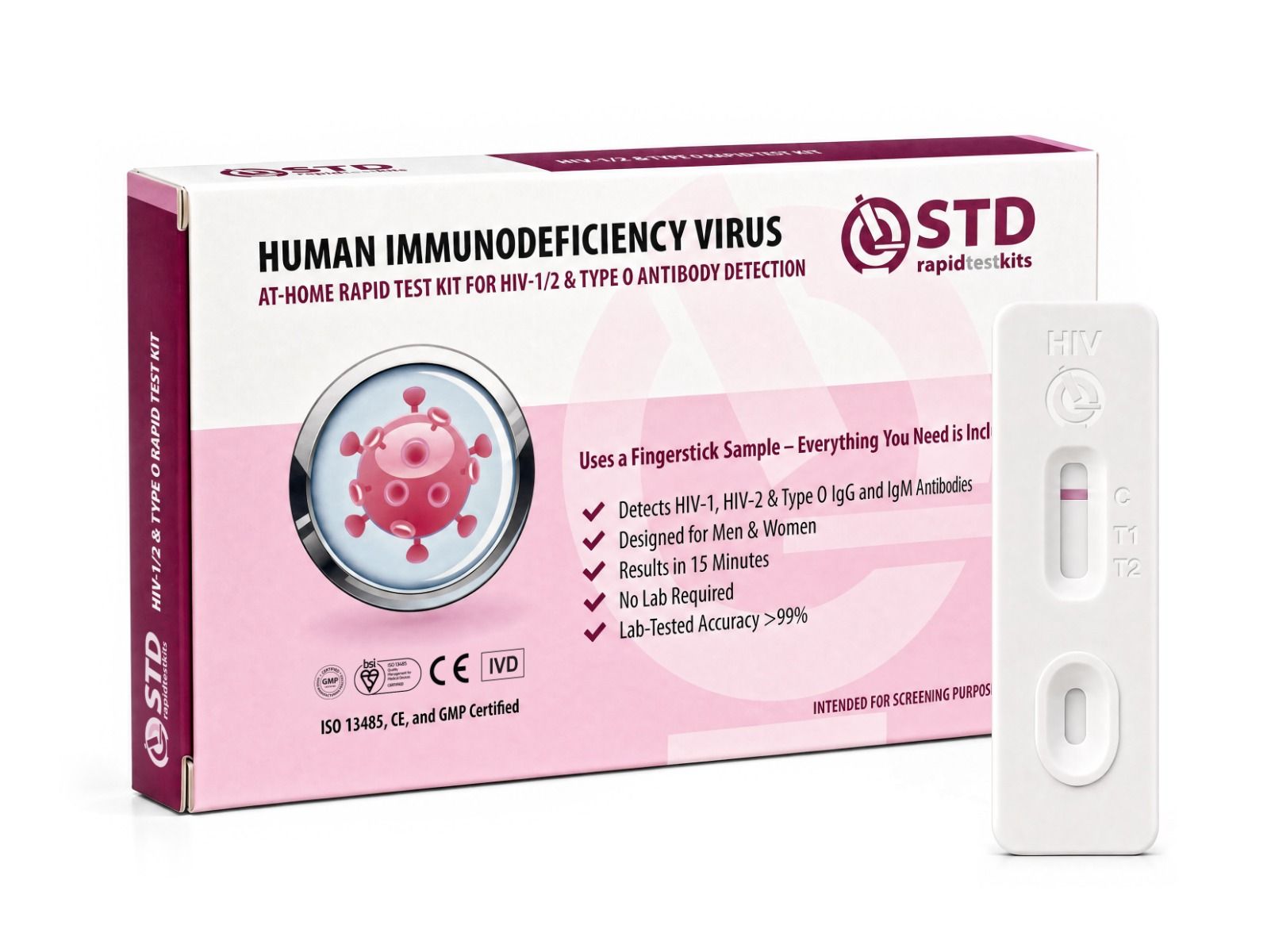
A useful self-test is straightforward. A small fingerstick draws a drop of blood onto a test cassette. A buffer drop runs the sample along a strip coated with antibody-binding reagents. Within about 15 minutes a single-line result reads non-reactive; a double-line result reads preliminary reactive and should be confirmed at a clinic with a fourth-generation antigen/antibody test. The technology is lateral-flow chemistry, not NAAT, so confirmatory lab work remains the standard for a definitive diagnosis.
This article is published by stdrapidtestkits.com, which sells at-home STI testing kits. Product recommendations below are based on fit for the reader's concern, not commercial benefit. Information about clinical testing, PrEP, and treatment refers to services provided by clinics and is independent of any product sold here.
Window Periods: Why Timing Matters for HIV Tests
A negative result tested too soon after an exposure is the most common false-reassurance trap. HIV antibody tests detect the body's immune response to the virus, not the virus itself. That response takes time to develop, usually long enough that a test taken within the first two to three weeks of exposure can miss an infection that becomes detectable later.
The window varies by test technology. Third-generation antibody tests (including most rapid at-home tests) typically reach near-99% sensitivity by about 90 days post-exposure, with most infections detectable within 23 to 90 days. Fourth-generation antigen/antibody combination tests, used in many clinics, detect both HIV p24 antigen and antibodies and typically shorten the window to about 18 to 45 days. NAAT (nucleic acid amplification) tests, used in early-infection workups, can detect viral RNA from about 10 to 33 days post-exposure.
The practical takeaway: if a possible exposure is recent and the result is negative, plan a follow-up test that lines up with the window for the test type you used. Anyone with high concern for a recent exposure should also ask a clinic about post-exposure prophylaxis (PEP), which is most effective when started within 72 hours of the exposure. And because exposure events typically carry risk for more than one infection at a time, a broader baseline screen often makes more sense than testing for HIV alone.
| Test type | Detection window | Best time to test after exposure |
|---|---|---|
| HIV antibody test (rapid at-home or lab) | 23 to 90 days | Confirm at 12 weeks |
| HIV antigen/antibody combo (fourth-generation, lab) | 18 to 45 days | Confirm at 6 weeks |
| HIV RNA / NAAT (lab) | 10 to 33 days | 3 to 4 weeks post-exposure |
U=U: Undetectable Equals Untransmittable
The single most important shift in HIV science in the last decade is the formal recognition of "Undetectable equals Untransmittable." When a person with HIV is on antiretroviral therapy (ART) and maintains an undetectable viral load (fewer than 200 copies of HIV RNA per milliliter of blood), the risk of sexual transmission to a partner is effectively zero. The consensus is endorsed by the CDC, the World Health Organization, and the Prevention Access Campaign (WHO HIV fact sheet).
U=U reframes both prevention and disclosure. A partner who is on stable treatment and confirmed undetectable is, from a transmission standpoint, not infectious through sex. The protection comes from sustained viral suppression rather than from any single visible barrier, which is why treatment as prevention now sits alongside condoms and PrEP in the standard prevention toolkit.
The reframe also matters for stigma. HIV-positive status, in 2026, is a treatable chronic condition with a clear path to suppression and a normal life expectancy when care is consistent. Most people on first-line ART reach an undetectable viral load within four to six months of starting treatment.

When the Result Is Positive: What Comes Next
A reactive home test is preliminary. The standard next step is a clinic visit for confirmatory testing, usually a fourth-generation antigen/antibody test followed by a viral load measurement and a CD4 count. Treatment ideally begins the same day, regardless of CD4 number; "rapid start" ART has become the U.S. standard of care for newly diagnosed adults.
Most modern first-line regimens are a single tablet taken once daily. Common combinations include bictegravir/tenofovir alafenamide/emtricitabine (Biktarvy) and dolutegravir-based regimens. Side-effect profiles are generally mild compared with older regimens. Within four to six months of starting treatment, most people reach an undetectable viral load.
The emotional arc rarely matches the medical timeline. Grief, anger, and quiet relief can arrive in waves over months. Linkage-to-care navigators, offered through most public-health departments and many community clinics, help bridge the gap between diagnosis and a stable treatment routine. They are usually no-cost regardless of insurance, and asking for one is reasonable and common.
Disclosure to current and recent partners is the other early task. Anonymous partner-notification services are available through most state health departments if telling someone face to face feels unsafe or impossible. A simple script works for the people you do tell: "I tested HIV-positive recently. I'm starting treatment. I'm telling you so you can get tested too."
First-week action list after a reactive result
- Confirm with a fourth-generation antigen/antibody test and a viral load measurement at a clinic.
- Ask the clinic about rapid-start ART that same day; this is now the U.S. standard of care.
- Request a linkage-to-care navigator through the clinic or your state health department (usually no-cost regardless of insurance).
- Contact your state health department about anonymous partner-notification services if face-to-face disclosure feels unsafe.
Community-Led Prevention That Works
The most effective prevention programs for Black gay and bisexual men share a feature: they are designed and led by Black queer people, and they meet people in spaces where they already exist. Greater Than AIDS, a Kaiser Family Foundation public-information campaign focused on the Black community, has produced both general awareness materials and targeted MSM resources, distributed through Black community media, barbershops, salons, and partner organizations (KFF: Black Americans and HIV/AIDS).
Organizations such as Us Helping Us in Washington DC, and similar Black MSM-led groups across major Southern cities, provide testing, PrEP navigation, and mental-health services in spaces designed for the community they serve. Mobile testing programs that show up at Pride events, Black-owned clubs, HBCU campuses, and faith-affirming churches catch people who would never proactively schedule a clinic visit. Peer health navigators, often Black queer men themselves, dramatically increase the share of clients who follow through on referrals to PrEP and to ongoing care.
The details look different from city to city. Us Helping Us in DC runs late-night walk-in testing on weekends at sites in Wards 7 and 8, where clinic hours rarely line up with the work schedules of the men they serve. THRIVE SS in Atlanta pairs peer-navigator services with social events. SisterLove in Atlanta integrates Black women's reproductive health work with services for Black gay and bisexual men in the same neighborhoods. A reader looking for similar groups locally can start with the HIV.gov locator filtered for Ryan White-funded clinics, then ask those clinics which community partners they refer to.
What effective community-led programs share
- Led by Black queer people, not by outside organizations bringing services in.
- Trust-building precedes service delivery; programs invest months in community presence before measuring testing or PrEP uptake.
- Peer health navigators who share lived experience with clients are the most consistent predictor of follow-through on referrals.
Faith, Family, and Chosen Community
For many Black gay and bisexual men, the church is where they first encountered the idea that their sexuality was a problem. It is also, for many, where they encountered their first sustained community of care. Both can be true at the same time, and the path forward usually involves separating one from the other.
A growing number of Black-led congregations now host HIV testing events, partner with local health departments, and explicitly affirm LGBTQ members. Faith leaders like Bishop Yvette Flunder and the Fellowship of Affirming Ministries have been doing this work for decades. If a current religious community is contributing to silence around testing or status, affirming Black religious community exists in most major U.S. cities and is actively recruiting.
Family silence is harder to address from outside, but it bends. Families that initially reject a son's sexuality often shift over years, particularly as they encounter other openly queer family members or affirming community institutions. Chosen family, the network of friends, mentors, and partners who provide practical and emotional support that biological family sometimes cannot, plays a documented protective role in HIV outcomes among Black MSM. People in stronger chosen-family networks test more often, disclose more easily, and adhere to treatment more consistently. In qualitative interviews with this population, a single named figure (a best friend, a romantic partner, a community-organization mentor) is typically the person who first accompanied them to a clinic for an HIV test.
The GLMA provider directory lists clinicians who have documented competence with LGBTQ patients. The Fellowship of Affirming Ministries directory lists congregations that explicitly welcome LGBTQ members; chapters exist in most major U.S. cities. The HIV.gov locator filters by Ryan White-funded clinics, which are required by program rules to provide non-discriminatory care.
Mental Health, Trauma, and Healing
The mental-health load of an HIV diagnosis is real and well-studied. Depression rates are significantly elevated in the first year after diagnosis, with multiple studies reporting rates substantially above the general population. For Black gay men, that load compounds with the cumulative stress of racism, queerphobia, and the daily work of code-switching in systems that have not centered you.
Care is layered. Therapy through a Black or LGBTQ-affirming clinician helps when access exists. Peer-led groups help too; organizations such as TheBody and the Black AIDS Institute publish curated lists of online and in-person communities. Telling one trusted person who agrees to listen without trying to fix is sometimes the most useful first step.
If formal therapy is out of reach, federally qualified health centers (FQHCs) and many AIDS service organizations offer sliding-scale or no-cost mental-health care. Most jurisdictions also operate 24/7 peer-support lines staffed by people living with HIV, which provide a different kind of help than clinical care: someone who has actually been through this and can talk about what worked.
Black gay and bisexual men have been disproportionately affected by HIV in the United States, and the disparity has persisted across more than a decade of surveillance.
Where to Start This Week
Closing the HIV gap among Black gay men requires systemic change across clinics, insurance pathways, provider training, community programs, and the cultural conversations that determine who feels welcome to ask for care. That is policy work, and it is happening slowly in places where Black queer voices are leading.
What an individual can control today is the testing part. If your last test was more than three months ago and you are sexually active, schedule one this week. An at-home rapid antibody test, a mail-in lab kit, or a free community testing site all work. Pick whichever you will actually complete. If you are HIV-negative and sexually active, PrEP is appropriate to discuss; telehealth PrEP services exist if your in-person provider has not raised it. The HIV.gov locator, the GLMA provider directory, and the Ryan White locator can identify clinics with documented competence in LGBTQ care.
None of this requires being out to anyone you are not ready to be out to. None of it requires a confession to a healthcare system that has historically failed Black patients. It requires the specific, narrow steps that the data shows reduce diagnoses, treatment delays, and onward transmission. Every Black gay or bisexual man who tests, starts PrEP, or reaches viral suppression moves the next year's data in the right direction.
Three protective levers any individual can control
- Test on a routine cadence: every 3 to 6 months if you have multiple partners or partners of unknown status; at least annually otherwise.
- Ask about PrEP. It is appropriate for anyone who wants to stay HIV-negative and reduces sexual transmission risk by about 99% when taken as prescribed.
- Know that U=U is real: a partner on stable ART with an undetectable viral load cannot transmit HIV sexually, and most people reach undetectable status within four to six months of starting treatment.
Frequently Asked Questions
- Why are HIV rates higher among Black gay men even when behavior is similar to other groups?
- CDC and peer-reviewed research consistently show that Black gay and bisexual men report similar or fewer partners and comparable condom use to white peers. The drivers are structural: partner-pool prevalence (HIV is more common within the network, so per-encounter exposure risk is higher), PrEP access gaps, provider bias, and the cumulative effect of medical mistrust on testing frequency. The variables that can close the gap are access, trust, and prescription patterns.
- How often should sexually active gay or bisexual men get tested for HIV?
- If you have multiple partners or recent condomless sex outside a confirmed-monogamous relationship, every three months is the practical cadence. Annual covers everyone else who is sexually active. An at-home kit makes the more frequent schedule easier to keep without a clinic visit each time.
- I tested negative but I'm still worried after a recent exposure. Could the result be too early?
- Yes. HIV antibody tests detect the immune response to the virus, which takes time to develop. Most rapid antibody tests reach near-99% sensitivity by about 90 days post-exposure but can miss an infection in the first two to three weeks. Fourth-generation clinic tests shorten that window to roughly 18 to 45 days, and NAAT tests can detect viral RNA from about 10 days. If concern is high, ask a clinic about PEP within 72 hours and plan a follow-up test that matches the window for the test type used.
- Is PrEP appropriate for me, and how do I get a prescription?
- PrEP is appropriate for anyone who wants to lower their risk of acquiring HIV through sex. Reduction in risk is about 99% when taken daily as prescribed. The usual path is a clinic visit, an HIV test (you must be HIV-negative to start), basic kidney function labs, and a prescription. Many states offer PrEP through telehealth providers and community-based clinics with sliding-scale or no-cost options, and the federal Ready, Set, PrEP program covers medication at no cost for people without insurance. If a provider declines without explanation, that is a reason to seek a second opinion rather than to stop asking.
- What does "Undetectable equals Untransmittable" actually mean?
- A person with HIV who is on antiretroviral therapy and maintains an undetectable viral load (fewer than 200 copies of HIV RNA per milliliter of blood) cannot transmit HIV to a sexual partner. This is the CDC and WHO consensus, supported by large studies including PARTNER and PARTNER2. Sustained viral suppression is the protective factor. Most people on first-line ART reach undetectable status within four to six months of starting treatment.
- Is HIV still a life-shortening diagnosis?
- With consistent antiretroviral treatment, life expectancy for people diagnosed and treated promptly is now close to that of HIV-negative peers. The biggest predictors of poor outcomes are late diagnosis and inconsistent access to treatment, which is exactly where the racial disparities concentrate. Catching infection early and getting on a stable regimen is what closes the outcomes gap.
- Can I get HIV from oral sex?
- Oral sex carries a much lower HIV transmission risk than receptive anal sex. The risk is not zero, particularly when open mouth sores, gum disease, or recent dental work are present, but it is low enough that the CDC categorizes it as a low-risk activity. Other STIs, including syphilis, gonorrhea, and HSV, transmit through oral sex more readily than HIV does, which is one reason a fuller STI panel is often more informative than HIV testing alone after an oral exposure.
- How do I bring up HIV testing with a partner without making it awkward?
- The most effective phrasings make testing routine rather than an accusation. Versions like "I test every three months, want to do it together?" or "My last test was a month ago, negative; what's your situation?" treat the conversation as standard sexual health practice. If you have tested HIV-positive and need to disclose to a recent partner, keep it brief and centered on their next step: "I tested HIV-positive recently. I'm starting treatment. I'm telling you so you can get tested too." Most state health departments offer anonymous partner-notification services if telling someone directly feels unsafe or impossible.
- Do at-home rapid HIV tests work as well as clinic tests?
- At-home rapid tests use lateral-flow antibody chemistry, the same technology behind many clinic point-of-care tests. They are highly sensitive once past the test's window period (typically 23 to 90 days post-exposure for third-generation tests). They are not a substitute for fourth-generation antigen/antibody confirmation, which clinics use for definitive diagnosis. A reactive home result should always be confirmed at a clinic. A non-reactive result outside the window period is reliable.
- U.S. Centers for Disease Control and Prevention. HIV and Gay and Bisexual Men. Surveillance overview and demographic breakdowns of new HIV diagnoses among MSM in the United States, including the 2022 share-of-diagnoses figures and PrEP coverage gaps.
- U.S. Centers for Disease Control and Prevention, MMWR. Racial and Ethnic Disparities in HIV Pre-Exposure Prophylaxis Coverage. Documents the persistent PrEP awareness-and-uptake gap among Black and Latino gay men, drawing on 2017 NHBS survey data.
- U.S. Centers for Disease Control and Prevention. HIV Testing. CDC testing recommendations including at-least-annual testing for sexually active gay and bisexual men, and every-three-months testing for those with multiple partners or not on PrEP.
- HIV.gov. Pre-Exposure Prophylaxis (PrEP) overview, including the approximately 99% reduction in sexually acquired HIV risk when taken as prescribed, and Treatment as Prevention / U=U consensus material.
- World Health Organization. HIV fact sheet. Global epidemiology, treatment as prevention, U=U consensus, and clinical guidance referenced for the viral-suppression and transmission claims in this article.
- Kaiser Family Foundation. Black Americans and HIV/AIDS: The Basics. Fact sheet covering population-level HIV burden, transmission patterns, geographic distribution, and disparities in testing and care linkage among Black Americans, including the roughly 12%-of-population context.
- aidsmap. Reporting on the CDC's CROI 2024 update to lifetime HIV diagnosis risk among Black, white, and Hispanic/Latino MSM, including the revised 1-in-3 (Black MSM, 2017 to 2021), 1-in-5 (Latino MSM), and 1-in-15 (white MSM) figures.
- Rosenberg ES, Millett GA, Sullivan PS, del Rio C, Curran JW. Understanding the HIV disparities between black and white men who have sex with men in the USA using the HIV care continuum: a modeling study. Lancet HIV, 2014. Peer-reviewed analysis of behavioral and care-continuum drivers of the racial disparity.
