Published: October 2025 | Last updated: May 2026 | Editorial review and quality control: Martina N.
You are staring at faint dark spots on your palms, soles, or torso, and a late-night search led you here. The honest answer is that secondary syphilis can appear on Black and brown skin in ways that do not match the classic textbook photos most people learned from. It does not always look red. It often does not itch or hurt. And it can fade on its own while the infection quietly continues. This guide walks through what to look for at each stage, how to tell the rash apart from common look-alikes like heat rash and eczema, and when testing makes practical sense.
Key Takeaways
- On Black and brown skin, a secondary syphilis rash is more often dull brown, copper, purplish, or ashen than the textbook red, and it usually does not itch.
- Painless spots on the palms or soles are one of the more specific signs and worth a syphilis blood test, even if the rash later fades on its own.
Inflammation Doesn't Always Look Red on Darker Skin
Most medical descriptions of a syphilis rash say something like “rosy red spots scattered across the body.” That language was written for and tested on lighter skin, and it does not translate well. On Fitzpatrick types IV through VI, the skin tones common across many Black, African, Afro-Caribbean, South Asian, and Latino communities, inflammation reads differently. The same biological process produces a dull brown, ashen, copper, or violet-toned patch instead of an angry red one.
That visual gap matters because it changes how the rash gets noticed and how it gets named. A spot that would jump out as a red rash on light skin can read as a slightly darker shadow on melanated skin. Some people only see it under certain lighting, or only realize something is off after running a finger over the area and feeling a faint roughness. The lesions are still there; the visual signal is just quieter.
Color is only one part of the picture. Distribution matters too. Secondary syphilis tends to spread across the torso, arms, thighs, and, in many cases, the palms and soles. A painless rash that includes the palms or soles is unusual, which is part of why it is a hallmark of this stage. Eczema, heat rash, and contact dermatitis rarely behave that way.
What does a syphilis rash look like on Black skin?
On Black and brown skin, a syphilis rash usually appears as dull brown, copper-toned, ashen, or purplish flat spots and slightly raised bumps rather than the classic red rash. It typically does not itch or hurt, often shows up on the palms and soles as well as the torso, and can fade on its own in two to six weeks while the infection continues silently. A syphilis blood test is the only reliable way to confirm or rule it out.
The Three Stages of Syphilis
Syphilis unfolds in stages, and the rash that brings most people to a search engine belongs to the second stage. Knowing which stage most closely matches the timing of your possible exposure makes the rest of the article easier to use.
The first stage, primary syphilis, usually starts with a single sore called a chancre. It appears around three weeks after exposure, give or take, and shows up at the spot where the bacterium entered the body, often the genitals, anus, mouth, or lips. On darker skin, a chancre can look like a clean-edged ulcer or a slightly darker, raised plaque. It is typically painless. Many people never notice it, especially when the sore is inside the vagina, anus, or mouth.
Secondary syphilis follows weeks later, usually four to ten weeks after the chancre first appeared. This is the stage with the body rash, and the one most people are trying to identify. It can be diffuse or patchy, flat or slightly bumpy. It rarely itches. Sometimes it disappears within two weeks; sometimes it lingers for two months. Whatever its course, it goes away on its own even without treatment.
That disappearance leads into the latent stage. There are no visible symptoms. The bacterium is still in the body, quietly continuing. People can stay in latent syphilis for years before either being detected on a routine blood test or progressing to late-stage disease.
| Stage | What It May Look Like on Black Skin | Common Locations | Pain or Itch? |
|---|---|---|---|
| Primary | Smooth round ulcer or slightly darker raised plaque, clean edges | Genitals, anus, mouth, lips | Usually painless |
| Secondary | Dull brown, copper, ashen, or purplish flat spots and slight bumps; often subtle in natural light | Palms, soles, torso, arms, thighs, sometimes mouth | Typically no itch or pain |
| Latent | No visible rash or sore | None visible | No symptoms |
What the Rash Looks Like on Black and Brown Skin
The figures below are clinical reference images of secondary syphilis on deeply pigmented skin. They are not meant for self-diagnosis. They exist to fill a visible gap, because most search results return images of red rashes on lighter skin, which makes it harder to recognize the same condition on darker skin. Color, shape, distribution, and whether the area itches all factor into clinical judgment.
Why the Rash Often Goes Missed on Darker Skin
There is a systemic reason this question keeps getting searched. Dermatology training materials have historically underrepresented darker skin tones. When clinicians learn that rashes are “erythematous,” a Latin word that translates roughly to “reddened,” the mental template attached to that word is built on lighter-skin photographs. The same inflammation produces a different color signal on melanated skin, but the template does not always update.
Multiple reviews of medical-school imagery have documented this gap. The American Academy of Dermatology, the Skin of Color Society, and several major textbooks have been pushing publishers to add more clinical photography of conditions on Fitzpatrick IV through VI skin, exactly so this kind of recognition delay shows up less often in practice. Progress is real but uneven. In the meantime, advocating for testing when the visual is subtle is reasonable, not pushy.
One practical implication: if a clinician calls a rash “eczema” or “a heat reaction” without explaining the reasoning, and the spots are painless, do not itch, and show up on the palms or soles, it is fair to ask whether a syphilis blood test is also worth running. A simple antibody screen rules it in or out within minutes to days, depending on the test format.
If a provider dismisses subtle dark spots without explaining their reasoning, a calm one-line ask is reasonable: “Given the location on my palms and the lack of itch, can we also run a syphilis antibody test to rule it out?” Most clinicians will add the test on the same blood draw. Asking once is not pushy; it is filling a documented training gap.
Syphilis Rash vs Heat Rash vs Eczema on Dark Skin
The conditions most often confused with secondary syphilis on darker skin are heat rash (miliaria), eczema (atopic or contact dermatitis), and post-inflammatory hyperpigmentation from an older skin event. The key differentiators are itch, distribution, and how quickly the spots respond to the obvious explanations.
Heat rash typically itches or prickles. It clusters in sweaty areas such as the neck, chest, and skin folds, and it improves within a few days once the skin cools and air-dries. Eczema almost always itches, often intensely, and over time the affected skin can thicken, crack, or scale. Both of those patterns differ sharply from secondary syphilis, which usually does not itch at all and does not improve with cooling, moisturizing, or hydrocortisone cream.
| Condition | Color on Dark Skin | Itchy? | Palms or Soles Involved? | Responds to Cool Air or Moisturizer? |
|---|---|---|---|---|
| Secondary syphilis | Dull brown, copper, ashen, purplish | Usually no | Often yes | No |
| Heat rash (miliaria) | Small darker bumps, slightly raised | Yes, prickly | Rare | Yes, within days |
| Atopic or contact eczema | Darker patches, thickening over time | Very common, often intense | Uncommon | Partial, with steroid cream |
| Post-inflammatory hyperpigmentation | Flat, deeper-brown patches | No | Possible if the original event was there | Fades slowly over months |
How the Rash Feels (And What Else Comes With It)
One of the most searched questions is whether a syphilis rash itches. The honest answer is that it usually does not. That is part of what makes it confusing, because most people associate “a rash” with discomfort. When something looks present but feels like nothing, the brain tends to file it under cosmetic and move on.
Secondary syphilis rashes are typically painless and non-itchy. Some people describe a faint dryness or a slightly rough surface when they run a finger across the spots, but many notice the rash purely by sight. The texture difference, when present, is closer to a fine sandpaper feel than to the cracked, weeping texture of eczema or the raised burning of contact dermatitis.
The rash also rarely travels alone. Many people develop a constellation of mild whole-body symptoms in the same window: low-grade fever, swollen lymph nodes in the neck, armpit, or groin, patchy hair thinning along the scalp or eyebrows (sometimes called moth-eaten alopecia), mild sore throat, mouth patches, fatigue, and joint aches. None of these are dramatic on their own. Together, they form a pattern that is easy to brush off as a viral bug or stress.
A painless rash that does not itch, especially when it involves the palms or soles and travels alongside swollen lymph nodes or unexplained fatigue, is one of the more specific signs of secondary syphilis. Common rashes like heat rash or contact eczema rarely behave this way, so this combination is worth a blood test even when the spots look faint.
Editorial disclosure: stdrapidtestkits.com sells at-home syphilis tests, and the product links in this article go to our own catalog. We recommend tests based on fit for the reader's situation, not commercial benefit.
How Long Does a Syphilis Rash Last on Black Skin?
The rash from secondary syphilis can last anywhere from two to six weeks, sometimes a little longer. Occasionally it fades within two weeks. The duration is not a useful diagnostic clue on its own, because the rash can disappear regardless of whether the infection has been treated.
That disappearance is one of the trickiest features of the disease. It looks like resolution, but it is not. The bacterium has simply transitioned into the latent stage, where it continues to live in the body without producing visible signs. This is how people answer “yes” to the search query “can you have syphilis without knowing?”. Many cases are caught only on a routine blood test taken months or years later, often during a pregnancy screen, a blood donation, or a new-relationship STI panel.
On darker skin, the rash often leaves behind temporary hyperpigmentation. Once the inflammatory spots fade, the skin where they sat can stay slightly darker than the surrounding tissue for weeks to months. That residual color is post-inflammatory pigmentation, not active infection, but it can create real anxiety about whether something is still happening. Time and gentle skin care usually fade it.
| Weeks After Exposure | What Tends to Happen | What You Might Notice |
|---|---|---|
| 3 to 6 weeks | Primary chancre may appear at the entry site | A single painless sore, often unnoticed if internal |
| 6 to 12 weeks | Secondary rash appears across the body | Brown, copper, or dusky patches, palms and soles often involved, swollen lymph nodes, mild fatigue |
| 3 to 6 months | Rash fades, latent stage begins | No visible symptoms, infection continues silently in the bloodstream |
| 12 months and beyond | Latent stage continues, occasional relapses possible in early latent disease | Often no signs, only detected by blood test |
When Testing Makes Sense
If a rash you cannot explain is on your skin right now, especially one that involves the palms or soles, testing is appropriate at this point in time. By the time secondary syphilis symptoms appear, antibody blood tests are reliably positive, so a rapid screen or a clinic-based RPR plus treponemal confirmation gives a clear answer.
The CDC's general guidance is that most antibody-based syphilis tests become reliably positive about three to six weeks after exposure [1, 2]. If your possible exposure was very recent, say within the last two weeks, a test today may be slightly early. Testing now still establishes a useful baseline, with a repeat test in three to four weeks if the first result is negative. Waiting indefinitely out of anxiety does not help anyone; it just stretches out the worry.
Routine syphilis screening is also recommended for several specific groups: pregnant people, sexually active men who have sex with men, people living with HIV, anyone with a new partner whose status is unknown, and anyone whose partner has tested positive. The screening is brief and the treatment, if needed, is straightforward.
Testing is the only way to know for sure if you have syphilis. Talk to your healthcare provider about whether you should be tested.
At-Home Rapid Test vs Clinic Blood Test
Two routes lead to a usable answer: a rapid lateral-flow test taken at home with a fingerstick blood drop, or a clinic blood draw processed at a laboratory. Both are useful. They answer slightly different questions and fit different situations.
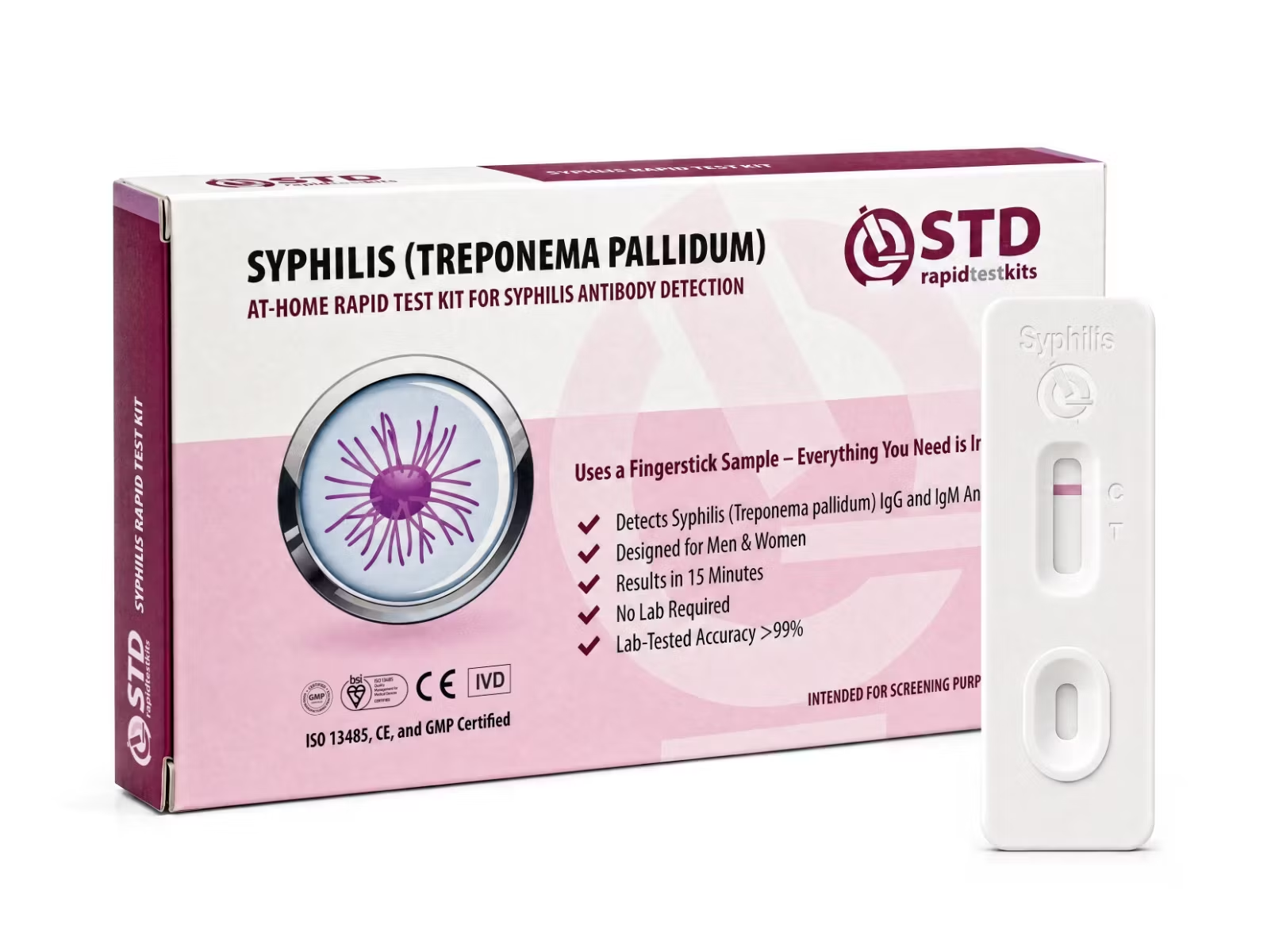
An at-home rapid test detects treponemal antibodies, the body's response to the syphilis bacterium. The cassette reads in about 15 minutes. Sensitivity is high once the antibody response has matured, generally three to six weeks after exposure. A positive result from a rapid test should be confirmed at a clinic with a quantitative RPR or VDRL test, which also helps stage the infection and guide treatment.
A clinic blood test uses the same antibody chemistry plus, often, a second confirmatory test on the same sample. Results take from a few hours at a same-day clinic to several days at a primary-care lab. The clinic route is the default if you want a single visit that covers testing, confirmation, and treatment in one place. The at-home route is the default if waiting-room visibility is a barrier and you would otherwise put it off.
| Feature | At-Home Rapid Test | Clinic Blood Test |
|---|---|---|
| Privacy | Very high, no third party involved | Moderate, depends on the clinic |
| Result speed | About 15 minutes | Same day to several days |
| Sample type | Fingerstick whole blood, lateral-flow cassette | Venous blood draw, laboratory immunoassay plus RPR or VDRL |
| Best for confirmed staging | Screening only, positive should be lab-confirmed | Yes, includes confirmatory and titer tests |
| Treatment access | Telehealth referral after positive result | Often available on the same visit |
What Untreated Syphilis Can Do
Syphilis is treatable. Antibiotics, mostly long-acting penicillin given by injection, are highly effective at every stage. Early-stage disease often needs only a single dose. The infection responds reliably to medication, and outcomes after treatment are excellent.
The reason early treatment matters is that untreated syphilis does not actually resolve when the rash fades. It transitions into the latent stage and stays in the body. After about a year of untreated latent disease, sometimes longer, a smaller percentage of cases progress to late-stage or tertiary syphilis. That stage can affect the cardiovascular system, the central nervous system, the eyes, and the bones. It is much rarer in places where antibiotic treatment is accessible, but it is the reason routine testing remains worthwhile.
Untreated syphilis during pregnancy is also a serious concern because it can be passed to the fetus. Congenital syphilis is preventable when a pregnant person is tested early and treated promptly, which is why prenatal syphilis screening is standard in most countries.
Congenital syphilis is preventable. Routine prenatal screening (typically at the first prenatal visit and again in the third trimester for higher-risk pregnancies) catches infection early enough that a single course of penicillin protects the fetus. If you are pregnant or planning a pregnancy and notice a rash that fits the description above, ask for a syphilis test at your next visit even if your last screen was negative.
Treatment Is Usually Straightforward When Caught Early
For primary, secondary, or early latent syphilis, treatment is usually one injection of long-acting benzathine penicillin G. Late latent or tertiary disease takes a longer course, typically three weekly injections. People with a penicillin allergy can usually be desensitized for pregnancy or given an alternative oral antibiotic regimen under clinician supervision.
Some people experience a brief flu-like reaction in the hours after treatment, called a Jarisch-Herxheimer reaction [2]. It happens because the bacteria are dying off and releasing inflammatory by-products. The reaction is uncomfortable but short-lived, usually fading within 24 hours. It does not indicate a medication allergy; it means the medication is working.
Follow-up blood tests confirm that the infection has cleared. The numbers, called RPR titers, should drop steadily. A stable or rising titer prompts re-treatment. This is one of the reasons positive at-home results need to plug into clinic follow-up; the titer tracking is what proves treatment success.
Follow-up blood test schedule after treatment
- 3 months after treatment: first RPR titer check, should show a fourfold drop or trending downward.
- 6 months after treatment: second RPR check, expected to be lower again or non-reactive.
- 12 months after treatment: final RPR check for early-stage disease, confirms sustained clearance.
- If the titer plateaus or rises at any check, re-treatment is considered.
Talking to a Partner Without Drama
This part tends to feel heavier than the diagnosis itself. The good news is the conversation does not have to be dramatic. A short, factual script works better than a long apology.
The next step is testing and treatment for anyone potentially exposed, without requiring a confession or a timeline. Syphilis can stay undetected for months or years, so a positive result does not come with a reliable timestamp, and there is no useful information to be gained from relitigating who-met-whom-when.
If a face-to-face conversation feels impossible, public health departments in most U.S. states and many other countries offer anonymous partner notification services. The department contacts the partner on your behalf and does not share your name. This is a routine service designed specifically for these situations.
“I had a rash that turned out to be secondary syphilis. It is treatable with one antibiotic injection. I am letting you know so you can get tested too, and I am happy to share any of the information I found while sorting this out.”
Notice what that script does not include: no accusations, no moral framing, no demand for a confession. Facts plus care.

If You're Still Unsure, Here's a Calm Path Forward
If you reached this section because you searched “syphilis rash on Black skin” and you are still squinting at your palms or soles, a few practical steps reduce the uncertainty without amplifying the panic.
You deserve privacy, clarity, and a process that does not require explaining yourself to anyone. Whether that means a clinic visit, an online order for a discreet rapid kit, or a telehealth consult, the goal is the same: convert the uncertainty into a clear answer you can act on.
Four next steps
- Do not rely on appearance alone. Secondary syphilis on melanated skin easily reads as dry skin, eczema, or post-inflammatory pigmentation.
- Check the timing. If it has been more than three to six weeks since a possible exposure, a syphilis antibody test is reliable now.
- If the exposure is more recent than three weeks, test now to establish a baseline and repeat in three to four weeks.
- If the rash includes the palms or soles, or travels with swollen lymph nodes or unexplained fatigue, treat that combination as a meaningful signal worth a blood test.
Frequently Asked Questions
- What does a syphilis rash actually look like on Black skin?
- On Fitzpatrick V and VI skin, secondary syphilis usually shows up as dull brown, copper-toned, ashen, or purplish flat spots and slightly raised bumps. It is rarely the bright red rash shown in older textbooks. It typically does not itch or hurt, and it often involves the palms and soles in addition to the torso, arms, and thighs.
- Does a syphilis rash itch or hurt?
- Usually neither. That is one of its identifying features. Secondary syphilis is known for being clinically quiet on the skin, with no itch, no burning, and no pain. The lack of discomfort is part of why so many people brush it off as dry skin or post-inflammatory pigmentation.
- Can a syphilis rash really show up on the palms and soles?
- Yes, and that distribution is one of the strongest clinical clues. Heat rash, eczema, and most other common rashes rarely involve the palms or soles. A painless rash on those areas, especially when paired with swollen lymph nodes or fatigue, is a textbook secondary-syphilis pattern and warrants a blood test.
- What if the rash has already faded? Do I still need to test?
- Yes. A faded rash does not mean the infection has cleared. Syphilis transitions on its own into a symptom-free latent stage while the bacterium remains in the body, so a blood antibody test will return a positive result regardless of whether the rash is currently visible. A recently suspicious rash, even one that disappeared weeks ago, is still a reason to test now.
- How is a syphilis rash different from eczema or heat rash on dark skin?
- Heat rash and eczema almost always itch. Heat rash improves quickly when the skin cools and air-dries; eczema responds at least partly to moisturizer and steroid cream. Secondary syphilis does neither. It does not itch, it does not respond to topical treatments, and it commonly involves the palms or soles, which the other two rarely do.
- How accurate is an at-home rapid syphilis test?
- Rapid lateral-flow tests detect treponemal antibodies and are highly accurate once the antibody response has matured, generally three to six weeks after exposure. Sensitivity at that point is in the mid-to-high 90s for most CE-marked rapid tests, and specificity is similar. A positive result from a rapid test should be confirmed at a clinic with an RPR or VDRL titer, which also guides treatment.
- Can syphilis stay hidden for years without symptoms?
- Yes. After the secondary rash fades, syphilis can spend years in the latent stage with no outward signs. People often discover it during routine screening, such as a prenatal panel or a new-relationship STI test. This is why screening is recommended even when there are no current symptoms, especially for groups at higher background risk.
- If I test positive, does that mean my partner cheated?
- Not automatically. Syphilis can stay undetected for months or years before showing up on a blood test, so a positive result does not come with a reliable timestamp. The constructive next step is testing and treatment for current partners. Anonymous partner-notification services through public health departments are available if a direct conversation is not workable.
How We Sourced This Article: This guide synthesizes current public-health guidance from the U.S. Centers for Disease Control and Prevention, the World Health Organization, the UK National Health Service, the Mayo Clinic, and MedlinePlus, alongside dermatology education focused on clinical presentation on Fitzpatrick IV through VI skin. The article was written by our editorial team and reviewed by a board-certified dermatologist. It is general information, not a substitute for individual clinical advice.
- U.S. Centers for Disease Control and Prevention. Syphilis fact sheet describing stages, transmission, symptom progression, and the recommendation that testing is the only reliable way to confirm infection.
- U.S. Centers for Disease Control and Prevention. STI Treatment Guidelines covering syphilis screening intervals, RPR and treponemal testing, benzathine penicillin G dosing for each stage, and the Jarisch-Herxheimer reaction.
- World Health Organization. Syphilis fact sheet on global epidemiology, clinical features of primary and secondary syphilis, and congenital syphilis prevention.
- UK National Health Service. Syphilis overview describing symptom patterns, the painless chancre, the secondary rash on the palms and soles, and testing pathways.
- Mayo Clinic. Syphilis overview covering symptoms, stages, causes, and treatment.
- MedlinePlus, U.S. National Library of Medicine. Syphilis overview covering symptoms across stages, testing, and treatment for patient audiences.
