
Published: September 2025 | Last updated: April 2026 | Editorial review and quality control: Martina N.
A few words spoken in a clinic room can hijack the rest of the day. Strawberry cervix is one of those phrases. It sounds vivid, almost alarming, and it tends to send people straight to a search bar where the first results are usually about sexually transmitted infections or cancer. The reality is calmer. The term describes a visual pattern, it most often points to one specific and treatable infection, and it has very little in common with how cervical cancer actually behaves on examination. This guide explains what the phrase means, why clinicians use it, and what comes next when they do.
Does strawberry cervix mean I have cervical cancer?
No. Strawberry cervix is the visual pattern of small red pinpoint spots a clinician sees on the cervix during a pelvic exam. It usually signals inflammation from trichomoniasis, a common parasitic STI that responds to a short course of prescription antibiotics. Cervical cancer develops slowly over years from HPV-driven cell changes and almost never produces this pinpoint pattern. The strawberry pattern is a clue, not a diagnosis, and lab testing confirms the actual cause.
Key Takeaways
- Strawberry cervix describes tiny red spots from inflamed capillaries on the cervix. It is most often associated with trichomoniasis, a treatable parasitic infection cleared by a short course of prescription antibiotics.
- Cervical cancer follows a completely different pattern. It develops slowly from persistent HPV infection over years and is detected through Pap and HPV screening, not through a visual finding on a routine exam.
What "Strawberry Cervix" Actually Means
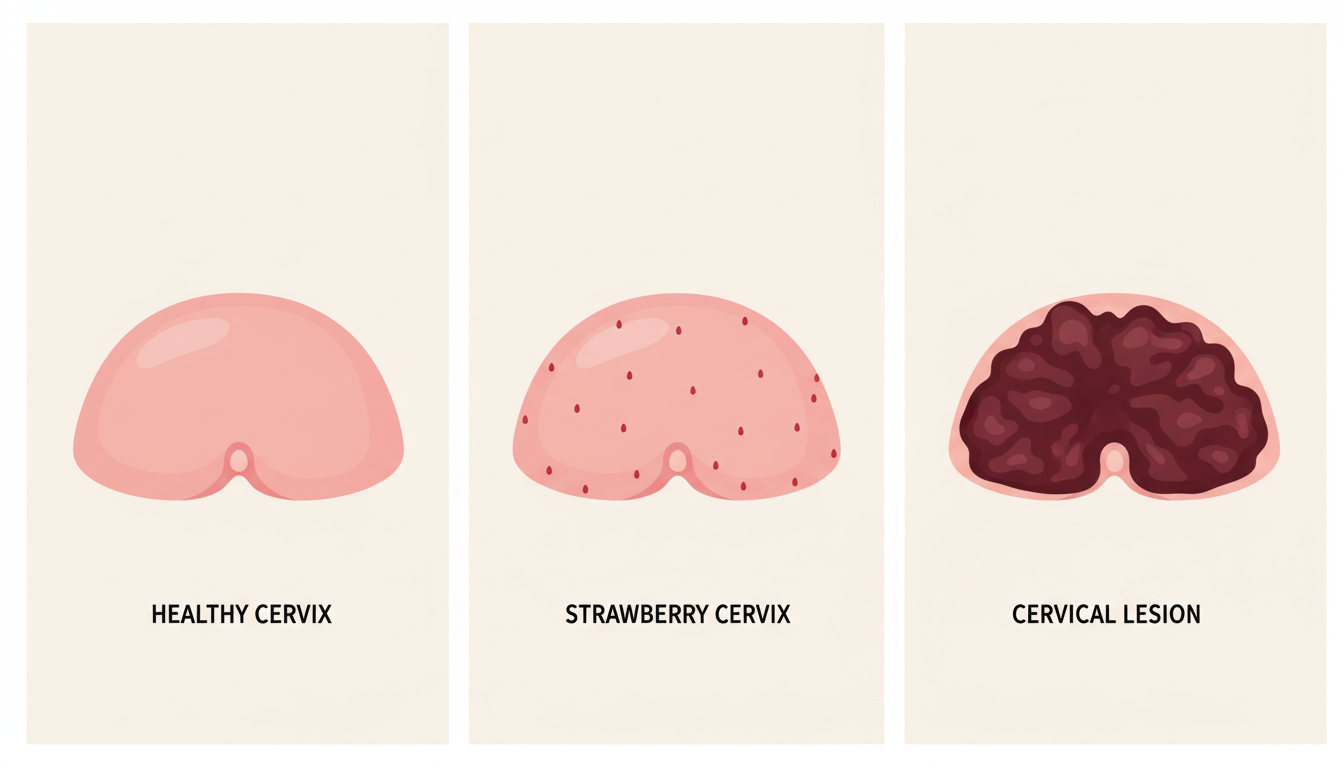
The cervix sits at the top of the vagina, and during a pelvic exam a clinician uses a speculum to gently open the vaginal walls so they can see it under bright light. Healthy cervical tissue normally looks smooth and pink, similar to the inside of the cheek.
Sometimes the surface looks different. Instead of even pink tissue, the cervix shows tiny red dots scattered across a slightly inflamed background. The pattern can resemble strawberry seeds against the pink surface, which is where the term comes from. Clinicians refer to those dots as punctate hemorrhages or cervical petechiae. They are tiny areas of bleeding from inflamed capillaries near the surface of the tissue.
It is important to understand what the term is and is not. Strawberry cervix is a description of an appearance, not a disease. It tells you what the clinician saw with their eyes during the exam. It does not, on its own, identify the cause. Many conditions can inflame the cervix enough to produce visible vascular spotting, and a visual exam alone cannot confirm any of them.
The pattern has appeared in medical literature for decades and is most strongly linked to one parasitic infection, but published clinical studies show it actually appears in only a minority of cases of that infection. Many people with the underlying cause never develop the visual sign at all, and a similar appearance can occur with other conditions entirely.
Infection vs. Cancer: Two Completely Different Processes
The biggest reason people worry about strawberry cervix is the leap from "something unusual on my cervix" to "is this cancer?" The leap is understandable. Cervical cancer is heavily discussed in public health campaigns, and any visible change in cervical tissue can feel ominous.
Medically, infection and cancer arise from completely different processes, with different timelines and different visual signatures.
Trichomoniasis is an infection caused by a microscopic single-celled parasite called Trichomonas vaginalis. The parasite attaches to cells lining the vagina and cervix, where it triggers inflammation. Symptoms (when they appear at all) can begin within days to weeks after exposure, and the infection clears with a short course of prescription antibiotics. The cervical inflammation resolves once the parasite is gone, usually within days to a couple of weeks.
Cervical cancer develops slowly over many years. It begins when persistent infection with high-risk types of human papillomavirus (HPV) causes cervical cells to grow abnormally. Those changes pass through stages of cervical dysplasia long before invasive cancer appears, which is exactly why screening tests like Pap smears and HPV testing exist. They catch the earliest abnormal changes years before any symptoms develop.
The visual appearance during a pelvic exam reflects these different biological processes. Infection produces inflammation, redness, and capillary spotting that can clear within weeks of treatment. Cancer, when it is visible at all on a routine speculum exam, produces structural changes in the tissue: irregular lesions, ulcers, masses, or areas of unusual thickness. Those look very different from a field of pinpoint dots.
| Feature | Strawberry Cervix (Trichomoniasis) | Cervical Cancer |
|---|---|---|
| Underlying cause | Parasitic infection (Trichomonas vaginalis) | Long-term cellular changes driven by persistent high-risk HPV |
| Time to develop | Days to weeks after exposure | Years of progressive cellular changes |
| Typical appearance | Small red pinpoint spots from inflamed capillaries on otherwise pink tissue | Irregular lesions, ulcers, masses, or thickened tissue (often detected by screening before any visual change) |
| How it is confirmed | Vaginal or cervical swab tested in lab (NAAT or rapid antigen) | Pap test, HPV test, colposcopy, biopsy |
| Treatment | Short course of prescription antibiotic (metronidazole or tinidazole) | Stage-dependent: surgery, radiation, chemotherapy |
| Long-term outlook | Usually resolves completely after treatment | Highly stage-dependent; early detection through screening dramatically improves outcomes |
Why Trichomoniasis Gets Blamed First
When clinicians see the strawberry pattern, trichomoniasis is the first condition that comes to mind. There is a clinical reason for that. Among sexually transmitted infections, T. vaginalis has the strongest documented association with this specific cervical appearance. The World Health Organization estimates that around 156 million new trichomoniasis infections occur globally each year among adults aged 15 to 49, ranking it among the most common curable STIs worldwide.
The infection has a few characteristic features when symptoms do appear. People may notice a frothy, yellow-green vaginal discharge with a distinct odor, vaginal itching or burning, discomfort during sex, or pain when urinating. The cervix may become inflamed enough to develop the punctate hemorrhage pattern that gives the term its name.
The crucial caveat: most people with trichomoniasis have no symptoms at all. According to the CDC, about 70 percent of trichomoniasis infections produce no signs or symptoms. Many people only learn they have it through routine testing, and many never develop the strawberry cervix visual sign even when actively infected. The reverse is also true. Plenty of inflamed cervixes are not caused by trichomoniasis.
So when a clinician sees the pattern and mentions trichomoniasis, that is them following the most likely lead. It is not a diagnosis on its own. Confirmation requires laboratory testing of a swab sample. Once confirmed, trichomoniasis is one of the easiest STIs to treat. A single oral dose, or a short course, of metronidazole or tinidazole clears most infections. Sexual partners are treated at the same time to prevent reinfection bouncing back and forth.

What Else Can Cause a Red or Inflamed Cervix
The cervix is sensitive vascular tissue. It changes with hormones, reacts to friction, and responds to a range of infections, only some of which are sexually transmitted. Strawberry-style petechiae are most associated with trichomoniasis, but a generally red or inflamed cervix has a much wider differential. Knowing the alternatives helps explain why a visual finding alone never finishes the diagnostic story.
| Possible Cause | Sexually Transmitted? | Common Symptoms | May Cause a Red or Inflamed Cervix |
|---|---|---|---|
| Trichomoniasis | Yes (parasitic STI) | Frothy yellow-green discharge, itching, sometimes none | Yes, classically with the strawberry pattern |
| Chlamydia | Yes (bacterial STI) | Often asymptomatic; mild discharge, spotting after sex | Possible, with cervicitis |
| Gonorrhea | Yes (bacterial STI) | Thicker discharge, pelvic pain, sometimes silent | Possible, with cervicitis |
| Bacterial vaginosis | No (bacterial imbalance) | Thin gray-white discharge with fishy odor | Sometimes, mild redness |
| Yeast infection (candidiasis) | No (fungal overgrowth) | Thick white discharge, intense itching | Occasionally, with surrounding inflammation |
| Cervicitis from irritation | Not necessarily | Mild spotting, soreness, sometimes none | Yes, from physical or chemical irritation |
| Hormonal changes (pregnancy, ovulation, hormonal contraception) | No | Often no symptoms; cervix may look fragile or inflamed | Sometimes, due to vascular changes |
How Doctors Tell the Difference During an Exam
When clinicians evaluate the cervix, they read several things at once. Color, texture, bleeding pattern, presence and quality of discharge, and how the tissue responds when touched all add data points. They also weigh those visual clues against the patient's history: any new sexual partners, current symptoms, last Pap result, and overall risk profile.
An inflamed cervix from infection typically looks red, sometimes swollen, often with surrounding discharge. The tissue may bleed slightly when touched gently with a swab, a finding clinicians call contact bleeding. The strawberry pattern, when present, sits on top of that inflamed background.
Cancerous and precancerous changes look different. They tend to produce structural abnormalities (irregular tissue surfaces, ulcers, growths, or areas that look thicker than the surrounding tissue) rather than a uniform field of red dots. They typically develop quietly over years and frequently turn up on Pap or HPV screening before they ever become visible on routine speculum exam.
Even with experienced clinical eyes, visual examination alone rarely provides a final answer for either category, which is why diagnostic testing is the next step.
The World Health Organization estimates that around 156 million new trichomoniasis infections occur globally each year among adults aged 15 to 49, ranking it among the most common curable sexually transmitted infections in the world. The U.S. Centers for Disease Control and Prevention reports that about 70 percent of people with the infection have no signs or symptoms, which is why routine testing matters even when nothing feels wrong.
Testing and Diagnosis: Two Different Tracks
The testing path depends on what is being evaluated. Confirming an active infection and screening for long-term cancer risk are different jobs that use different tools.
If trichomoniasis is suspected, a clinician collects a vaginal or cervical swab. Modern laboratory methods can detect the parasite quickly and accurately. Nucleic acid amplification tests (NAATs) are the most sensitive option used in clinics; rapid antigen tests are designed for at-home and point-of-care use and produce a result within minutes. Detection improves as the parasite has time to multiply, so testing is most reliable from about a week after exposure, with stronger reliability around the two-week mark. A test taken too early can come back falsely negative, which is why follow-up testing is sometimes recommended for very recent exposures.
Cervical cancer screening follows an entirely separate track. Pap tests look for abnormal changes in cervical cells, and HPV tests look for the high-risk strains of HPV that cause those changes over time. These are screening tools, not infection tests. They are designed to catch cellular changes years before invasive cancer develops, which is what makes routine screening one of the most effective cancer prevention tools in modern medicine.
| What Is Being Evaluated | Test Used | What It Detects | Purpose |
|---|---|---|---|
| Active trichomoniasis infection | Vaginal or cervical swab (lab NAAT or rapid antigen) | Presence of Trichomonas vaginalis | Confirm active infection |
| Other STI causes of cervicitis | Vaginal/cervical swab for chlamydia and gonorrhea NAAT | Bacterial pathogens | Identify or rule out concurrent infection |
| Cervical dysplasia (precancerous changes) | Pap test (cervical cytology) | Abnormal cell changes | Detect precancerous changes for monitoring or treatment |
| High-risk HPV | HPV DNA test | Cancer-associated HPV strains | Identify ongoing cancer risk |
| Suspected advanced cervical disease | Colposcopy with biopsy | Tissue-level abnormalities | Confirm or rule out cancer |
What Happens If It Is Trichomoniasis
If testing confirms trichomoniasis, the path forward is straightforward and short. The standard treatment is a single oral dose, or a short multi-day course, of metronidazole or tinidazole. Most people start to feel better within days as the inflammation settles. The cervix returns to its normal smooth pink appearance once the parasite is gone.
A few practical points matter for treatment to work properly. Sexual partners should be treated at the same time, even if they have no symptoms, otherwise the infection passes back and forth between people in a cycle that can last months. Sexual activity is paused until treatment is complete and any symptoms have cleared. Alcohol is avoided during and shortly after treatment with metronidazole or tinidazole because the combination can cause unpleasant nausea.
Retesting is often recommended within about three months of completing treatment to confirm the infection has cleared and to catch any reinfection from an untreated partner. Trichomoniasis can persist silently for months without symptoms before it is detected, which means a positive result does not actually tell anyone when transmission happened. Timeline assumptions about who infected whom are usually unreliable, and treating a positive result is more useful than relitigating the past.
A negative trichomoniasis test does not mean nothing is happening. The clinician will usually consider other causes of cervical inflammation: chlamydia or gonorrhea (often tested at the same time), bacterial vaginosis, yeast overgrowth, or non-infectious irritation. If symptoms persist, follow-up testing or evaluation is appropriate. Calm, methodical workup almost always finds the explanation.
When Cervical Changes Should Be Taken Seriously
Strawberry cervix itself is rarely related to cancer, but that does not mean every cervical finding can be brushed off. Routine cervical cancer screening remains one of the most effective preventive tools in modern medicine, exactly because cervical cancer can develop quietly over years.
Most current guidelines recommend cervical cancer screening starting in a person's twenties, with the testing interval depending on age, previous results, and whether the screening uses a Pap test, HPV test, or both together. Many people with early precancerous changes have no symptoms at all, which is why scheduled screening matters even when the cervix looks fine on routine exam.
Some symptoms warrant prompt evaluation regardless of any prior strawberry cervix finding. Those signals are not specific to cancer and most often turn out to be something else, but they belong on a clinician's desk rather than in a search bar.
- New bleeding between periods or after sex
- Persistent unusual discharge that does not respond to treatment
- Pelvic pain that does not have an obvious cause
- Any abnormal Pap or HPV screening result
- Cervical inflammation that returns after treatment or persists despite a negative STI panel
None of these are specific to cancer, and most turn out to have benign explanations. They are still worth a clinic visit rather than a Google session, because the workup is short and the answers are usually reassuring.
Why The Phrase Triggers So Much Anxiety
Medical language can feel like an accusation when it lands without context. The word strawberry sounds vivid; cervix is anatomy many people only think about during stressful medical moments; and a search bar will reliably return the most catastrophic possibilities first. Put those three together and the spiral writes itself.
It helps to separate the description from the diagnosis. Strawberry cervix tells you the clinician saw a particular pattern of inflammation. The pattern is most often caused by a treatable infection. Sometimes it is caused by something else benign. Almost never is it caused by cancer. Testing turns the visual finding into actual information, and the resulting plan is usually short: a course of antibiotics, a follow-up test, and life moves on.
It also helps to drop the moral weight that often attaches to a possible STI conversation. Infections are biological events, not character verdicts.
Strawberry cervix is a clue, not a verdict. The next step is testing, not panic. Most causes are treatable; cervical cancer follows an entirely different pattern that is caught by routine Pap and HPV screening, not by a visual finding during a routine exam.
Frequently Asked Questions
- If a doctor said I have a strawberry cervix, do I definitely have an STI?
- No. The phrase describes a visual pattern of small red spots, not a diagnosis. The pattern is most often associated with trichomoniasis, but it can also appear with other forms of cervicitis, hormonal changes, or even physical irritation. A swab test confirms what is actually causing the inflammation.
- Would I notice symptoms if it were trichomoniasis?
- Often not. The CDC reports that about 70 percent of trichomoniasis infections produce no signs or symptoms, which is why testing matters. Some people experience frothy yellow-green discharge, itching, burning during urination, or discomfort during sex. Others feel completely normal and only find out through a routine swab.
- Could the spots really be caused by something other than trichomoniasis?
- Yes. Chlamydia, gonorrhea, bacterial vaginosis, yeast infections, hormonal shifts, and non-infectious irritation can all cause cervical redness or inflammation. The classic strawberry pattern is most strongly linked to trichomoniasis, but visual findings overlap, which is why labs (not eyes) provide the diagnosis.
- What does cervical cancer actually look like during an exam?
- Cervical cancer does not usually look like the strawberry pattern. Visible findings, when present at all, tend to be irregular lesions, areas that look ulcerated, or growths that look thicker than surrounding tissue. Most precancerous changes have no visible appearance and are caught only through Pap or HPV screening, which is exactly the point of routine cervical cancer screening.
- If trichomoniasis is confirmed, how is it treated?
- Most cases clear with a single antibiotic dose. The two practical things to watch are partner treatment (everyone exposed gets treated together, including people without symptoms, so the infection does not cycle back) and avoiding alcohol during and just after the medication. A follow-up swab around three months later confirms it is gone.
- Does a positive trichomoniasis test mean my partner cheated?
- Not necessarily. Trichomoniasis can persist silently for months without symptoms, which means a positive result does not pin down when transmission happened. Treating both partners and moving on is usually more productive than trying to reconstruct the timeline from a single test.
- If I have a strawberry cervix, do I need to stop having sex?
- Until the cause is known and any necessary treatment is complete, yes. Pausing sexual activity prevents passing trichomoniasis (or another infection) back and forth between partners. Once treatment is finished and symptoms have cleared, normal activity can resume.
- What if I heard the term years ago and never followed up?
- If the inflammation cleared on its own or you were treated at some point afterward, there is usually no lasting issue. If you are unsure, a current trichomoniasis swab gives a clean answer for now. Sexual health is not a record to be ashamed of; it is information you can act on whenever you choose to.
How To Get Real Answers Instead Of Spiraling
If a clinician used the term, the most useful next step is a confirmatory test. In a clinic that usually means a vaginal or cervical swab sent for nucleic acid amplification testing. At home, a rapid lateral-flow swab test can give a result within about fifteen minutes for trichomoniasis specifically. Many people prefer the at-home option for the privacy and the speed, especially when the alternative is days of waiting and rumination.
If the situation involves a recent new partner, unfamiliar symptoms, or simply an unsettled feeling about overall sexual health, a broader screening panel is often more useful than testing for one infection at a time. The 10-in-1 women's panel covers trichomoniasis alongside other common STIs in a single self-swab and fingerstick collection, so the result lands as one comprehensive picture rather than a series of partial answers.

The Bottom Line
Health anxiety thrives in uncertainty, and a single unfamiliar phrase from a clinic visit can spiral into worst-case thinking within minutes. The cervix tells a story, and clinicians know how to read it. When they describe a strawberry cervix, they are usually pointing at inflammation from a treatable infection, most often trichomoniasis. Testing turns the visual clue into a confirmed answer, treatment resolves the infection, and routine Pap and HPV screening continues to handle long-term cancer risk on its own track.
What started as a frightening phrase ends as a routine medical situation with a known plan.
- World Health Organization, Trichomoniasis fact sheet. Global incidence estimates and asymptomatic-presentation data for Trichomonas vaginalis infection.
- U.S. Centers for Disease Control and Prevention, Trichomoniasis. Clinical presentation, asymptomatic rates, transmission, diagnosis, and treatment guidance.
- U.K. National Health Service, Trichomoniasis overview. Symptoms, testing, and treatment guidance for the U.K. context.
- Mayo Clinic, Trichomoniasis: symptoms and causes. Patient-facing clinical overview of trichomoniasis presentation and risk factors.
- Mayo Clinic, Cervical cancer: symptoms and causes. Disease mechanism, HPV link, and presenting symptoms.
- National Cancer Institute, Cervical cancer overview. Disease biology, risk factors, screening, and treatment information from the U.S. National Institutes of Health.
- Cleveland Clinic, Cervicitis: causes, symptoms, diagnosis and treatment. Differential diagnosis information for cervical inflammation, both infectious and non-infectious.
