
Published: September 2025 | Last updated: April 2026 | Editorial review and quality control: Martina N.
A negative STD test feels like the end of the conversation. You booked the appointment, gave a sample, and got a clean report. What most testing experiences don't tell you is which infections were tested for, and just as importantly, which ones weren't.
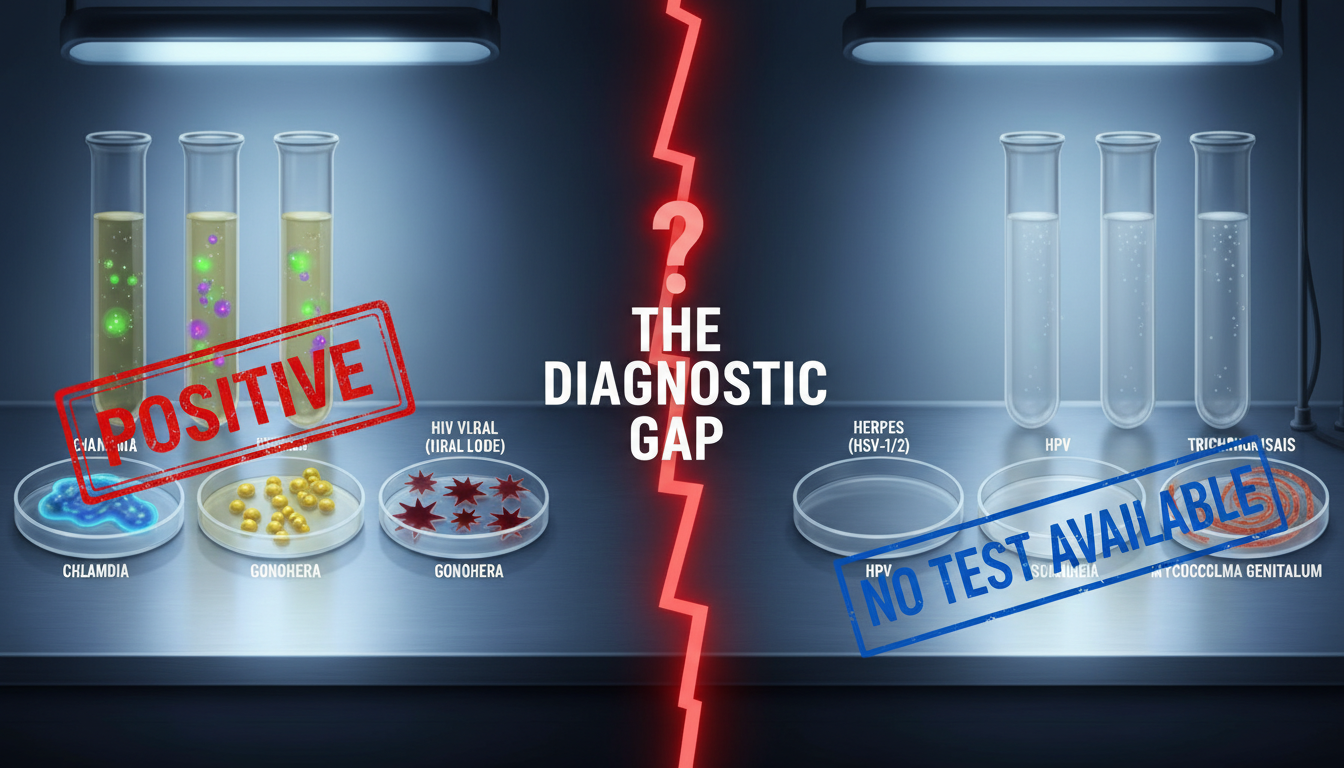
“STD panel” is not a standardized term. The infections included vary by clinic, by lab, by insurance code, and by the at-home kit you bought. Several of the most common sexually transmitted infections in the U.S., including herpes, trichomoniasis, HPV, and Mycoplasma genitalium, are routinely excluded from standard panels unless you specifically ask for them. The space between “I got tested” and “I tested negative for X” is where many people slip through the cracks.
Why might a “full” STD panel miss the infection you actually have?
Most standard panels test for chlamydia, gonorrhea, HIV, and syphilis. They typically do NOT include herpes (HSV-1 / HSV-2), trichomoniasis, HPV, or Mycoplasma genitalium unless you request them by name. Window periods (the time between exposure and a detectable result), sample type (urine, swab, or blood), and the body site sampled (genital, throat, or rectal) all change what a “negative” result really means. To know what you've been screened for, ask your provider or read the kit's panel list before you sample.
Key Takeaways
- A “standard” STD panel typically covers four infections: chlamydia, gonorrhea, HIV, and syphilis. Herpes, trichomoniasis, HPV, and Mycoplasma genitalium are usually not included unless you ask by name.
- Test timing matters. Each infection has a window period; testing too early can return a false negative even if you eventually test positive.
What a Standard STD Panel Really Covers
There is no single national definition of a “standard” or “comprehensive” STD test. Clinics, labs, and at-home kits each bundle a different set of infections together and call the result a panel. The core four (chlamydia, gonorrhea, HIV, and syphilis) are usually present. Most other infections are not, even when the kit is marketed as “full” or “complete.”
The Centers for Disease Control and Prevention publishes screening guidance by population (sexually active women under 25, men who have sex with men, pregnant patients, transgender and gender-diverse persons, and people with HIV) rather than a single test bundle for everyone. Insurance coding, lab capability, provider judgment, and risk-screening questions all shape which tests get ordered. The result is that two people who both ask for a “full panel” can walk away with different test menus and equal confidence in a misleading negative.
The table below summarizes what a routine panel typically covers and what almost always requires an explicit request, drawing on the CDC's STI screening recommendations.
| Infection | In Standard Panel? | Requires Special Request? | Why It's Often Skipped |
|---|---|---|---|
| Chlamydia | Yes | No | Universal screening recommended |
| Gonorrhea | Yes | No | Universal screening recommended |
| HIV | Yes | No | Recommended at least once for all adults |
| Syphilis | Often | Sometimes | Sometimes omitted in low-risk profiles |
| Herpes (HSV-1 / HSV-2) | Rarely | Yes | CDC does not recommend routine asymptomatic screening |
| Trichomoniasis | Rarely | Yes | Often only ordered when symptomatic |
| HPV | Rarely | Yes (women) | Co-tested only during cervical Pap; no routine male test |
| Mycoplasma genitalium | No | Yes | Newer pathogen, limited test availability |
Window Periods: Why Timing Affects Accuracy
Even when the right tests are ordered, a result can still be misleading if the sample was taken too soon. Every infection has a window period, the time between exposure and when a test can reliably detect the infection. Test before that window closes and a real infection can come back as a false negative, then surface days or weeks later as symptoms or as a partner notification.
The window depends on the test technology. Lab nucleic acid amplification tests (NAATs) for chlamydia and gonorrhea become reliable within a couple of weeks of exposure. Antibody tests for HSV or syphilis take longer because the body has to mount a measurable immune response. Fourth-generation HIV antigen-antibody tests detect infection earlier than antibody-only assays, and the CDC's HIV testing guidance details the exact windows by test type, including 18 to 45 days for lab antigen/antibody tests.
| Infection | Earliest Reliable Test | Best Time to Test |
|---|---|---|
| Chlamydia (NAAT) | 1 to 2 weeks | 2 weeks |
| Gonorrhea (NAAT) | 1 to 2 weeks | 2 weeks |
| Syphilis (antibody) | 3 to 6 weeks | 6 to 12 weeks |
| HIV (4th-gen antigen / antibody, lab) | 18 to 45 days | 6 weeks |
| Trichomoniasis (NAAT) | 1 to 4 weeks | 2 to 4 weeks |
| Herpes (HSV antibody) | 4 to 6 weeks | 12 to 16 weeks |
Anatomy Matters: Throat, Genital, and Rectal Tests Aren't Interchangeable
One of the most common gaps in STD testing happens when a single sample gets treated as a full-body screen. A urine sample tests the urethra. A vaginal or penile swab tests the genital tract. Throat and rectal infections need their own dedicated swabs from those sites. A negative urine NAAT for chlamydia or gonorrhea does not rule out a pharyngeal infection from oral sex, and a vaginal swab will not detect rectal gonorrhea acquired through receptive anal sex.
This is why the CDC's screening guidance for men who have sex with men and other higher-exposure groups specifically calls for site-by-site sampling. If your provider didn't ask where you've had sex, the resulting test menu is almost certainly incomplete. Speaking up changes what gets tested. Saying “I had unprotected oral sex” or “I was the receptive partner during anal sex” is the difference between a one-tube test and a three-site swab.
Our at-home rapid tests use genital self-swabs (chlamydia, gonorrhea, trichomoniasis, HPV) and fingerstick blood samples (HIV, syphilis, hepatitis B, hepatitis C, HSV-1, HSV-2). We do not sell pharyngeal (throat) or rectal swab kits. If your exposure included oral or anal sex, see a clinic for site-specific swabbing in addition to any at-home screening you do.
Why Herpes Is Excluded by Default
Herpes is one of the most common sexually transmitted infections worldwide, and yet it is almost never included in routine STD testing. The CDC's STI screening recommendations state plainly that HSV-2 serologic screening among the general population is not recommended. The reasoning is twofold. First, antibody tests can confirm exposure but cannot pinpoint when infection occurred or whether the virus is currently active. Second, in low-prevalence populations the rate of false positives can be high enough to cause significant emotional distress for results that may not be clinically actionable.
That logic protects some patients and frustrates others. Many people genuinely want to know their HSV status, especially before starting a new relationship or after a partner discloses a diagnosis. The flip side of routine exclusion is that you can carry and transmit HSV-2 for years without symptoms and without ever being offered a test.
If you want a herpes test, you can ask for one. The two main options are a type-specific IgG antibody blood test (useful 12 to 16 weeks after suspected exposure) or a swab PCR of an active sore (useful only when you have symptoms). Some providers will push back on routine antibody testing in the absence of symptoms; you have the right to discuss it and to make an informed choice. At-home rapid HSV antibody tests are also available for both HSV-1 and HSV-2 if a clinic visit isn't an option.
The Three Most-Skipped: Trichomoniasis, HPV, and Mycoplasma genitalium
Beyond herpes, three other infections account for most of the surprise positives that come after a “clean” panel.
Trichomoniasis is a parasitic infection that the CDC describes as one of the most common curable STIs in the U.S. About 70% of people with the infection have no signs or symptoms, which is one reason routine panels skip it. When symptoms do appear, they more often surface in women and people with vaginas (itching, foul-smelling discharge, or burning); men are more likely to carry the infection silently while still being able to transmit it. Treatment is a single antibiotic dose. Self-collected vaginal swab tests are widely available, including at-home rapid versions for vaginal self-swab. Note: our at-home trichomoniasis kit is validated for vaginal self-collection only; male readers needing a trich test should see a clinic.
HPV rarely appears on a “standard” STD panel. For women, high-risk HPV testing is included as part of cervical cancer screening, with co-testing (a Pap test plus an HPV test) typically discussed for ages 30 to 65. For men, no routine HPV test exists, even though men can carry and transmit the high-risk strains linked to oropharyngeal, anal, and penile cancers. HPV vaccination is recommended routinely through age 26, with a shared decision between patient and clinician for adults 27 through 45 who weren't previously vaccinated.
Mycoplasma genitalium is a more recently recognized bacterial cause of urethritis in men and cervicitis or pelvic inflammatory disease in women. NAAT testing for M. genitalium has only become broadly available in recent years, so many clinics still do not order it routinely. It is also notable for emerging antibiotic resistance, which is why diagnostic testing is preferred over empiric treatment when symptoms persist after first-line antibiotics for chlamydia or gonorrhea.
Trichomoniasis: most often silent (about 70% of carriers have no symptoms), curable with one antibiotic dose, almost never on a default panel.
HPV: high-risk-strain testing exists for women as part of cervical screening (typically discussed at ages 30 to 65); no routine male HPV test. Vaccination is the main prevention tool.
Mycoplasma genitalium: bacterial urethritis or cervicitis. Worth asking about if symptoms persist after first-line antibiotics for chlamydia or gonorrhea.
At-Home Rapid Tests vs Lab Panels: What Each Covers
At-home and clinic-based testing both have a place. The accuracy gap between them is smaller than people often assume; the coverage gap is usually bigger. The single most useful question to ask of any test, at home or in a clinic, is which infections are actually included.
At-home rapid kits use lateral-flow chemistry similar to a home pregnancy test or COVID rapid antigen. They produce results in about fifteen minutes and are suited to private, on-your-own-schedule screening. They are not the same technology as a laboratory NAAT or PCR, which has higher analytical sensitivity and remains the lab “gold standard” for infections like chlamydia, gonorrhea, and trichomoniasis. A positive at-home rapid test is worth confirming with a clinic-based NAAT when possible, and any persistent symptom that contradicts a negative at-home result deserves a clinic follow-up regardless of the kit's stated accuracy.
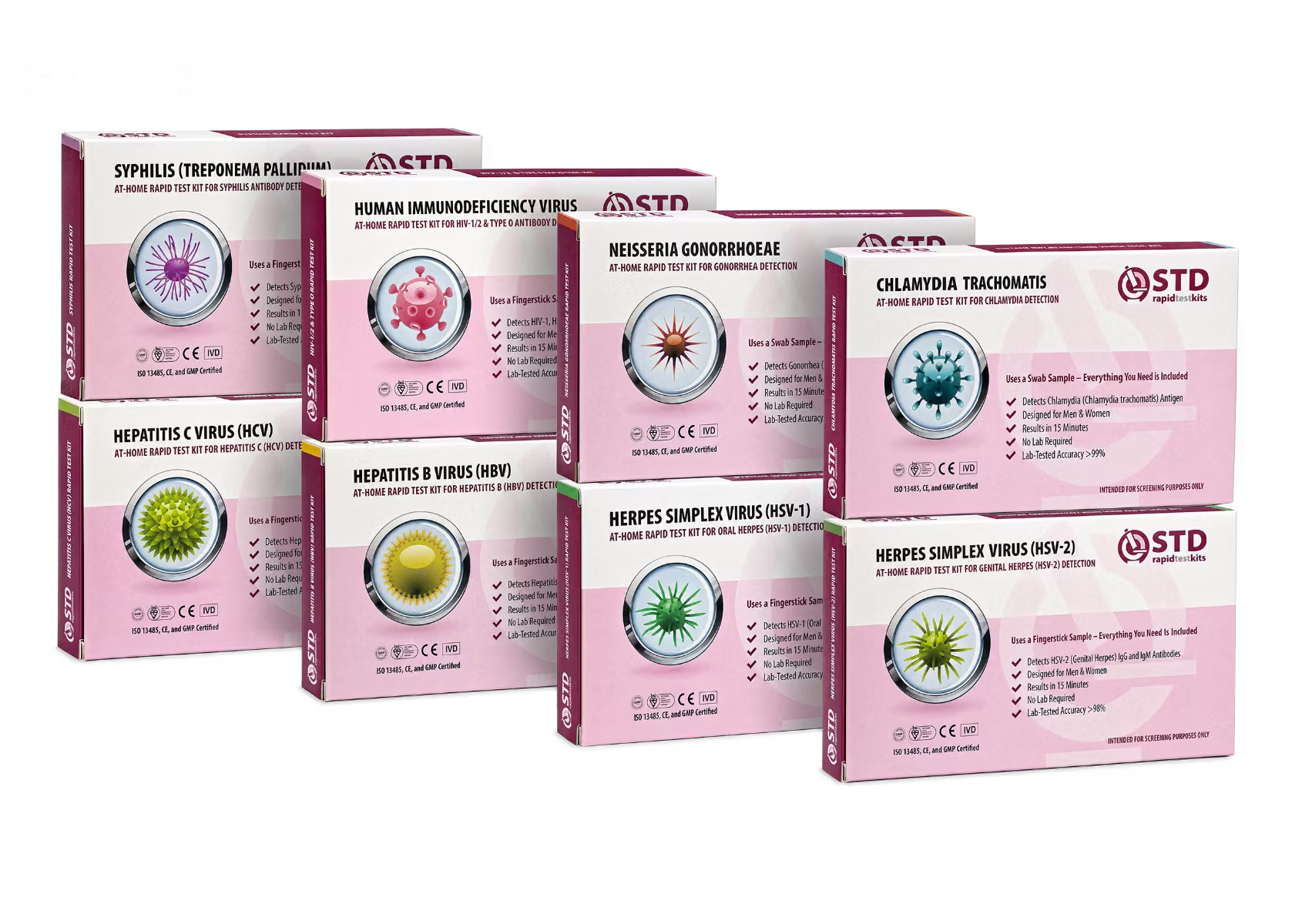
The other place at-home kits diverge from clinics is in coverage. A reputable at-home rapid kit will list every pathogen on the panel. A clinic “STD panel” may not. If your kit lists chlamydia, gonorrhea, HIV, and syphilis only, that is what you tested for. Herpes, trichomoniasis, HPV, and Mycoplasma genitalium are not in that bundle. Combination kits exist that add several of the commonly missed infections; check the panel list before you order.
The practical takeaway is that a coverage gap and an accuracy gap are different problems. A clinic NAAT for chlamydia is more analytically sensitive than an at-home rapid, but a clinic panel that omits trichomoniasis still won't tell you whether you have trichomoniasis. Picking a test means looking at both questions: how well does it detect what it tests for, and what is on the test menu in the first place?
How to Ask for the Right Tests
Asking for expanded testing is informed care, not paranoia. The phrasing below works for both clinic visits and telehealth conversations:
- “Can you walk me through which specific infections this panel tests for?”
- “I'd like herpes (HSV-1 and HSV-2) and trichomoniasis added to my panel.”
- “Is Mycoplasma genitalium included, or do I need to request it separately?”
- “I had oral sex. Can you swab my throat for gonorrhea and chlamydia?”
- “I had receptive anal sex. Can you do a rectal swab for chlamydia and gonorrhea?”
- “What HIV test are you using? Is it a fourth-generation antigen-antibody combo?”
For at-home kits, the same logic applies: read the kit's product page and confirm exactly which pathogens are included before you sample. If a kit advertises “comprehensive” without listing every pathogen, treat that as a yellow flag and look for one with a transparent panel list.
Some providers may decline to add herpes antibody testing in the absence of symptoms, citing the CDC guidance discussed above. That is a defensible clinical position, but you can ask for the test anyway and discuss the predictive value of a result in your individual case. The decision is yours.
When to Retest
Retesting is not overkill; it is how testing protocols work. The need is driven by three situations.
The first is timing. If you tested within days of exposure, your sample was almost certainly drawn before the relevant window periods closed. Plan a follow-up at the two-to-four-week mark for chlamydia, gonorrhea, and trichomoniasis; at three to six weeks for HIV (fourth-generation lab antigen/antibody) and syphilis; and at three months for HSV antibody testing.
The second is coverage. If your previous test only included a subset of infections, retesting with a broader panel can fill the gaps. This is especially worth considering if you've had new partners, condom failure, or symptoms since the last test.
The third is partner notification. If a current or former partner discloses a positive diagnosis, retesting is essential regardless of when you last tested. Some infections (HSV, syphilis, HIV) take weeks to seroconvert, and a clean prior result may simply reflect an unexpired window.
HSV-2 serologic screening among the general population is not recommended.
FAQs
- What does a “full STD panel” actually test for?
- Most full panels cover four infections: chlamydia, gonorrhea, HIV, and syphilis. Beyond that, coverage varies by clinic and kit; herpes, trichomoniasis, HPV, and Mycoplasma genitalium are almost always excluded unless you ask. Always read the test menu before sampling.
- Why isn't herpes included in routine testing?
- The CDC's STI screening recommendations state that HSV-2 serologic screening among the general population is not recommended. The blood test cannot tell when infection occurred, and false positives are more common in low-prevalence groups. You can still request the test if you want it; clinicians should discuss the predictive value with you before ordering.
- Can I have an STD in my throat or rectum and not know it?
- Yes. Pharyngeal (throat) gonorrhea and chlamydia, and rectal gonorrhea and chlamydia, are often asymptomatic and require dedicated swabs from those sites. A urine sample or genital swab does not detect them. If you've had oral or receptive anal sex, ask explicitly for site-specific swabs.
- I tested negative but still have symptoms. What now?
- Trust the symptoms. Possibilities include testing too early (window-period false negative), the infection wasn't on the panel (herpes, trich, M. genitalium), wrong sample site (throat or rectal infection missed by urine), or a non-STI cause like bacterial vaginosis or a yeast infection. A retest with broader coverage and a clinic visit are both reasonable next steps.
- How long after exposure should I wait to test?
- It depends on the infection. Chlamydia and gonorrhea NAATs are reliable within one to two weeks. Fourth-generation HIV antigen/antibody lab tests detect infection within 18 to 45 days of exposure. Syphilis antibody tests are reliable at three to six weeks. HSV antibody testing is most accurate at twelve to sixteen weeks. Test once early if you want; plan a follow-up after the relevant window closes.
- Are at-home rapid tests as accurate as clinic tests?
- At-home rapid tests use lateral-flow chemistry and are designed for screening accuracy in symptomatic and high-pretest-probability cases. They are not the same technology as laboratory NAATs, which have higher analytical sensitivity. A positive at-home result is worth confirming with a clinic NAAT when possible. The two are complementary screening tools.
- What is Mycoplasma genitalium and should I worry about it?
- It's a bacterium that can cause urethritis in men and cervicitis or pelvic inflammatory disease in women. Symptoms overlap with chlamydia. NAAT testing only became broadly available in recent years, so many clinics still don't order it routinely. If you have urinary or pelvic symptoms that didn't resolve after first-line antibiotics, ask about M. genitalium testing.
- Can I get an STI even if we used a condom?
- Condoms substantially lower the risk of HIV, chlamydia, gonorrhea, syphilis, and trichomoniasis. They offer less protection against herpes and HPV, which spread through skin-to-skin contact in areas a condom may not cover. Oral sex without a barrier is a known transmission route for several STIs as well. Consistent condom use plus regular testing is more protective than either alone.
For Women Who Want the Broadest At-Home Coverage
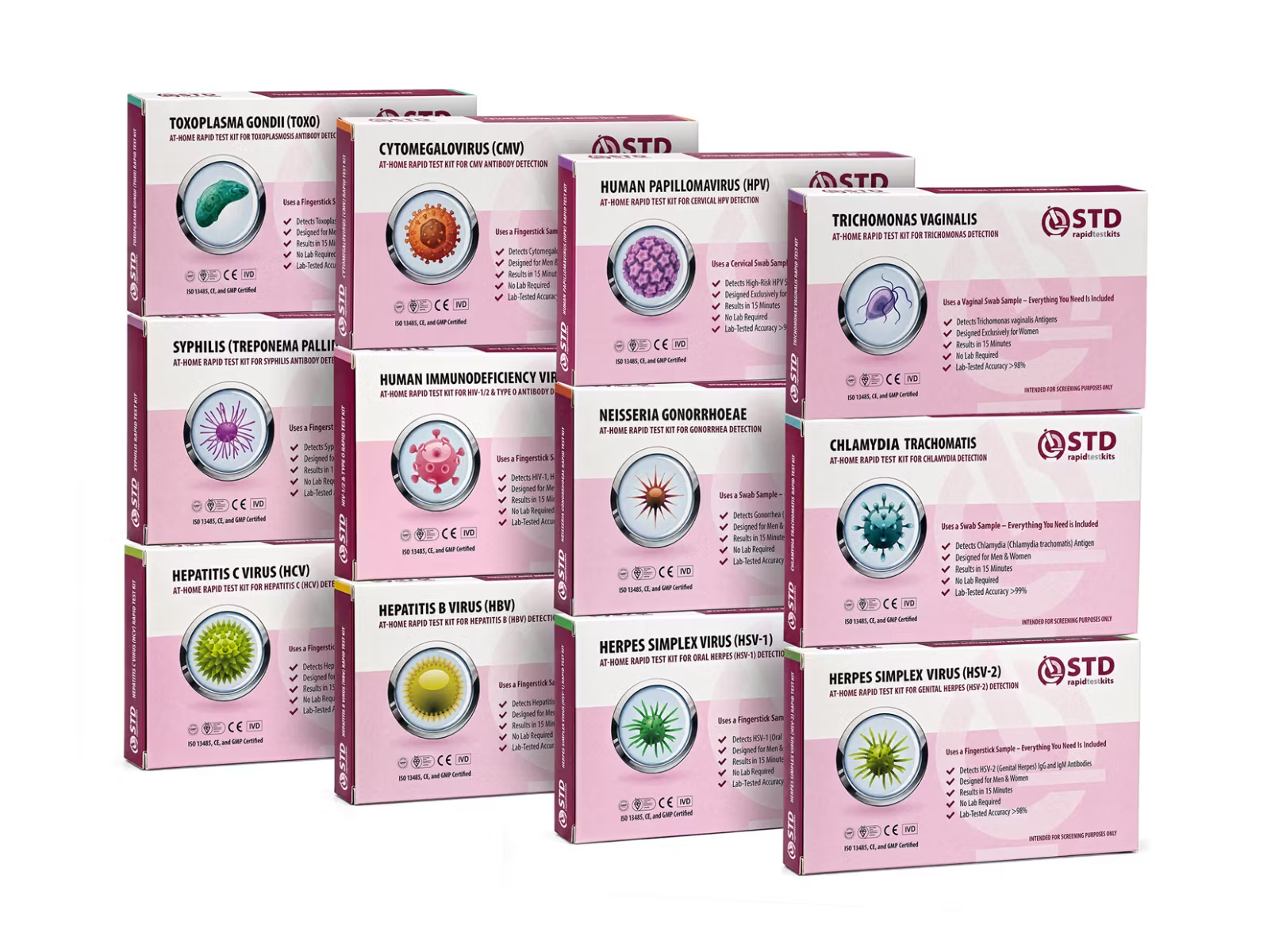
Most of the infections discussed above (trichomoniasis, HPV, the cervical-screening side of HPV co-testing) are validated in our catalog for vaginal self-swab. If you want a single at-home kit that bundles those women-specific tests with the standard four-pathogen blood panel, the option below is the broadest we offer.
- U.S. Centers for Disease Control and Prevention. STI screening recommendations organized by population, including the explicit statement that HSV-2 serologic screening among the general population is not recommended.
- U.S. Centers for Disease Control and Prevention. HIV testing guidance, including window periods of 18 to 45 days for fourth-generation lab antigen/antibody assays.
- U.S. Centers for Disease Control and Prevention. Trichomoniasis overview and prevalence, including the figure that about 70% of people with the infection have no signs or symptoms.
- U.S. Centers for Disease Control and Prevention. Mycoplasma genitalium overview, used for the antibiotic-resistance and limited-test-availability claims.
- U.S. Centers for Disease Control and Prevention. Cervical cancer screening guidance, including the discussion of HPV co-testing for ages 30 to 65.
- U.S. Centers for Disease Control and Prevention. HPV vaccines and vaccination schedule, including routine vaccination through age 26 and shared clinical decision-making for adults 27 through 45.
- U.S. Centers for Disease Control and Prevention. Genital herpes overview, used for general background on HSV-1 and HSV-2 transmission and presentation.
