
Published: November 2025 | Last updated: May 2026 | Editorial review and quality control: Martina N.
You just had a conversation you weren't ready to have. A current or recent partner tested positive for HPV. Your routine STI panel came back clean a year ago, you have no symptoms, and now you're piecing together a timeline that won't add up. Maybe you're the one who passed it on. Maybe you didn't. Maybe nobody can ever know for sure.
That uncertainty is the most disorienting part of HPV. Most other infections we worry about leave a trail: a sore, a fever, a positive test on a routine screen. HPV usually leaves none of those, especially for partners with a penis, where no FDA-approved screening test exists outside of visible warts. So if you're sitting with the question "did I infect someone I cared about, and how did I not know," this guide is for you. We'll walk through what the science says about silent transmission, why the standard testing system misses so many people, and what to do next when guilt is loud and answers are quiet.
Key Takeaways
- Most people with HPV have no symptoms and no way to know they carry it. Transmission happens during this silent window and isn't the same as deception.
- HPV can stay hidden for months or years, so a partner's positive test rarely points to who passed it. Vaccination and honest conversation matter more than reconstructing the timeline.
The Truth About Silent HPV Transmission
HPV is the most common sexually transmitted infection in the world. According to the CDC's Genital HPV Infection fact sheet, you can get HPV even if you have had sex with only one person, and roughly 9 out of 10 HPV infections go away on their own within two years thanks to the immune system.
About 40 of the more than 200 known HPV types infect the genital area. Some of those types cause genital warts. A smaller group, the high-risk types, can cause cell changes that, over many years, sometimes lead to cervical, anal, penile, or oropharyngeal cancer. The large majority of HPV infections cause no symptoms, no abnormal cells, and nothing noticeable on a routine exam.
That biology is what makes HPV uniquely guilt-inducing. If you have no warts, no abnormal Pap, no symptoms of any kind, you have no way of knowing you're carrying the virus. And what you can't see, you can't disclose. So when a partner finally gets a positive test, the conversation often arrives years after the original exposure.
HPV at a glance
- Roughly 9 out of 10 HPV infections clear on their own within two years, according to the CDC's Genital HPV Infection fact sheet.
- About 40 of the more than 200 known HPV types infect the genital area; the rest infect skin elsewhere on the body.
- A smaller group of high-risk types account for nearly all HPV-linked cancers, while a separate group of low-risk types causes most genital warts.
- You can get HPV even after sex with only one person, because HPV spreads through skin-to-skin contact and a partner may have been silently carrying it for years.
Why You Didn't Know You Had It
The testing landscape isn't fair, and it isn't symmetric. For people with a cervix, two screening tools detect high-risk HPV before it causes cancer: the Pap test (which looks for abnormal cervical cells caused by HPV) and the HPV DNA test (which looks for the virus itself). U.S. guidelines recommend a combination of these starting around age 25, with timing that varies by age and prior results. Either approach can pick up high-risk types the immune system hasn't yet cleared.
For everyone else, including cis men and trans people without a cervix, the situation is bluntly different. No FDA-approved screening test for HPV exists outside of visible lesions: no swab, no blood test, no at-home rapid test for general use. Clinicians can biopsy a visible wart to identify the strain, but if you have no warts, there's nothing to test. The gap is in available technology, not in your medical records, and it is the single biggest reason "silent carriers" exist.
So if you're the partner who likely transmitted it, the most accurate sentence may be: no medical option available to you would have flagged this. Not at your annual physical. Not at the STI clinic. Not anywhere. That's a structural problem with how HPV screening works, not a personal failure on your part.
For people with a cervix: the Pap test, the HPV DNA test, or both used together (co-testing) detect high-risk HPV during routine cervical screening. For people without a cervix: no FDA-approved screening test exists outside of visual or biopsy diagnosis of visible warts. That asymmetry, not personal carelessness, is why silent transmission is so common.
How Long HPV Can Stay Hidden
HPV doesn't follow a tidy timeline. Someone can acquire it, clear it without symptoms, and still leave a partner with a positive test years later. The virus also doesn't always trigger detectable cell changes on the first Pap test after exposure. According to the World Health Organization's HPV fact sheet, persistent high-risk HPV infections can take 15 to 20 years to progress to cervical cancer in immunocompetent women, and 5 to 10 years in immunocompromised women. That long incubation, combined with the fact that one immune system can clear what another doesn't, is why "who gave it to whom" is usually a question dates alone cannot answer.
Practically, this means a positive test today might reflect an exposure from a previous relationship, or a current one. It might reflect a strain one partner has cleared while the other hasn't. Your immune system isn't your partner's, and the same type of HPV can run different courses in two different bodies.
The table below covers a few common scenarios couples encounter when one or both partners test positive for HPV. None of these results, on its own, points to infidelity or to a recent exposure.
| Test scenario | What it might mean (none of these prove infidelity) |
|---|---|
| You tested negative, your partner tested positive | Your body may have already cleared the infection, you may have a type that isn't on standard screening panels, or no test option may be available to you. |
| You both tested positive | You likely passed it between each other at some point. The strain may be the same or different, and timing usually can't be reconstructed. |
| You have visible warts, your partner doesn't | Different HPV types behave differently. Warts (caused mostly by low-risk types) are not the same as the high-risk types detected on a Pap test. |
Breaking the Guilt Loop
Reading the science doesn't always quiet the spiral. Many people who find out a partner has HPV go through a sharp, specific kind of guilt: "I didn't know. I didn't disclose. I should have known. They might get cancer. It's my fault." That feeling is common enough that public-health counselors hear it constantly in post-diagnosis conversations.
The clinical reality, though, is narrower than the feeling. Responsibility, in any reasonable ethical sense, depends on what a person knew and what they could have known. With HPV, the answer to both is usually "almost nothing." No test is available to most people, there are no symptoms to flag, and there is no standard of care that says you should have done something different. The harshest interpretation, that you were dishonest, isn't supported by how HPV behaves.
What does help is the next set of decisions: getting tested for the infections you can be tested for, talking honestly to your partner, considering the HPV vaccine if you're under the age cap, and building a habit of regular screening for anyone with a cervix. Those are the steps that change outcomes, and none of them require resolving the guilt first.
Responsibility requires three things you usually didn't have with HPV: a way to detect it, a duty to disclose it, and a reasonable choice to do otherwise. With no available test, no symptoms, and no standard of care that would have flagged the infection, the honest verdict is shared bad luck, not personal harm. Treat the next 48 hours as logistics, not a trial: schedule the appointments you can schedule, ask the questions you can ask, and let the emotional processing happen on its own slower track.
Can You Still Pass It On Without Symptoms?
Yes. This is the single most misunderstood thing about HPV, and it's the reason the virus is so widespread. You can carry and transmit HPV with no warts, no abnormal Pap, no itching, no other symptoms. You can be in a long-term, monogamous relationship and still pass it on. You can have used condoms every single time and still pass it on, because condoms reduce risk significantly but don't cover all the skin-to-skin contact areas where HPV lives. That limitation applies to oral sex and other forms of skin-to-skin genital contact as well, where condom coverage is partial at best.
Most standard STI panels, the ones you'd get at a clinic or at home, do not include HPV at all. So a "clean" STI test result doesn't rule it out. The only way a partner with a cervix learns about high-risk HPV is usually through Pap or HPV DNA testing done as part of cervical-cancer screening. The only way a partner without a cervix learns about it is usually by seeing visible warts in the mirror.
Public-health clinicians sometimes call HPV a "stealth" infection. The label is descriptive: HPV sidesteps the systems most people rely on for "am I clean?" reassurance.
Can I really give someone HPV with zero symptoms and a clean STI test?
Yes. Most people transmit HPV without ever knowing they carry it. Standard STI panels do not test for HPV, no FDA-approved HPV test exists for cis men outside of visible warts, and roughly 9 in 10 infections clear silently within two years. Per the CDC, you can get HPV even if you have only ever had sex with one person.
What Testing Looks Like Now, and What It Doesn't
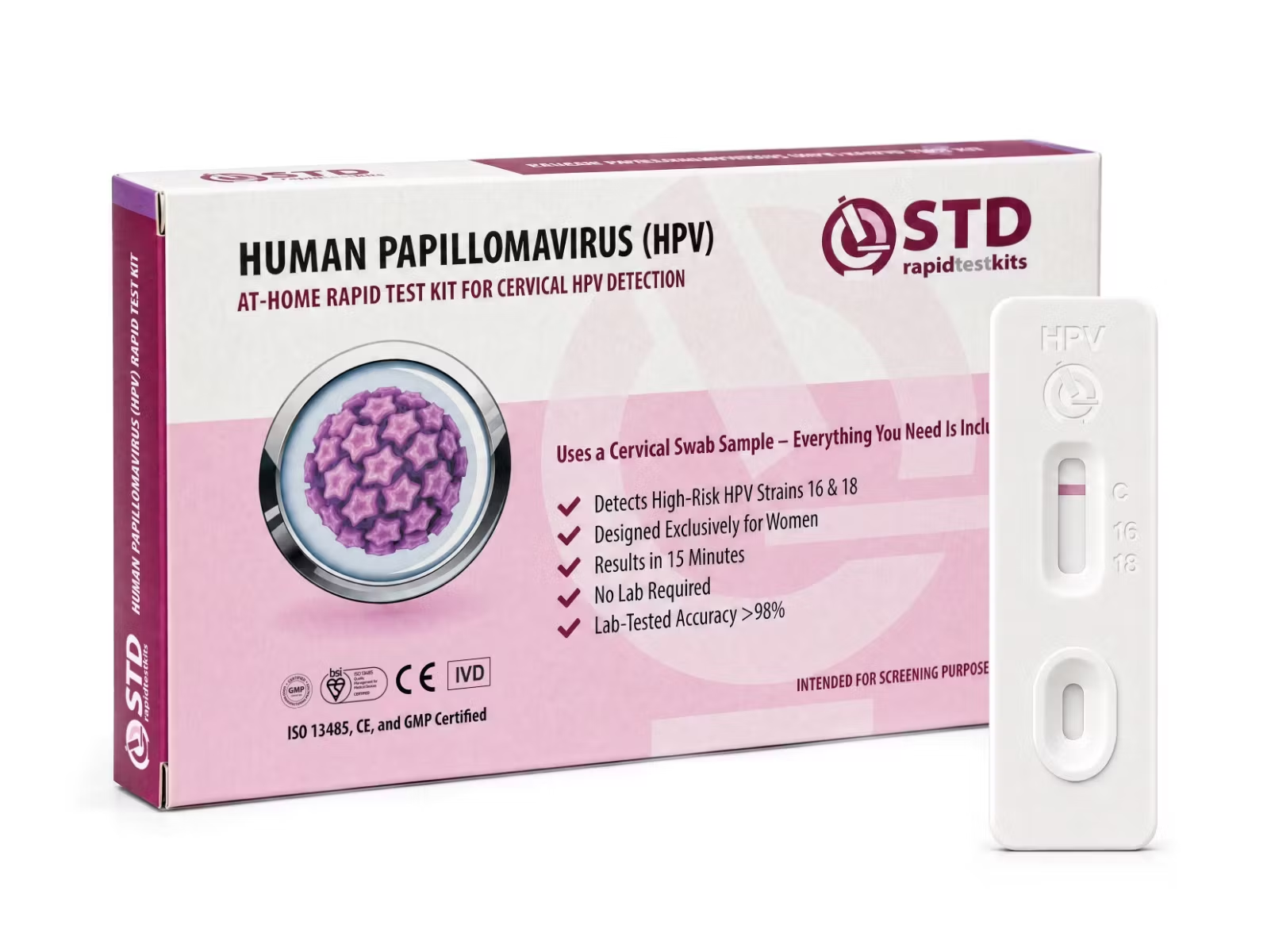
If you're trying to figure out whether to get tested after a partner's HPV diagnosis, the honest answer depends on your anatomy. For people with a cervix, the main testing options are well-established and clinic-based: a Pap test, an HPV DNA test, or both done together (co-testing). The MedlinePlus HPV page from the U.S. National Library of Medicine walks through screening basics in plain English. There are also a small number of at-home options that use a self-collected vaginal swab. These are more limited in availability and scope, but they exist.
For people without a cervix, the testing situation is bluntly unsatisfying. No routine HPV screen exists for cis men, no widely-available test exists for oral HPV, and no rectal HPV screen is recommended for the general population. A clinician can examine and, if needed, biopsy visible lesions, but absent visible warts, there's nothing to test. The asymmetry is frustrating, and it is the current standard of care.
The table below summarizes what testing exists, by body type. We publish this guide as part of stdrapidtestkits.com, which sells at-home rapid STI tests; we point to a product when it genuinely fits a section, and we flag the gap when it doesn't.
| Body type | Common HPV testing method | Availability |
|---|---|---|
| People with a cervix | Pap test, HPV DNA test, or co-testing | Clinic-based; some at-home self-swab options exist |
| People without a cervix (cis men, some trans people) | No routine screening; biopsy of visible warts only | Clinic only when lesions are present |
| Anyone with visible warts | Visual diagnosis or biopsy | Clinic only |
The Role of HPV Vaccines, Even After Exposure
If you've already had HPV, the vaccine doesn't clear the infection you've got. It does, however, protect against the specific strains it covers, which you might not have encountered yet. The CDC's HPV vaccine page describes the current 9-valent vaccine (sold as Gardasil 9 in the U.S.), which covers seven high-risk types responsible for most HPV-related cancers plus two types that cause most genital warts.
Vaccination is routinely recommended through age 26. For adults aged 27 through 45, the CDC recommends shared clinical decision-making, meaning the choice depends on your specific risk profile and a conversation with your clinician. The vaccine is not therapeutic for an existing infection, but the American Cancer Society's guidance on HPV prevention ranks vaccination as the highest-evidence step either partner can take going forward.
Through age 26: routine vaccination recommended for everyone who hasn't completed the series. Ages 27 through 45: shared clinical decision-making with your provider based on your specific exposure history and risk profile. After age 45: the FDA-approved indication doesn't extend further; ask your clinician about other prevention steps.
What to Say to a Partner After HPV Comes Up
There's no perfect script for this. There are a few things that consistently land better than others, though, and they're worth saying out loud.
First, acknowledge the diagnosis without arguing the timeline. Trying to prove "it wasn't me" usually goes badly, partly because the science can't establish that, and partly because it sounds defensive in a moment your partner needs you present. A line like "I didn't know I had this, and it's possible I did and just couldn't have known. I'm sorry this is what we're navigating, and I want to understand it with you" does more in a tense conversation than a long explanation of incubation periods.
Second, share what you've learned about how common HPV is. The information that most sexually active people will be exposed at some point, and that most infections clear without harm, is genuinely reassuring context your partner may not have. It also normalizes the diagnosis rather than treating it as a catastrophe.
Third, talk about next steps together. Is anyone in the relationship vaccine-eligible? When is the next cervical screening due? Are there other STIs worth ruling out in the same window of concern? Decisions feel less heavy when both people are making them.
Acknowledge: "I didn't know I had this, and it's possible I did and just couldn't have known. I'm sorry this is what we're navigating." Normalize: "Most sexually active people are exposed at some point, and most infections clear on their own; the science backs that up." Plan together: "What does the next gynecology appointment look like, and is there anything I can do alongside you—testing, vaccination, going with you?"
Should You Retest or Wait It Out?
If your partner just got a positive HPV result, your own next step depends on what you can test for and what your screening history looks like. For a partner with a cervix who hasn't had a Pap or HPV DNA test in over a year, scheduling one is a reasonable response. If recent results were normal, your clinician may suggest sticking with the existing screening schedule, since high-risk HPV usually progresses slowly and isn't an emergency. For a partner without a cervix, there's typically nothing to retest unless visible warts appear, which is the only thing a clinician can diagnose without a screening test.
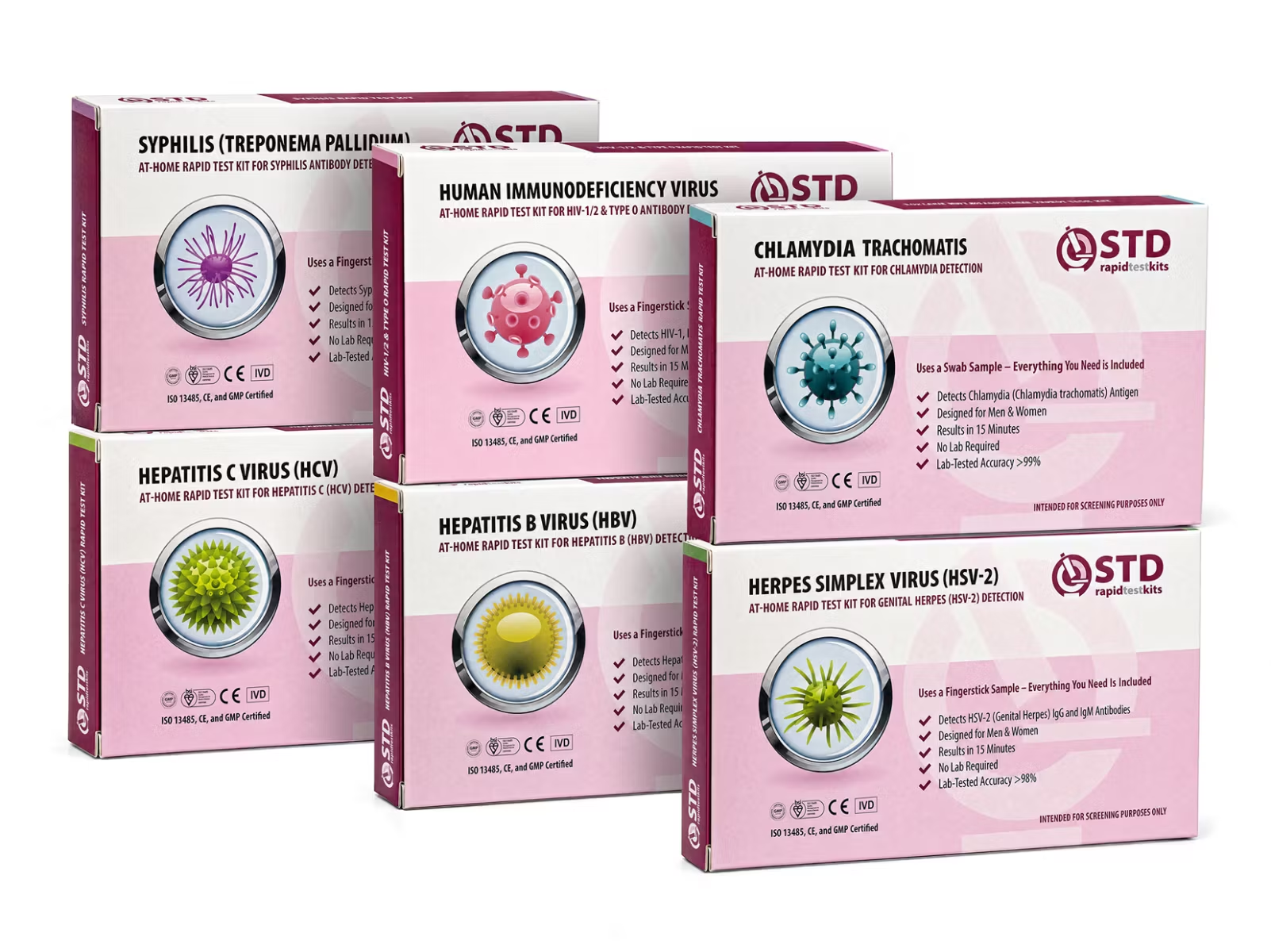
Beyond HPV itself, this is a sensible moment to think about a broader STI screen. HIV, syphilis, chlamydia, gonorrhea, and hepatitis run on different timelines than HPV, and clinicians often treat any partner's STI diagnosis as a trigger for refreshing all of them.
In long-term relationships, mutual HPV infections can take turns showing up in two partners. It doesn't mean someone cheated. One immune system can clear what another doesn't, or one partner had access to testing the other didn't.
How to Support Your Partner Without Disappearing Into Guilt
If you might have been the one who passed HPV on, the easiest temptation is to make the conversation entirely about your guilt. Resist that. Your partner is also processing real things: anxiety about cervical cancer, questions about fertility, questions about trust, fear about what to tell future partners. Your role is to be a present co-investigator in what comes next, not the central character in a self-blame spiral.
A few practical ways to do this. Offer to attend the next gynecology appointment together if your partner wants company. Get tested for the STIs you can be tested for, on the same timeline, so it's a shared step rather than a one-sided burden. Read a couple of legitimate sources together (the CDC, WHO, and American Cancer Society pages cited throughout this article are good ones) so you're working from the same information.
Couples who navigate this together tend to come out with more honest conversations about sexual health than they had before.
You're Not Alone, and You're Not the Villain
Here's the part most articles skip: most people who unknowingly pass HPV did everything a reasonable person would do, including annual physicals, full STI panels at the clinic, consistent condom use, and (often) a single relationship at a time. None of that catches HPV, because the screening infrastructure doesn't reach that far for everyone. HPV screening gaps are a systemic shortfall, and the people they affect haven't done anything wrong.
Look at what you knew at the time, what testing was offered to you, and what you did with the information you had. The honest version of that ledger usually doesn't support the harsh self-judgment guilt produces. What it does support is forward motion: get vaccinated if you're under the age cap, get tested for what you can test for, talk to your partner, and stay current on cervical screening if that applies to either of you.
If guilt is interfering with daily function (sleep, appetite, intimacy, work focus), this is a reasonable moment to talk to a therapist or counselor. HPV diagnoses can stir up a lot more than the medical situation calls for, and a few sessions to unpack the emotional weight is well within normal.
It usually takes 15 to 20 years for abnormal cells to become cancer.
FAQs
- Can I really give someone HPV even if I had no symptoms?
- Yes, and it's the most common way HPV moves between partners. Most people with HPV have no warts and no abnormal Pap result, so they have no way of knowing they carry it. You can feel "clean," test negative on a standard STI panel that doesn't include HPV, and still pass the virus on through skin-to-skin contact.
- I tested negative on my STI panel. Doesn't that mean I didn't have HPV?
- Not necessarily. Standard STI panels almost never include HPV. There's no FDA-approved HPV screening test for people without a cervix outside of visible warts. So a clean panel rules out the infections it tests for, but it can't rule out HPV.
- How long can HPV stay hidden before it shows up?
- Years, sometimes more than a decade. Because the virus can linger silently in either partner's body, a positive test today rarely tells you when the exposure happened, which is why attributing blame based on timing rarely holds up.
- Does my partner's HPV diagnosis mean someone cheated?
- Almost never. HPV doesn't follow a fixed schedule, and a positive test today can reflect an exposure from years before the current relationship. The virus can also clear in one partner while persisting in another. Infidelity is one possible explanation, but it's far from the most likely one.
- What can I do now that I might have passed it on?
- Lead with conversation rather than self-blame. Acknowledge the diagnosis, get tested for the STIs you can be tested for, ask your clinician whether the HPV vaccine still makes sense for you (it does for many people through age 45), and support your partner's cervical screening schedule if that applies.
- Can I get tested for HPV?
- If you have a cervix, yes: ask your clinician about a Pap test, an HPV DNA test, or both together. There are also self-collected vaginal swab options. If you don't have a cervix, no, not unless visible warts appear and a clinician examines or biopsies them. The asymmetry is frustrating and is the current U.S. standard of care.
- Does HPV go away on its own?
- Roughly 9 in 10 HPV infections clear within two years thanks to the immune system, often without ever causing symptoms. A minority of high-risk infections persist and need monitoring through cervical screening, which is why ongoing Pap or HPV DNA testing matters for anyone with a cervix.
- Should I still get the HPV vaccine if I might already have had HPV?
- In many cases, yes. The vaccine doesn't treat infections you already have, but it protects against strains you haven't been exposed to yet. The CDC recommends routine vaccination through age 26 and shared clinical decision-making for adults aged 27 through 45. Ask your clinician whether it fits your situation.
- U.S. Centers for Disease Control and Prevention. Genital HPV Infection fact sheet, used here for transmission basics and the 9-in-10 two-year clearance figure.
- U.S. Centers for Disease Control and Prevention. HPV Clinical Overview, used here for natural history and high-risk vs low-risk type behavior.
- U.S. Centers for Disease Control and Prevention. HPV Vaccination, used here for current age recommendations and 9-valent vaccine coverage.
- World Health Organization. Human papillomavirus (HPV) and cervical cancer fact sheet, used here for the 15-to-20-year progression timeline cited in the quote block and prose.
- American Cancer Society. How to Protect Against HPV, used here for prevention guidance beyond vaccination and the ranking of vaccination as the highest-evidence step.
- U.S. National Library of Medicine. MedlinePlus HPV topic page, used here for a patient-facing description of HPV screening options.
