Published: October 2025 | Last updated: May 2026 | Editorial review and quality control: Martina N.
A gonorrhea rapid test done well at home gives a private answer in under twenty minutes. Done badly, it gives a number that feels real but is not. The difference is usually a handful of small choices: when you tested relative to a possible exposure, how you collected the sample, whether the kit was stored correctly, and how patiently you waited for the lines to develop. None of these steps are hard, and all of them change the answer.
This guide walks every stage of the process, from the moment the discreet package arrives at your door to the moment you decide what the lines on the cassette actually mean. It also covers the edge cases (faint lines, missing controls, expired kits) and when to follow up with a clinic NAAT for confirmation.
Key Takeaways
- Most at-home gonorrhea rapid tests work best when used at least 7 to 14 days after a possible exposure, swabbed from the actual infection site, and read within the time window printed on the kit (usually 10 to 20 minutes).
- Any visible test line, faint or bold, counts as a positive that needs clinic confirmation. If the control line never appears, the test is invalid (not negative) and should be repeated with a fresh kit.
Why At-Home Rapid Testing Helps
Privacy is the leading reason people pick an at-home gonorrhea test over a clinic visit. For readers in small towns, in conservative households, or sharing a family insurance plan where every claim shows up on a parent or partner's portal, walking into a sexual-health clinic can carry social cost that has nothing to do with the actual exam. A plain box delivered to the doorstep and opened behind a locked bathroom door removes that calculus entirely.
Speed is the second draw. A lateral-flow rapid test reads in 10 to 20 minutes. A clinic-administered nucleic acid amplification test (NAAT) typically takes 1 to 3 business days for results to land in your portal. That gap matters when anxiety is high after a condom slip, a partner's disclosure, or the start of an unfamiliar symptom. A home rapid test answers a more immediate question: where do I likely stand right now, and what should I do next? It works alongside a laboratory NAAT, which remains the standard for confirming any positive result.
The trade-off is that you become the lab tech. Sample collection, timing, and result reading all sit on you, and small shortcuts move the accuracy needle fast. The rest of this guide is the procedure for not taking shortcuts.
The World Health Organization estimates roughly 82 million new gonorrhea infections worldwide in 2020 among adults aged 15 to 49. Many are asymptomatic, especially in pharyngeal and rectal sites. Faster, more private screening at home is one piece of how that gap gets closed.

What Comes Inside the Box
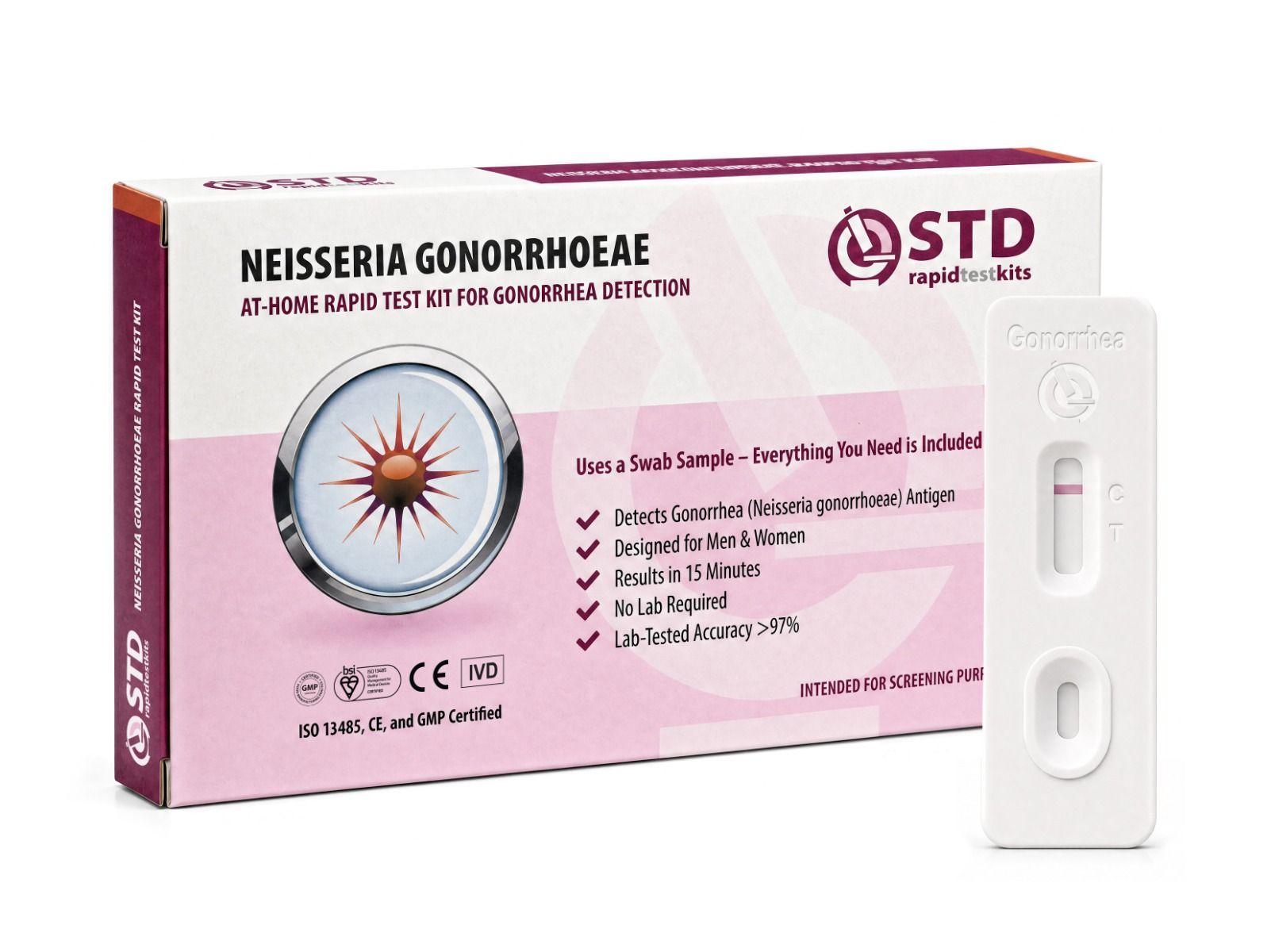
Opening the package for the first time can feel anticlimactic. Instead of a single magic stick, you find a small collection of parts: a sterile sample collection swab, a buffer solution vial, a dropper or pipette, the lateral-flow test cassette itself, an instruction leaflet, and a biohazard disposal bag for the used components. Each part has a single job. Skipping or fumbling any one of them shifts the result from reliable to unreliable.
The test cassette is the most familiar piece. It looks like a small flat plastic window, similar in size and shape to a home pregnancy test. Inside that plastic shell is a paper-strip immunoassay coated with antibodies that bind to Neisseria gonorrhoeae surface antigens. When the buffer-diluted sample flows along the strip, captured antigens light up the test line, and an internal control band lights up to confirm the chemistry ran properly.
The buffer vial is doing more than diluting the sample. Its mild salts and detergents lyse bacterial cell walls so the antigens are released and free to bind. Plain water will not perform that chemistry, which is why substitutions tend to produce invalid or false-negative results. The instruction leaflet is the only authoritative source for drop counts, read windows, and storage rules specific to that brand of kit. Read it once before unpacking anything else.
| Component | What it does | Critical handling note |
|---|---|---|
| Sample swab | Collects mucosal cells carrying gonorrhea antigens from the target site | Hold by the plastic shaft only; never touch the cotton tip; do not brush against skin or fabric before insertion |
| Buffer solution vial | Lyses bacterial cell walls and releases antigens for detection; provides the flow medium for the cassette strip | Use only the included buffer; never substitute water or saline; mix the swab for the full specified time (usually 15 to 30 seconds) |
| Dropper or pipette nozzle | Delivers the prepared sample to the cassette well in measured drops | Use the exact drop count specified (usually 2 to 3); more is not safer and floods the strip |
| Test cassette | Displays the control and test lines using antibody binding chemistry | Read flat on a stable surface, within the time window printed on the kit (typically 10 to 20 minutes) |
Step 1: Storage and Preparation Before You Start
The least glamorous part of using a home rapid test is also the most overlooked. Lateral-flow kits are temperature-sensitive biological products. Most manufacturers specify storage between 2 and 30 degrees Celsius (about 36 to 86 Fahrenheit), out of direct sunlight, and away from moisture. A box left on a hot dashboard in summer, or in a humid bathroom cabinet near a steamy shower, can lose chemical potency long before the printed expiration date.
Check the expiration date the moment the kit arrives. Most kits run 18 to 24 months from manufacture. An expired kit can still produce visible lines, but the antibody binding has weakened, and the line intensity and reliability no longer match the manufacturer's validation data. A test that drifts from 99 percent specificity down to 90 percent under poor storage looks identical on the bench. You only learn the difference after the result confuses you.
Prepare the space before opening the seal. Wash hands thoroughly with soap and warm water and dry them on a clean towel. Wipe a flat surface with disinfectant, lay out the components in the order the instructions list them, and set a timer for the read window the kit specifies (most are between 10 and 20 minutes). Bring the unopened pouch to room temperature if it has been stored cold, since condensation inside the cassette window can interfere with the read.
- Storage range: 2 to 30 degrees Celsius (36 to 86 Fahrenheit), out of direct sunlight.
- Check the expiration date the moment the kit arrives.
- Wash and dry hands; wipe a flat work surface.
- Bring the pouch to room temperature if it was stored cold.
- Set a timer for the read window before opening the seal.
Step 2: Collecting the Sample Correctly
Sample collection is where most preventable failures happen. Our at-home gonorrhea kit uses a sterile self-collection swab inserted into the urethra (penile anatomy) or vagina (vaginal anatomy), depending on the user. The instructions will specify how far to insert the swab (typically 2 to 4 centimeters past the opening), how long to rotate it against the mucosal surface (usually 10 to 15 seconds), and which direction to rotate. Those numbers are not approximate. They reflect the amount of epithelial tissue the assay needs to load up enough antigen for a confident read.
Two collection failures cause most false negatives. The first is swabbing too superficially, brushing the external skin instead of reaching the columnar epithelium where Neisseria gonorrhoeae colonizes. The second is contaminating the swab tip by touching the cotton end with fingers or letting it drag across underwear. Neither hurts. Both quietly nullify the test.
At-home rapid swab kits validated for genital sites do not detect oral or rectal gonorrhea. Pharyngeal (throat) and rectal gonorrhea are both common, especially after oral or anal exposure, and the only reliable way to test those sites is a clinic-administered swab processed by a laboratory NAAT. If the exposure included oral or anal contact, the right next step is a clinic visit. The two swab types answer different anatomical questions, and using a genital swab to settle a pharyngeal one is the most common reason readers get a falsely reassuring negative result.

Step 3: Running the Test
Once the swab is collected, the next stage looks simple but is precision-dependent. Following the instructions in their specified order, drop the swab into the buffer vial, swirl or twist for the time the leaflet specifies (usually 10 to 30 seconds), then squeeze the vial to express buffer through the swab before discarding it. The buffer now carries the released antigens and is ready to be pipetted onto the cassette.
Use the dropper or vial nozzle to place exactly the number of drops the instructions specify (typically two to three) into the cassette sample well. Adding more is not safer. Extra fluid floods the strip, can carry the sample past the test line before it has time to bind, and may produce a faint streak that mimics a faint positive. Adding fewer drops can starve the strip and prevent the control line from developing, giving a false invalid.
Set the cassette flat on the prepared surface and start the timer. Do not pick it up to inspect during the run. Tilting changes how fluid moves along the strip, and motion blurs the developing line. The control band usually starts to appear within 2 to 5 minutes, which is the earliest confirmation that the chemistry is working. The test line may take the full read window to fully develop, particularly with lower antigen loads.
Disclosure: this site sells at-home rapid tests; the products linked below are from our catalog.
Step 4: Timing the Read Window
The read window is the most underrated detail in a rapid test. Each kit specifies a minimum time before the result is interpretable (usually 10 minutes) and a maximum time after which evaporation effects can produce ghost lines that mimic positives (typically 20 to 30 minutes). Reading at minute 7 risks calling negative on a test that has not finished developing. Reading at minute 45 risks calling positive on a test that finished correctly and then started drying.
If you set a timer and physically leave the room, you eliminate two anxiety problems at once. You stop staring at the cassette and convincing yourself you see a line that has not formed yet, and you stop checking back twenty minutes after the window has closed when residual buffer has begun to evaporate.
If the kit's read window is, for example, 10 to 20 minutes, the correct interpretation is the result you see at minute 10 and confirm at minute 20. Anything that appears for the first time at minute 35 is not a result. It is an artifact of dried reagent. The line intensity may also shift across the window. A clear test line at minute 10 that fades by minute 15 is still a positive. A faint shadow that appears only at minute 25 should be treated with caution and the test repeated.
Read the cassette as soon as the kit's minimum time hits (usually 10 minutes). Confirm what you see at the maximum time (usually 20 minutes). Anything that appears for the first time after the window closes is evaporation artifact, not a result.
Step 5: Reading the Control and Test Lines
The core of result interpretation is simple. The control line appears on every valid test. The test line appears when gonorrhea antigen is detected in the sample. Three combinations cover every outcome.
If the control line is visible and there is no test line, the result is negative within the limits of the test. If the control line is visible and any test line is also visible (clear or faint), the result is positive and warrants confirmatory testing at a clinic before treatment. If the control line is not visible at all, regardless of what the test region shows, the test is invalid and must be repeated with a fresh kit. A missing control line does not mean negative. It means the test did not run.
The most anxiety-inducing case is the faint test line. The clinical rule is unambiguous: any visible test line, no matter how pale, should be read as positive. Faint lines occur when antigen levels are low, which can happen early in infection, in asymptomatic carriers, or with samples that were marginal in volume. Treat the faint line as a signal to confirm with a laboratory NAAT, rather than retesting at home hoping for a clearer answer. A second home test repeats the same assay at the same sensitivity.
Photograph the cassette inside the read window in good light. A photo gives a record you can show a clinician, and protects against second-guessing the line later when memory and anxiety distort what you saw.
| Control line | Test line | Interpretation |
|---|---|---|
| Visible | None visible | Negative within the limits of the test. If symptoms or exposure suggest gonorrhea, confirm with a clinic NAAT after the window has closed. |
| Visible | Visible (faint or clear) | Positive. Treat any visible test line as a positive result and confirm with a clinic NAAT before starting treatment. |
| Not visible | Any state | Invalid. The test did not run correctly. Discard and repeat with a fresh kit. |
When the Line is Faint or the Test Looks Invalid
Faint lines and invalid results account for most of the follow-up questions readers send in, and the right response differs sharply between the two.
A faint test line that appears within the read window is a positive. The intensity of the test line in lateral-flow assays does not correlate cleanly with infection severity. A barely visible line and a bold line can both reflect active gonorrhea infection. The next step is a clinic NAAT for confirmation, followed by treatment if the NAAT confirms the result. Single-dose intramuscular ceftriaxone is the current CDC-recommended treatment for uncomplicated gonorrhea, and most clinics will administer it the same day a positive NAAT comes back. Partners from the past 60 days should be notified and tested, since reinfection from an untreated partner is one of the most common reasons people get a positive result a second time.
A missing control line is a different conversation. It means something interfered with the chemistry: an expired kit, contaminated buffer, an insufficient sample volume, or an off-spec storage history. The cassette has produced no result. Discard it (the biohazard bag included in the kit is for exactly this case) and run a fresh test, double-checking the drop count, the buffer mixing time, and whether the swab was fully expressed into the vial. If two consecutive kits return invalid, the kit lot is probably compromised, and a clinic NAAT is the most efficient next step.
Faint test line + visible control line, within the read window: positive. Book a clinic NAAT for confirmation and same-day treatment.
No control line, regardless of the test region: invalid. Discard the cassette and run a fresh kit. If a second kit also returns invalid, go straight to a clinic NAAT.
Common Mistakes That Quietly Wreck Accuracy
A few patterns account for the majority of false-negative results in at-home gonorrhea testing, and recognizing them in advance is more effective than trying to retest a way out of them.
Testing too early is first. Gonorrhea has a typical incubation window of 2 to 14 days, and antigen-based rapid tests need enough bacterial load to register. A test run 36 hours after an exposure event will often miss an infection that becomes detectable 10 days later. CDC guidance suggests waiting at least 7 days, and preferably 14, after a known exposure before drawing meaningful conclusions from a negative result.
Wrong-site testing is second. A genital swab kit cannot answer for the pharynx or rectum, and a urine-based kit (which our catalog does not currently sell) cannot reliably detect cervical or pharyngeal infection. Pick the test that matches the site the answer is needed for.
Contamination of the swab tip is third. Touching the cotton end with fingers, brushing it against underwear, or dropping it on the counter before insertion all introduce skin flora and dilute the gonorrheal antigen load. Hold the swab by the plastic shaft only.
Buffer skips are fourth. Mixing the swab in the buffer for 5 seconds instead of the specified 15 to 30 seconds under-releases antigen. Adding water to a low buffer vial dilutes the chemistry. Either choice will quietly drop sensitivity without producing a visibly different test.
At-Home Rapid vs Lab NAAT: How They Compare
Lateral-flow rapid tests and laboratory NAATs are different technologies aimed at the same target. They answer complementary questions rather than substituting for each other.
A laboratory NAAT amplifies and detects gonorrhea genetic material directly. It is the most sensitive test currently available, with sensitivity in the high 90s percent range across genital, pharyngeal, and rectal sample types when collected and processed correctly. NAAT is the CDC-recommended test method for diagnosis and confirmation. Its trade-offs are turnaround time (typically 1 to 3 business days), clinic logistics, cost (lab and provider fees that may or may not be insurance-covered), and the privacy considerations that drive many readers to home testing in the first place.
An at-home lateral-flow rapid test uses antibody binding to bacterial antigens. Sensitivity in real-world use depends on sample quality, infection stage, and storage history. Conservative published ranges for well-conducted lateral-flow assays sit in the mid-80s to low-90s percent for symptomatic genital infections, and lower for asymptomatic or pharyngeal infection. Specificity (the rate of correctly identifying uninfected samples) is typically high, often above 95 percent. The trade-offs are the inverse of NAAT: speed, privacy, no clinic appointment, and a result you can act on within twenty minutes.
The clinically sensible workflow uses both in sequence. A rapid test gives an immediate read for orientation and decision-making. A NAAT confirms any positive (and provides a definitive answer if the rapid was inconclusive). Treating either as a complete answer on its own misses what each is good at.
| Feature | At-home rapid lateral-flow | Lab NAAT |
|---|---|---|
| Detection method | Antibody binding to bacterial antigens | Direct amplification of bacterial nucleic acid |
| Result turnaround | 10 to 20 minutes at home | 1 to 3 business days from collection |
| Sensitivity range | Mid-80s to low-90s percent for symptomatic genital infection (per published lateral-flow studies) | Typically high 90s percent across genital, pharyngeal, and rectal samples |
| Specificity range | Generally above 95 percent for symptomatic genital infection | Generally above 99 percent across sample types |
| Sample sites supported | Genital self-swab only in our catalog; home pharyngeal and rectal kits are not currently validated for sale | Genital, pharyngeal, and rectal (clinician or self-collected per protocol) |
| Best use | Immediate orientation after a possible exposure; private screening with no clinic visit | Confirmatory diagnosis, complex cases, and any positive result from a home test |
Nucleic acid amplification tests (NAATs) are the most sensitive tests for detecting Neisseria gonorrhoeae infection and are recommended for testing urogenital, pharyngeal, and rectal specimens.
When to Retest and When to See a Clinician
Three situations warrant a clinical follow-up rather than a repeat home test. A positive rapid result, even a faint positive, needs a confirmatory NAAT and same-visit treatment in the great majority of clinics. A second home test repeats the same assay chemistry at the same sensitivity, so it adds delay rather than diagnostic clarity.
An invalid result that repeats on a second kit suggests a kit-level problem rather than a user error, and a NAAT is faster than waiting on a third home kit to arrive. Symptoms that persist or worsen after a negative home test (especially within a known exposure window) should also be evaluated clinically. Pharyngeal and rectal infections are often invisible to home swabs and can drive symptoms that a genital test misses.
Retest after treatment is separately recommended by the CDC. The current guidance is a test of cure at approximately 7 to 14 days after treatment for pharyngeal gonorrhea, and a routine re-screen at 3 months for genital infection because reinfection from untreated partners is the dominant source of repeat positives. The 3-month re-screen is the single most underused piece of gonorrhea care.
If anxiety is driving the decision rather than a clear clinical indication, the right move is usually to wait out the post-exposure window (14 days minimum, ideally with a quiet plan to retest after that), and to use the time for partner conversations rather than serial home testing. The cassette does not change its answer by being tested more often.

FAQs
- How accurate is an at-home gonorrhea rapid test compared to a clinic test?
- In published validation studies, sensitivity for symptomatic genital infection runs roughly 85 to 92 percent for the rapid lateral-flow test versus the high 90s percent for a clinic NAAT. The clinical implication is straightforward: use the home test for fast private screening, and confirm any positive (or any uncertain result) with a clinic NAAT before treatment.
- What does it mean if I see only a faint test line?
- Any visible test line counts as positive, even if it is much fainter than the control line. Faint lines are common in early infection or in samples with lower antigen loads, but the rule is the same: confirm at a clinic with a NAAT before starting any treatment. Repeating the rapid test at home will not produce a more definitive read. It usually adds anxiety without adding information.
- How soon after a possible exposure should I test?
- Wait at least 7 days, and preferably 14, after a known exposure. Gonorrhea has a typical incubation window of 2 to 14 days, and rapid tests need detectable bacterial load to register. Testing 24 hours after a risk event will frequently miss an infection that is still building, so a result inside the window should be confirmed with a follow-up test 14 days out.
- The control line never appeared. What now?
- The test is invalid, not negative. Something interfered with the chemistry: a low sample volume, expired or heat-damaged reagents, or a buffer problem. Discard the cassette in the biohazard bag included with the kit and run a fresh test, paying careful attention to drop count and buffer mixing time. If a second kit also comes back invalid, the kit lot may be compromised, and a clinic NAAT is the faster path forward.
- Can I use a urine sample for our at-home swab test?
- No. Our kit is validated for self-collected genital swabs only, and the buffer chemistry is calibrated for swab-released antigens. Substituting urine into a swab kit will not produce a reliable result. Some commercial products use urine-based formats, but they are a different test class. Mail-in lab NAATs that accept urine samples exist; those go to a laboratory and are not the same workflow as a home rapid test.
- How do I know if my kit has expired or been damaged?
- Check the printed expiration date on the foil pouch the moment the kit arrives. Most kits are good for 18 to 24 months from manufacture. Beyond that date, the antibody chemistry degrades and the result becomes unreliable. Storage matters as much as the date: a kit stored above 30 degrees Celsius (for example, in a hot car or a sun-facing windowsill) may be compromised before the printed date. If the pouch is bulging, damp, or has visible condensation inside, do not use it.
- If the rapid test is negative, do I still need a clinic confirmation?
- Often no. A negative result on a properly run home test, taken at least 14 days after the last possible exposure, is reasonable evidence of no detected infection at that sample site. Two exceptions: persistent or worsening symptoms despite the negative result, which warrants a clinic visit regardless; and oral or anal exposure, which the genital swab cannot answer for and which requires a clinic-administered pharyngeal or rectal swab processed by a laboratory NAAT.
- After treatment, when should I retest?
- Pharyngeal gonorrhea: retest 7 to 14 days after treatment as a test of cure. Genital gonorrhea: routine re-screen at 3 months to catch reinfection from an untreated partner. Schedule the 3-month follow-up at the same visit as treatment so it does not get forgotten.
How we sourced this article: Our article was constructed based on current advice from the most prominent public health and medical organizations (CDC, WHO, NHS, Mayo Clinic), and then molded into simple language based on the situations that people actually experience when running a rapid test at home. We weighed the trade-offs between speed, privacy, and laboratory-grade accuracy, then summarized the practical procedures most home-test users need. The reference list below is a subset of the most directly useful sources behind the article.
- U.S. Centers for Disease Control and Prevention. Sexually Transmitted Infections Treatment Guidelines, 2021: Gonococcal Infections. Source for NAAT as the recommended diagnostic method, ceftriaxone treatment, test-of-cure timing, and the 3-month re-screen recommendation.
- U.S. Centers for Disease Control and Prevention. Gonorrhea main topic page. Source for incubation window, symptom timing, pharyngeal and rectal infection patterns, and partner-notification guidance.
- World Health Organization. Sexually Transmitted Infections (STIs) Fact Sheet. Source for global gonorrhea epidemiology (82 million new infections in 2020) and the public-health context for at-home screening.
- UK National Health Service. Gonorrhoea conditions page. Source for symptom patterns and testing routes for genital, pharyngeal, and rectal infection in general-public language.
- Mayo Clinic. Gonorrhea: Diagnosis and Treatment. Source for diagnostic methodology comparison between rapid antigen testing and laboratory NAAT.
